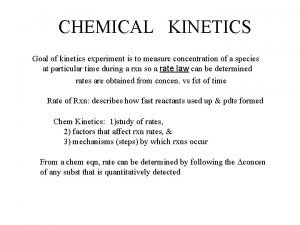
Chemical Kinetics The area of chemistry that concerns
- Slides: 11
Chemical Kinetics The area of chemistry that concerns reaction rates and reaction mechanisms.
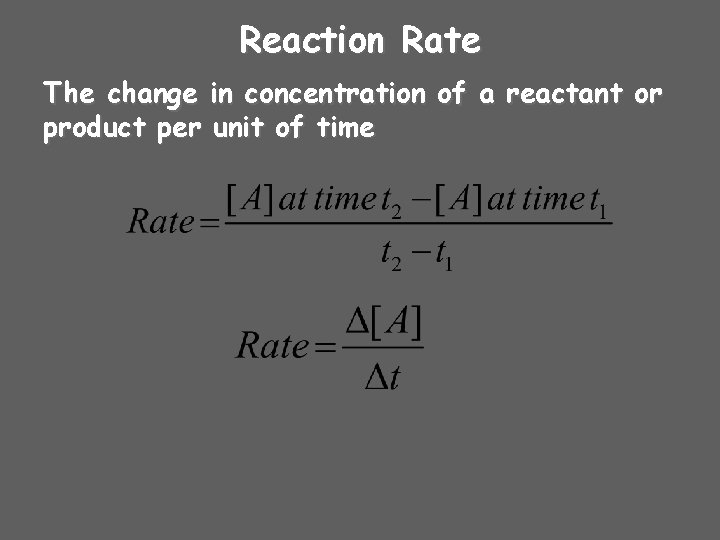
Reaction Rate The change in concentration of a reactant or product per unit of time
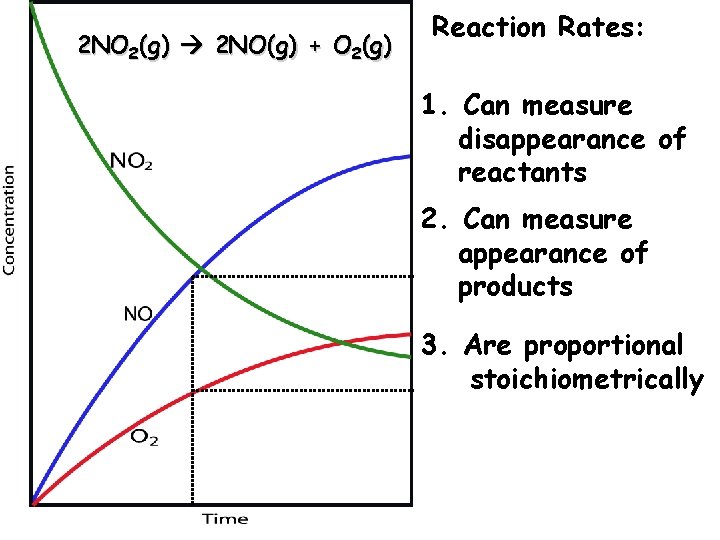
2 NO 2(g) 2 NO(g) + O 2(g) Reaction Rates: 1. Can measure disappearance of reactants 2. Can measure appearance of products 3. Are proportional stoichiometrically
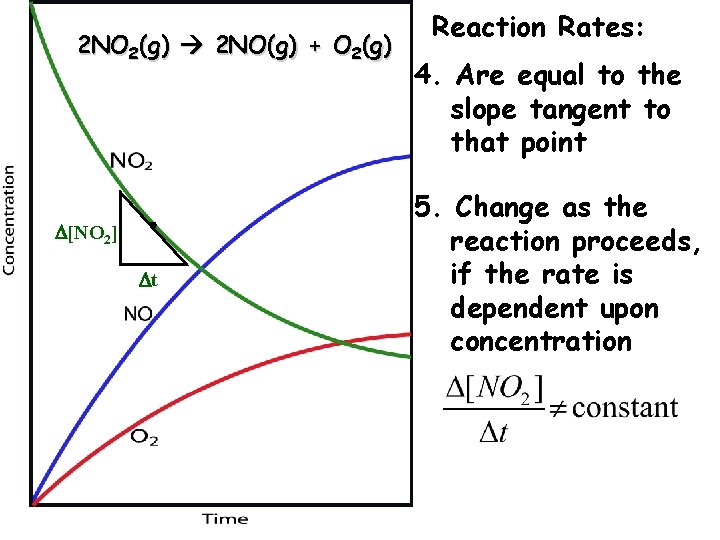
2 NO 2(g) 2 NO(g) + O 2(g) [NO 2] t Reaction Rates: 4. Are equal to the slope tangent to that point 5. Change as the reaction proceeds, if the rate is dependent upon concentration
Rate Laws Differential rate laws express (reveal) the relationship between the concentration of reactants and the rate of the reaction. The differential rate law is usually just called “the rate law. ” Integrated rate laws express (reveal) the relationship between concentration of reactants and time
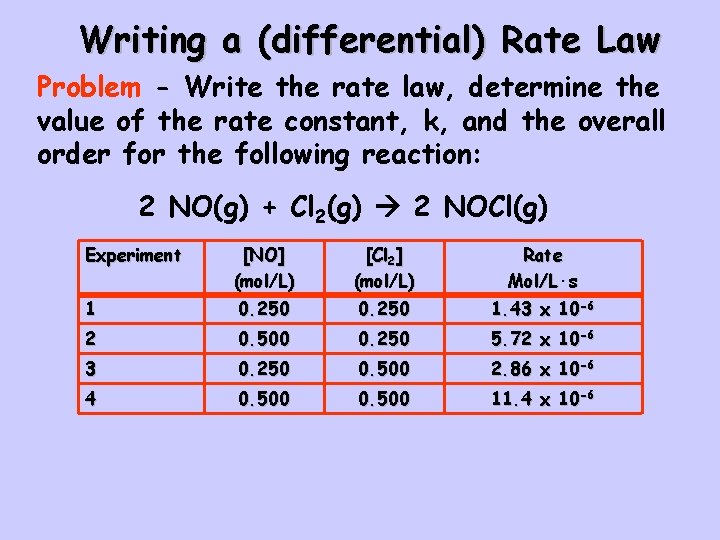
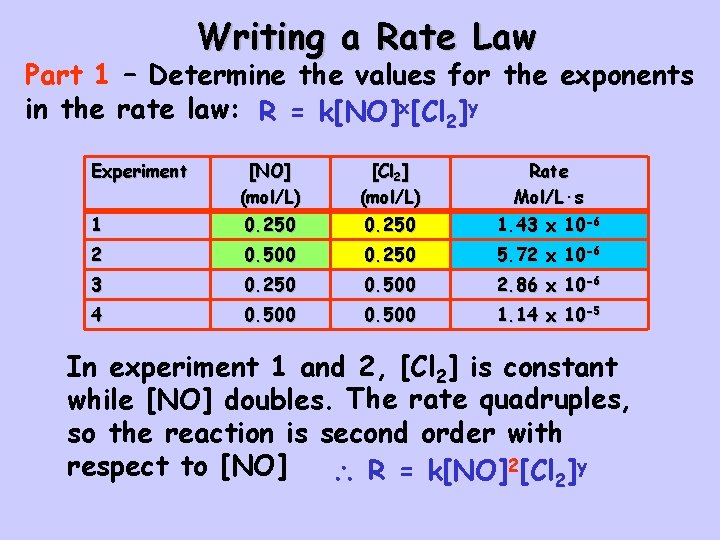
Writing a (differential) Rate Law Problem - Write the rate law, determine the value of the rate constant, k, and the overall order for the following reaction: 2 NO(g) + Cl 2(g) 2 NOCl(g) Experiment [NO] (mol/L) [Cl 2] (mol/L) Rate Mol/L·s 1 0. 250 1. 43 x 10 -6 2 0. 500 0. 250 5. 72 x 10 -6 3 0. 250 0. 500 2. 86 x 10 -6 4 0. 500 11. 4 x 10 -6
Writing a Rate Law Part 1 – Determine the values for the exponents in the rate law: R = k[NO]x[Cl 2]y Experiment [NO] (mol/L) [Cl 2] (mol/L) Rate Mol/L·s 1 0. 250 1. 43 x 10 -6 2 0. 500 0. 250 5. 72 x 10 -6 3 0. 250 0. 500 2. 86 x 10 -6 4 0. 500 1. 14 x 10 -5 In experiment 1 and 2, [Cl 2] is constant while [NO] doubles. The rate quadruples, so the reaction is second order with respect to [NO] R = k[NO]2[Cl 2]y
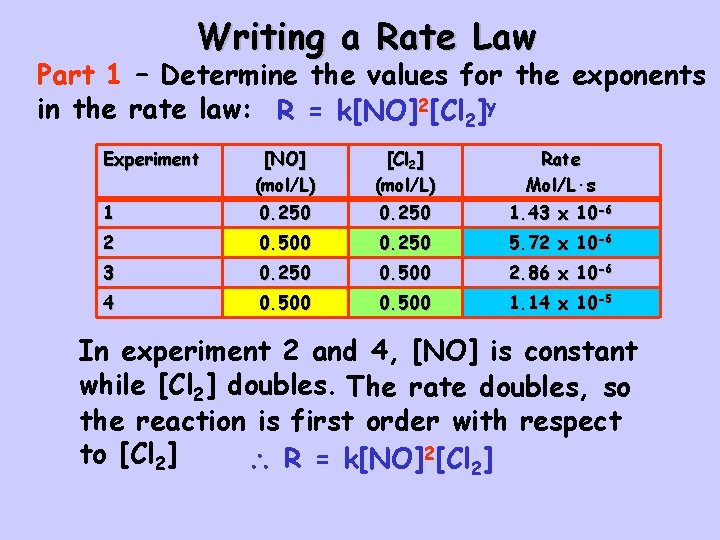
Writing a Rate Law Part 1 – Determine the values for the exponents in the rate law: R = k[NO]2[Cl 2]y Experiment [NO] (mol/L) [Cl 2] (mol/L) Rate Mol/L·s 1 0. 250 1. 43 x 10 -6 2 0. 500 0. 250 5. 72 x 10 -6 3 0. 250 0. 500 2. 86 x 10 -6 4 0. 500 1. 14 x 10 -5 In experiment 2 and 4, [NO] is constant while [Cl 2] doubles. The rate doubles, so the reaction is first order with respect to [Cl 2] R = k[NO]2[Cl 2]
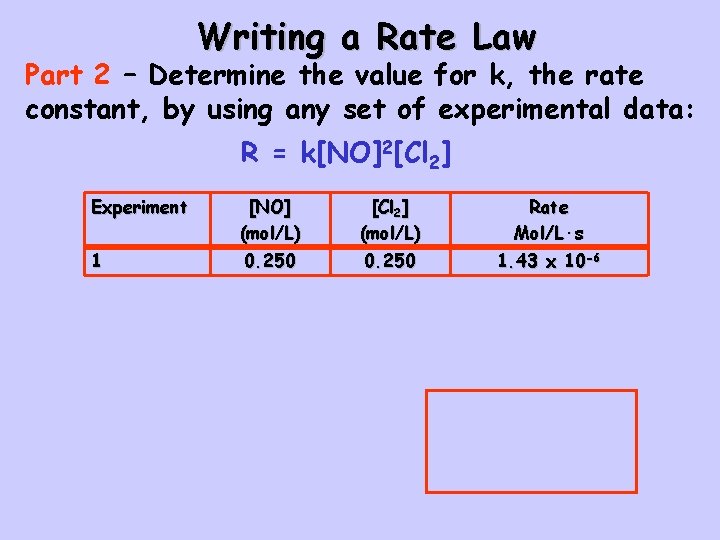
Writing a Rate Law Part 2 – Determine the value for k, the rate constant, by using any set of experimental data: R = k[NO]2[Cl 2] Experiment [NO] (mol/L) [Cl 2] (mol/L) Rate Mol/L·s 1 0. 250 1. 43 x 10 -6
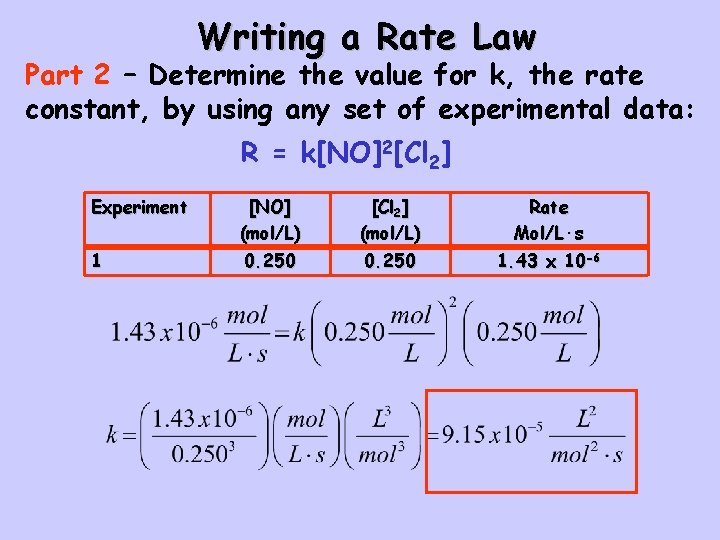
Writing a Rate Law Part 2 – Determine the value for k, the rate constant, by using any set of experimental data: R = k[NO]2[Cl 2] Experiment [NO] (mol/L) [Cl 2] (mol/L) Rate Mol/L·s 1 0. 250 1. 43 x 10 -6
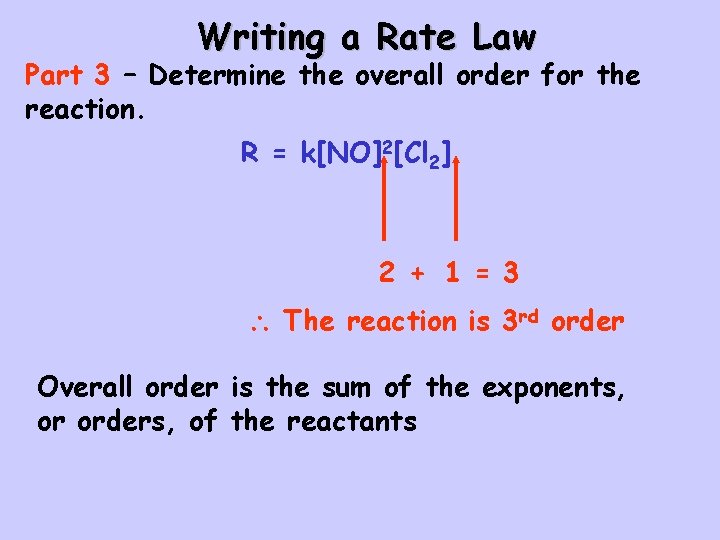
Writing a Rate Law Part 3 – Determine the overall order for the reaction. R = k[NO]2[Cl 2] 2 + 1 = 3 The reaction is 3 rd order Overall order is the sum of the exponents, or orders, of the reactants