Chapter 6 Phonation Clinical Applications Perry C Hanavan

- Slides: 68
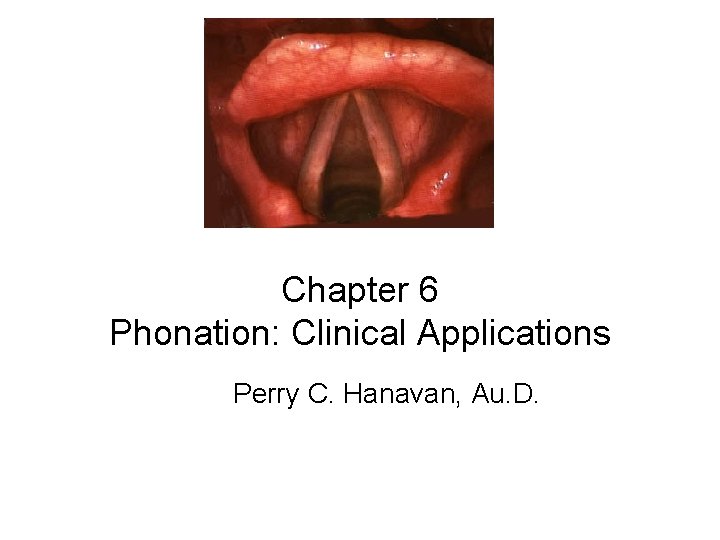
Chapter 6 Phonation: Clinical Applications Perry C. Hanavan, Au. D.
Cultures The Jimi Hendrix of Mongolia Incredible Human Machine Steven Tyler Wall of Sound Naturally 7 Dr. Patricia Kuhl: Linguist Genius of Babies
Question What is meant by phonation? A. Whispered speech sound B. Voiced speech sound C. Produce a nasal sound D. Use your lips to produce sound E. I don’t know
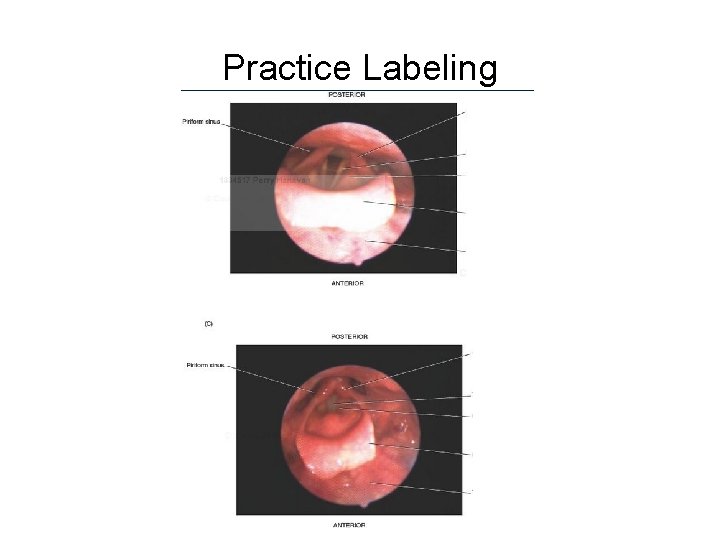
Practice Labeling
Review
Question Which non-speech function is helpful for lifting or pushing heavy objects? A. Coughing B. Abdominal fixation C. Throat clearing D. Swallowing reflex E. All the above
Larynx: Non-Speech Functions • • Coughing Abdominal fixation Throat clearing Swallowing reflex
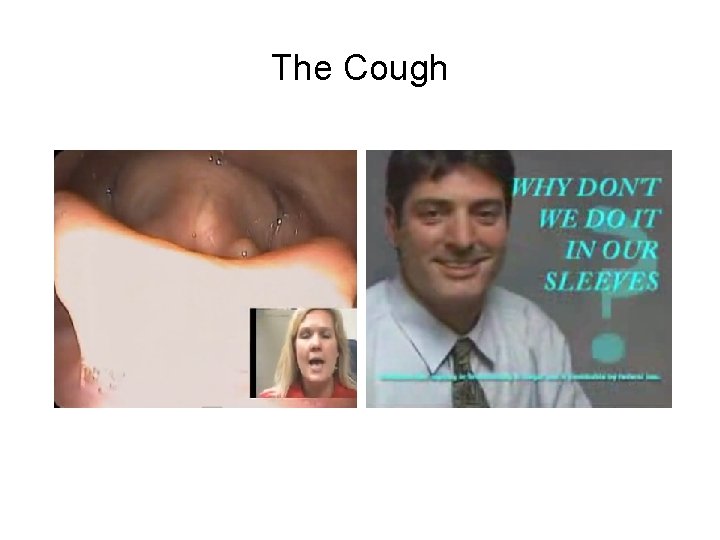
The Cough
The Cough • Can voluntarily cough • Reflex triggered when irritant stimulates one or more cough receptors • Receptors transmit message to cough center in brain, telling body to cough • Cough begins with deep inhalation, at which point opening between vocal cords at upper part of larynx (glottis) shuts, trapping air in lungs • As diaphragm and other muscles press against lungs, vocal folds suddenly abduct, producing explosive outflow of air at speeds exceeding 100 miles per hour
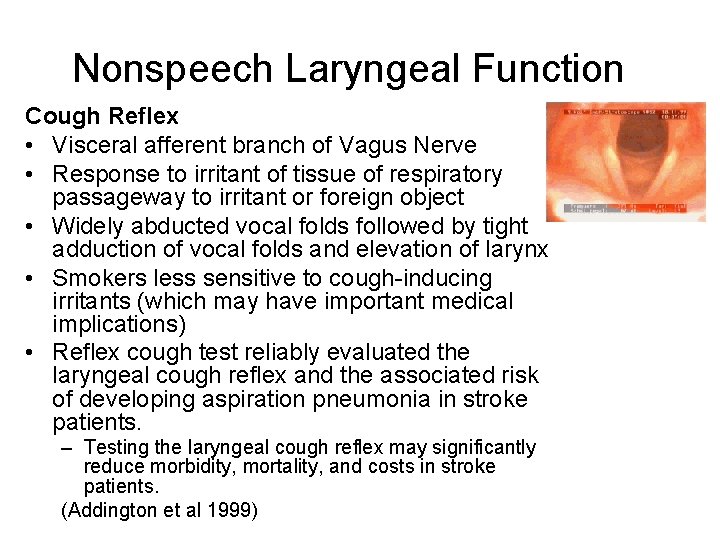
Nonspeech Laryngeal Function Cough Reflex • Visceral afferent branch of Vagus Nerve • Response to irritant of tissue of respiratory passageway to irritant or foreign object • Widely abducted vocal folds followed by tight adduction of vocal folds and elevation of larynx • Smokers less sensitive to cough-inducing irritants (which may have important medical implications) • Reflex cough test reliably evaluated the laryngeal cough reflex and the associated risk of developing aspiration pneumonia in stroke patients. – Testing the laryngeal cough reflex may significantly reduce morbidity, mortality, and costs in stroke patients. (Addington et al 1999)
Clearing Throat
Swallowing Reflex • Bolus of food triggers reflex as it passes tongue above larynx • Larynx elevates • Epiglottis drops down to cover aditus (opening to larynx from pharynx) • Tight adduction of folds
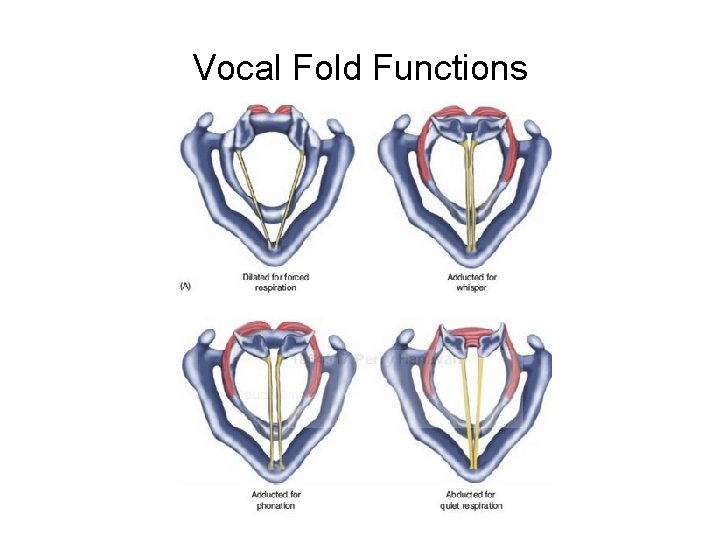
Vocal Fold Functions
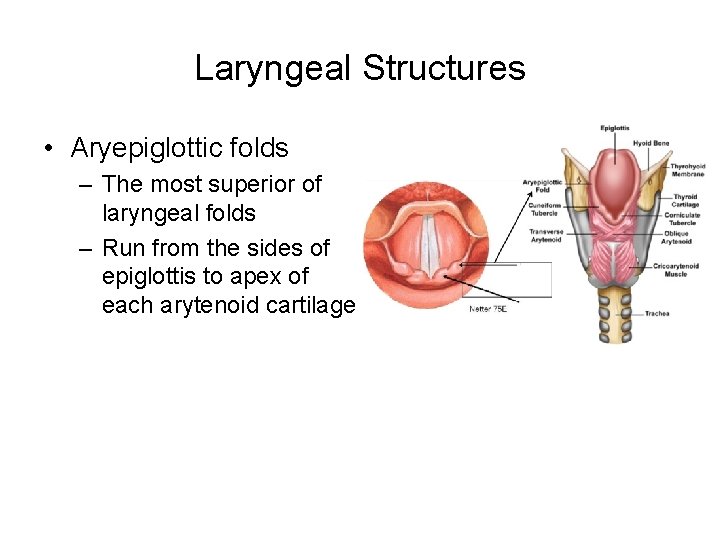
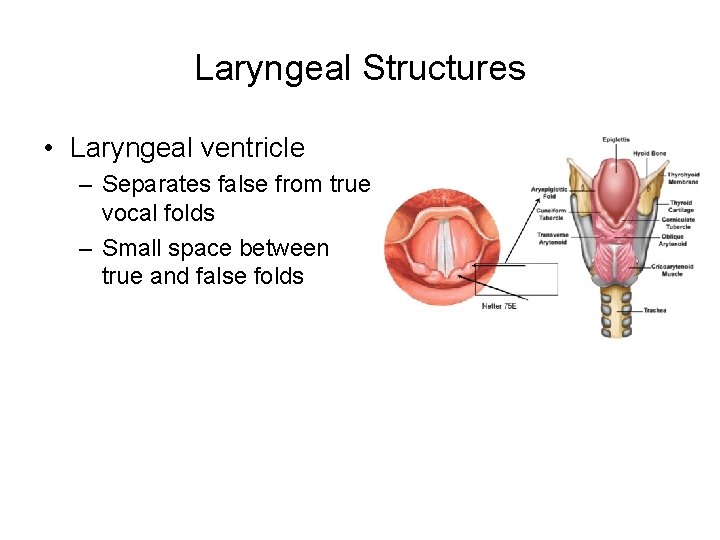
Laryngeal Structures • Aryepiglottic folds – The most superior of laryngeal folds – Run from the sides of epiglottis to apex of each arytenoid cartilage
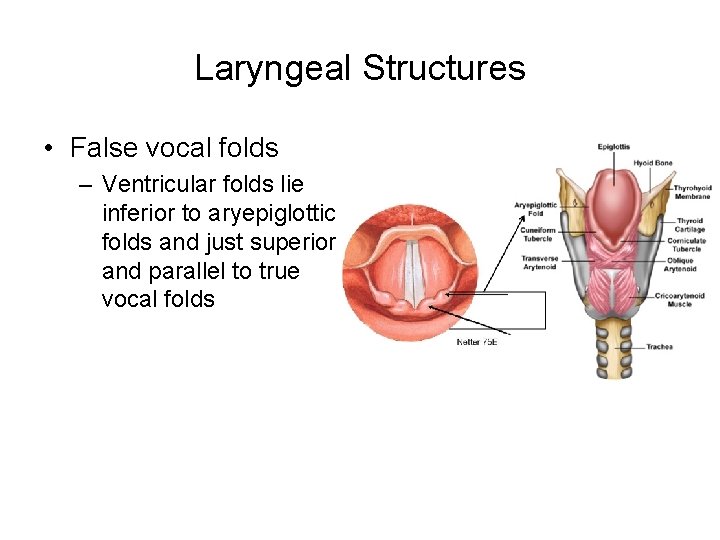
Laryngeal Structures • False vocal folds – Ventricular folds lie inferior to aryepiglottic folds and just superior and parallel to true vocal folds
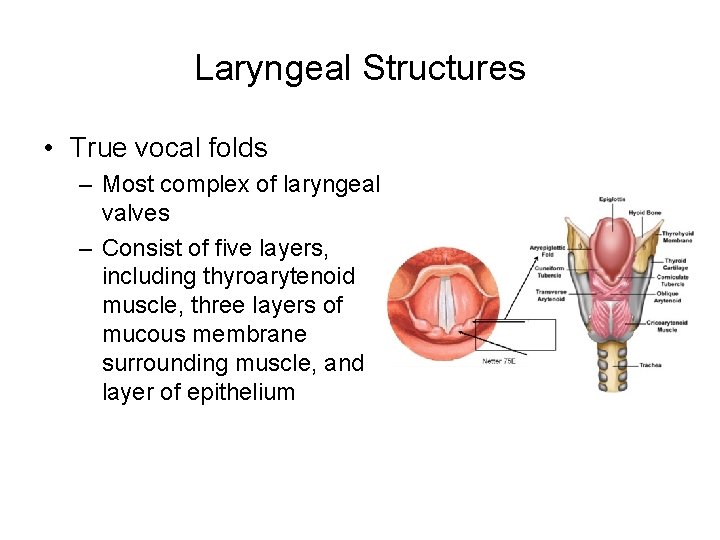
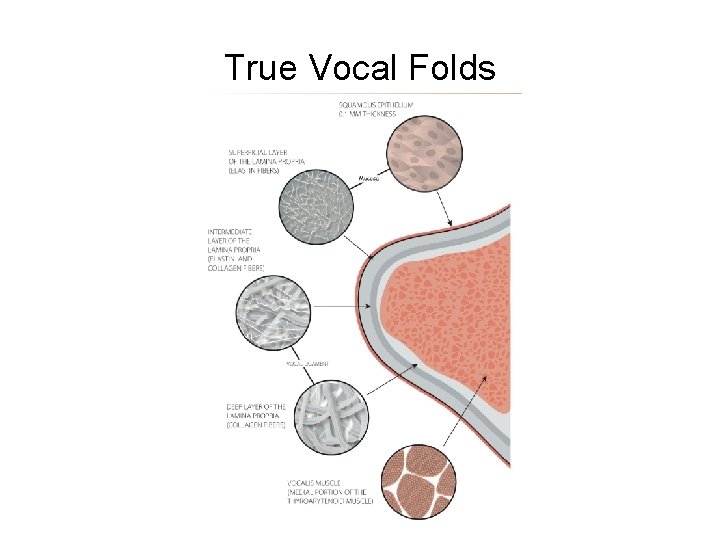
Laryngeal Structures • True vocal folds – Most complex of laryngeal valves – Consist of five layers, including thyroarytenoid muscle, three layers of mucous membrane surrounding muscle, and layer of epithelium
True Vocal Folds
Laryngeal Structures • Laryngeal ventricle – Separates false from true vocal folds – Small space between true and false folds
Laryngeal Function for Speech • Attack – Simultaneous – Breathy – Glottal • • Termination Sustained phonation Vocal register Whispering
Laryngeal Function for Speech • Attack - process of bringing folds together for phonation, requires muscles (three types): – Simultaneous - adduction and onset of exhalation occurs together – Breathy - airflow begins before phonation “hope”, Breathy phonation - failure to completely close folds – Glottal- used when word begins with stressed vowel, normal process (Hard glottal attack – damaging) • Termination - process of fold retraction (abduction) • Sustained phonation - requires maintenance of tonic (sustained tensing) of musculature (actual phonation does not require repeated adduction and abduction)
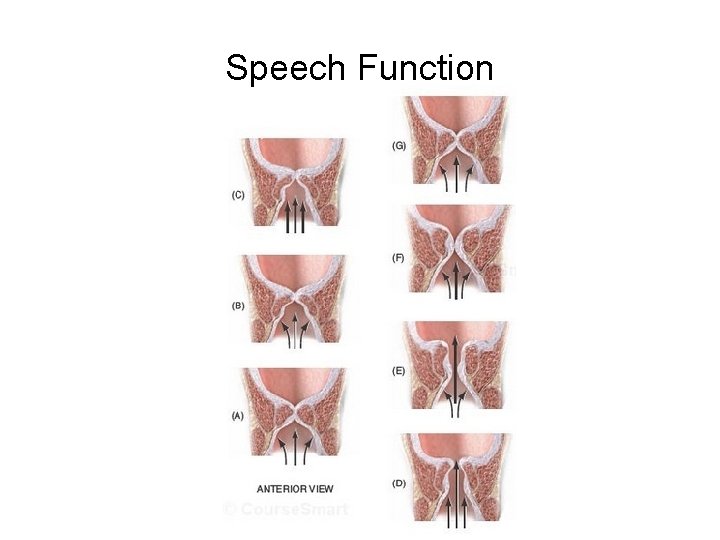
Speech Function
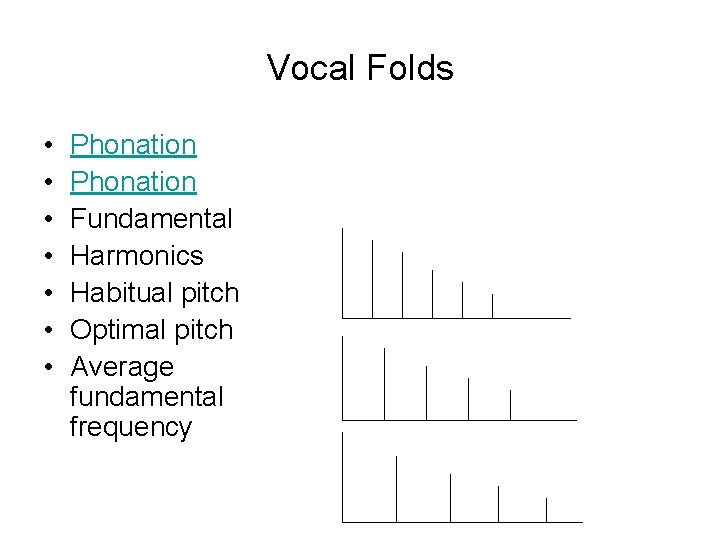
Vocal Folds • • Phonation Fundamental Harmonics Habitual pitch Optimal pitch Average fundamental frequency
Question Register or pattern of phonation used in daily conversations: A. Falsetto B. Whistle C. Modal D. Vocal fry E. Whisper
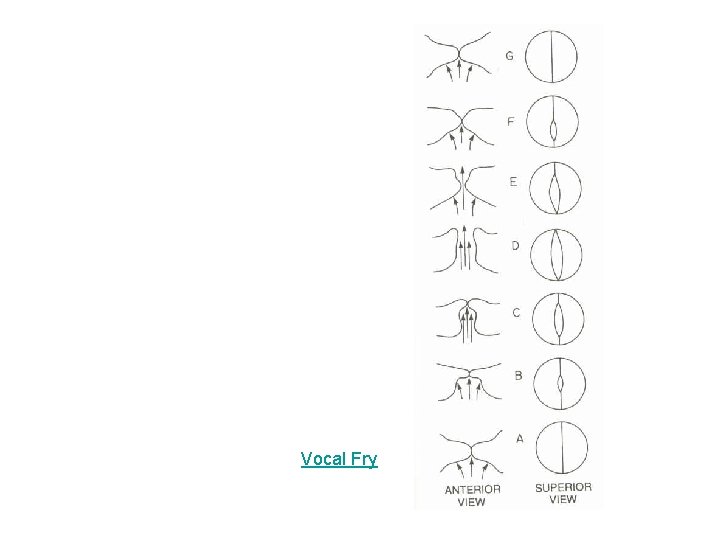
Vocal Register • Vocal register - differences in mode of vibration of vocal folds – Modal register - pattern of phonation used in daily conversations – Glottal fry - (rough voice) vibrating portion flaccid, lateral portion tensed resulting in strong medial compression with short, thick folds and low glottal pressure – Falsetto - long and extremely thin folds – Whistle register - turbulence on edge of vocal folds – Whispering - not actually phonatory because no voicing partially adducted and tensed to produce turbulence, strenuous and fatiguing
Modal Register • Modal register or modal phonation refers to the pattern of phonation used in daily conversation • Example
Vocal Fry
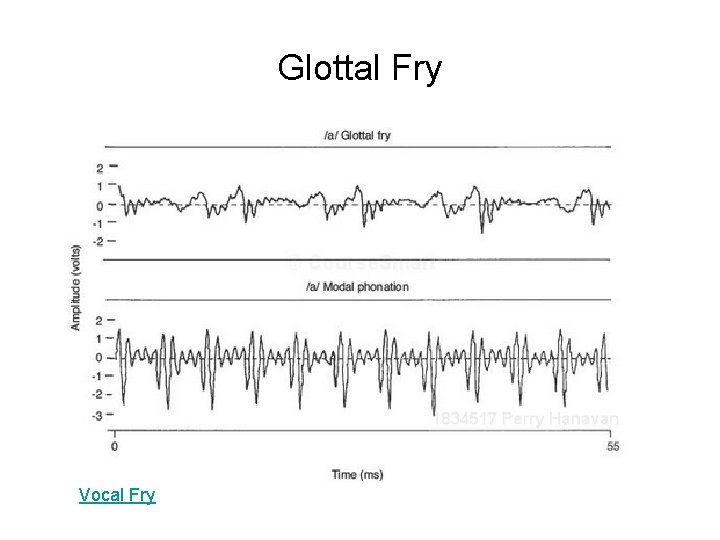
Glottal Fry • Also known as pulse register or Strohbass (straw bass) • Vocal folds vibrate between 30 and 90 Hz • Frying pan sound of eggs frying • Low subglottal pressure • Tension of the vocalis is significantly reduced relative to modal vibration, so that the vibrating margin is flaccid and thick. The lateral portion of folds is tensed creating thick folds • Example
Glottal Fry Vocal Fry
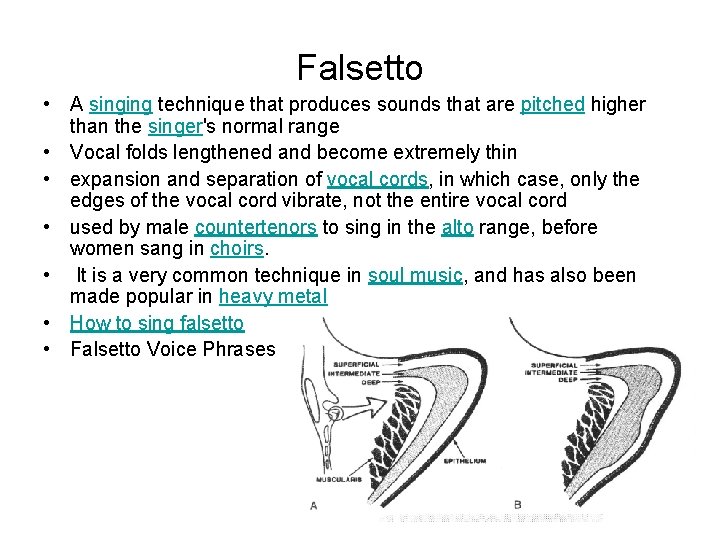
Falsetto • A singing technique that produces sounds that are pitched higher than the singer's normal range • Vocal folds lengthened and become extremely thin • expansion and separation of vocal cords, in which case, only the edges of the vocal cord vibrate, not the entire vocal cord • used by male countertenors to sing in the alto range, before women sang in choirs. • It is a very common technique in soul music, and has also been made popular in heavy metal • How to sing falsetto • Falsetto Voice Phrases
Whistle Register • Register above falsetto • (flageolet register) is the highest register of the human voice • Up to 2500 Hz in females • Product of turbulence on the edge of the vocal fold • Not considered a mode of vibration as product of turbulence • Mariah Carey
Whispering • Not a phonatory mode • Voicing removed • Mariah Carey
Question Maintaining childhood pitch despite having passed through puberty… A. Aphonia B. Puberphonia C. Phonia fear D. Non-phonia
Puberphonia • Maintenance of the childhood pitch despite having passed through puberty • Puberphonia • Other voice disorders
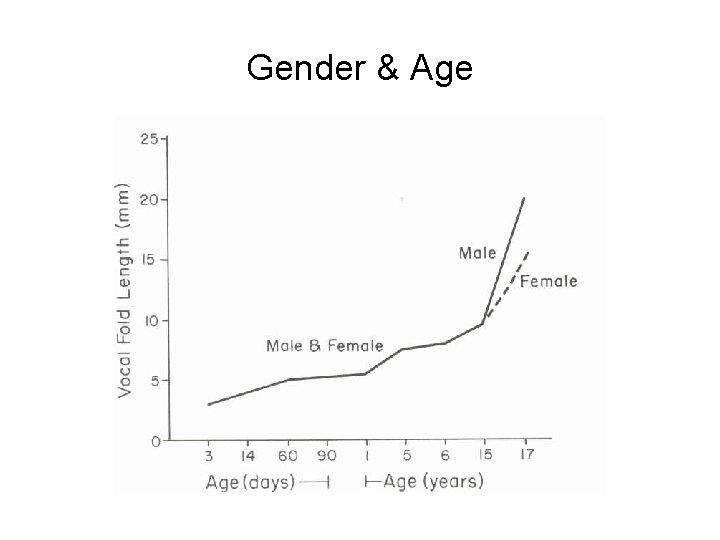
Gender & Age
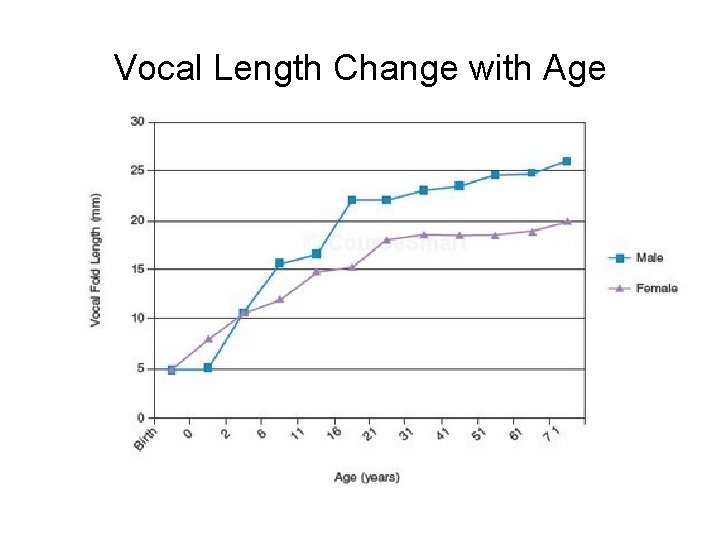
Vocal Length Change with Age
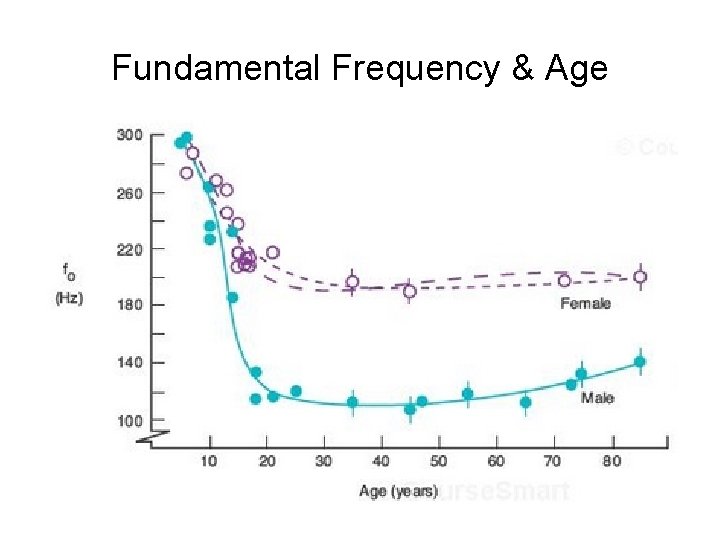
Fundamental Frequency & Age
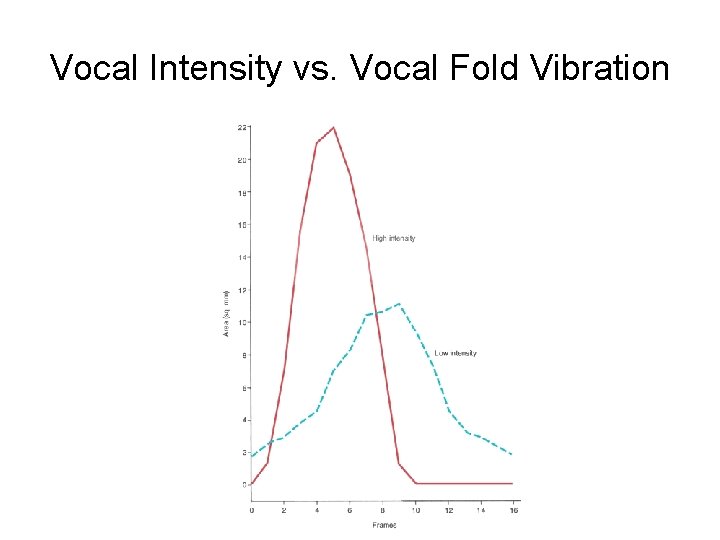
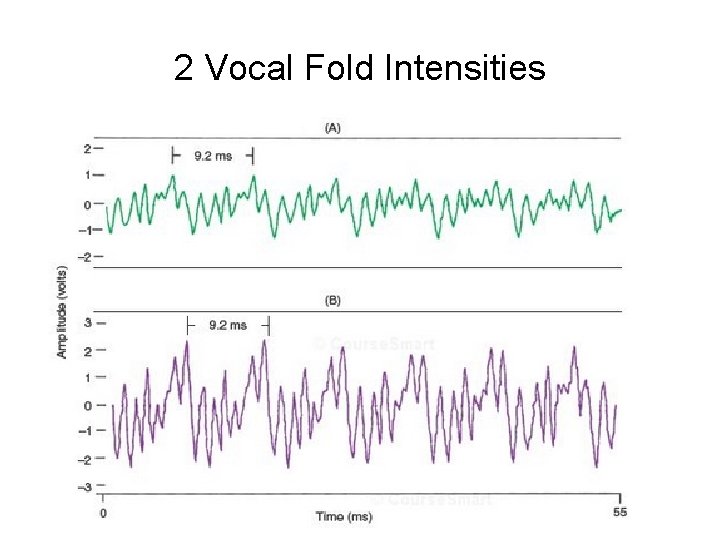
Vocal Intensity vs. Vocal Fold Vibration
2 Vocal Fold Intensities
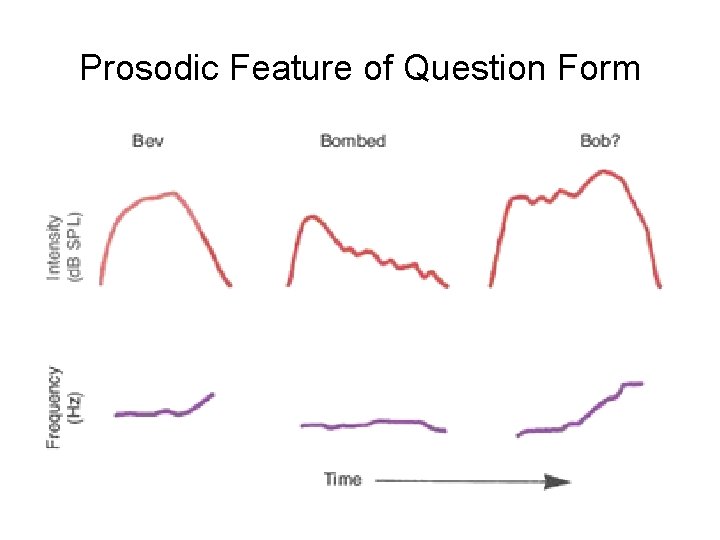
Prosodic Feature of Question Form
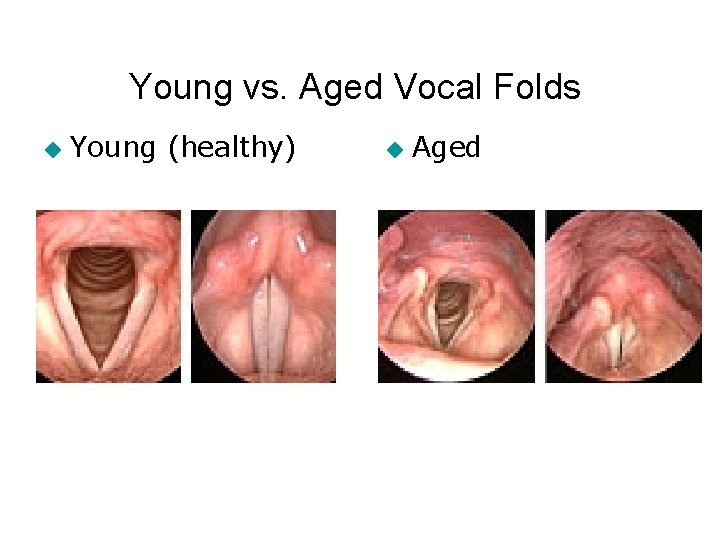
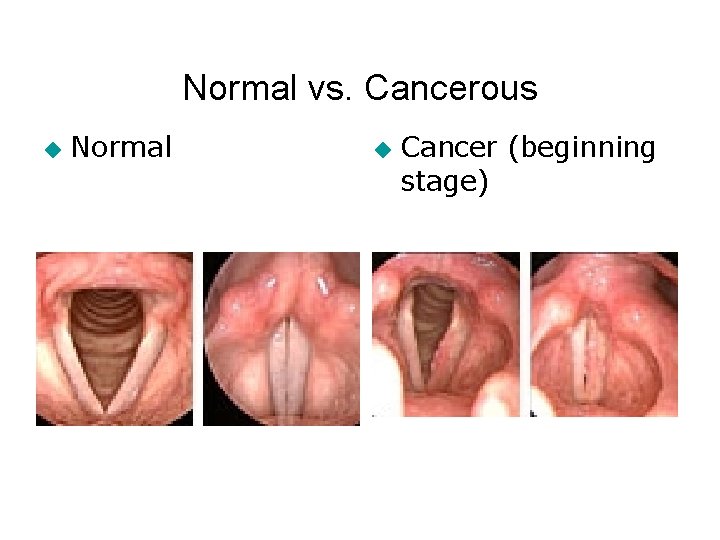
Aging Voice • Voice quality of the aging voice and disease (cancer of larynx) have similar characteristics –Hoarse, shaky, breathy, weak, & altered pitch • Voice changes in elderly likely influenced by disease rather than physiologic aging • Woo (1992) study of 64 patients aged 65 and older found that only 11 had functional problems related to aging –others had lesions, cancer, or inflammatory problems
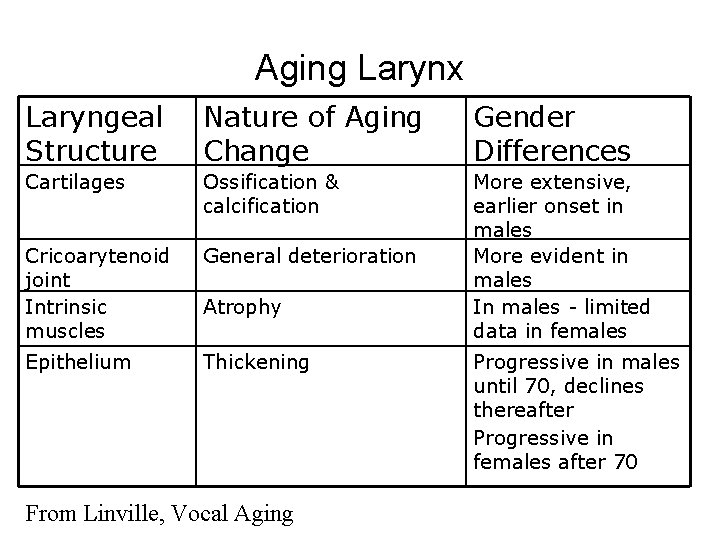
Normal Changes in the Aging Voice • Decrease in breath support –thus weakened voice –try to compensate by sphyncterically contracting larynx during phonation, producing a strained quality leading to muscular tension dysphonia • Laryngeal changes –ossification of laryngeal cartilages and joints may cause “bowing” of the vocal folds which may be most common benign aging pathology –loss of vocal fold mass decreasing ability to adduct vocal folds - thus weak, breathy voice
Young vs. Aged Vocal Folds ◆ Young (healthy) ◆ Aged
Normal vs. Cancerous ◆ Normal ◆ Cancer (beginning stage)
Normal Changes Con’t • Other changes… –changes in the cricoarytenoid due to aging may account for some of the pitch variability –men, beginning in 60’s and each decade aftervocal cords become thin and atrophied resulting in a higher pitched conversational voice –women, pitch seems to lower through life— vocal cords may become more polypoid after menapause due to estrogen deprivation which causes substantial changes in mucous membranes lining vocal tract
Presbylaryngis • Age related structural changes of vocal folds may cause glottal gap during voice production • Woo states: –“presbylaryngis is not a common disorder and should be a diagnosis of exclusion made only after careful medical and speech evaluation”
Aging Larynx Laryngeal Structure Nature of Aging Change Gender Differences Cartilages Ossification & calcification Cricoarytenoid joint Intrinsic muscles General deterioration More extensive, earlier onset in males More evident in males In males - limited data in females Epithelium Thickening Atrophy From Linville, Vocal Aging Progressive in males until 70, declines thereafter Progressive in females after 70
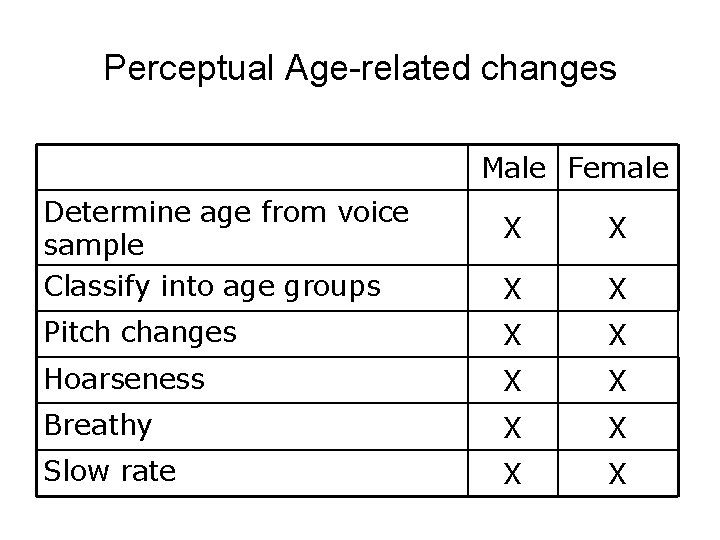
Perceptual Age-related changes Male Female Determine age from voice sample Classify into age groups X X Pitch changes X X Hoarseness X X Breathy X X Slow rate X X
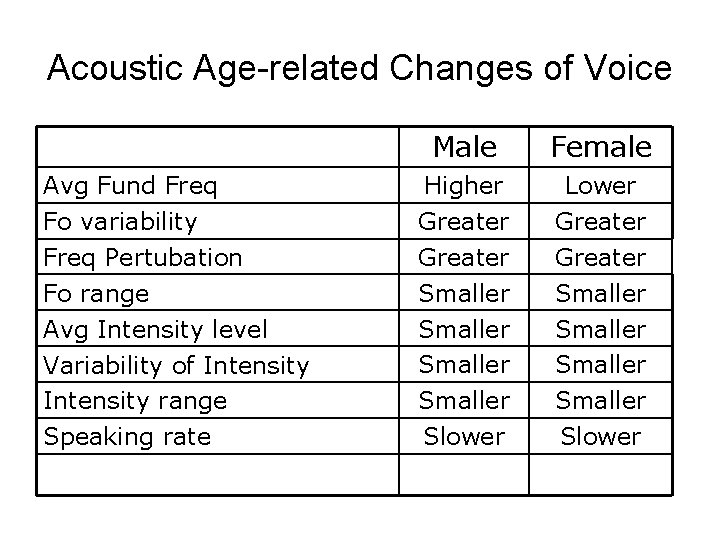
Acoustic Age-related Changes of Voice Avg Fund Freq Fo variability Freq Pertubation Fo range Avg Intensity level Variability of Intensity range Speaking rate Male Female Higher Greater Smaller Slower Lower Greater Smaller Slower
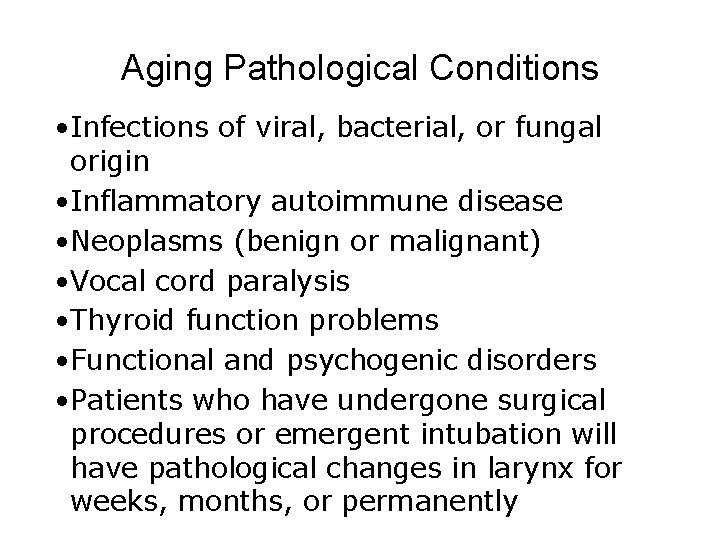
Aging Pathological Conditions • Infections of viral, bacterial, or fungal origin • Inflammatory autoimmune disease • Neoplasms (benign or malignant) • Vocal cord paralysis • Thyroid function problems • Functional and psychogenic disorders • Patients who have undergone surgical procedures or emergent intubation will have pathological changes in larynx for weeks, months, or permanently
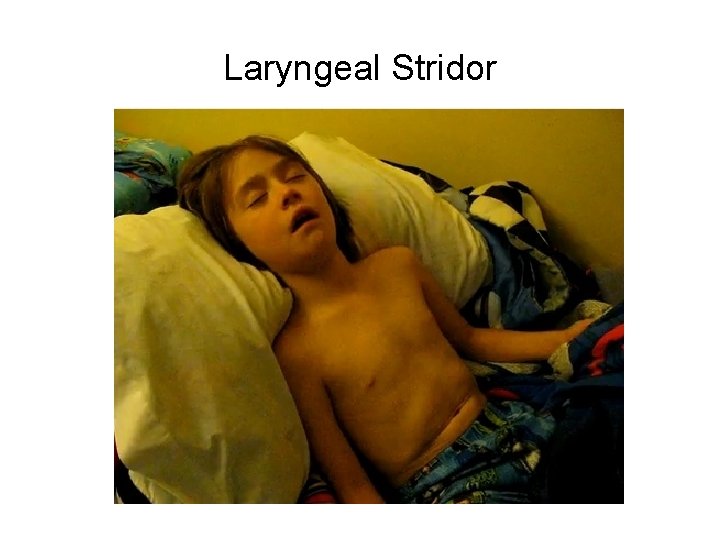
Laryngeal Stridor
Voice Disorders • • • Voice Doctor Voice Disorders Functional Voice Disorders of the Larynx Cancer of the Larynx
Vocal Cords • Phonation • Vocal cords (variables) – Length – Mass (thickness) – Tension – Normal Vocal Cord Images/Videos
Question Who has the longer vocal folds? A. Men B. Women C. Young boys D. Young girls E. Cats
Question Whose pitch rises as they age? A. Men B. Women C. Young boys D. Young girls E. Cats
Question When does the most dramatic change in phonation occur? A. Childhood B. Pubescence C. Adulthood D. Elderly E. Infancy
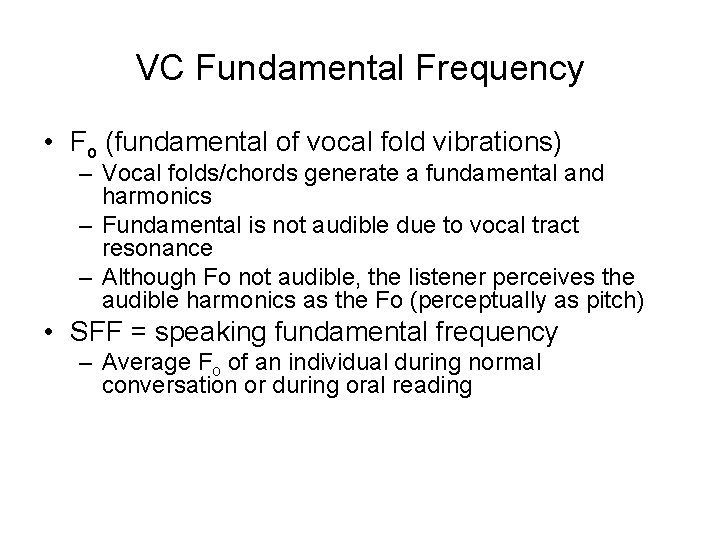
VC Fundamental Frequency • Fo (fundamental of vocal fold vibrations) – Vocal folds/chords generate a fundamental and harmonics – Fundamental is not audible due to vocal tract resonance – Although Fo not audible, the listener perceives the audible harmonics as the Fo (perceptually as pitch) • SFF = speaking fundamental frequency – Average Fo of an individual during normal conversation or during oral reading
VC Fundamental Frequency • SFF variations: – – – Age Gender Emotions Sentence type Disease Medications
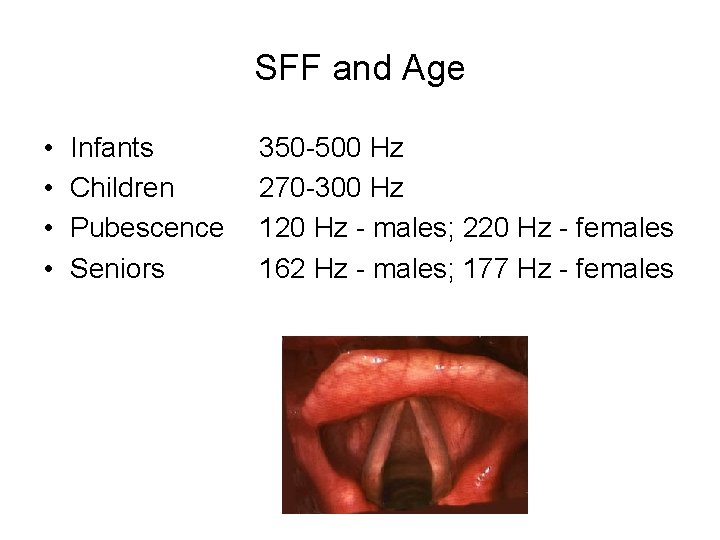
SFF and Age • • Infants Children Pubescence Seniors 350 -500 Hz 270 -300 Hz 120 Hz - males; 220 Hz - females 162 Hz - males; 177 Hz - females
Gender • Pubescence – More dramatic change in males than females SFF • Seniors – SFF increases in males – SFF decreases in females
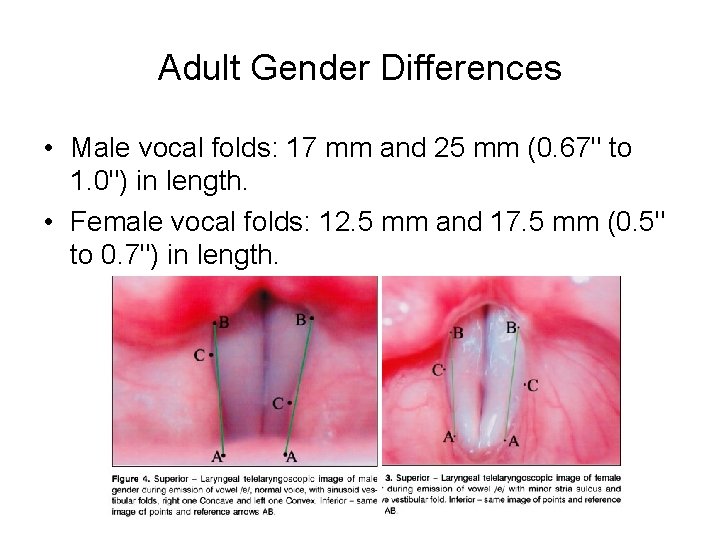
Adult Gender Differences • Male vocal folds: 17 mm and 25 mm (0. 67" to 1. 0") in length. • Female vocal folds: 12. 5 mm and 17. 5 mm (0. 5" to 0. 7") in length.
Frequency Variables • Stress and accent of sounds in speech • Prosody features of speech • Measured by: – Fo. SD • Normal conversation 20 -35 Hz • Varies by age, gender, emotions – Semitones=pitch sigma (2 -4 semitones) – Range – difference between highest and lowest Fo in sample of speech
Question Whose voice has the greatest frequency variation? A. Infants B. Children C. Adolescents D. Adults E. Seniors
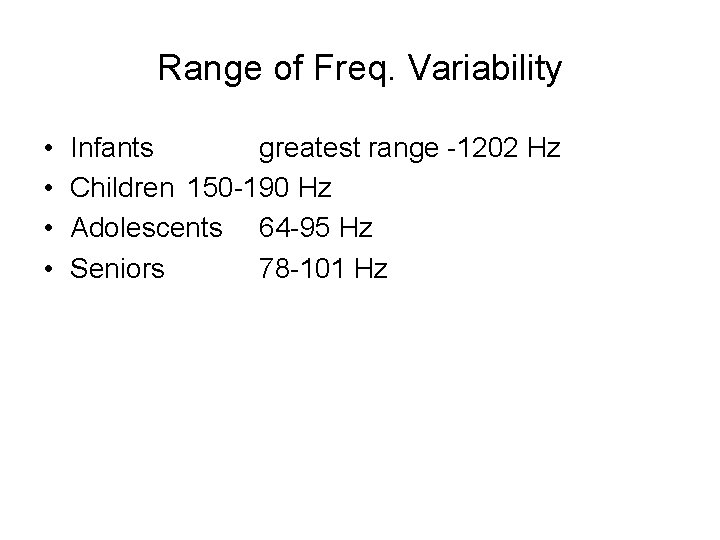
Range of Freq. Variability • • Infants greatest range -1202 Hz Children 150 -190 Hz Adolescents 64 -95 Hz Seniors 78 -101 Hz
Question What can influence our voice intensity? A. Prosody of speech B. Emotions C. Social situations D. Health E. All the above
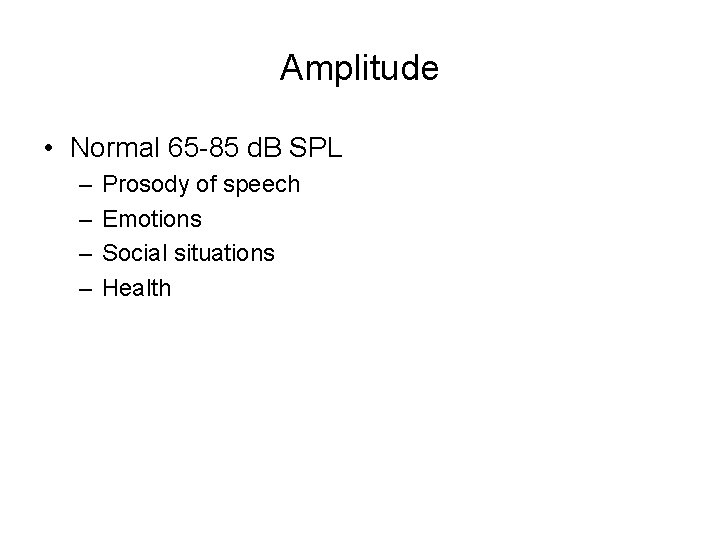
Amplitude • Normal 65 -85 d. B SPL – – Prosody of speech Emotions Social situations Health
Medications Adversely Affecting Voice • • • Antidepressants Muscle relaxants Diuretics Antihypertensives (blood pressure medication) Antihistamines (allergy medications) Anticholinergics (asthma medications) High-dose Vitamin C (greater than five grams per day) Angiotensin-converting-enzyme (ACE) inhibitors (blood pressure medication) may induce a cough or excessive throat clearing. Pill may cause edema in the vocal cords due to estrogen. Estrogen replacement therapy post-menopause may have effect. Low level of thyroid replacement medication in patients with hypothyroidism. Anticoagulants (blood thinners) may increase chances of vocal cord hemorrhage or polyp formation in response to trauma.
Medical Conditions Affecting Voice • • • Poor health Laryngitis Laryngopharyngeal Reflux Disease (LPRD) Voice misuse and overuse Benign vocal cord nodules Vocal Cord Hemorrhage Vocal Cord Paralysis and Paresis Neurologic related Laryngeal cancer
Voice Disorders • Diplophonia – Muscle Tension Dysphonia (MTD) is a general term to describe excessive and unnecessary tension of laryngeal muscles during voicing. – MTD is often referred to by many different names including - hyperfunction, functional dysphonia, ventricular or false vocal fold compression, etc. – MTD is thought to be a compensatory mechanism in the presence of underlying laryngeal pathology. – Symptoms often include a sensation of excessive laryngeal tension and strain, vocal fatigue, and hoarseness. • Neurologic – Spasmodic disphonia