Chapter 3 Introduction to Risk Management Meaning of











- Slides: 60
Chapter 3 Introduction to Risk Management • Meaning of Risk Management • Objectives of Risk Management • Steps in the RM Process • Benefits of Risk Management • Personal RM • Corporate RM – ERM (FMEA) 3 -1
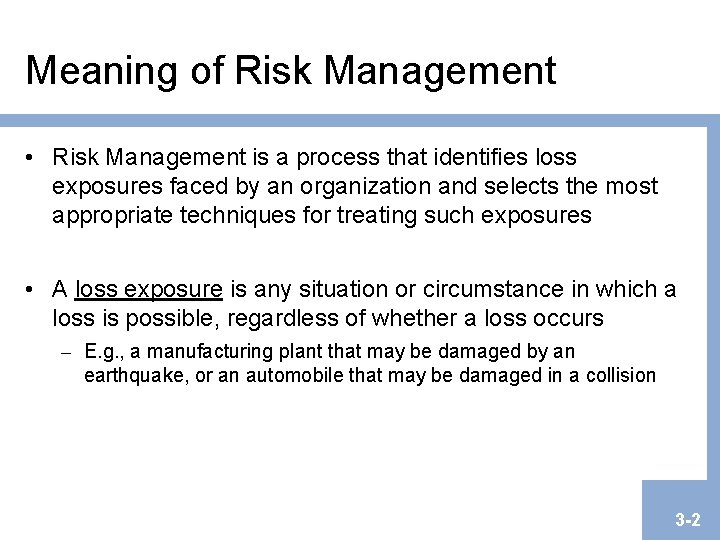
Meaning of Risk Management • Risk Management is a process that identifies loss exposures faced by an organization and selects the most appropriate techniques for treating such exposures • A loss exposure is any situation or circumstance in which a loss is possible, regardless of whether a loss occurs – E. g. , a manufacturing plant that may be damaged by an earthquake, or an automobile that may be damaged in a collision 3 -2
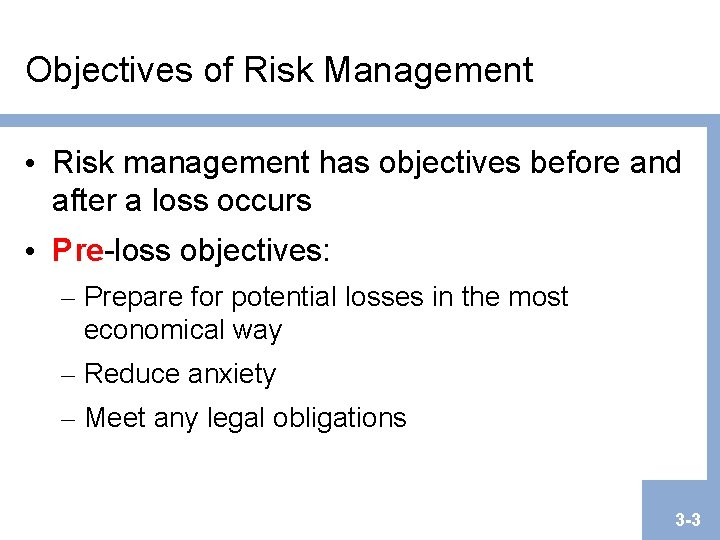
Objectives of Risk Management • Risk management has objectives before and after a loss occurs • Pre-loss objectives: – Prepare for potential losses in the most economical way – Reduce anxiety – Meet any legal obligations 3 -3
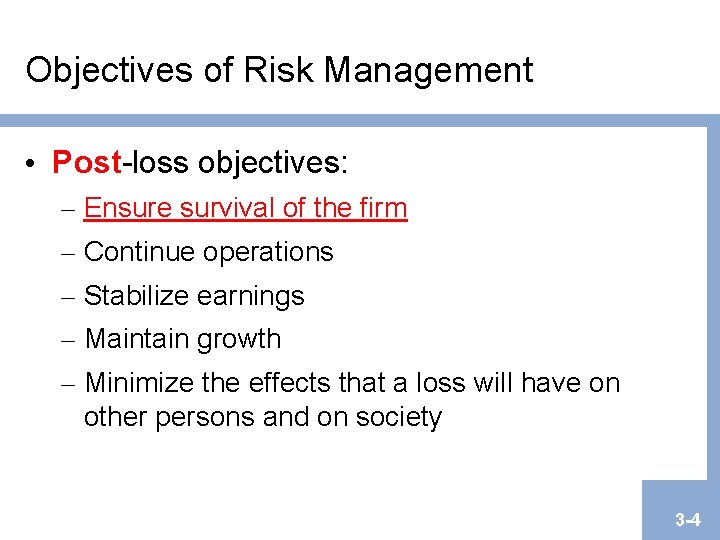
Objectives of Risk Management • Post-loss objectives: – Ensure survival of the firm – Continue operations – Stabilize earnings – Maintain growth – Minimize the effects that a loss will have on other persons and on society 3 -4
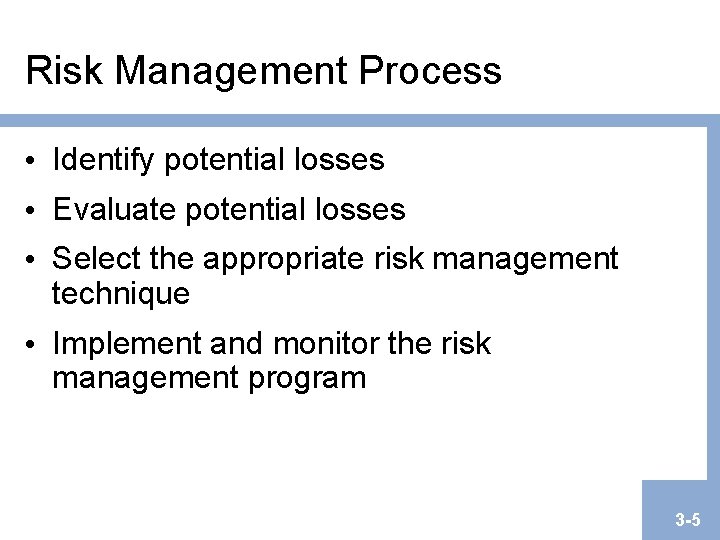
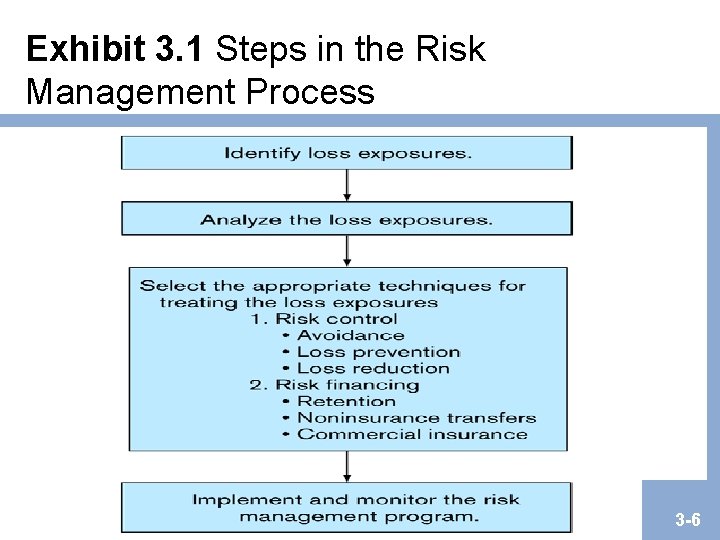
Risk Management Process • Identify potential losses • Evaluate potential losses • Select the appropriate risk management technique • Implement and monitor the risk management program 3 -5
Exhibit 3. 1 Steps in the Risk Management Process 3 -6
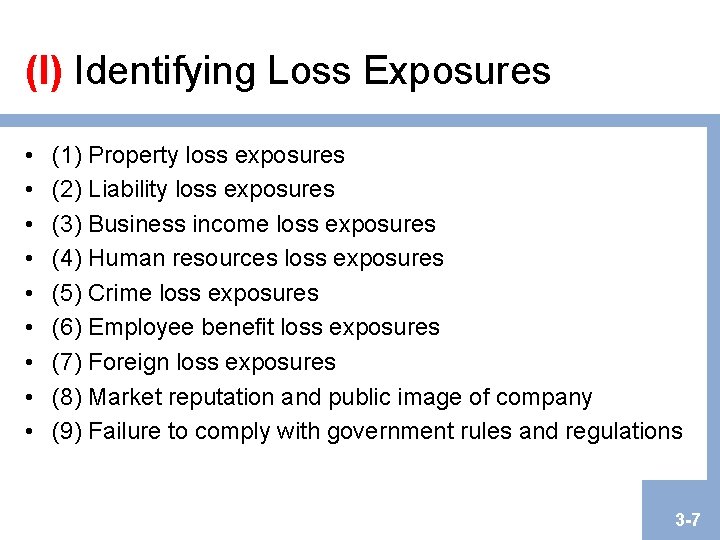
(I) Identifying Loss Exposures • • • (1) Property loss exposures (2) Liability loss exposures (3) Business income loss exposures (4) Human resources loss exposures (5) Crime loss exposures (6) Employee benefit loss exposures (7) Foreign loss exposures (8) Market reputation and public image of company (9) Failure to comply with government rules and regulations 3 -7
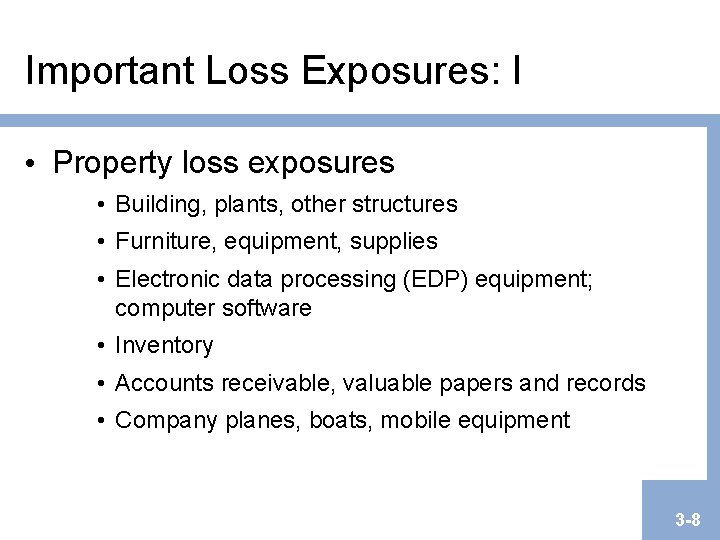
Important Loss Exposures: I • Property loss exposures • Building, plants, other structures • Furniture, equipment, supplies • Electronic data processing (EDP) equipment; computer software • Inventory • Accounts receivable, valuable papers and records • Company planes, boats, mobile equipment 3 -8
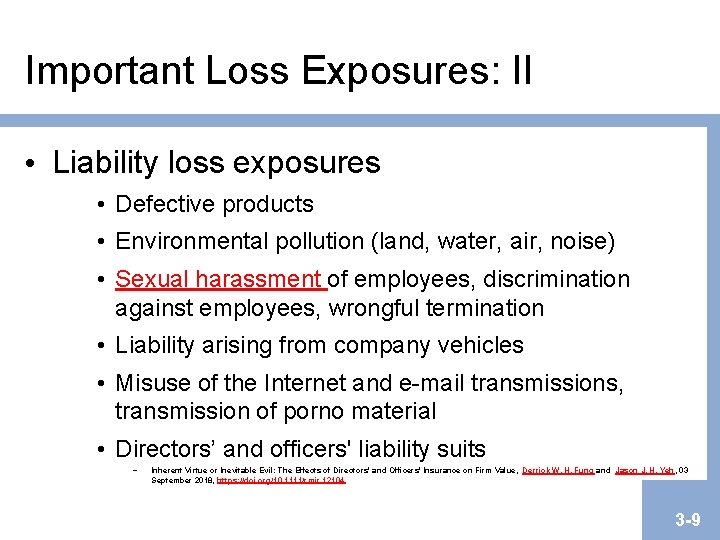
Important Loss Exposures: II • Liability loss exposures • Defective products • Environmental pollution (land, water, air, noise) • Sexual harassment of employees, discrimination against employees, wrongful termination • Liability arising from company vehicles • Misuse of the Internet and e-mail transmissions, transmission of porno material • Directors’ and officers' liability suits – Inherent Virtue or Inevitable Evil: The Effects of Directors' and Officers' Insurance on Firm Value, Derrick W. H. Fung and Jason J. H. Yeh, 03 September 2018, https: //doi. org/10. 1111/rmir. 12104 3 -9
Important Loss Exposures: III • Business income loss exposure • Loss of income from a covered loss • Continuing expenses after a loss • Extra expenses • Contingent business income losses 3 -10
Important Loss Exposures: IV • Human resources loss exposure • Death or disability of key employees • Retirement or unemployment • Job-related injuries or disease experienced by workers (Joanna Tse Yuen-Man 謝婉雯:The Miracle Box) 3 -11
Important Loss Exposures: V • Crime loss exposures • Holdups, robberies, burglaries • Employee theft and dishonesty • Fraud and embezzlement • Internet and computer crime exposures 3 -12
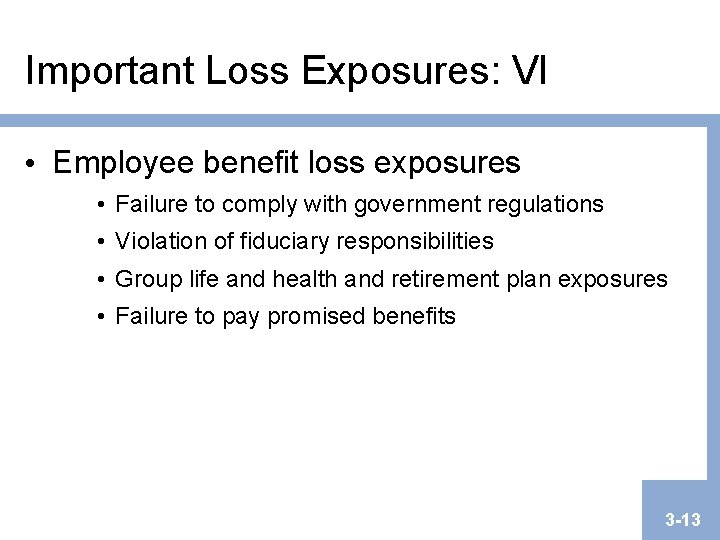
Important Loss Exposures: VI • Employee benefit loss exposures • Failure to comply with government regulations • Violation of fiduciary responsibilities • Group life and health and retirement plan exposures • Failure to pay promised benefits 3 -13
Important Loss Exposures: VII • Foreign loss exposures • Plants, business property, inventory • Foreign currency risks • Kidnapping of key personnel • Political risks – Marsh Report, Political Risk Map 2020: Trade Tensions Threaten Political Stability 3 -14
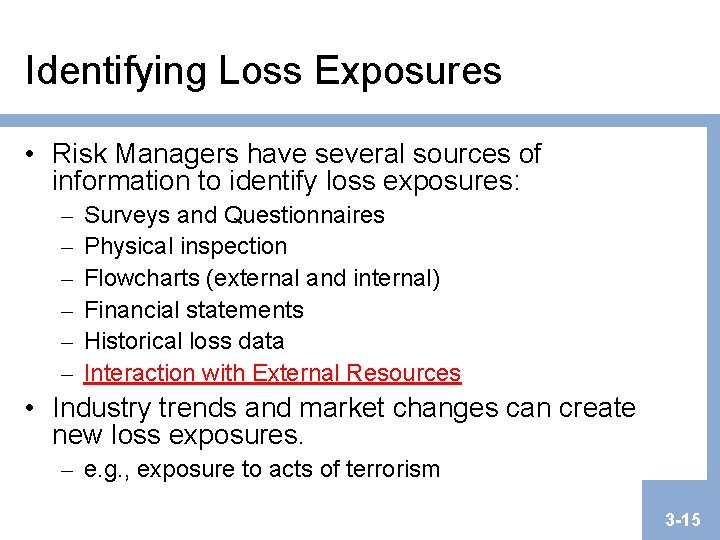
Identifying Loss Exposures • Risk Managers have several sources of information to identify loss exposures: – – – Surveys and Questionnaires Physical inspection Flowcharts (external and internal) Financial statements Historical loss data Interaction with External Resources • Industry trends and market changes can create new loss exposures. – e. g. , exposure to acts of terrorism 3 -15
(II) Analyzing Loss Exposures • Estimate the frequency and severity of loss for each type of loss exposure – Loss frequency refers to the probable number of losses that may occur during some given time period (#Losses / #Exposures) – Loss severity refers to the probable size of the losses that may occur ($Losses / #Losses) – Expected Loss = ($Losses / #Exposures) • Once loss exposures are analyzed, they can be ranked according to their relative importance • Loss severity is more important than loss frequency: – The maximum possible loss is the worst loss that could happen to the firm during its lifetime – The maximum probable loss is the worst loss that is likely to happen 3 -16
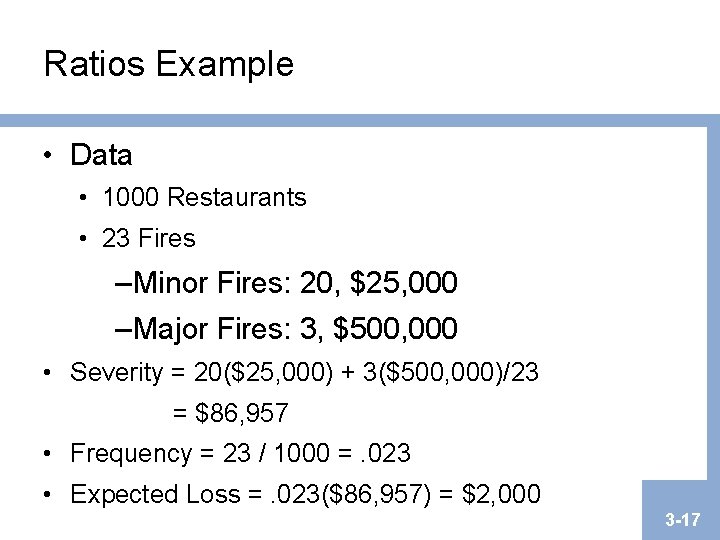
Ratios Example • Data • 1000 Restaurants • 23 Fires – Minor Fires: 20, $25, 000 – Major Fires: 3, $500, 000 • Severity = 20($25, 000) + 3($500, 000)/23 = $86, 957 • Frequency = 23 / 1000 =. 023 • Expected Loss =. 023($86, 957) = $2, 000 3 -17
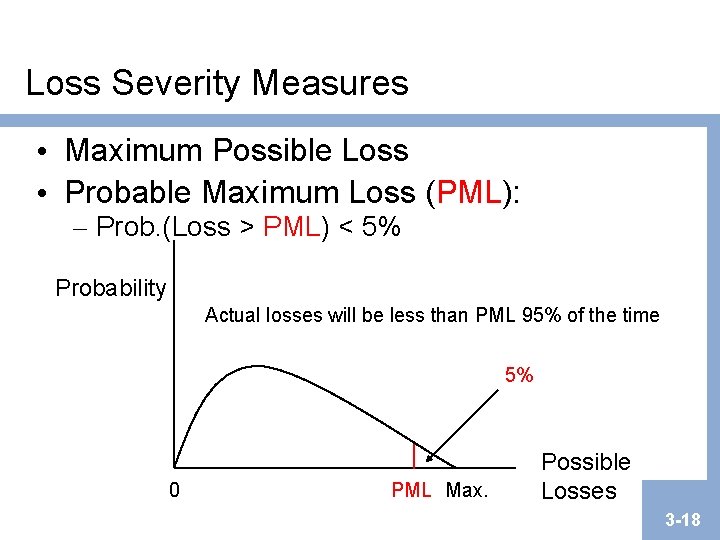
Loss Severity Measures • Maximum Possible Loss • Probable Maximum Loss (PML): – Prob. (Loss > PML) < 5% Probability Actual losses will be less than PML 95% of the time 5% 0 PML Max. Possible Losses 3 -18
Ex-Insight 4. 2 Figure 3: Products Liability Risk Profile 3 -19
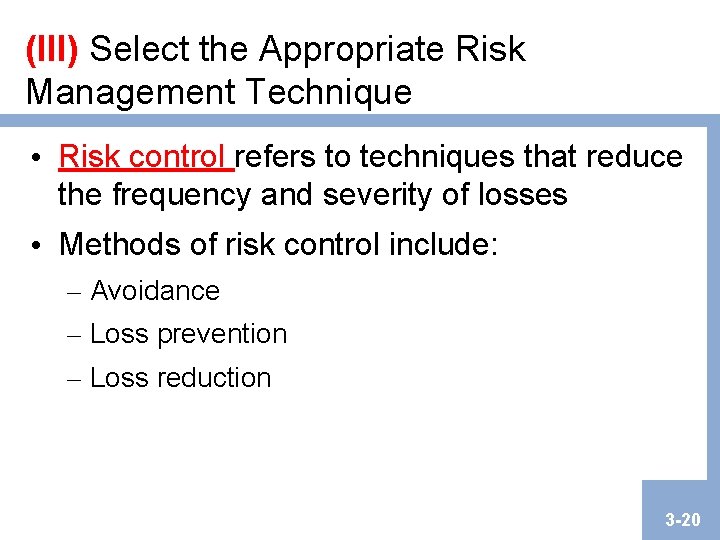
(III) Select the Appropriate Risk Management Technique • Risk control refers to techniques that reduce the frequency and severity of losses • Methods of risk control include: – Avoidance – Loss prevention – Loss reduction 3 -20
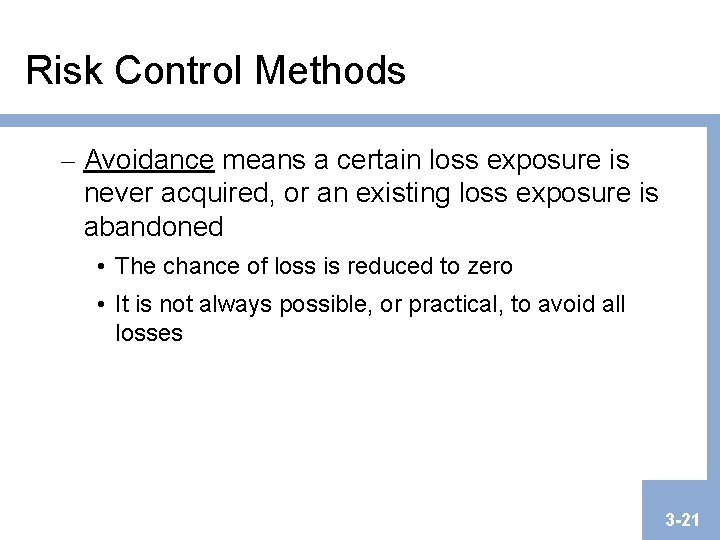
Risk Control Methods – Avoidance means a certain loss exposure is never acquired, or an existing loss exposure is abandoned • The chance of loss is reduced to zero • It is not always possible, or practical, to avoid all losses 3 -21
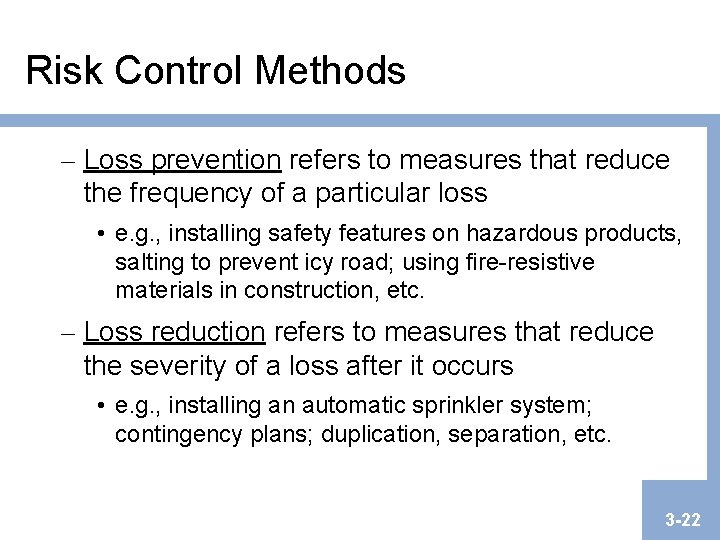
Risk Control Methods – Loss prevention refers to measures that reduce the frequency of a particular loss • e. g. , installing safety features on hazardous products, salting to prevent icy road; using fire-resistive materials in construction, etc. – Loss reduction refers to measures that reduce the severity of a loss after it occurs • e. g. , installing an automatic sprinkler system; contingency plans; duplication, separation, etc. 3 -22
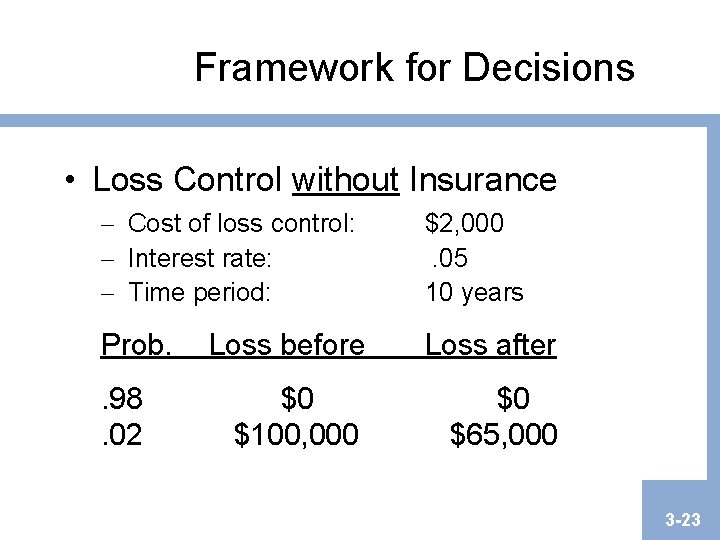
Framework for Decisions • Loss Control without Insurance – Cost of loss control: – Interest rate: – Time period: $2, 000. 05 10 years Prob. Loss before Loss after $0 $100, 000 $0 $65, 000 . 98. 02 3 -23
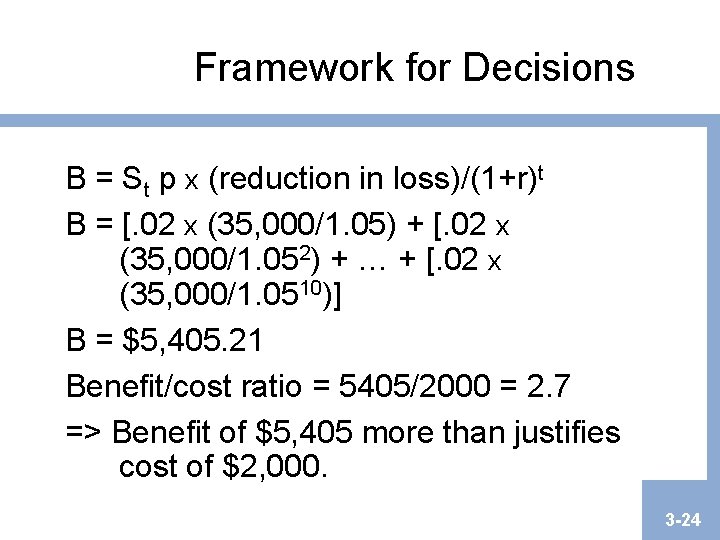
Framework for Decisions B = St p x (reduction in loss)/(1+r)t B = [. 02 x (35, 000/1. 05) + [. 02 x (35, 000/1. 052) + … + [. 02 x (35, 000/1. 0510)] B = $5, 405. 21 Benefit/cost ratio = 5405/2000 = 2. 7 => Benefit of $5, 405 more than justifies cost of $2, 000. 3 -24
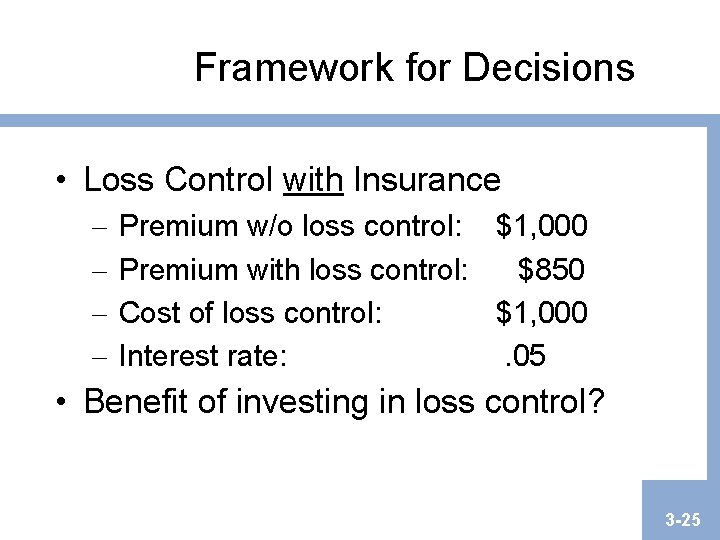
Framework for Decisions • Loss Control with Insurance – – Premium w/o loss control: $1, 000 Premium with loss control: $850 Cost of loss control: $1, 000 Interest rate: . 05 • Benefit of investing in loss control? 3 -25
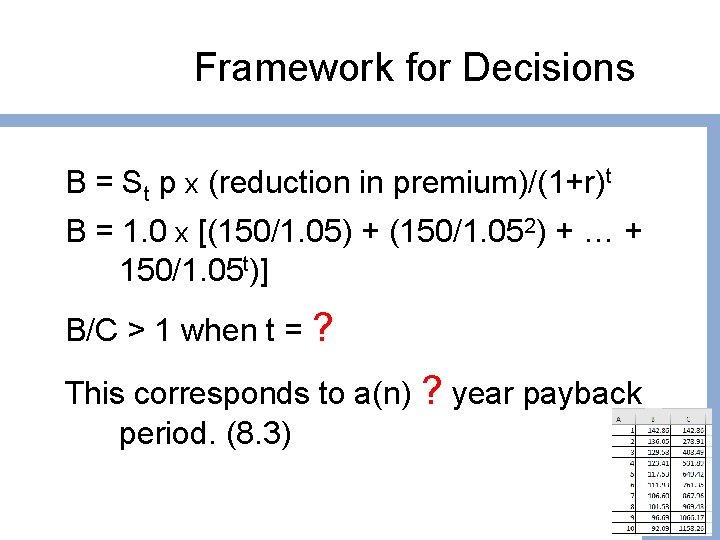
Framework for Decisions B = St p x (reduction in premium)/(1+r)t B = 1. 0 x [(150/1. 05) + (150/1. 052) + … + 150/1. 05 t)] B/C > 1 when t = ? This corresponds to a(n) ? year payback period. (8. 3) 3 -26
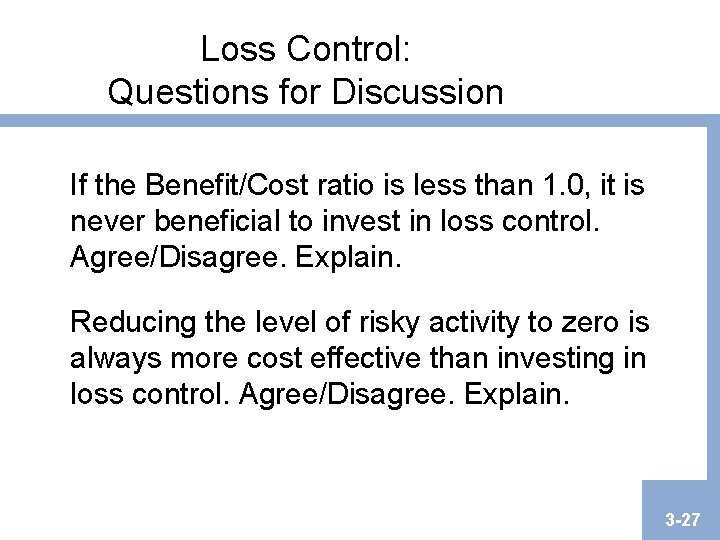
Loss Control: Questions for Discussion If the Benefit/Cost ratio is less than 1. 0, it is never beneficial to invest in loss control. Agree/Disagree. Explain. Reducing the level of risky activity to zero is always more cost effective than investing in loss control. Agree/Disagree. Explain. 3 -27
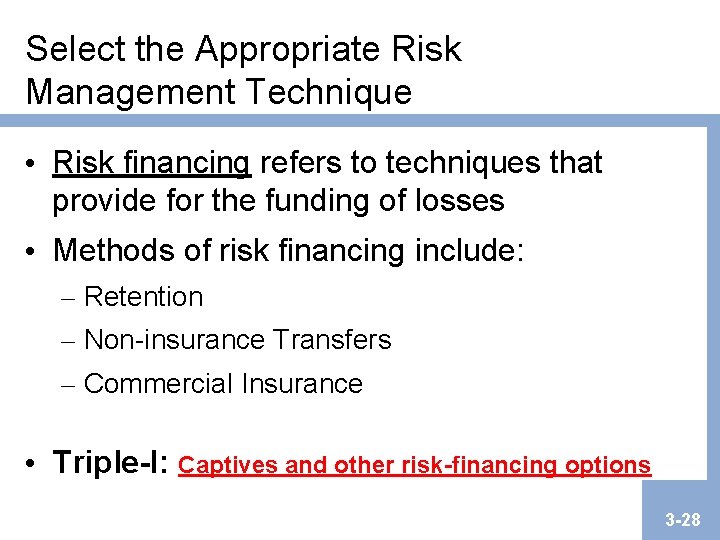
Select the Appropriate Risk Management Technique • Risk financing refers to techniques that provide for the funding of losses • Methods of risk financing include: – Retention – Non-insurance Transfers – Commercial Insurance • Triple-I: Captives and other risk-financing options 3 -28
Risk Financing Methods: Retention • Retention means that the firm retains part or all of the losses that can result from a given loss – Retention is effectively used when: • No other method of treatment is available • The worst possible loss is not serious • Losses are highly predictable – The retention level is the dollar amount of losses that the firm will retain • A financially strong firm can have a higher retention level than a financially weak firm • The maximum retention may be calculated as a percentage of the firm’s net working capital 3 -29
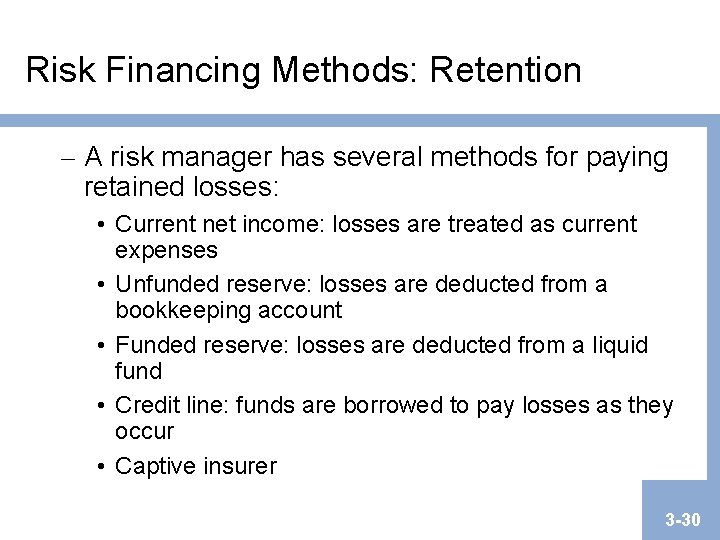
Risk Financing Methods: Retention – A risk manager has several methods for paying retained losses: • Current net income: losses are treated as current expenses • Unfunded reserve: losses are deducted from a bookkeeping account • Funded reserve: losses are deducted from a liquid fund • Credit line: funds are borrowed to pay losses as they occur • Captive insurer 3 -30
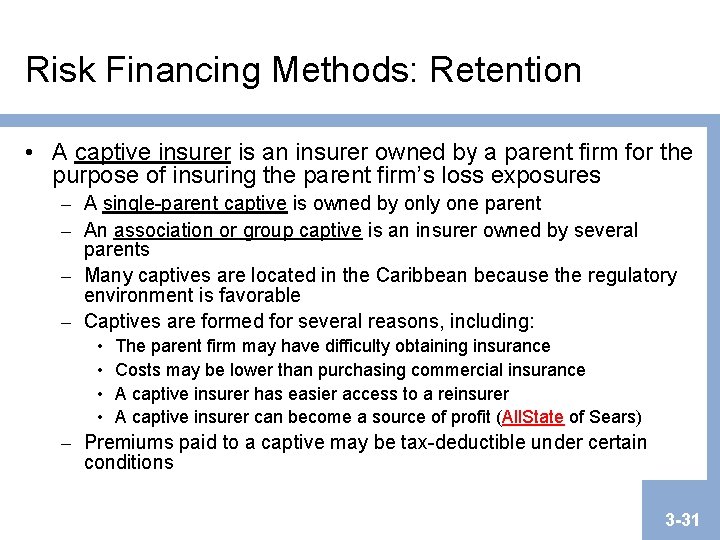
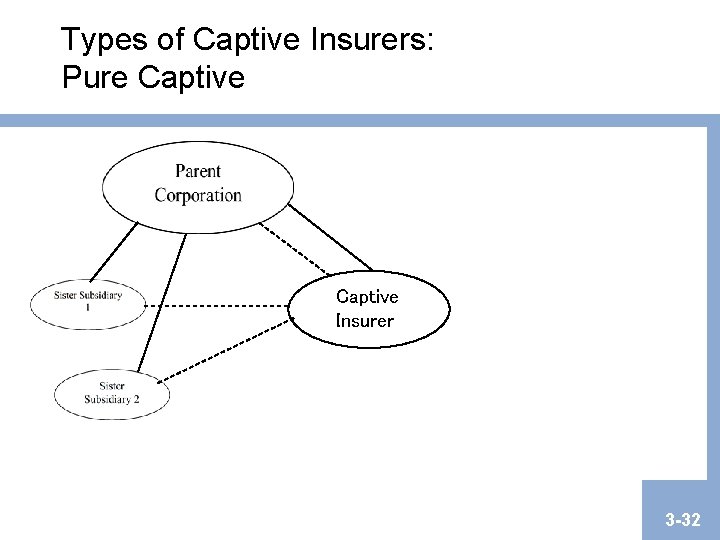
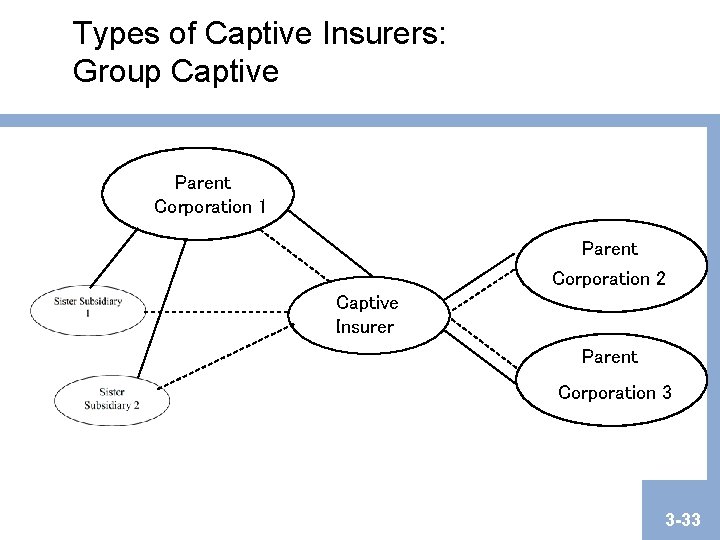
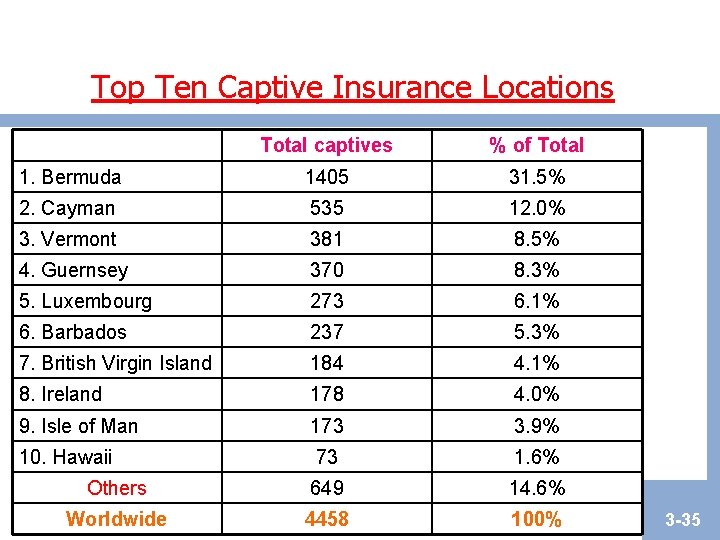
Risk Financing Methods: Retention • A captive insurer is an insurer owned by a parent firm for the purpose of insuring the parent firm’s loss exposures – A single-parent captive is owned by only one parent – An association or group captive is an insurer owned by several parents – Many captives are located in the Caribbean because the regulatory environment is favorable – Captives are formed for several reasons, including: • • The parent firm may have difficulty obtaining insurance Costs may be lower than purchasing commercial insurance A captive insurer has easier access to a reinsurer A captive insurer can become a source of profit (All. State of Sears) – Premiums paid to a captive may be tax-deductible under certain conditions 3 -31
Types of Captive Insurers: Pure Captive Insurer 3 -32
Types of Captive Insurers: Group Captive Parent Corporation 1 Parent Corporation 2 Captive Insurer Parent Corporation 3 3 -33
Types of Captive Insurers: Broad Captive Parent Corporation 1 Parent Corporation 2 Captive Insurer Parent Corporation 3 3 -34
Top Ten Captive Insurance Locations Total captives % of Total 1. Bermuda 1405 31. 5% 2. Cayman 535 12. 0% 3. Vermont 381 8. 5% 4. Guernsey 370 8. 3% 5. Luxembourg 273 6. 1% 6. Barbados 237 5. 3% 7. British Virgin Island 184 4. 1% 8. Ireland 178 4. 0% 9. Isle of Man 173 3. 9% 10. Hawaii 73 1. 6% Others 649 14. 6% Worldwide 4458 100% 3 -35
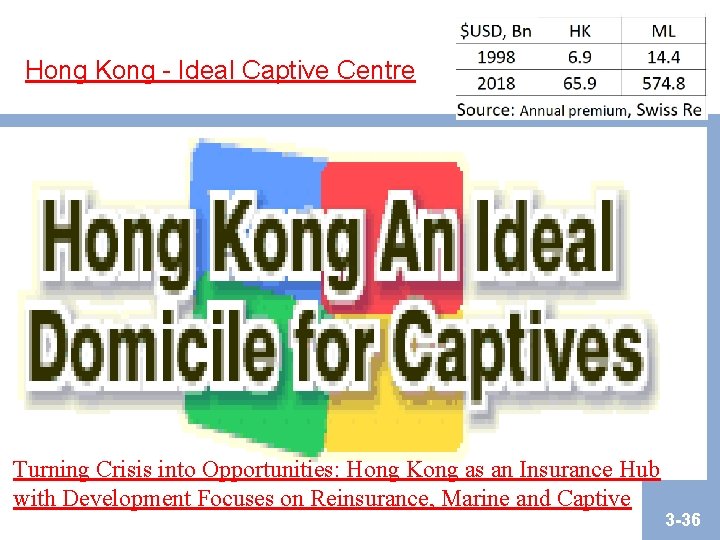
Hong Kong - Ideal Captive Centre Turning Crisis into Opportunities: Hong Kong as an Insurance Hub with Development Focuses on Reinsurance, Marine and Captive 3 -36
CNOOC Insurance @ HK 3 -37
Risk Financing Methods: Retention • Self-insurance is a special form of planned retention – Part or all of a given loss exposure is retained by the firm – A more accurate term would be self-funding – Widely used for workers compensation and group health benefits • A risk retention group (RRG) is a group captive that can write any type of liability coverage except employer liability, workers compensation, and personal lines – Federal regulation allows employers, trade groups, governmental units, and other parties to form risk retention groups – They are exempt from many state insurance laws 3 -38
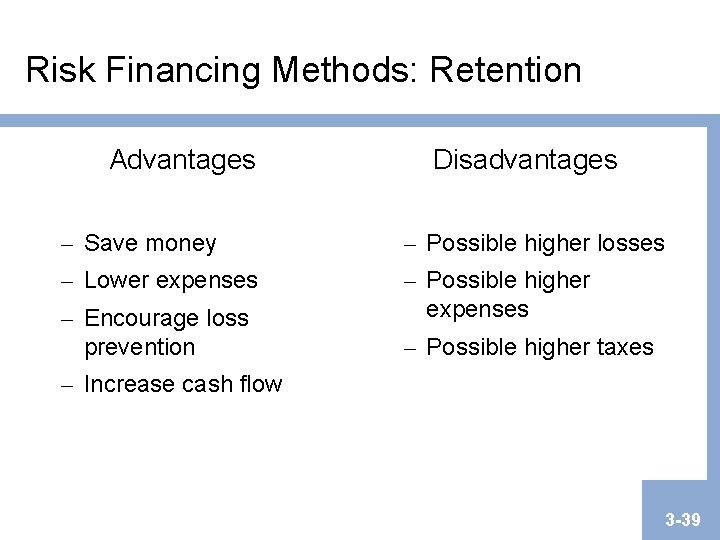
Risk Financing Methods: Retention Advantages Disadvantages – Save money – Possible higher losses – Lower expenses – Possible higher expenses – Encourage loss prevention – Possible higher taxes – Increase cash flow 3 -39
Risk Financing Methods: Noninsurance Transfers • A non-insurance transfer is a method other than insurance by which a pure risk and its potential financial consequences are transferred to another party – Examples include: • Contracts, leases, hold-harmless agreements 3 -40
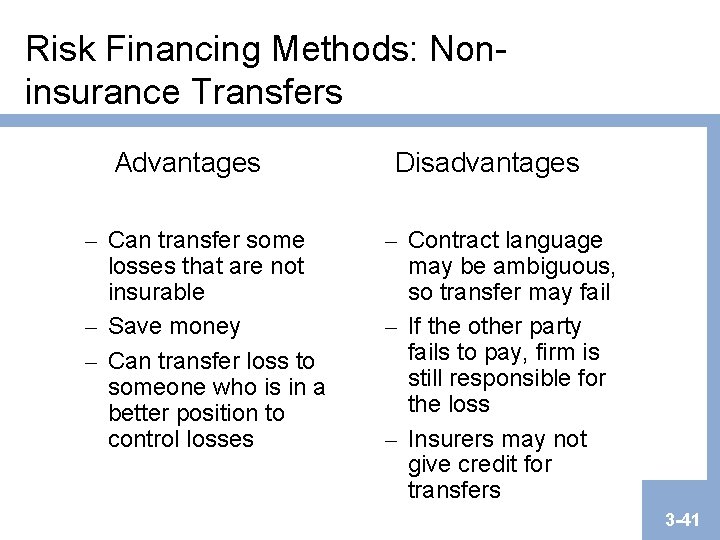
Risk Financing Methods: Noninsurance Transfers Advantages – Can transfer some losses that are not insurable – Save money – Can transfer loss to someone who is in a better position to control losses Disadvantages – Contract language may be ambiguous, so transfer may fail – If the other party fails to pay, firm is still responsible for the loss – Insurers may not give credit for transfers 3 -41
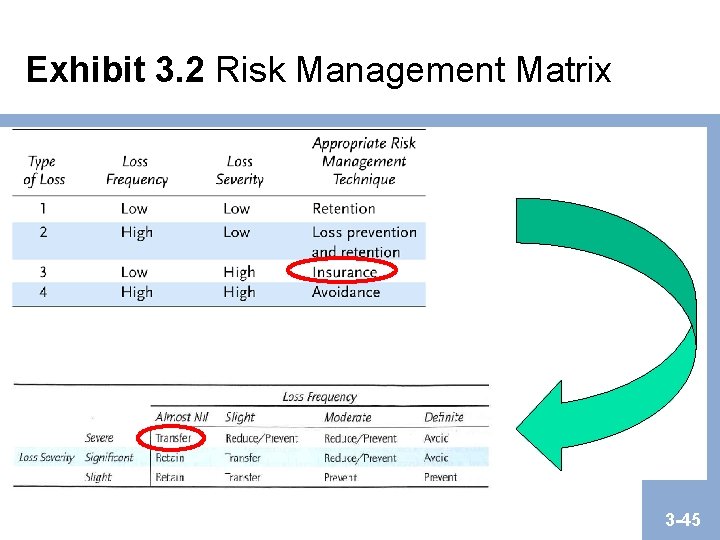
Risk Financing Methods: Insurance • Insurance is appropriate for loss exposures that have a low probability of loss but for which the severity of loss is high – The risk manager selects the coverages needed, and policy provisions: • A deductible is a provision by which a specified amount is subtracted from the loss payment otherwise payable to the insured • An excess insurance policy is one in which the insurer does not participate in the loss until the actual loss exceeds the amount a firm has decided to retain – The risk manager selects the insurer, or insurers, to provide the coverages 3 -42
Risk Financing Methods: Insurance – The risk manager negotiates the terms of the insurance contract • A manuscript policy is a policy specially tailored for the firm – Language in the policy must be clear to both parties • The parties must agree on the contract provisions, endorsements, forms, and premiums – The risk manager must periodically review the insurance program 3 -43
Risk Financing Methods: Insurance Advantages – Firm is indemnified for losses – Uncertainty is reduced – Insurers may provide other risk management services – Premiums are taxdeductible Disadvantages – Premiums may be costly • Opportunity cost should be considered – Negotiation of contracts takes time and effort – The risk manager may become lax in exercising loss control 3 -44
Exhibit 3. 2 Risk Management Matrix 3 -45
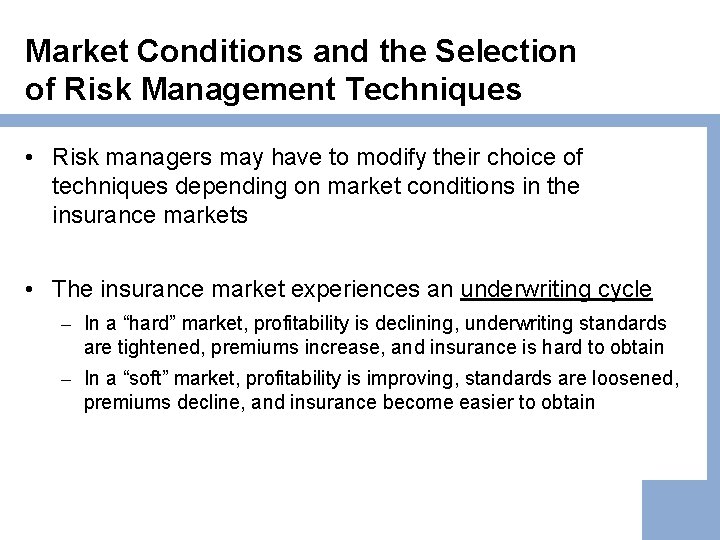
Market Conditions and the Selection of Risk Management Techniques • Risk managers may have to modify their choice of techniques depending on market conditions in the insurance markets • The insurance market experiences an underwriting cycle – In a “hard” market, profitability is declining, underwriting standards are tightened, premiums increase, and insurance is hard to obtain – In a “soft” market, profitability is improving, standards are loosened, premiums decline, and insurance become easier to obtain
(IV) Implement and Monitor the Risk Management Program • Implementation of a risk management program begins with a risk management policy statement that: – Outlines the firm’s risk management objectives – Outlines the firm’s policy on loss control – Educates top-level executives in regard to the risk management process – Gives the risk manager greater authority – Provides standards for judging the risk manager’s performance • A risk management manual may be used to: – Describe the risk management program – Train new employees – standards for judging the risk manager’s performance • RM@Universities: O. R. M. at UW-Madison vs. F. O. at CUHK 3 -47
Implement and Monitor the Risk Management Program • A successful risk management program requires active cooperation from other departments in the firm • The risk management program should be periodically reviewed and evaluated to determine whether the objectives are being attained – The risk manager should compare the costs and benefits of all risk management activities 3 -48
Benefits of Risk Management • Pre-loss and post-loss objectives are attainable • A risk management program can reduce a firm’s cost of risk – The cost of risk includes premiums paid, retained losses, outside risk management services, financial guarantees, internal administrative costs, taxes, fees, and other expenses • Reduction in pure loss exposures allows a firm to enact an enterprise risk management program to treat both pure and speculative loss exposures • Society benefits because both direct and indirect losses are reduced 3 -49
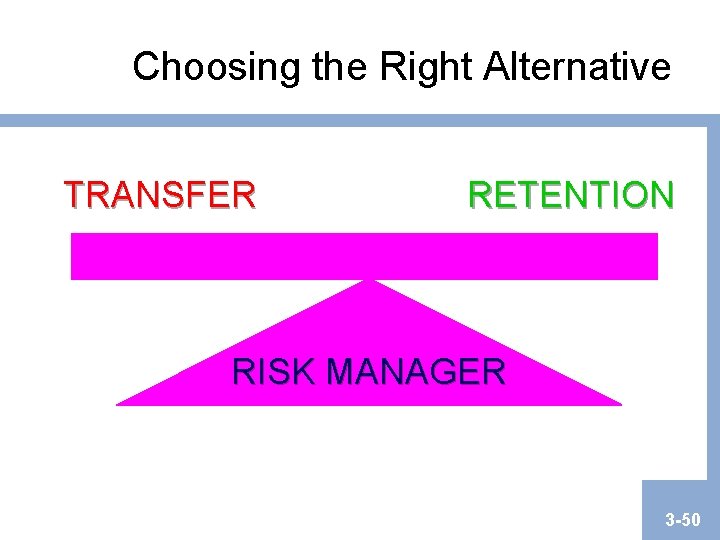
Choosing the Right Alternative TRANSFER RETENTION RISK MANAGER 3 -50
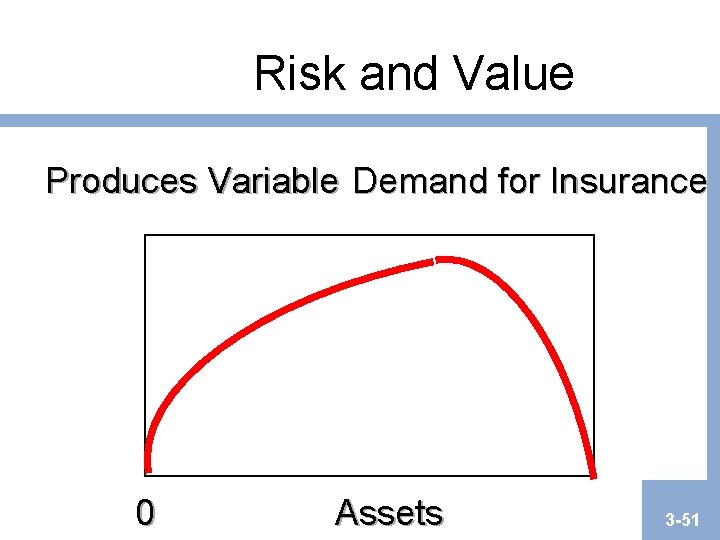
Risk and Value Produces Variable Demand for Insurance 0 Assets 3 -51
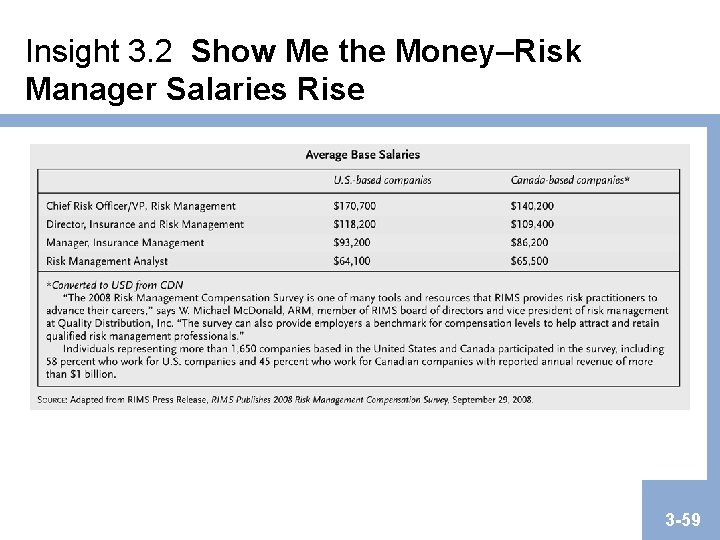
Insight 3. 2 Show Me the Money–Risk Manager Salaries Rise 3 -52
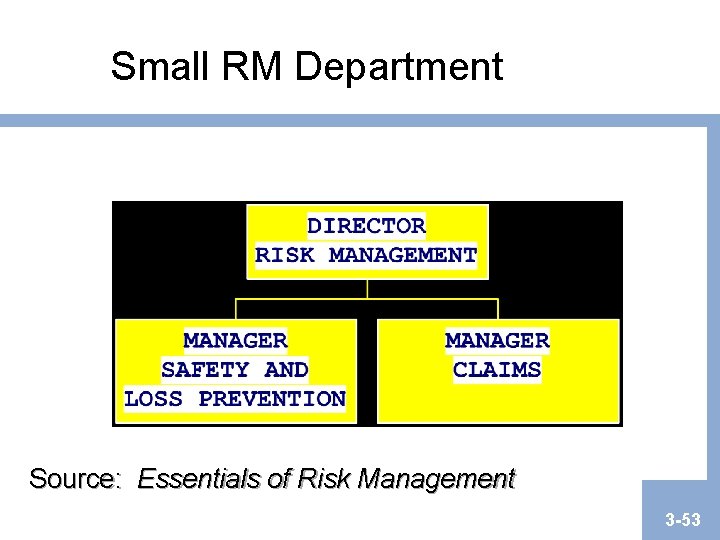
Small RM Department Source: Essentials of Risk Management 3 -53
Medium-sized Department Source: Essentials of Risk Management 3 -54
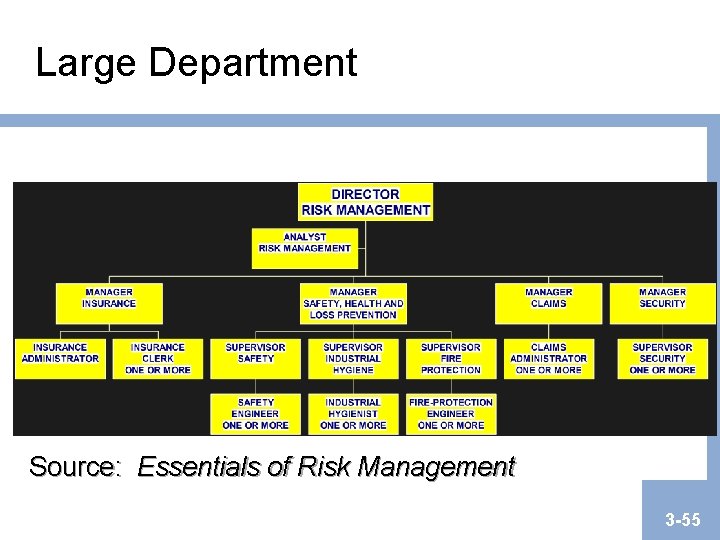
Large Department Source: Essentials of Risk Management 3 -55
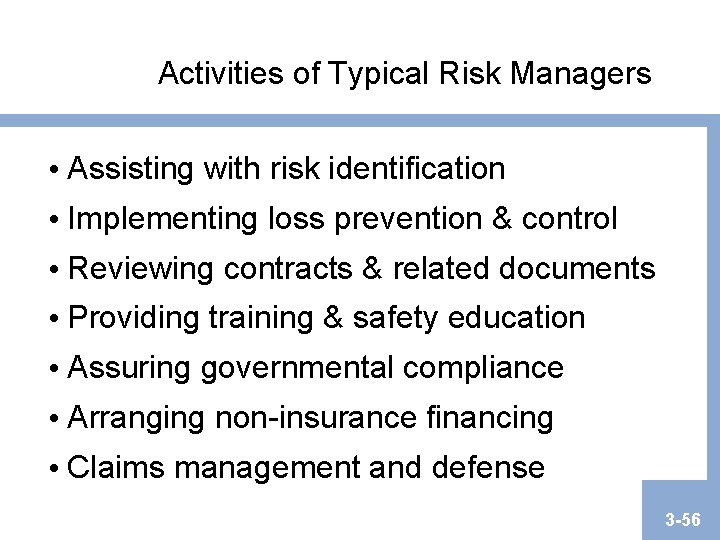
Activities of Typical Risk Managers • Assisting with risk identification • Implementing loss prevention & control • Reviewing contracts & related documents • Providing training & safety education • Assuring governmental compliance • Arranging non-insurance financing • Claims management and defense 3 -56
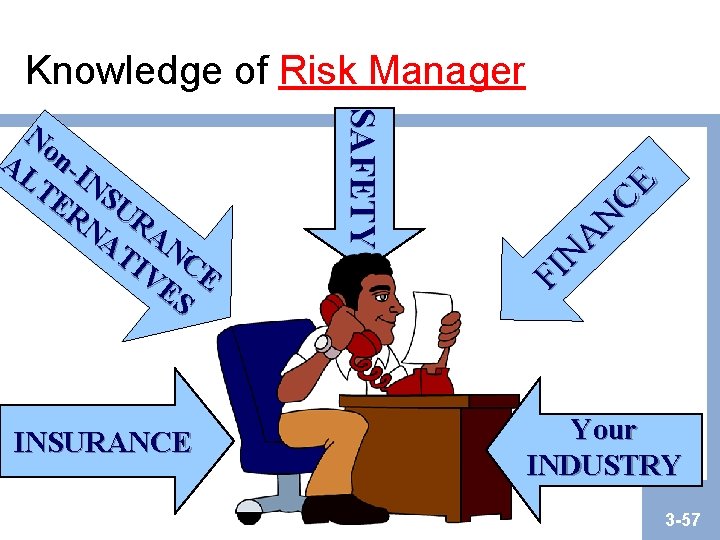
INSURANCE SAFETY No AL n-I TE NS RN UR AT AN IV CE ES FI N A N CE Knowledge of Risk Manager Your INDUSTRY 3 -57
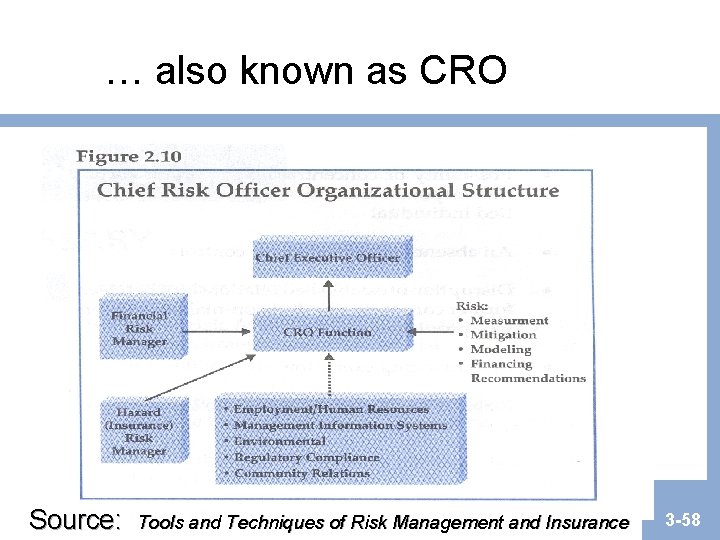
… also known as CRO Source: Tools and Techniques of Risk Management and Insurance 3 -58
Insight 3. 2 Show Me the Money–Risk Manager Salaries Rise 3 -59
Personal Risk Management • Personal risk management refers to the identification of pure risks faced by an individual or family, and to the selection of the most appropriate technique for treating such risks • The same principles applied to corporate risk management apply to personal risk management 3 -60