
Chapter 33 The Basics of Risk Management Section
Chapter 33 The Basics of Risk Management Section 33. 1 Types of Risk
Read to Learn Discuss risk and risk management. Describe different types of risk.
The Main Idea Everybody faces risk that can lead to loss, injury, or even death. Individuals and businesses can use strategies to manage risk as ways to reduce or avoid loss.
Key Concepts Risk Management Types of Risk
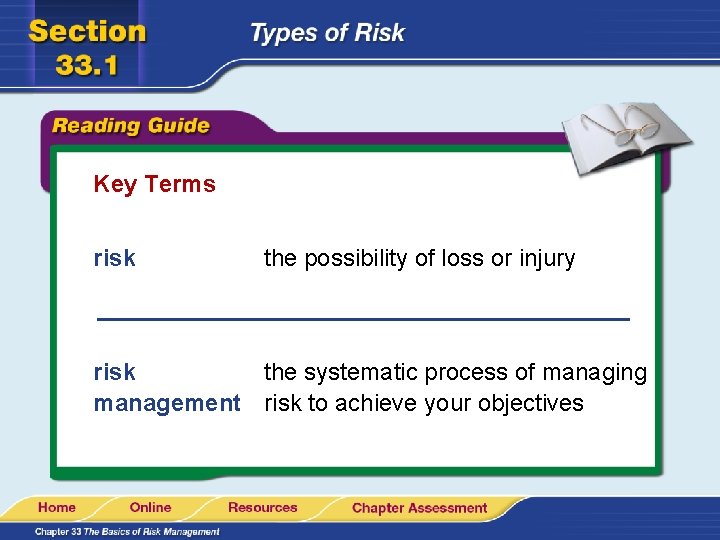
Key Terms risk the possibility of loss or injury risk the systematic process of managing management risk to achieve your objectives
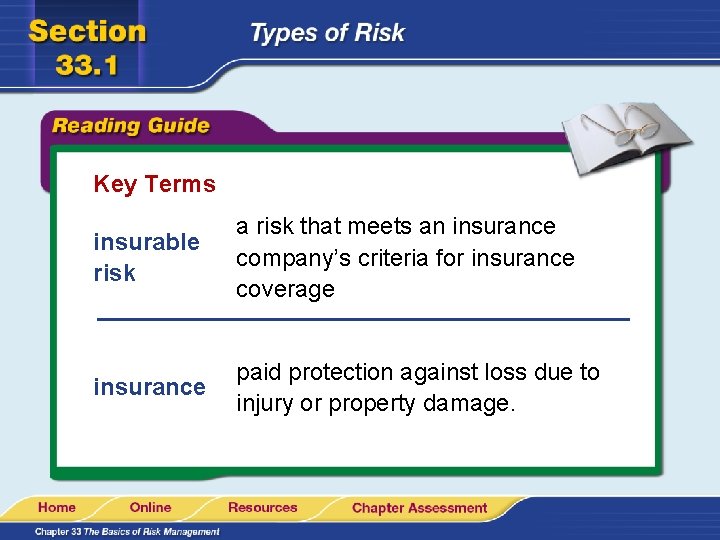
Key Terms insurable risk a risk that meets an insurance company’s criteria for insurance coverage insurance paid protection against loss due to injury or property damage.
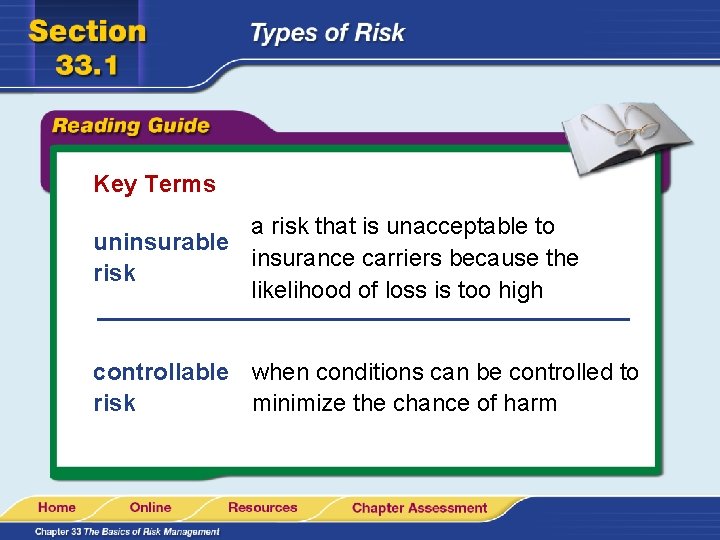
Key Terms a risk that is unacceptable to uninsurable insurance carriers because the risk likelihood of loss is too high controllable when conditions can be controlled to risk minimize the chance of harm
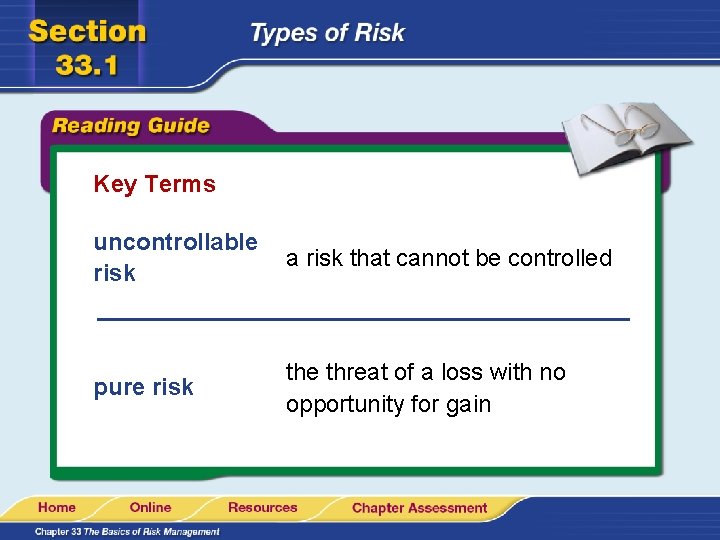
Key Terms uncontrollable risk a risk that cannot be controlled pure risk the threat of a loss with no opportunity for gain
Key Terms economic risk the likelihood of economic loss human risk the risk of harm caused by human mistakes, dishonesty, or another risk that is attributed to people
Key Terms natural risk the possibility of a catastrophe caused by a flood, tornado, fire, lightning, drought, or earthquake
Risk Management All people and businesses make decisions that create risk the possibility for loss or injury
Risk Management Business risk is risk that businesses specifically face, such as the potential for financial loss.
Risk Management Individuals and businesses should learn about risk management the systematic process of managing risk to achieve your objectives
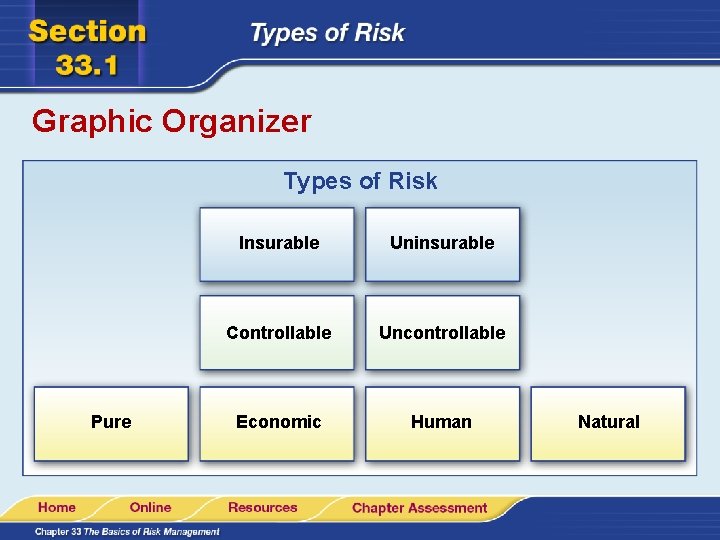
Graphic Organizer Types of Risk Pure Insurable Uninsurable Controllable Uncontrollable Economic Human Natural
Types of Risk A person can purchase insurance for an insurable risk. insurance paid protection against loss due to injury or property insurable risk a risk that meets and insurance company’s criteria for insurance coverage
Types of Risk Property in a flood zone might be considered an uninsurable risk by insurance companies. uninsurable risk a risk that is unacceptable to insurance carriers because the likelihood of loss is too high
Types of Risk Environmental damage is a controllable risk when conditions can be controlled to minimize the chance of harm
Types of Risk The risk of doing business in the global marketplace is an example of uncontrollable risk a risk that cannot be controlled
Pure Risk The risk of being in an accident while driving your car is an example of a pure risk the threat of a loss with no opportunity for gain
Pure Risk The purpose of insurance is to hedge against the risk of potential financial loss.
Economic Risk Economic risk can be unavoidable, but you can take steps to protect yourself from loss. economic risk the likelihood of economic loss
Economic Risk If businesses fail to change their products when competitors offer more features, they may face economic harm.
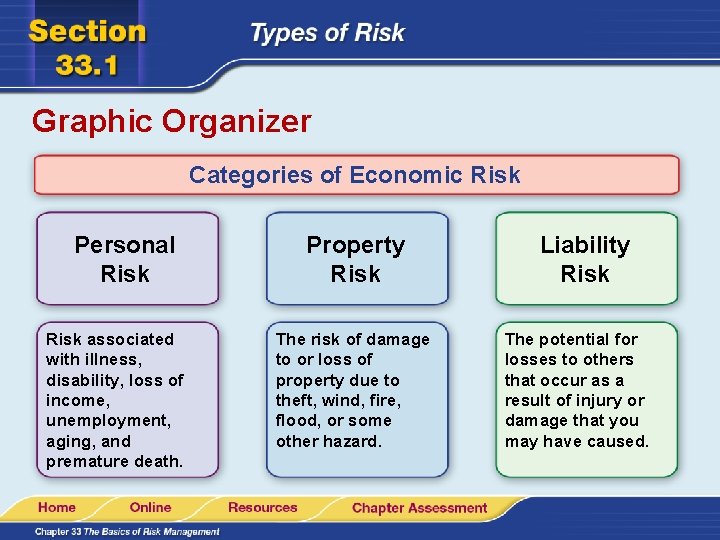
Graphic Organizer Categories of Economic Risk Personal Risk associated with illness, disability, loss of income, unemployment, aging, and premature death. Property Risk The risk of damage to or loss of property due to theft, wind, fire, flood, or some other hazard. Liability Risk The potential for losses to others that occur as a result of injury or damage that you may have caused.
Human Risk For businesses, human risk ranges from the financial impact of theft or embezzlement to jobrelated injury or illness. human risk the risk of harm caused by human mistakes, dishonesty, or another risk that is attributed to people
Human Risk Types of human risk include: Customer dishonesty Employee risk Computer-related crime
Your company has experienced a rash of thefts. Some employees have mentioned their suspicions about one particular employee. No one has come forward with evidence against this employee. Decision Making Should you confront this employee or conduct a search of his or her work area? What should you tell the police? Explain your answer.
Answer False accusations can have a negative impact on a company. However, employing someone suspected of a crime might threaten everyone’s safety and expose the company to legal risks. Investigation may be necessary, provided it is done discretely.
Natural Risk It can be difficult to buy insurance for certain types of natural risk the possibility of a catastrophe caused by a flood, tornado, fire, lightening, drought, or earthquake
Natural Risk Some risk is caused by people and is also called natural risk. Examples include: Power outages Terrorism Oil spills War Arson
Weather Disasters The United States sustained 67 weather disasters between 1980 and 2005, in which overall damages and costs reached or exceeded $1 billion at the time of each event, according to the National Climatic Data Center.
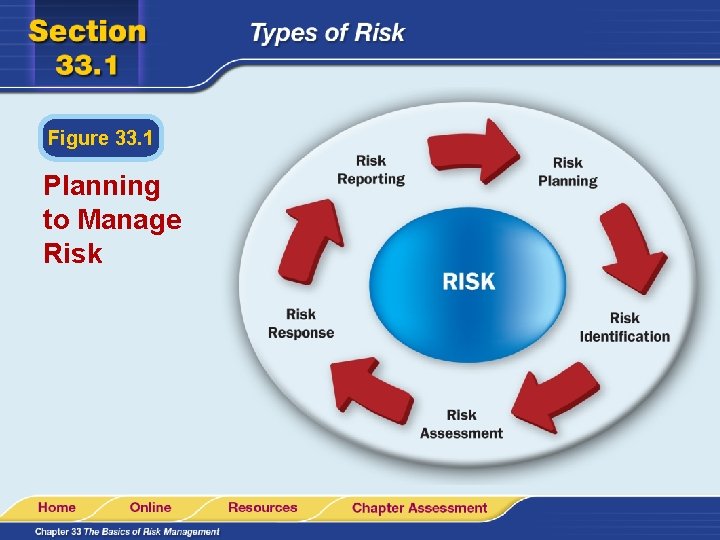
Figure 33. 1 Planning to Manage Risk
1. Why do businesses and individuals practice risk management? Both individuals and businesses face risk and use risk management strategies to prevent and reduce losses.
2. What are the four main types of risk discussed in the chapter? insurable, uninsurable, controllable, and uncontrollable
3. Describe some types of human risk. customer dishonesty such as theft, fraudulent payment, or nonpayment, employee dishonesty, and computer-related crimes
End of Chapter 33 The Basics of Risk Management Section 33. 1 Types of Risk
- Slides: 35