Chapter 2 Properties of Matter 2 1 Classifying



- Slides: 43
Chapter 2 Properties of Matter 2 -1 Classifying Matter
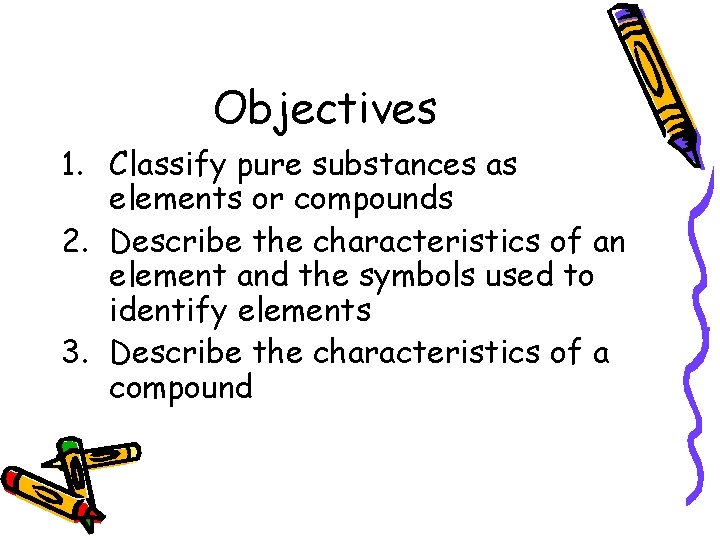
Objectives 1. Classify pure substances as elements or compounds 2. Describe the characteristics of an element and the symbols used to identify elements 3. Describe the characteristics of a compound
Pure Substances • Matter that always has exactly the same composition is classified as a _____substance. • Every sample of a given substance has the same properties because a substance has a fixed, _______ composition. • Ex – Table ______ (Na) and _____(C 6 H 12 O 6) • Can be classified into _______ and ______
Elements • ____ is a substance that cannot be broken down into simpler substances. • _____are the smallest particle of an element. • An element has a fixed composition because it contains only_______type of atom.
Examples of Elements • Most are ______– Aluminum (Al) • Some are _______– Carbon (C) • Two are liquids are room temperature – ____ (Br) and____ (Hg)
Symbols for Elements • The ______ letter is always capitalized • If there is a _______ letter it is not capitalized -Na (sodium) • If the symbol contains only one letter, it is _______ capitalized - C
Compounds • A _____ is a substance that is made from two or more simpler substances and can be broken down into those simpler substances. • A compound always contains ______or more elements joined in a fixed proportion. • Ex. Water – ______
Mixtures • The _____ of a mixture can vary because of composition of a mixture is not fixed. • Example - ____
Beaker Breaker!! 1. ) Can an element or a compound be broken down into simpler parts? 2. ) What is an example of a pure substance? 3. )What are the building blocks of elements?
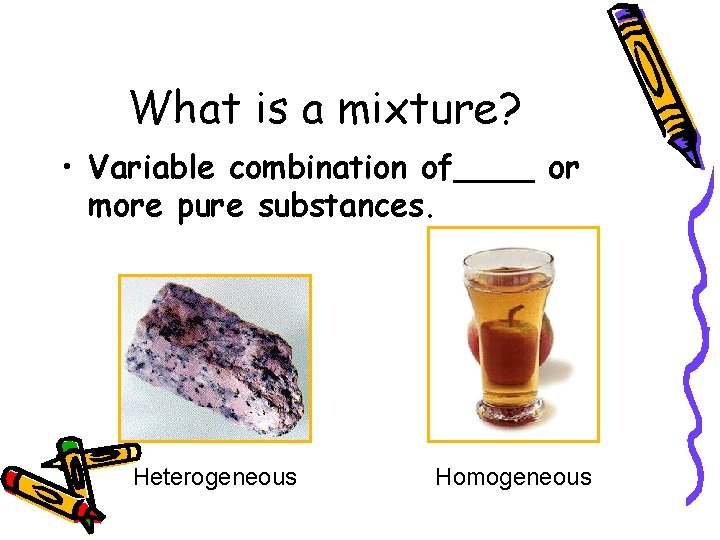
What is a mixture? • Variable combination of____ or more pure substances. Heterogeneous Homogeneous
What is the difference between a homogeneous and a heterogeneous substance? • Heterogeneous: substance whose composition is ______ uniform throughout……always a _____
What is the difference between a homogeneous and a heterogeneous substance? • Homogeneous: substance that is _____ (same) in its composition
A mixture may be… • Homogeneous • (______) • Heterogeneous • (____)
Solutions • When substances ____ and form a homogeneous mixture, the mixture that forms is called a_____. • Ex: ____ water and _____ wiper fluid • _______ passes through liquid solutions without being scattered in all directions
Suspensions • A heterogeneous mixture that ____ into layers over time is called a _____. • Ex: Shaking a jar of _______ and ______
Colloids • A____contains some particles that are intermediate in size between the small particles in solution and the larger particles in a suspension. • _______ is a colloid of water droplets in air • _____ of light is a property of a colloid
Beaker Breaker!! 1. ) When substances dissolve and form a homogeneous mixture, the mixture that forms is called a______. 2. ) Is fog an example of a colloid or a suspension? 3. ) A heterogeneous mixture that separates into layers over time is called a_______
Solutions Cont. • Recall that a solution is a homogeneous mixture of two or more substances • Two components 1. _____ 2. _____
Solutes • A ____ is a substance whose particles are dissolved in a solution.
Solvents • The substance in which the solute dissolves is called the ____.
Example • _______ solution • Solute = ______ • Solvent = _______
Beaker Breaker!! 1. ) A_________is a substance whose particles are dissolved in a solution. 2. ) The substance in which the solute dissolves is called the __________. 3. ) sugar in water – circle the solvent and underline the solute
2 -2 Physical Properties • A _____ property is any characteristic of a material that can be observed or measured without changing the composition of the substances in the material
Examples of physical properties 1. 2. 3. 4. 5. 6. 7.
Viscosity • The tendency of a liquid to keep from flowing – _____ to flowing is called ____. • Example - ____
Conductivity • A material’s ability to allow _______ to flow is called _______ • Example : Metals = ______ conductivity or also know as _____ • Stirring soup with a____spoon verses wooden spoon
Malleability • Malleability is the ability of a solid to be_____ without shattering. • Ex gold and ______
Hardness • One way to compare the hardness of two materials is to see which of the materials can _____ the other. • Ex: Kitchen knife (stainless steel) scratching _____
Melting Point and Boiling Point • The temperature at which a substance changes from a _______to a ______ is its ____point. • The temperature at which a substance _____ is its _______point • Ex: _______ at 0 degrees Celsius and 100 degrees Celsius
Density • _______can be used to test the purity of a substance. • Density = Ex: Silver coin density = 9. 9 g/cm 3 Actual density of silver = 10. 5 g/cm 3 Coin is not _______silver
Beaker Breaker!! 1. ) Name one of the seven physical properties________ 2. ) Which physical property is defined as a material’s ability to allow heat to flow? 3. ) Aluminum and Gold are examples are what physical property? _______
Using Properties to Separate Mixtures 1. ____ is a process that separates materials based on the size of their particles 2. ______ is a process that separates the substances in a solution based on their _______ points.
Recognizing Physical Changes • A _____ change occurs when some of the properties of a material change, but the substances in the material remains the same. • Ex: slowly heating butter in a pan –changes from solid to liquid, but the substance in the butter remains the _____. • _____ a tomato • Crumpling a piece of paper
Chemical Properties • A ____ property is any ability to produce a change in the______ of matter. • Chemical properties can be observed only when the substances in a sample of matter are ____ into different substances.
Examples 1. ______ is a material’s ability to burn in the presence of oxygen. Ex. _____ and _____
Reactivity • The property that describes how readily a substance combines chemically with other substances is ______. • Example – _____ in air ____ is highly reactive Nitrogen has a ______ reactivity - _______ is another example
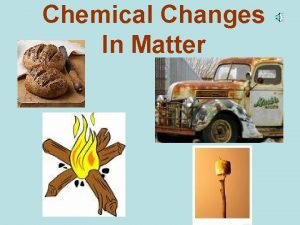
Recognizing Chemical Changes • A ____ change occurs when a substance reacts and forms one or more _______ substances. Examples: cake ______ in oven leaves on trees change ____ food ____ in your stomach
Three common types of evidence 1. Change in _______ 2. The production of a ____ 3. The formation of a _____
A change in color • Ex: ____tarnishing a ____ burning then turning black and shrivels
Production of a Gas • Ex: Combining vinegar and baking soda – _____of carbon dioxide form
Formation of a Precipitate • Any _____that forms and separates from a liquid mixture is called a _______. • Ex: when acid is added to _____, proteins in the milk undergo a chemical change that alters their structure, causing them to stick together in ______
Is a change chemical or physical? • When matter undergoes a chemical change, the _____ of matter changes. • When matter undergoes a physical change, the composition of the matter remains the____.
Beaker Breaker!! 1. ) What is one of the three common types of evidence of a chemical change? 2. ) Any solid that forms and separates from a liquid mixture is called a_____ 3. ) Gasoline and paper is an example of what chemical property?