CHAPTER 2 Motion in One Dimension QUESTION 1















- Slides: 55
CHAPTER 2 Motion in One Dimension
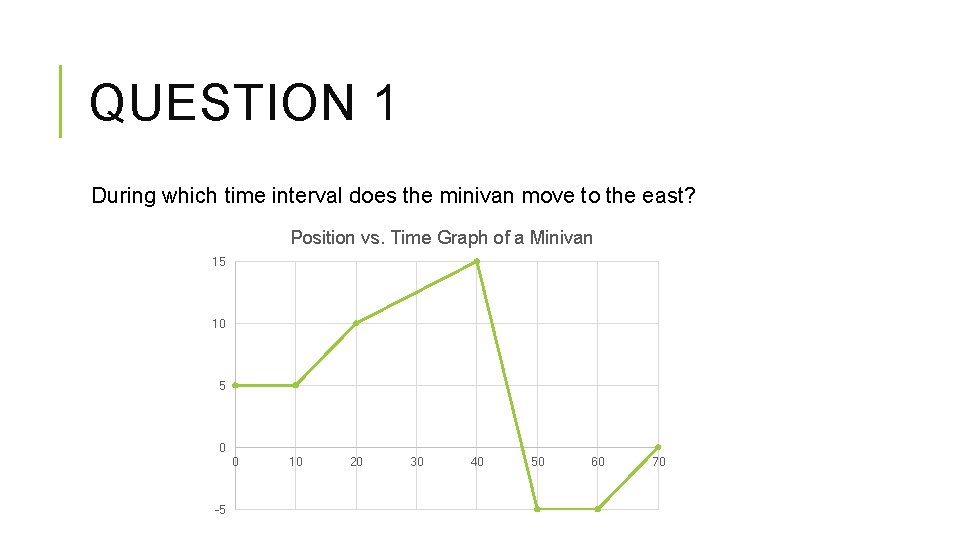
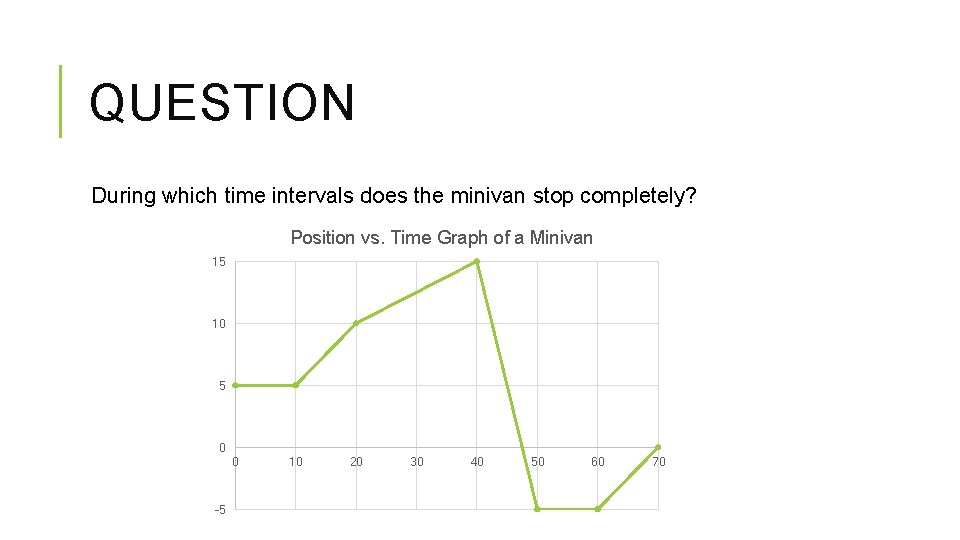
QUESTION 1 During which time interval does the minivan move to the east? Position vs. Time Graph of a Minivan 15 10 5 0 0 -5 10 20 30 40 50 60 70
ANSWER 0 – 40 s, 60 – 70 s
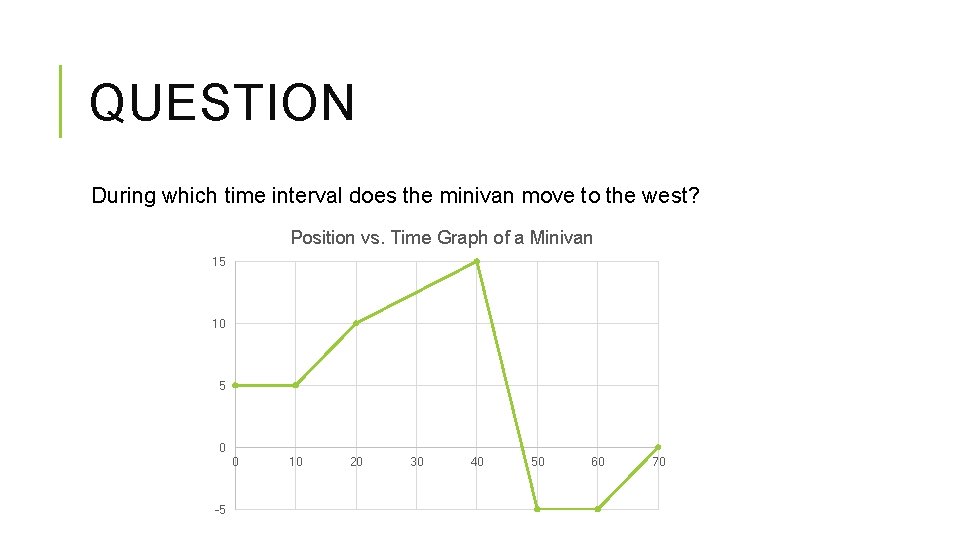
QUESTION During which time interval does the minivan move to the west? Position vs. Time Graph of a Minivan 15 10 5 0 0 -5 10 20 30 40 50 60 70
ANSWER 40 – 50 s, 50 – 60 s
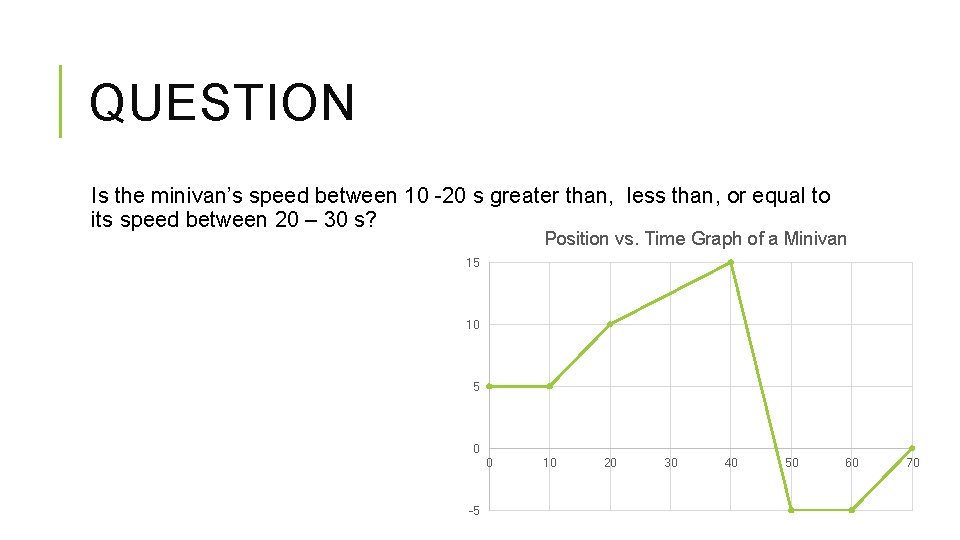
QUESTION Is the minivan’s speed between 10 -20 s greater than, less than, or equal to its speed between 20 – 30 s? Position vs. Time Graph of a Minivan 15 10 5 0 0 -5 10 20 30 40 50 60 70
ANSWER Greater than
QUESTION During which time intervals does the minivan stop completely? Position vs. Time Graph of a Minivan 15 10 5 0 0 -5 10 20 30 40 50 60 70
ANSWER 0 – 10 s, 50 – 60 s
ANSWER A juggler throws a ball straight up into the air. The ball remains in the air for 2. 4 s before it lands back in the juggler’s hand. How much time elapsed before the ball reached its maximum height?
ANSWER 1. 2 s
QUESTION A juggler throws a ball straight up into the air. The ball remains in the air for 2. 4 s before it lands back in the juggler’s hand. With what speed does the juggler throw the ball into the air?
ANSWER 11. 8 m/s
QUESTION During takeoff, a plane accelerates at 4 m/s 2 and takes 40 s to reach takeoff speed. What is the velocity of the plane at takeoff?
ANSWER 160 m/s
QUESTION A car with an initial speed of 31. 4 km/h accelerates at a uniform rate of 1. 2 m/s 2 for 1. 3 s. What is the final speed of the car during this time?
ANSWER 10. 3 m/s
QUESTION A car with an initial speed of 31. 4 km/h accelerates at a uniform rate of 1. 2 m/s 2 for 1. 3 s. What is the displacement of the car during this time?
ANSWER 12. 35 m
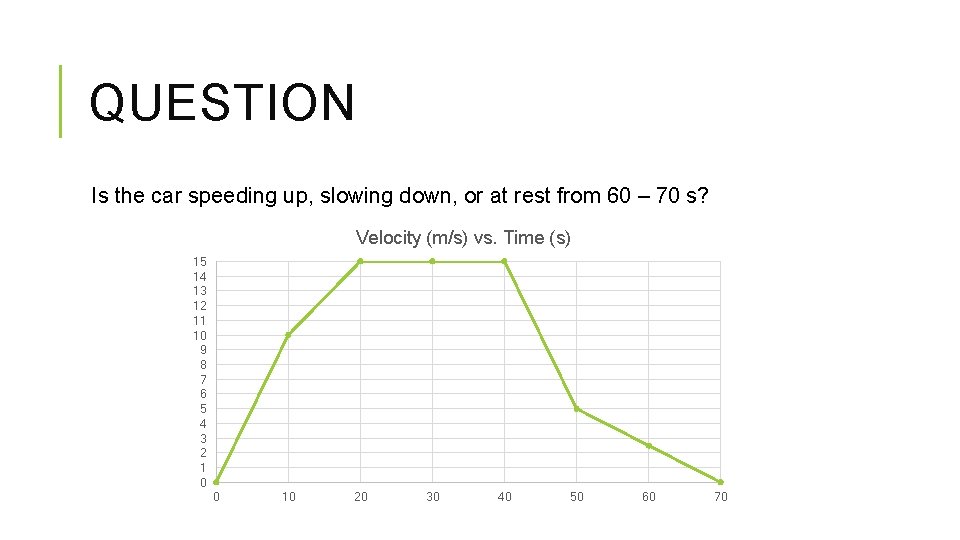
QUESTION Is the car speeding up, slowing down, or at rest from 60 – 70 s? Velocity (m/s) vs. Time (s) 15 14 13 12 11 10 9 8 7 6 5 4 3 2 1 0 0 10 20 30 40 50 60 70
ANSWER Slowing down
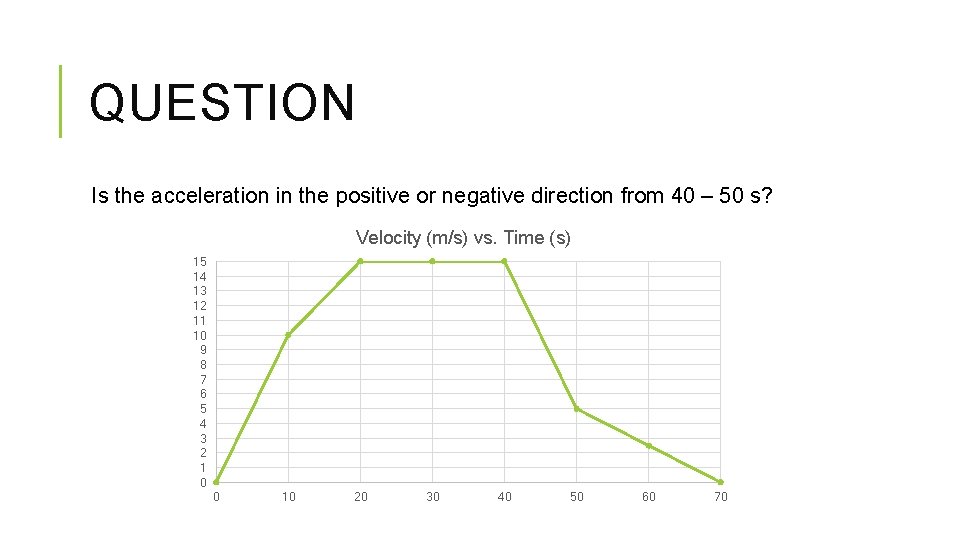
QUESTION Is the acceleration in the positive or negative direction from 40 – 50 s? Velocity (m/s) vs. Time (s) 15 14 13 12 11 10 9 8 7 6 5 4 3 2 1 0 0 10 20 30 40 50 60 70
ANSWER negative
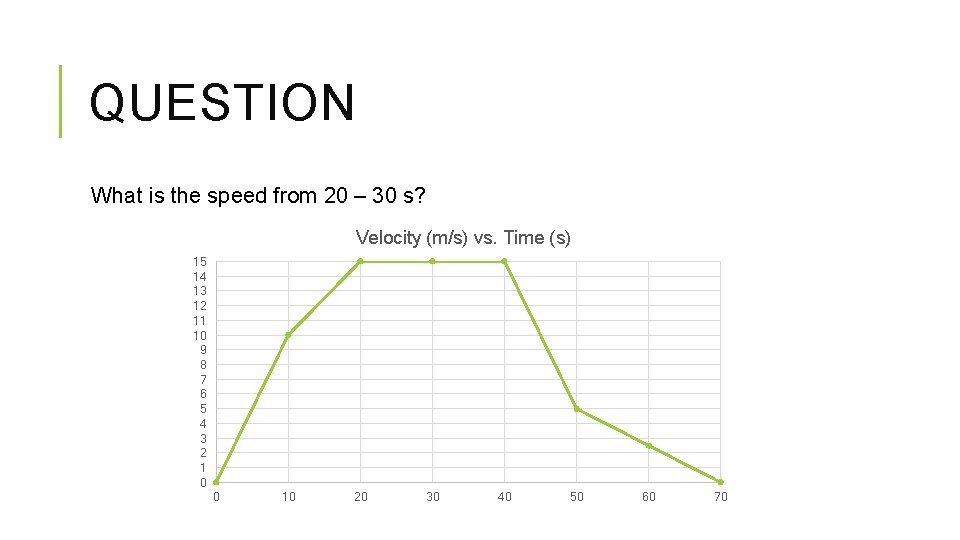
QUESTION What is the speed from 20 – 30 s? Velocity (m/s) vs. Time (s) 15 14 13 12 11 10 9 8 7 6 5 4 3 2 1 0 0 10 20 30 40 50 60 70
ANSWER 15 m/s
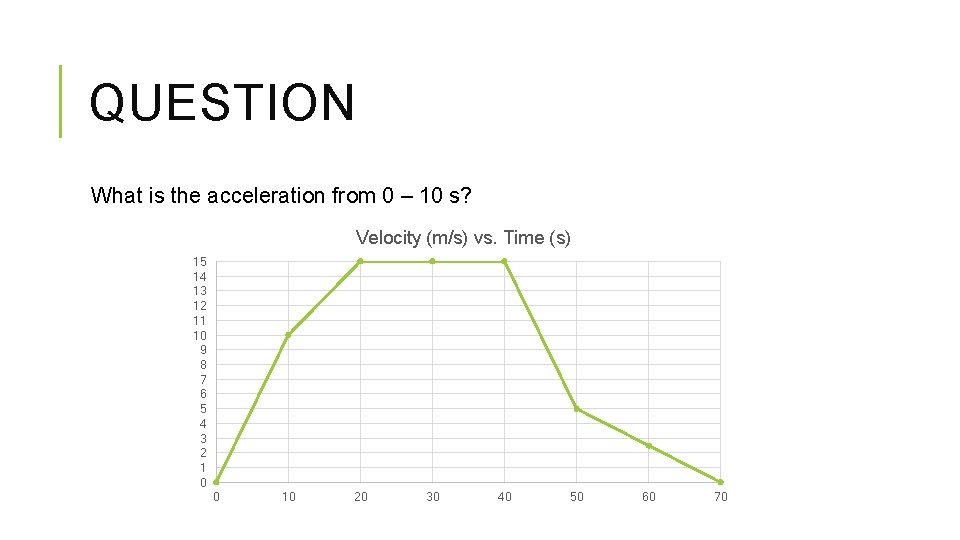
QUESTION What is the acceleration from 0 – 10 s? Velocity (m/s) vs. Time (s) 15 14 13 12 11 10 9 8 7 6 5 4 3 2 1 0 0 10 20 30 40 50 60 70
ANSWER 1 m/s 2
QUESTION A ball is thrown vertically upward. What is the ball’s velocity when it reaches its maximum altitude?
ANSWER 0 m/s
QUESTION A ball is thrown vertically upward. Does its acceleration increase, decrease, or remain constant?
ANSWER Remains constant
QUESTION A rocket moves upward, starting from rest with an acceleration of 29. 4 m/s 2 for 3. 98 s. It runs out of fuel at the end of the 3. 98 s but does not stop. How high does it rise above the ground?
ANSWER 931 m
QUESTION An elevator is moving upward at 1. 20 m/s when it experiences an acceleration of 0. 31 m/s 2 downward, over a distance of 0. 75 m. What will be its final velocity?
ANSWER 0. 99 m/s
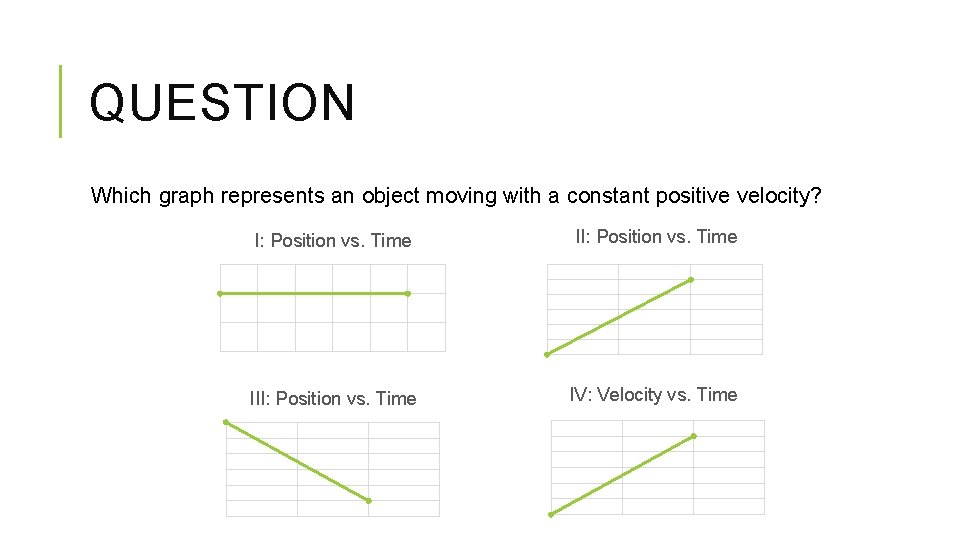
QUESTION Which graph represents an object moving with a constant positive velocity? I: Position vs. Time III: Position vs. Time IV: Velocity vs. Time
ANSWER II
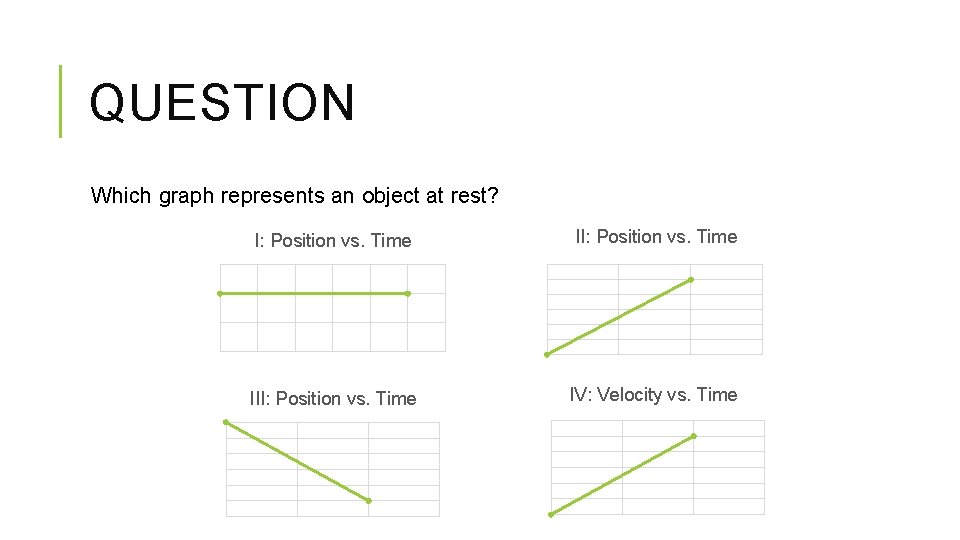
QUESTION Which graph represents an object at rest? I: Position vs. Time III: Position vs. Time IV: Velocity vs. Time
ANSWER I
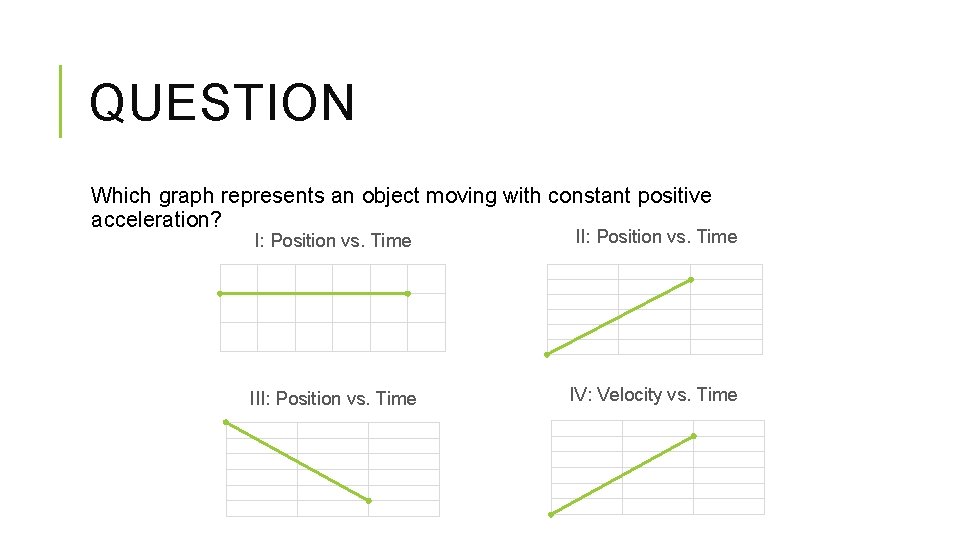
QUESTION Which graph represents an object moving with constant positive acceleration? I: Position vs. Time III: Position vs. Time IV: Velocity vs. Time
ANSWER IV
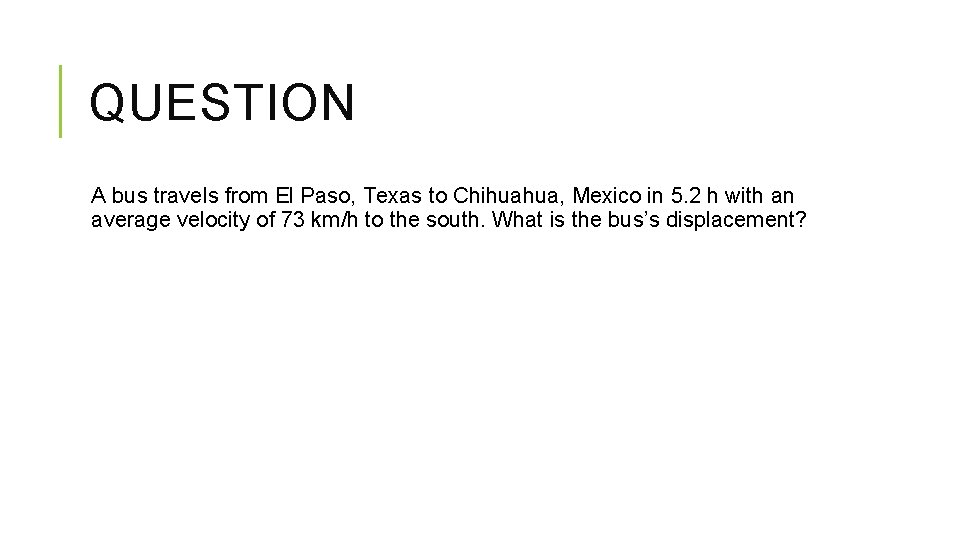
QUESTION A bus travels from El Paso, Texas to Chihuahua, Mexico in 5. 2 h with an average velocity of 73 km/h to the south. What is the bus’s displacement?
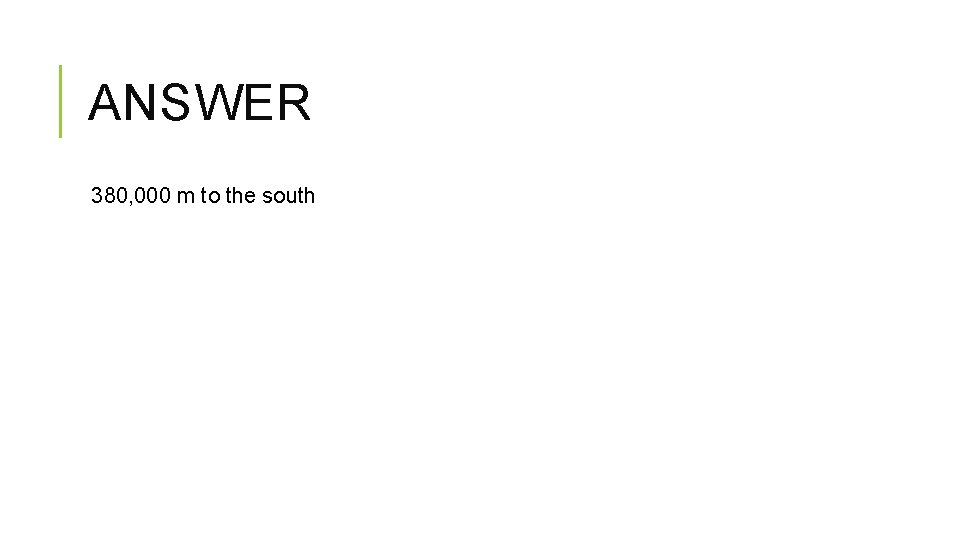
ANSWER 380, 000 m to the south
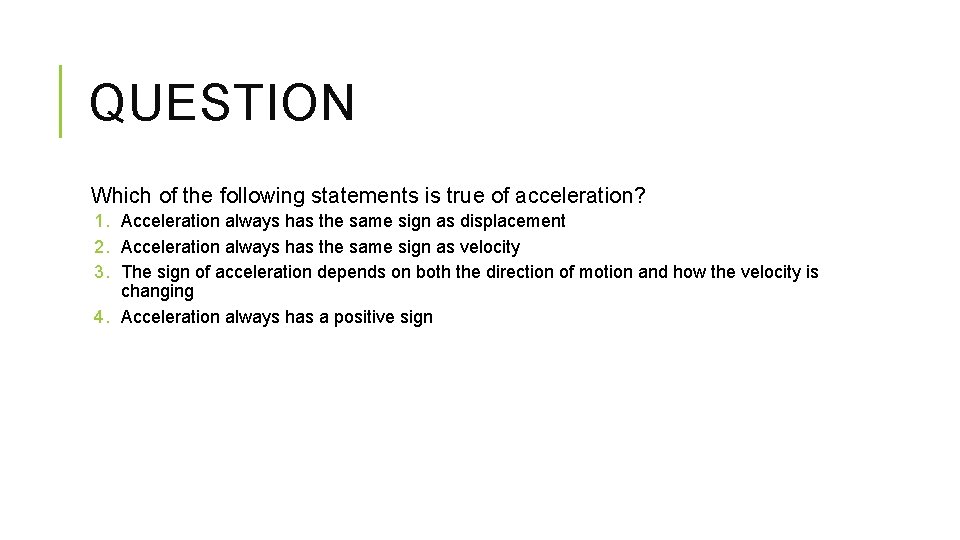
QUESTION Which of the following statements is true of acceleration? 1. Acceleration always has the same sign as displacement 2. Acceleration always has the same sign as velocity 3. The sign of acceleration depends on both the direction of motion and how the velocity is changing 4. Acceleration always has a positive sign
ANSWER 3
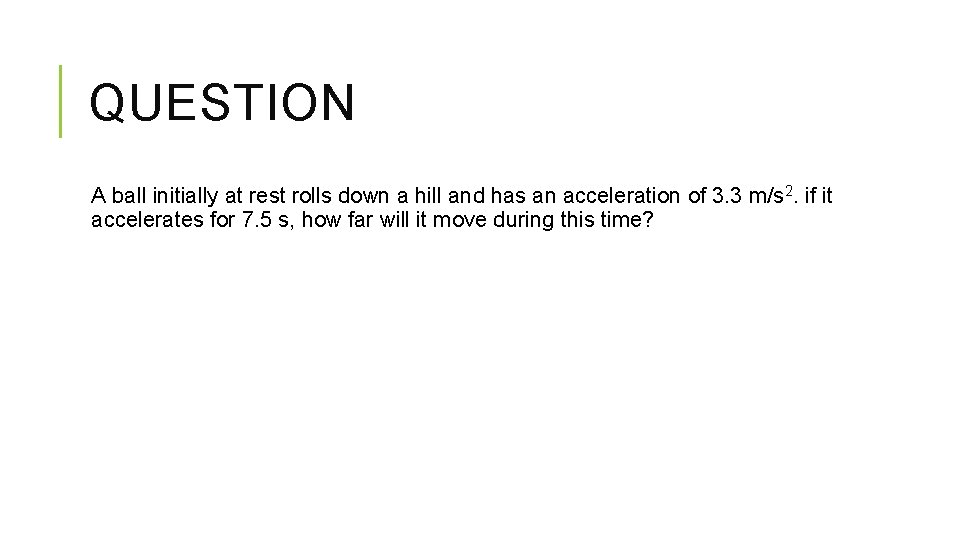
QUESTION A ball initially at rest rolls down a hill and has an acceleration of 3. 3 m/s 2. if it accelerates for 7. 5 s, how far will it move during this time?
ANSWER 93 m
QUESTION Which of the following statements is true for a ball thrown vertically upward? 1. The ball has a negative acceleration on the way up and a positive acceleration on the way down. 2. The ball has a positive acceleration on the way up and a negative acceleration on the way down 3. The ball has zero acceleration on the way up and a positive acceleration on the way down. 4. The ball has a constant acceleration throughout its flight.
ANSWER 4
QUESTION A snowmobile travels in a straight line. The snowmobile’s initial velocity is +3 m/s. If the snowmobile accelerates at a rate of +0. 50 m/s 2 for 7. 0 s, what is its final velocity?
ANSWER +6. 5 m/s
QUESTION A snowmobile travels in a straight line. The snowmobile’s initial velocity is +3. 0 m/s. If the snowmobile accelerates at a rate of -0. 60 m/s 2 from its initial velocity of +3. 0 m/s, how long will it take to reach a complete stop?
ANSWER 5. 0 s
QUESTION A car travels 5 m east, stops, turns around and travels 5 m west. What is the car’s displacement?
ANSWER 0 m