
Monday 1 February 2016 Today we will be
Monday, 1 February 2016 Today we will be focusing on rolling along with our Quarter 3 AR Reading Goal! Believe it or not, we are almost HALF WAY to the end of 3 rd nine weeks, so you should be about half way to your AR goal!!! Assemble all reading supplies before the bell. You should have your AR book, your updated reading log, your AR reminder bookmark, and something to write with. Get started by filling in today’s reading log entry. Begin reading right away to maximize your time. Sit where you like but MAKE WISE CHOICES Tomorrow is a library day, so be sure to bring your AR materials again to class tomorrow!
Today’s Work 1. AR Reading and Quizzing Time AND Individual TIB or Reading Conferences as needed 2. Analytical Writing Review using YOUR book • Topic Sentence • Incorporated Quote with Citation • 3 Supporting detailed sentences • Conclusion Choose from the following topic sentences that best connects with where you are in your reading. *Theme: The story is about _____ and reveals theme _________. *Conflict: The author uses internal OR external conflict to show ____. *Characterization: The author uses direct OR indirect characterization to develop the character of ____. *Figurative Language or Imagery: The author uses figurative language OR imagery to ____. Be sure to catch up on AR! Are you half-way there?
Tuesday, 2 February 2016 Welcome! We will be pushing into our next unit which will focus on reviewing important reading and writing strategies as well as some test taking skills. Pick up this unit’s packet by the door, and begin by answering only questions 1 & 2 on the bell work pages. Note changes on the board. Once you have the answer written in your packet, take out a strip of paper from your table and write just your answers on it with your name. We will use these in a Friday drawing. Ex. My card would look like this: 1. C 2. A Lundon Soper
Should all U. S. students be required to speak at least one language besides English? Today is all about getting informed and developing your own point of view! “Why Learn Another Language? ” (Roberts 4 -6) “Why Waste Time on a Foreign Language? ” (Matthews 6 -7) 1. READ and ANNOTATE both articles! Take notes in the margins (questions, comments, opinions, connections, etc. ), and underline information you find useful, particularly convincing evidence. 2. As you read, answer the CLOSE READ question imbedded in article 1 in complete sentences. Remember, “textual evidence” means a quote directly from the text with a citation!!! 3. Answer DISCUSS AND DECIDE on p. 7 in a complete paragraph in the blank space provided. • Think analytically. Take a stand, incorporate and cite evidence that helps to prove your point, and explain! • Decide on a position you would like to take on this question – yes or no. • Include THREE pieces of evidence from any of the texts to support your position. • Don’t forget to cite and explain HOW your evidence proves your point! As soon as you finish these tasks, read and quiz for AR!!! If you need a library visit today, you may go after today’s work is complete.
Wednesday, 3 February 2016 Welcome! Yesterday we began organizing our ideas to use for a persuasive writing or argument. Today, we will discuss our ideas and analyze another student’s work to see how effectively she delivers her argument First, let’s use our good testing strategies! Take out this unit’s working guide, and begin by answering only questions 3 -5 on the bell work pages. Once you have the answer written in your packet, take out a strip of paper from your table and write just the correct answers with your name Ex. My card would look like this 3. C 4. A 5. D Lundon Soper
Should all U. S. students be required to speak at least one language besides English? With your groups, discuss the decisions you developed yesterday in your class work: Looking Back: Discuss and Decide You have now read two sources about the importance of learning another language in school. Should students be required to learn a language besides English? As you discuss, cite evidence from the sources to explain your points. Share Out Which opinion do you take: Should all students be required to speak at least one language besides English? WHY? Use evidence!
Should all U. S. students be required to speak at least one language besides English? Next, Read/Analyze Adeline’s argumentative essay. The side notes are the comments that her teacher, Mr. Columbo, wrote. Did Adeline convince you that students should not be required to speak a second language? Underline/highlight the most compelling OR important evidence in her essay. Get ready to share this evidence! Terminology of Argumentative Texts With your partner deconstruct what makes a GOOD persuasive argument: Read each term and explanation. Then look back at Adeline Jones’ argumentative essay and find specific examples in the text to complete the chart on p. 10.
Thursday, 4 February 2016 Prepare for Acuity. Remember to do your very own PERSONAL best, never give up, and keep thinking. Log into Acuity. Wait patiently before doing ANYTHING else, we will start together. We will be taking the MATH test today. 1. It is a 65 minute test – we will all begin at the same time and I will provide check times on the board. 2. Use 75% of your time (45 minutes) and a prize awaits you! 3. Answer every question to the best of your ability, think hard but keep moving. 4. If you have time, CHECK your work. 5. Bring me your i. Pad BEFORE you finish your test, and I will finish it with you. 6. When you are finished, turn in your scrap paper and read your AR book. Good luck and good thinking! You can do this!
Thursday, 4 February 2016 Welcome! We have ideas upon ideas. We’ve looked at a student model. Now, is the time to take all of the knowledge we have gathered and work through the process of developing our own STRONG argumentative essay. First, let’s review some testing strategies. Take out this unit’s packet, and begin by answering only questions 6 -8 on the bell work pages. Once you have the answer written in your packet, take out a strip of paper from your table and write just the correct answer’s letters on it and your name. Ex. My card would look like this 6. C 7. A 8. D Lundon Soper
Should students be required to stay in school until they are 18? Partner Read and Talk to the Text p. 12 -15 • Read all four short sources related to our central question: Letter, Newspaper Article, Data Analysis, & Radio Interview. Annotate the texts, marking strong evidence for both sides. • While reading, take notes in the margins (questions, comments, opinions, connections, etc. ), and underline information you find useful. Briefly answer the “Discuss and Decide” question after the first two pieces. Answer the CLOSE READ questions on p. 15 • Answer thoroughly in complete sentences. Remember, “textual evidence” means a quote directly from the text. • Think analytically by answering questions clearly with evidence as support! Respond Thoroughly to the Chart and Questions on p. 16 • Evaluate all four sources. Are they credible, in other words, are they reliable and authoritative? Why? • Use your own paper to answer the prose constructed-response questions on p. 16. You must respond in a detailed paragraph for each using and explaining evidence from the texts. Use your analytical writing skills
Friday, 5 February 2016 Today is the day we put it ALL TOGETHER! First, let’s review some testing strategies. Take out this unit’s packet, and begin by answering only questions 9 -10 on the bell work pages. Once you have the answer written in your packet, take out a strip of paper from your table and write just the answers and your name. Ex. My card would look like: 9. C 10. A Lundon Soper
Should students be required to stay in school until they are 18? Use the organizer on page 17 to QUICKLY plan your writing! Spend no more than 10 minutes planning the basic skeleton of YOUR 5 -6 paragraph in-class essay. Keep in mind that you will have the equivalent of one class period to write, so plan accordingly. Planning and Prewriting • • • Make a Precise CLAIM or THESIS that provides a clear answer to the prompt. Briefly State Your REASONS—You may focus on 2 (for a 5 ¶ essay) or 3 (for a 6 ¶ essay) Outline the EVIDENCE you will use to support your reasons. How will you respond to the opposing claim, or COUNTERCLAIM? What do you want to make sure to include in your CONCLUSION? Just like the model, think about… Audience: Your teacher Purpose: Demonstrate your understanding of the requirements of an argument essay. Style: Use formal and objective tone that isn’t defensive. Transitions: Use words such as furthermore or another reason, to create cohesion, or flow.
Performance Time! Should students be required to stay in school until they are age 18? Now it is time to go through the process of writing an argument essay of your own! • Using your planner, write your OWN 5 -6 paragraph essay in response to the question on the lined sheets provided in your packet. • Review your annotated passages to incorporate and cite evidence as you work. • Use your time well!!! Today’s work is about both craft and speed! In addition to work time today, you may use some of your AR time on Monday to finish your writing if needed. Remember, this is like a practice test. Give it your ALL and use your time. If you finish early, use the editing checklist to proofread your work. I can’t wait to see how well you do
Monday, 8 February 2016 Today’s the day we FINISH our first practice test! Show me everything you know! Assemble all essay and reading supplies before the bell. You should have your Argument Packet, your AR book, your updated Reading Log, your AR reminder bookmark, and a writing utensil. Get started by opening up to your essay from Friday and reviewing your planning so you have a reminder of what direction you were taking for writing your essay. When your thoughts are back together, continue drafting your practice test essay. Remember, if this was test day you would have between 20 -30 more minutes of writing time, so prep yourself with this in mind.
Today’s Work 1. Finish your persuasive essay practice test to the BEST of your ability. • Using your planner, write your OWN 5 -6 paragraph essay in response to the question. • Review your annotated passages to incorporate and cite evidence as you work. • Use your time well!!! Today’s work is about both craft and speed! 2. Use the 6 Point rubric scale to access your OWN writing There is a class set of rubrics for every student at the front. Pick one up as soon as your finish your essay. Read through the criteria carefully—this is how you will be evaluated during ISTEP! • Grade yourself according to the scale • On the back of your essay, write the score you received (1 -6) and explain what you did well, what you need to improve on, and why you earned that score. • TURN IN YOUR PACKET TODAY!!! 3. AR Reading and Quizzing: Be sure to catch up on AR! Are you half-way there?
Tuesday, 9 February December 2016 Prepare for Acuity. Remember to do your very own PERSONAL best, never give up, and keep thinking. I believe in you! Log into Acuity at acuity. rbbcsc. k 12. in. us. Wait patiently before doing ANYTHING else, we will start together. We will be taking the Language Arts and Writing test today. 1. It is a 65 minute test – we will all begin at the same time and I will provide check times periodically. 2. Use 75% of your time (45 minutes) and a prize awaits you! 3. Answer every question to the best of your ability, think hard but keep moving. 4. If you have time, CHECK your work. 5. Bring me your i. Pad BEFORE you finish your test, and I will finish it with you. 6. When you are finished, read your AR book. Good luck and good thinking! You can do this!
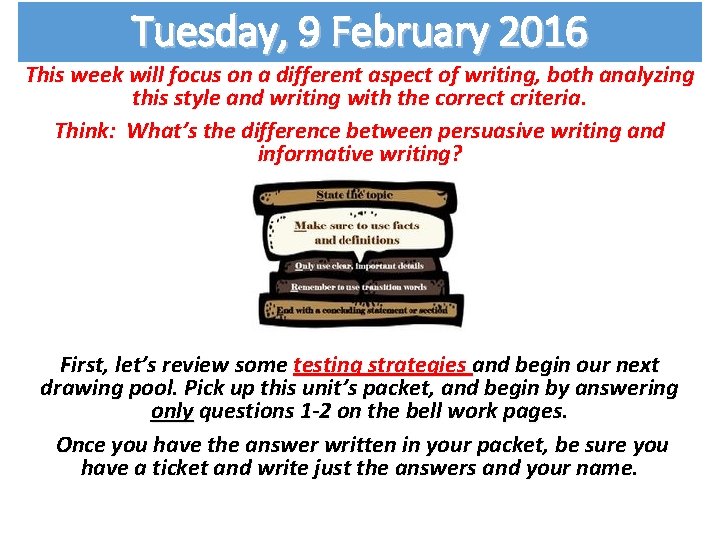
Tuesday, 9 February 2016 This week will focus on a different aspect of writing, both analyzing this style and writing with the correct criteria. Think: What’s the difference between persuasive writing and informative writing? First, let’s review some testing strategies and begin our next drawing pool. Pick up this unit’s packet, and begin by answering only questions 1 -2 on the bell work pages. Once you have the answer written in your packet, be sure you have a ticket and write just the answers and your name.
Getting a Quick Refresher p. 36 -37 Individually Read/Talk to the text: Get Organized Ms. Chen’s student’s read the following text to help them learn strategies for writing informative essays. As you read, underline information that is useful in writing your own. Answer the question when finished: Which text structure would be more helpful in discussing how a car works? Why? Causal Chain
Analyzing Student Models p. 38 -41 Next, Read/Analyze Cassandra’s informative essay. The side notes are the comments that her teacher, Ms. Chen, wrote. What type of cause-effect organization is used in this essay? Why is this an effective way to present information on erosion? Underline/highlight important evidence in her essay to show this. Get ready to share this evidence! Then, Read/Analyze Trevor’s informative essay. The side notes are the comments that her teacher, Ms. Chen, wrote. Could a cause-and-effect organization be used with this topic? If so, which model would work best? Underline/highlight important evidence in his essay to show this. Get ready to share this evidence!
What makes an effective informative essay? An effective Informative Essay must include: 1. 2. 3. 4. A clear topic introducing what the essay is about. Text structure to organize the pattern of the essay. A main idea to control the idea of the overall essay. Supporting evidence, evidence which is relevant quotes and concrete facts, taken from sources to support the main idea. 5. Domain-specific vocabulary which are only related to the topic of interest and are not generally used in conversation. 6. Text features to help organize the text (headings, bolding, lists, timelines, tables, etc. ) _____________________________________ Reflection p. 42 Knowing these key factors of informative writing and after looking at each student model closely, decide which model was more successful in creating the more effective informative essay. Create a claim and cite textual evidence for support. (Think analytically! )
Wednesday, 10 February 2016 Welcome! Yesterday we began analyzing different techniques of informative writing and decided “Who did it better? ” Today, we will discuss our ideas and begin to work toward our OWN informative essay. First, let’s review some testing strategies. Get out this unit’s packet, and begin by answering only questions 3 -4 on the bell work pages. USE YOUR STRATEGIES! Annotate—“Boom”—Eliminate!!! Once you have the answer written in your packet, be sure you have a ticket and write just the answers and your name.
Research: What are the effects of an earthquake? Partner Read and Talk to the Text from pgs. 44 -48 • Read all four sources (brochure, blog, news report, and an insurance claim) while you annotate the texts, marking strong details for the question at hand. What are the effects of an earthquake? • While reading, take notes in the margins (questions, comments, opinions, connections, etc. ), and underline information you find useful. Briefly answer the “Close Read” & “Discuss and Decide” questions in the margin and by highlighting your textual evidence. Answer the MULTIPLE CHOICE questions on pgs. 49 -50 • Use your notes and refer to the sources to help you answer each question. Thoroughly Answer the Constructed-Response Questions • Use additional paper, if needed, to answer the prose constructed-response questions on p. 51. You must respond in a detailed paragraph for each using and explaining evidence from the texts. • Use your analytical writing skills Anything unfinished in class is homework!!! STOP after finishing page 51.
Thursday, 11 February 2016 Prepare for Acuity. Remember to do your very own PERSONAL best, never give up, and keep thinking. I know you can do this. I believe in you. Log into Acuity at acuity. rbbcsc. k 12. in. us. Wait patiently before doing ANYTHING else, we will start together. We will be taking the READING test today. 1. It is a 65 minute test – we will all begin at the same time and I will provide check times periodically. 2. Use 75% of your time (45 minutes) and a prize awaits you! 3. Answer every question to the best of your ability, think hard but keep moving. 4. If you have time, CHECK your work. 5. Raise your hand or bring me your i. Pad BEFORE your finish test and I will finish it with you. 6. When you are finished, read your AR book or work on other academic tasks. Good luck and good thinking! You can do this!
Thursday, 11 February 2016 Today is the day we put it ALL TOGETHER! Today is the start to your informative practice writing test. Pick up a ticket and find your seat number. First, let’s review some testing strategies. Take out this unit’s packet, and begin by answering only questions 5 -6 on the bell work pages. USE YOUR STRATEGIES! Read—Annotate—“Boom!”—Eliminate!!! Once you have the answer written in your packet, write just the answers and your name on your ticket.
Write a cause-and-effect essay that answers the question: What are the effects of an earthquake? Use the organizer on page 52 to QUICKLY plan your writing! Spend no more than 10 minutes planning the basic skeleton of YOUR 5 paragraph in-class essay. Keep in mind that you will have the equivalent of one class period to write, so plan accordingly. Planning and Prewriting Based on details and evidence presented in the sources, what are the effects of earthquakes? • Brainstorm—What might you include in your introduction? Hook? Main idea? Background Information? • Focus on a CAUSE -- Earthquakes • Briefly State the EFFECTS of this cause. Focus on 3 important and specific details (for a 5 ¶ essay) For example, effects of earthquakes on the earth, effects earthquakes on the economy, etc. • Outline the EVIDENCE you will use to support your effects. • What do you want to make sure to include in your CONCLUSION? Just like the model, think about… Audience: Your teacher Purpose: Demonstrate your understanding of the specific requirements of an informative essay. Style: Use a formal and objective tone—be academic! Transitions: Use words and phrases such as “because” and “so” to create cohesion, or flow.
Performance Time! What are the effects of an earthquake? Now it is time to go through the process of writing an informative essay of your own! • Using your planner, write your OWN 5 paragraph essay in response to the question. • Review your annotated passages to incorporate and cite evidence as you work. • Use your time well!!! Today’s work is about both craft and speed! In addition to work time today, you will have additional time tomorrow. Remember, this is like a practice test. Give it your ALL and use your time. If you finish early, use the editing checklist to proofread your work. I can’t wait to see how well you do
Friday, 12 February 2016 Today is the day we continue to put it ALL TOGETHER! Pick up a ticket and find your seat number. First, let’s review some testing strategies. Take out this unit’s packet, and begin by answering only questions 7 -8 on the bell work pages. USE YOUR STRATEGIES! Read—Annotate—“Boom”—Eliminate!!! Once you have the answer written in your packet, take out a strip of paper and write just the answers and your name.
Performance Time! What are the effects of an earthquake? Now it is time to go through the process of writing an informative essay of your own! • Using your planner, write your OWN 5 paragraph essay in response to the question. • Review your annotated passages to incorporate and cite evidence as you work. • Consider your audience and your purpose as you write. • Use your time well!!! Today’s work is about both craft and speed! When you are finished writing: Use the 6 Point rubric scale on the front table to evaluate and reflect on your OWN work, then turn in your packet. • Read through the criteria carefully • Grade yourself according to the scale • On the back of your essay, write the score you received (1 -6) and explain what you did well, what you need to improve on. • Turn in your packet Use any remaining time for AR reading and quizzing! Be sure to bring AR supplies on Monday for your FULL reading day!
Tuesday, 16 February 2016 Today we will be focusing on continuing our Quarter 3 AR Reading Goal and visiting the library as needed! Are you at least half-way to your goal? Assemble all reading supplies before the bell. You should have your AR book, your updated reading log, your AR reminder bookmark, and something to write with. Get started by filling in today’s reading log entry. Begin reading right away to maximize your time. Sit where you like but MAKE WISE CHOICES
Wednesday, 17 February 2016 After doing an awesome job of working through longer writings for the last few weeks, today we will focus on working together to refine our SHORT reading and writing skills! Get ready to do some small readings, quick discussions, and even quicker writings Using today’s handout, read the “Warm-Up Thinking” question and make a quick list of your ideas. What strategies can we use when we are asked to read a short passage and answer questions that follow? This is BRAINSTORMING, so quickly jot down everything you can think of that might be helpful!
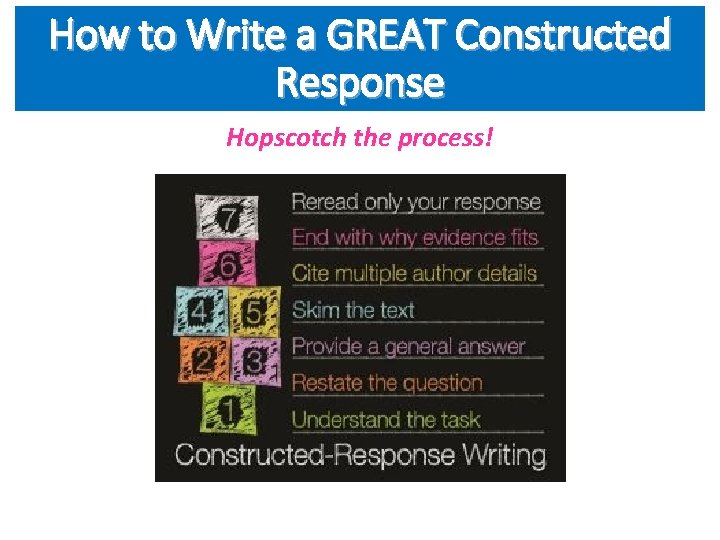
How to Write a GREAT Constructed Response Hopscotch the process!
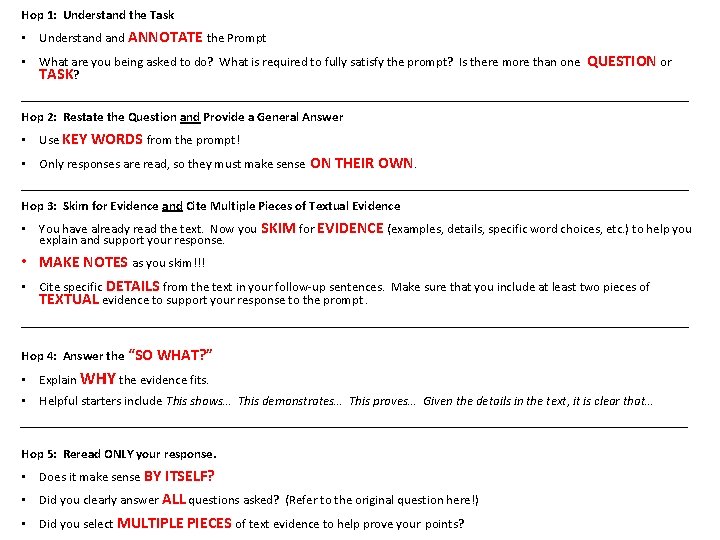
Hop 1: Understand the Task • Understand ANNOTATE the Prompt • What are you being asked to do? What is required to fully satisfy the prompt? Is there more than one QUESTION or TASK? ____________________________________________________ Hop 2: Restate the Question and Provide a General Answer • Use KEY WORDS from the prompt! • Only responses are read, so they must make sense ON THEIR OWN. ____________________________________________________ Hop 3: Skim for Evidence and Cite Multiple Pieces of Textual Evidence • You have already read the text. Now you SKIM for EVIDENCE (examples, details, specific word choices, etc. ) to help you explain and support your response. • MAKE NOTES as you skim!!! • Cite specific DETAILS from the text in your follow-up sentences. TEXTUAL evidence to support your response to the prompt. Make sure that you include at least two pieces of ____________________________________________________ Hop 4: Answer the “SO WHAT? ” • Explain WHY the evidence fits. • Helpful starters include This shows… This demonstrates… This proves… Given the details in the text, it is clear that… ____________________________________________________ Hop 5: Reread ONLY your response. • Does it make sense BY ITSELF? • Did you clearly answer ALL questions asked? (Refer to the original question here!) • Did you select MULTIPLE PIECES of text evidence to help prove your points?
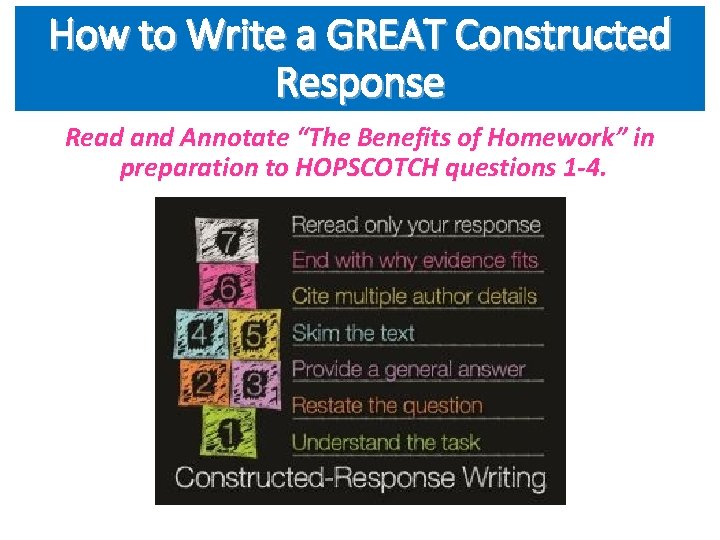
How to Write a GREAT Constructed Response Read and Annotate “The Benefits of Homework” in preparation to HOPSCOTCH questions 1 -4.
Exemplar Response to #1 Use key words from the prompt and provide a general answer. In the article “The Benefits of Homework, ” the author claims that homework can have a positive impact if it “supports a student’s learning” and can be accomplished in a reasonable amount of time (2). Cite multiple pieces of text evidence to support your answer. The author uses findings from a study conducted by the University of Missouri. Columbia, recommendations from “leading education groups, ” and common sense arguments about the value of practice, repetition, and life skills gained through homework to support his or her central idea (3 -9). So what? Why does the evidence fit? What does it show? The evidence used to support the claim demonstrates the academic benefits of homework while addressing common homework concerns like the appropriate amount of homework for all ages and the impact of homework on family life. What does the writer do well? What works?
Exemplar Response to #2 -3 • • • Use key words from the prompt and answer the general question. Provide multiple pieces of textual evidence to support your answer. Answer the “So what? ” Why does the evidence fit? What does it show? Choice A provides the best support for the author’s claim in “The Benefits of Homework. ” The author claims that homework is only beneficial if it “does not take too much time to complete” (2). Given the author’s claim, readers would certainly question what constitutes a reasonable amount of homework for students at various grade-levels. Choice A answers this question by providing the common recommendation of “leading education groups” (4). The evidence is authoritative, closely tied to the claim, and goes beyond simple personal opinions or feelings about homework, which are less convincing than the recommendations of experts. What does the writer do well? What works?
Exit Slip • Quickly Reflect on the Exit Slip Provided—be honest • Drop it in the box when you return your packet to your class folder.
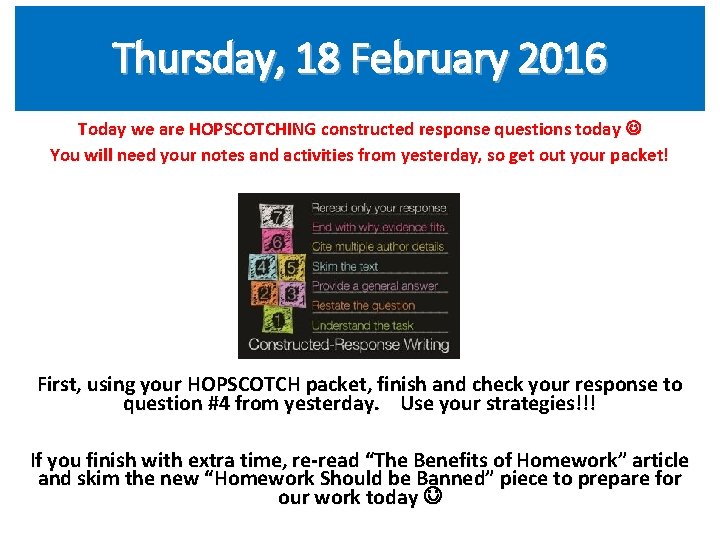
Thursday, 18 February 2016 Today we are HOPSCOTCHING constructed response questions today You will need your notes and activities from yesterday, so get out your packet! First, using your HOPSCOTCH packet, finish and check your response to question #4 from yesterday. Use your strategies!!! If you finish with extra time, re-read “The Benefits of Homework” article and skim the new “Homework Should be Banned” piece to prepare for our work today
Exemplar Response to #4 • Use key words from the prompt and answer the general question. • Provide multiple pieces of textual evidence to support your answer. • Answer the “So what? ” Why does the evidence fit? What does it show? In the text “The Benefits of Homework, ” the author presents a strong, cohesive, and authoritative argument. The author’s claim appears early in the piece, and the structure (through the use of text features like headings) is clear and organized (2). Most importantly, the author uses a variety of evidence from university studies, education experts, and parent/student surveys to support the claim (3 -9). The evidence covers the ways in which homework supports learning and achievement, the benefits it shows beyond the classroom, and respectfully addresses the common counterarguments in the homework debate. Fist to Five?
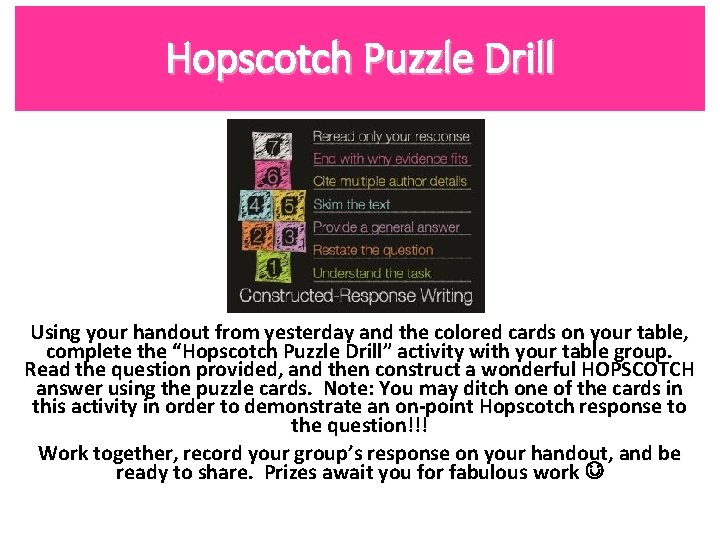
Hopscotch Puzzle Drill Using your handout from yesterday and the colored cards on your table, complete the “Hopscotch Puzzle Drill” activity with your table group. Read the question provided, and then construct a wonderful HOPSCOTCH answer using the puzzle cards. Note: You may ditch one of the cards in this activity in order to demonstrate an on-point Hopscotch response to the question!!! Work together, record your group’s response on your handout, and be ready to share. Prizes await you for fabulous work
Independent Practice • Treat this like a mini practice test of your growing constructed response skills. Follow the instructions in your packet to answer questions 5, 6, and 7. • Work INDEPENDENTLY and use your time well. Remember to advocate for yourself and ask questions if you get stuck. I can’t answer questions during ISTEP, but I can absolutely answer them now if you are feeling unsure. Today is all about PRACTICE and GROWTH!!! • Remember to use your good reading strategies and follow all of our HOPSCOTCH steps as you work Homework: Finish HOPSCOTCH questions as needed. You should come in tomorrow with answers prepared for 5, 6, and 7!
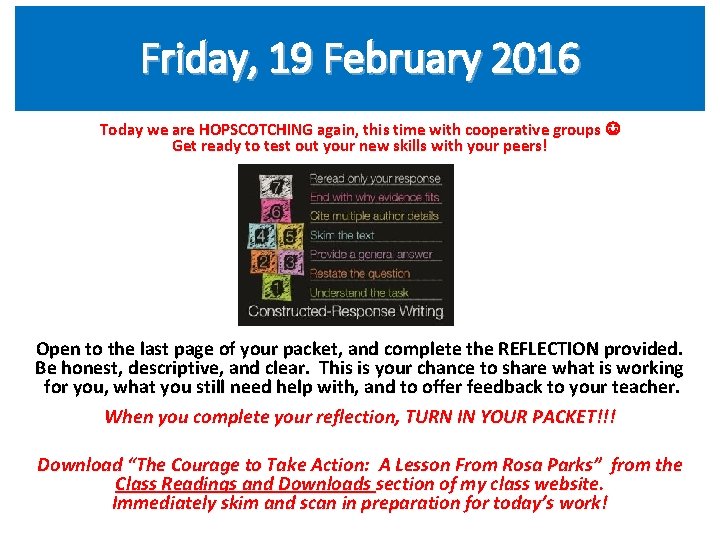
Friday, 19 February 2016 Today we are HOPSCOTCHING again, this time with cooperative groups Get ready to test out your new skills with your peers! Open to the last page of your packet, and complete the REFLECTION provided. Be honest, descriptive, and clear. This is your chance to share what is working for you, what you still need help with, and to offer feedback to your teacher. When you complete your reflection, TURN IN YOUR PACKET!!! Download “The Courage to Take Action: A Lesson From Rosa Parks” from the Class Readings and Downloads section of my class website. Immediately skim and scan in preparation for today’s work!
Read and Annotate Read annotate the new piece, “The Courage to Take Action: A Lesson From Rosa Parks. ” Use your strong reading strategies as we read. Questions: “The Courage to Take Action: A Lesson From Rosa Parks” 1. 2. 3. 4. 5. A. What is the author’s purpose in writing this speech? Explain your answer using details from the text. According to President Obama, what were the long-term effects of the Montgomery bus boycott? Use details from the text to support your answer. The THEME or CENTRAL IDEA of the speech can best be stated as… A. B. C. D. One small act can have large and far-reaching effects. Rosa Parks’ stubborn and persistent nature should be admired. Rosa Parks’ quiet leadership stretched far beyond her famous bus arrest. The best way to honor someone’s memory is to carry on their legacy. Explain your choice of theme. Support your answer using details from the text. In paragraphs 9 -11, the speech goes far beyond simply honoring the memory of Rosa Parks. It suggests that people today can learn a key lesson from her example. What is this lesson? Explain your answer using details from the text. Is it reasonable, based on this speech, to conclude that Rosa Parks was passionate about equality and freedom? Explain your answer using details from the text. How did Rosa Parks become an icon of the civil rights movement? Explain your answer using details from the text.
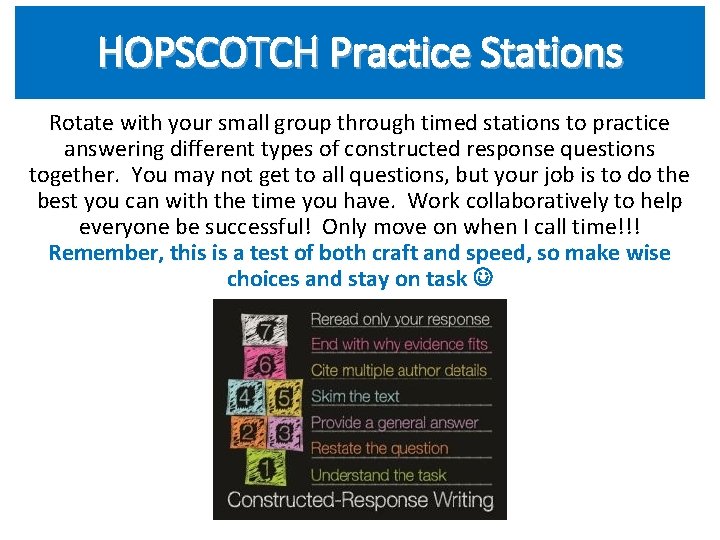
HOPSCOTCH Practice Stations Rotate with your small group through timed stations to practice answering different types of constructed response questions together. You may not get to all questions, but your job is to do the best you can with the time you have. Work collaboratively to help everyone be successful! Only move on when I call time!!! Remember, this is a test of both craft and speed, so make wise choices and stay on task
Evaluate YOUR Progress On short constructed responses, you are graded using a 2 -1 -0 scale. A rating of 2 is the highest possible score, while a rating of 0 is the lowest possible score. Our goal is to ALWAYS exceed expectations and get a 2, and HOPSCOTCHING our responses can help us do that! 2 points: The response fulfills all the requirements of the task. The information given is text-based and relevant to the task. 1 point: The response fulfills some of the requirements of the task, but some of the information may be too general, too simplistic, or not supported by the text. 0 point: The response does not fulfill the requirements of the task because it contains information that is inaccurate, incomplete, and/or missing altogether. Reflect on your progress so far. On the corner of your handout, give yourself a rating: 2, 1, or 0 based on where you feel your responses currently fall. Briefly note where you still would like to improve.
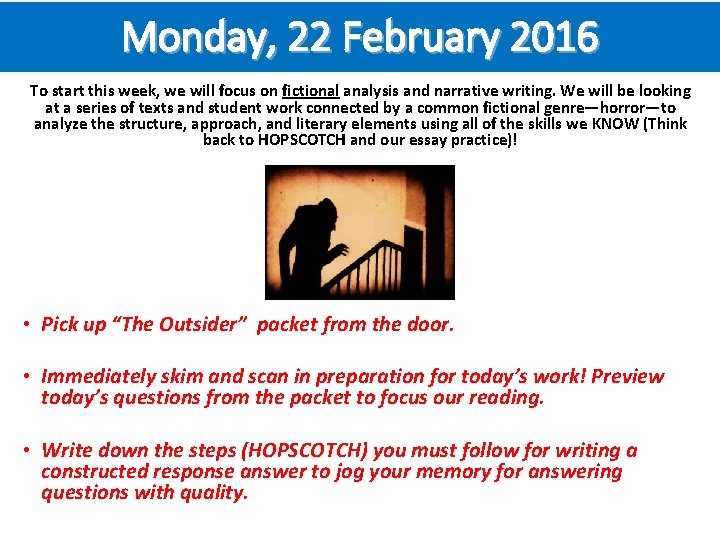
Monday, 22 February 2016 To start this week, we will focus on fictional analysis and narrative writing. We will be looking at a series of texts and student work connected by a common fictional genre—horror—to analyze the structure, approach, and literary elements using all of the skills we KNOW (Think back to HOPSCOTCH and our essay practice)! • Pick up “The Outsider” packet from the door. • Immediately skim and scan in preparation for today’s work! Preview today’s questions from the packet to focus our reading. • Write down the steps (HOPSCOTCH) you must follow for writing a constructed response answer to jog your memory for answering questions with quality.
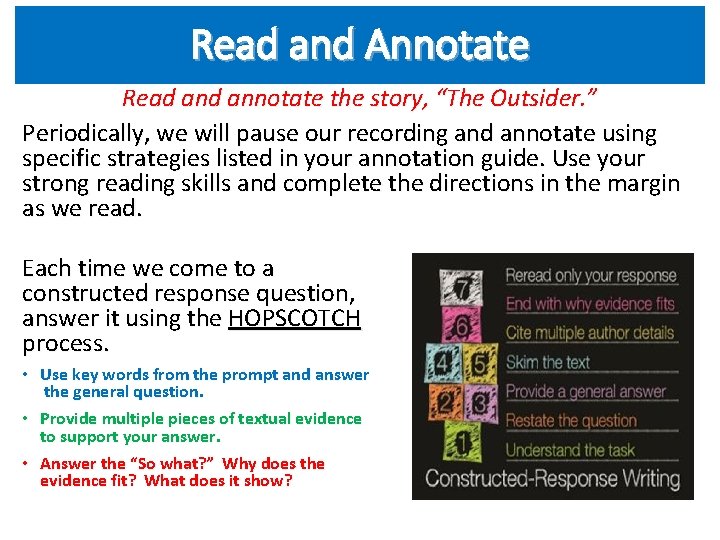
Read and Annotate Read annotate the story, “The Outsider. ” Periodically, we will pause our recording and annotate using specific strategies listed in your annotation guide. Use your strong reading skills and complete the directions in the margin as we read. Each time we come to a constructed response question, answer it using the HOPSCOTCH process. • Use key words from the prompt and answer the general question. • Provide multiple pieces of textual evidence to support your answer. • Answer the “So what? ” Why does the evidence fit? What does it show?
Exemplar Response • Use key words from the prompt and answer the general question. • Provide multiple pieces of textual evidence to support your answer. • Answer the “So what? ” Why does the evidence fit? What does it show? The narrator’s statement about his background and description of his surroundings create suspense through detailed imagery that helps the reader visualize a dark and haunting structure. The narrator describes, using vivid description, an old castle-like building “full of dark passages” and ceilings covered in “cobwebs and shadows” (11 -12). He also creates a haunting and thrilling backdrop to the story when he explains that there is an “accursed smell everywhere, as of the piled-up corpses of dead generations” (14 -15). These vivid phrases use dark description to create an eerie, haunting, and disturbing setting which provides a suspenseful mood for the overall story line. Fist to Five?
Homework Finish reading and annotating “The Outsider” by H. P. Lovecraft. Answer our TWO remaining constructed response questions in the packet following our HOPSCOTCH strategies!!! This is your chance to show off your skills 1. Answer the question using key words from the prompt. 2. Cite multiple pieces of evidence. 3. Explain WHY the evidence fits and/or how it proves your point.
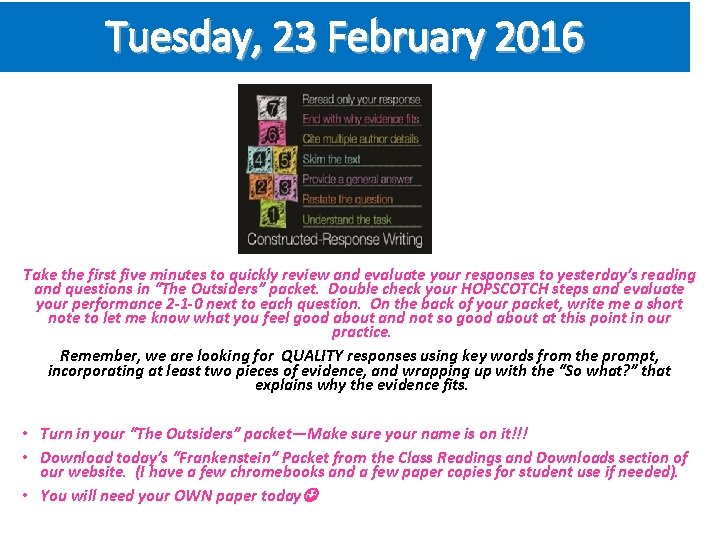
Tuesday, 23 February 2016 Take the first five minutes to quickly review and evaluate your responses to yesterday’s reading and questions in “The Outsiders” packet. Double check your HOPSCOTCH steps and evaluate your performance 2 -1 -0 next to each question. On the back of your packet, write me a short note to let me know what you feel good about and not so good about at this point in our practice. Remember, we are looking for QUALITY responses using key words from the prompt, incorporating at least two pieces of evidence, and wrapping up with the “So what? ” that explains why the evidence fits. • Turn in your “The Outsiders” packet—Make sure your name is on it!!! • Download today’s “Frankenstein” Packet from the Class Readings and Downloads section of our website. (I have a few chromebooks and a few paper copies for student use if needed). • You will need your OWN paper today
Today you will be partner reading and annotating two short pieces: “Frankenstein, ” a poem inspired by literature AND “Man-Made Monster, ” an essay about how our views of Frankenstein’s monster have changed. Use the annotation guides with the readings to help you identify helpful evidence while you digest each piece. Each time you come to a constructed response question, pause and answer it using the HOPSCOTCH process ON YOUR OWN PAPER. I will only collect your answer sheet for a grade. • Use key words from the prompt and answer the general question. • Provide multiple pieces of textual evidence to support your answer. • Answer the “So what? ” Why does the evidence fit? What does it show? Homework: Finish all 5 questions on your own paper for tomorrow!
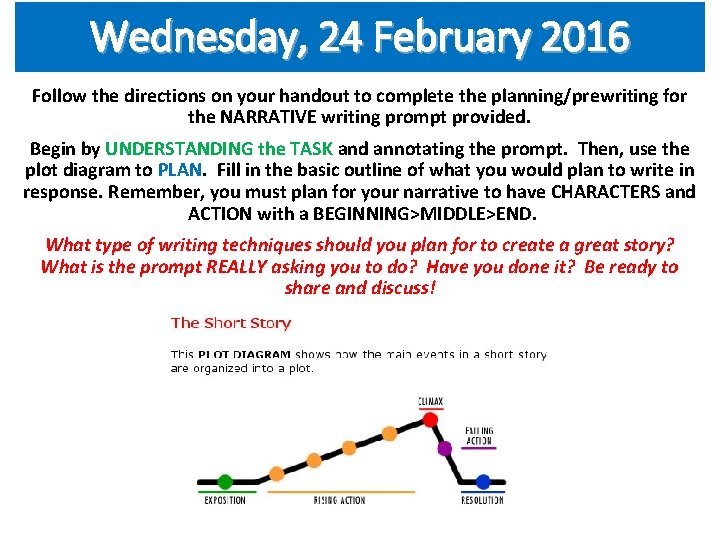
Wednesday, 24 February 2016 Follow the directions on your handout to complete the planning/prewriting for the NARRATIVE writing prompt provided. Begin by UNDERSTANDING the TASK and annotating the prompt. Then, use the plot diagram to PLAN. Fill in the basic outline of what you would plan to write in response. Remember, you must plan for your narrative to have CHARACTERS and ACTION with a BEGINNING>MIDDLE>END. What type of writing techniques should you plan for to create a great story? What is the prompt REALLY asking you to do? Have you done it? Be ready to share and discuss!
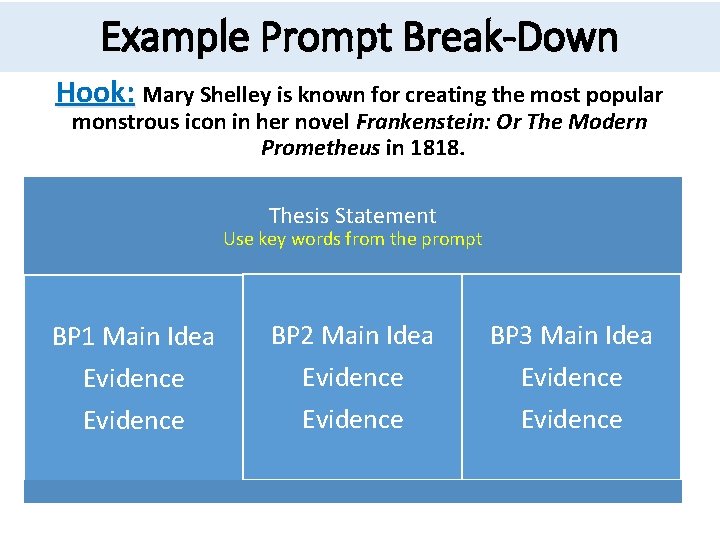
Example Prompt Break-Down Hook: Mary Shelley is known for creating the most popular monstrous icon in her novel Frankenstein: Or The Modern Prometheus in 1818. Thesis Statement Use key words from the prompt BP 1 Main Idea BP 2 Main Idea BP 3 Main Idea Evidence Evidence
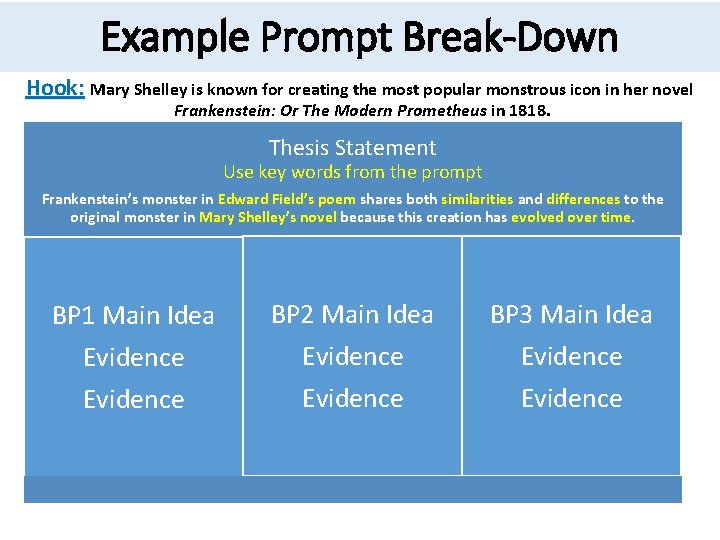
Example Prompt Break-Down Hook: Mary Shelley is known for creating the most popular monstrous icon in her novel Frankenstein: Or The Modern Prometheus in 1818. Thesis Statement Use key words from the prompt Frankenstein’s monster in Edward Field’s poem shares both similarities and differences to the original monster in Mary Shelley’s novel because this creation has evolved over time. BP 1 Main Idea Evidence BP 2 Main Idea Evidence BP 3 Main Idea Evidence
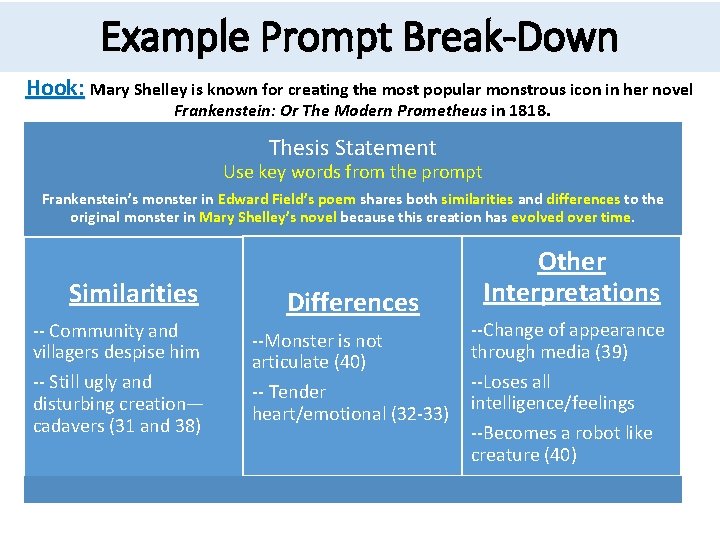
Example Prompt Break-Down Hook: Mary Shelley is known for creating the most popular monstrous icon in her novel Frankenstein: Or The Modern Prometheus in 1818. Thesis Statement Use key words from the prompt Frankenstein’s monster in Edward Field’s poem shares both similarities and differences to the original monster in Mary Shelley’s novel because this creation has evolved over time. Similarities -- Community and villagers despise him -- Still ugly and disturbing creation— cadavers (31 and 38) Differences --Monster is not articulate (40) -- Tender heart/emotional (32 -33) Other Interpretations --Change of appearance through media (39) --Loses all intelligence/feelings --Becomes a robot like creature (40)
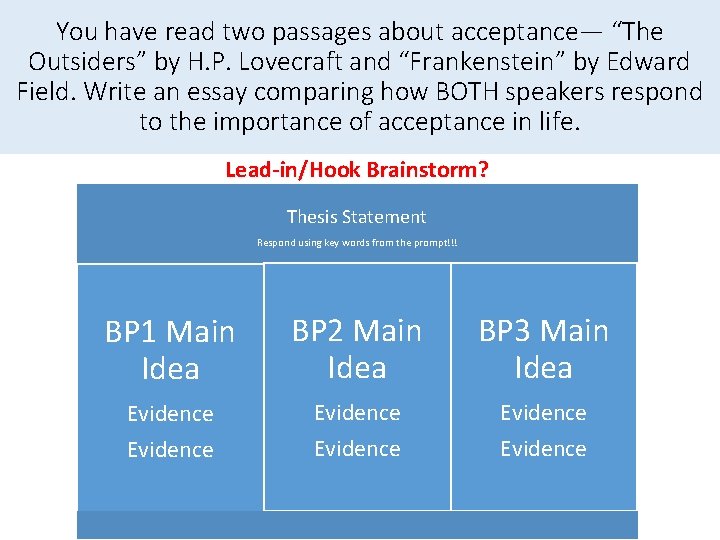
You have read two passages about acceptance— “The Outsiders” by H. P. Lovecraft and “Frankenstein” by Edward Field. Write an essay comparing how BOTH speakers respond to the importance of acceptance in life. Lead-in/Hook Brainstorm? Thesis Statement Respond using key words from the prompt!!! BP 1 Main Idea BP 2 Main Idea BP 3 Main Idea Evidence Evidence
Thursday, 25 February 2016 You have all the skills and knowledge ALREADY in your brains to be successful!!! You need to dig into your toolbox and apply the strategies we have been practicing so hard. It’s been a lot of work getting to this point, but you are SO capable Let’s begin today with recapping and brainstorming everything we need to remember to make sure we are ready for our English ISTEP tests next week. Brainstorm on your own paper: What MUST we remember for ISTEP days? Ideas might include procedures, supplies, things NOT to bring or do, content, reminders from practice, etc.
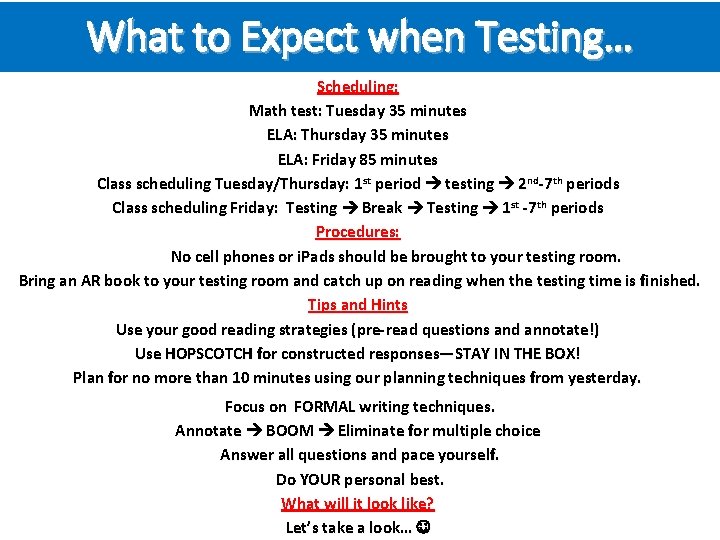
What to Expect when Testing… Scheduling: Math test: Tuesday 35 minutes ELA: Thursday 35 minutes ELA: Friday 85 minutes Class scheduling Tuesday/Thursday: 1 st period testing 2 nd-7 th periods Class scheduling Friday: Testing Break Testing 1 st -7 th periods Procedures: No cell phones or i. Pads should be brought to your testing room. Bring an AR book to your testing room and catch up on reading when the testing time is finished. Tips and Hints Use your good reading strategies (pre-read questions and annotate!) Use HOPSCOTCH for constructed responses—STAY IN THE BOX! Plan for no more than 10 minutes using our planning techniques from yesterday. Focus on FORMAL writing techniques. Annotate BOOM Eliminate for multiple choice Answer all questions and pace yourself. Do YOUR personal best. What will it look like? Let’s take a look…
Practice Test Take your time to read through the following passages and answer the 4 questions with it. Be sure to… Use your good reading strategies!!! Annotate the text AND the questions. Use HOPSCOTCH for constructed responses and STAY IN THE BOX! Annotate BOOM Eliminate for multiple choice. Answer all questions and pace yourself. Do YOUR best work. Check your work with extra time! TREAT this like the real thing. Apply all of the strategies we have practiced and do your best. When finished – read your AR book.
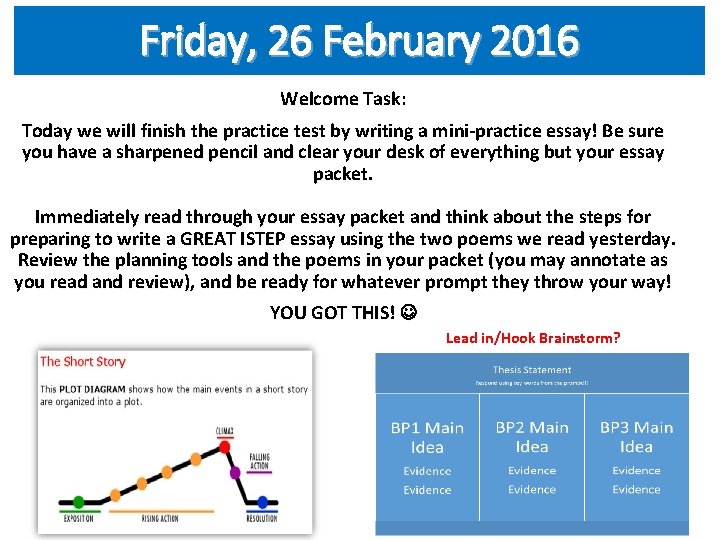
Friday, 26 February 2016 Welcome Task: Today we will finish the practice test by writing a mini-practice essay! Be sure you have a sharpened pencil and clear your desk of everything but your essay packet. Immediately read through your essay packet and think about the steps for preparing to write a GREAT ISTEP essay using the two poems we read yesterday. Review the planning tools and the poems in your packet (you may annotate as you read and review), and be ready for whatever prompt they throw your way! YOU GOT THIS! Lead in/Hook Brainstorm?
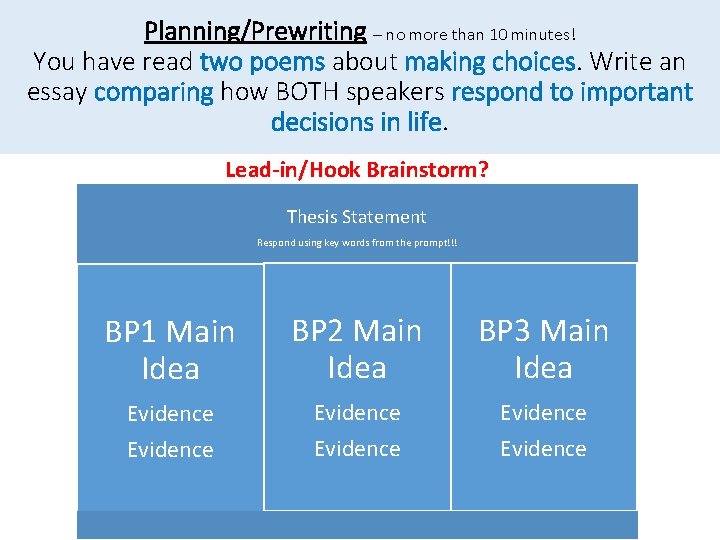
Planning/Prewriting – no more than 10 minutes! You have read two poems about making choices Write an essay comparing how BOTH speakers respond to important decisions in life Lead-in/Hook Brainstorm? Thesis Statement Respond using key words from the prompt!!! BP 1 Main Idea BP 2 Main Idea BP 3 Main Idea Evidence Evidence
Performance Time! You have read two poems about making choices. Write an essay comparing how BOTH speakers respond to important decisions in life. Now it is time to go through the process of writing your essay! You won’t have time to write the entire essay, but you should begin just to give yourself a feel for the process of timed-test writing. Remember, writing practice is like English class conditioning, and getting started is the toughest part! • Using your planner, write your OWN 5 paragraph essay in response to the question. • Review your annotated passages to incorporate and cite evidence as you work. • Consider your audience and your purpose as you write. • Use your time well!!! Today’s work is about both craft and speed! In the final 5: Use the 6 Point rubric scale on the front table to evaluate and reflect on your OWN work so far, then turn in your packet. • Read through the criteria carefully and grade yourself according to the scale • On the back of your essay, write the score you received (1 -6) based on what you have written so far, and explain what you did well as what you need to improve on. • Be sure to turn in your work so far.
Friday, 26 February 2016 Pick up your work by the door, and check your practice test QUICKLY 1. The author supports the claim that the Great Wall symbolizes the Chinese people and culture through examples of team work and strong will. For example, people from across China worked together to build one wall to protect themselves from a common enemy (1). Also, it was built to connect several smaller walls, so it has become a symbol of unity and will power in the face of hardship (4). Notice: I answered the question in my own words. Then, I provided two pieces of RELEVANT evidence from the text--I paraphrased and cited each. I ran out of room for my full “So what, ” so I wrote carefully and wrapped up concisely. I used ALL MY SPACE in my response and stayed inside the text box (why use three lines when you have 6? )! I DID NOT plop quotes by themselves or copy the text without quotation marks. 1. D-- really emphasizes the topic of CHOICES explored in the poem. 2. B-- shows that success in life is about the CHOICES one makes, which supports the overall message of the poem. 3. A-- A is the only choice that entirely fits BOTH poems.
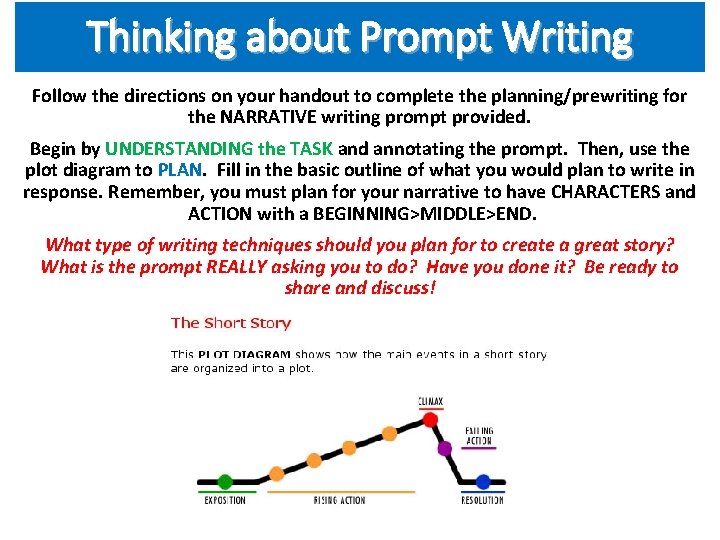
Thinking about Prompt Writing Follow the directions on your handout to complete the planning/prewriting for the NARRATIVE writing prompt provided. Begin by UNDERSTANDING the TASK and annotating the prompt. Then, use the plot diagram to PLAN. Fill in the basic outline of what you would plan to write in response. Remember, you must plan for your narrative to have CHARACTERS and ACTION with a BEGINNING>MIDDLE>END. What type of writing techniques should you plan for to create a great story? What is the prompt REALLY asking you to do? Have you done it? Be ready to share and discuss!
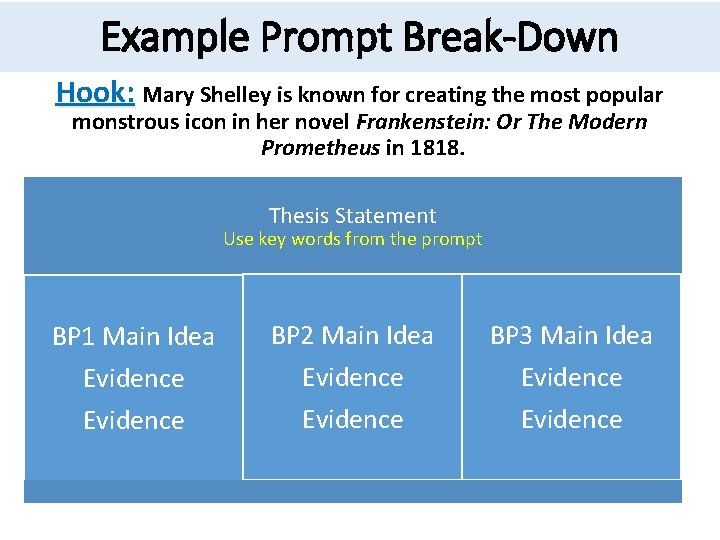
Example Prompt Break-Down Hook: Mary Shelley is known for creating the most popular monstrous icon in her novel Frankenstein: Or The Modern Prometheus in 1818. Thesis Statement Use key words from the prompt BP 1 Main Idea BP 2 Main Idea BP 3 Main Idea Evidence Evidence
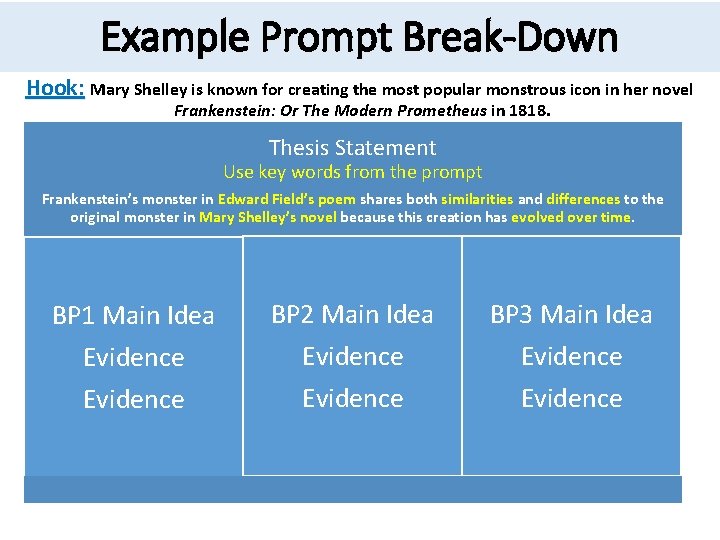
Example Prompt Break-Down Hook: Mary Shelley is known for creating the most popular monstrous icon in her novel Frankenstein: Or The Modern Prometheus in 1818. Thesis Statement Use key words from the prompt Frankenstein’s monster in Edward Field’s poem shares both similarities and differences to the original monster in Mary Shelley’s novel because this creation has evolved over time. BP 1 Main Idea Evidence BP 2 Main Idea Evidence BP 3 Main Idea Evidence
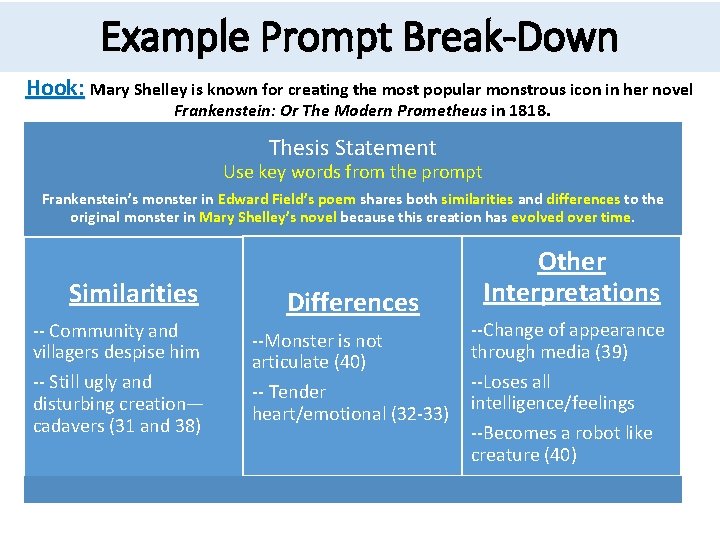
Example Prompt Break-Down Hook: Mary Shelley is known for creating the most popular monstrous icon in her novel Frankenstein: Or The Modern Prometheus in 1818. Thesis Statement Use key words from the prompt Frankenstein’s monster in Edward Field’s poem shares both similarities and differences to the original monster in Mary Shelley’s novel because this creation has evolved over time. Similarities -- Community and villagers despise him -- Still ugly and disturbing creation— cadavers (31 and 38) Differences --Monster is not articulate (40) -- Tender heart/emotional (32 -33) Other Interpretations --Change of appearance through media (39) --Loses all intelligence/feelings --Becomes a robot like creature (40)
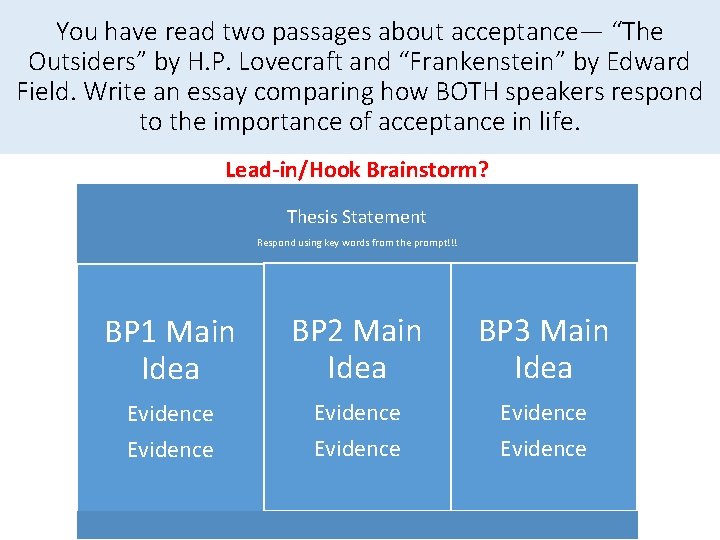
You have read two passages about acceptance— “The Outsiders” by H. P. Lovecraft and “Frankenstein” by Edward Field. Write an essay comparing how BOTH speakers respond to the importance of acceptance in life. Lead-in/Hook Brainstorm? Thesis Statement Respond using key words from the prompt!!! BP 1 Main Idea BP 2 Main Idea BP 3 Main Idea Evidence Evidence
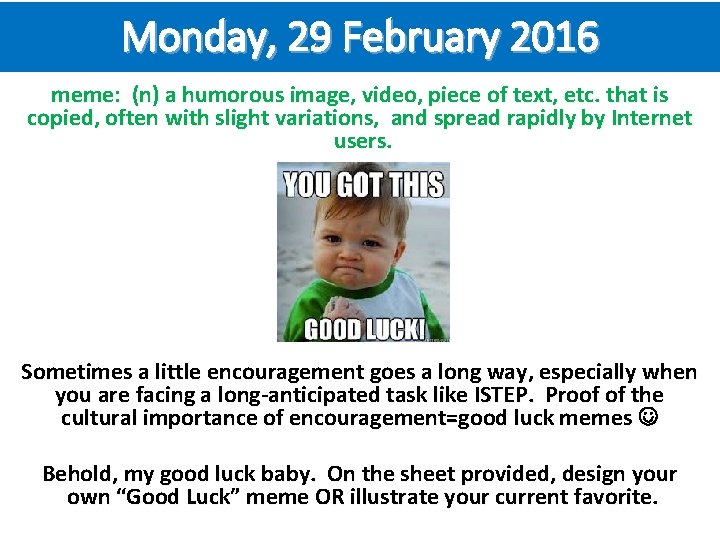
Monday, 29 February 2016 meme: (n) a humorous image, video, piece of text, etc. that is copied, often with slight variations, and spread rapidly by Internet users. Sometimes a little encouragement goes a long way, especially when you are facing a long-anticipated task like ISTEP. Proof of the cultural importance of encouragement=good luck memes Behold, my good luck baby. On the sheet provided, design your own “Good Luck” meme OR illustrate your current favorite.
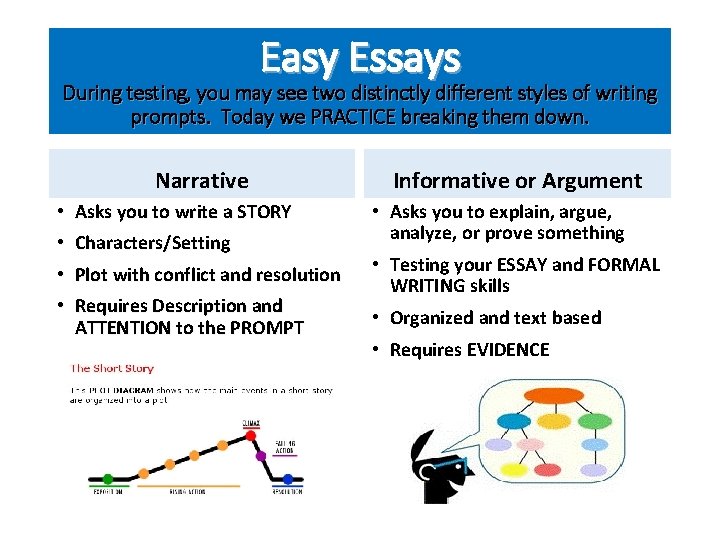
Easy Essays During testing, you may see two distinctly different styles of writing prompts. Today we PRACTICE breaking them down. Narrative • Asks you to write a STORY • Characters/Setting • Plot with conflict and resolution • Requires Description and ATTENTION to the PROMPT Informative or Argument • Asks you to explain, argue, analyze, or prove something • Testing your ESSAY and FORMAL WRITING skills • Organized and text based • Requires EVIDENCE
Write a quick EASY ESSAYS organizer for the following prompt: Aesop said, “No act of kindness, no matter how small, is ever wasted. ” Explain how Write a acts quick EASY ESSAYS organizer the following prompt: o small of kindness canforhave an impact others.
Write a quick EASY ESSAYS organizer for the following prompt: Write about someone who has shared wisdom and experience with you. Explain why it is important to learn from the experiences of others.
Write a quick EASY ESSAYS organizer for the following prompt: Write a story about a time when someone shared wisdom and experience with you. Explain what happened and what you learned from this experience.
Write a quick EASY ESSAYS organizer for the following prompt: Where is one place in the world you would like to visit? Explain why you want to visit this place, and what you would like to see or do once you arrive.
Write a quick EASY ESSAYS organizer for the following prompt: Think about how daily life has changed over the past hundred years because of technology. Explain how advancements in technology have changed daily life.
Write a quick EASY ESSAYS organizer for the following prompt: Most schools offer a variety of activities, classes, and clubs. Identify one of these that students enjoy, and explain why it should be included and/or supported at your school.
Write a quick EASY ESSAYS organizer for the following prompt: You have been asked to share a lesson with elementary school students. Explain the lesson you would share and why it would be important.
Write a quick EASY ESSAYS organizer for the following prompt: Write the story of learning this lesson from the point of view of the elementary school child.
Write a quick EASY ESSAYS organizer for the following prompt: Community parks, state parks, and national parks provide activities. Write about an enjoyable way to spend time outdoors.
Write an introduction for the following prompt: Explain the benefits of having a good attitude, even during difficult times. Write a. Provide quick EASY examples ESSAYS organizer for theyour following prompt: from own experiences.
Write a quick EASY ESSAYS organizer for the following prompt: What are the advantages of earning your own money to purchase something special? State your claim and explain using personal examples.
Write a quick EASY ESSAYS organizer for the following prompt: When people ask advice they often talk to more than one person. Explain why seeking multiple opinions can help someone make a better choice.
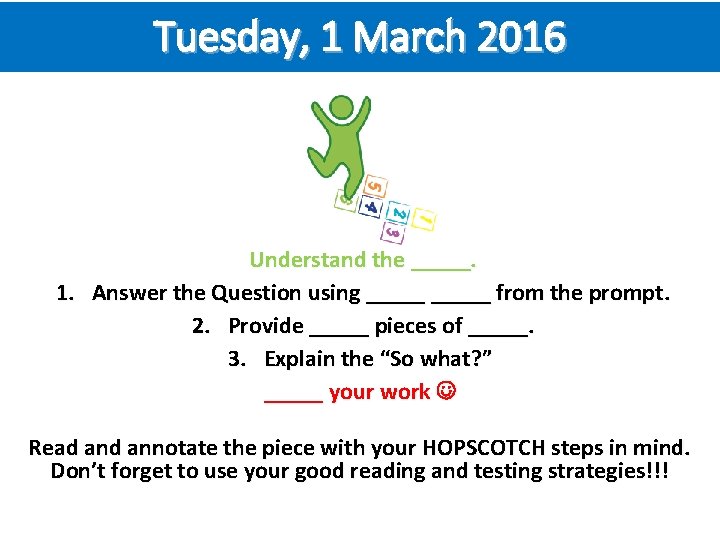
Tuesday, 1 March 2016 Understand the _____. 1. Answer the Question using _____ from the prompt. 2. Provide _____ pieces of _____. 3. Explain the “So what? ” _____ your work Read annotate the piece with your HOPSCOTCH steps in mind. Don’t forget to use your good reading and testing strategies!!!
Question 1 How does Michael most likely feel at the beginning of his trip? What evidence from the passage supports this inference? Use details from the text to support your response.
Example Answer Question 1 Michael most likely feels _____at the beginning of his trip. Incorporate evidence #1__________. Incorporate evidence #2_________. So What? Why/How do my examples prove my point?
Question 2 Michael does not want the border agent to know why he is going to Canada. What evidence from the passage best supports this conclusion? Explain using details from the text.
Example Answer Question 2 Readers could easily conclude that Michael does not want the border agent to know why he is going to Canada. Incorporate evidence #1 __________. Incorporate evidence #2_________. So What? Why/How do my examples prove my point?
Question 3 This trip to his childhood home is clearly important to Michael. Inferring from details in the text, what are two possible reasons the trip is important to Michael? Support your answer using evidence from the passage.
Example Answer Question 3 Two possible reasons the trip is important to Michael include ________ and ________. Incorporate evidence #1 __________. Incorporate evidence #2 _________. So What? Why/How do my examples prove my point?
Question 4 What is a theme or central idea of “A Winter’s Drive”? Explain your thinking using details from the text.
Example Answer Question 4 “A Winter’s Drive” is about (topic) and shows______________. Incorporate evidence #1 __________. Incorporate evidence #2 _________. So What? Why/How do my examples prove my point? OR The theme or central idea of “A Winter’s Drive is ____________. Incorporate evidence #1 __________. Incorporate evidence #2 _________. So What? Why/How do my examples prove my point?
Wednesday, 2 March 2016 Today we PRACTICE reading, writing, and thinking—think of this as English class conditioning Pick up the readings by the door. Read annotate BOTH passages, quickly using your good reading strategies! Get ready to do some answer practice in groups
Thursday, 3 March 2016 Today we PRACTICE reading, writing, and thinking through play! This is English class conditioning through the GREAT ELA GAMES (ISTEP Edition)
Friday, 4 March 2016 Today we PRACTICE reading, writing, and thinking through play! This is English class conditioning through the GREAT ELA GAMES (ISTEP Edition) continued…
- Slides: 93