Chapter 2 Challenges of Section 1 Parenting and



- Slides: 58
Chapter 2 Challenges of
Section 1 Parenting and Families p 47
Objectives: • Explain how a knowledge of child development can help parents. • Identify and describe Galinsky’s six stages of parenthood. • Describe the challenges and rewards of parenthood. • Develop a self-assessment for judging a person’s readiness for parenthood. • Explain how good resource management skills relate to parenting.
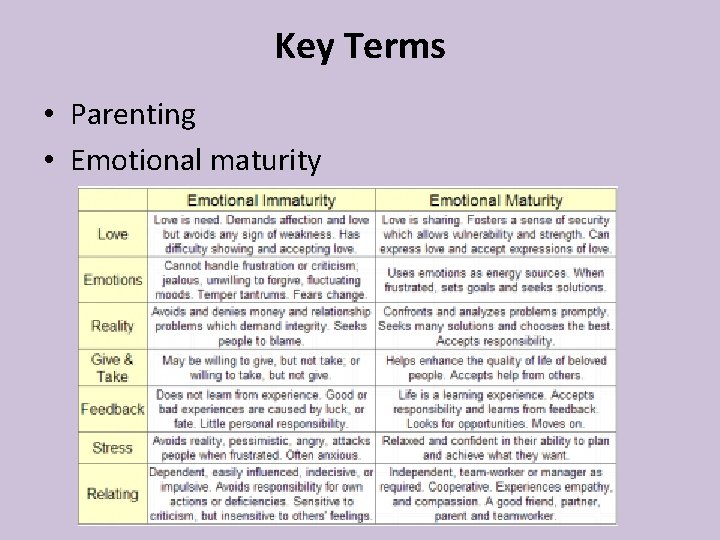
Key Terms • Parenting • Emotional maturity
Opener – Read and Discuss • Parenting and Families p 47 • Does this sound like a job you would apply for? Why/Why Not?
Parenting: A Learning Process p 47 • Parenting=caring for children and helping them grow and develop. • Involves understanding and meeting the needs of children.
Parenting: A Learning Process p 47 cont. Requires Good Judgment • Know when to help and when to let them try on their own. They need to learn how to bounce back when they fail. • Know when to encourage children to try new things, explore likes and dislikes. Avoid pushing. • Know when to change parenting skills to match the stage the development the child is in.
Who besides parents, would benefit from these skills? • • Other relatives Friends Teenagers Teachers Sunday school teachers Club leaders People in general
Having Reasonable Expectations p 48 Having reasonable expectations of children is necessary to understanding them. Do these sound familiar: Act your age Grow up How old are you You act like a child
Having Reasonable Expectations p 48 cont. • If you understand the stages and what they are capable of in each stage, you will have more reasonable expectations. • However, every child is individual and develops at their own rate.
Discussion • Identify some of the possible frustrations of having a young child help with the dishes. • What are some words of encouragement you could give to a child doing dishes that would reinforce positive actions?
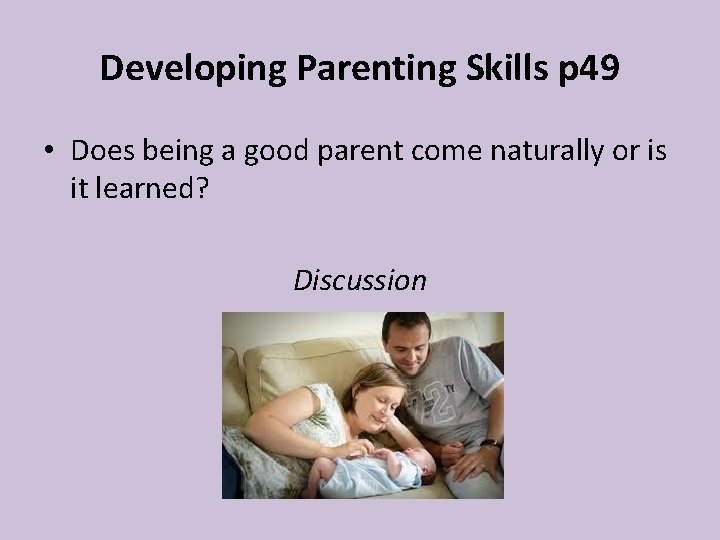
Developing Parenting Skills p 49 • Does being a good parent come naturally or is it learned? Discussion
Ways to gain/learn parenting skills: • Classes or workshops in child development –schools, hospitals, community groups, health depts. , private sectors • Ex: feeding, behaviors, health, financial stress, relationships • Read books, magazines, internet (be sure it’s reliable – snopes. com or some reputable organization.
Ways to gain/learn parenting skills: cont. • Work with children • Talk with family and friends (don’t try recreating the wheel and do it all on your own) • Observe parents with children
Reading Check p 48 teacher’s text • Who needs to have good parenting skills? • Why is it important for adults to understand child development? • What are some ways to develop parenting skills?
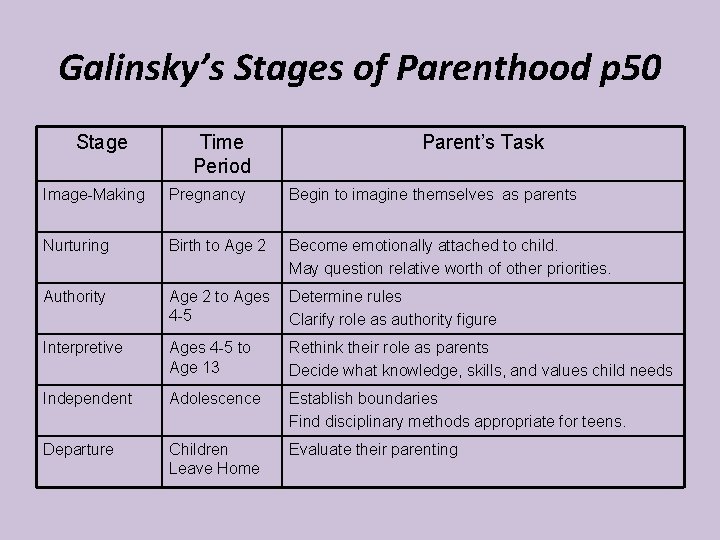
Galinsky’s Stages of Parenthood p 50 Stage Time Period Parent’s Task Image-Making Pregnancy Begin to imagine themselves as parents Nurturing Birth to Age 2 Become emotionally attached to child. May question relative worth of other priorities. Authority Age 2 to Ages 4 -5 Determine rules Clarify role as authority figure Interpretive Ages 4 -5 to Age 13 Rethink their role as parents Decide what knowledge, skills, and values child needs Independent Adolescence Establish boundaries Find disciplinary methods appropriate for teens. Departure Children Leave Home Evaluate their parenting
Assignment: • Choose one of Galinsky’s stages to research. • Prepare a one-page summary of your findings. • Share your report with the class.
The Changes That Parenthood Brings p 50 • Life radically changes – How? Brainstorm
Assignment • For 3 days, write out your daily schedules including one weekend day. • Include all your activities on the schedule. • Imagine you have just become a parent. • Re-examine your schedule. • How would your daily life change? • What activities would be added? • What activities would be dropped?
Challenges of Parenthood p 51 • When you become a parent, your life is no longer your own. Your first responsibility is your child? Even though there are numerous changes, most parents adjust to them.
In addition to learning what to expect, plan for it. • Talk over issue ahead of time to prevent problems later. Who will be the wage earner. Budget expenses Decide what to give up Decide who will baby sit Ask parents if they will help in certain area
In addition to learning what to expect, plan for it. Cont. • Decide ahead of time how you will share parenting duties. • Make time to be alone as a couple. • Relax, keep a sense of humor. • Don’t expect too much of yourself. (your house may not be a tidy, you may not have the best mowed lawn etc. )
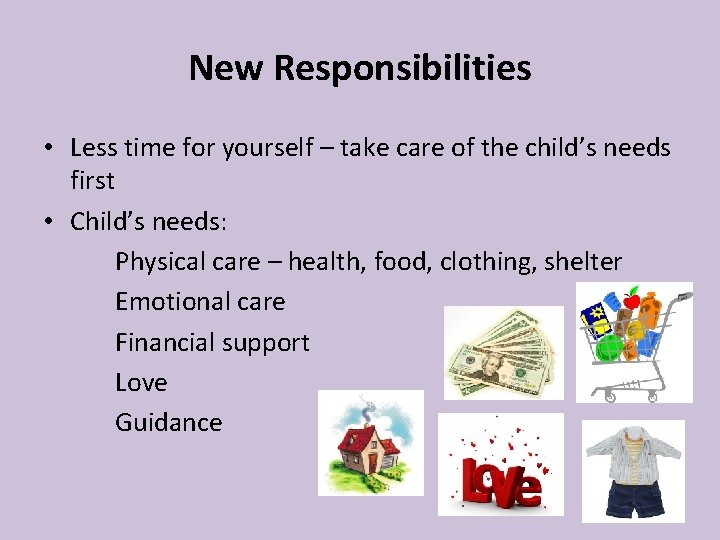
New Responsibilities • Less time for yourself – take care of the child’s needs first • Child’s needs: Physical care – health, food, clothing, shelter Emotional care Financial support Love Guidance
Changes in Lifestyle • Takes a huge amount of time and energy • Feeding, bathing, diapering, playing, comforting, supervising • Less time for leisure and outings • Less time for rest • Less time for solitude
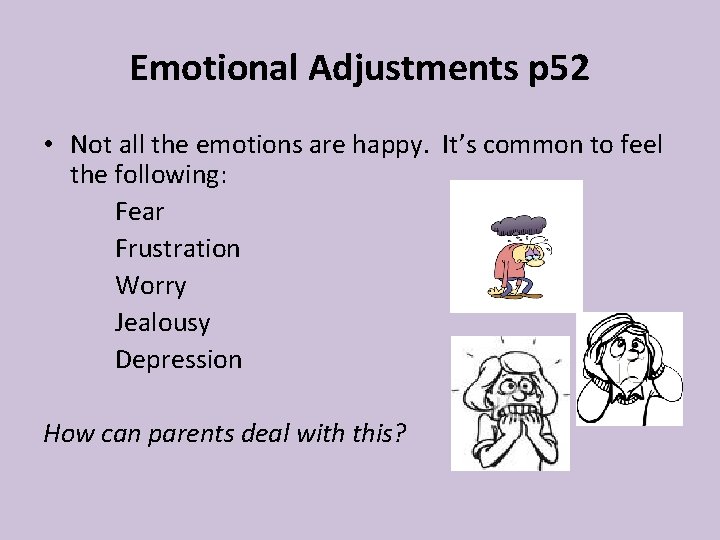
Emotional Adjustments p 52 • Not all the emotions are happy. It’s common to feel the following: Fear Frustration Worry Jealousy Depression How can parents deal with this?
Changes in Relationships p 52 • Conflicts with spouse – tires, exhausted, money problems • Friends – no time to hang out • Your parents – may feel closer to them, they help out, you understand their sacrifices • Your parents – may resent advice
Employment p 53 • One parent may give up a job or go part-time, to stay home with the child – reduced income • May choose to work at home • Promotions and job moves may be on hold • May not accept overtime • May change jobs if you travel have to travel
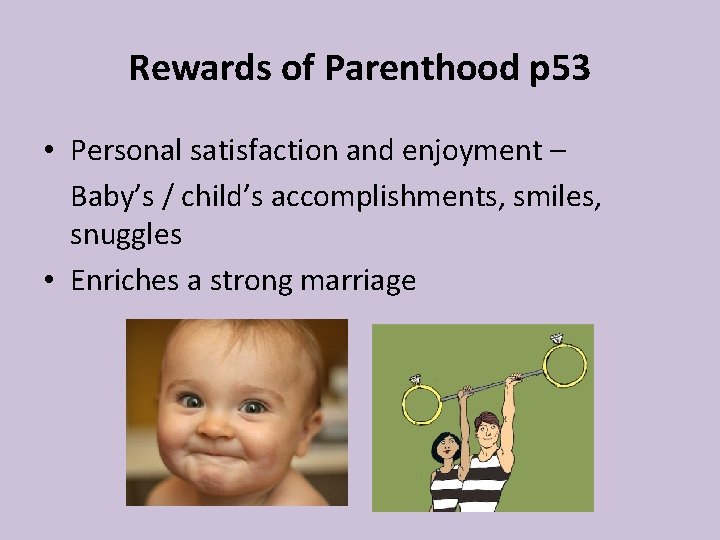
Rewards of Parenthood p 53 • Personal satisfaction and enjoyment – Baby’s / child’s accomplishments, smiles, snuggles • Enriches a strong marriage
Making Decisions about Parenthood p 54 • Look at the following: Emotional maturity Desire for parenthood Health considerations Financial concerns Resource management skills
Emotional Maturity • Responsible enough to consistently put someone else’s needs before their own needs. • Secure enough to devote their attentions to a child without expecting anything in return • Control their temper when an infant cries for hours on end or when they break a favorite possession • Able to handle being constantly on call • Sound judgment
Emotional Maturity cont. • Reasoning and emotional control are centered in the frontal lobes, the front part of the brain, which is one of the last parts of the brain to mature. • Frontal lobes do not fully develop until late teens or early 20 s
Desire for Parenthood p 55 • Parenthood is not a cure for a poor marriage or poor self-esteem.
Health Considerations p 55 • Both should have checkups before conception • Riskier for women under 17 and over age 35 • Teens less likely to have proper nutrition, gain adequate weight, and seek good prenatal care. • Women over 35 are at greater risk for diabetes, hbp, downs syndrome
Financial Concerns p 55 • It is expensive. (clothes, diapers, food, equipment, health care, child care, loss of income, space…) • Consider the cost of having a baby and not just for the first year. • Many parent have to change their way of life after they have a baby. • Will both parents continue to work?
Read together: • Looking At Real Life p 55 and answer personal application questions.
Resource Management Skills • Use the resources you have wisely – money, time, skills, energy, family, friends, • Most resources are limited so you need a plan
Resource Management Skills cont. 5 steps to good resource management (read together p 56 & 57) 1. Set Goals 2. Identify Resources 3. Make a plan 4. Put the plan into action 5. Reevaluate the plan from time to time
Assignment • Review Questions p 57
Section 2 p 58
Objectives: • Distinguish between sexuality and sexual activity. • Summarize what people consider when making responsible decisions about sexual activity. • Describe the possible consequences of sexual activity. • Evaluate the challenges of teen pregnancy.
Terms • • Sexuality Hormones Sexually transmitted disease (STD) Abstinence Paternity Confidential adoption Open adoption
Teen Sexuality p 58 Sexuality refers to a person’s view of himself or herself as a male or female. It has physical, intellectual, emotional and social aspects. It involves: Physical maturity or the ability to be sexually active. How people feel about themselves A sense of responsibility for and understanding of other people and their feelings.
Teen Sexuality p 58 cont. • People show their sexuality by their attitudes, the way they walk, talk, move, and dress. • Hormones=chemical in your body • They dictate changes as teens become sexually mature (puberty) • The changes can be emotional and physical.
Teen Sexuality p 58 cont During puberty social development changes: • Attractions to new friends • Attractions to the opposite sex • Relationships with family change • Become more independent • Want to spend more time with friends • Question authority
Values and Sexuality p 59 Passed on from family • Trust • Self-respect • Respect for others • Commitment • Loyalty • How to treat the opposite sex • How to balance old friendships with someone of the opposite sex
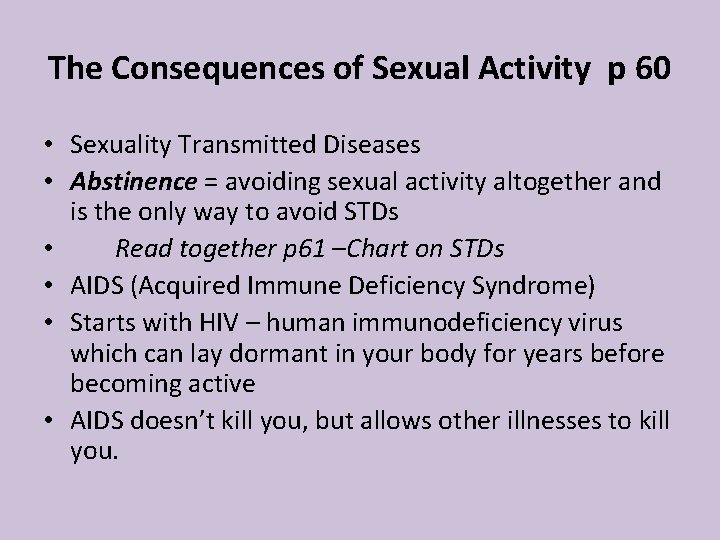
The Consequences of Sexual Activity p 60 • Sexuality Transmitted Diseases • Abstinence = avoiding sexual activity altogether and is the only way to avoid STDs • Read together p 61 –Chart on STDs • AIDS (Acquired Immune Deficiency Syndrome) • Starts with HIV – human immunodeficiency virus which can lay dormant in your body for years before becoming active • AIDS doesn’t kill you, but allows other illnesses to kill you.
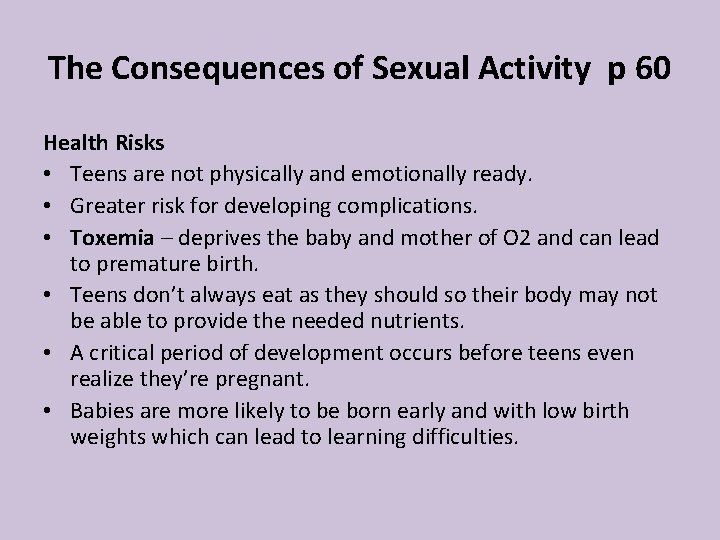
The Consequences of Sexual Activity p 60 Health Risks • Teens are not physically and emotionally ready. • Greater risk for developing complications. • Toxemia – deprives the baby and mother of O 2 and can lead to premature birth. • Teens don’t always eat as they should so their body may not be able to provide the needed nutrients. • A critical period of development occurs before teens even realize they’re pregnant. • Babies are more likely to be born early and with low birth weights which can lead to learning difficulties.
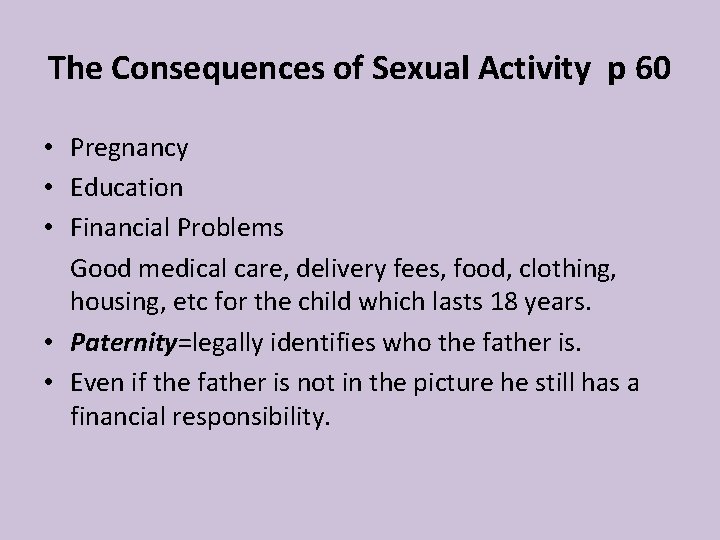
The Consequences of Sexual Activity p 60 • Pregnancy • Education • Financial Problems Good medical care, delivery fees, food, clothing, housing, etc for the child which lasts 18 years. • Paternity=legally identifies who the father is. • Even if the father is not in the picture he still has a financial responsibility.
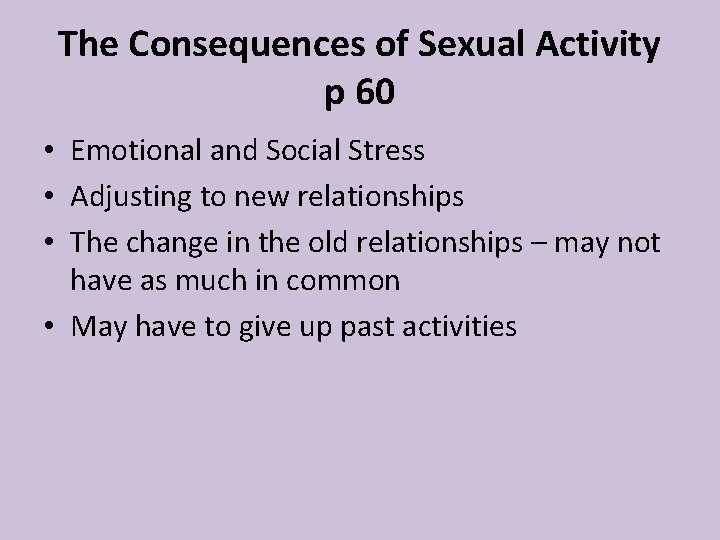
The Consequences of Sexual Activity p 60 • Emotional and Social Stress • Adjusting to new relationships • The change in the old relationships – may not have as much in common • May have to give up past activities
Deciding to Abstain p 62 Dangerous and Foolish Attitudes: • “It can’t happen to me. ” • “It won’t happen on the first time. ” • “It won’t happen if I only do it once. ” • “People can’t get pregnant the first time. ” • “If you love me you will do it. ” • “Everyone’s doing it. ”
Deciding to Abstain p 62 • Think about this decision before you are in the “heat of passion. ” • Once this decision has been made, stick to it and remember why you made it in the first place. • Don’t let others push you into it. They may have their own agendas for pushing you. They may say they think it’s cool but may really wish they hadn’t. They may not want others to succeed where they failed. They may want justification – “Everyone’s doing it. ”
Before you have sex ask yourself --Am I ready to be a parent? Emotionally Physically Socially Financially
When Teen Pregnancy Occurs p 63 • Don’t ignore the symptoms. • Some people are in denial.
Weighing the Options p 65 Single parenthood • Can be rewarding but draining and even harder for teens. • Teen parents suffer from burnout or depression. • Teens need support: emotional and financial. • Be realistic about how much help they will need and be able to receive. • Don’t romanticize the situation- if the boy isn’t interested in marriage before the birth, most likely won’t be afterward.
Weighing the Options p 65 cont. Marriage p 65 • After the new wears off, the strains of responsibility and the new social situation sets in. • Can be rewarding if there is a positive maturing – 2 parents to care for the child and a health home. • If the relationship is not positive and maturing – can be stressful for everyone.
Weighing the Options p 65 cont. Adoption p 66 • It is when you legally give up your rights to your child and let someone else raise them. • Think about it carefully as it is a permanent decision. 2 types: • Confidential = the birth parents don’t know the adoptive parents • Open Adoption = birth and adoptive parents know each other.
Career Opportunities p 67 • Read together Assignment p 66 • Review Questions Assignment p 68 • Reviewing the Chpt • Learning from Research p 69 • Choose one, write a report, present to class.
• Chapter Test