
Anna Freud National Centre for Children and Families
- Slides: 23
Anna Freud National Centre for Children and Families 13 th September 2017 Reflective Parenting Increasing Mentalizing in the Parent-Infant Relationship Dr Sheila Redfern Head of STAMS at Anna Freud
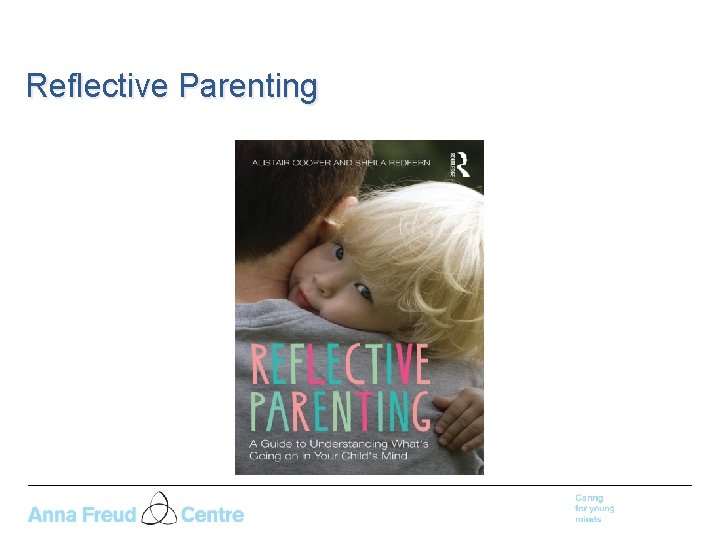
Reflective Parenting
Why reflective parenting? Parents high in Reflective Functioning (RF) have more secure attachment histories and more securely attached children. Reflective parenting teaches a child about their emotions, how to recognise them and then how to control them (emotion regulation) Secure attachment one of the best predictors of resilience in later life (evidence studies) Secure attachment is associated with mentalizing skills and Theory of Mind (Fonagy, Redfern and Charman, 1997) Reflective parenting helps an infant and young child to understand other minds and other perspectives
Making a case for being Reflective Responding sensitively to infant cues (expressions of interest, wishes and intentions) is related to: • Secure attachment (Slade, Grienenberger, Bernbach, Levy & Locker, 2005) • Cognitive development (Hirsh-Pasek & Burchinal, 2006) • Social development (Booth, Rose-Krasnor, Mc. Kinnon & Rubin, 1994) • Fewer behavioural problems (Brotman et al. , 2009) • Better emotional regulation skills (Bernier, Carlson & Whipple, 2010; Davidov & Grusec, 2006) 4
Mentalizing the self and mentalizing other • Reflective Parenting makes a distinction between self and other mentalizing • Suchman et al (2010) demonstrated a two factor model of parental reflective functioning. • Parents’ capacity to mentalize themselves (self mentalizing) was more highly predictive of the quality of parental caregiving than their capacity to mentalize the child. Also led to more interactive, scaffolded play. 5
What happens when mentalization goes wrong? When parent misperceives the baby’s inner state, mirroring will not accurately reflect the baby’s feelings. Mother not congruent but baby still takes in parent’s representation. As it is ‘incongruent’ it feels alien to the baby. This ‘alien self’ carries on inside the self. Leads to inner fragmentation and confusion. Link to Mother and Baby Interaction Clip 6
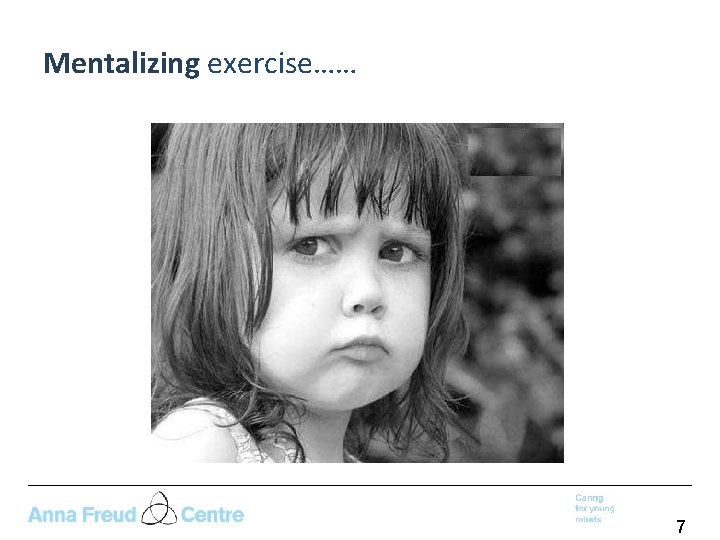
Mentalizing exercise…… 7
What is mentalizing theory? Mentalizing is a form of imaginative mental activity about others or oneself, namely, perceiving and interpreting human behaviour in terms of intentional mental states (e. g. needs, desires, feelings, beliefs, goals, purposes, and reasons).
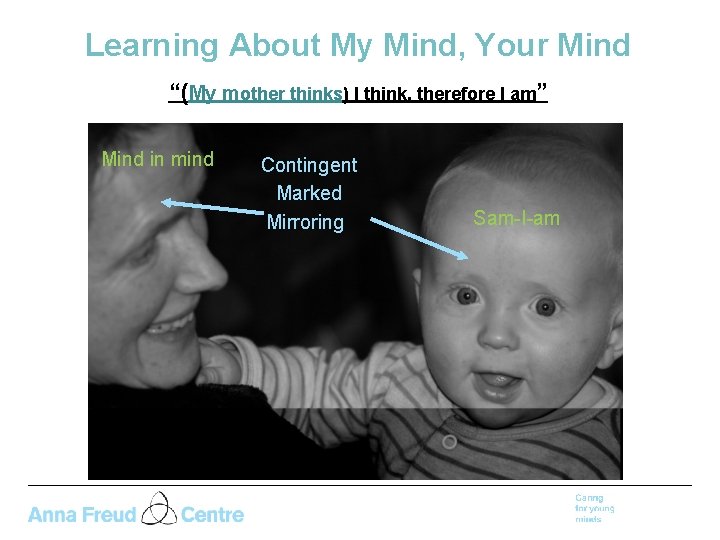
Mentalization For normal development the child needs to experience a mind that has his mind in mind. A mind that is able to reflect on his intentions accurately. That does not overwhelm him. Baby needs a relationship with another human who can be emotionally in touch with the baby. A person who can show a representation of the baby’s feelings on their face – contingent marked mirroring. 9
Learning About My Mind, Your Mind “(My mother thinks) I think, therefore I am” Mind in mind Contingent Marked Mirroring Sam-I-am
Mirroring When parents are able to reflect on the mental states (internal thoughts and feelings) of their infant, the infant starts to control his own feelings. This process occurs because when parents ‘mirror’ back to the infant (through the way they speak to, look at and behave with the infant) how the infant is feeling, the infant begins to understand, and eventually to control, their own emotions.
Still face experiment What is the baby in the film enjoying first? How does the mother show the baby that she knows she has a mind? When the mother’s face changes what does the baby experience? Why does the baby ‘recover’ Link to still face
What happens when mentalization goes wrong? When parent misperceives the baby’s inner state, mirroring will not accurately reflect the baby’s feelings. Mother not congruent but baby still takes in parent’s representation. As it is ‘incongruent’ it feels alien to the baby. This ‘alien self’ carries on inside the self. Leads to inner fragmentation and confusion. 13
How the Professional APP increases epistemic trust • • • The APP is a method that explicitly connects with a parent’s own experience Designed to facilitate an experience of being recognised, “I experience you experiencing me” This felt experience opens up the possibility of new learning because a parent feels connected with, regulated and feel safe enough to think about herself in the world “I am ready to learn something new about the world and how I am within the world” • Make a concerted effort to see the world from a parent’s standpoint to open her mind to your communication 14
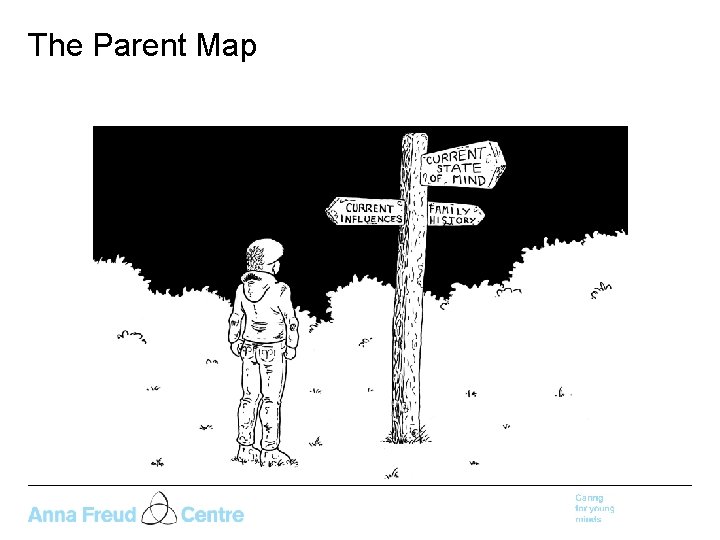
The Parent Map
Helping the parent 1. Think about the need to be aware of yourself. 2. Think about what influences your parenting, include your thoughts and feelings, the influence of past experiences. 3. Use strong feelings to trigger self-reflection and make a connection with how this influences your parenting. 4. Identify times when you think there might be a link between current and past experiences. 5. Build a story of how you got to feel and think the way you do now: a. Did your level of emotional reaction fit the situation? b. What do you think may have contributed to you reacting in this way? c. How might a friend have experienced you in this situation, what would they have seen? d. Can you link your reaction in this situation to previous situations? 6. Use your awareness of your ‘triggers’ to help guide you during future interactions; imagine, predict and reflect on where and how similar feelings and thoughts may arise.
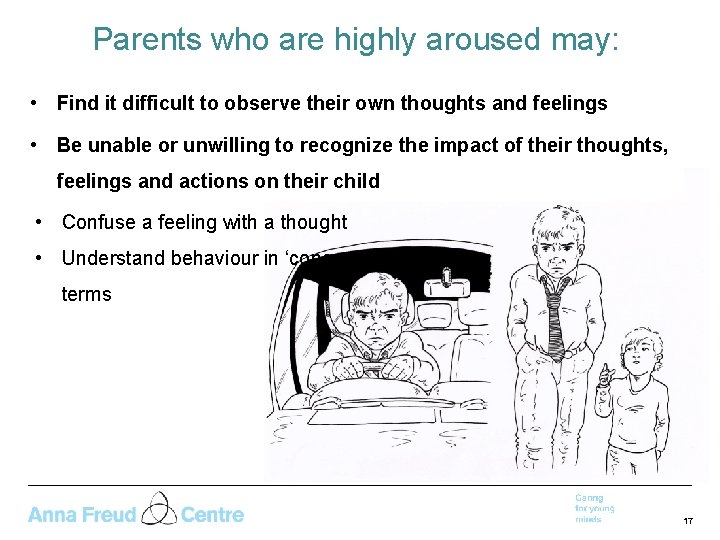
Parents who are highly aroused may: • Find it difficult to observe their own thoughts and feelings • Be unable or unwilling to recognize the impact of their thoughts, feelings and actions on their child • Confuse a feeling with a thought • Understand behaviour in ‘concrete’ terms 17
Parents who are highly aroused may also § Default to negative understandings of their infant’s behaviour and his underlying intentionality § Not be able to see how one thing has led to another § Be inflexible from their perspective § Feel that different perspectives are dangerous § Struggle to relate thoughts to reality § Act without thinking, or avoid thinking.
Parents who are under aroused may ▪ Lack curiosity and interest in self and other ▪ Seem flat, bored, going through the motions ▪ Be an absence of mentalisation “I don’t know” ▪ Express a lack of reference to mental states ▪ Indicate that “my sense of what it is to be me” is cut off ▪ Cut of from the impact of what is going on
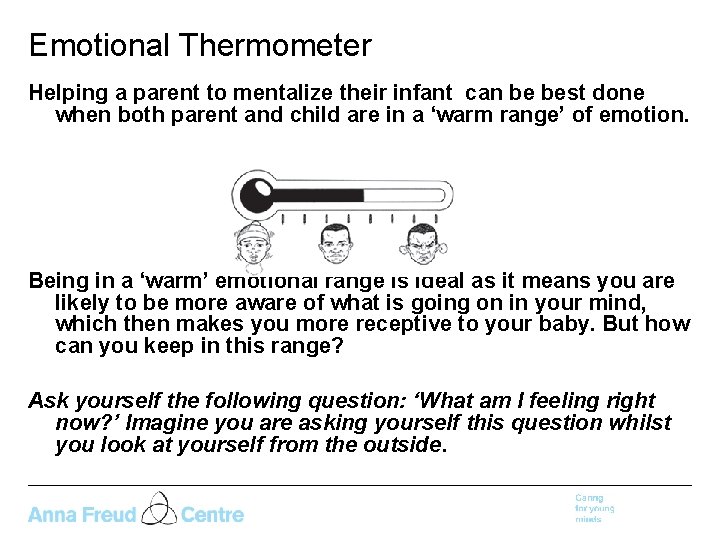
Emotional Thermometer Helping a parent to mentalize their infant can be best done when both parent and child are in a ‘warm range’ of emotion. Being in a ‘warm’ emotional range is ideal as it means you are likely to be more aware of what is going on in your mind, which then makes you more receptive to your baby. But how can you keep in this range? Ask yourself the following question: ‘What am I feeling right now? ’ Imagine you are asking yourself this question whilst you look at yourself from the outside.
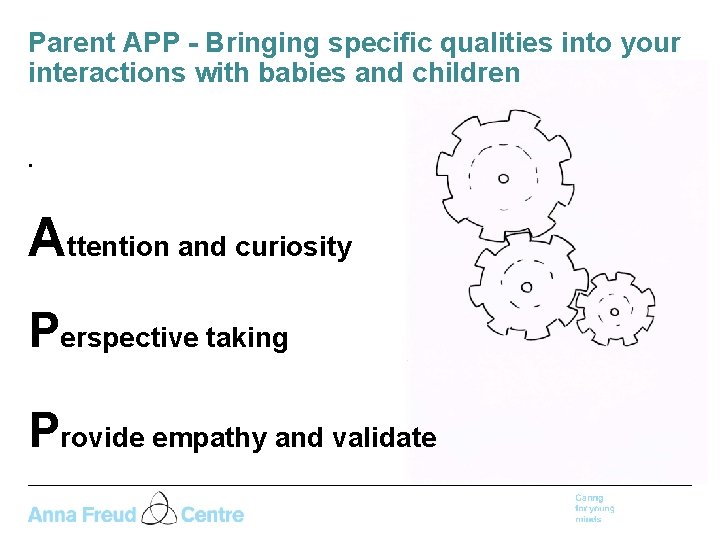
Parent APP - Bringing specific qualities into your interactions with babies and children. Attention and curiosity Perspective taking Provide empathy and validate
Using the Parent APP Aim of the Parent APP is to help parents and child/infant feel a greater emotional connection and understanding. 1. Start to notice and be curious about what might be going on in your baby’s mind. 2. Be more aware of your tone, expression and the words you use. 3. Be curious about what’s going on inside your baby’s mind, show him you are interested in his inside story, rather than just what he does on the outside. 4. You cannot be expected to always know what his inside story is because you have separate minds. It is normal to be puzzled by why a baby is reacting or acting in a certain way and this does not make you a less competent parent.
Some references Meins, E. , & Fernyhough, C. (1999). Linguistic acquisitional style and mentalising development: The role of maternal mind-mindedness. Cognitive Development, 14, 363– 380. Fonagy, P. & Bateman, A. (2012) Handbook of Mentalizing in Mental Health Practise Cooper, A. & Redfern, S. Reflective Parenting: A Guide To Understanding What’s Going on in your chlid’s mind. Routledge, 2016 “Minding the Child: mentalization-based interventions with children, young people and their families. ” Ed. Midgley N and Vrouva I, Routledge, 2012. Suchman N. E. , Decoste C. , Mc. Mahon T. J. , Rounsaville B. , Mayes L. (2011) The mothers and toddlers program, an attachment-based parenting intervention for substance-using women: results at 6 -week follow-up in a randomized clinical pilot. Infant Ment. Health J. 32 427– 449