Parenting Styles and Outcomes Thought to Consider The




- Slides: 19
Parenting Styles and Outcomes Thought to Consider: The way children are parented when they are young can influence the type of people they become.
4. 02 Warm-up 12/12/19 Adults taking parenting class or reading books about raising children are examples of what protective factor that decrease risk of child abuse and neglect? a. Knowledge of child development b. Parental resilience c. Social connections d. Nurturing a child
4. 01 KU 5 FA 5
4. 02 Warm-up 11/26/18 Holly’s parents allow her to choose the chores she will complete for the week. Which parenting style does this most likely illustrate? a. Authoritarian b. Democratic c. Permissive d. Laissez-faire
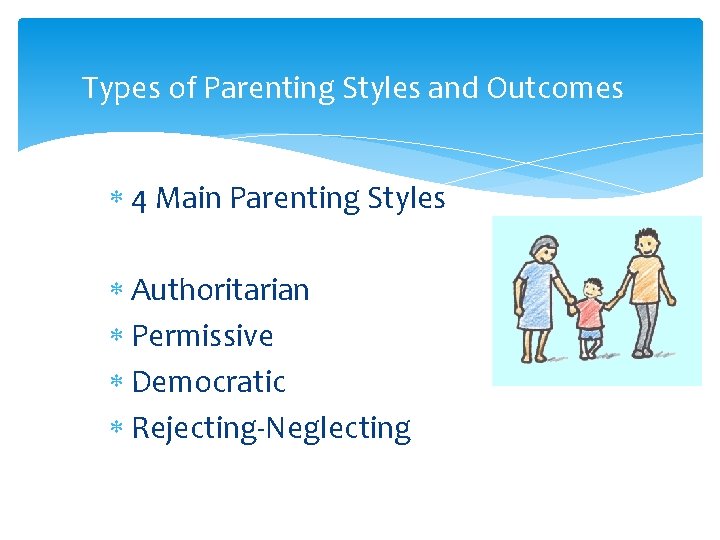
Types of Parenting Styles and Outcomes 4 Main Parenting Styles Authoritarian Permissive Democratic Rejecting-Neglecting
Types of Parenting Styles and Outcomes What’s your parent’s style? Do you fit any of the potential outcomes?
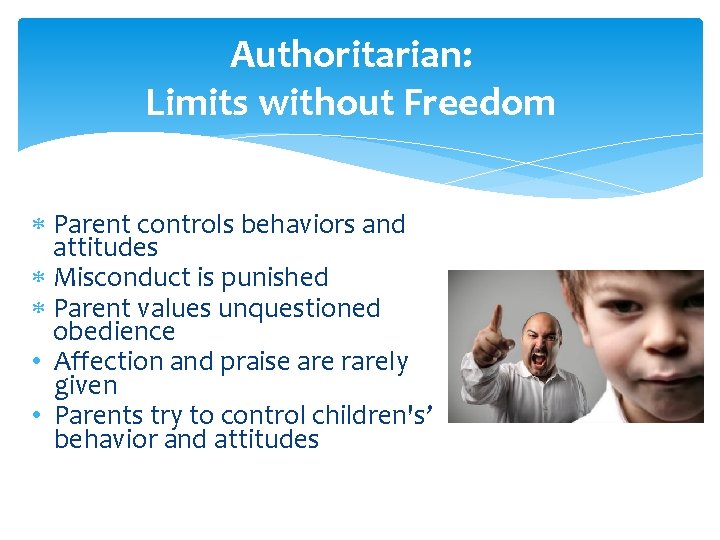
Authoritarian: Limits without Freedom Parent controls behaviors and attitudes Misconduct is punished Parent values unquestioned obedience • Affection and praise are rarely given • Parents try to control children's’ behavior and attitudes
Outcomes of Authoritarian Style • Obedient • Distrustful • Discontent • Withdrawn • Unhappy • Hostile • Often Rebel
Permissive: Freedom without limits Parents are warm but non-controlling and place few demands upon children Children are rarely punished and have little respect for order and routine Rarely punish Discipline is lax Children may take advantage of parent(s)
Outcomes of Permissive Parenting • Aggressive • Least self-reliant • Least self-controlled • Least exploratory • Often unhappy
Democratic: Freedom within limits Stress freedom, with rights and responsibilities Parent(s) set limits and enforce rules Willing to listen to child’s requests Exert firm control, but explain reasoning Consistent, demanding Respect’s child’s uniqueness Combine control with encouragement
Outcomes of Democratic Style • Happy • Content, friendly, generous • Cooperative • Values high achievement • Less likely to be seriously disruptive or delinquent
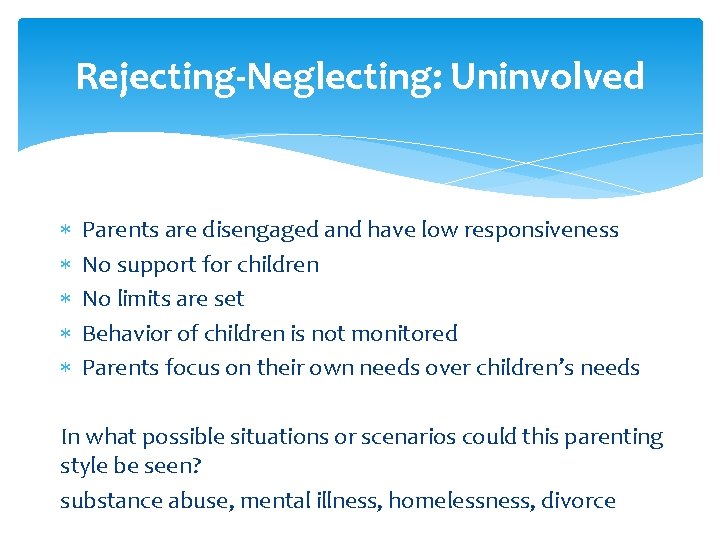
Rejecting-Neglecting: Uninvolved Parents are disengaged and have low responsiveness No support for children No limits are set Behavior of children is not monitored Parents focus on their own needs over children’s needs In what possible situations or scenarios could this parenting style be seen? substance abuse, mental illness, homelessness, divorce
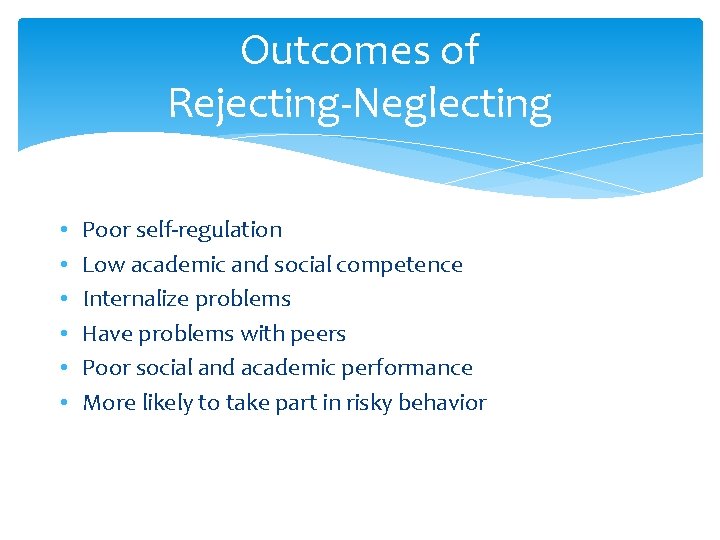
Outcomes of Rejecting-Neglecting • • • Poor self-regulation Low academic and social competence Internalize problems Have problems with peers Poor social and academic performance More likely to take part in risky behavior
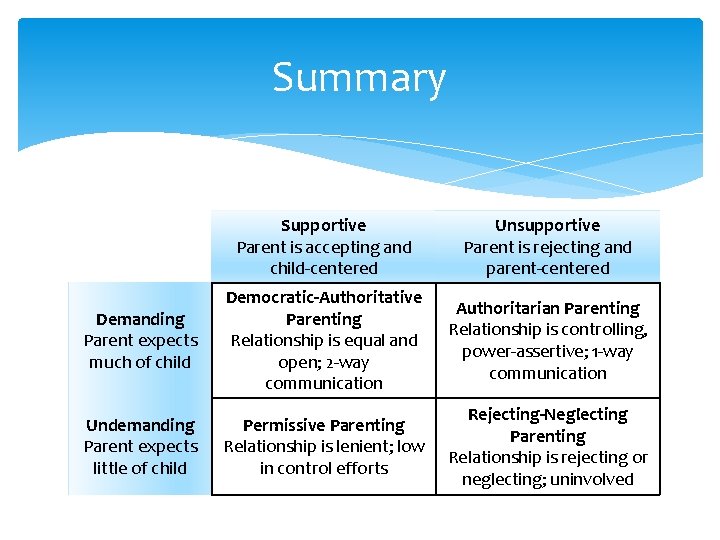
Summary Supportive Parent is accepting and child-centered Unsupportive Parent is rejecting and parent-centered Demanding Parent expects much of child Democratic-Authoritative Parenting Relationship is equal and open; 2 -way communication Authoritarian Parenting Relationship is controlling, power-assertive; 1 -way communication Undemanding Parent expects little of child Permissive Parenting Relationship is lenient; low in control efforts Rejecting-Neglecting Parenting Relationship is rejecting or neglecting; uninvolved
Gilinsky's Styles of Parenthood Notes
Kahoot 4. 02 Parenting Styles Worksheet
Galinsky’s Style of Parenting Discussion and Notes https: //quizlet. com/32669 798/the-six-stages-ofparenthood-galinsky-flash cards/? _sm_au_=i. VVPt 3 P 7 r 6 Tn. TZ 7 Q
Now it’s your turn! Choose 1 parenting style. Develop a case study/narrative that demonstrates that style. It should be a story about the parents and children and how they interact. Use supporting details WITHOUT saying the style. I will collect and then you will read someone else to try and figure out what style of parenting is being portrayed!