
Business Mathematics MTH367 Lecture 31 Chapter 20 Optimization
Business Mathematics MTH-367 Lecture 31
Chapter 20 Optimization: Functions of Several Variables
Chapter Objectives • Provide an understanding of the calculus of functions which contain two independent variables. • Overview the optimization procedures for functions which contain more than one independent variables. • Introduce the nature of and procedures for optimization of functions subject to constraining conditions.
Main Topics of Chapter 20 • Partial Derivatives • Optimization of Bivariate Functions • Applications of Bivariate Optimization
Last Lecture Summary We studied Sec. 19. 4: Applications of Integral calculus, by solving variety of different problems in business, economic and finance.
Today’s Topics We will study Chapter 20. • Partial Derivatives • Second Order Partial Derivatives • Optimization of Bivariate Functions
Partial Derivatives The calculus of bivariate functions is very similar to that of single-variable functions. In this section we will discuss derivatives of bivariate functions and their interpretation.
Derivatives of Bivariate Functions • With single-variable functions, the derivative represents the instantaneous rate of change in the dependent variable with respect to a change in the independent variable. • For bivariate functions, there are two partial derivatives. • These derivatives represent the instantaneous rate of change in the dependent variable with respect to changes in the two independent variables, separately.
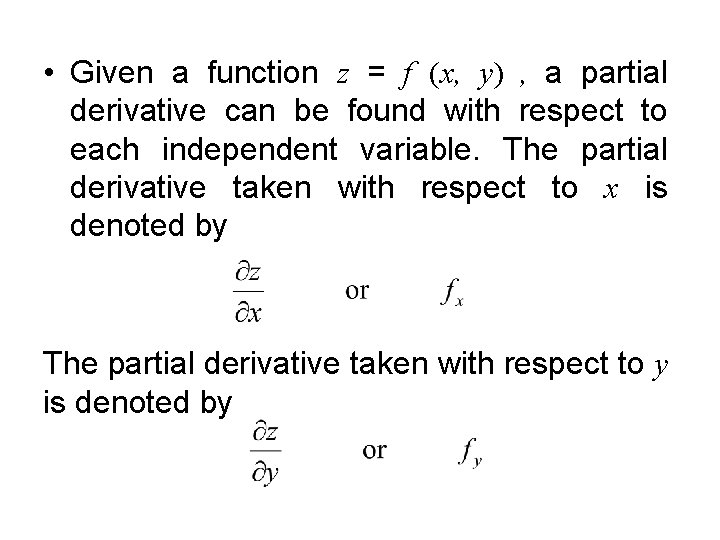
• Given a function z = f (x, y) , a partial derivative can be found with respect to each independent variable. The partial derivative taken with respect to x is denoted by The partial derivative taken with respect to y is denoted by
Although both notational forms are used to denote the partial derivative, we will use the subscripted notation fx and fy in this chapter.
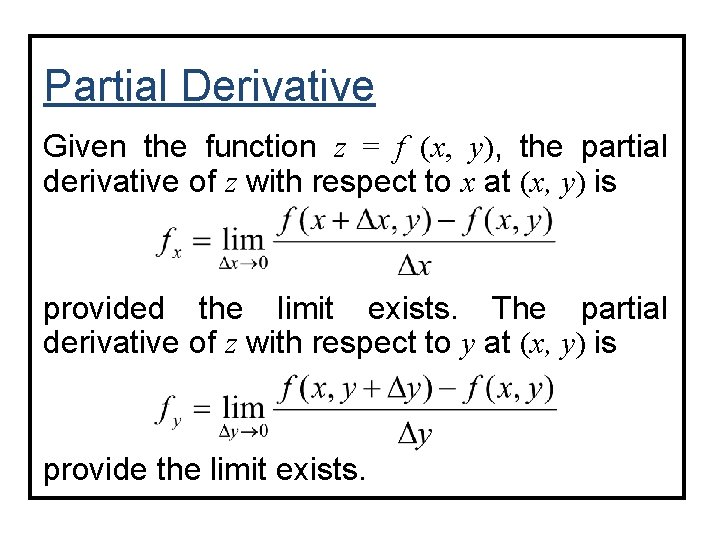
Partial Derivative Given the function z = f (x, y), the partial derivative of z with respect to x at (x, y) is provided the limit exists. The partial derivative of z with respect to y at (x, y) is provide the limit exists.
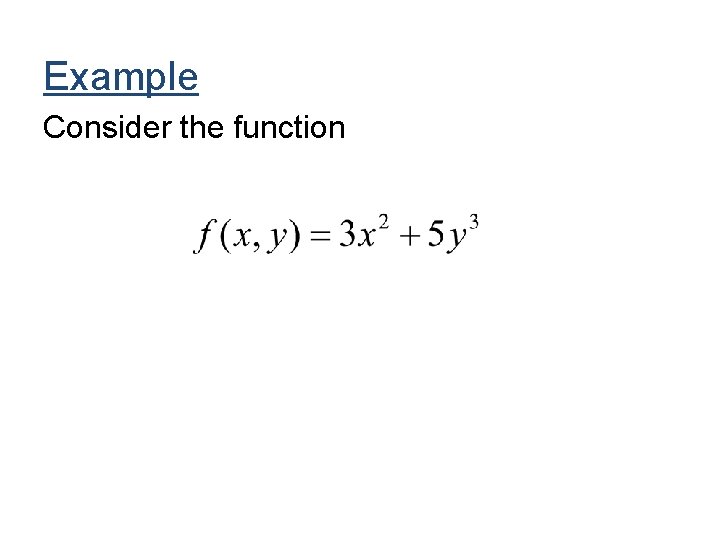
Example Consider the function



• Fortunately, partial derivatives are found more easily using the same differentiation rules we used in Chap. 15 – 17. • The only exception is that when a partial derivative is found with respect to one independent variable, the other independent variable is assumed to be held constant. • For instance, in finding the partial derivative with respect to x, y is assumed to be constant. • A very important point is that the variable which is assumed constant must be treated as a constant in applying the rules of differentiation.
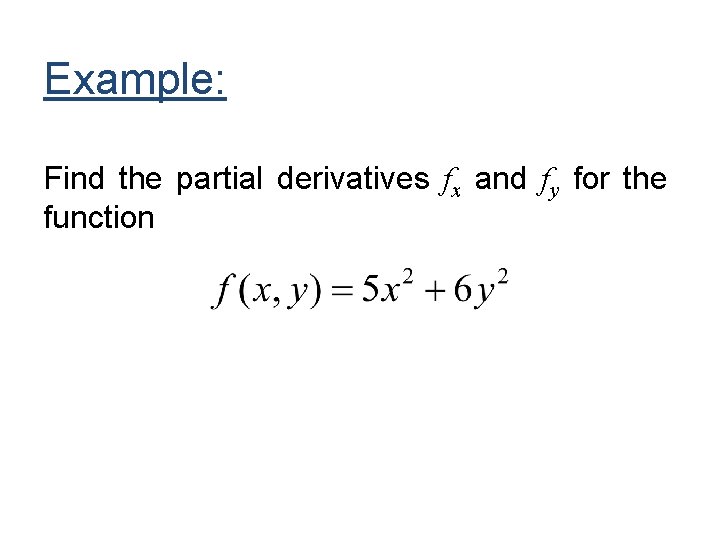
Example: Find the partial derivatives fx and fy for the function

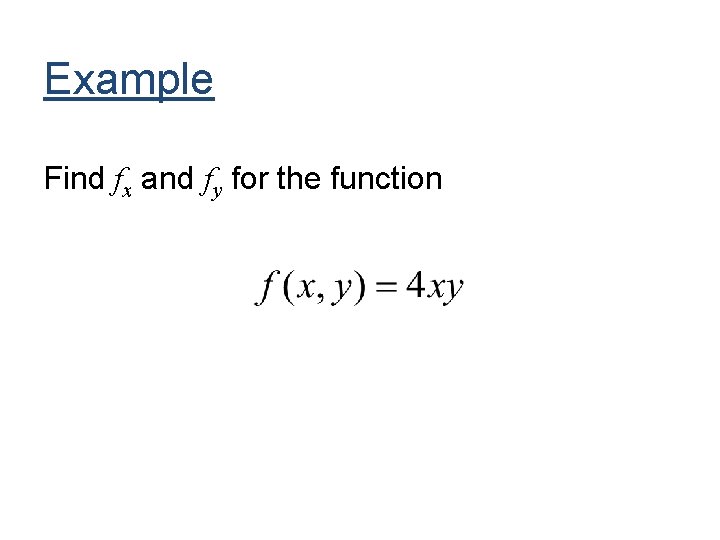
Example Find fx and fy for the function



Second Order Partial Derivatives Type-1 (Pure Second Order Partial Derivatives)
Type-2 (Mixed Partial Derivatives)

Example


Optimization of Bivariate Functions The process of finding optimum values of bivariate functions is very similar to that used for single variable functions.
Critical Points As with single-variable functions, we will have a particular interest in identifying relative maximum and minimum points on the surface representing a function f(x, y). Relative maximum and minimum points have the same meaning in three dimensions as in two dimensions.
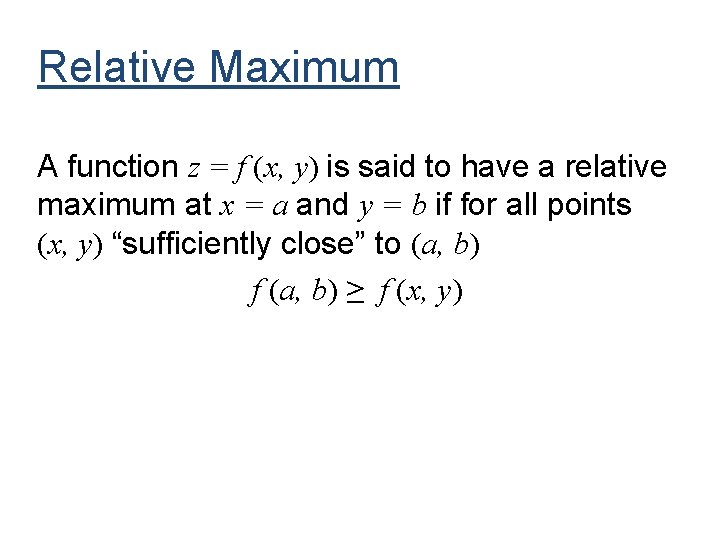
Relative Maximum A function z = f (x, y) is said to have a relative maximum at x = a and y = b if for all points (x, y) “sufficiently close” to (a, b) f (a, b) ≥ f (x, y)
Relative Minimum A function z = f (x, y) is said to have a relative minimum at x = a and y = b if for all points (x, y) “sufficiently close” to (a, b) f (a, b) ≤ f (x, y)
Necessary Condition For Relative Extrema A necessary condition for the existence of a relative maximum or a relative minimum of a function f whose partial derivatives fx and fy both exist is that:
Critical Points • The values x* and y* at which fx = 0 and fy = 0 are critical values. • The corresponding point (x*, y*, f (x*, y*)) is a candidate for a relative maximum or minimum on f and is called a critical point.
Example Locate any critical points on the graph of the function.

Review We covered section 20. 2: Partial Derivatives Started Sec. 20. 3: Optimization of Bivariate Functions • Partial Derivatives • Second Order Partial Derivatives • Optimization of Bivariate Functions

Next Lecture
- Slides: 37