
Contemporary Mathematics for Business and Consumers Third Edition
Contemporary Mathematics for Business and Consumers Third Edition By: Robert A. Brechner COPYRIGHT © 2003 by South-Western, a division of Thomson Learning. TM is a trademark used herein under license. ALL RIGHTS RESERVED. No part of this work covered by the copyright hereon may be reproduced or used in any form or by any means–graphic, electronic, or mechanical, including photocopying, recording, taping, Web distribution or information storage and retrieval systems–without the written permission of the publisher. For permission to use material from this text or product, contact us by Tel (800) 730 -2214 Fax (800) 730 -2215 http: //www. thomsonrights. com

Chapter 10 Simple Interest and Promissory Notes Copyright © 2003 by South-Western
Chapter 10, Simple Interest and Promissory Notes n Section I Understanding and Computing Simple Interest 10 -1 Computing simple interest for loans with terms of years or months. 10 -2 Calculating simple interest for loans with terms of days by using the exact interest and ordinary interest methods. 10 -3 Calculating the maturity value of a loan. 10 -4 Calculating the number of days of a loan. 10 -5 Determining the maturity date of a loan.
Chapter 10, Simple Interest and Promissory Notes (Cont. ) n Section II Using the Simple Interest Formula 10 -6 Solving for the principal. 10 -7 Solving for the rate. 10 -8 Solving for the time. 10 -9 Calculating loans involving partial payments before maturity.
Chapter 10, Simple Interest and Promissory Notes (Cont. ) n Section III Understanding Promissory Notes and Discounting 10 -10 Calculating bank discount and proceeds for simple discount notes. 10 -11 Calculating true or effective rate of interest for a simple discount note. 10 -12 Discounting notes before maturity.
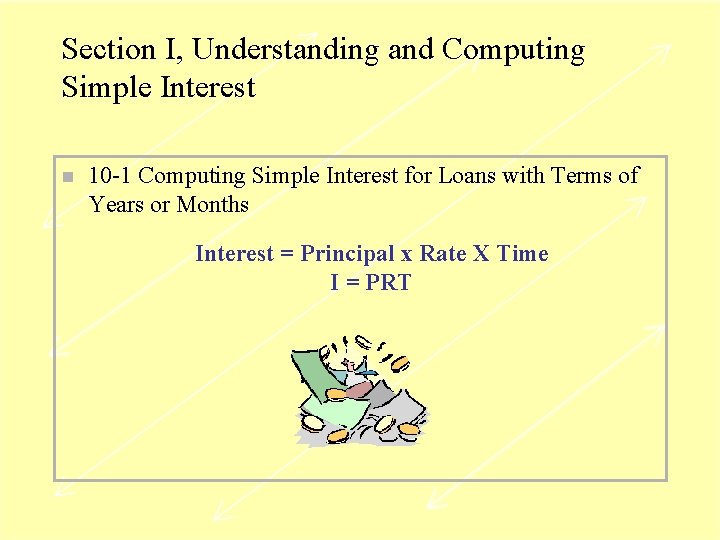
Section I, Understanding and Computing Simple Interest n 10 -1 Computing Simple Interest for Loans with Terms of Years or Months Interest = Principal x Rate X Time I = PRT
10 -2, Calculating Simple Interest for Loans with Terms of Days by Using the Exact Interest and Ordinary Interest methods n Simple Interest Formula – Days Time = Number of days of a loan 365 n Ordinary Interest Time = Number of days of a loan 360
10 -3, Calculating Maturity Value of a Loan Maturity value = Principal + Interest Maturity value =Principal (1 + Rate X Time) MV + P(1+RT)
Everybody’s Business When using the maturity value formula, MV = P (1+RT), the order of the operation is v Multiply rate times time v Add the 1 v Multiply by the principal
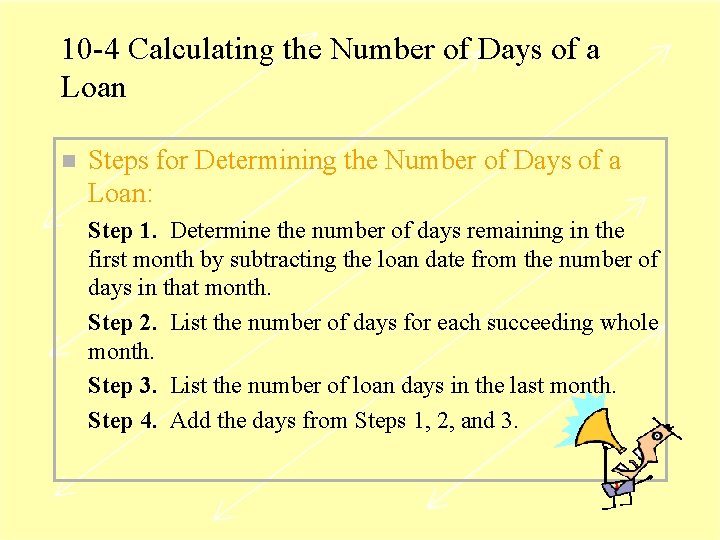
10 -4 Calculating the Number of Days of a Loan n Steps for Determining the Number of Days of a Loan: Step 1. Determine the number of days remaining in the first month by subtracting the loan date from the number of days in that month. Step 2. List the number of days for each succeeding whole month. Step 3. List the number of loan days in the last month. Step 4. Add the days from Steps 1, 2, and 3.
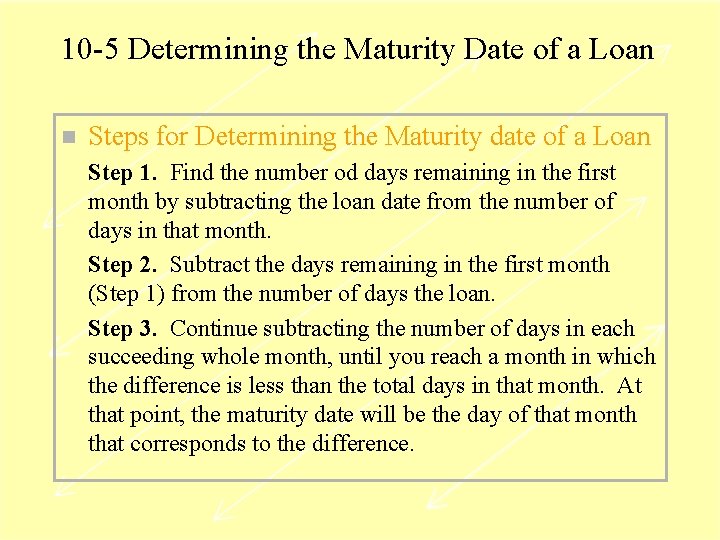
10 -5 Determining the Maturity Date of a Loan n Steps for Determining the Maturity date of a Loan Step 1. Find the number od days remaining in the first month by subtracting the loan date from the number of days in that month. Step 2. Subtract the days remaining in the first month (Step 1) from the number of days the loan. Step 3. Continue subtracting the number of days in each succeeding whole month, until you reach a month in which the difference is less than the total days in that month. At that point, the maturity date will be the day of that month that corresponds to the difference.

Everybody’s Business In business, due dates that fall on weekends or holidays are commonly advanced to the next business day.
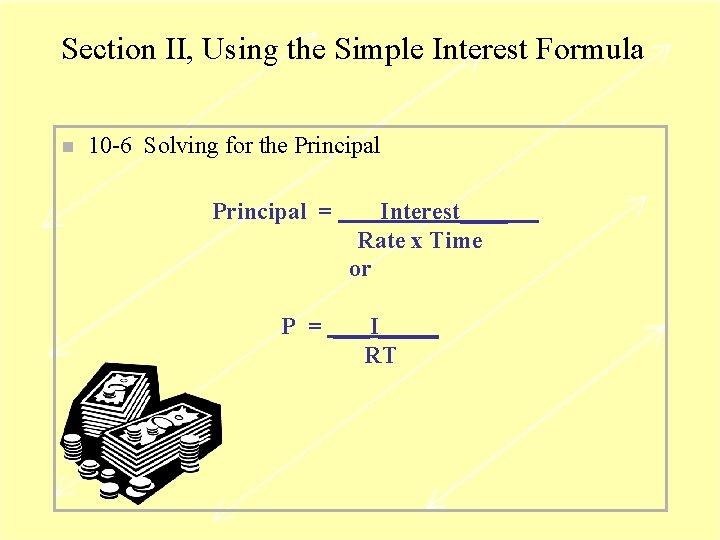
Section II, Using the Simple Interest Formula n 10 -6 Solving for the Principal = Interest____ Rate x Time or P = ___I_____ RT
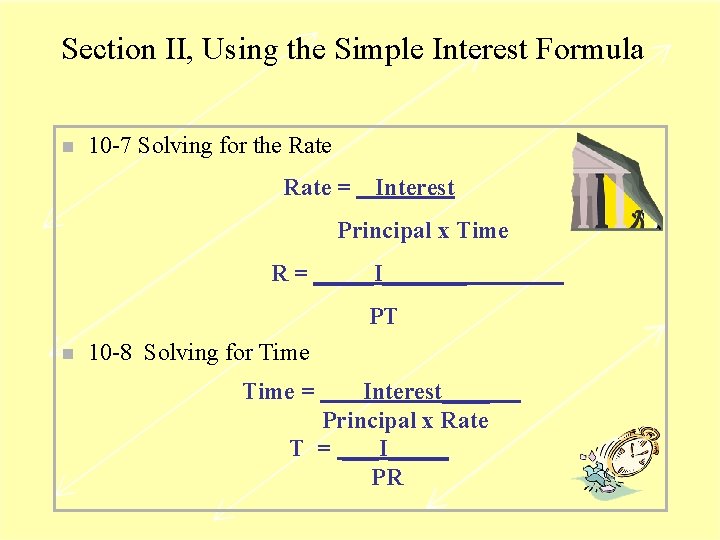
Section II, Using the Simple Interest Formula n 10 -7 Solving for the Rate = Interest Principal x Time R = _____I_______ PT n 10 -8 Solving for Time = Interest____ Principal x Rate T = ___I_____ PR
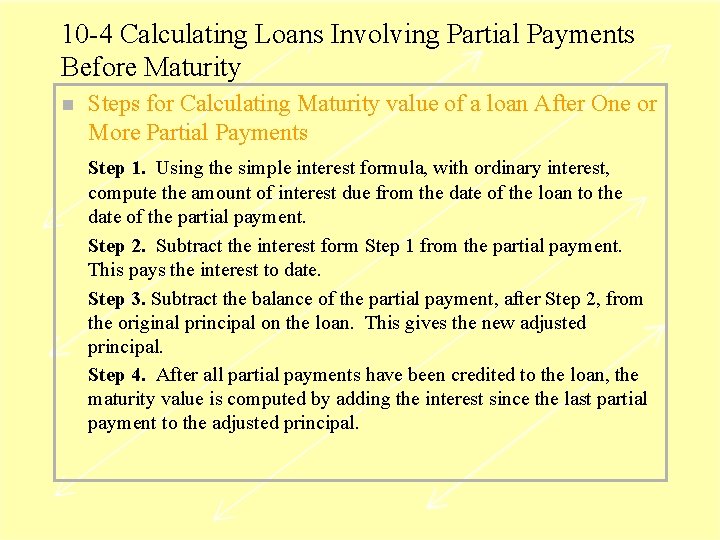
10 -4 Calculating Loans Involving Partial Payments Before Maturity n Steps for Calculating Maturity value of a loan After One or More Partial Payments Step 1. Using the simple interest formula, with ordinary interest, compute the amount of interest due from the date of the loan to the date of the partial payment. Step 2. Subtract the interest form Step 1 from the partial payment. This pays the interest to date. Step 3. Subtract the balance of the partial payment, after Step 2, from the original principal on the loan. This gives the new adjusted principal. Step 4. After all partial payments have been credited to the loan, the maturity value is computed by adding the interest since the last partial payment to the adjusted principal.
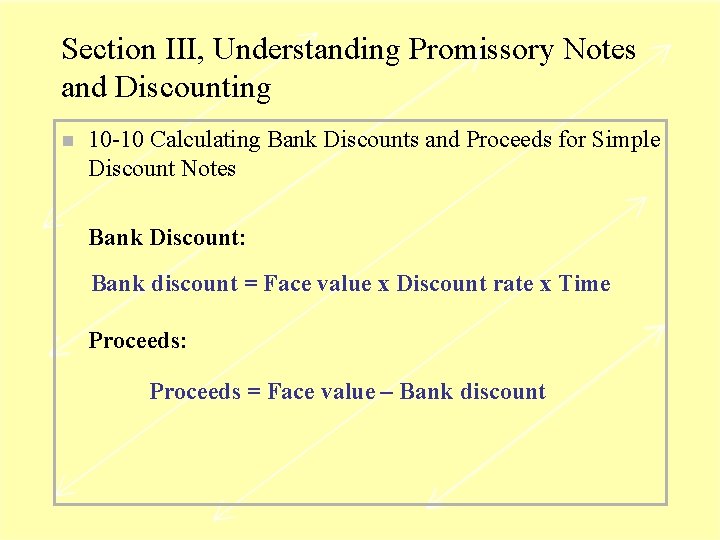
Section III, Understanding Promissory Notes and Discounting n 10 -10 Calculating Bank Discounts and Proceeds for Simple Discount Notes Bank Discount: Bank discount = Face value x Discount rate x Time Proceeds: Proceeds = Face value – Bank discount
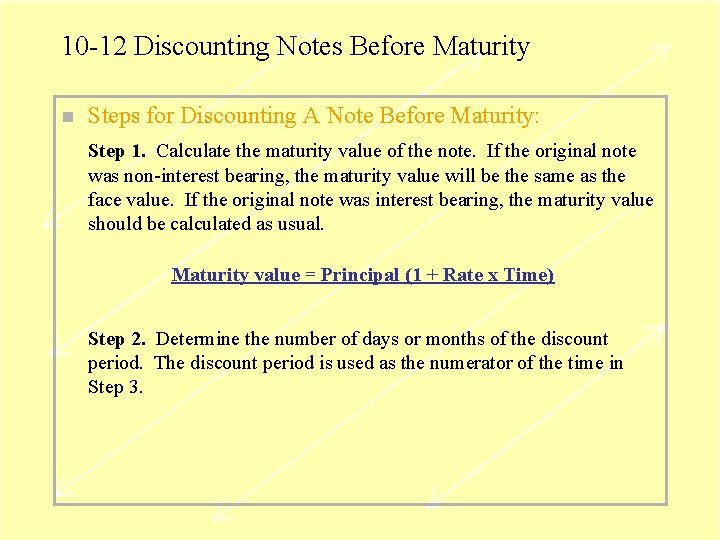
10 -12 Discounting Notes Before Maturity n Steps for Discounting A Note Before Maturity: Step 1. Calculate the maturity value of the note. If the original note was non-interest bearing, the maturity value will be the same as the face value. If the original note was interest bearing, the maturity value should be calculated as usual. Maturity value = Principal (1 + Rate x Time) Step 2. Determine the number of days or months of the discount period. The discount period is used as the numerator of the time in Step 3.
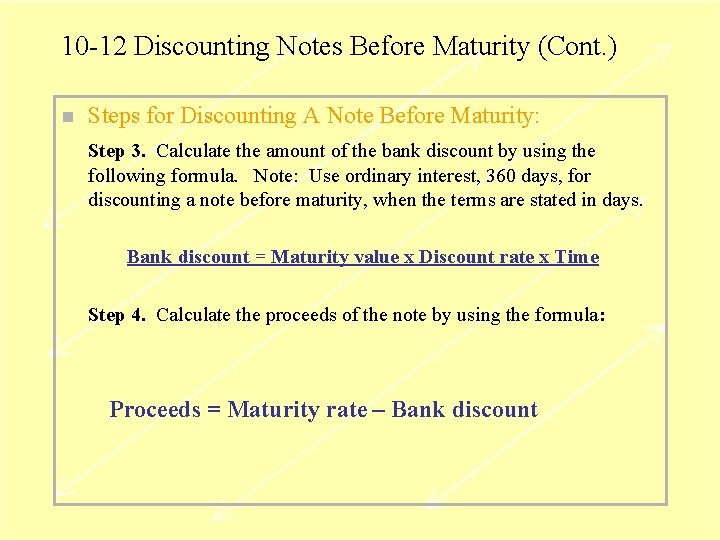
10 -12 Discounting Notes Before Maturity (Cont. ) n Steps for Discounting A Note Before Maturity: Step 3. Calculate the amount of the bank discount by using the following formula. Note: Use ordinary interest, 360 days, for discounting a note before maturity, when the terms are stated in days. Bank discount = Maturity value x Discount rate x Time Step 4. Calculate the proceeds of the note by using the formula: Proceeds = Maturity rate – Bank discount

Everybody’s Business Many companies are forced to extend credit to their business customers due to “competitive pressures, ” not because they want to be in the loan business. Discounting the note at their bank is a way of getting their money sooner.
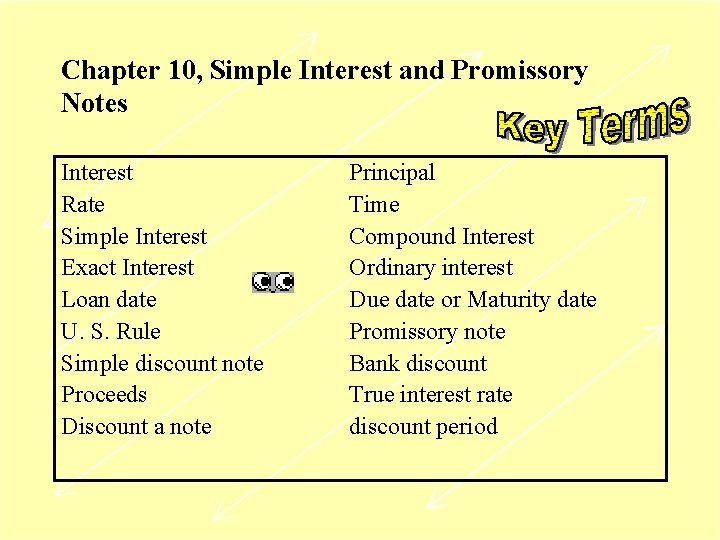
Chapter 10, Simple Interest and Promissory Notes Interest Rate Simple Interest Exact Interest Loan date U. S. Rule Simple discount note Proceeds Discount a note Principal Time Compound Interest Ordinary interest Due date or Maturity date Promissory note Bank discount True interest rate discount period
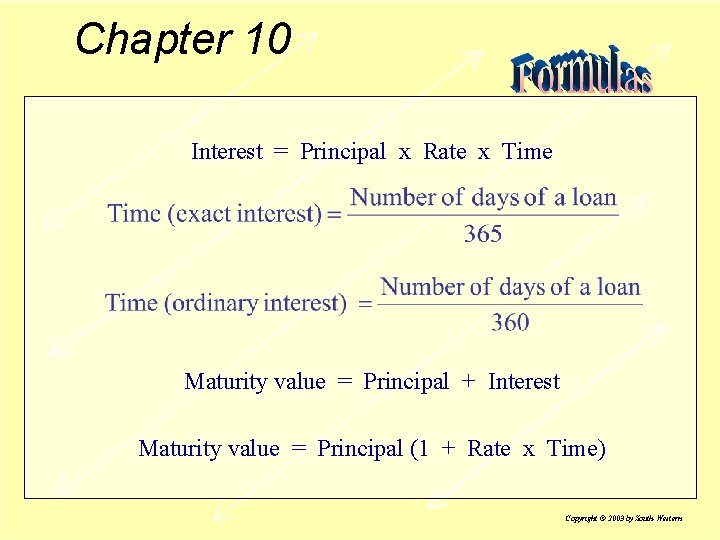
Chapter 10 Interest = Principal x Rate x Time Maturity value = Principal + Interest Maturity value = Principal (1 + Rate x Time) Copyright © 2003 by South-Western
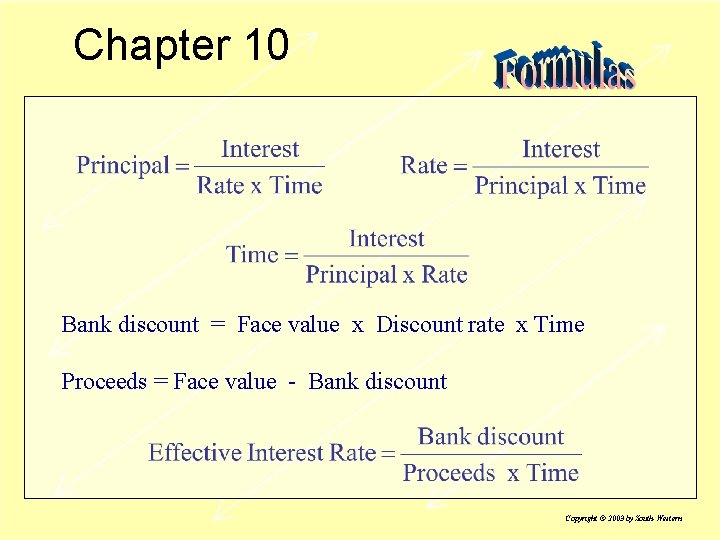
Chapter 10 Bank discount = Face value x Discount rate x Time Proceeds = Face value - Bank discount Copyright © 2003 by South-Western
- Slides: 22