
Business Mathematics MTH367 Lecture 32 Chapter 20 Optimization

Business Mathematics MTH-367 Lecture 32

Chapter 20 Optimization: Functions of Several Variables continued
Last Lecture Summary We covered section 20. 2: Partial Derivatives Started Sec. 20. 3: Optimization of Bivariate Functions • Partial Derivatives of Bivariate Functions • Interpreting Partial Derivatives • Second-Order Partrial Derivatives

Today’s Topics We will continue with Sec. 20. 3: Optimization of Bivariate Functions • Review of Relative Extrema • Distinguishing Critical Points • Test for critical points • Applications of Bivariate Optimization

Optimization of Bivariate Functions We start with the revision of the optimization of bivariate functions, which was introduced in last lecture.
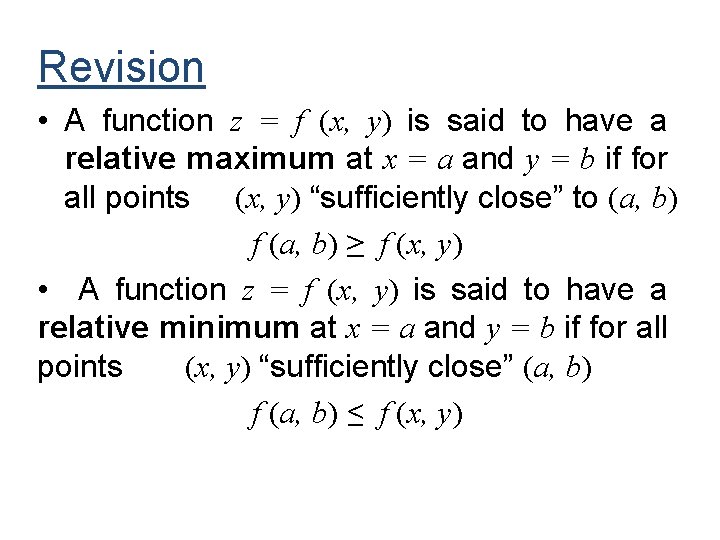
Revision • A function z = f (x, y) is said to have a relative maximum at x = a and y = b if for all points (x, y) “sufficiently close” to (a, b) f (a, b) ≥ f (x, y) • A function z = f (x, y) is said to have a relative minimum at x = a and y = b if for all points (x, y) “sufficiently close” (a, b) f (a, b) ≤ f (x, y)
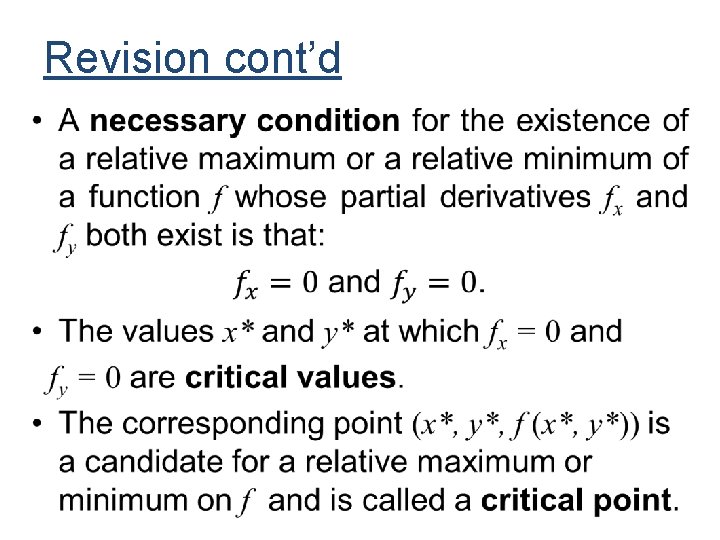
Revision cont’d •

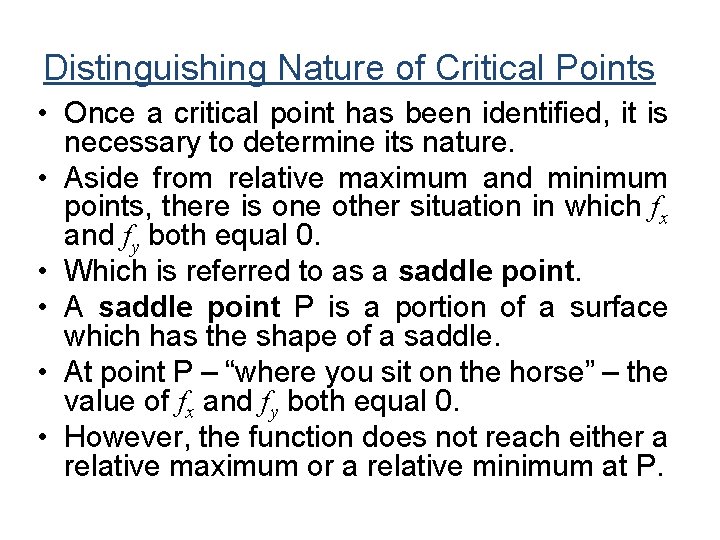
Distinguishing Nature of Critical Points • Once a critical point has been identified, it is necessary to determine its nature. • Aside from relative maximum and minimum points, there is one other situation in which fx and fy both equal 0. • Which is referred to as a saddle point. • A saddle point P is a portion of a surface which has the shape of a saddle. • At point P – “where you sit on the horse” – the value of fx and fy both equal 0. • However, the function does not reach either a relative maximum or a relative minimum at P.
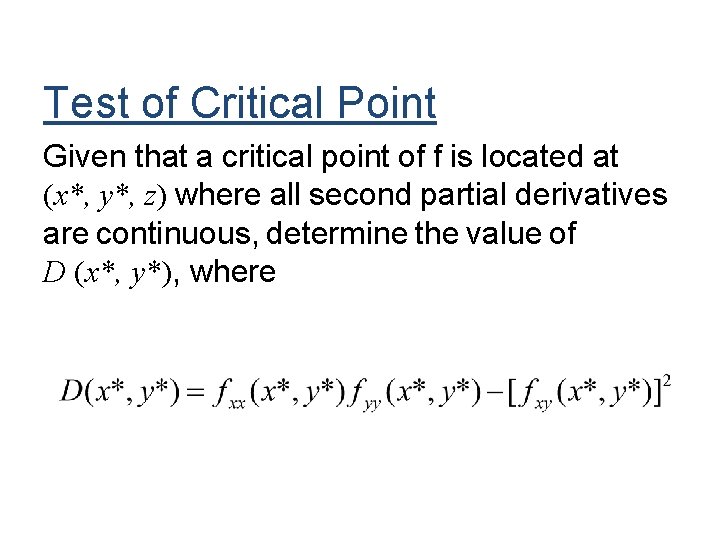
Test of Critical Point Given that a critical point of f is located at (x*, y*, z) where all second partial derivatives are continuous, determine the value of D (x*, y*), where
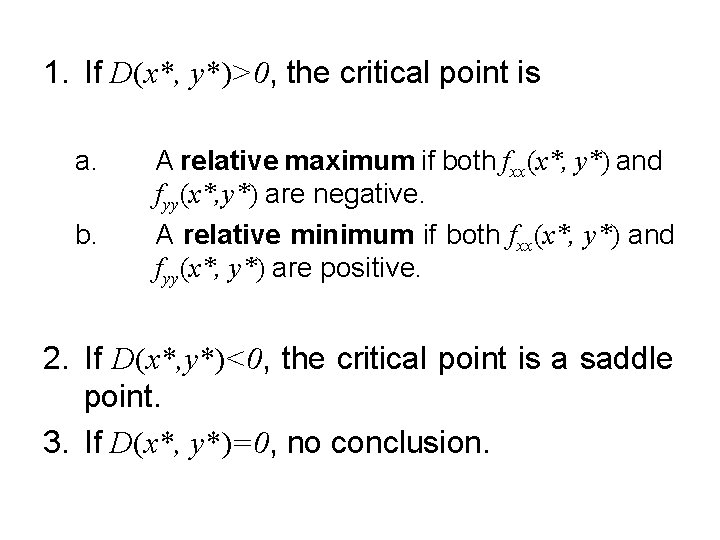
1. If D(x*, y*)>0, the critical point is a. b. A relative maximum if both fxx(x*, y*) and fyy(x*, y*) are negative. A relative minimum if both fxx(x*, y*) and fyy(x*, y*) are positive. 2. If D(x*, y*)<0, the critical point is a saddle point. 3. If D(x*, y*)=0, no conclusion.
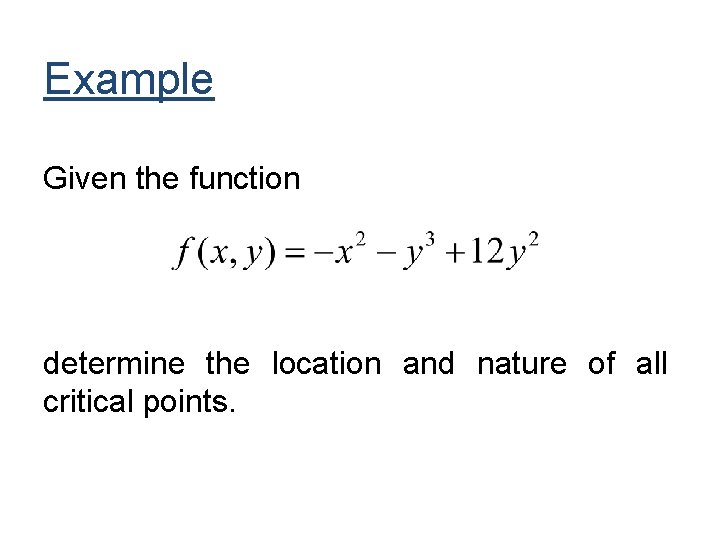
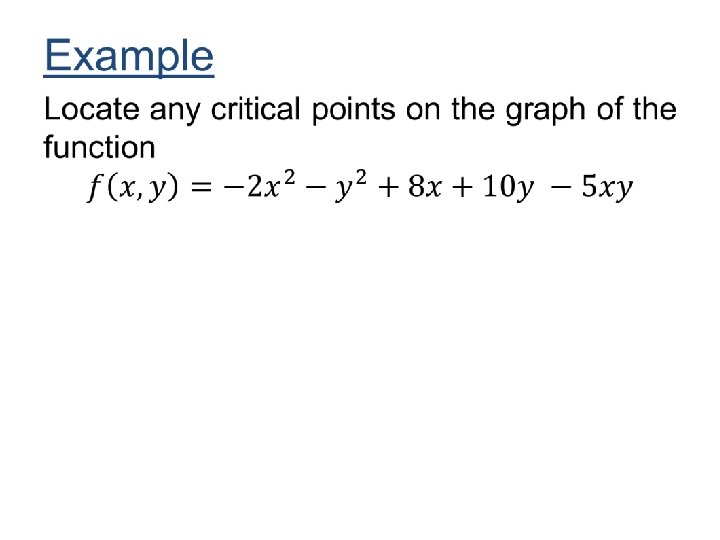
Example Given the function determine the location and nature of all critical points.




Applications of Bivariate Optimization This section presents some applications of the optimization of bivariate functions.
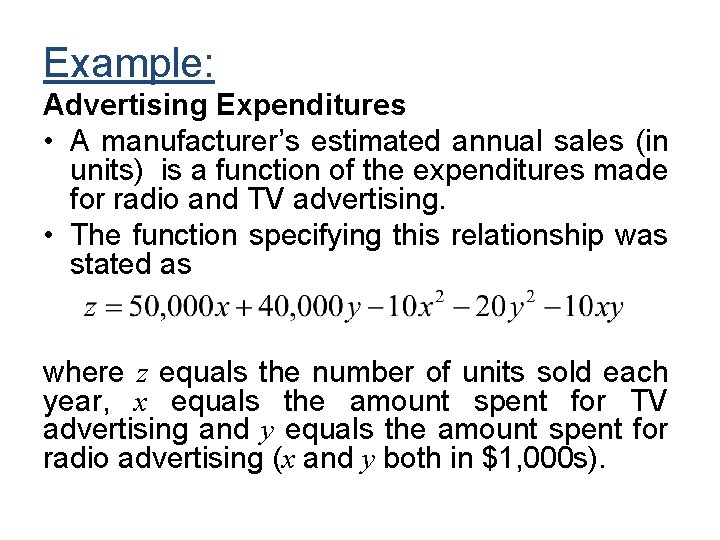
Example: Advertising Expenditures • A manufacturer’s estimated annual sales (in units) is a function of the expenditures made for radio and TV advertising. • The function specifying this relationship was stated as where z equals the number of units sold each year, x equals the amount spent for TV advertising and y equals the amount spent for radio advertising (x and y both in $1, 000 s).

Determine how much money should be spent on TV and radio advertising in order to sell maximum number of units.


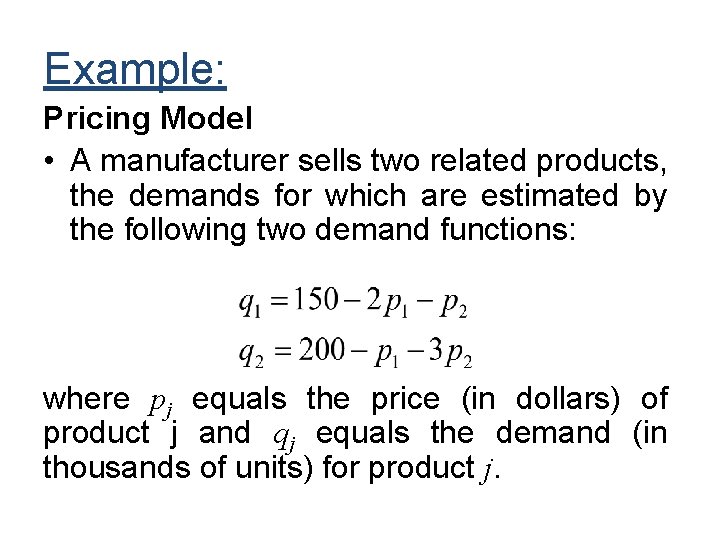
Example: Pricing Model • A manufacturer sells two related products, the demands for which are estimated by the following two demand functions: where pj equals the price (in dollars) of product j and qj equals the demand (in thousands of units) for product j.
• Examination of these demand functions indicates that the two products are related. • The demand for one product depends not only on the price charged for the product itself but also on the price charged for the other product. • The firm wants to determine the price it should charge for each product in order to maximize total revenue from the sale of the two products.
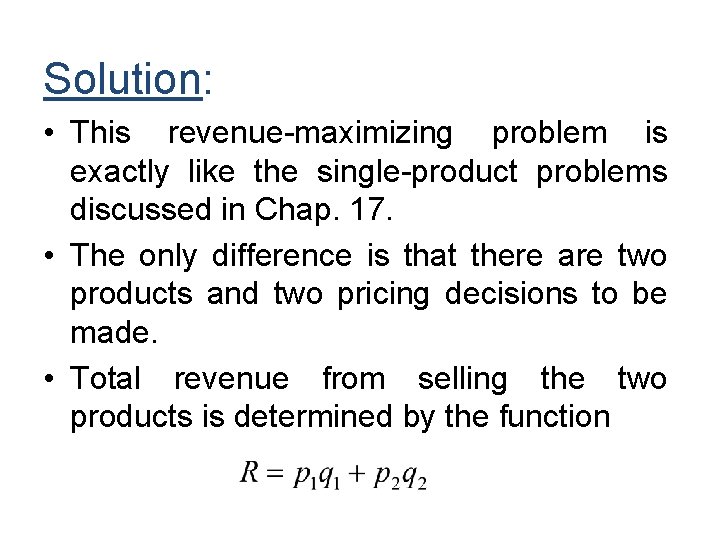
Solution: • This revenue-maximizing problem is exactly like the single-product problems discussed in Chap. 17. • The only difference is that there are two products and two pricing decisions to be made. • Total revenue from selling the two products is determined by the function
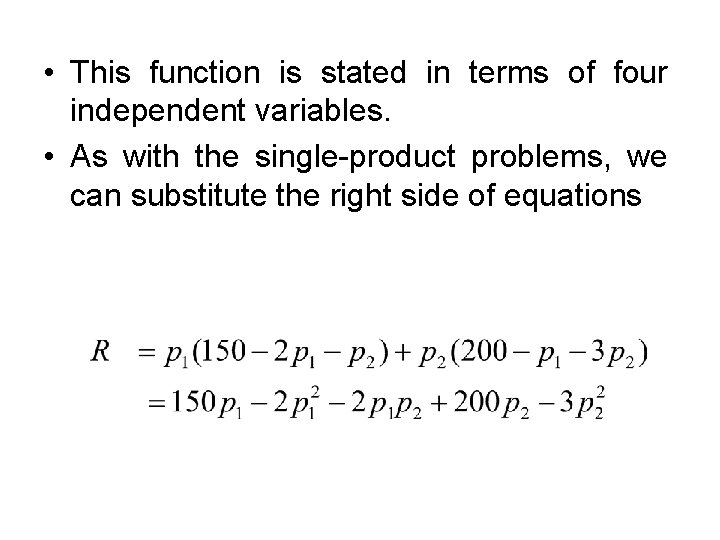
• This function is stated in terms of four independent variables. • As with the single-product problems, we can substitute the right side of equations
We can now proceed to examine the revenue for relative maximum points. The first partial derivatives are


Example: Satellite Clinic Location • A large health maintenance organization (HMO) is planning to locate a satellite clinic in a location which is convenient to three suburban townships. • The relative locations of which are indicated in the Figure. • The HMO wants to select a preliminary site by using the following criterion: Determine the location (x, y) which minimize the sum of the squares of the distances from each township to the satellite clinic.

• Figure
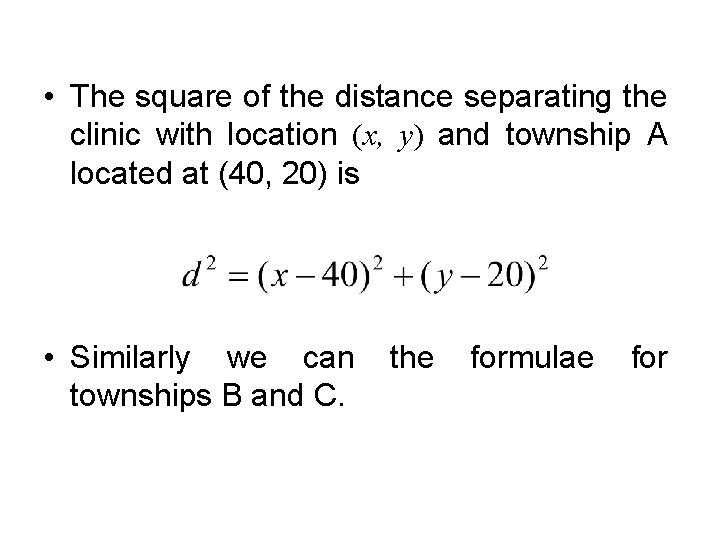
• The square of the distance separating the clinic with location (x, y) and township A located at (40, 20) is • Similarly we can the formulae for townships B and C.
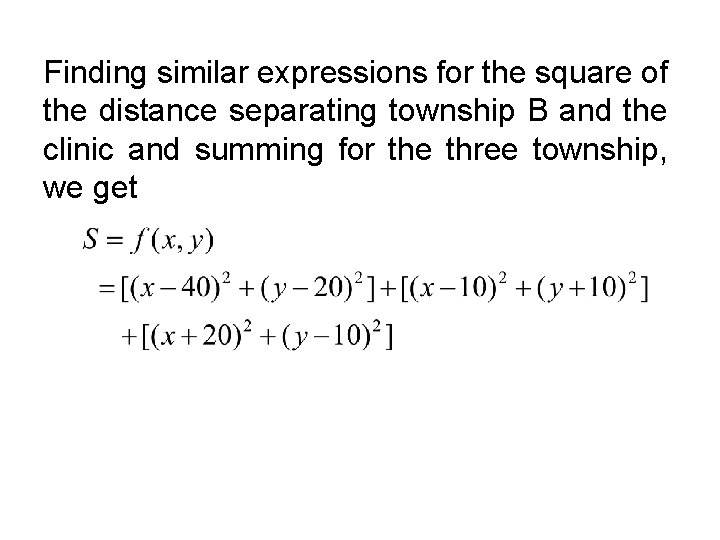
Finding similar expressions for the square of the distance separating township B and the clinic and summing for the three township, we get



Review We covered section 20. 3 and section 20. 4: : Optimization of Bivariate Functions • Critical Points and their types • Relative Maximum and Minimum • Test for critical points • Applications of Bivariate Optimization Finished the material for the course of Business Mathematics MTH-367.
- Slides: 36