ASE Annual Conference Support for your first years


- Slides: 58
ASE Annual Conference: Support for your first years in teaching Julian Clarke Spring 2020
Welcome 2 Copyright © AQA and its licensors. All rights reserved.
This meeting will be recorded Exam boards have an Ofqual requirement to record event audio. Recordings are kept for the lifetime of the specification and not shared as an accompaniment to session resources. The recording will begin now. 3 Copyright © AQA and its licensors. All rights reserved.
Outline for the session • • • 4 Structure of secondary assessment in England What is a specification? Recent reform of qualifications Overview of awarding Our Science papers and mark schemes Our resources Copyright © AQA and its licensors. All rights reserved.
Structure of secondary assessment in England 5 Copyright © AQA and its licensors. All rights reserved.
Secondary assessment in England • ‘The Office of Qualifications and Examinations Regulation (Ofqual) regulates qualifications, examinations and assessments in England. ’* • Independent of government and reports directly to Parliament. • In October 2018, there were over 150 awarding organisations recognised by Ofqual. • Which awarding organisations are involved with GCSE Science in England? *This information is available from: gov. uk/government/organisations/ofqual/about This contains public sector information licensed under the Open Government License v. 3. 0 6 Copyright © AQA and its licensors. All rights reserved.
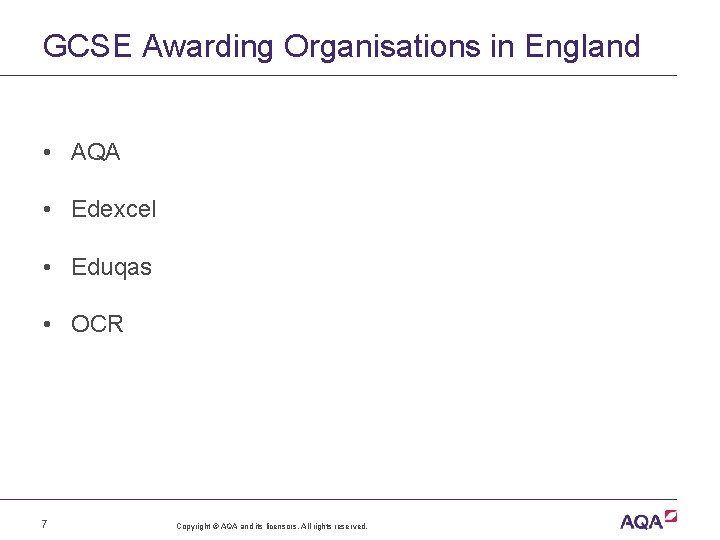
GCSE Awarding Organisations in England • AQA • Edexcel • Eduqas • OCR 7 Copyright © AQA and its licensors. All rights reserved.
Joint Council for Qualifications (JCQ) • Umbrella organisation for all four English Awarding Organisations. • Determines the general rules and regulations which are applied to the conduct of all assessments. 8 Copyright © AQA and its licensors. All rights reserved.
Regulation Department for Education (Df. E) • ‘…is responsible for children’s services and education, including higher and further education policy, apprenticeships and wider skills in England. ’ • Overall responsibility for setting national policy with regard to education: o national curriculum (KS 1 -4) o types of qualifications (GCSE’s, A-levels, Tech Awards etc) including subjects. This information is from gov. uk/government/organisations/department-for-education/about This contains public sector information licensed under the Open Government License v. 3. 0 9 Copyright © AQA and its licensors. All rights reserved.
Regulation Ofqual • Set criteria for qualifications (eg types and duration of assessment). • Regulate the day-to-day activity of the Awarding Organisations: o awarding and standards o malpractice o ensuring that we are telling centres is fair and equitable o conflicts of interest (eg examiners who write text books/teachers that write assessments). 10 Copyright © AQA and its licensors. All rights reserved.
Df. E subject content • Subject content is the minimum content that must be in a subject specification; for GCSE science, this: o considers overlaps with Science Po. S (KS 1 -4) o provides continuity and progression to AS/A-level. • Subject content is owned by the Df. E. • Df. E subject content for GCSE and A-level Science was produced in consultation with Ofqual, all four AOs and key stakeholders (ASE, RSB, RSC, IOP etc). 11 Version 3. 0 Copyright © AQA and its licensors. All rights reserved.
Df. E subject content • If any organisation wishes to produce a GCSE or A-level Science qualification which is recognised for performance table points, they must: o use the Df. E subject content o be accredited by Ofqual (subject level guidance). 12 Version 3. 0 Copyright © AQA and its licensors. All rights reserved.
What is a specification? 13 Copyright © AQA and its licensors. All rights reserved.
What is a specification? • Each Awarding Organisation creates its own unique subject specification. • Specifications for a subject must be based on the Df. E subject content. 14 Copyright © AQA and its licensors. All rights reserved.
What is a specification? • The specification outlines: o details of the assessments o subject content to be taught o administration relating to the specification. • Ofqual: o accredit the specification for teaching in England o regulate the operation of the specification. 15 Copyright © AQA and its licensors. All rights reserved.
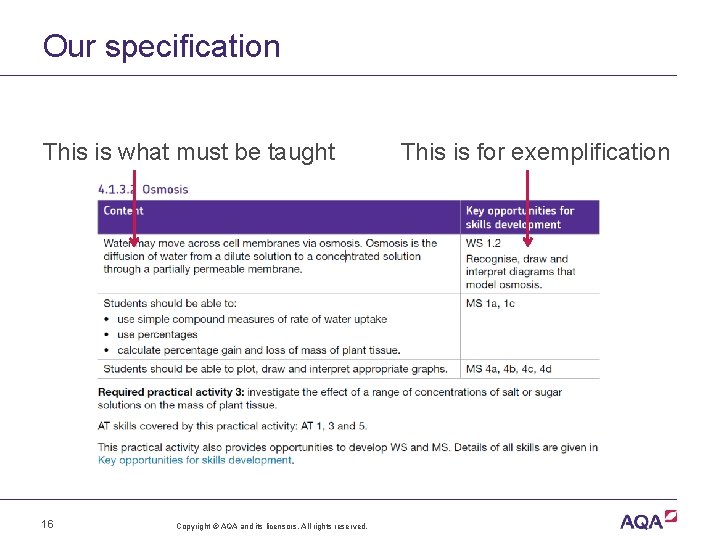
Our specification This is what must be taught 16 Copyright © AQA and its licensors. All rights reserved. This is for exemplification
Our specification For teaching purposes: • the specification is the definitive document • all content will be covered over a set period of time • assessments are based on the content of the specification only. 17 Copyright © AQA and its licensors. All rights reserved.
Recent reforms of qualifications 18 Copyright © AQA and its licensors. All rights reserved.
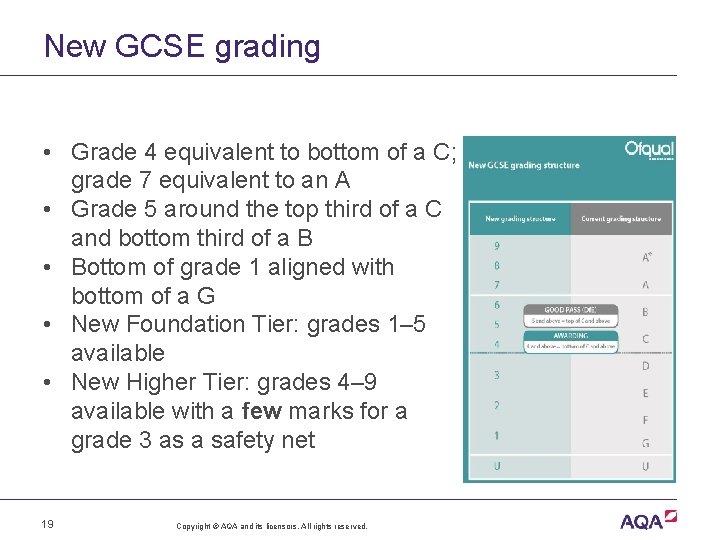
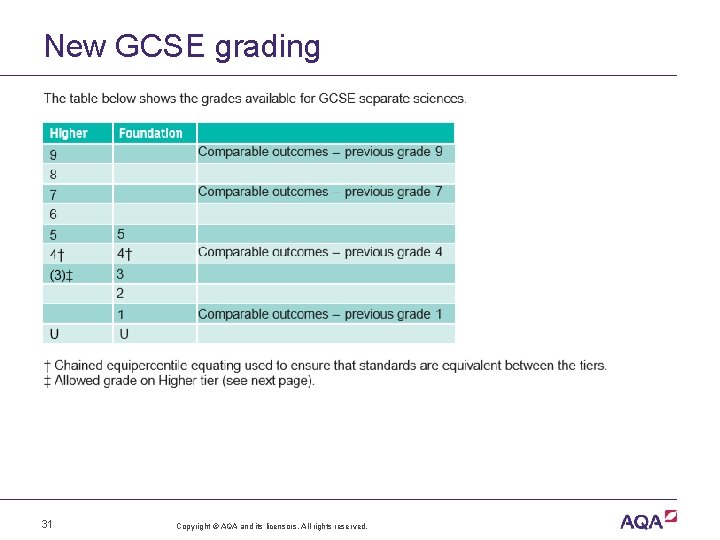
New GCSE grading • Grade 4 equivalent to bottom of a C; grade 7 equivalent to an A • Grade 5 around the top third of a C and bottom third of a B • Bottom of grade 1 aligned with bottom of a G • New Foundation Tier: grades 1– 5 available • New Higher Tier: grades 4– 9 available with a few marks for a grade 3 as a safety net 19 Copyright © AQA and its licensors. All rights reserved.
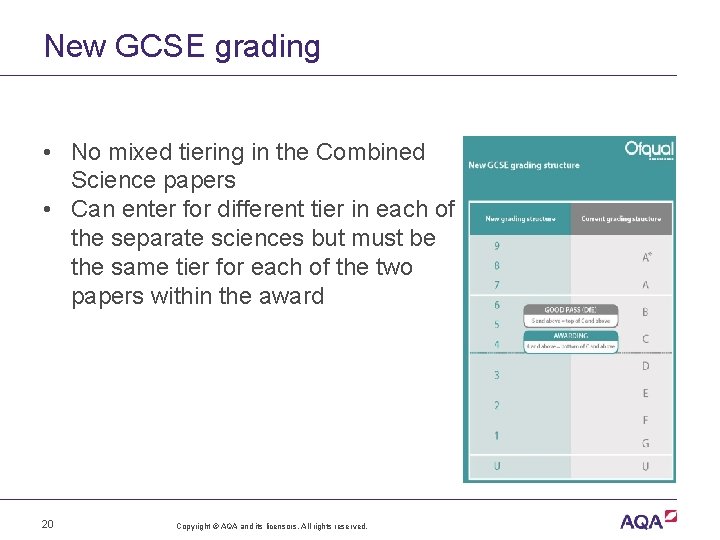
New GCSE grading • No mixed tiering in the Combined Science papers • Can enter for different tier in each of the separate sciences but must be the same tier for each of the two papers within the award 20 Copyright © AQA and its licensors. All rights reserved.
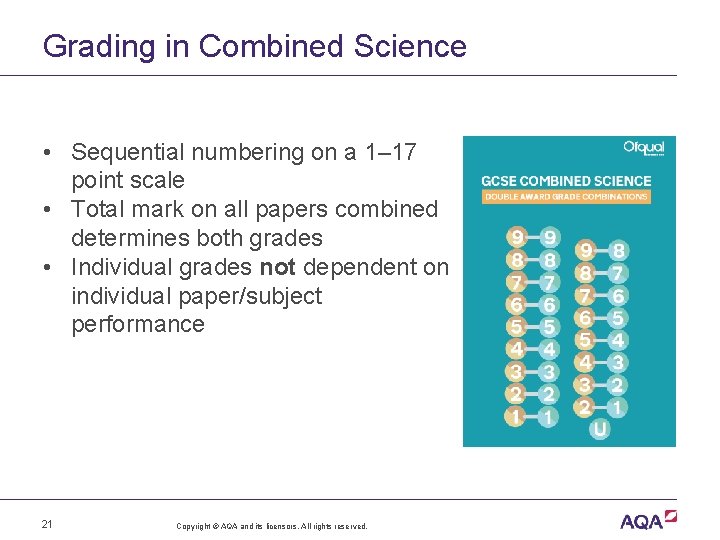
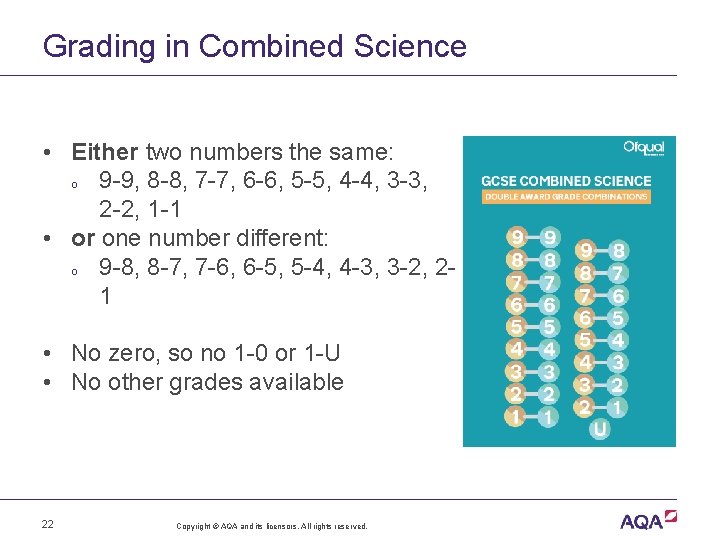
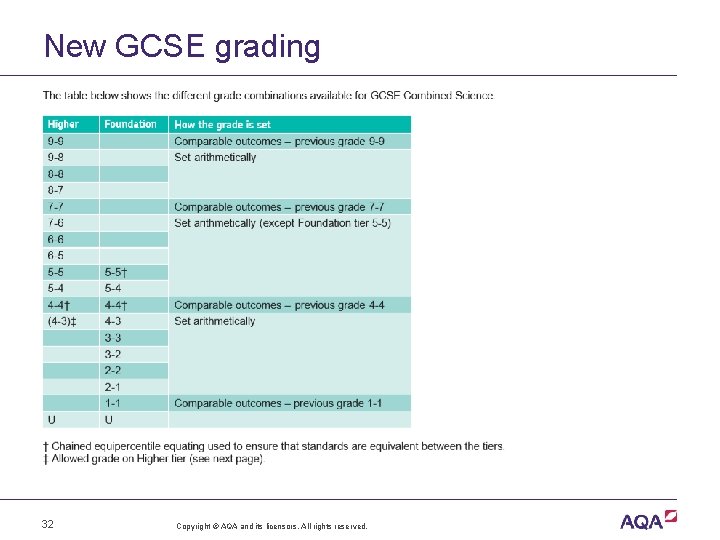
Grading in Combined Science • Sequential numbering on a 1– 17 point scale • Total mark on all papers combined determines both grades • Individual grades not dependent on individual paper/subject performance 21 Copyright © AQA and its licensors. All rights reserved.
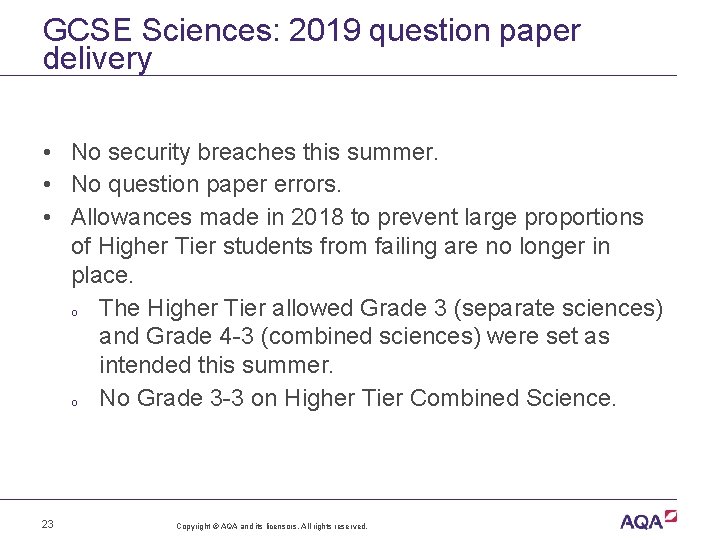
Grading in Combined Science • Either two numbers the same: o 9 -9, 8 -8, 7 -7, 6 -6, 5 -5, 4 -4, 3 -3, 2 -2, 1 -1 • or one number different: o 9 -8, 8 -7, 7 -6, 6 -5, 5 -4, 4 -3, 3 -2, 21 • No zero, so no 1 -0 or 1 -U • No other grades available 22 Copyright © AQA and its licensors. All rights reserved.
GCSE Sciences: 2019 question paper delivery • No security breaches this summer. • No question paper errors. • Allowances made in 2018 to prevent large proportions of Higher Tier students from failing are no longer in place. o The Higher Tier allowed Grade 3 (separate sciences) and Grade 4 -3 (combined sciences) were set as intended this summer. o No Grade 3 -3 on Higher Tier Combined Science. 23 Copyright © AQA and its licensors. All rights reserved.
The awarding process 24 Copyright © AQA and its licensors. All rights reserved.
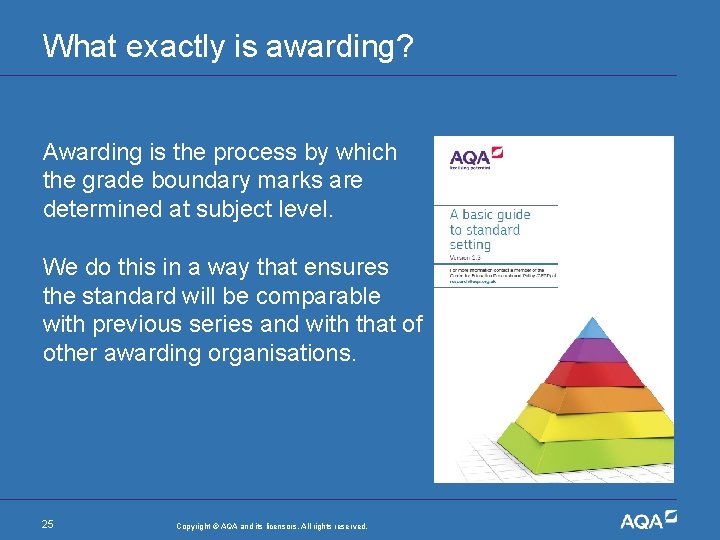
What exactly is awarding? Awarding is the process by which the grade boundary marks are determined at subject level. We do this in a way that ensures the standard will be comparable with previous series and with that of other awarding organisations. 25 Copyright © AQA and its licensors. All rights reserved.
Getting the right grade – assessments • Every answer in a written exam paper is marked by us. • Papers are either traditionally marked (the examiner sees a full script) or electronically marked (the examiner marks single questions). • We employ over 23, 000 examiners during the summer period. • We mark over 2, 000 scripts each year. • Marking starts in late April and must be completed by 7 August. 26 Copyright © AQA and its licensors. All rights reserved.
Getting the right grade – awarding • Every year an awarding committee meet to determine the grade boundaries for a qualification. • The determination is based on statistical evidence and examiner judgement. • Statistics are collected across all awarding organisations for a subject; this ensures that the subject outcomes are comparable. 27 Copyright © AQA and its licensors. All rights reserved.
Getting the right grade – awarding • Decisions are made on key boundaries: o GCSE: 7, 4 and 1 o GCE: A and E. • Written exam marks can fluctuate year on year; this allows us to deal with differences in demand of the written assessment. 28 Copyright © AQA and its licensors. All rights reserved.
How is a grade boundary decided? The ‘statistical’ element Our Centre for Education Research and Compliance (CERP) use a range of statistics to make predictions which suggest the most appropriate statistically recommended grade boundaries. These are based on how comparable students have performed in previous series, KS 2 data and matched data. 29 Copyright © AQA and its licensors. All rights reserved.
How is a grade boundary decided? The ‘judgemental’ element The awarding meeting uses a balance of judgemental and statistical evidence to make recommendations. The committee will look at a range of scripts for each ‘judgemental grade boundary’ (7, 4 and 1 for GCSE). 30 Copyright © AQA and its licensors. All rights reserved.
New GCSE grading 31 Copyright © AQA and its licensors. All rights reserved.
New GCSE grading 32 Copyright © AQA and its licensors. All rights reserved.
Our Science papers and mark schemes 33 Copyright © AQA and its licensors. All rights reserved.
Key points for successful assessment design • Good mark schemes are at the heart of the validity of the assessment and the reliability of marking. • When writing questions it is important to consider how to avoid mark compression, for example by ensuring questions are distinct and by encouraging examiners to use the full mark range. • Avoid double jeopardy (ie students must know the answer to one question in order to answer the next). 34 Copyright © AQA and its licensors. All rights reserved.
Key points for successful assessment design • Question content must be mapped to the specification. • Questions should be perfectly aligned with their mark schemes. • Students should be able to access all available marks. 35 Copyright © AQA and its licensors. All rights reserved.
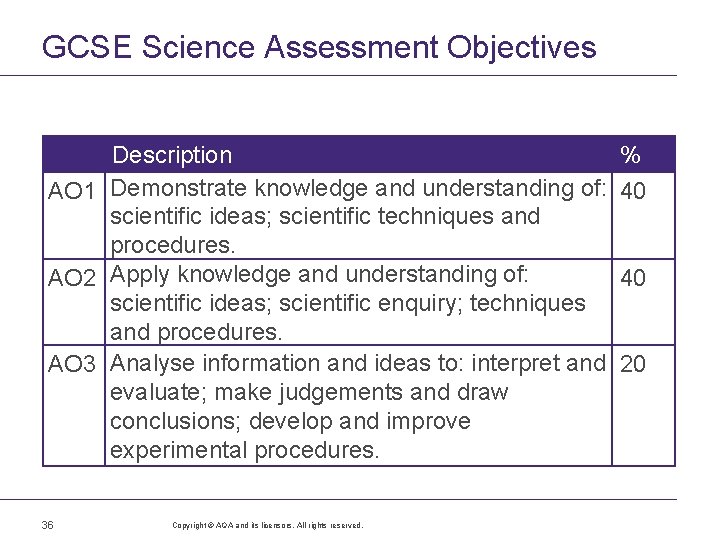
GCSE Science Assessment Objectives Description AO 1 Demonstrate knowledge and understanding of: scientific ideas; scientific techniques and procedures. AO 2 Apply knowledge and understanding of: scientific ideas; scientific enquiry; techniques and procedures. AO 3 Analyse information and ideas to: interpret and evaluate; make judgements and draw conclusions; develop and improve experimental procedures. 36 Copyright © AQA and its licensors. All rights reserved. % 40 40 20
Level of demand in GCSE Science papers H 9 High demand 60% F 5 40% 4 3 60% Standard demand 30% common marks 6 5 40% Foundation Tier: 60% low demand 40% standard demand Higher Tier: 40% standard demand 60% high demand 15% of marks assess practical skills Low demand 1 Copyright © AQA and its licensors. All rights reserved. 37 4 Assessment structure of the Trilogy, Synergy and Separate sciences specs Combined Science: 20% of marks assess maths skills – covering all 3 levels of demand B-10%, C-20%, P-30%
Assessing equations at different demand levels • • Recall Application Recall and application Use of Physics Equations Sheet Copyright © AQA and its licensors. All rights reserved. 38
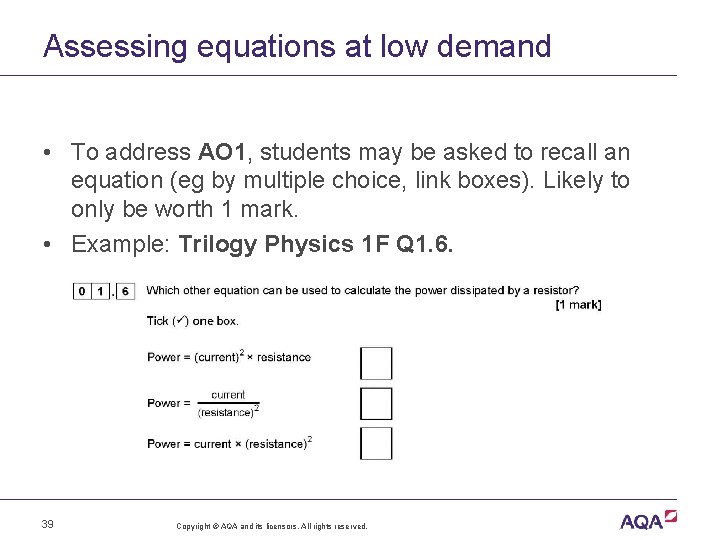
Assessing equations at low demand • To address AO 1, students may be asked to recall an equation (eg by multiple choice, link boxes). Likely to only be worth 1 mark. • Example: Trilogy Physics 1 F Q 1. 6. 39 Copyright © AQA and its licensors. All rights reserved.
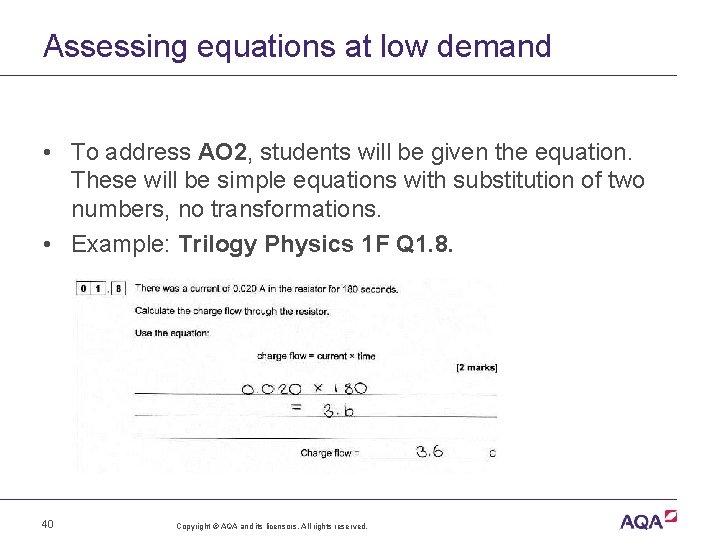
Assessing equations at low demand • To address AO 2, students will be given the equation. These will be simple equations with substitution of two numbers, no transformations. • Example: Trilogy Physics 1 F Q 1. 8. 40 Copyright © AQA and its licensors. All rights reserved.
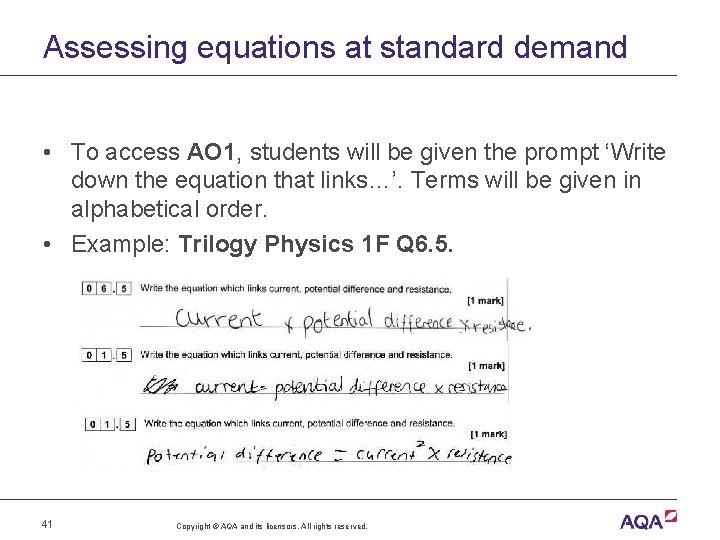
Assessing equations at standard demand • To access AO 1, students will be given the prompt ‘Write down the equation that links…’. Terms will be given in alphabetical order. • Example: Trilogy Physics 1 F Q 6. 5. 41 Copyright © AQA and its licensors. All rights reserved.
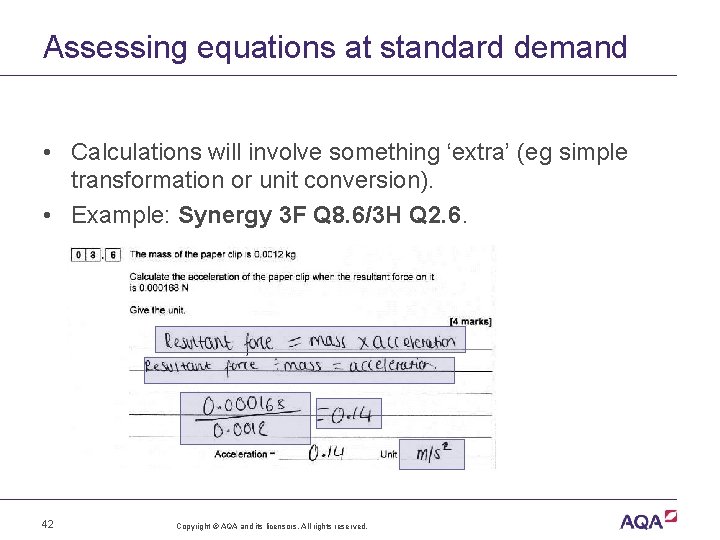
Assessing equations at standard demand • Calculations will involve something ‘extra’ (eg simple transformation or unit conversion). • Example: Synergy 3 F Q 8. 6/3 H Q 2. 6. 42 Copyright © AQA and its licensors. All rights reserved.
Assessing equations at high demand • No prompt is given about which equation to use. • There are no marks simply for writing the equation down without doing something with it (so no AO 1). • Questions will involve transformations or ‘something extra’. • At highest demand (target grades 8 9) questions will include complex equations, transformations and multiple steps. 43 Copyright © AQA and its licensors. All rights reserved.
Our Science papers and mark schemes Making questions clear • • 44 Command words Avoiding repetition or unnecessary information Answer line prompts Use of bold Copyright © AQA and its licensors. All rights reserved.
Our Science papers and mark schemes Our exams explained • • • 45 Ramping of demand Question scaffolding Multiple choice Calculations Extended response Copyright © AQA and its licensors. All rights reserved.
Resources 46 Copyright © AQA and its licensors. All rights reserved.
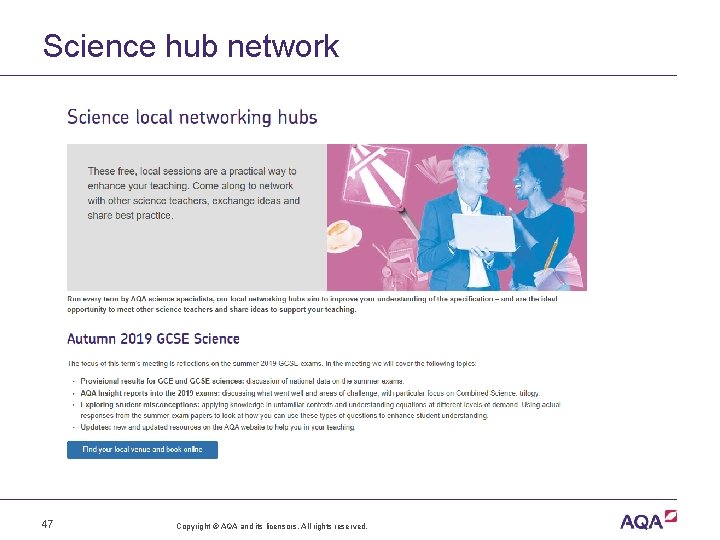
Science hub network 47 Copyright © AQA and its licensors. All rights reserved.
Resources Visit our website for a range of science resources, including: • • 48 specifications past papers schemes of work practical Handbooks. Copyright © AQA and its licensors. All rights reserved.
Become an examiner/moderator • Complements your teaching • Boost your career/CV while increasing your personal development • Gain a clearer understanding of our mark schemes and assessment process • Inspire your teaching • Network with fellow professionals • Raise your students’ attainment • Earn extra income with all the convenience of home working 49 Copyright © AQA and its licensors. All rights reserved.
Enhanced Results Analysis • Free service, available through e-AQA • Review school, class and individual student performance • Make comparisons with whole AQA cohort • Identify skills or topics that were challenging so that you can address this with later year groups • Download data for your own analysis 50 Copyright © AQA and its licensors. All rights reserved.
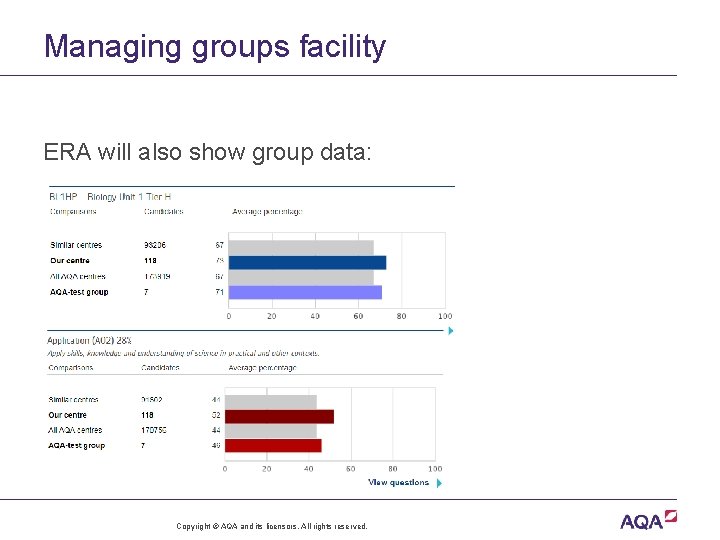
Managing groups facility ERA will also show group data: Copyright © AQA and its licensors. All rights reserved.
Updates • Updates to GCSE specifications on website: o minor corrections and clarifications o copy of amendments list given in booklet. • Assessment resources on Exampro: o 2018 papers now in question bank o 2019 Extended response question highlights o MERi. T analysis for 2019 mocks o KS 3 -4 transition tests. • A-level Environmental Science Practical Handbook. • GCSE Science modular training materials. 52 Copyright © AQA and its licensors. All rights reserved.
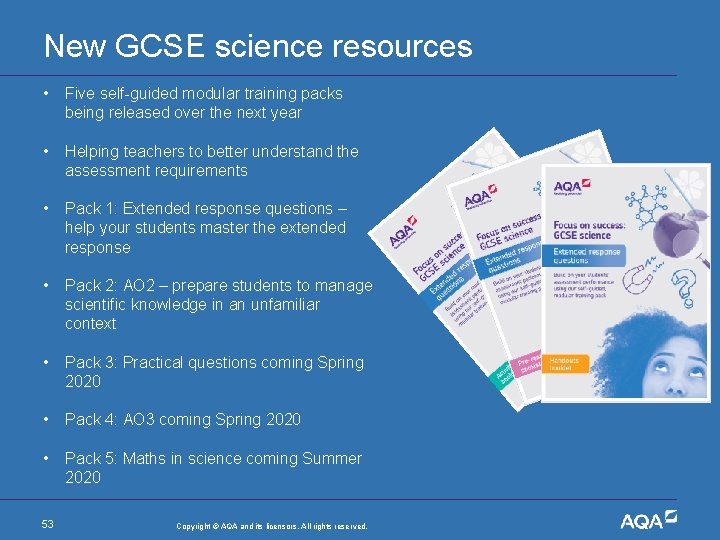
New GCSE science resources • Five self-guided modular training packs being released over the next year • Helping teachers to better understand the assessment requirements • Pack 1: Extended response questions – help your students master the extended response • Pack 2: AO 2 – prepare students to manage scientific knowledge in an unfamiliar context • Pack 3: Practical questions coming Spring 2020 • Pack 4: AO 3 coming Spring 2020 • Pack 5: Maths in science coming Summer 2020 53 Copyright © AQA and its licensors. All rights reserved.
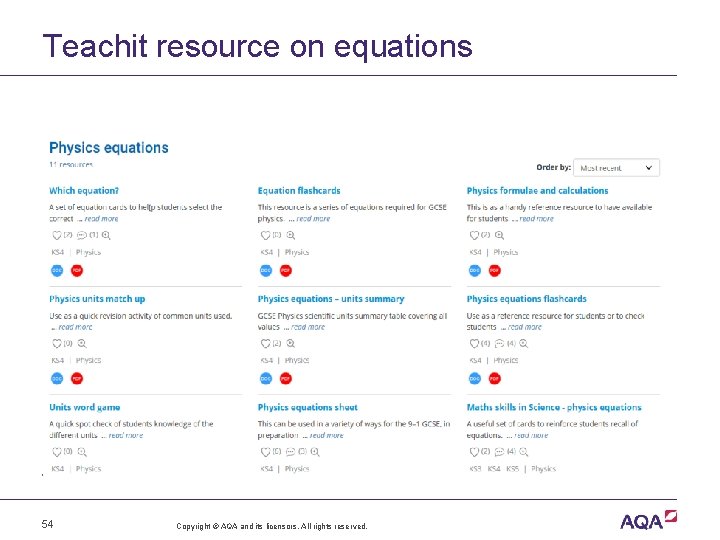
Teachit resource on equations www. teachitscience. co. uk/ks 4 -physics/physics-equations/tags/4282 54 Copyright © AQA and its licensors. All rights reserved.
Any questions? 55 Copyright © AQA and its licensors. All rights reserved.
How did we do? • Please rate this session on the Sched Conference app. • Using the postcards provided, please write: o one thing you enjoyed about our session or will take away for your teaching o one thing you feel could be improved. • Please hand your postcard in as you leave. 56 Copyright © AQA and its licensors. All rights reserved.
Get in touch For qualification information, resources and support, please visit: aqa. org. uk/science Enquiries: Tel: 01483 477 756 Email: gcsescience@aqa. org. uk alevelscience@aqa. org. uk 57 Copyright © AQA and its licensors. All rights reserved.
Thank you 58 Copyright © AQA and its licensors. All rights reserved. Follow us on Twitter @AQACPD