NACADA Annual Conference 2015 CRITICAL ADVISING An Approach

- Slides: 20
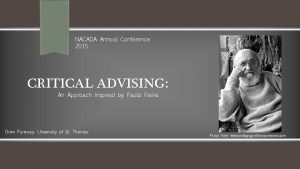
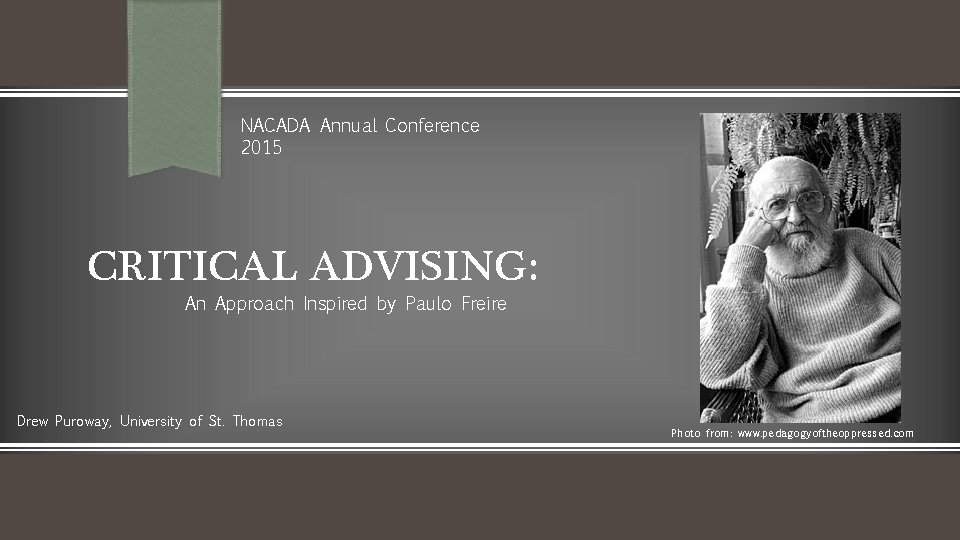
NACADA Annual Conference 2015 CRITICAL ADVISING: An Approach Inspired by Paulo Freire Drew Puroway, University of St. Thomas Photo from: www. pedagogyoftheoppressed. com
What is your dream for humanity? Why do you roll out of bed each morning and do the work of advising?
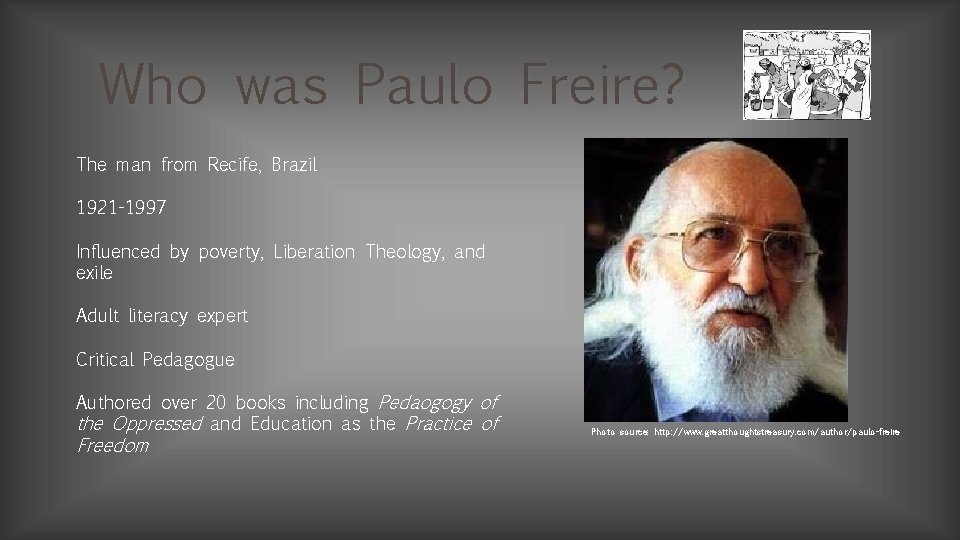
Who was Paulo Freire? The man from Recife, Brazil 1921 -1997 Influenced by poverty, Liberation Theology, and exile Adult literacy expert Critical Pedagogue Authored over 20 books including Pedaogogy of the Oppressed and Education as the Practice of Freedom Photo source: http: //www. greatthoughtstreasury. com/author/paulo-freire
What is Critical Theory/critical theory? Horkheimer : “critical theory is adequate only if it meets three criteria: it must be explanatory, practical, and normative, all at the same time. That is, it must explain what is wrong with current social reality, identify the actors to change it, and provide both clear norms for criticism and achievable practical goals for social transformation. ” -as cited in Bohman (2015) Critical Pedagogy ala Freire: 1) That it takes a clear position on human action – that it is necessary for liberation 2) Action is a form of knowledge 3) Critical theories are reflective rather than natural science theories which are objectifying Critical literacy ala Shor: "Habits of thought, reading, writing, and speaking which go beneath surface meaning, first impressions, dominant myths, official pronouncements, traditional clichés, received wisdom, and mere opinions, to understand the deep meaning, root causes, social context, ideology, and personal consequences of any action, event, object, process, organization, experience, text, subject matter, policy, mass media, or discourse. " (Empowering Education, 1992, p. 129)
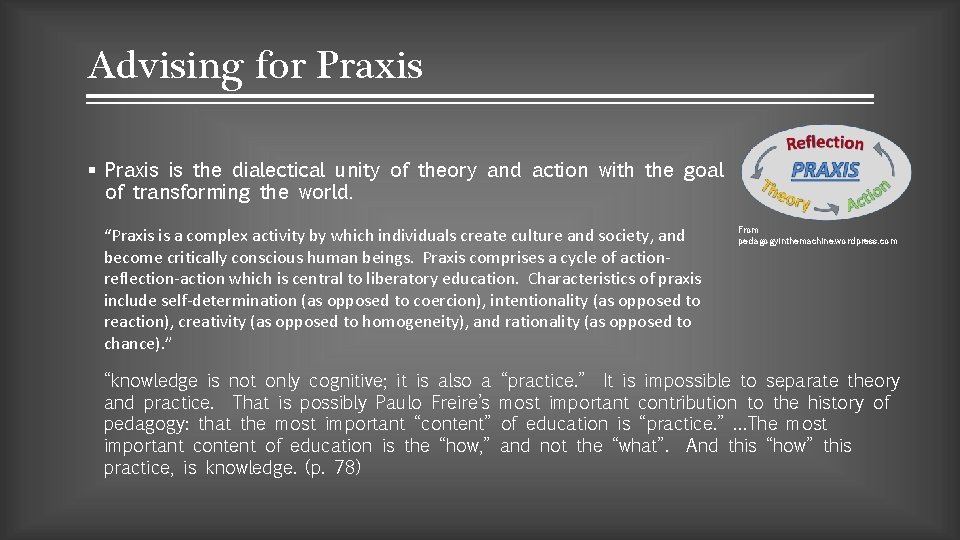
Advising for Praxis § Praxis is the dialectical unity of theory and action with the goal of transforming the world. “Praxis is a complex activity by which individuals create culture and society, and become critically conscious human beings. Praxis comprises a cycle of actionreflection-action which is central to liberatory education. Characteristics of praxis include self-determination (as opposed to coercion), intentionality (as opposed to reaction), creativity (as opposed to homogeneity), and rationality (as opposed to chance). ” “knowledge is not only cognitive; it is also a and practice. That is possibly Paulo Freire’s pedagogy: that the most important “content” important content of education is the “how, ” practice, is knowledge. (p. 78) From pedagogyinthemachine. wordpress. com “practice. ” It is impossible to separate theory most important contribution to the history of of education is “practice. ” …The most and not the “what”. And this “how” this
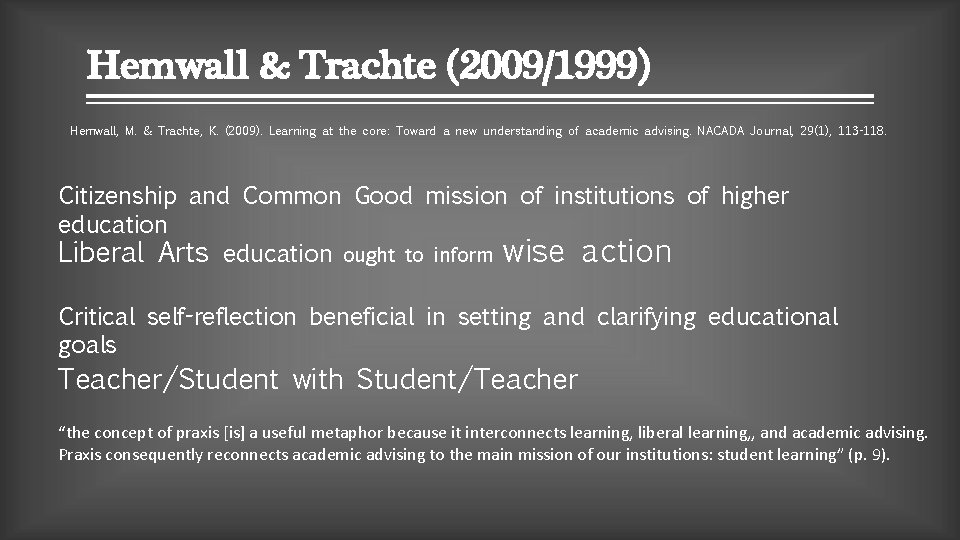
Hemwall & Trachte (2009/1999) Hemwall, M. & Trachte, K. (2009). Learning at the core: Toward a new understanding of academic advising. NACADA Journal, 29(1), 113 -118. Citizenship and Common Good mission of institutions of higher education Liberal Arts education ought to inform wise action Critical self-reflection beneficial in setting and clarifying educational goals Teacher/Student with Student/Teacher “the concept of praxis [is] a useful metaphor because it interconnects learning, liberal learning, , and academic advising. Praxis consequently reconnects academic advising to the main mission of our institutions: student learning” (p. 9).
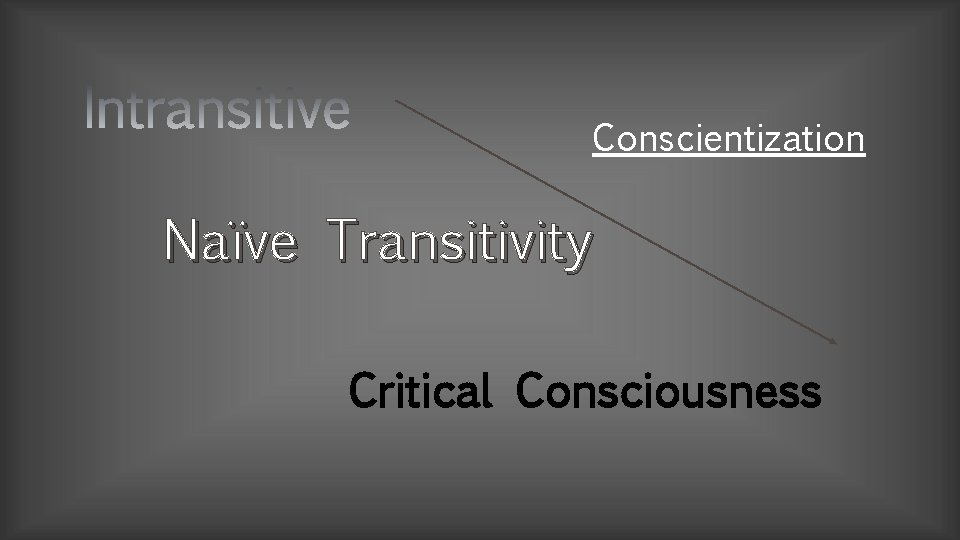
Conscientization Naïve Transitivity Critical Consciousness
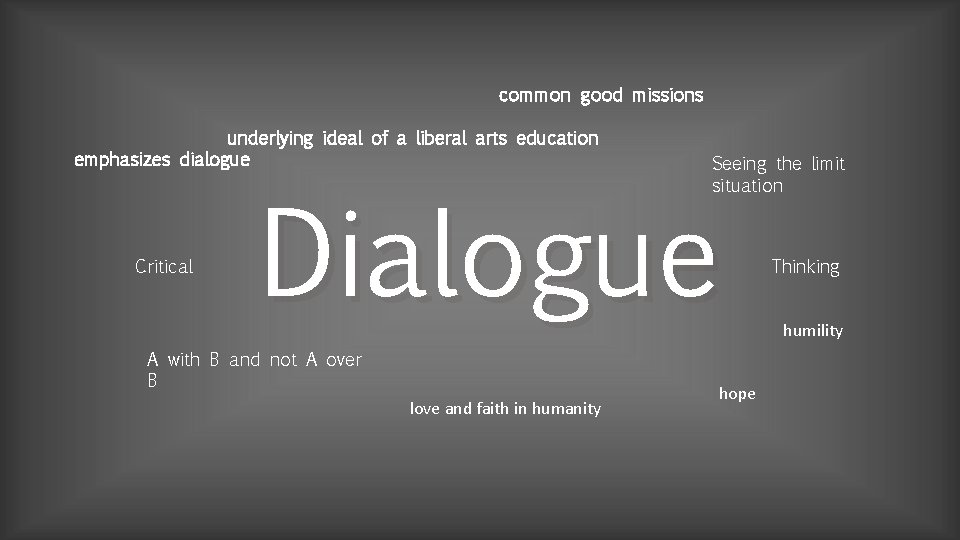
common good missions underlying ideal of a liberal arts education emphasizes dialogue Critical Seeing the limit situation Dialogue A with B and not A over B love and faith in humanity hope Thinking humility
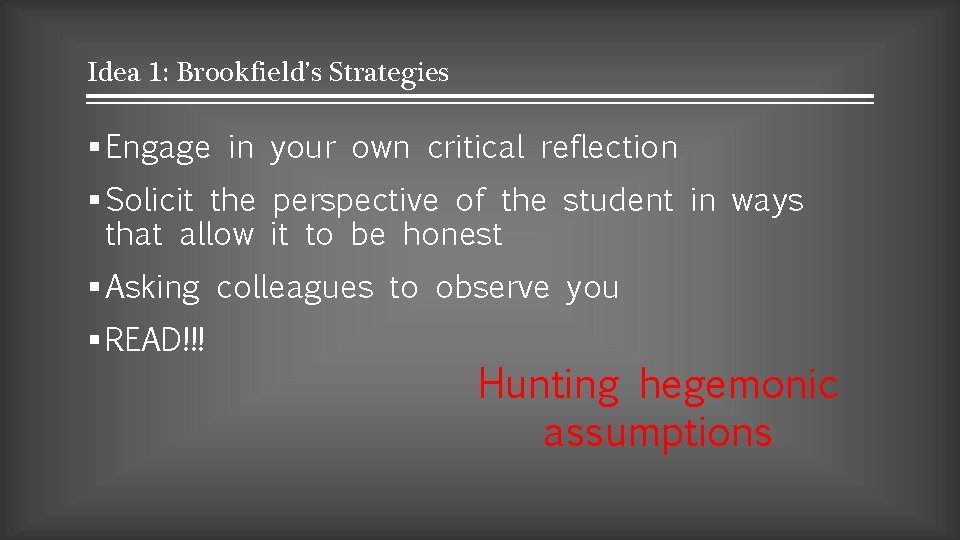
Idea 1: Brookfield’s Strategies § Engage in your own critical reflection § Solicit the perspective of the student in ways that allow it to be honest § Asking colleagues to observe you § READ!!! Hunting hegemonic assumptions
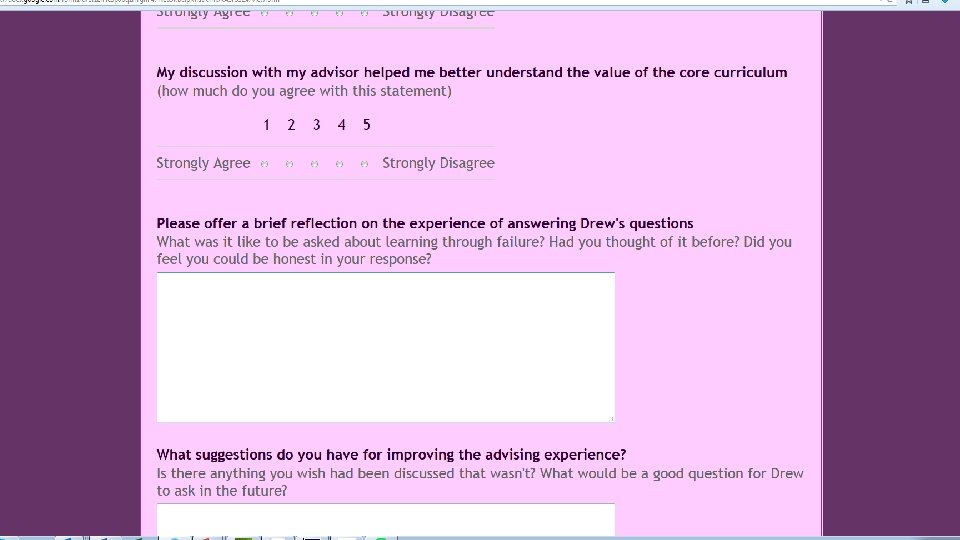
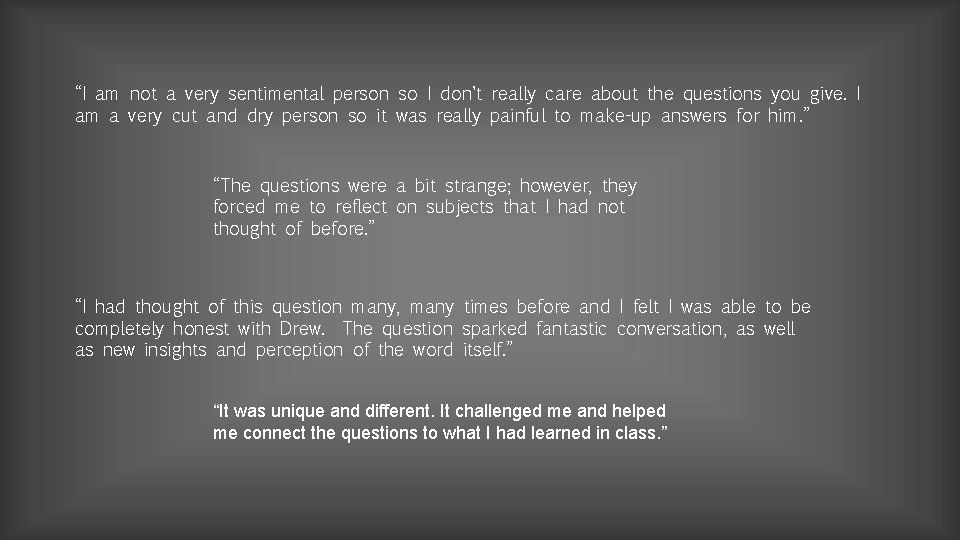
“I am not a very sentimental person so I don't really care about the questions you give. I am a very cut and dry person so it was really painful to make-up answers for him. ” “The questions were a bit strange; however, they forced me to reflect on subjects that I had not thought of before. ” “I had thought of this question many, many times before and I felt I was able to be completely honest with Drew. The question sparked fantastic conversation, as well as new insights and perception of the word itself. ” “It was unique and different. It challenged me and helped me connect the questions to what I had learned in class. ”
Idea 1: Brookfield’s Strategies § Engage in your own critical reflection § Solicit the perspective of the student in ways that allow it to be honest § Asking colleagues to observe you § READ!!! Hunting hegemonic assumptions
Idea 2: Powerful Questions § What have you learned about how to work with others? § Have your classes caused you to change how you see the world or actions that you take in the world? (ie. Vegetarianism; activism; belief in god; atheism) § Are you more curious now than when you began higher education? § What are some problems you are seeing in the world? § How would you define freedom? Do you think that higher education has made/is making you more free? In what ways is it making you less free? § What does the "Common Good" mean to you? § How do you want to live your life? How has college informed that? § How do your current courses relate (or not relate) to what is really important in your life?
Idea 3: Problemitize the curriculum “It is not possible to create without serious intellectual discipline; likewise it is not possible to create within a system of fixed, rigid, or imposed rules” (Freire, 1996, p. 169). Freire, P. (1996). Letters to Cristina. New York: Routledge. Paradox
Idea 4: Advocate for common good projects § Hemwall & Trachte (2009): “an advisor who is guided by the concept of praxis might ask probing questions…. ’Tell me why you want to be a physician’” (p. 9) § This approach engages students in critical self reflection that leads to real learning § Advising for praxis rejects the notions that advising can be politically neutral § In rejecting neutrality it can become more ethical Risks exist
Rejecting Neutrality “My ethical duty…[as] one of the agents, is to express my respect for differences in ideas and positions. I must respect even positions opposed to my own, positions that I combat earnestly and with passion”. “Washing one's hands of the conflict between the powerful and the powerless means to side with the powerful, not to be neutral. “ There is no such thing as a neutral educational process. Education either functions as an instrument that is used to facilitate the integration of the younger generation into the logic of the present system and bring about conformity to it, or it becomes ‘the practice of freedom, ’ the means by which men and women deal critically and creatively with reality and discover how to participate in the transformation of their world. ” (Shaul in the forward to Freire’s Pedagogy of the Oppressed)
Problems/Challenges: Massive body of literature Context Radical worldview Is the Pedagogy of the Oppressed relevant for those with a great deal of privilege?
Questions • How to advise for praxis? Other conceptualizations of Freire? • Problems you see with this framework? • Is the Pedagogy of the Oppressed relevant for those with a great deal of privilege? • Other voices of critical theory or pedagogy that shine further light on the conversation?
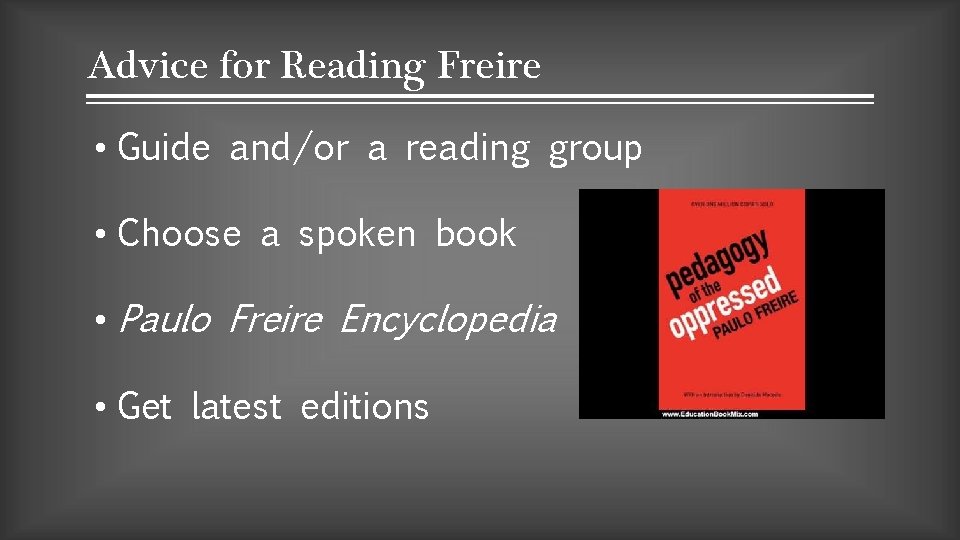
Advice for Reading Freire • Guide and/or a reading group • Choose a spoken book • Paulo Freire Encyclopedia • Get latest editions
References Brookfield, S. D. (1995). Becoming a Critically Reflective Teacher. San Francisco: Jossey Bass. Freire, P. & Faundez, A. (1989). Learning to Question: A Pedagogy of Liberation. New York: Continum. Freire, P. (1996). Letters to Cristina. New York: Routledge. Freire, P. (2000). Pedagogy of the oppressed. New York: Routledge. Freire, P. (2005). Education for critical consciousness. New York: Continum. Freire, P. (2007). Pedagogy of Hope. New York: Continum. Gerhardt, H-P. (1993). Paulo Freire (1921 -97. Prospects: the quarterly review of comparative education. 23 (3), 493 -458. Hemwall, M. & Trachte, K. (2009). Learning at the core: Toward a new understanding of Journal, 29(1), 113 -118. academic advising. NACADA Holst, J. D. (2006). Paulo Freire in Chile: 1964 -1969: Pedagogy of the oppressed in its sociopolitical economic context. Harvard Educational Review, 76(2), 243 -270. Shor, I. (1992). Empowering Education: Critical Teaching for Social Change. Chicago, IL: University of Chicago Press Streck, D. R. , Redin, E. , and Zitkoski, J. J. EDS (2012). Paulo Freire Encyclopedia. Lanham, MD: Rowman & Littlefield Publishers, Inc.