Artificial Intelligence Knowledge Representation Knowledge Representation Topics 1
- Slides: 80
Artificial Intelligence Knowledge Representation
Knowledge Representation Topics 1. 2. 3. 4. Knowledge Representation (KR) KR Using Predicate Logic KR Using Rules
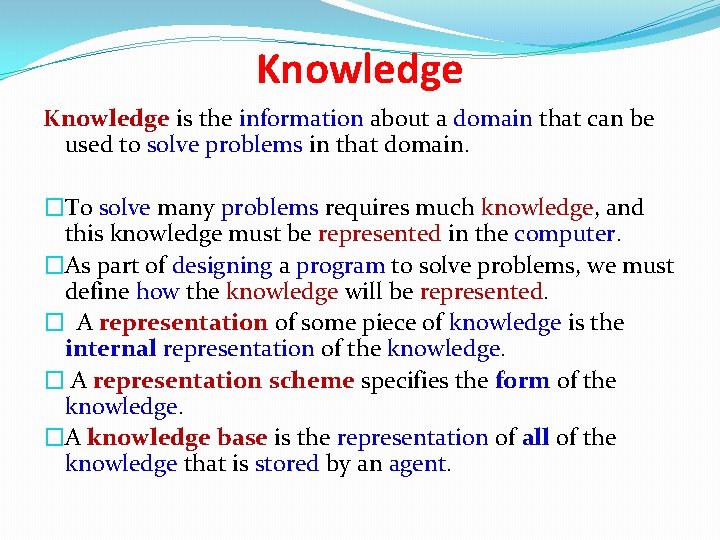
Knowledge is the information about a domain that can be used to solve problems in that domain. �To solve many problems requires much knowledge, and this knowledge must be represented in the computer. �As part of designing a program to solve problems, we must define how the knowledge will be represented. � A representation of some piece of knowledge is the internal representation of the knowledge. � A representation scheme specifies the form of the knowledge. �A knowledge base is the representation of all of the knowledge that is stored by an agent.
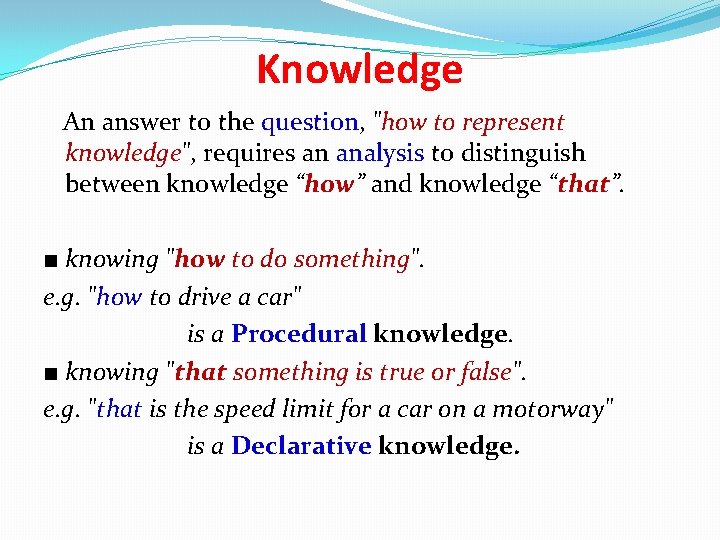
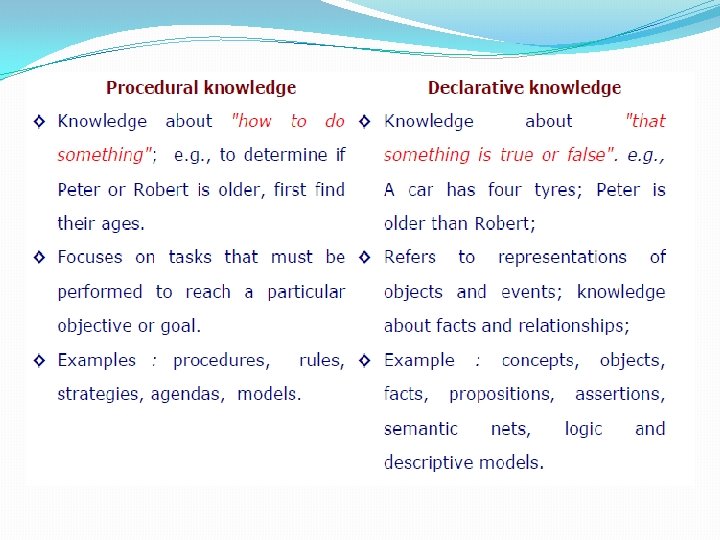
Knowledge An answer to the question, "how to represent knowledge", requires an analysis to distinguish between knowledge “how” and knowledge “that”. ■ knowing "how to do something". e. g. "how to drive a car" is a Procedural knowledge. ■ knowing "that something is true or false". e. g. "that is the speed limit for a car on a motorway" is a Declarative knowledge.
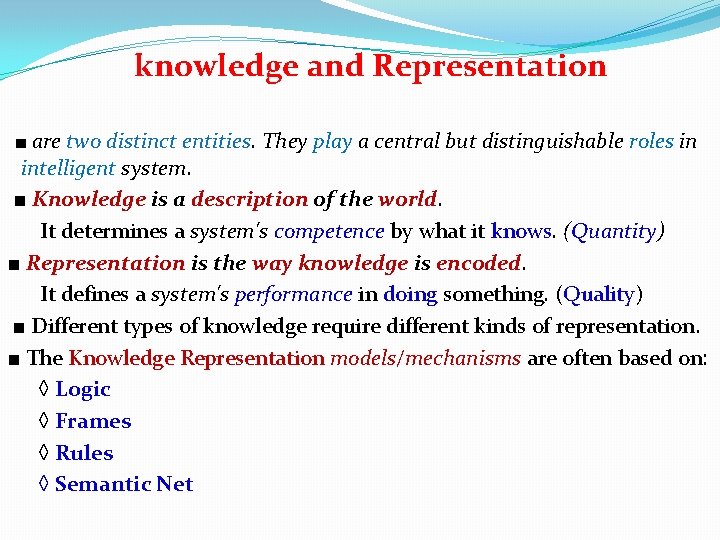
knowledge and Representation ■ are two distinct entities. They play a central but distinguishable roles in intelligent system. ■ Knowledge is a description of the world. It determines a system's competence by what it knows. (Quantity) ■ Representation is the way knowledge is encoded. It defines a system's performance in doing something. (Quality) ■ Different types of knowledge require different kinds of representation. ■ The Knowledge Representation models/mechanisms are often based on: ◊ Logic ◊ Frames ◊ Rules ◊ Semantic Net
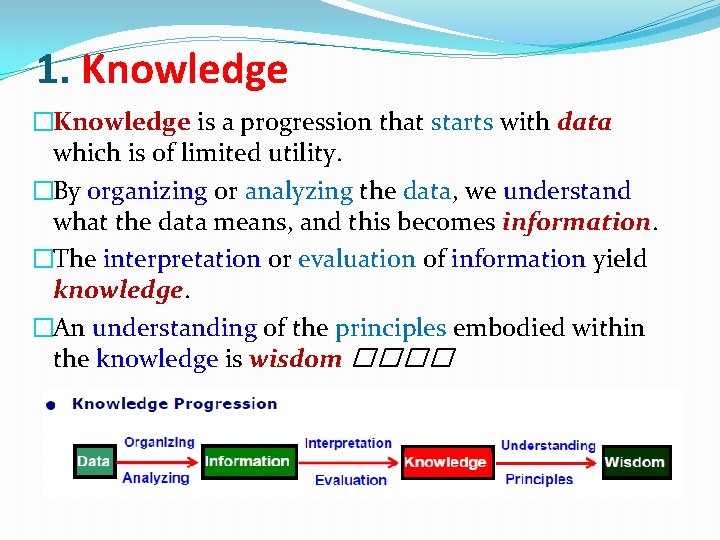
1. Knowledge �Knowledge is a progression that starts with data which is of limited utility. �By organizing or analyzing the data, we understand what the data means, and this becomes information. �The interpretation or evaluation of information yield knowledge. �An understanding of the principles embodied within the knowledge is wisdom ����.
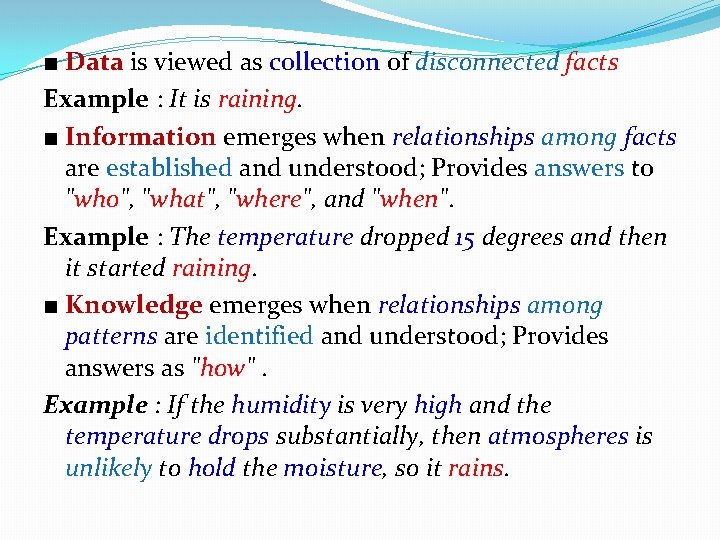
■ Data is viewed as collection of disconnected facts Example : It is raining. ■ Information emerges when relationships among facts are established and understood; Provides answers to "who", "what", "where", and "when". Example : The temperature dropped 15 degrees and then it started raining. ■ Knowledge emerges when relationships among patterns are identified and understood; Provides answers as "how". Example : If the humidity is very high and the temperature drops substantially, then atmospheres is unlikely to hold the moisture, so it rains.
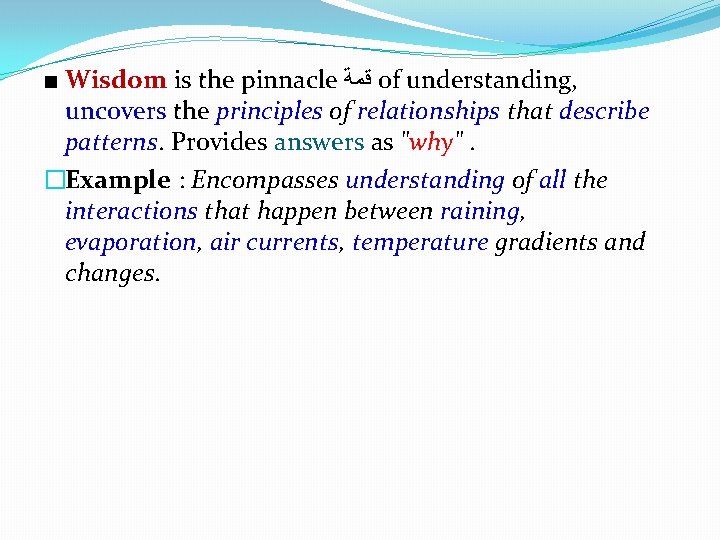
■ Wisdom is the pinnacle ﻗﻤﺔ of understanding, uncovers the principles of relationships that describe patterns. Provides answers as "why". �Example : Encompasses understanding of all the interactions that happen between raining, evaporation, air currents, temperature gradients and changes.
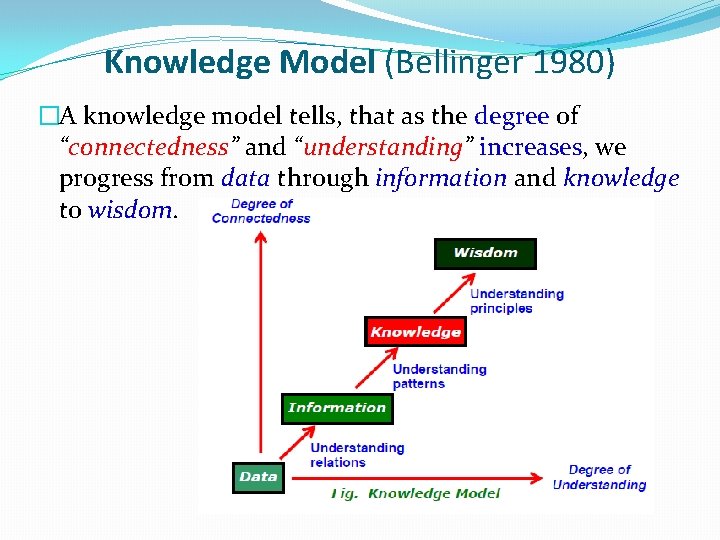
Knowledge Model (Bellinger 1980) �A knowledge model tells, that as the degree of “connectedness” and “understanding” increases, we progress from data through information and knowledge to wisdom.
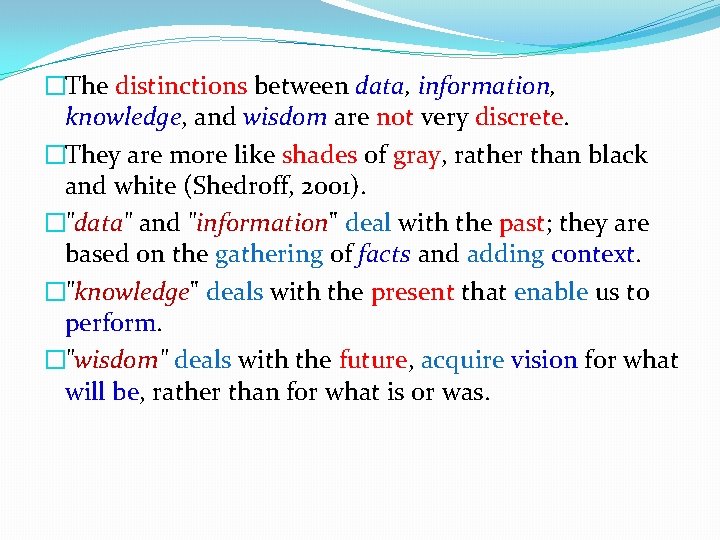
�The distinctions between data, information, knowledge, and wisdom are not very discrete. �They are more like shades of gray, rather than black and white (Shedroff, 2001). �"data" and "information" deal with the past; they are based on the gathering of facts and adding context. �"knowledge" deals with the present that enable us to perform. �"wisdom" deals with the future, acquire vision for what will be, rather than for what is or was.
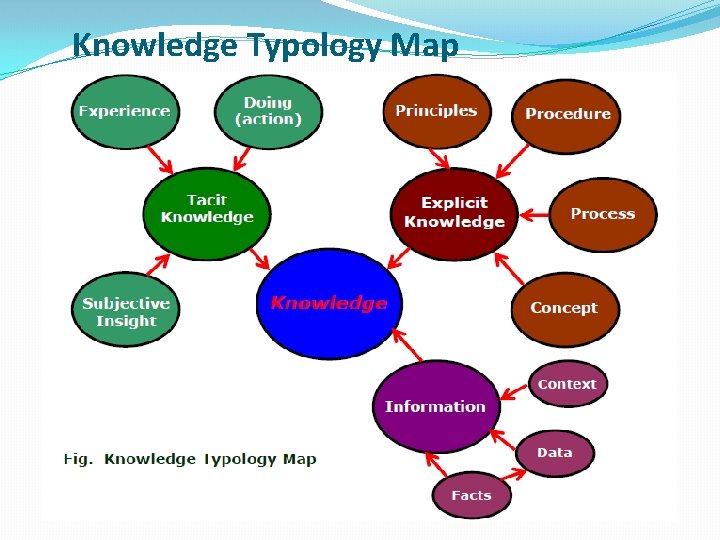
Knowledge Typology Map
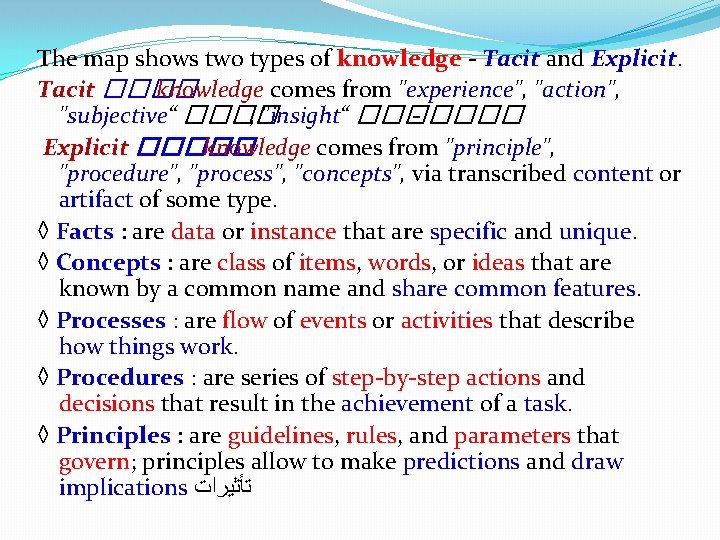
The map shows two types of knowledge - Tacit and Explicit. Tacit ���� knowledge comes from "experience", "action", "subjective“ ���� , "insight“ ����� - ���� Explicit ����� knowledge comes from "principle", "procedure", "process", "concepts", via transcribed content or artifact of some type. ◊ Facts : are data or instance that are specific and unique. ◊ Concepts : are class of items, words, or ideas that are known by a common name and share common features. ◊ Processes : are flow of events or activities that describe how things work. ◊ Procedures : are series of step-by-step actions and decisions that result in the achievement of a task. ◊ Principles : are guidelines, rules, and parameters that govern; principles allow to make predictions and draw implications ﺗﺄﺜﻴﺮﺍﺕ
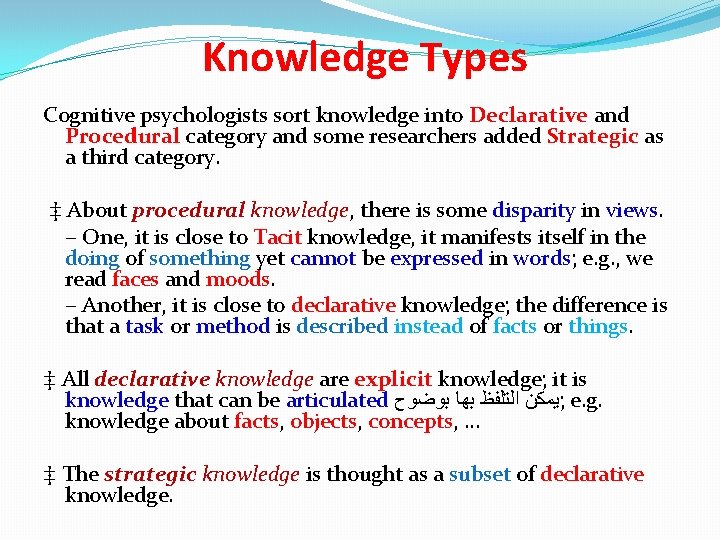
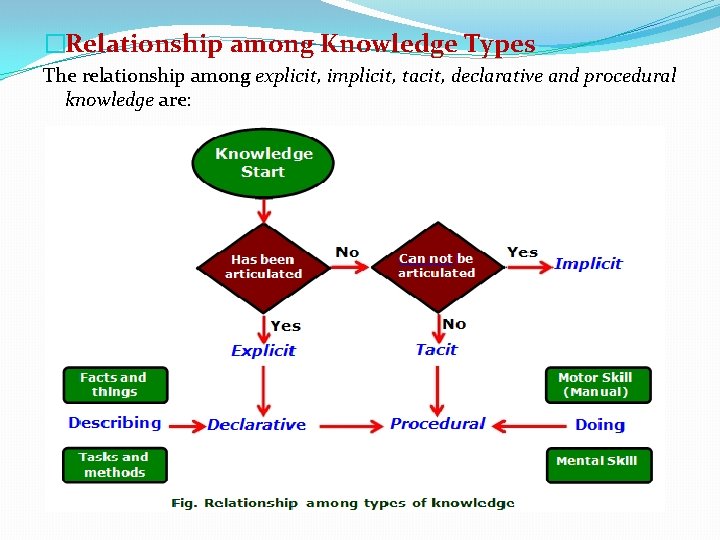
Knowledge Types Cognitive psychologists sort knowledge into Declarative and Procedural category and some researchers added Strategic as a third category. ‡ About procedural knowledge, there is some disparity in views. − One, it is close to Tacit knowledge, it manifests itself in the doing of something yet cannot be expressed in words; e. g. , we read faces and moods. − Another, it is close to declarative knowledge; the difference is that a task or method is described instead of facts or things. ‡ All declarative knowledge are explicit knowledge; it is knowledge that can be articulated ; ﻳﻤﻜﻦ ﺍﻟﺘﻠﻔﻆ ﺑﻬﺎ ﺑﻮﺿﻮﺡ e. g. knowledge about facts, objects, concepts, … ‡ The strategic knowledge is thought as a subset of declarative knowledge.
�Relationship among Knowledge Types The relationship among explicit, implicit, tacit, declarative and procedural knowledge are:
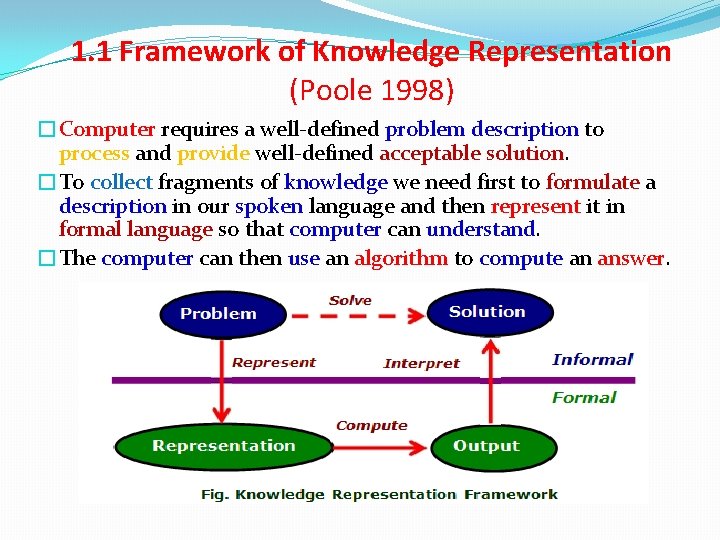
1. 1 Framework of Knowledge Representation (Poole 1998) �Computer requires a well-defined problem description to process and provide well-defined acceptable solution. �To collect fragments of knowledge we need first to formulate a description in our spoken language and then represent it in formal language so that computer can understand. �The computer can then use an algorithm to compute an answer.
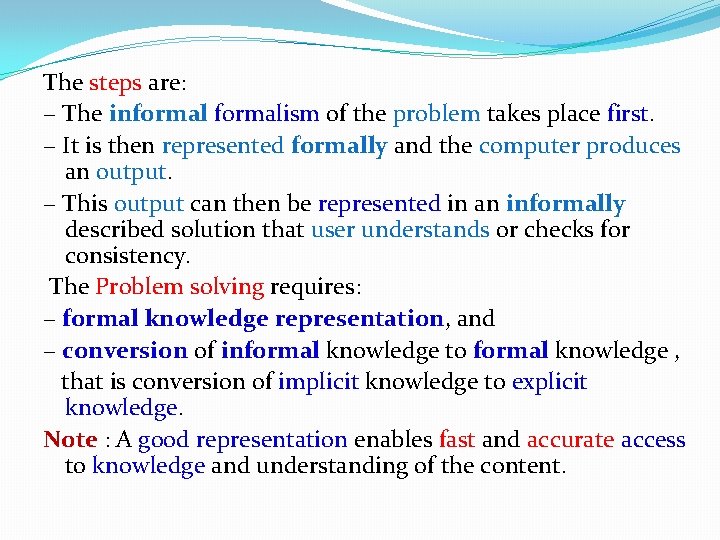
The steps are: − The informalism of the problem takes place first. − It is then represented formally and the computer produces an output. − This output can then be represented in an informally described solution that user understands or checks for consistency. The Problem solving requires: − formal knowledge representation, and − conversion of informal knowledge to formal knowledge , that is conversion of implicit knowledge to explicit knowledge. Note : A good representation enables fast and accurate access to knowledge and understanding of the content.
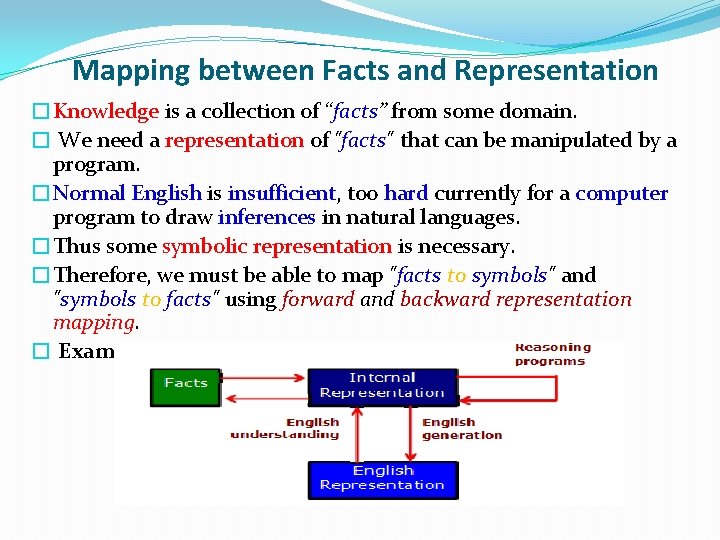
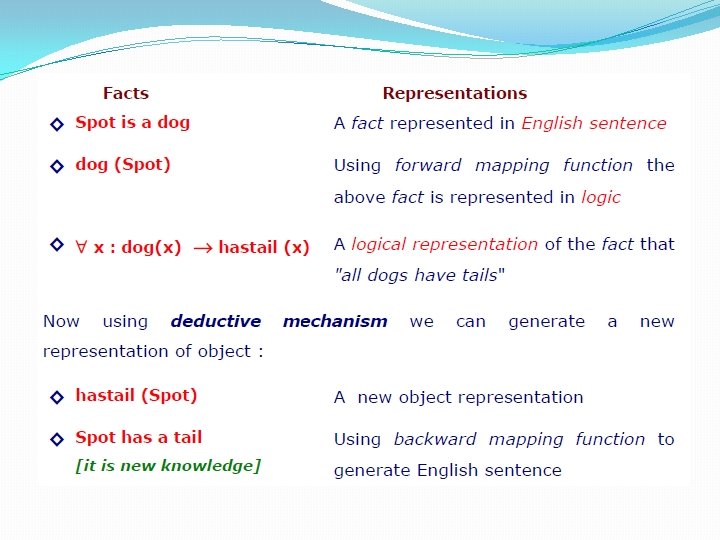
Mapping between Facts and Representation �Knowledge is a collection of “facts” from some domain. � We need a representation of "facts" that can be manipulated by a program. �Normal English is insufficient, too hard currently for a computer program to draw inferences in natural languages. �Thus some symbolic representation is necessary. �Therefore, we must be able to map "facts to symbols" and "symbols to facts" using forward and backward representation mapping. � Example : Consider an English sentence
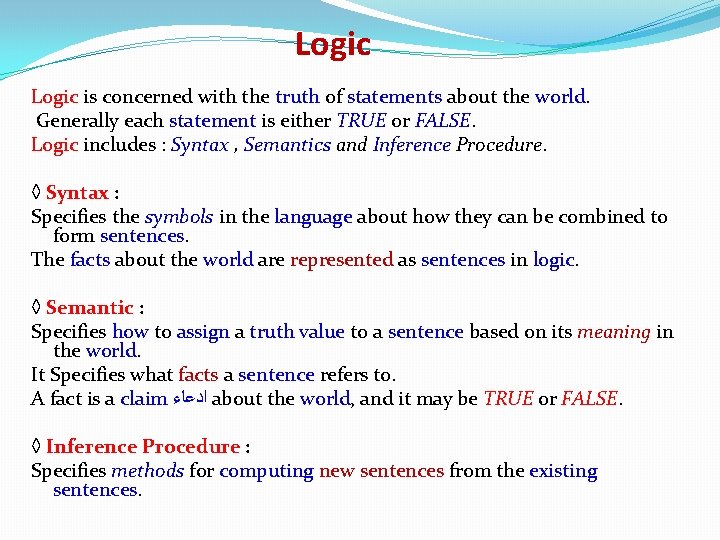
Logic is concerned with the truth of statements about the world. Generally each statement is either TRUE or FALSE. Logic includes : Syntax , Semantics and Inference Procedure. ◊ Syntax : Specifies the symbols in the language about how they can be combined to form sentences. The facts about the world are represented as sentences in logic. ◊ Semantic : Specifies how to assign a truth value to a sentence based on its meaning in the world. It Specifies what facts a sentence refers to. A fact is a claim ﺍﺩﻋﺎﺀ about the world, and it may be TRUE or FALSE. ◊ Inference Procedure : Specifies methods for computing new sentences from the existing sentences.
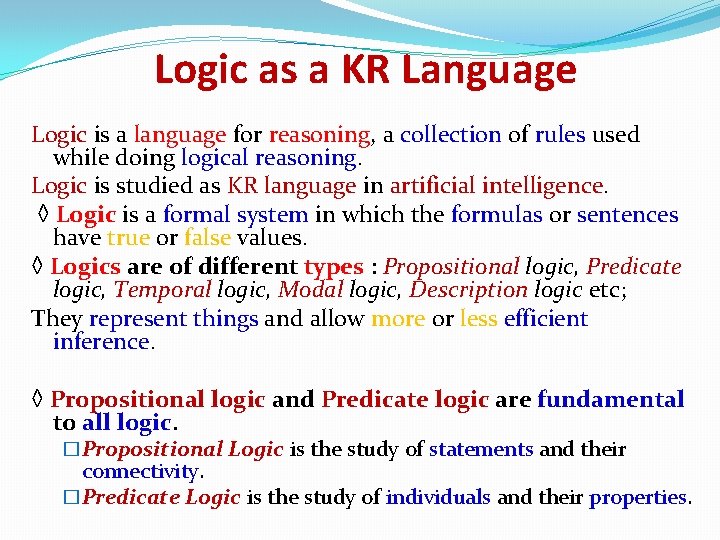
Logic as a KR Language Logic is a language for reasoning, a collection of rules used while doing logical reasoning. Logic is studied as KR language in artificial intelligence. ◊ Logic is a formal system in which the formulas or sentences have true or false values. ◊ Logics are of different types : Propositional logic, Predicate logic, Temporal logic, Modal logic, Description logic etc; They represent things and allow more or less efficient inference. ◊ Propositional logic and Predicate logic are fundamental to all logic. �Propositional Logic is the study of statements and their connectivity. �Predicate Logic is the study of individuals and their properties.
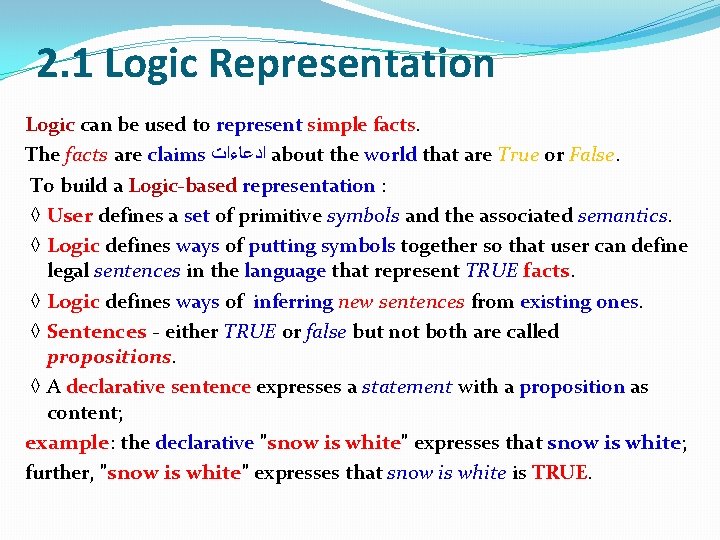
2. 1 Logic Representation Logic can be used to represent simple facts. The facts are claims ﺍﺩﻋﺎﺀﺍﺕ about the world that are True or False. To build a Logic-based representation : ◊ User defines a set of primitive symbols and the associated semantics. ◊ Logic defines ways of putting symbols together so that user can define legal sentences in the language that represent TRUE facts. ◊ Logic defines ways of inferring new sentences from existing ones. ◊ Sentences - either TRUE or false but not both are called propositions. ◊ A declarative sentence expresses a statement with a proposition as content; example: the declarative "snow is white" expresses that snow is white; further, "snow is white" expresses that snow is white is TRUE.
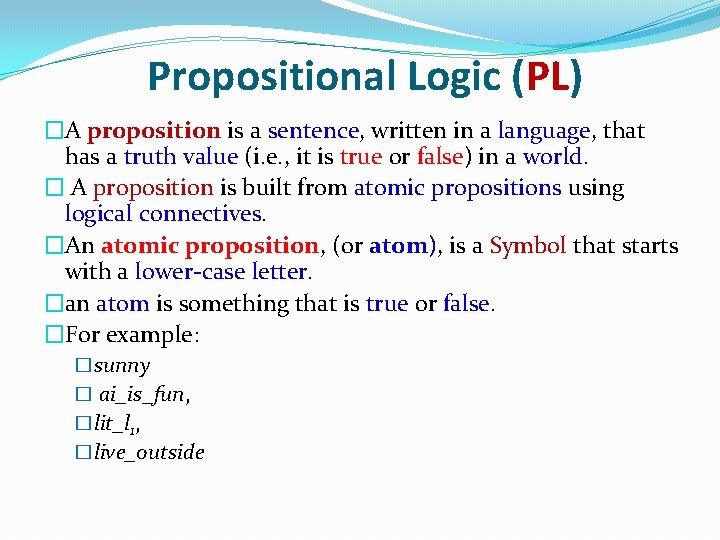
Propositional Logic (PL) �A proposition is a sentence, written in a language, that has a truth value (i. e. , it is true or false) in a world. � A proposition is built from atomic propositions using logical connectives. �An atomic proposition, (or atom), is a Symbol that starts with a lower-case letter. �an atom is something that is true or false. �For example: �sunny � ai_is_fun, �lit_l 1, �live_outside
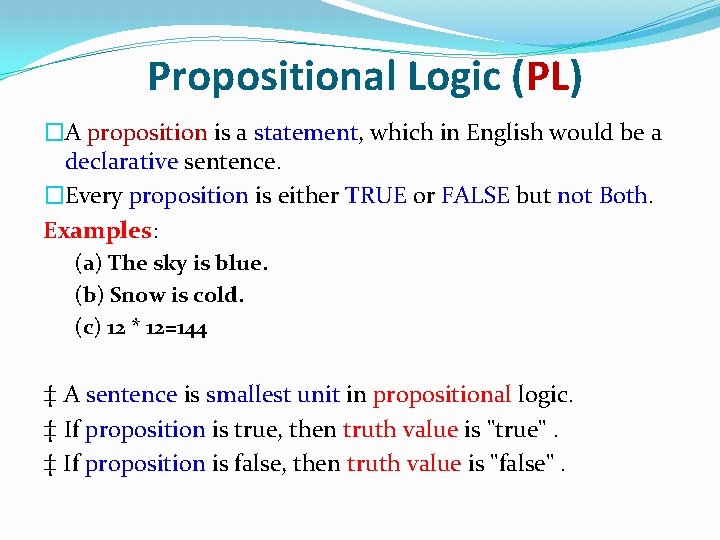
Propositional Logic (PL) �A proposition is a statement, which in English would be a declarative sentence. �Every proposition is either TRUE or FALSE but not Both. Examples: (a) The sky is blue. (b) Snow is cold. (c) 12 * 12=144 ‡ A sentence is smallest unit in propositional logic. ‡ If proposition is true, then truth value is "true". ‡ If proposition is false, then truth value is "false".
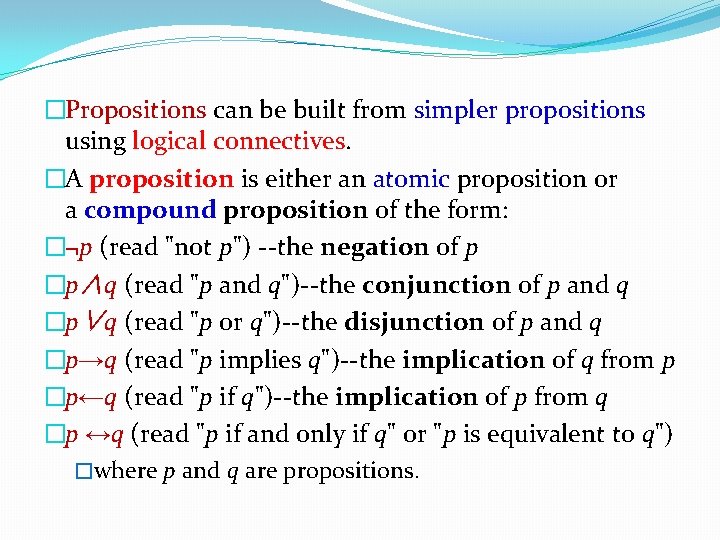
�Propositions can be built from simpler propositions using logical connectives. �A proposition is either an atomic proposition or a compound proposition of the form: �¬p (read "not p") --the negation of p �p∧q (read "p and q")--the conjunction of p and q �p∨q (read "p or q")--the disjunction of p and q �p→q (read "p implies q")--the implication of q from p �p←q (read "p if q")--the implication of p from q �p ↔q (read "p if and only if q" or "p is equivalent to q") �where p and q are propositions.
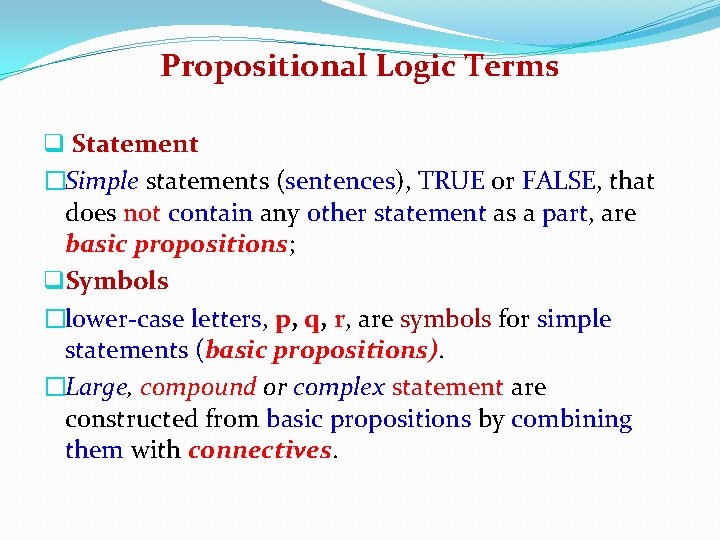
Propositional Logic Terms q Statement �Simple statements (sentences), TRUE or FALSE, that does not contain any other statement as a part, are basic propositions; q. Symbols �lower-case letters, p, q, r, are symbols for simple statements (basic propositions). �Large, compound or complex statement are constructed from basic propositions by combining them with connectives.
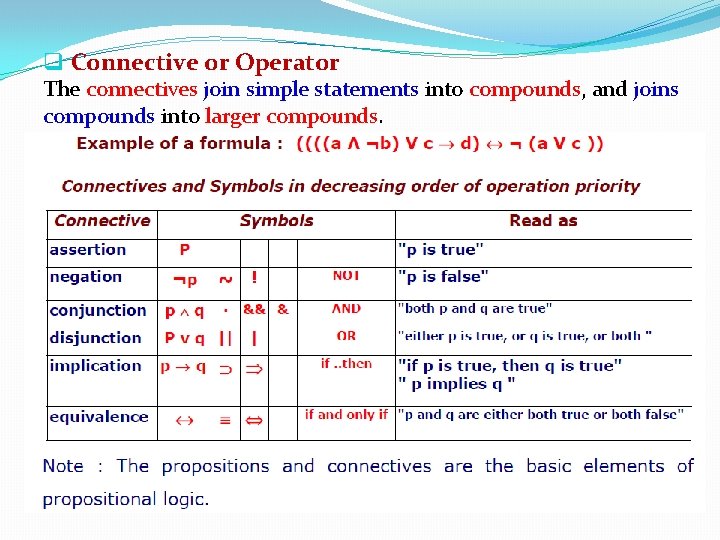
q Connective or Operator The connectives join simple statements into compounds, and joins compounds into larger compounds.
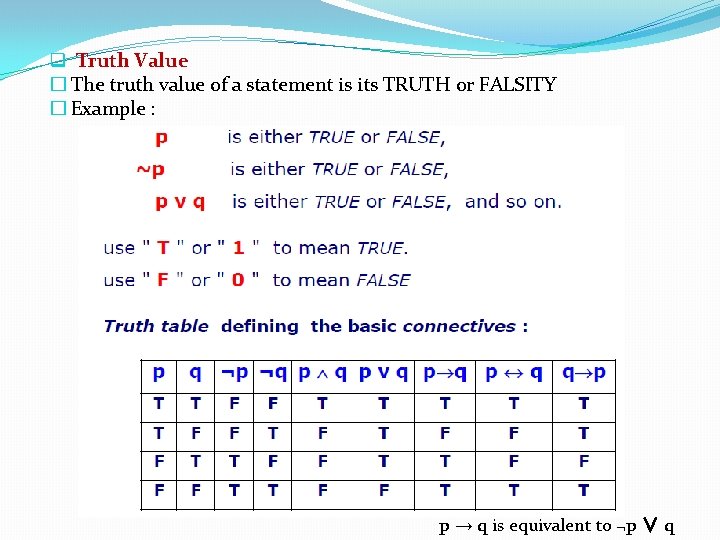
q Truth Value � The truth value of a statement is its TRUTH or FALSITY � Example : p → q is equivalent to ¬p ∨ q
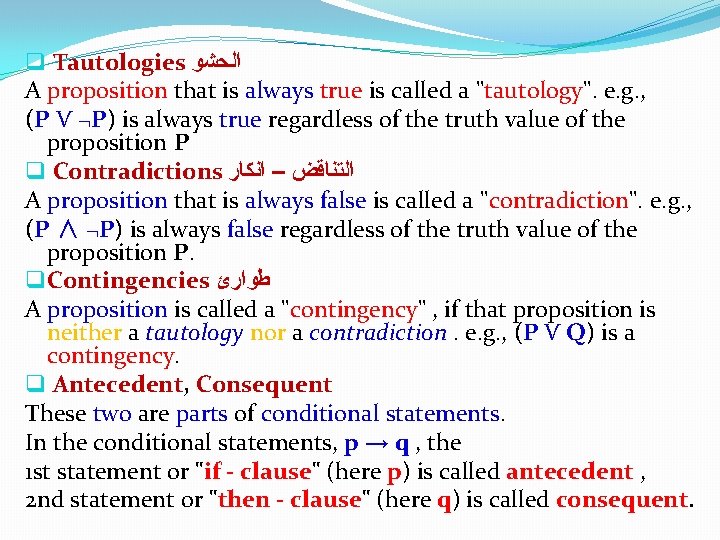
q Tautologies ﺍﻟﺤﺸﻮ A proposition that is always true is called a "tautology". e. g. , (P Ѵ ¬P) is always true regardless of the truth value of the proposition P q Contradictions ﺍﻟﺘﻨﺎﻗﺾ – ﺍﻧﻜﺎﺭ A proposition that is always false is called a "contradiction". e. g. , (P ∧ ¬P) is always false regardless of the truth value of the proposition P. q Contingencies ﻃﻮﺍﺭﺉ A proposition is called a "contingency" , if that proposition is neither a tautology nor a contradiction. e. g. , (P Ѵ Q) is a contingency. q Antecedent, Consequent These two are parts of conditional statements. In the conditional statements, p → q , the 1 st statement or "if - clause" (here p) is called antecedent , 2 nd statement or "then - clause" (here q) is called consequent.
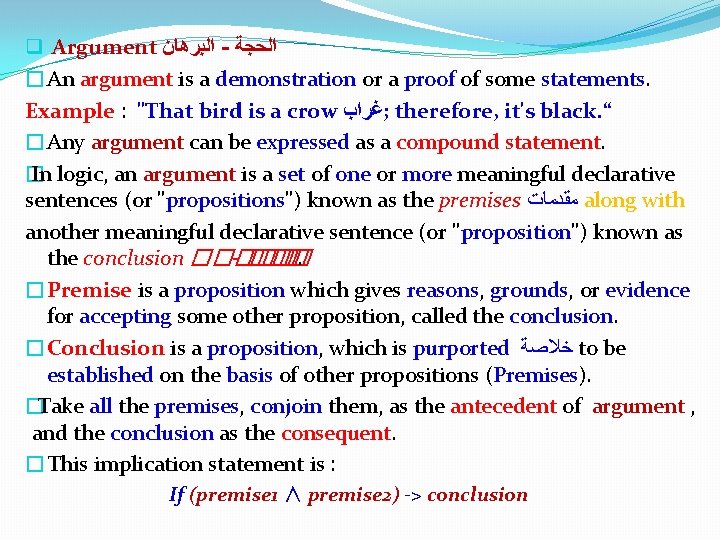
q Argument ﺍﻟﺒﺮﻫﺎﻥ - ﺍﻟﺤﺠﺔ �An argument is a demonstration or a proof of some statements. Example : "That bird is a crow ; ﻏﺮﺍﺏ therefore, it's black. “ �Any argument can be expressed as a compound statement. � In logic, an argument is a set of one or more meaningful declarative sentences (or "propositions") known as the premises ﻣﻘﺪﻣﺎﺕ along with another meaningful declarative sentence (or "proposition") known as the conclusion ����� - ��� �. �Premise is a proposition which gives reasons, grounds, or evidence for accepting some other proposition, called the conclusion. �Conclusion is a proposition, which is purported ﺧﻼﺻﺔ to be established on the basis of other propositions (Premises). � Take all the premises, conjoin them, as the antecedent of argument , and the conclusion as the consequent. �This implication statement is : If (premise 1 ∧ premise 2) -> conclusion
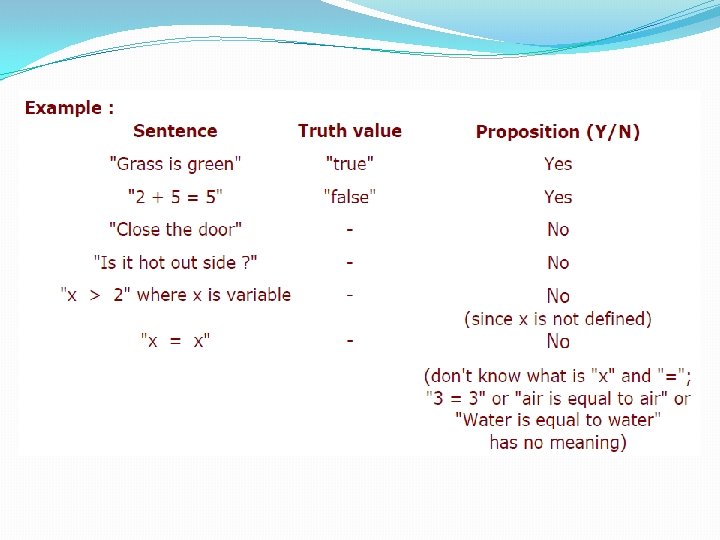
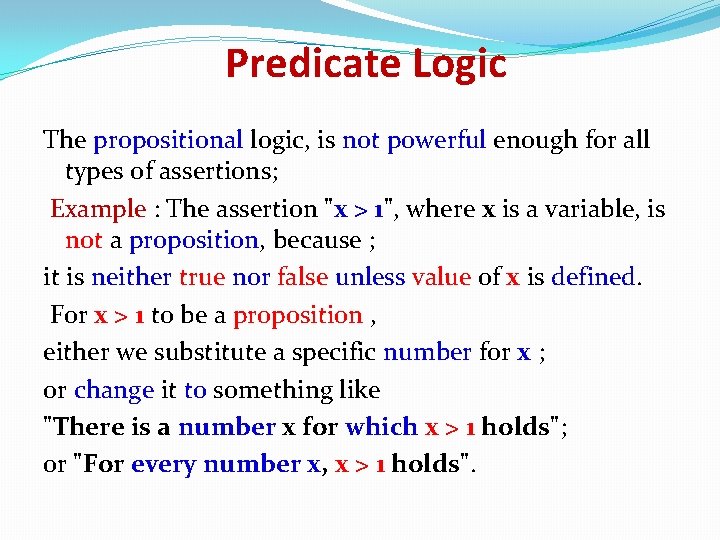
Predicate Logic The propositional logic, is not powerful enough for all types of assertions; Example : The assertion "x > 1", where x is a variable, is not a proposition, because ; it is neither true nor false unless value of x is defined. For x > 1 to be a proposition , either we substitute a specific number for x ; or change it to something like "There is a number x for which x > 1 holds"; or "For every number x, x > 1 holds".
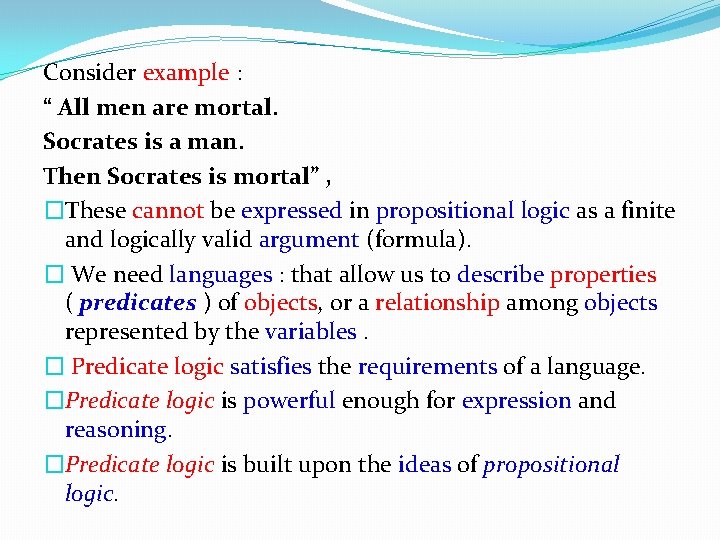
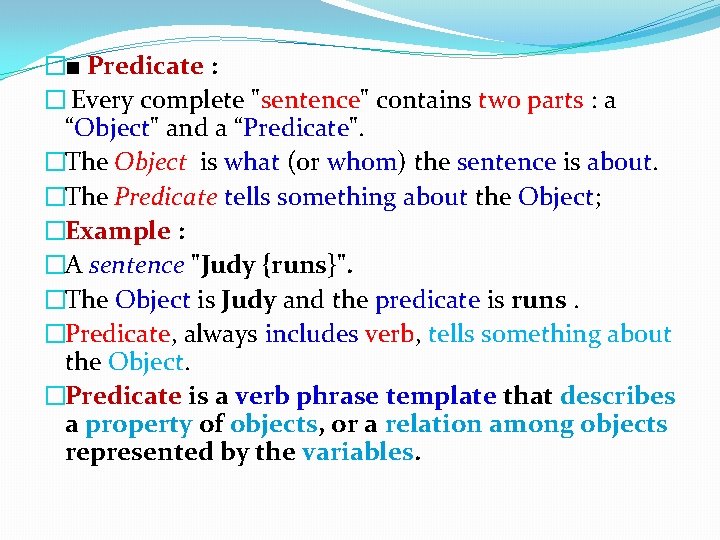
Consider example : “ All men are mortal. Socrates is a man. Then Socrates is mortal” , �These cannot be expressed in propositional logic as a finite and logically valid argument (formula). � We need languages : that allow us to describe properties ( predicates ) of objects, or a relationship among objects represented by the variables. � Predicate logic satisfies the requirements of a language. �Predicate logic is powerful enough for expression and reasoning. �Predicate logic is built upon the ideas of propositional logic.
�■ Predicate : � Every complete "sentence" contains two parts : a “Object" and a “Predicate". �The Object is what (or whom) the sentence is about. �The Predicate tells something about the Object; �Example : �A sentence "Judy {runs}". �The Object is Judy and the predicate is runs. �Predicate, always includes verb, tells something about the Object. �Predicate is a verb phrase template that describes a property of objects, or a relation among objects represented by the variables.
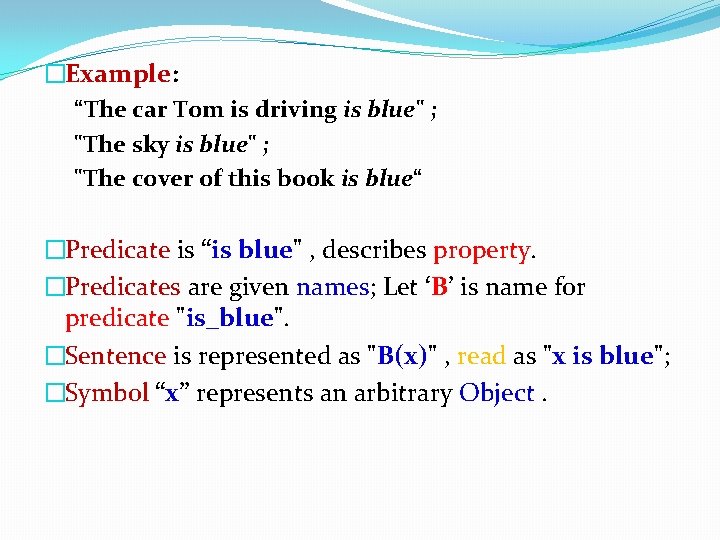
�Example: “The car Tom is driving is blue" ; "The sky is blue" ; "The cover of this book is blue“ �Predicate is “is blue" , describes property. �Predicates are given names; Let ‘B’ is name for predicate "is_blue". �Sentence is represented as "B(x)" , read as "x is blue"; �Symbol “x” represents an arbitrary Object.
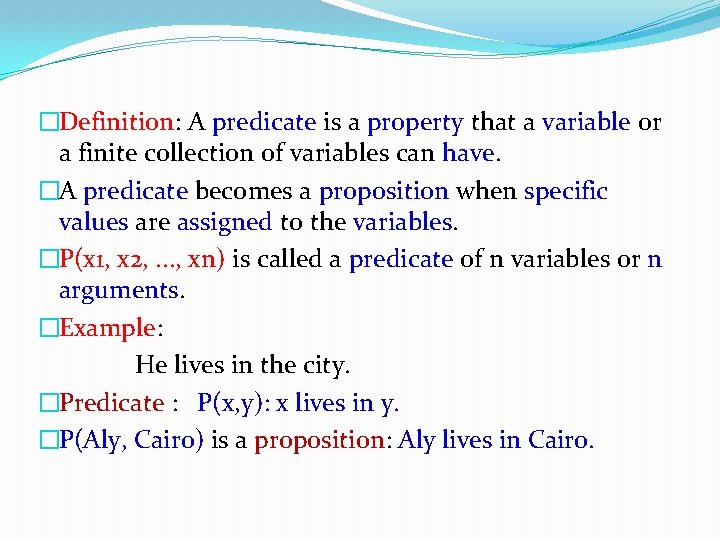
�Definition: A predicate is a property that a variable or a finite collection of variables can have. �A predicate becomes a proposition when specific values are assigned to the variables. �P(x 1, x 2, . . . , xn) is called a predicate of n variables or n arguments. �Example: He lives in the city. �Predicate : P(x, y): x lives in y. �P(Aly, Cairo) is a proposition: Aly lives in Cairo.
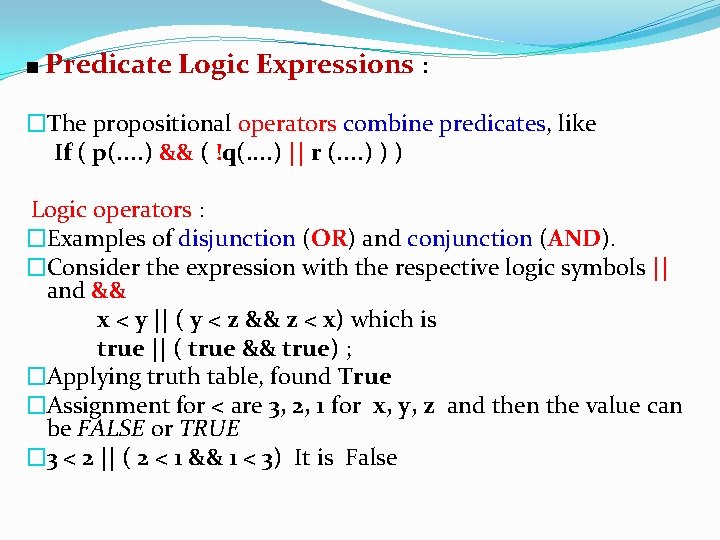
■ Predicate Logic Expressions : �The propositional operators combine predicates, like If ( p(. . ) && ( !q(. . ) || r (. . ) ) ) Logic operators : �Examples of disjunction (OR) and conjunction (AND). �Consider the expression with the respective logic symbols || and && x < y || ( y < z && z < x) which is true || ( true && true) ; �Applying truth table, found True �Assignment for < are 3, 2, 1 for x, y, z and then the value can be FALSE or TRUE � 3 < 2 || ( 2 < 1 && 1 < 3) It is False
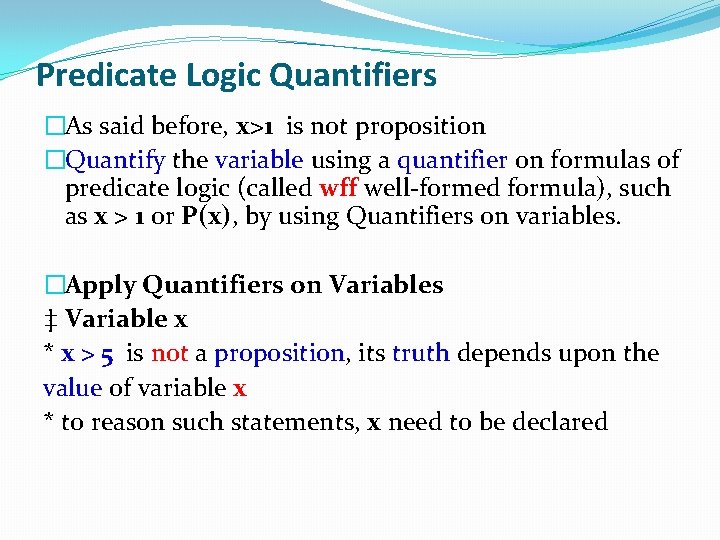
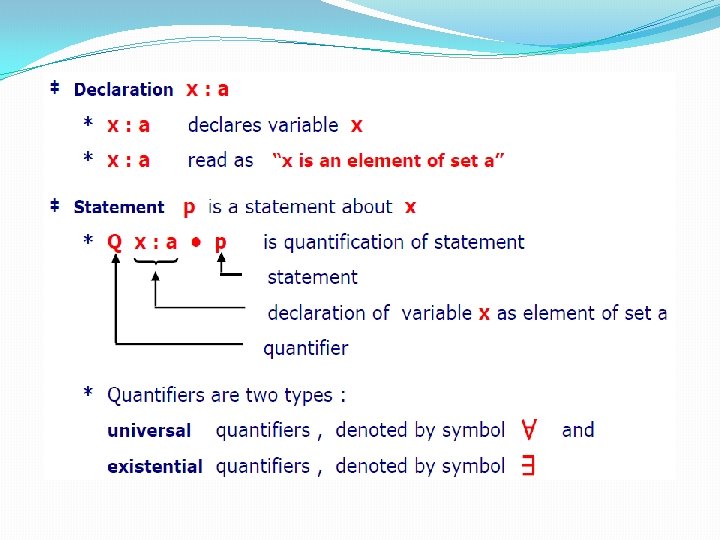
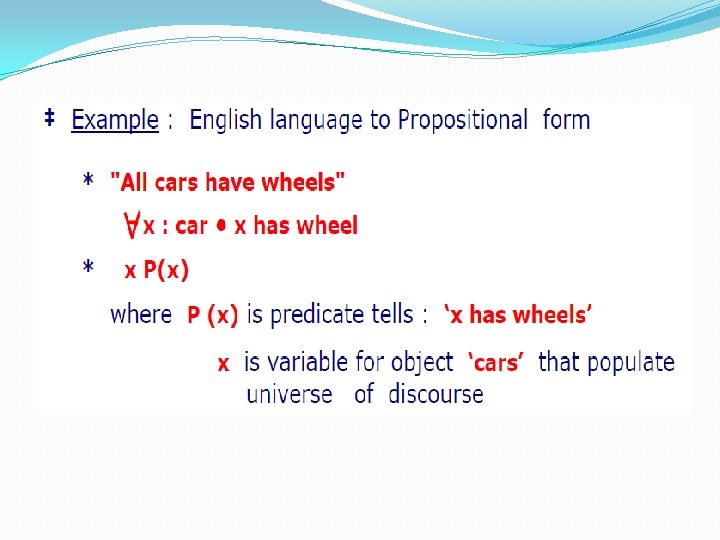
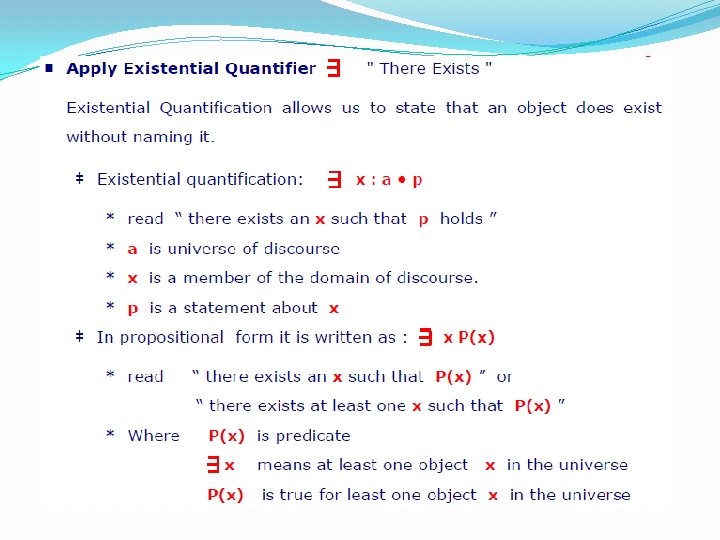
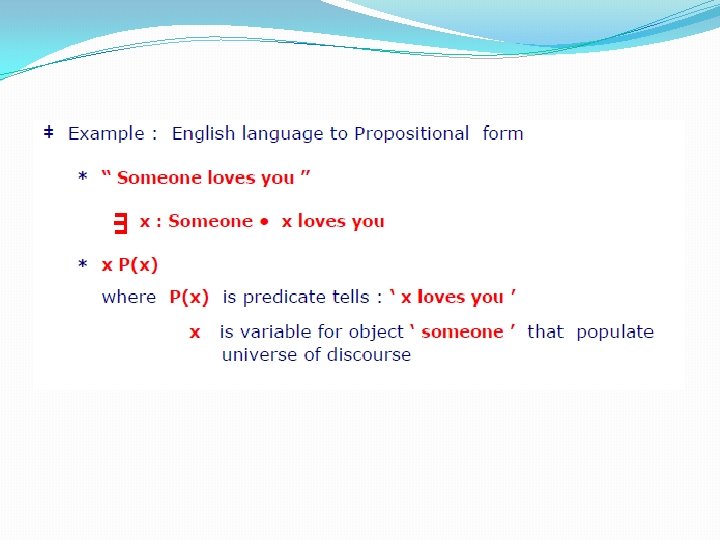
Predicate Logic Quantifiers �As said before, x>1 is not proposition �Quantify the variable using a quantifier on formulas of predicate logic (called wff well-formed formula), such as x > 1 or P(x), by using Quantifiers on variables. �Apply Quantifiers on Variables ‡ Variable x * x > 5 is not a proposition, its truth depends upon the value of variable x * to reason such statements, x need to be declared
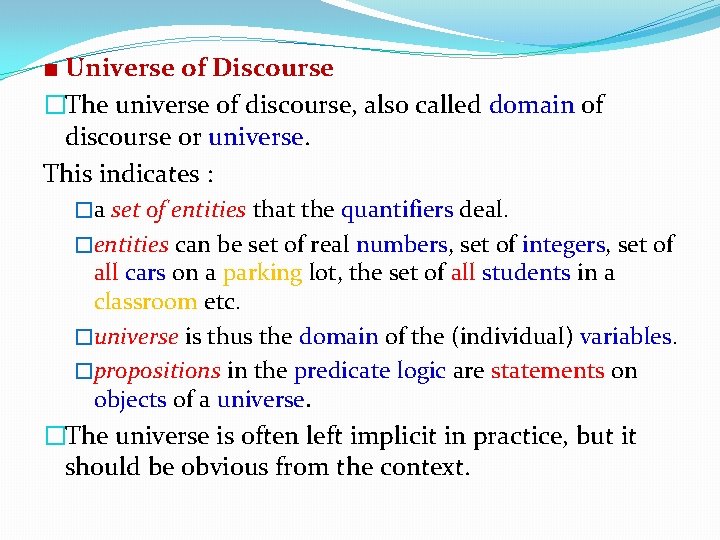
■ Universe of Discourse �The universe of discourse, also called domain of discourse or universe. This indicates : �a set of entities that the quantifiers deal. �entities can be set of real numbers, set of integers, set of all cars on a parking lot, the set of all students in a classroom etc. �universe is thus the domain of the (individual) variables. �propositions in the predicate logic are statements on objects of a universe. �The universe is often left implicit in practice, but it should be obvious from the context.
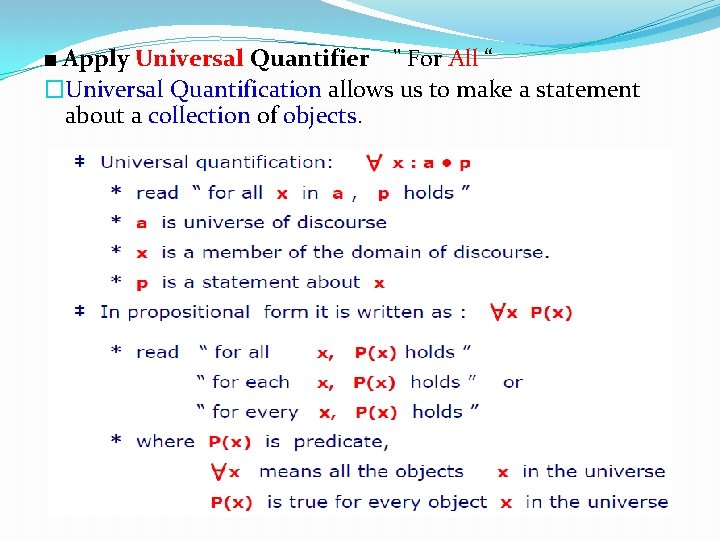
■ Apply Universal Quantifier " For All “ �Universal Quantification allows us to make a statement about a collection of objects.
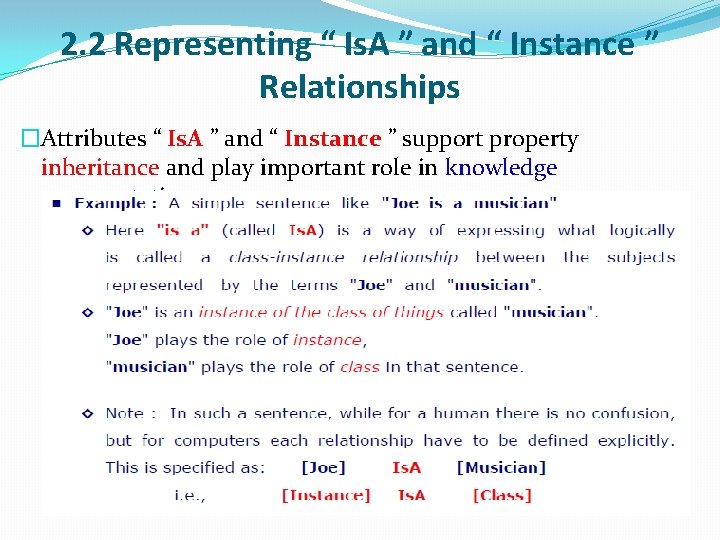
2. 2 Representing “ Is. A ” and “ Instance ” Relationships �Attributes “ Is. A ” and “ Instance ” support property inheritance and play important role in knowledge representation
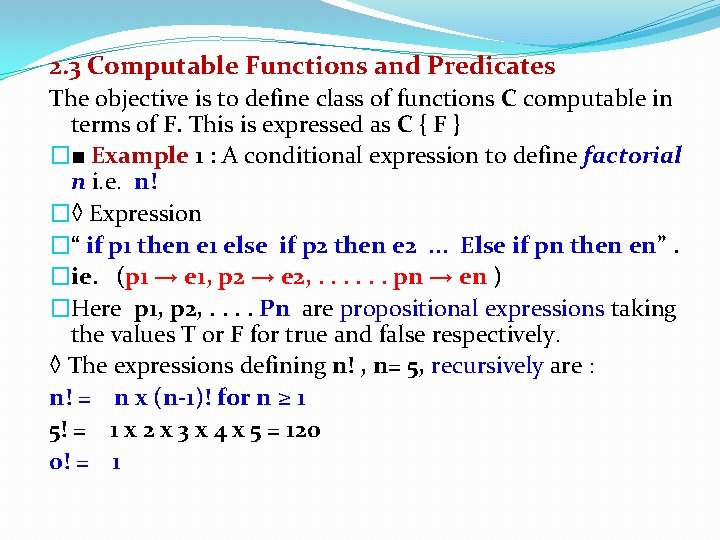
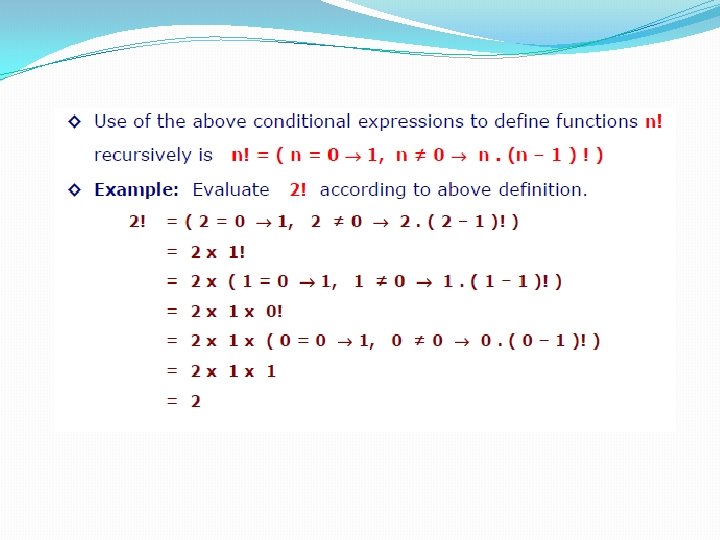
2. 3 Computable Functions and Predicates The objective is to define class of functions C computable in terms of F. This is expressed as C { F } �■ Example 1 : A conditional expression to define factorial n i. e. n! �◊ Expression �“ if p 1 then e 1 else if p 2 then e 2 . . . Else if pn then en”. �ie. (p 1 → e 1, p 2 → e 2, . . . pn → en ) �Here p 1, p 2, . . Pn are propositional expressions taking the values T or F for true and false respectively. ◊ The expressions defining n! , n= 5, recursively are : n! = n x (n-1)! for n ≥ 1 5! = 1 x 2 x 3 x 4 x 5 = 120 0! = 1
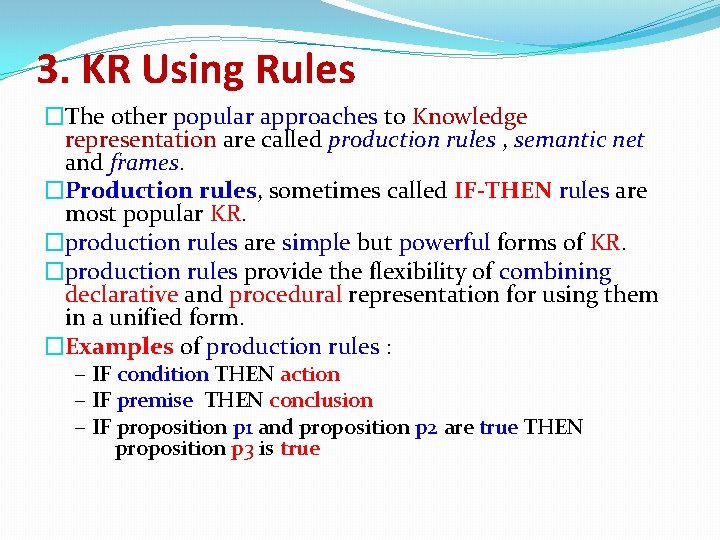
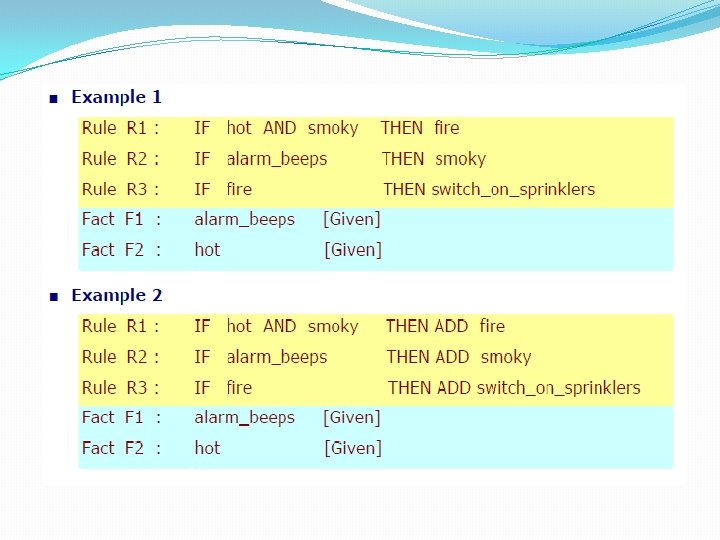
3. KR Using Rules �The other popular approaches to Knowledge representation are called production rules , semantic net and frames. �Production rules, sometimes called IF-THEN rules are most popular KR. �production rules are simple but powerful forms of KR. �production rules provide the flexibility of combining declarative and procedural representation for using them in a unified form. �Examples of production rules : − IF condition THEN action − IF premise THEN conclusion − IF proposition p 1 and proposition p 2 are true THEN proposition p 3 is true
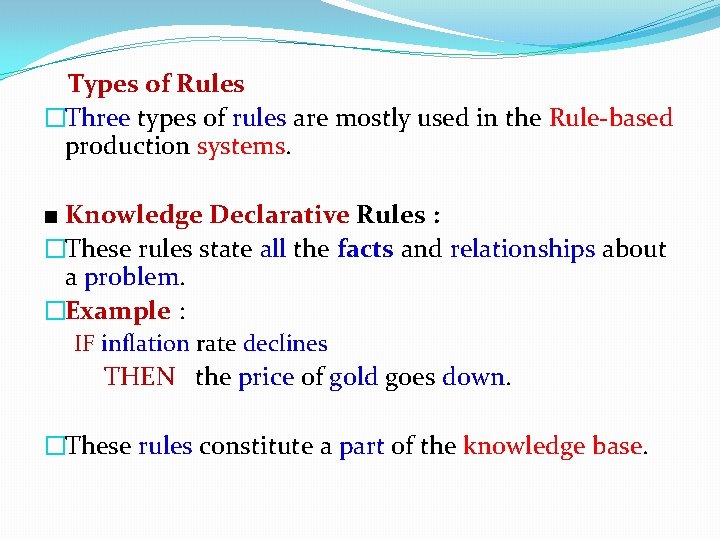
Types of Rules �Three types of rules are mostly used in the Rule-based production systems. ■ Knowledge Declarative Rules : �These rules state all the facts and relationships about a problem. �Example : IF inflation rate declines THEN the price of gold goes down. �These rules constitute a part of the knowledge base.
■ Inference Procedural Rules �These rules advise on how to solve a problem, while certain facts are known. �Example : IF the data needed is not in the system THEN request it from the user. �These rules are part of the inference engine.
�■ Meta rules �These are rules for making rules. �Meta-rules reason about which rules should be considered for firing. �Example : IF the rules which do mention the current goal in their premise, AND there are rules which do not mention the current goal in their premise, THEN the former rule should be used in preference to the latter. �− Meta-rules direct reasoning rather than actually performing reasoning. �− Meta-rules specify which rules should be considered and in which order they should be invoked.
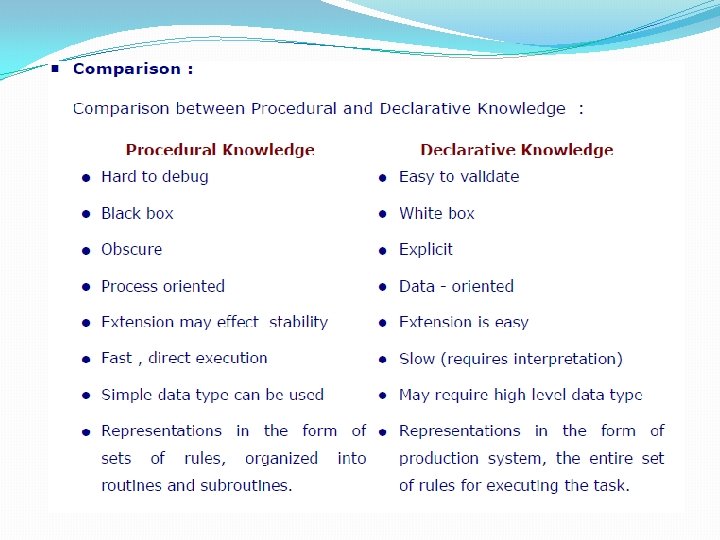
3. 1 Procedural versus Declarative Knowledge ■ Procedural Knowledge : knowing 'how to do' �Includes : rules, strategies, agendas, procedures, models. �These explains what to do in order to reach a certain conclusion. �Example: �Rule: To determine if Peter or Robert is older, first find their ages. �It is knowledge about 'how to do' something. �Accepts a description of the steps of a task or procedure. �It Looks similar to declarative knowledge, except that tasks or methods are being described instead of facts or things.
■ Declarative Knowledge : knowing 'what', knowing 'that‘ Includes : concepts, objects, facts, propositions, assertions, models. It is knowledge about facts and relationships, that − can be expressed in simple and clear statements, − can be added and modified without difficulty. �Examples : � A car has four tires; � Peter is older than Robert. �Declarative knowledge and explicit knowledge articulated knowledge and may be treated as synonyms for most practical purposes. �Declarative knowledge is represented in a format that can be manipulated, decomposed analyzed independent of its content.
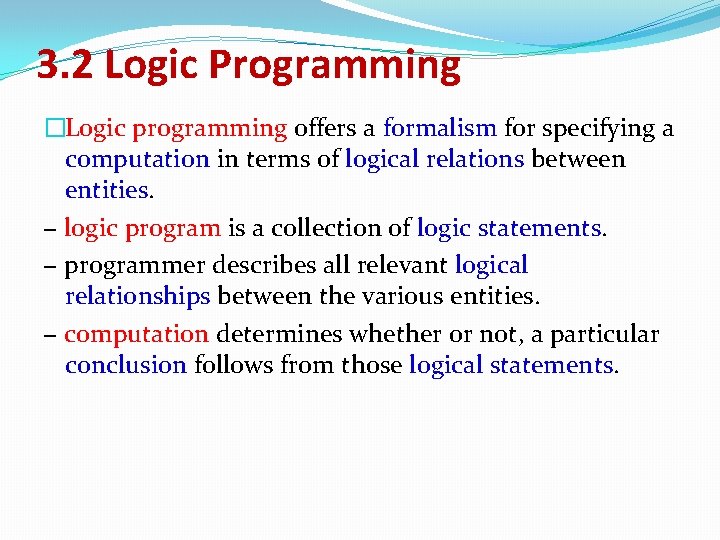
3. 2 Logic Programming �Logic programming offers a formalism for specifying a computation in terms of logical relations between entities. − logic program is a collection of logic statements. − programmer describes all relevant logical relationships between the various entities. − computation determines whether or not, a particular conclusion follows from those logical statements.
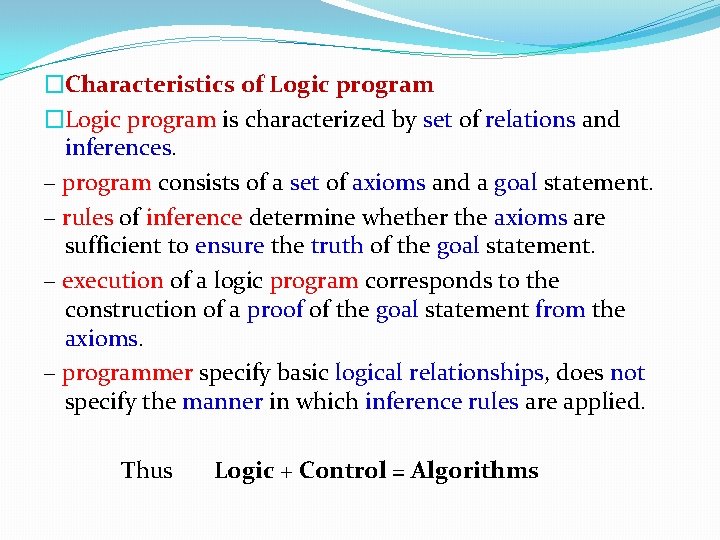
�Characteristics of Logic program �Logic program is characterized by set of relations and inferences. − program consists of a set of axioms and a goal statement. − rules of inference determine whether the axioms are sufficient to ensure the truth of the goal statement. − execution of a logic program corresponds to the construction of a proof of the goal statement from the axioms. − programmer specify basic logical relationships, does not specify the manner in which inference rules are applied. Thus Logic + Control = Algorithms
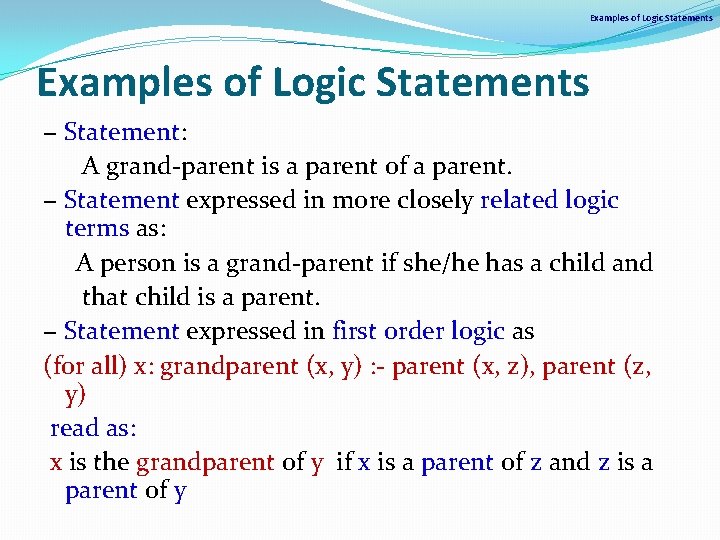
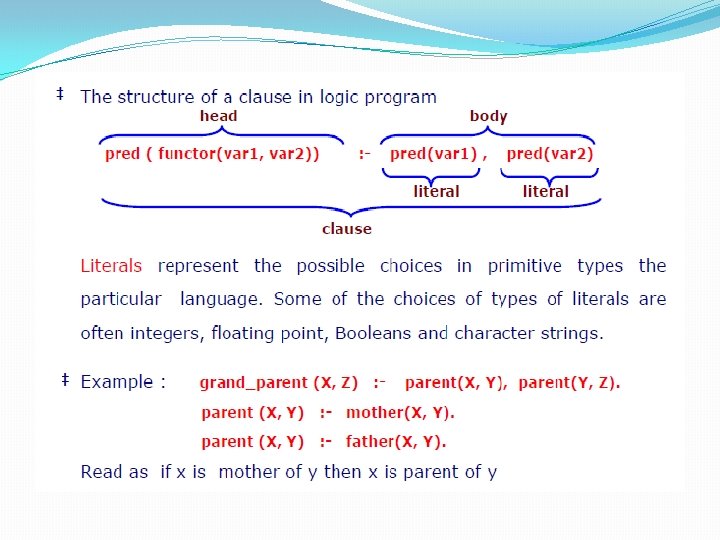
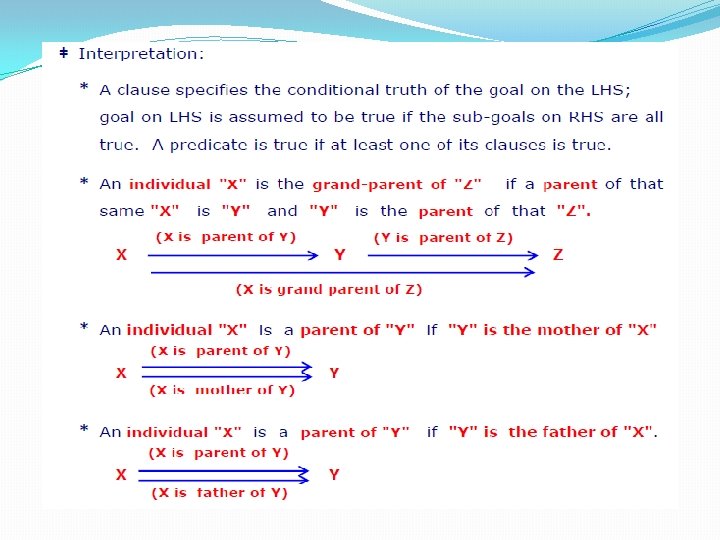
Examples of Logic Statements − Statement: A grand-parent is a parent of a parent. − Statement expressed in more closely related logic terms as: A person is a grand-parent if she/he has a child and that child is a parent. − Statement expressed in first order logic as (for all) x: grandparent (x, y) : - parent (x, z), parent (z, y) read as: x is the grandparent of y if x is a parent of z and z is a parent of y
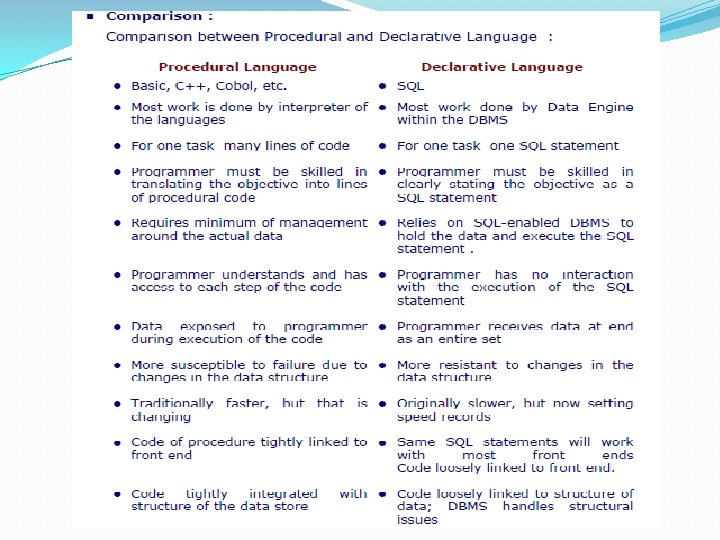
Logic Programming Language A programming language includes : − the syntax − the semantics of programs and − the computational model. � There are many ways of organizing computations. � The most familiar paradigm is procedural. � The program specifies a computation by saying "how" it is to be performed. FORTRAN, C, and Object-oriented languages fall under this approach. � Another paradigm is declarative. � The program specifies a computation by giving the properties of a correct answer. � PROLOG (PROgramming LOGic) is the most popular Logic programming language rose within the realm of Artificial Intelligence (AI).
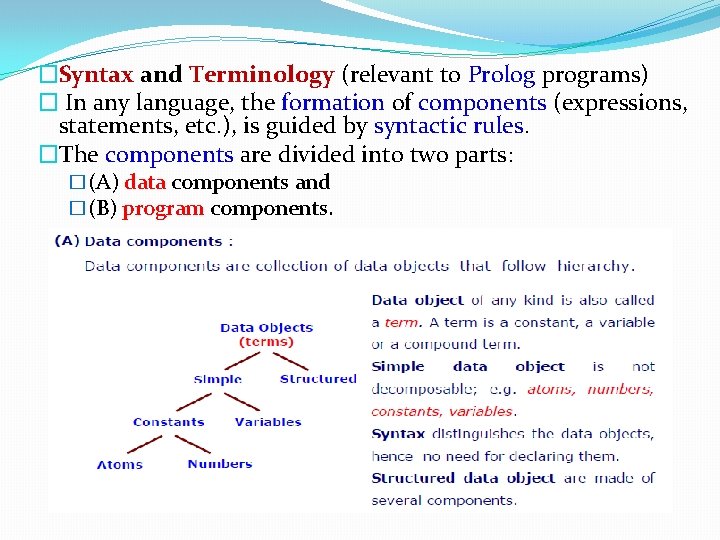
�Syntax and Terminology (relevant to Prolog programs) � In any language, the formation of components (expressions, statements, etc. ), is guided by syntactic rules. �The components are divided into two parts: �(A) data components and �(B) program components.
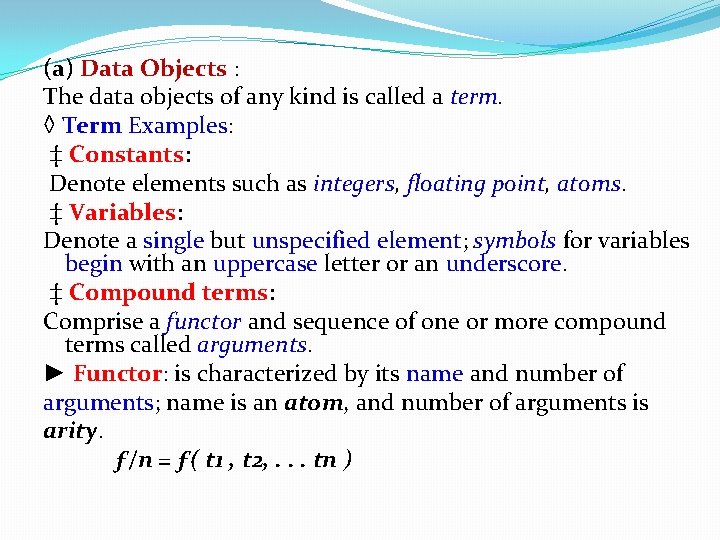
(a) Data Objects : The data objects of any kind is called a term. ◊ Term Examples: ‡ Constants: Denote elements such as integers, floating point, atoms. ‡ Variables: Denote a single but unspecified element; symbols for variables begin with an uppercase letter or an underscore. ‡ Compound terms: Comprise a functor and sequence of one or more compound terms called arguments. ► Functor: is characterized by its name and number of arguments; name is an atom, and number of arguments is arity. ƒ/n = ƒ( t 1 , t 2, . . . tn )
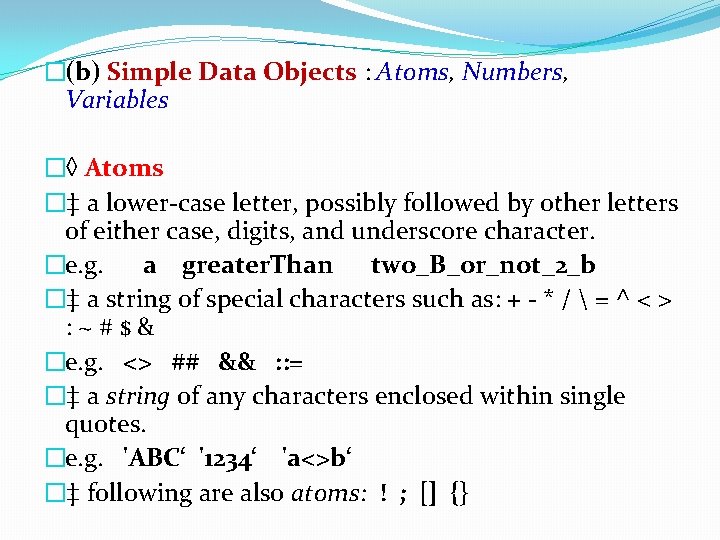
�(b) Simple Data Objects : Atoms, Numbers, Variables �◊ Atoms �‡ a lower-case letter, possibly followed by other letters of either case, digits, and underscore character. �e. g. a greater. Than two_B_or_not_2_b �‡ a string of special characters such as: + - * / = ^ < > : ~ # $ & �e. g. <> ## && : : = �‡ a string of any characters enclosed within single quotes. �e. g. 'ABC‘ '1234‘ 'a<>b‘ �‡ following are also atoms: ! ; [] {}
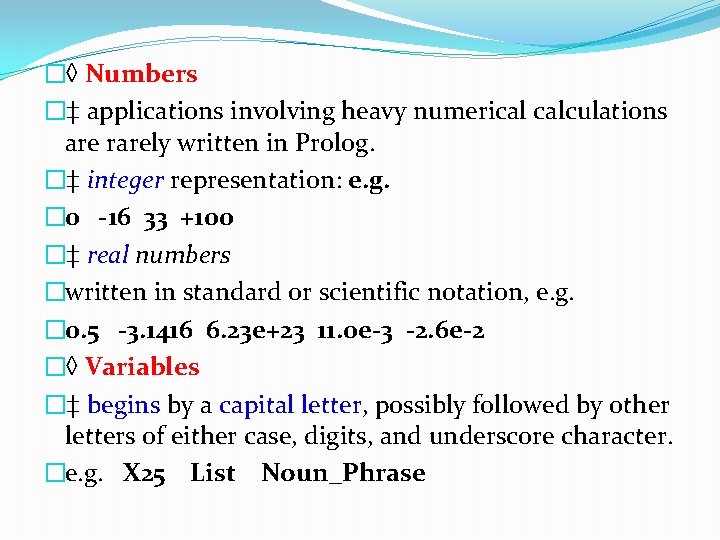
�◊ Numbers �‡ applications involving heavy numerical calculations are rarely written in Prolog. �‡ integer representation: e. g. � 0 -16 33 +100 �‡ real numbers �written in standard or scientific notation, e. g. � 0. 5 -3. 1416 6. 23 e+23 11. 0 e-3 -2. 6 e-2 �◊ Variables �‡ begins by a capital letter, possibly followed by other letters of either case, digits, and underscore character. �e. g. X 25 List Noun_Phrase
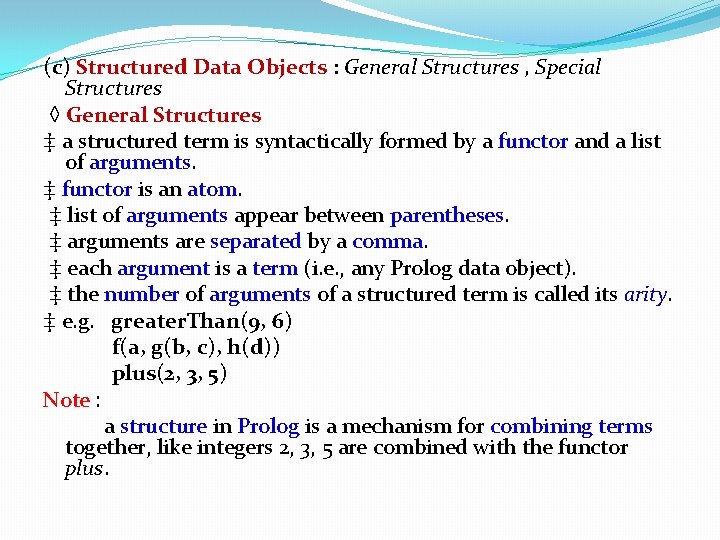
(c) Structured Data Objects : General Structures , Special Structures ◊ General Structures ‡ a structured term is syntactically formed by a functor and a list of arguments. ‡ functor is an atom. ‡ list of arguments appear between parentheses. ‡ arguments are separated by a comma. ‡ each argument is a term (i. e. , any Prolog data object). ‡ the number of arguments of a structured term is called its arity. ‡ e. g. greater. Than(9, 6) f(a, g(b, c), h(d)) plus(2, 3, 5) Note : a structure in Prolog is a mechanism for combining terms together, like integers 2, 3, 5 are combined with the functor plus.
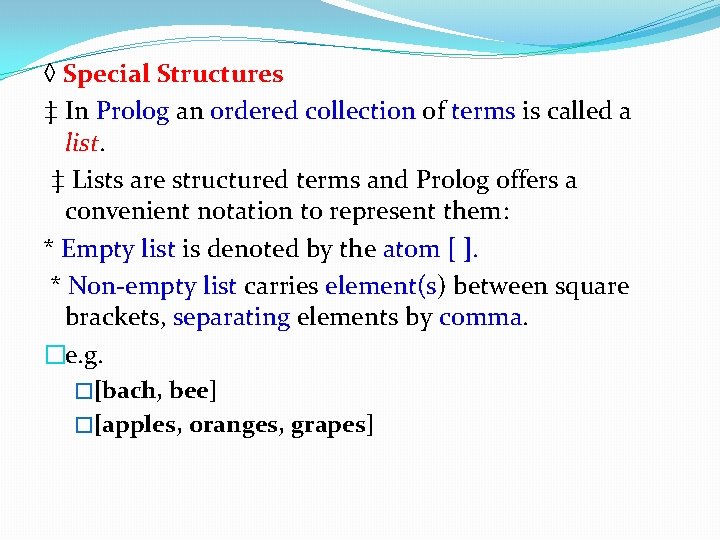
◊ Special Structures ‡ In Prolog an ordered collection of terms is called a list. ‡ Lists are structured terms and Prolog offers a convenient notation to represent them: * Empty list is denoted by the atom [ ]. * Non-empty list carries element(s) between square brackets, separating elements by comma. �e. g. �[bach, bee] �[apples, oranges, grapes]
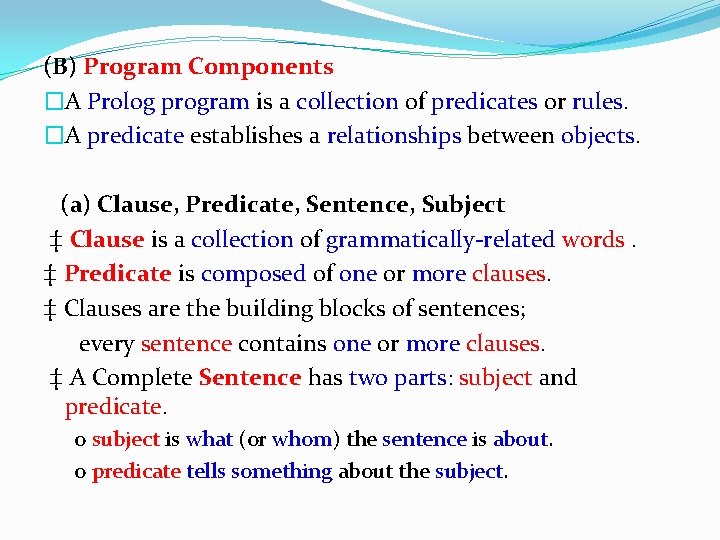
(B) Program Components �A Prolog program is a collection of predicates or rules. �A predicate establishes a relationships between objects. (a) Clause, Predicate, Sentence, Subject ‡ Clause is a collection of grammatically-related words. ‡ Predicate is composed of one or more clauses. ‡ Clauses are the building blocks of sentences; every sentence contains one or more clauses. ‡ A Complete Sentence has two parts: subject and predicate. o subject is what (or whom) the sentence is about. o predicate tells something about the subject.
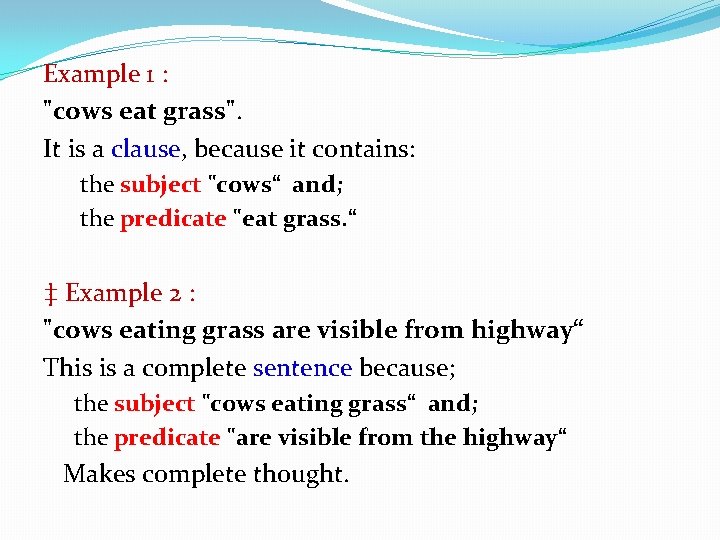
Example 1 : "cows eat grass". It is a clause, because it contains: the subject "cows“ and; the predicate "eat grass. “ ‡ Example 2 : "cows eating grass are visible from highway“ This is a complete sentence because; the subject "cows eating grass“ and; the predicate "are visible from the highway“ Makes complete thought.
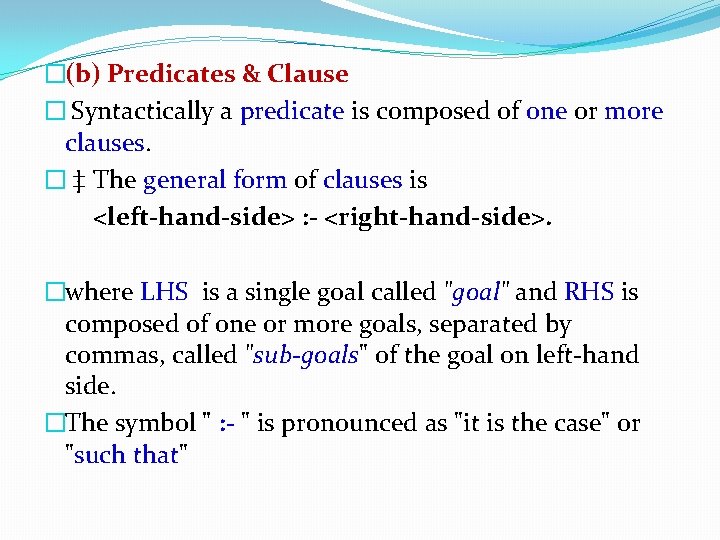
�(b) Predicates & Clause � Syntactically a predicate is composed of one or more clauses. � ‡ The general form of clauses is <left-hand-side> : - <right-hand-side>. �where LHS is a single goal called "goal" and RHS is composed of one or more goals, separated by commas, called "sub-goals" of the goal on left-hand side. �The symbol " : - " is pronounced as "it is the case" or "such that"
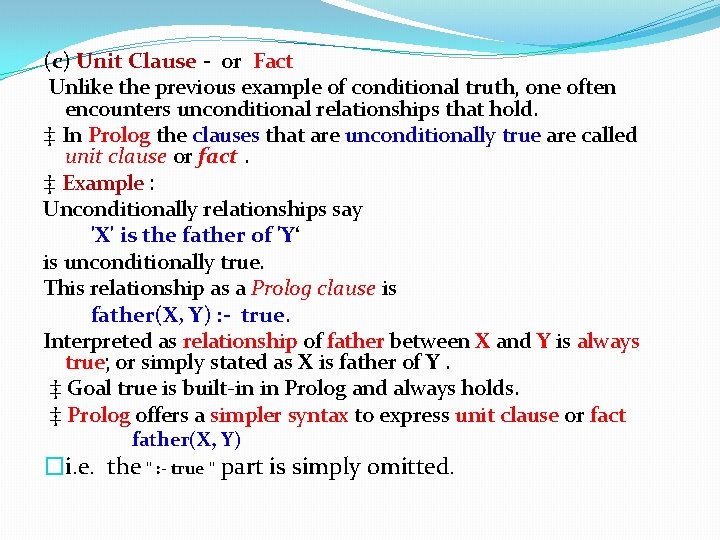
(c) Unit Clause - or Fact Unlike the previous example of conditional truth, one often encounters unconditional relationships that hold. ‡ In Prolog the clauses that are unconditionally true are called unit clause or fact. ‡ Example : Unconditionally relationships say 'X' is the father of 'Y‘ is unconditionally true. This relationship as a Prolog clause is father(X, Y) : - true. Interpreted as relationship of father between X and Y is always true; or simply stated as X is father of Y. ‡ Goal true is built-in in Prolog and always holds. ‡ Prolog offers a simpler syntax to express unit clause or fact father(X, Y) �i. e. the " : - true " part is simply omitted.
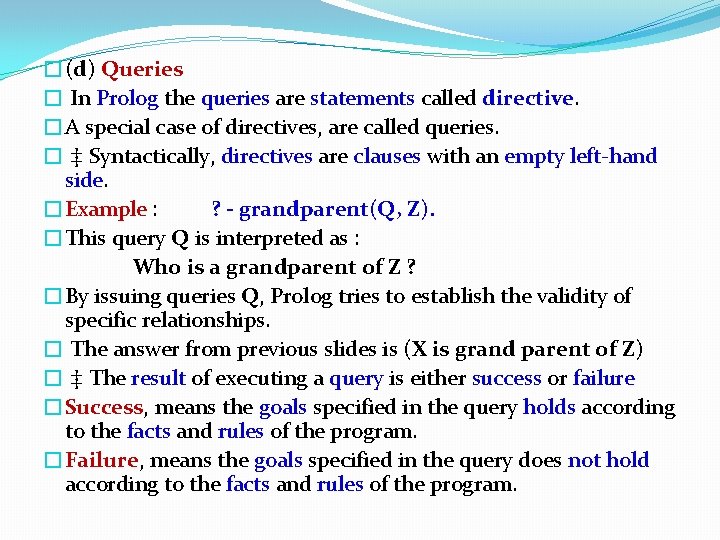
�(d) Queries � In Prolog the queries are statements called directive. �A special case of directives, are called queries. � ‡ Syntactically, directives are clauses with an empty left-hand side. �Example : ? - grandparent(Q, Z). �This query Q is interpreted as : Who is a grandparent of Z ? �By issuing queries Q, Prolog tries to establish the validity of specific relationships. � The answer from previous slides is (X is grand parent of Z) � ‡ The result of executing a query is either success or failure �Success, means the goals specified in the query holds according to the facts and rules of the program. �Failure, means the goals specified in the query does not hold according to the facts and rules of the program.
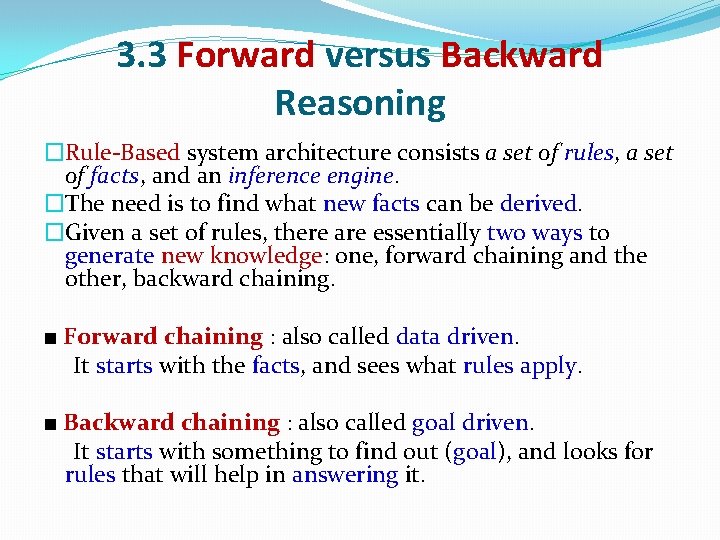
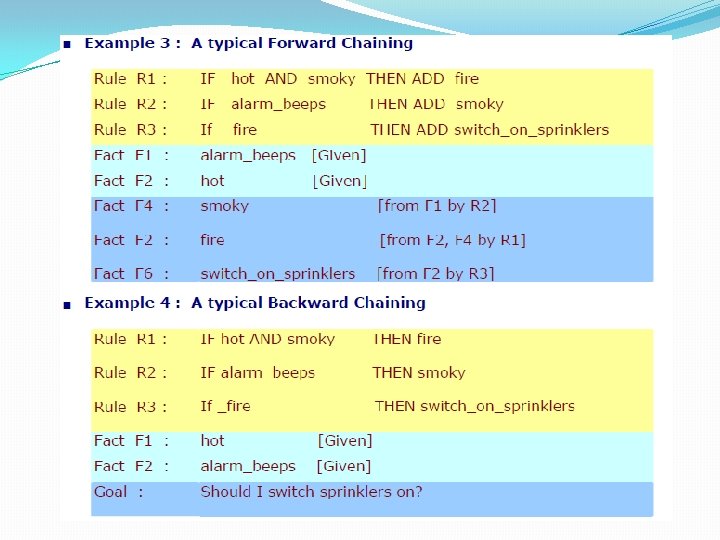
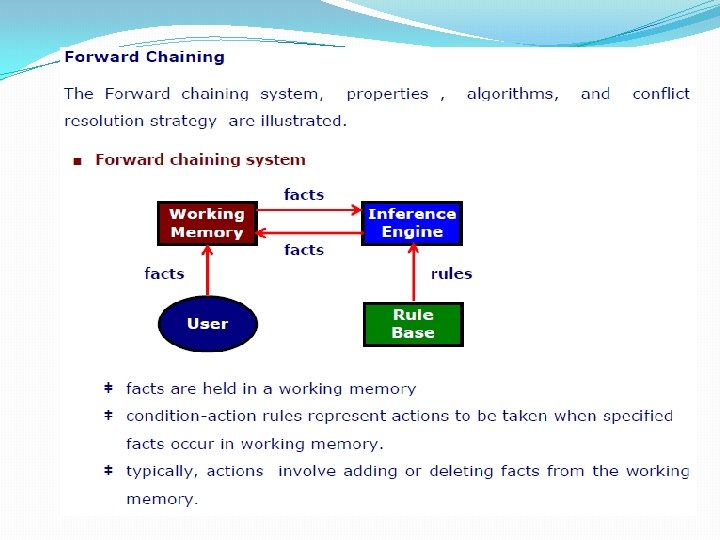
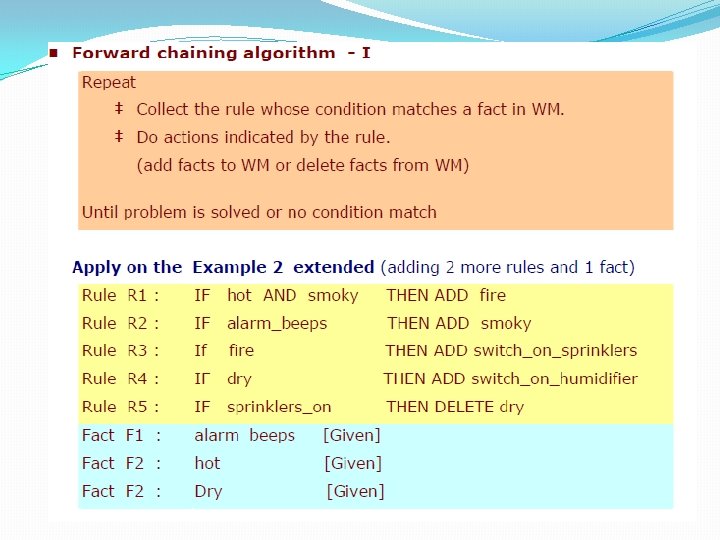
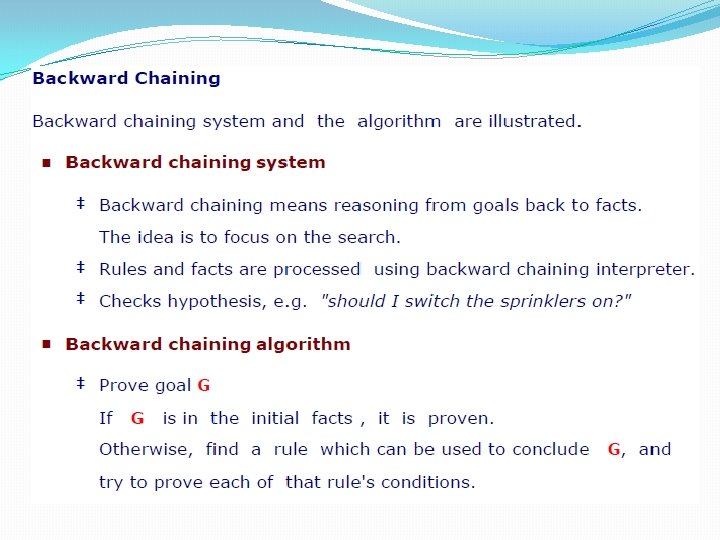
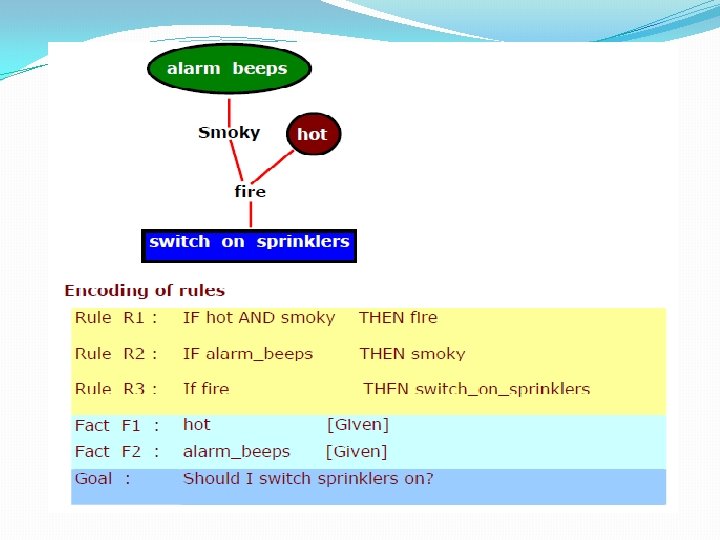
3. 3 Forward versus Backward Reasoning �Rule-Based system architecture consists a set of rules, a set of facts, and an inference engine. �The need is to find what new facts can be derived. �Given a set of rules, there are essentially two ways to generate new knowledge: one, forward chaining and the other, backward chaining. ■ Forward chaining : also called data driven. It starts with the facts, and sees what rules apply. ■ Backward chaining : also called goal driven. It starts with something to find out (goal), and looks for rules that will help in answering it.
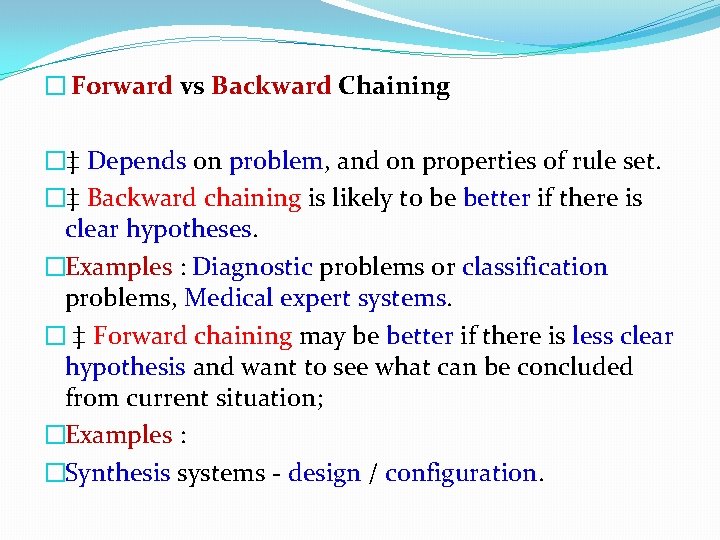
� Forward vs Backward Chaining �‡ Depends on problem, and on properties of rule set. �‡ Backward chaining is likely to be better if there is clear hypotheses. �Examples : Diagnostic problems or classification problems, Medical expert systems. � ‡ Forward chaining may be better if there is less clear hypothesis and want to see what can be concluded from current situation; �Examples : �Synthesis systems - design / configuration.