Antimatter in the Universe and the PAMELAFERMIAMS anomaly




- Slides: 44
Antimatter in the Universe and the PAMELA/FERMI/AMS… anomaly Gerry Skinner gerald. k. skinner@gmail. com Max-Planck Institut fur Extraterrestriche Physik , Garching Max-Planck Institut fur Astrophysik , Garching (Honorary) University of Birmingham, UK (Department of Astrophysics and Space Research) (Ex) University of Maryland (attached to NASA Goddard Space Flight Center) (Ex) Université Paul Sabatier, Toulouse (attached to Centre d’Etudes Spatiales des Rayonnements)
There is direct evidence for 1) Anti-protons and positrons ~0. 1 -100 Ge. V in Cosmic Rays 2) The annihilation of 1043 low energy (<~ ke. V) positrons per second in the Inter-Stellar Medium
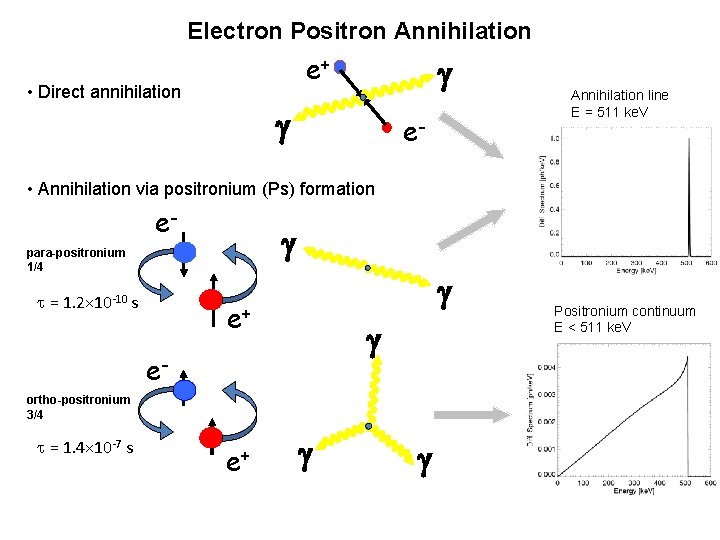
Electron Positron Annihilation e+ • Direct annihilation g g e- Annihilation line E = 511 ke. V • Annihilation via positronium (Ps) formation e- g para-positronium 1/4 t = 1. 2× 10 -10 s g e+ g eortho-positronium 3/4 t = 1. 4× 10 -7 s e+ g g Positronium continuum E < 511 ke. V
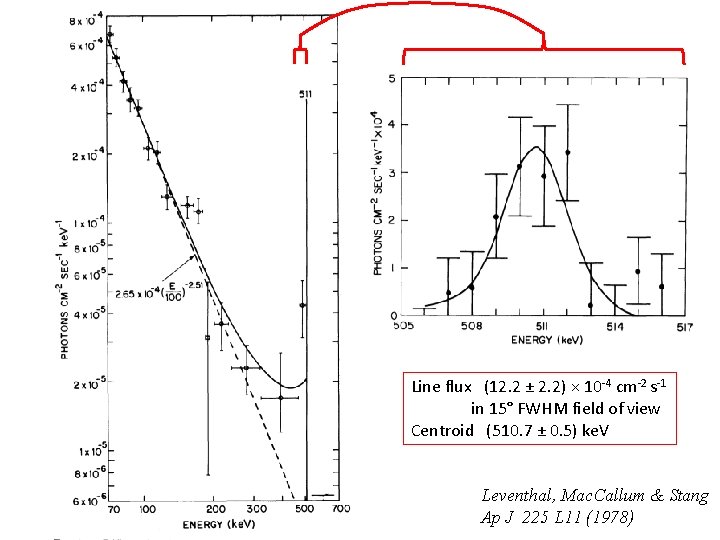
Line flux (12. 2 ± 2. 2) × 10 -4 cm-2 s-1 in 15° FWHM field of view Centroid (510. 7 ± 0. 5) ke. V Leventhal, Mac. Callum & Stang Ap J 225 L 11 (1978)
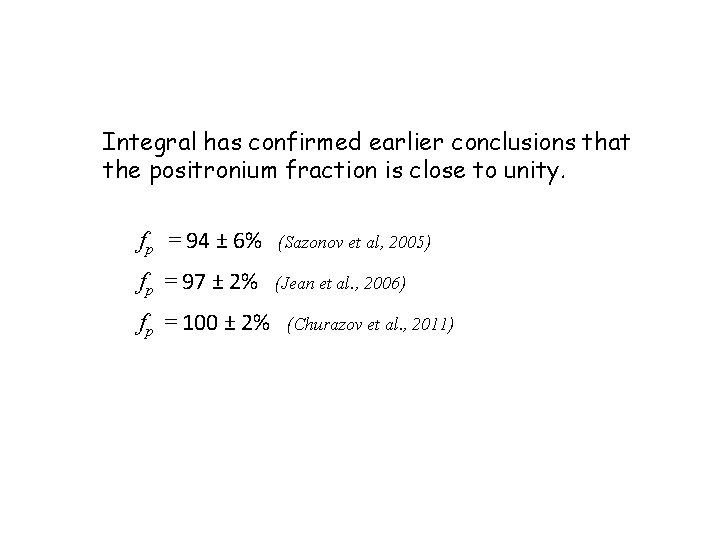
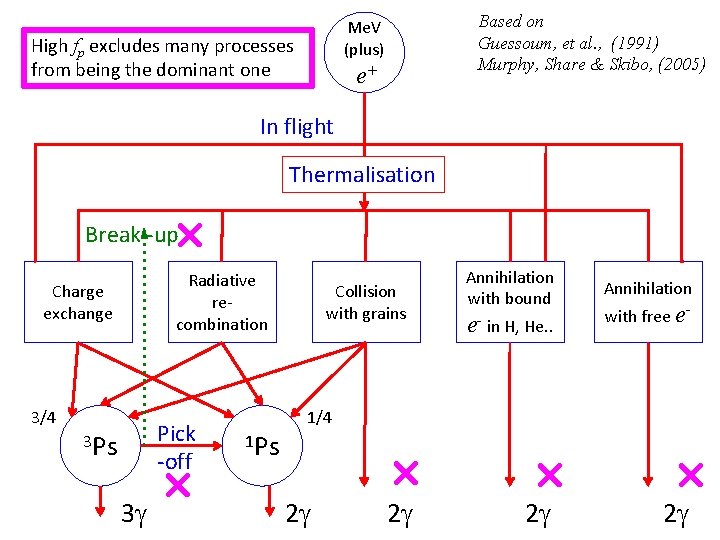
Integral has confirmed earlier conclusions that the positronium fraction is close to unity. fp = 94 ± 6% (Sazonov et al, 2005) fp = 97 ± 2% (Jean et al. , 2006) fp = 100 ± 2% (Churazov et al. , 2011)
Cold H 2 Warm Neutral Cold H Warm, Ionized Hot Line shapes expected for annihilation in different media Gessoum, Jean, Gillard (2005)
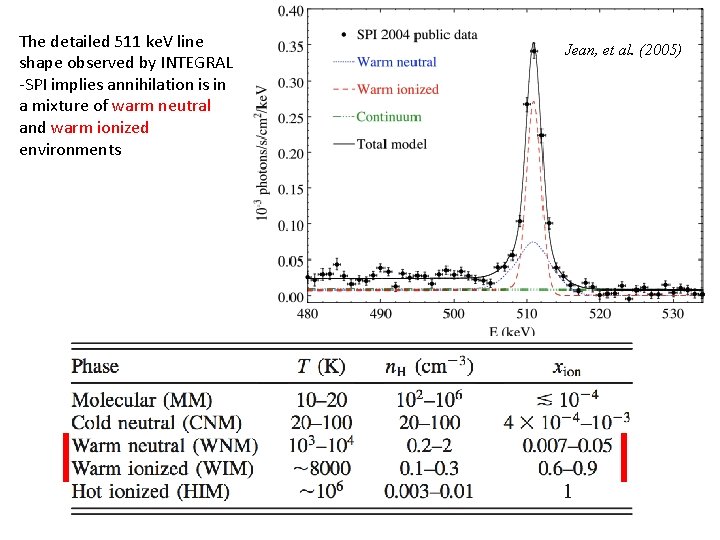
The detailed 511 ke. V line shape observed by INTEGRAL -SPI implies annihilation is in a mixture of warm neutral and warm ionized environments Jean, et al. (2005)
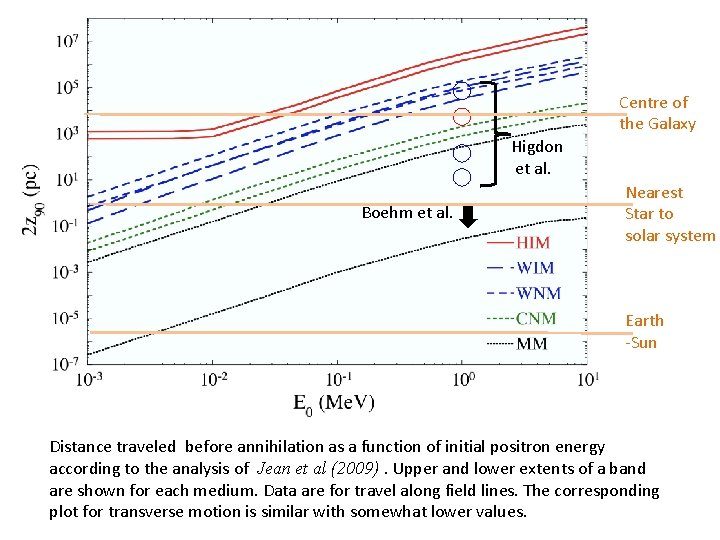
Centre of the Galaxy Higdon et al. Boehm et al. Nearest Star to solar system Earth -Sun Distance traveled before annihilation as a function of initial positron energy according to the analysis of Jean et al (2009). Upper and lower extents of a band are shown for each medium. Data are for travel along field lines. The corresponding plot for transverse motion is similar with somewhat lower values.
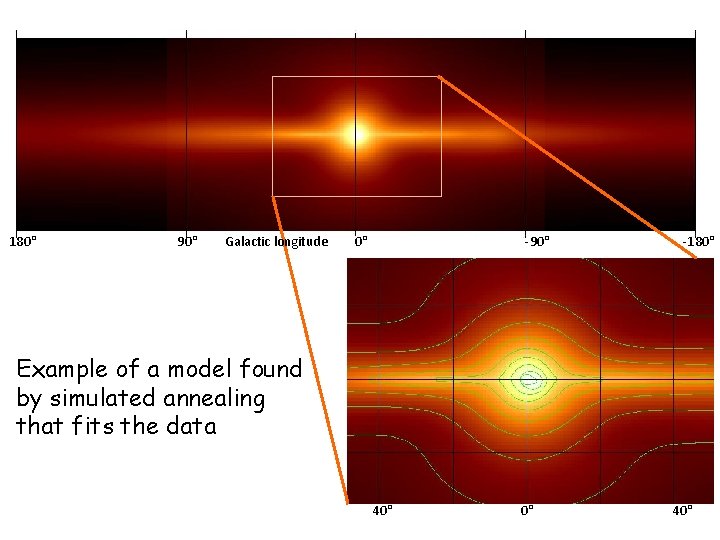
180° 90° Galactic longitude 0° -90° -180° Example of a model found by simulated annealing that fits the data 40° 0° 40°
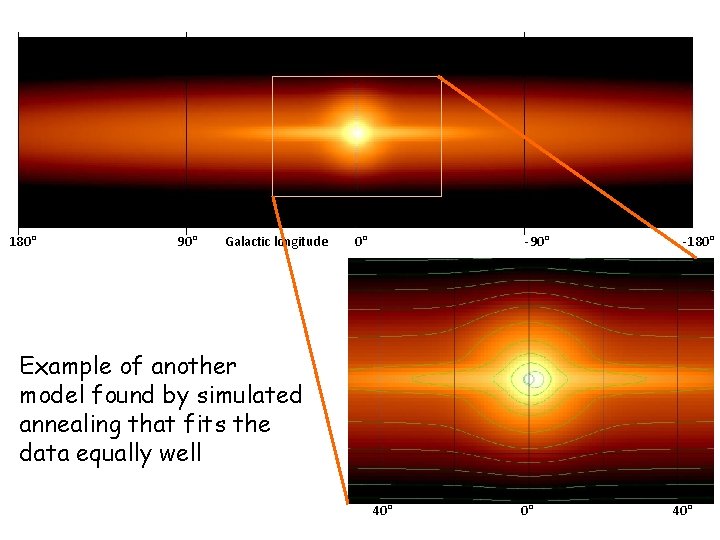
180° 90° Galactic longitude 0° -90° -180° Example of another model found by simulated annealing that fits the data equally well 40° 0° 40°
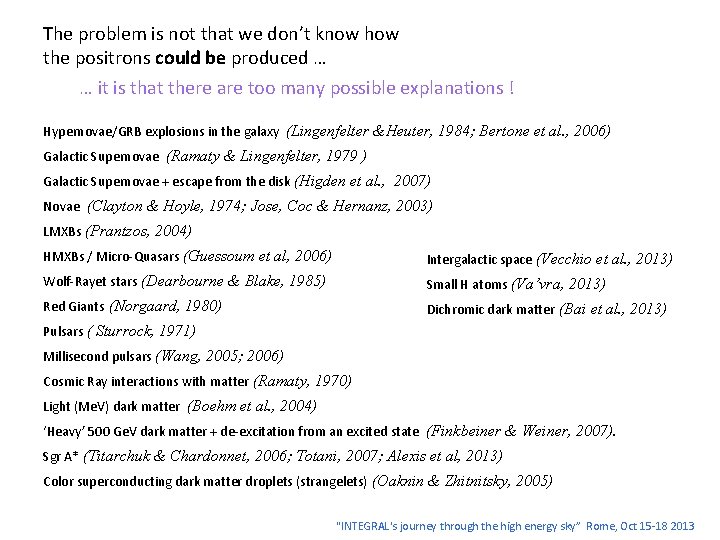
The problem is not that we don’t know how the positrons could be produced … … it is that there are too many possible explanations ! Hypernovae/GRB explosions in the galaxy (Lingenfelter &Heuter, 1984; Bertone et al. , 2006) Galactic Supernovae (Ramaty & Lingenfelter, 1979 ) Galactic Supernovae + escape from the disk (Higden et al. , 2007) Novae (Clayton & Hoyle, 1974; Jose, Coc & Hernanz, 2003) LMXBs (Prantzos, 2004) HMXBs / Micro-Quasars (Guessoum et al, 2006) Intergalactic space (Vecchio et al. , 2013) Wolf-Rayet stars (Dearbourne & Blake, 1985) Small H atoms (Va’vra, 2013) Red Giants (Norgaard, 1980) Dichromic dark matter (Bai et al. , 2013) Pulsars ( Sturrock, 1971) Millisecond pulsars (Wang, 2005; 2006) Cosmic Ray interactions with matter (Ramaty, 1970) Light (Me. V) dark matter (Boehm et al. , 2004) ‘Heavy’ 500 Ge. V dark matter + de-excitation from an excited state (Finkbeiner & Weiner, 2007). Sgr A* (Titarchuk & Chardonnet, 2006; Totani, 2007; Alexis et al, 2013) Color superconducting dark matter droplets (strangelets) (Oaknin & Zhitnitsky, 2005) "INTEGRAL's journey through the high energy sky” Rome, Oct 15 -18 2013
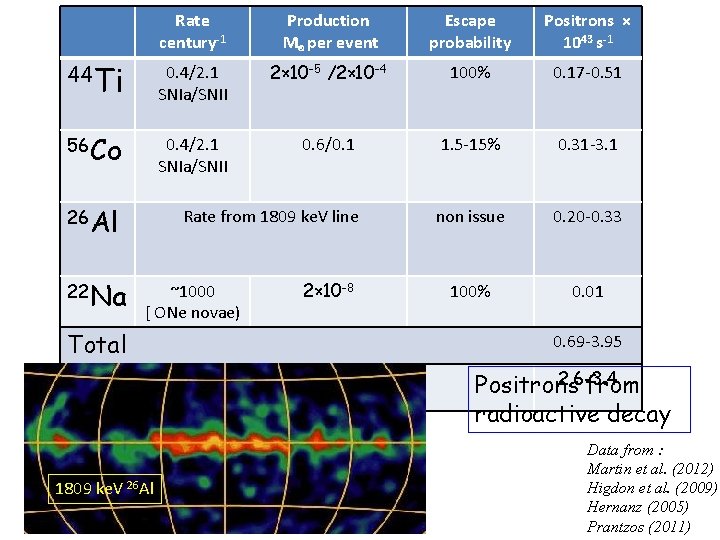
Rate century-1 Production M⊙ per event Escape probability Positrons × 1043 s-1 44 Ti 0. 4/2. 1 SNIa/SNII 2× 10 -5 /2× 10 -4 100% 0. 17 -0. 51 56 Co 0. 4/2. 1 SNIa/SNII 0. 6/0. 1 1. 5 -15% 0. 31 -3. 1 Rate from 1809 ke. V line non issue 0. 20 -0. 33 100% 0. 01 26 Al 22 Na ~1000 [ ONe novae) Total To explain 1809 ke. V 26 Al 2× 10 -8 0. 69 -3. 95 2. 6 -3. 4 Positrons from radioactive decay Data from : Martin et al. (2012) Higdon et al. (2009) Hernanz (2005) Prantzos (2011)
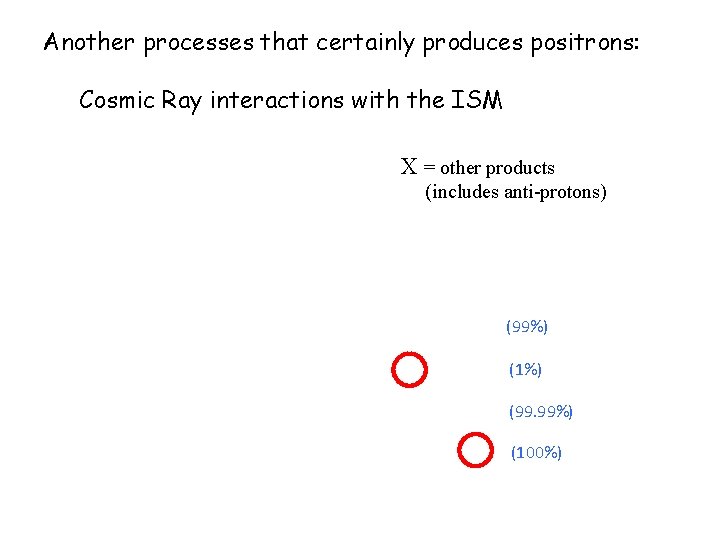
Another processes that certainly produces positrons: Cosmic Ray interactions with the ISM X = other products (includes anti-protons) (99%) (1%) (99. 99%) (100%)
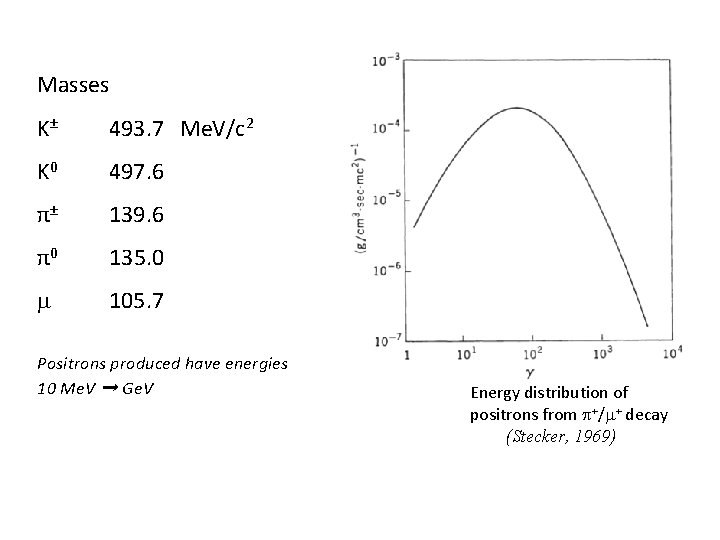
Masses K ± 493. 7 Me. V/c 2 K 0 497. 6 π ± 139. 6 π0 135. 0 m 105. 7 Positrons produced have energies 10 Me. V ➞ Ge. V Energy distribution of positrons from p+/m+ decay (Stecker, 1969)
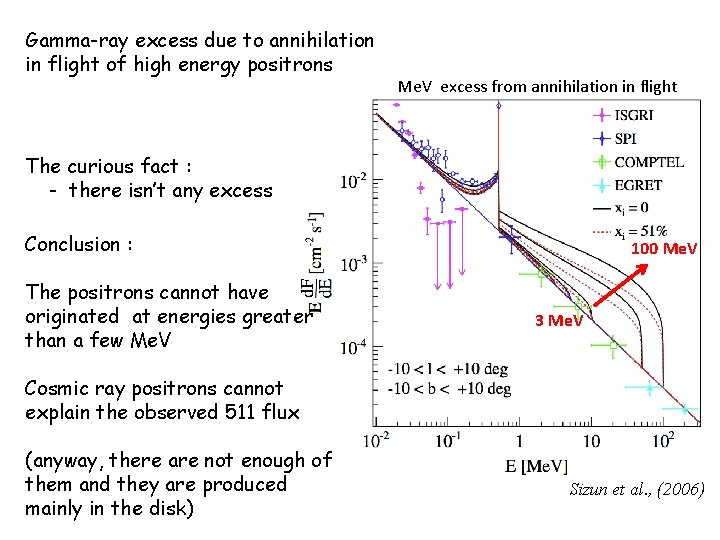
Gamma-ray excess due to annihilation in flight of high energy positrons Me. V excess from annihilation in flight The curious fact : - there isn’t any excess Conclusion : The positrons cannot have originated at energies greater than a few Me. V 100 Me. V 3 Me. V Cosmic ray positrons cannot explain the observed 511 flux (anyway, there are not enough of them and they are produced mainly in the disk) Sizun et al. , (2006)
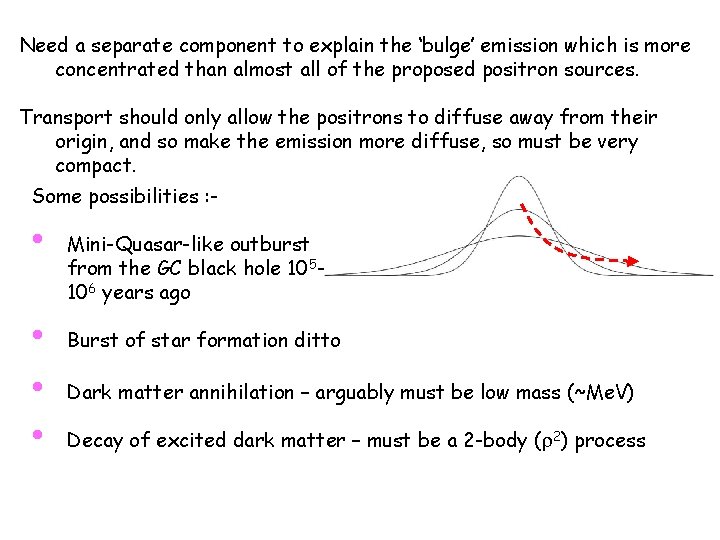
Need a separate component to explain the ‘bulge’ emission which is more concentrated than almost all of the proposed positron sources. Transport should only allow the positrons to diffuse away from their origin, and so make the emission more diffuse, so must be very compact. Some possibilities : - • • Mini-Quasar-like outburst from the GC black hole 105106 years ago Burst of star formation ditto Dark matter annihilation – arguably must be low mass (~Me. V) Decay of excited dark matter – must be a 2 -body (r 2) process
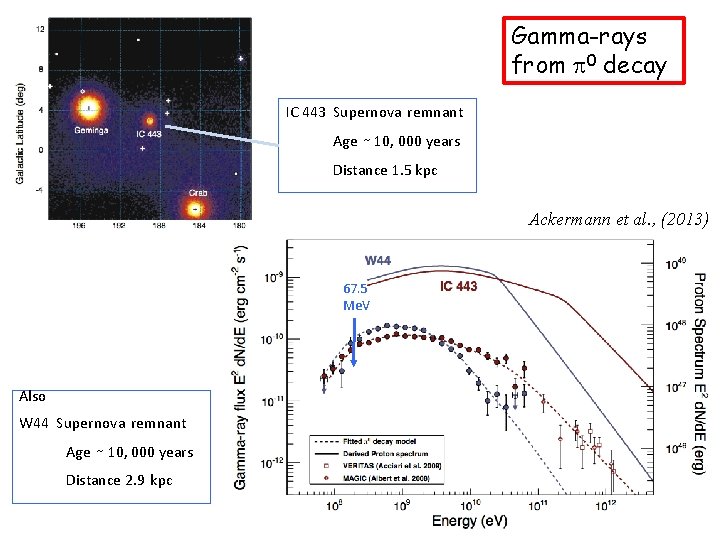
Gamma-rays from p 0 decay IC 443 Supernova remnant Age ∼ 10, 000 years Distance 1. 5 kpc Ackermann et al. , (2013) 67. 5 Me. V Also W 44 Supernova remnant Age ∼ 10, 000 years Distance 2. 9 kpc
• More direct evidence – Cosmic Rays measured inside the Solar System Model and low energy observations (Mosalenko et al (2002)
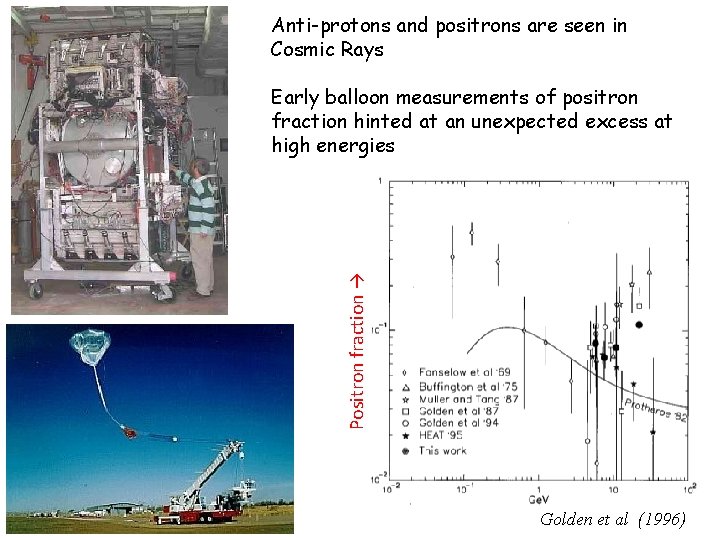
Anti-protons and positrons are seen in Cosmic Rays Positron fraction → Early balloon measurements of positron fraction hinted at an unexpected excess at high energies Golden et al (1996)
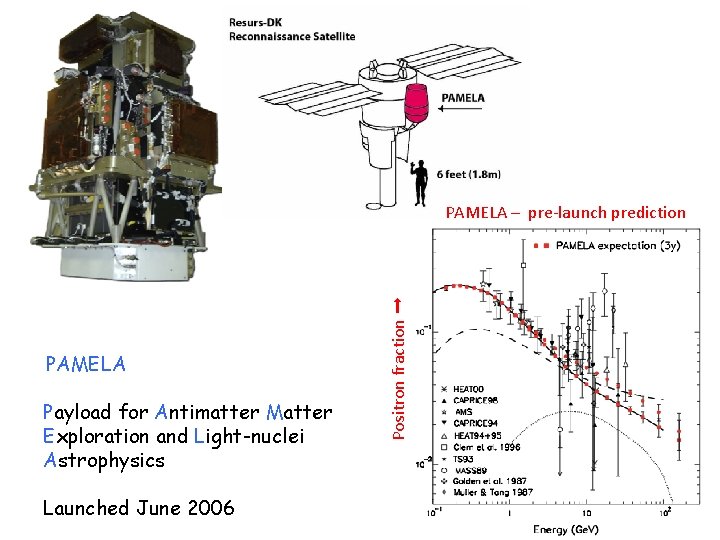
PAMELA Payload for Antimatter Matter Exploration and Light-nuclei Astrophysics Launched June 2006 Positron fraction ➞ PAMELA – pre-launch prediction
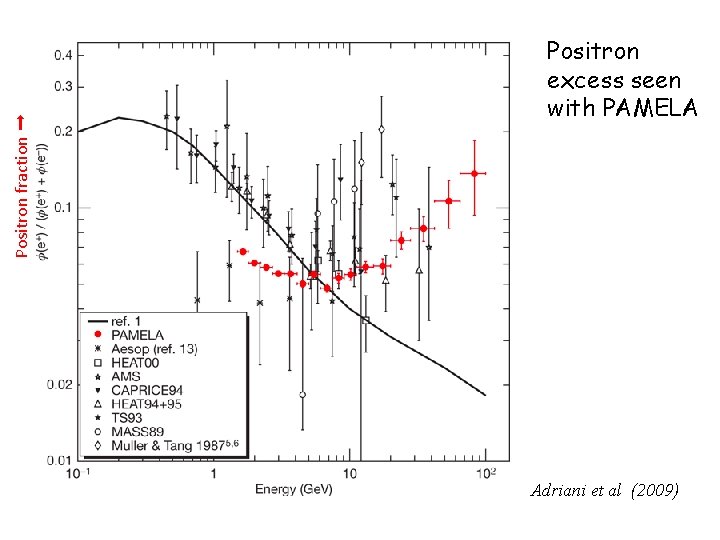
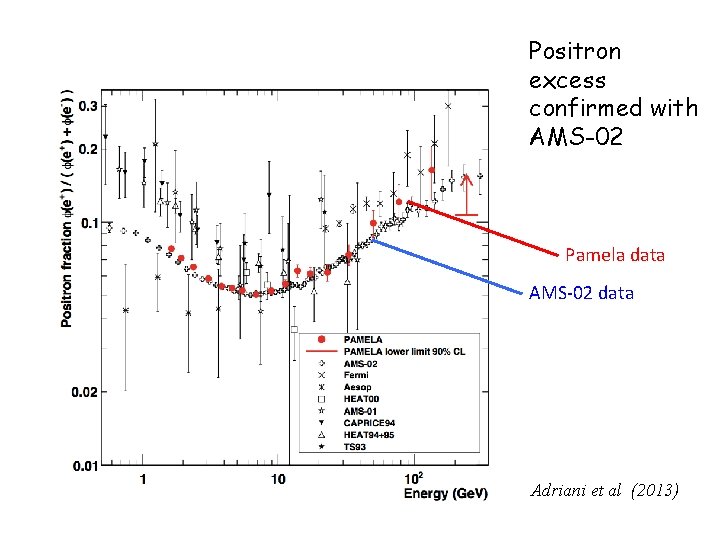
Positron fraction ➞ Positron excess seen with PAMELA ) Adriani et al (2009)
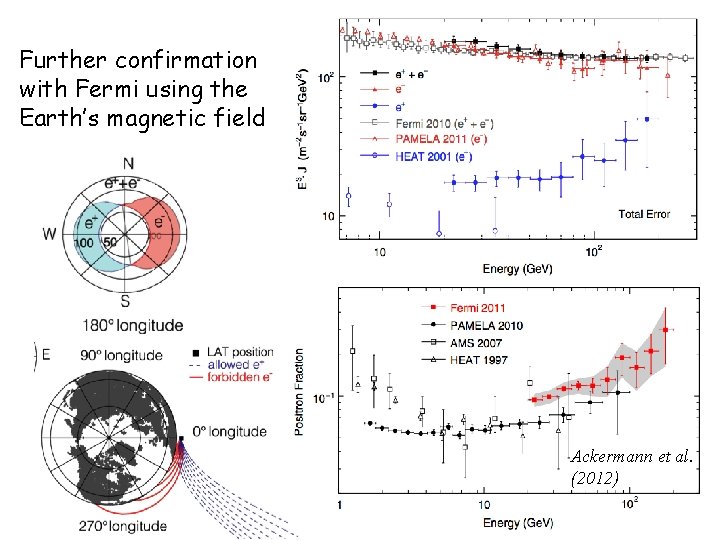
Further confirmation with Fermi using the Earth’s magnetic field Ackermann et al. (2012)
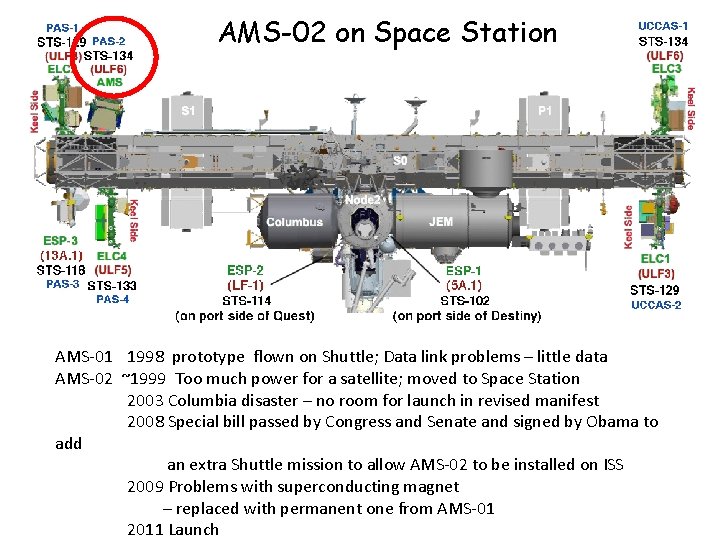
AMS-02 on Space Station AMS-01 1998 prototype flown on Shuttle; Data link problems – little data AMS-02 ~1999 Too much power for a satellite; moved to Space Station 2003 Columbia disaster – no room for launch in revised manifest 2008 Special bill passed by Congress and Senate and signed by Obama to add an extra Shuttle mission to allow AMS-02 to be installed on ISS 2009 Problems with superconducting magnet – replaced with permanent one from AMS-01 2011 Launch
Positron excess confirmed with AMS-02 Pamela data AMS-02 data Adriani et al (2013)
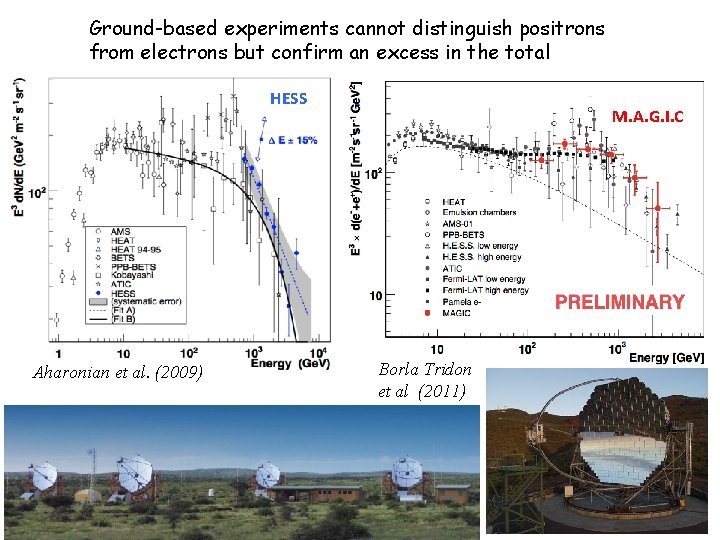
Ground-based experiments cannot distinguish positrons from electrons but confirm an excess in the total HESS Aharonian et al. (2009) M. A. G. I. C Borla Tridon et al (2011)
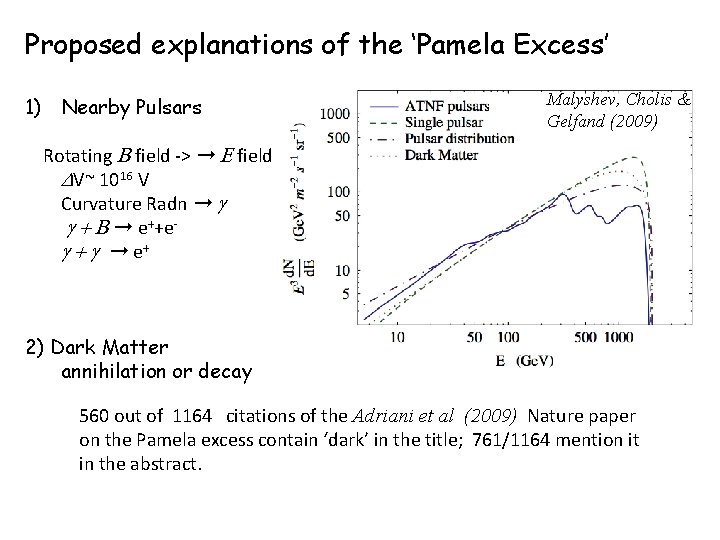
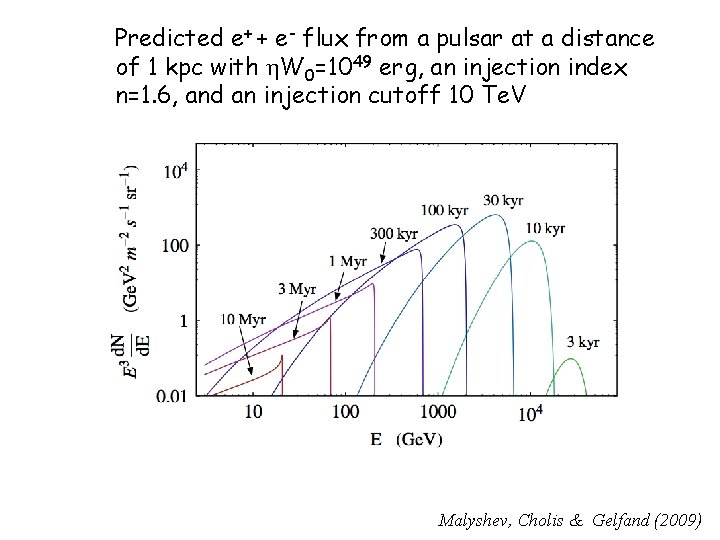
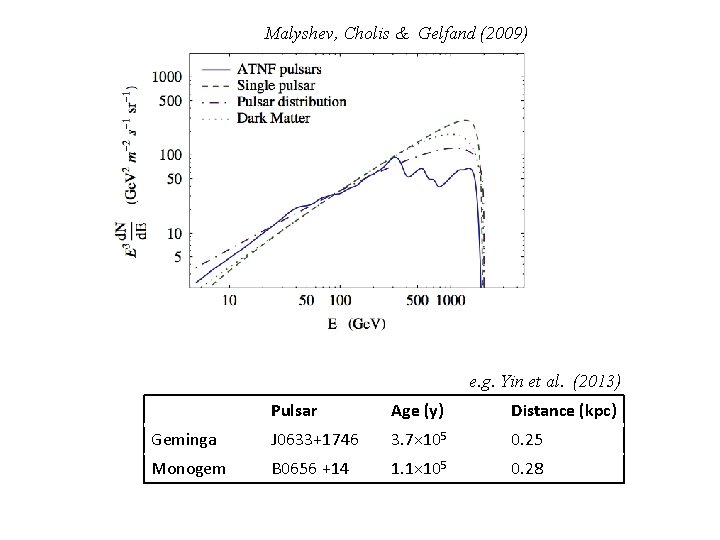
Proposed explanations of the ‘Pamela Excess’ 1) Nearby Pulsars Malyshev, Cholis & Gelfand (2009) Rotating B field -> ➞ E field DV~ 1016 V Curvature Radn ➞ g g + B ➞ e++eg + g ➞ e+ 2) Dark Matter annihilation or decay 560 out of 1164 citations of the Adriani et al (2009) Nature paper on the Pamela excess contain ‘dark’ in the title; 761/1164 mention it in the abstract.
Anti Stars; Anti Galaxies; Anti Clusters ? Dirac in his 1933 Nobel Lecture : “…. One might perhaps think that the same theory could be applied to protons. This would require the possibility of existence of negatively charged protons forming a mirror image of the usual positively charged ones. . … we must regard it rather as an accident that the Earth (and presumably the whole solar system), contains a preponderance of negative electrons and positive protons. It is quite possible that for some of the stars it is the other way about, these stars being built up mainly of positrons and negative protons. In fact, there may be half the stars of each kind. The two kinds of stars would both show exactly the same spectra, and there would be no way of distinguishing them by present astronomical methods”.
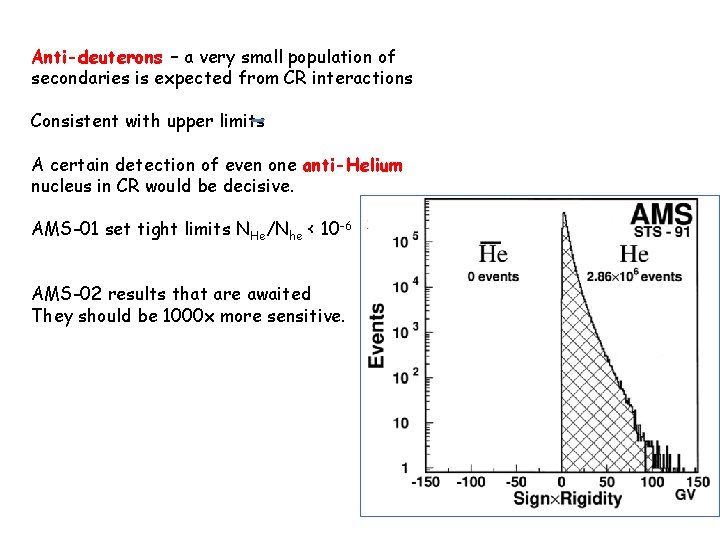
Anti-deuterons – a very small population of secondaries is expected from CR interactions Consistent with upper limits A certain detection of even one anti-Helium nucleus in CR would be decisive. AMS-01 set tight limits NHe/Nhe < 10 -6 AMS-02 results that are awaited They should be 1000 x more sensitive.
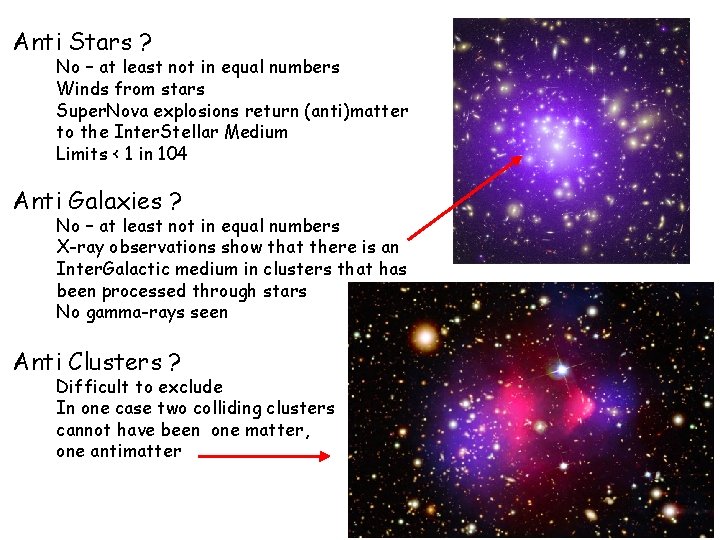
Anti Stars ? No – at least not in equal numbers Winds from stars Super. Nova explosions return (anti)matter to the Inter. Stellar Medium Limits < 1 in 104 Anti Galaxies ? No – at least not in equal numbers X-ray observations show that there is an Inter. Galactic medium in clusters that has been processed through stars No gamma-rays seen Anti Clusters ? Difficult to exclude In one case two colliding clusters cannot have been one matter, one antimatter
In principle, one CAN detect matter / anti-matter mixtures with electromagnetic radiation Polarized source Pulsar Rotation measure q Dispersion measure l 2 t l 3
Gravitational redshift The gravitational potential of the galaxy is well established from the velocity profile (which shows it to be dominated by dark matter) For radiation coming from 1 kpc from the centre (an angular offset of 7°), there will be a redshift of 1 part in 106. Would negative gravitation mass for positrons mean that 511 ke. V positronium annihilation radiation would show no such redshift ? But 1) The effect is small to measure at present 2) The redshift is a GR effect, but GR cannot hold
The END
Predicted e+ + e- flux from a pulsar at a distance of 1 kpc with h. W 0=1049 erg, an injection index n=1. 6, and an injection cutoff 10 Te. V Malyshev, Cholis & Gelfand (2009)
Malyshev, Cholis & Gelfand (2009) e. g. Yin et al. (2013) Pulsar Age (y) Distance (kpc) Geminga J 0633+1746 3. 7× 10⁵ 0. 25 Monogem B 0656 +14 1. 1× 10⁵ 0. 28
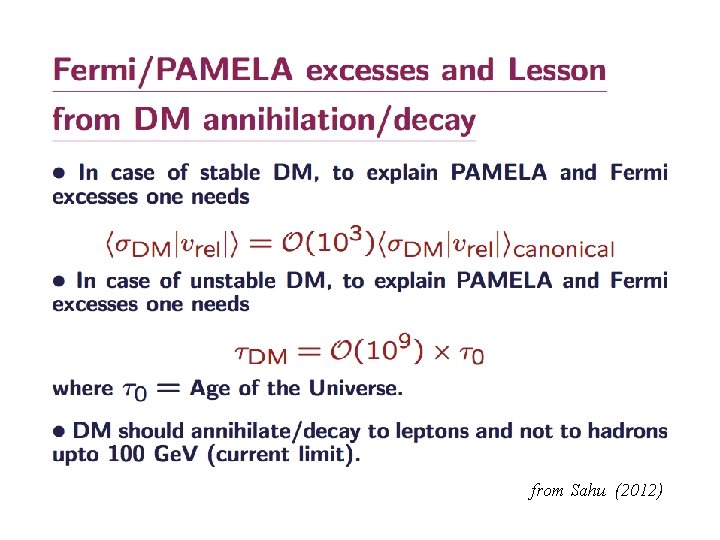
from Sahu (2012)
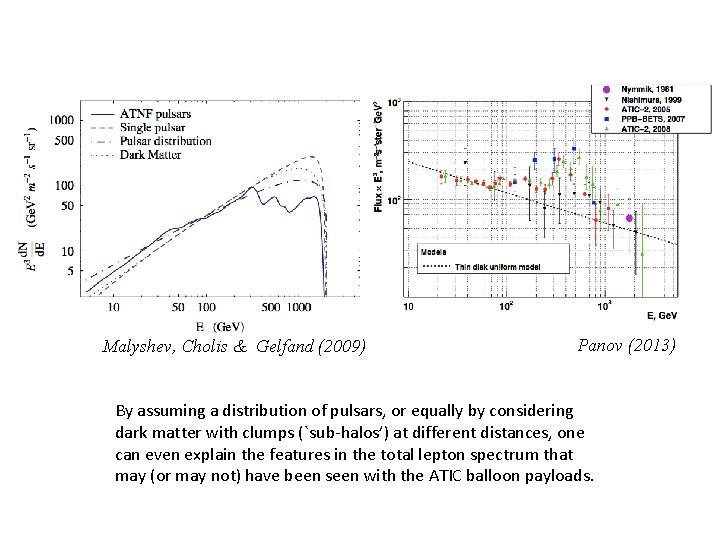
Malyshev, Cholis & Gelfand (2009) Panov (2013) By assuming a distribution of pulsars, or equally by considering dark matter with clumps (`sub-halos’) at different distances, one can even explain the features in the total lepton spectrum that may (or may not) have been seen with the ATIC balloon payloads.
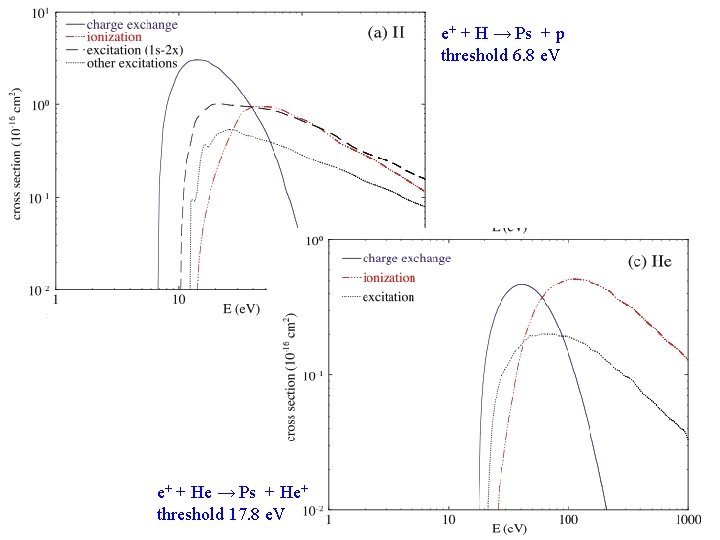
e+ + H → Ps + p threshold 6. 8 e. V e+ + He → Ps + He+ threshold 17. 8 e. V
Based on Guessoum, et al. , (1991) Murphy, Share & Skibo, (2005) Me. V (plus) High fp excludes many processes from being the dominant one e + In flight Thermalisation × Break -up Charge exchange 3/4 3 Ps Radiative recombination Pick -off × 3 g Collision with grains Annihilation with bound e- in H, He. . Annihilation with free e- 1/4 1 Ps 2 g × 2 g
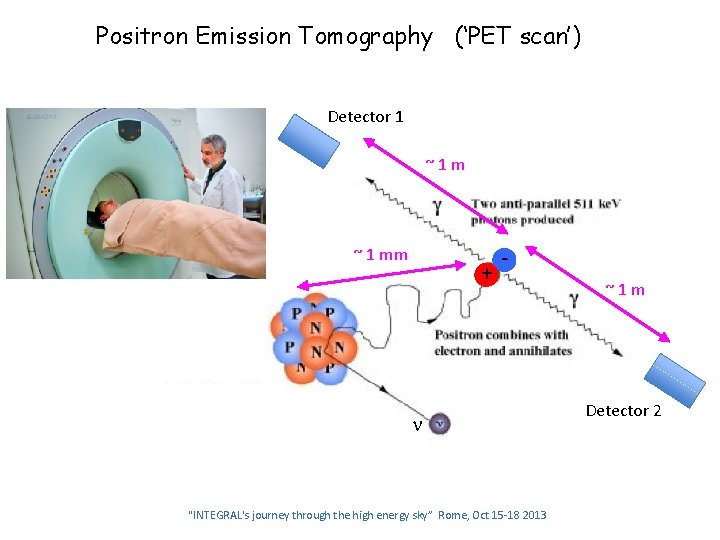
Positron Emission Tomography (‘PET scan’) Detector 1 ~ 1 mm + - n "INTEGRAL's journey through the high energy sky” Rome, Oct 15 -18 2013 ~ 1 m Detector 2
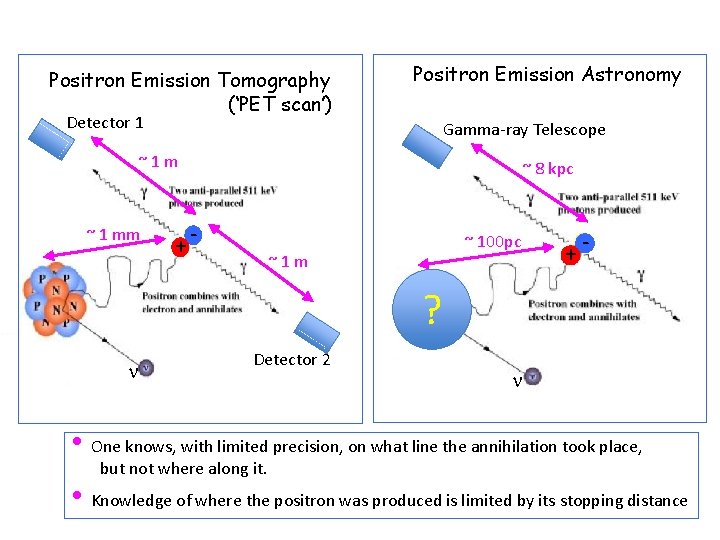
Positron Emission Tomography (‘PET scan’) Positron Emission Astronomy Detector 1 Gamma-ray Telescope ~ 1 mm ~ 8 kpc +- ~ 100 pc ~ 1 m +- ? n Detector 2 n • One knows, with limited precision, on what line the annihilation took place, but not where along it. • Knowledge of where the positron was produced is limited by its stopping distance
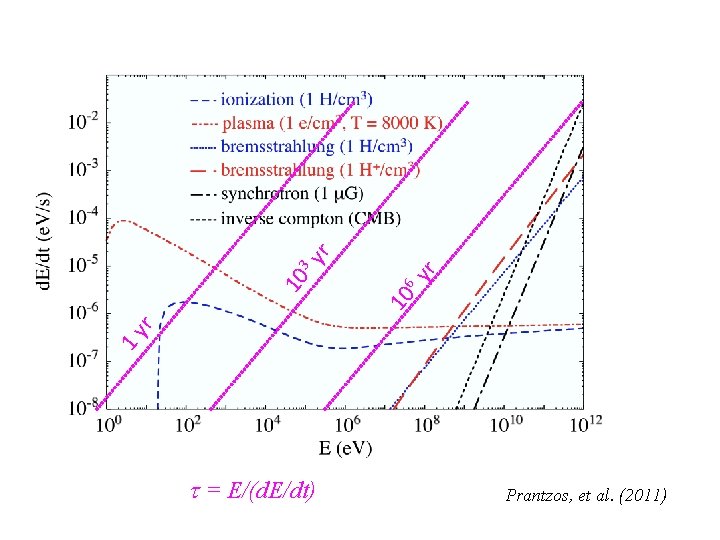
10 6 yr 10 3 yr r 1 y t = E/(d. E/dt) Prantzos, et al. (2011)
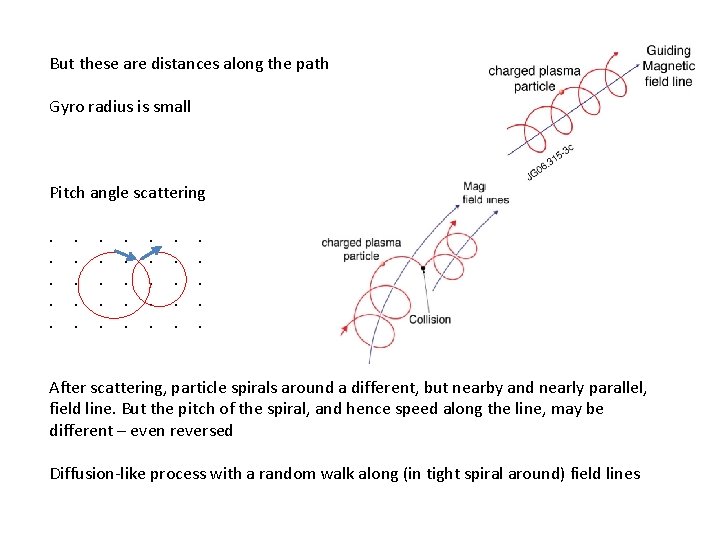
But these are distances along the path Gyro radius is small Pitch angle scattering. . . . . . . After scattering, particle spirals around a different, but nearby and nearly parallel, field line. But the pitch of the spiral, and hence speed along the line, may be different – even reversed Diffusion-like process with a random walk along (in tight spiral around) field lines
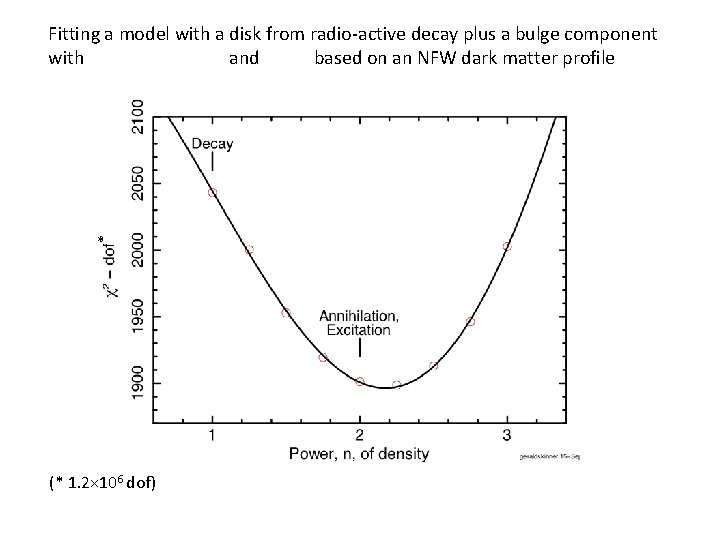
Fitting a model with a disk from radio-active decay plus a bulge component with and based on an NFW dark matter profile * (* 1. 2× 10⁶ dof)
“We show that the position of the central dark matter (DM) density peak may be expected to differ from the dynamical center of the Galaxy by several hundred parsecs. ” Invoked to explain an offset in the centroid of the possible Fermi 130 Ge. V line by ~1. 5° from the Galactic centre (to negative galactic longitudes). "INTEGRAL's journey through the high energy sky” Rome, Oct 15 -18 2013