
Page replacement q q Assume a normal page

- Slides: 71
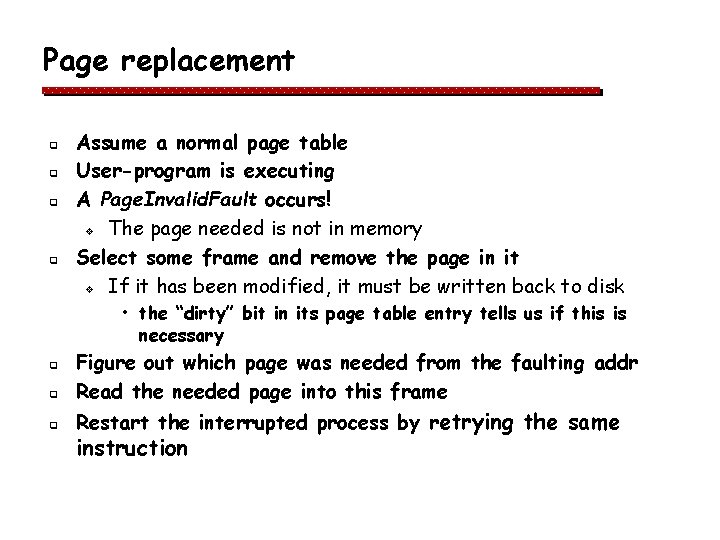
Page replacement q q Assume a normal page table User-program is executing A Page. Invalid. Fault occurs! v The page needed is not in memory Select some frame and remove the page in it v If it has been modified, it must be written back to disk • the “dirty” bit in its page table entry tells us if this is necessary q Figure out which page was needed from the faulting addr Read the needed page into this frame q Restart the interrupted process by retrying the same q instruction
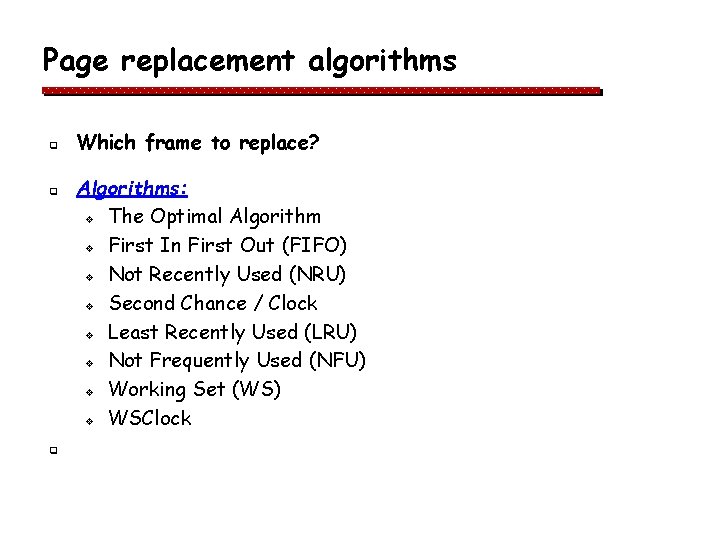
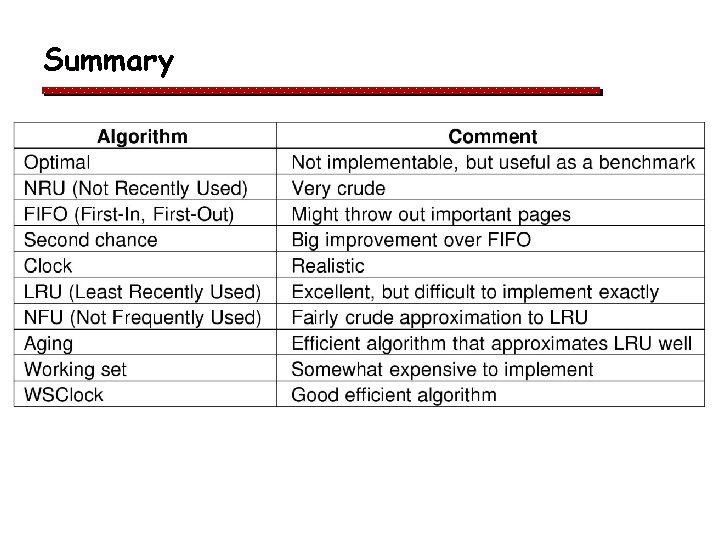
Page replacement algorithms q q q Which frame to replace? Algorithms: v The Optimal Algorithm v First In First Out (FIFO) v Not Recently Used (NRU) v Second Chance / Clock v Least Recently Used (LRU) v Not Frequently Used (NFU) v Working Set (WS) v WSClock
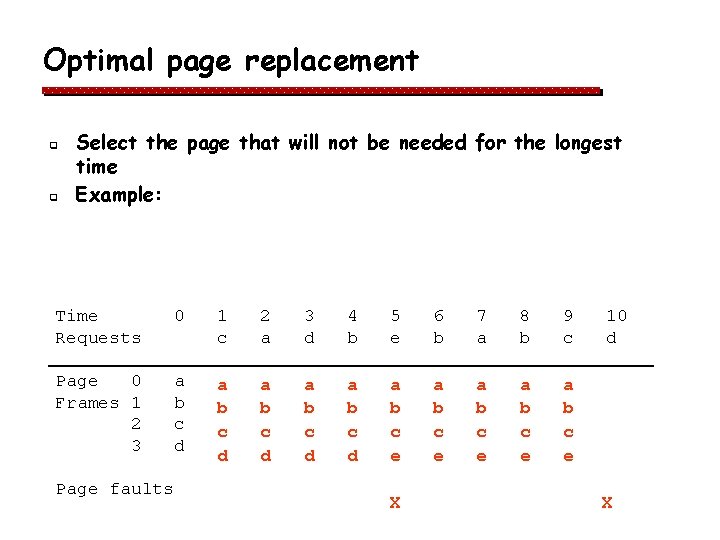
The optimal page replacement algorithm q Idea: v Select the page that will not be needed for the longest time
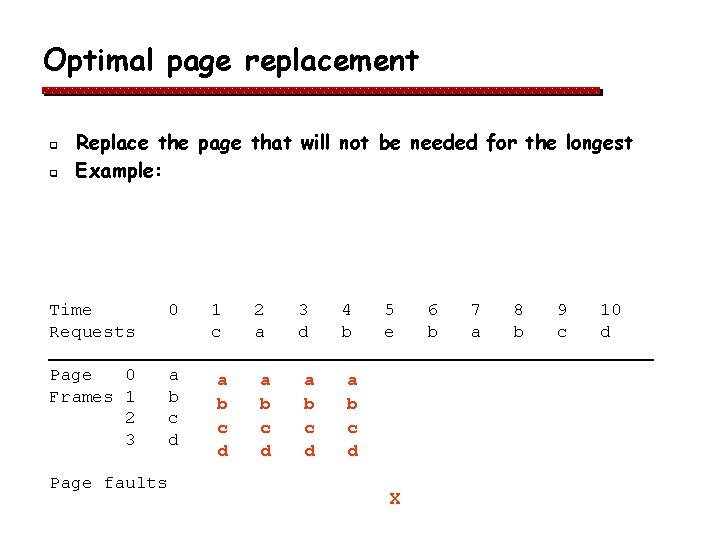
Optimal page replacement q q Replace the page that will not be needed for the longest Example: Time Requests 0 Page 0 Frames 1 2 3 a b c d Page faults 1 c a b c d 2 a a b c d 3 d a b c d 4 b 5 e a b c d X 6 b 7 a 8 b 9 c 10 d
Optimal page replacement q q Select the page that will not be needed for the longest time Example: Time Requests 0 1 c 2 a 3 d 4 b 5 e 6 b 7 a 8 b 9 c Page 0 Frames 1 2 3 a b c d a b c d a b c e a b c e Page faults X 10 d X
The optimal page replacement algorithm q q Idea: v Select the page that will not be needed for the longest time Problem?
The optimal page replacement algorithm q q Idea: v Select the page that will not be needed for the longest time Problem: v Can’t know the future of a program v Can’t know when a given page will be needed next v The optimal algorithm is unrealizable
The optimal page replacement algorithm q However: v We can use it as a control case for simulation studies • Run the program once • Generate a log of all memory references – Do we need all of them? • Use the log to simulate various page replacement algorithms • Can compare others to “optimal” algorithm
FIFO page replacement algorithm q Always replace the oldest page … v “Replace the page that has been in memory for the longest time. ”
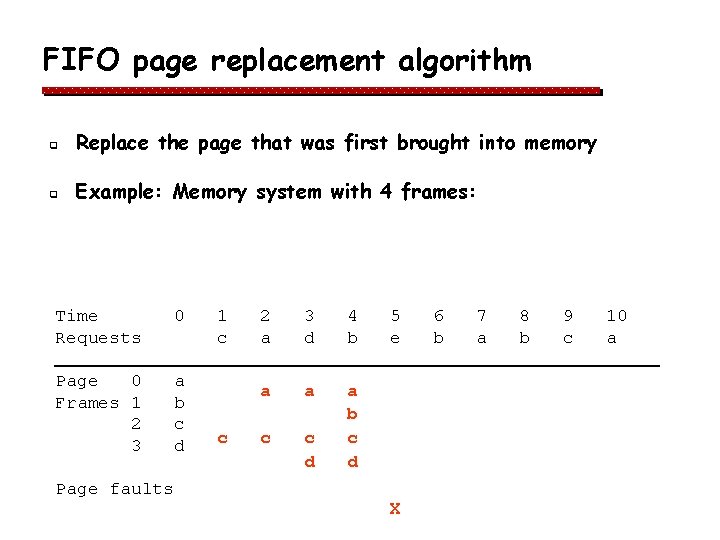
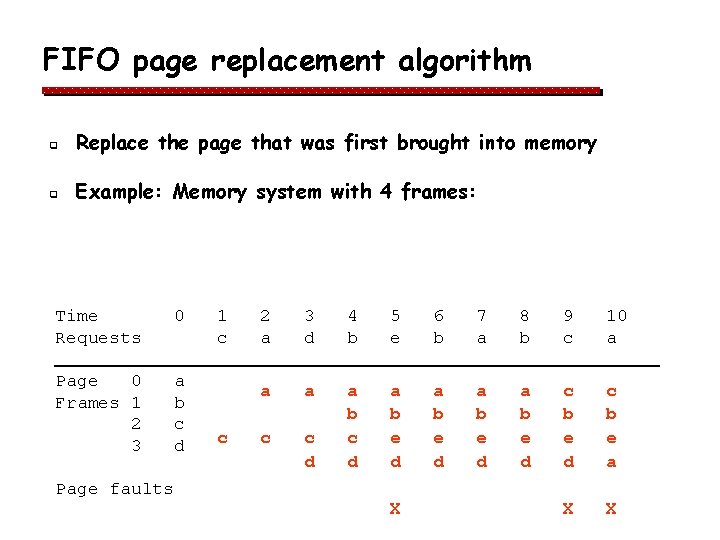
FIFO page replacement algorithm q Replace the page that was first brought into memory q Example: Memory system with 4 frames: Time Requests 0 Page 0 Frames 1 2 3 a b c d Page faults 1 c c 2 a 3 d 4 b a a c c d a b c d 5 e X 6 b 7 a 8 b 9 c 10 a
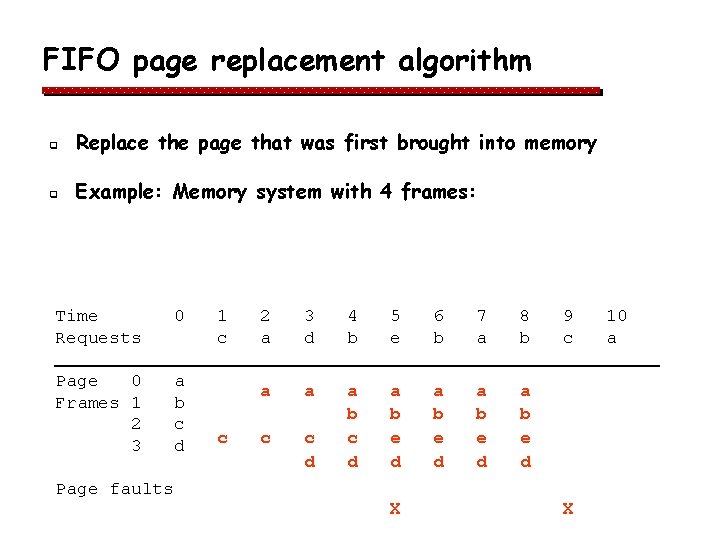
FIFO page replacement algorithm q Replace the page that was first brought into memory q Example: Memory system with 4 frames: Time Requests 0 Page 0 Frames 1 2 3 a b c d Page faults 1 c c 2 a 3 d 4 b 5 e 6 b 7 a 8 b a a c c d a b e d a b e d X 9 c X 10 a
FIFO page replacement algorithm q Replace the page that was first brought into memory q Example: Memory system with 4 frames: Time Requests 0 Page 0 Frames 1 2 3 a b c d Page faults 1 c c 2 a 3 d 4 b 5 e 6 b 7 a 8 b 9 c a a c c d a b e d a b e d c b e d X X 10 a X
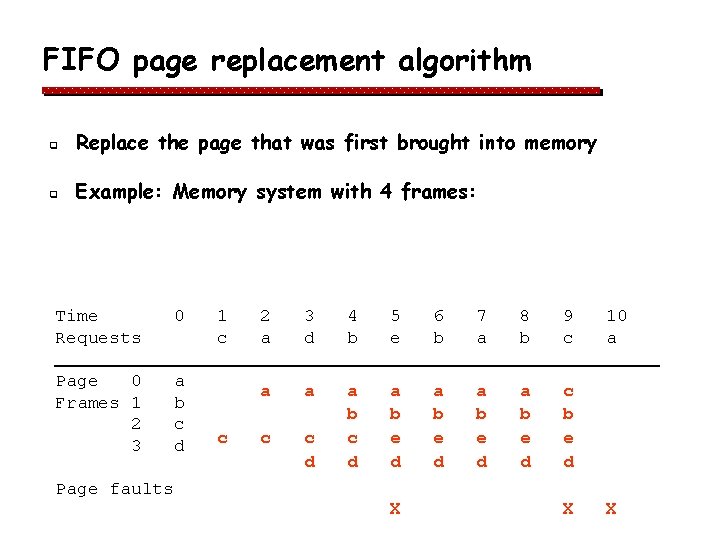
FIFO page replacement algorithm q Replace the page that was first brought into memory q Example: Memory system with 4 frames: Time Requests 0 Page 0 Frames 1 2 3 a b c d Page faults 1 c c 2 a 3 d 4 b 5 e 6 b 7 a 8 b 9 c 10 a a a c c d a b e d a b e d c b e a X X X
FIFO page replacement algorithm q q Always replace the oldest page. v “Replace the page that has been in memory for the longest time. ” Implementation v Maintain a linked list of all pages in memory v Keep it in order of when they came into memory v The page at the tail of the list is oldest v Add new page to head of list
FIFO page replacement algorithm q Disadvantage?
FIFO page replacement algorithm q Disadvantage: v The oldest page may be needed again soon v Some page may be important throughout execution v It will get old, but replacing it will cause an immediate page fault
How can we do better? q Need an approximation of how likely each frame is to be accessed in the future v v If we base this on past behavior we need a way to track past behavior Tracking memory accesses requires hardware support to be efficient
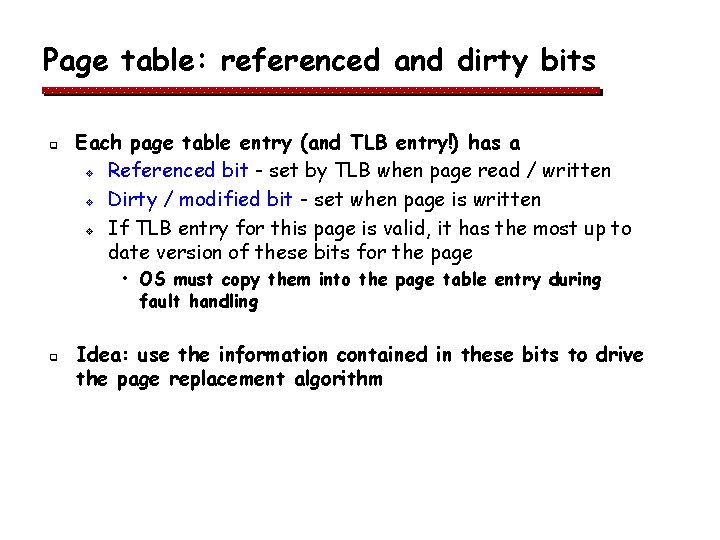
Page table: referenced and dirty bits q Each page table entry (and TLB entry!) has a v Referenced bit - set by TLB when page read / written v Dirty / modified bit - set when page is written v If TLB entry for this page is valid, it has the most up to date version of these bits for the page • OS must copy them into the page table entry during fault handling q Idea: use the information contained in these bits to drive the page replacement algorithm
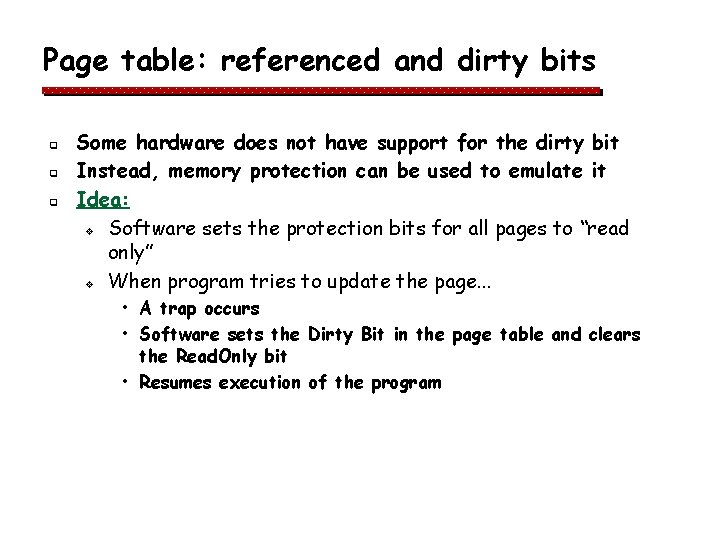
Page table: referenced and dirty bits q q q Some hardware does not have support for the dirty bit Instead, memory protection can be used to emulate it Idea: v Software sets the protection bits for all pages to “read only” v When program tries to update the page. . . • A trap occurs • Software sets the Dirty Bit in the page table and clears the Read. Only bit • Resumes execution of the program
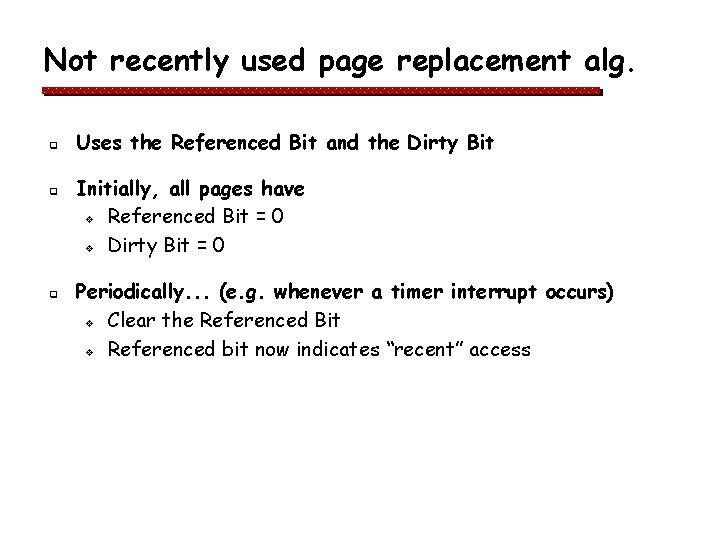
Not recently used page replacement alg. q q q Uses the Referenced Bit and the Dirty Bit Initially, all pages have v Referenced Bit = 0 v Dirty Bit = 0 Periodically. . . (e. g. whenever a timer interrupt occurs) v Clear the Referenced Bit v Referenced bit now indicates “recent” access
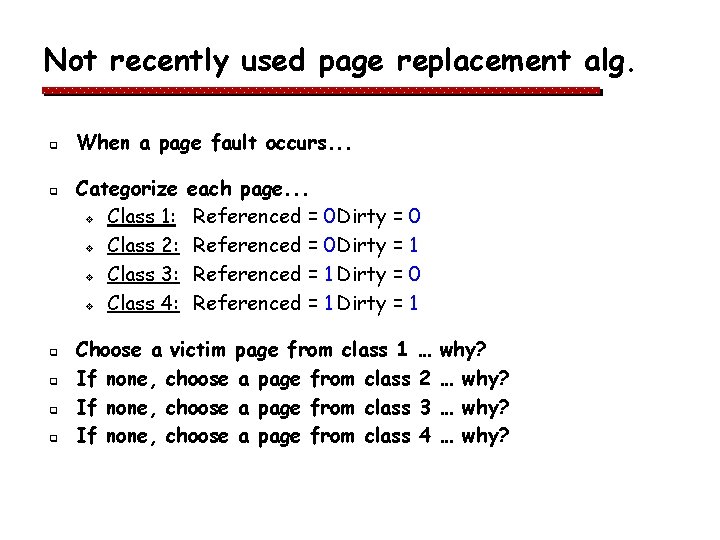
Not recently used page replacement alg. q q q When a page fault occurs. . . Categorize v Class 1: v Class 2: v Class 3: v Class 4: each page. . . Referenced = 0 Dirty = 1 Dirty = 0 1 Choose a victim page from class 1 If none, choose a page from class … 2 3 4 why? … why?
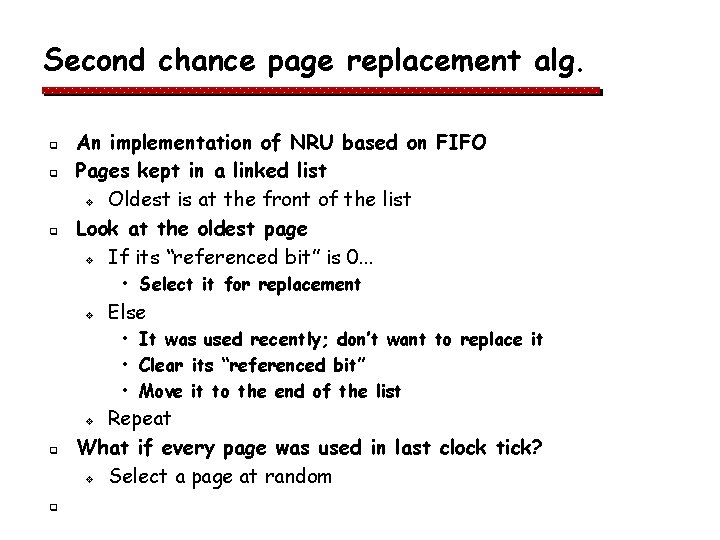
Second chance page replacement alg. q q q An implementation of NRU based on FIFO Pages kept in a linked list v Oldest is at the front of the list Look at the oldest page v If its “referenced bit” is 0. . . • Select it for replacement v Else • It was used recently; don’t want to replace it • Clear its “referenced bit” • Move it to the end of the list Repeat What if every page was used in last clock tick? v Select a page at random v q q
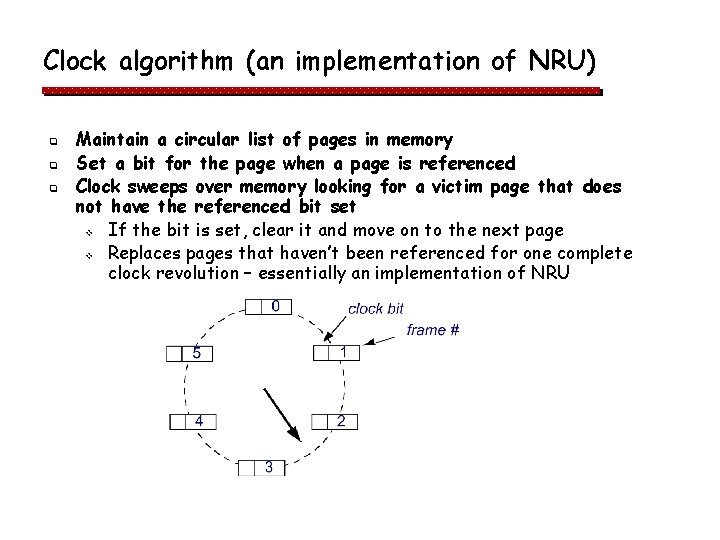
Clock algorithm (an implementation of NRU) q q q Maintain a circular list of pages in memory Set a bit for the page when a page is referenced Clock sweeps over memory looking for a victim page that does not have the referenced bit set v If the bit is set, clear it and move on to the next page v Replaces pages that haven’t been referenced for one complete clock revolution – essentially an implementation of NRU
Least recently used algorithm (LRU) q A refinement of NRU that orders how recently a page was used v Keep track of when a page is used v Replace the page that has been used least recently
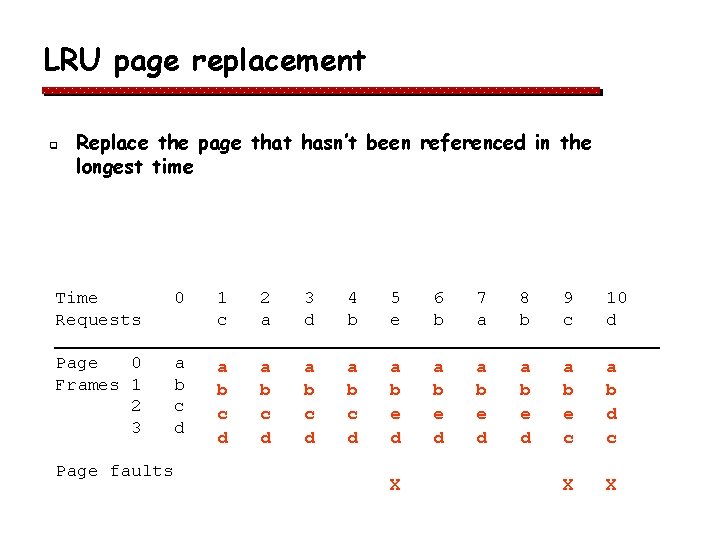
LRU page replacement q Replace the page that hasn’t been referenced in the longest time Time Requests 0 1 c 2 a 3 d 4 b 5 e 6 b 7 a 8 b 9 c 10 d Page 0 Frames 1 2 3 a b c d a b c d a b e d a b e c a b d c X X Page faults X
Least recently used algorithm (LRU) q But how can we implement this?
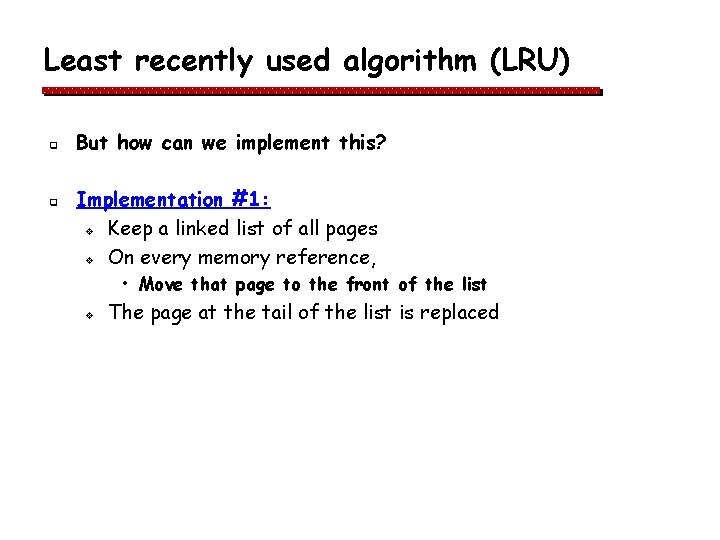
Least recently used algorithm (LRU) q q But how can we implement this? Implementation #1: v Keep a linked list of all pages v On every memory reference, • Move that page to the front of the list v The page at the tail of the list is replaced
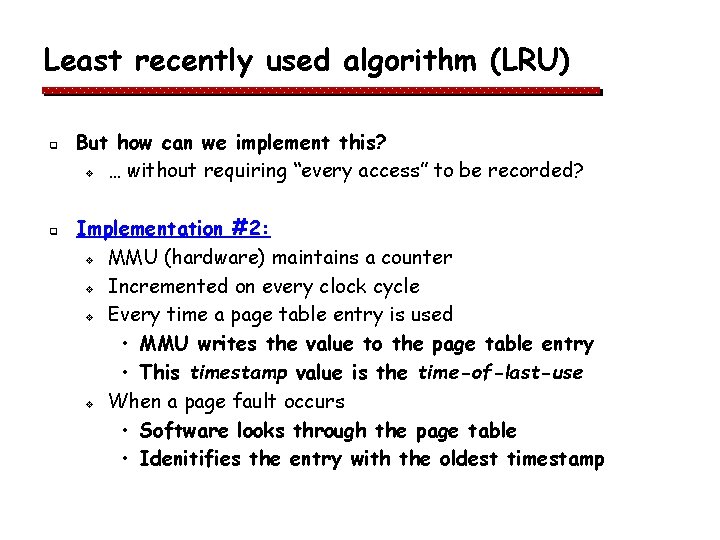
Least recently used algorithm (LRU) q q But how can we implement this? v … without requiring “every access” to be recorded? Implementation #2: v MMU (hardware) maintains a counter v Incremented on every clock cycle v Every time a page table entry is used • MMU writes the value to the page table entry • This timestamp value is the time-of-last-use v When a page fault occurs • Software looks through the page table • Idenitifies the entry with the oldest timestamp
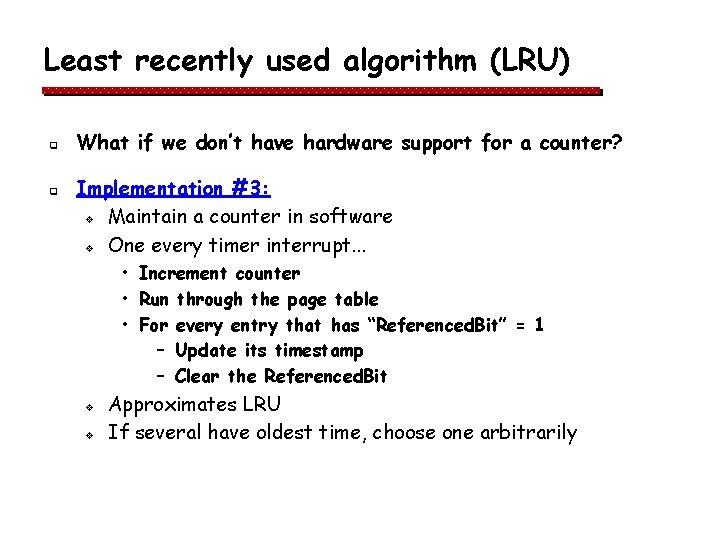
Least recently used algorithm (LRU) q q What if we don’t have hardware support for a counter? Implementation #3: v Maintain a counter in software v One every timer interrupt. . . • Increment counter • Run through the page table • For every entry that has “Referenced. Bit” = 1 – Update its timestamp – Clear the Referenced. Bit v v Approximates LRU If several have oldest time, choose one arbitrarily
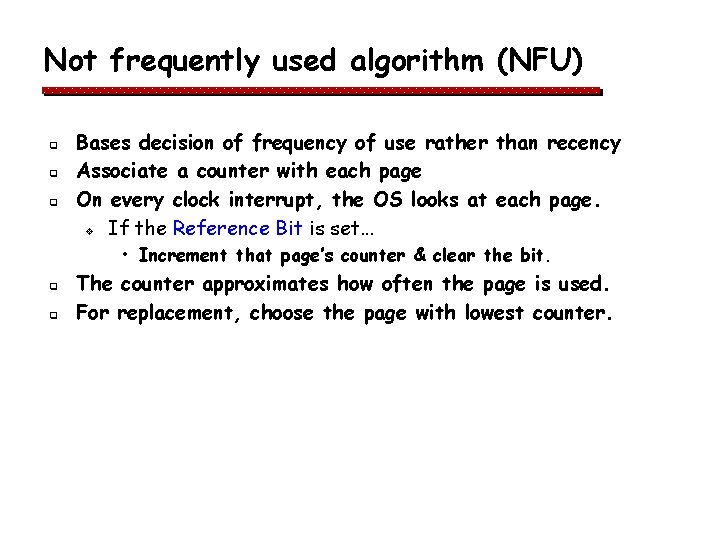
Not frequently used algorithm (NFU) q q q Bases decision of frequency of use rather than recency Associate a counter with each page On every clock interrupt, the OS looks at each page. v If the Reference Bit is set. . . • Increment that page’s counter & clear the bit. q q The counter approximates how often the page is used. For replacement, choose the page with lowest counter.
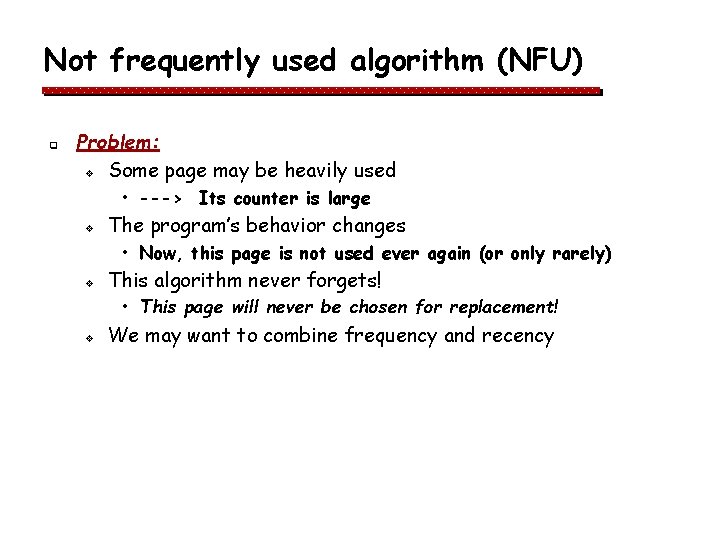
Not frequently used algorithm (NFU) q Problem: v Some page may be heavily used • ---> Its counter is large v The program’s behavior changes • Now, this page is not used ever again (or only rarely) v This algorithm never forgets! • This page will never be chosen for replacement! v We may want to combine frequency and recency
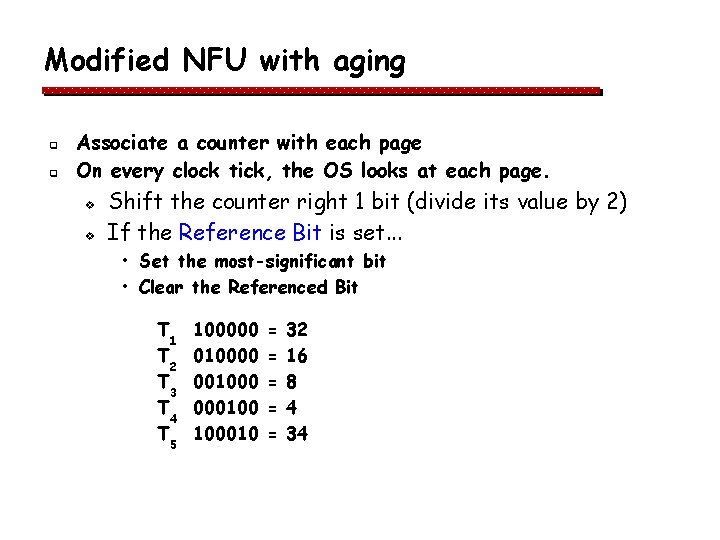
Modified NFU with aging q q Associate a counter with each page On every clock tick, the OS looks at each page. v v Shift the counter right 1 bit (divide its value by 2) If the Reference Bit is set. . . • Set the most-significant bit • Clear the Referenced Bit T 1 T 2 T 3 T 4 T 5 100000 010000 001000 000100 100010 = = = 32 16 8 4 34
Working set page replacement q Demand paging v Pages are only loaded when accessed v When process begins, all pages marked INVALID
Working set page replacement q q Demand paging v Pages are only loaded when accessed v When process begins, all pages marked INVALID Locality of reference v Processes tend to use only a small fraction of their pages
Working set page replacement q q q Demand paging v Pages are only loaded when accessed v When process begins, all pages marked INVALID Locality of Reference v Processes tend to use only a small fraction of their pages Working Set v The set of pages a process needs v If working set is in memory, no page faults v What if you can’t get working set into memory?
Working set page replacement q Thrashing v If you can’t get working set into memory page faults occur every few instructions v Little work gets done v Most of the CPU’s time is going on overhead
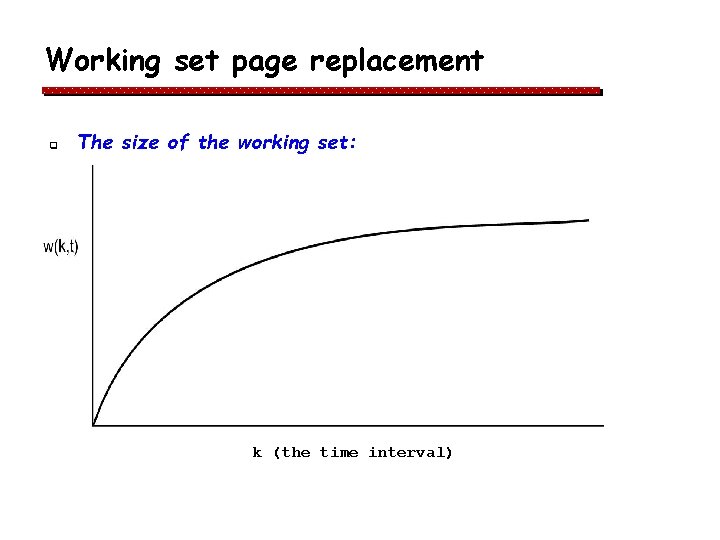
Working set page replacement q q q Based on prepaging (prefetching) v Load pages before they are needed Main idea: v Try to identify the process’s “working set” How big is the working set? v Look at the last K memory references v As K gets bigger, more pages needed. v In the limit, all pages are needed.
Working set page replacement q The size of the working set: k (the time interval)
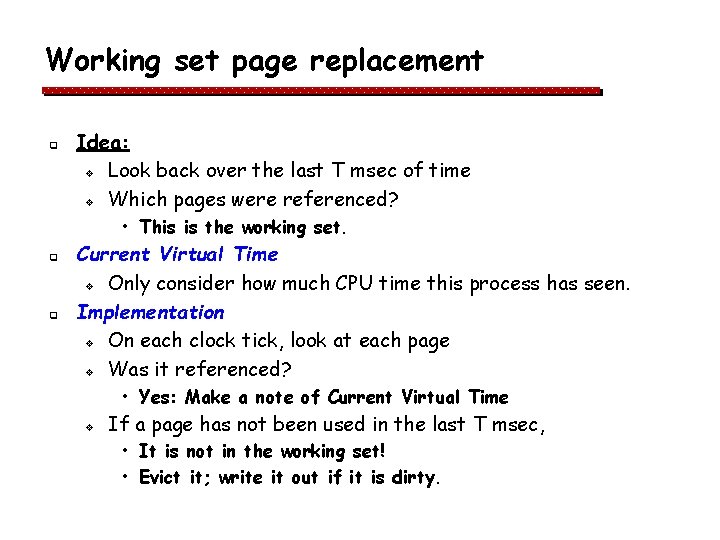
Working set page replacement q Idea: v Look back over the last T msec of time v Which pages were referenced? • This is the working set. q q Current Virtual Time v Only consider how much CPU time this process has seen. Implementation v On each clock tick, look at each page v Was it referenced? • Yes: Make a note of Current Virtual Time v If a page has not been used in the last T msec, • It is not in the working set! • Evict it; write it out if it is dirty.
Working set page replacement q a
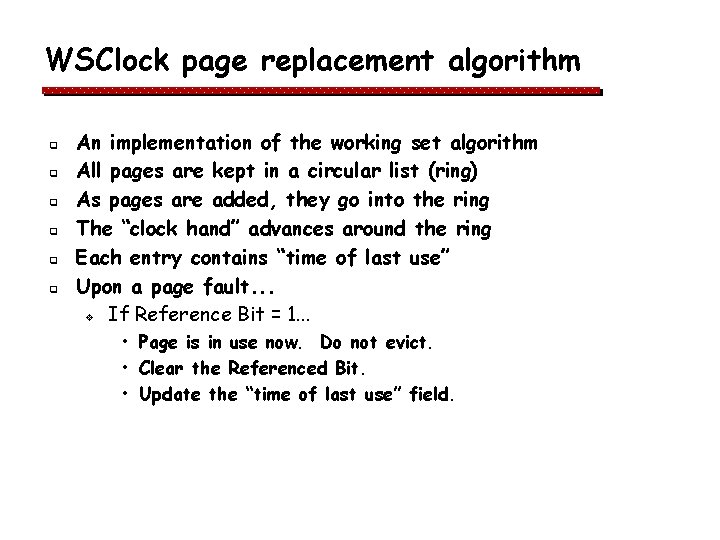
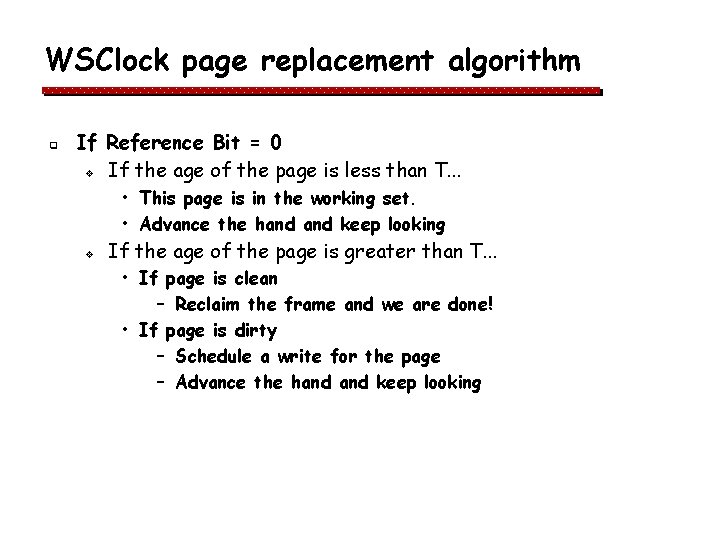
WSClock page replacement algorithm q q q An implementation of the working set algorithm All pages are kept in a circular list (ring) As pages are added, they go into the ring The “clock hand” advances around the ring Each entry contains “time of last use” Upon a page fault. . . v If Reference Bit = 1. . . • Page is in use now. Do not evict. • Clear the Referenced Bit. • Update the “time of last use” field.
WSClock page replacement algorithm q If Reference Bit = 0 v If the age of the page is less than T. . . • This page is in the working set. • Advance the hand keep looking v If the age of the page is greater than T. . . • If page is clean – Reclaim the frame and we are done! • If page is dirty – Schedule a write for the page – Advance the hand keep looking
But which algorithm is best?
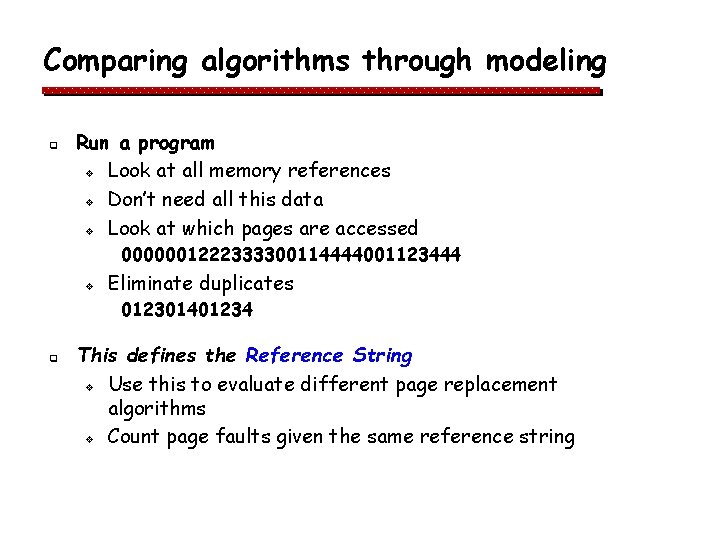
Comparing algorithms through modeling q Run a program v Look at all memory references v Don’t need all this data v Look at which pages are accessed 0000001222333300114444001123444 v Eliminate duplicates 012301401234 q This defines the Reference String v Use this to evaluate different page replacement algorithms v Count page faults given the same reference string
Summary
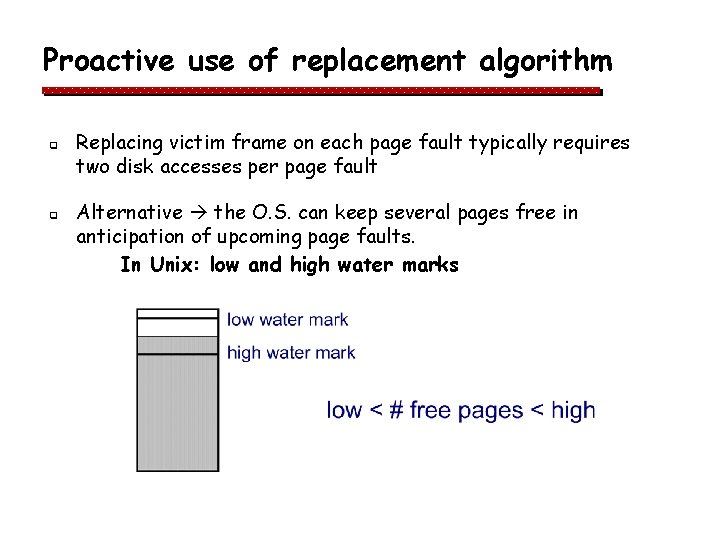
Proactive use of replacement algorithm q q Replacing victim frame on each page fault typically requires two disk accesses per page fault Alternative the O. S. can keep several pages free in anticipation of upcoming page faults. In Unix: low and high water marks
Free pages and the clock algorithm q q The rate at which the clock sweeps through memory determines the number of pages that are kept free: v Too high a rate --> Too many free pages marked v Too low a rate --> Not enough (or no) free pages marked Large memory system considerations v As memory systems grow, it takes longer and longer for the hand to sweep through memory v This washes out the effect of the clock somewhat
The UNIX memory model q UNIX page replacement v clock algorithm for page replacement • If page has not been accessed move it to the free list for use as allocatable page – If modified/dirty write to disk (still keep stuff in memory though) – If unmodified just move to free list v v High and low water marks for free pages Pages on the free-list can be re-allocated if they are accessed again before being overwritten
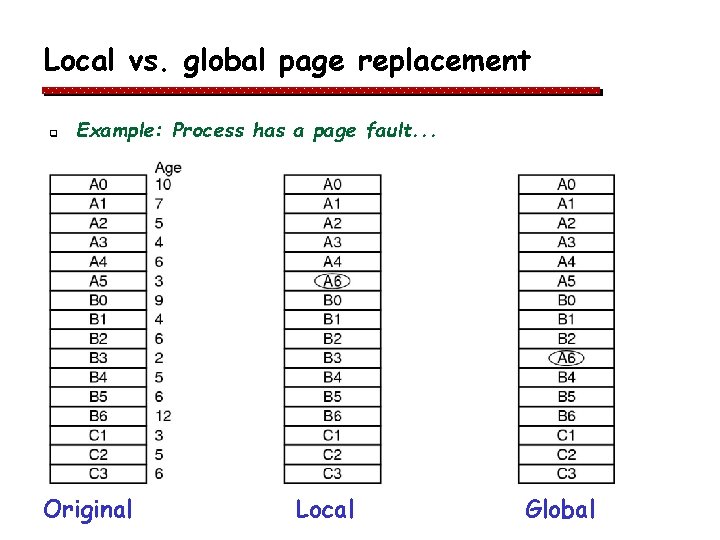
Local vs. global page replacement q q q Assume several processes: A, B, C, . . . Some process gets a page fault (say, process A) Choose a page to replace. Local page replacement v Only choose one of A’s pages Global page replacement v Choose any page
Local vs. global page replacement q Example: Process has a page fault. . . Original Local Global
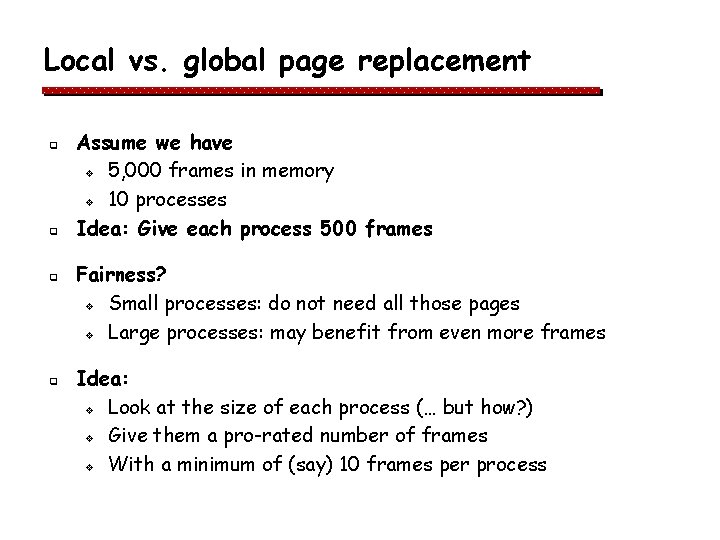
Local vs. global page replacement q q Assume we have v 5, 000 frames in memory v 10 processes Idea: Give each process 500 frames Fairness? v Small processes: do not need all those pages v Large processes: may benefit from even more frames Idea: v Look at the size of each process (… but how? ) v Give them a pro-rated number of frames v With a minimum of (say) 10 frames per process
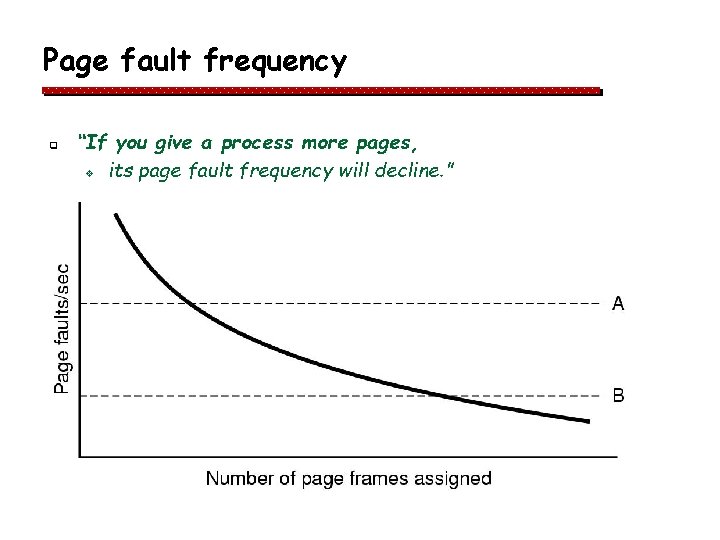
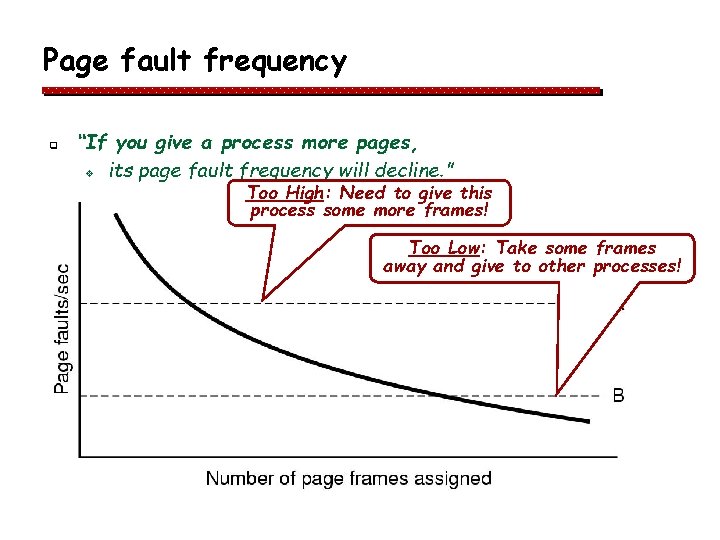
Page fault frequency q “If you give a process more pages, v its page fault frequency will decline. ”
Page fault frequency q “If you give a process more pages, v its page fault frequency will decline. ” Too High: Need to give this process some more frames! Too Low: Take some frames away and give to other processes!
Page fault frequency q Measure the page fault frequency of each process. Count the number of faults every second. q May want to consider the past few seconds as well. q
Page fault frequency q Measure the page fault frequency of each process. Count the number of faults every second. q May want to consider the past few seconds as well. q q Aging: v Keep a running value. v Every second • Count number of page faults • Divide running value by 2 • Add in the count for this second
Load control q Assume: v The best page replacement algorithm v Optimal global allocation of page frames
Load control q q Assume: v The best page replacement algorithm v Optimal global allocation of page frames Thrashing is still possible!
Load control q q Assume: v The best page replacement algorithm v Optimal global allocation of page frames Thrashing is still possible! v Too many page faults! v No useful work is getting done! v Demand for frames is too great!
Load Control q q q Assume: v The best page replacement algorithm v Optimal global allocation of page frames Thrashing is still possible! v Too many page faults! v No useful work is getting done! v Demand for frames is too great! Solution: v Get rid of some processes (temporarily). v Swap them out. v “Two-level scheduling”
Spare slides
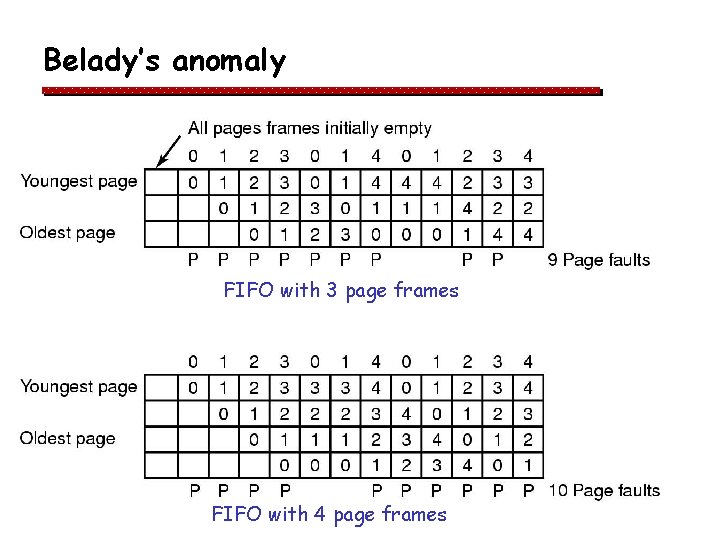
Belady’s anomaly q If you have more page frames (i. e. , more memory). . . v You will have fewer page faults, right? ? ?
Belady’s anomaly q q If you have more page frames (i. e. , more memory). . . v You will have fewer page faults, right? ? ? Not always!
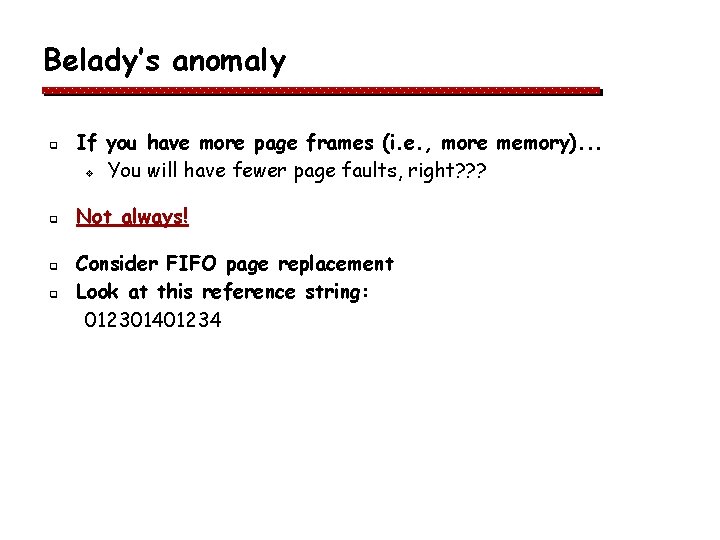
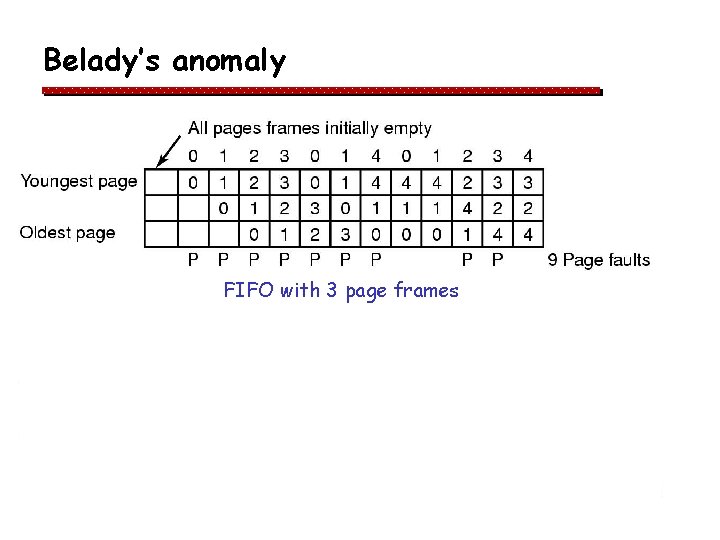
Belady’s anomaly q q If you have more page frames (i. e. , more memory). . . v You will have fewer page faults, right? ? ? Not always! Consider FIFO page replacement Look at this reference string: 012301401234
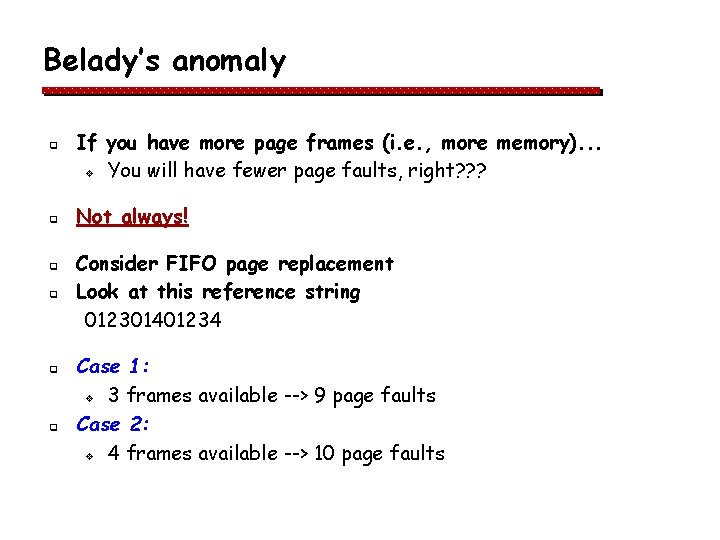
Belady’s anomaly q q q If you have more page frames (i. e. , more memory). . . v You will have fewer page faults, right? ? ? Not always! Consider FIFO page replacement Look at this reference string 012301401234 Case 1: v 3 frames available --> 9 page faults Case 2: v 4 frames available --> 10 page faults
Belady’s anomaly FIFO with 3 page frames
Belady’s anomaly FIFO with 3 page frames FIFO with 4 page frames
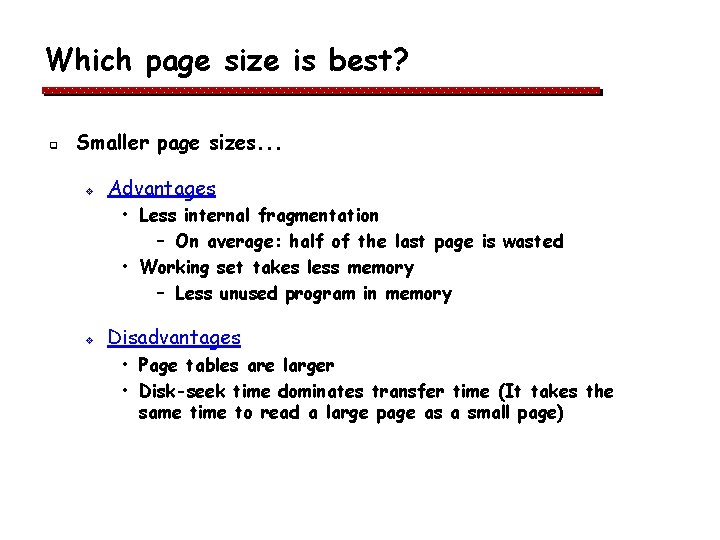
Which page size is best? q Smaller page sizes. . . v Advantages • Less internal fragmentation – On average: half of the last page is wasted • Working set takes less memory – Less unused program in memory v Disadvantages • Page tables are larger • Disk-seek time dominates transfer time (It takes the same time to read a large page as a small page)
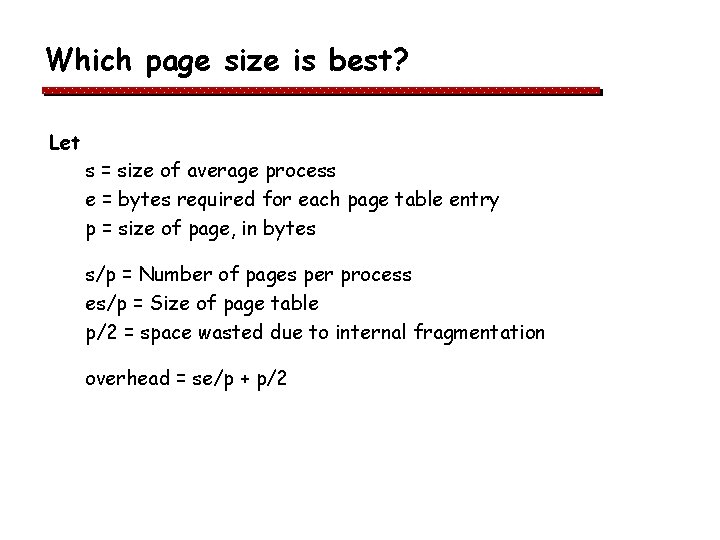
Which page size is best? Let s = size of average process e = bytes required for each page table entry p = size of page, in bytes s/p = Number of pages per process es/p = Size of page table p/2 = space wasted due to internal fragmentation overhead = se/p + p/2
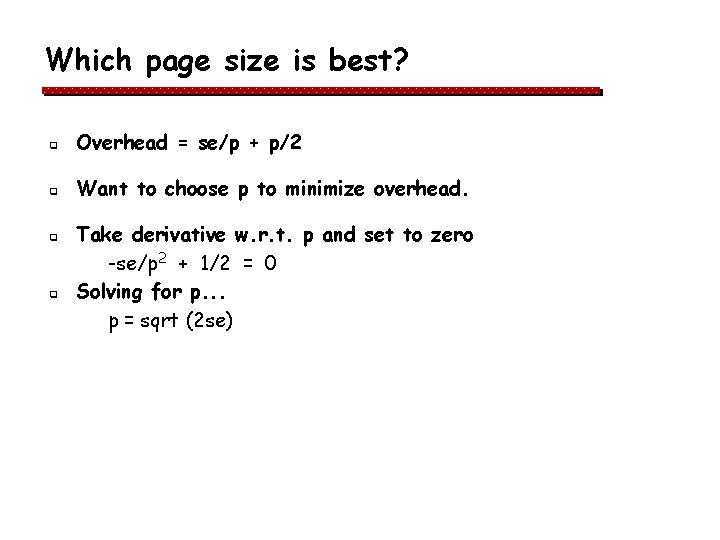
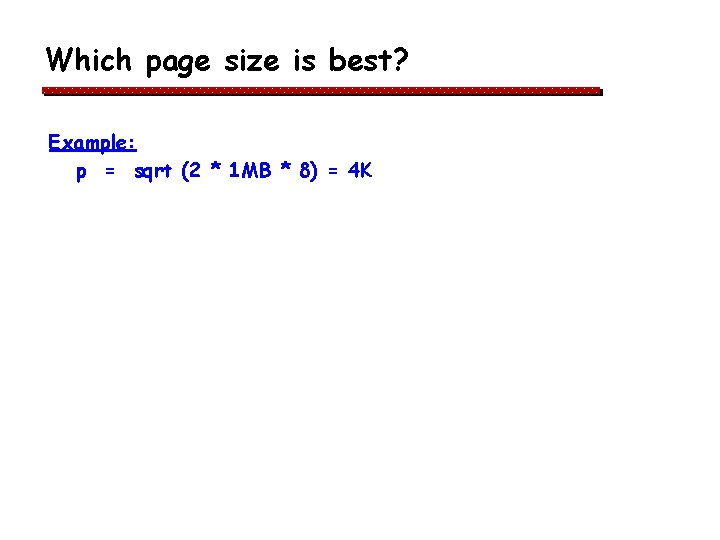
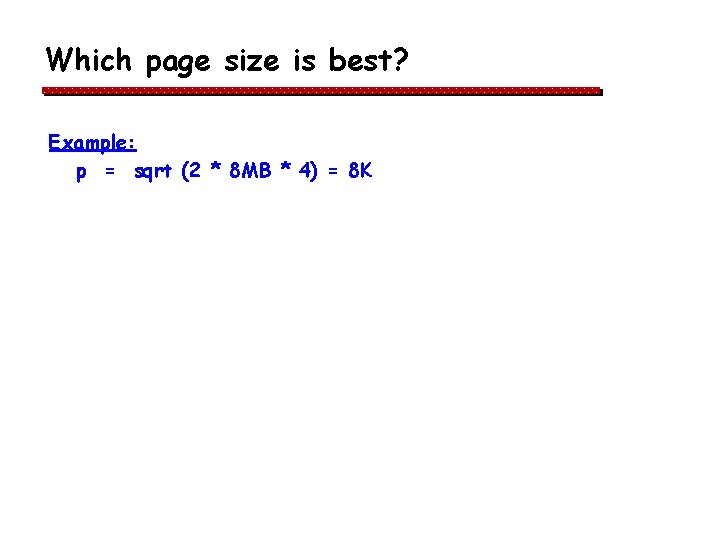
Which page size is best? q Overhead = se/p + p/2 q Want to choose p to minimize overhead. q q Take derivative w. r. t. p and set to zero -se/p 2 + 1/2 = 0 Solving for p. . . p = sqrt (2 se)
Which page size is best? Example: p = sqrt (2 * 1 MB * 8) = 4 K
Which page size is best? Example: p = sqrt (2 * 8 MB * 4) = 8 K