An Overview of Sexually Transmitted Infections in Canada
















- Slides: 44
An Overview of Sexually Transmitted Infections in Canada Thomas Wong, MD MPH FRCPC Community Acquired Infections Division Health Canada (613) 941 -7539 CIDPC Division of Community Acquired Infections 9/25/2020 1
Sexually Transmitted Infections (STIs) in Canada l l l Chlamydia Gonorrhea Syphilis HSV HPV CIDPC Division of Community Acquired Infections 9/25/2020 2
Chlamydia l l l Most prevalent bacterial STI in Canada Disproportionately affects adolescents and young adults Females account for over 2/3 of reported chlamydia cases ã CIDPC PID, chronic pelvic pain, ectopic pregnancy, infertility Division of Community Acquired Infections 9/25/2020 3
Reported Chlamydia Rates in Canada, by sex* • Data for 2002 are preliminary and changes are anticipated • Source: Sexual Health and STI Division, Health Canada 2004 CIDPC Division of Community Acquired Infections 9/25/2020 4
Reported Male Genital Chlamydia Rates in Canada, by age group* • Data for 2002 are preliminary and changes are anticipated • Source: Sexual Health and STI Division, Health Canada 2004 CIDPC Division of Community Acquired Infections 9/25/2020 5
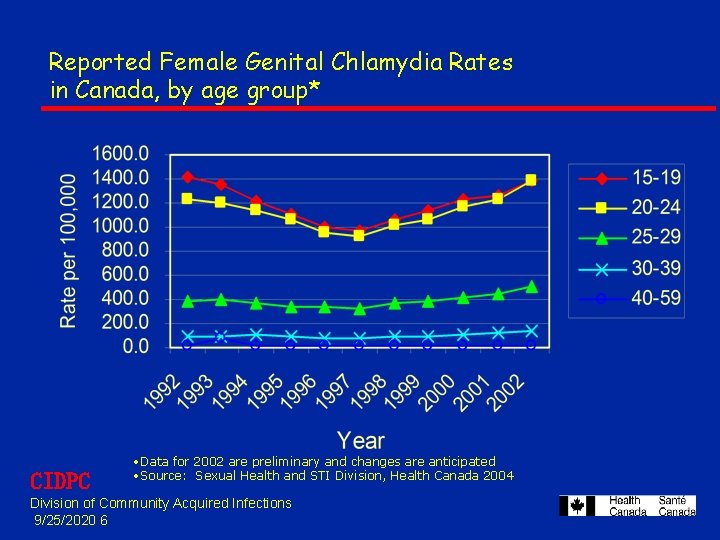
Reported Female Genital Chlamydia Rates in Canada, by age group* CIDPC • Data for 2002 are preliminary and changes are anticipated • Source: Sexual Health and STI Division, Health Canada 2004 Division of Community Acquired Infections 9/25/2020 6
Chlamydia l l Reported rate had been declining until the last few years Recent rate increase may be due in part to increased screening since the availability of new noninvasive NAAT (eg. PCR, LCR) – but not the whole story CIDPC Division of Community Acquired Infections 9/25/2020 7
Chlamydia: Factors favouring control l l Effective, single-dose treatment Non-invasive urine testing CIDPC Division of Community Acquired Infections 9/25/2020 8
Chlamydia: Hurdles and Challenges l l l Lack of chlamydia awareness/knowledge Majority of infections are asymptomatic ã 80% of females ã 50% of males “Hidden Epidemic” – lack of awareness and symptoms results in a lack of adequate screening, diagnosis, treatment and reporting. CIDPC Division of Community Acquired Infections 9/25/2020 9
Chlamydia Prevention and Control: Strategies l Increase Awareness – Sexual Health Education ã l l Canadian Sexual Health Education Guidelines Targeted Prevention and Promotion Take advantage of non-invasive testing and one-dose treatment CIDPC Division of Community Acquired Infections 9/25/2020 10
Gonorrhea l l l Second most commonly reported bacterial STI in Canada Males account for almost 2/3 of nationally reported cases Other STI often present with gonorrhea – especially chlamydia CIDPC Division of Community Acquired Infections 9/25/2020 11
Reported Gonorrhea Rates in Canada, by sex* • Data for 2002 are preliminary and changes are anticipated • Source: Sexual Health and STI Division, Health Canada 2004 CIDPC Division of Community Acquired Infections 9/25/2020 12
Reported Male Gonorrhea Rates in Canada, by age group* CIDPC • Data for 2002 are preliminary and changes are anticipated Division of • Source: Community Acquired Sexual Health. Infections and STI Division, Health Canada 2003 9/25/2020 13
Reported Female Gonorrhea Rates in Canada, by age group* • Data for 2002 are preliminary and changes are anticipated • Source: Sexual Health and STI Division, Health Canada 2003 CIDPC Division of Community Acquired Infections 9/25/2020 14
Gonorrhea in Canada l Gonorrhea rates in Canada had been declining until the last few years ã Rates have risen by more than 50% over past 5 yrs CIDPC Division of Community Acquired Infections 9/25/2020 15
Gonorrhea: Hurdles and Challenges l Lack of symptoms (asymptomatic): ã ã l Up to 80% of females 10 -20% of males Even more likely to be asymptomatic if infected at rectal or pharyngeal sites CIDPC Division of Community Acquired Infections 9/25/2020 16
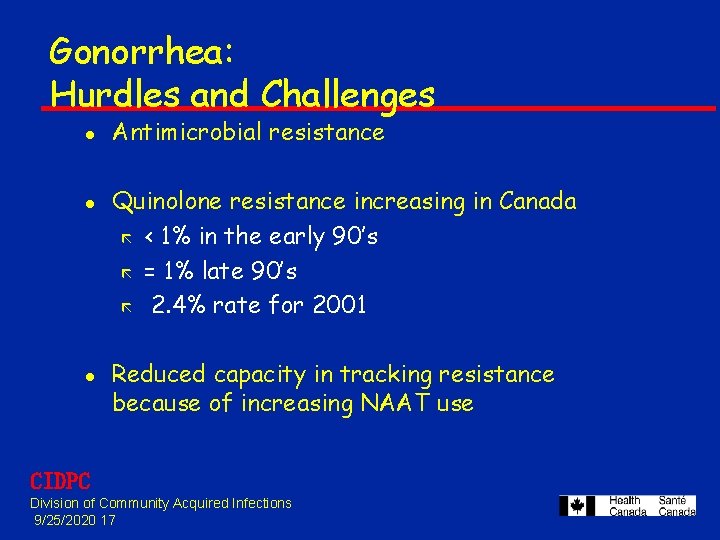
Gonorrhea: Hurdles and Challenges l l l Antimicrobial resistance Quinolone resistance increasing in Canada ã < 1% in the early 90’s ã = 1% late 90’s ã 2. 4% rate for 2001 Reduced capacity in tracking resistance because of increasing NAAT use CIDPC Division of Community Acquired Infections 9/25/2020 17
Gonorrhea: Factors favouring control l l Effective, single-dose treatment Non-invasive urine testing – continually improving and more available CIDPC Division of Community Acquired Infections 9/25/2020 18
Gonorrhea Prevention and Control: Strategies l Increase Awareness – Sexual Health Education ã l l CIDPC Canadian Sexual Health Education Guidelines Targeted Prevention and Promotion Take advantage of non-invasive testing and one-dose treatment Division of Community Acquired Infections 9/25/2020 19
Syphilis CIDPC Division of Community Acquired Infections 9/25/2020 20
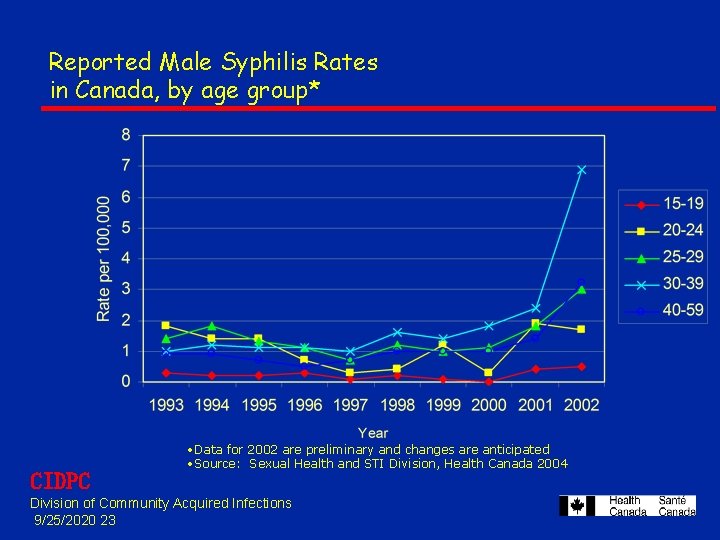
Syphilis l l l The least common of the 3 bacterial STIs The elimination of syphilis was seen as an imminent goal as recently as 1996 BUT – increasing national rates since 1997 CIDPC Division of Community Acquired Infections 9/25/2020 21
Reported Syphilis Rates in Canada, by sex* CIDPC • Data for 2002 are preliminary and changes are anticipated • Source: Sexual Health and STI Division, Health Canada 2004 Division of Community Acquired Infections 9/25/2020 22
Reported Male Syphilis Rates in Canada, by age group* CIDPC • Data for 2002 are preliminary and changes are anticipated • Source: Sexual Health and STI Division, Health Canada 2004 Division of Community Acquired Infections 9/25/2020 23
Reported Female Syphilis Rates in Canada, by age group* Data for 2002 are preliminary and changes are anticipated Source: Sexual Health and STI Division, Health Canada 2004 CIDPC Division of Community Acquired Infections 9/25/2020 24
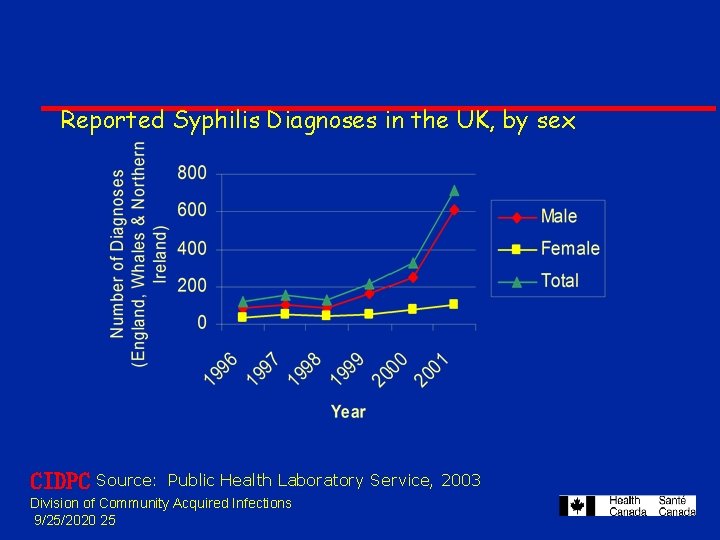
Reported Syphilis Diagnoses in the UK, by sex CIDPC Source: Public Health Laboratory Service, 2003 Division of Community Acquired Infections 9/25/2020 25
Rate per 100, 000 Reported Primary and Secondary syphilis rates in Canada and the United States* Year CIDPC U. S. Source: Sexually Transmitted Disease Surveillance, 2002, CDC * Data for 2001 and 2002 are preliminary and changes are anticipated Division of Community Acquired Infections 9/25/2020 26
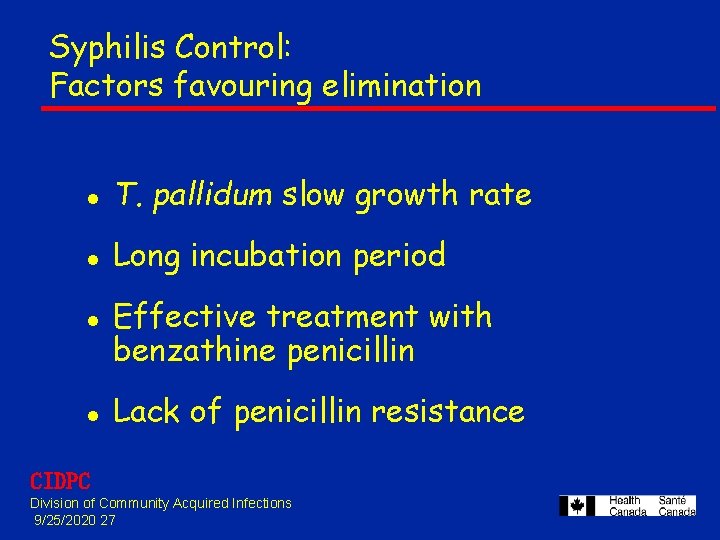
Syphilis Control: Factors favouring elimination l T. pallidum slow growth rate l Long incubation period l l Effective treatment with benzathine penicillin Lack of penicillin resistance CIDPC Division of Community Acquired Infections 9/25/2020 27
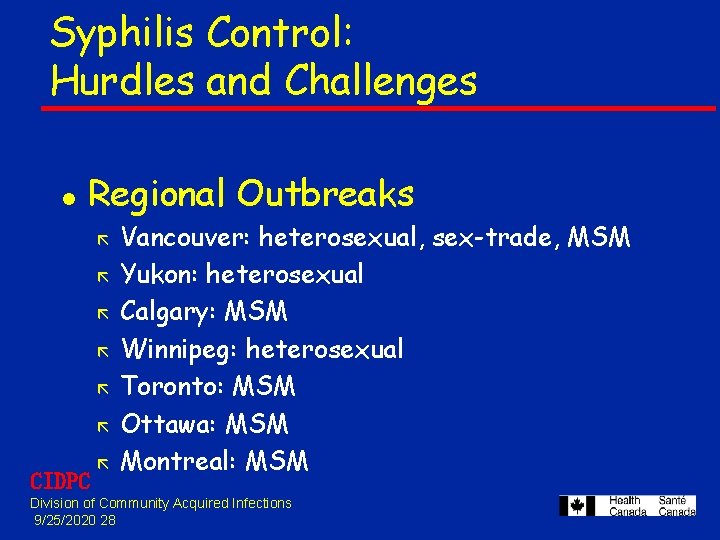
Syphilis Control: Hurdles and Challenges l Regional Outbreaks ã ã ã CIDPC ã Vancouver: heterosexual, sex-trade, MSM Yukon: heterosexual Calgary: MSM Winnipeg: heterosexual Toronto: MSM Ottawa: MSM Montreal: MSM Division of Community Acquired Infections 9/25/2020 28
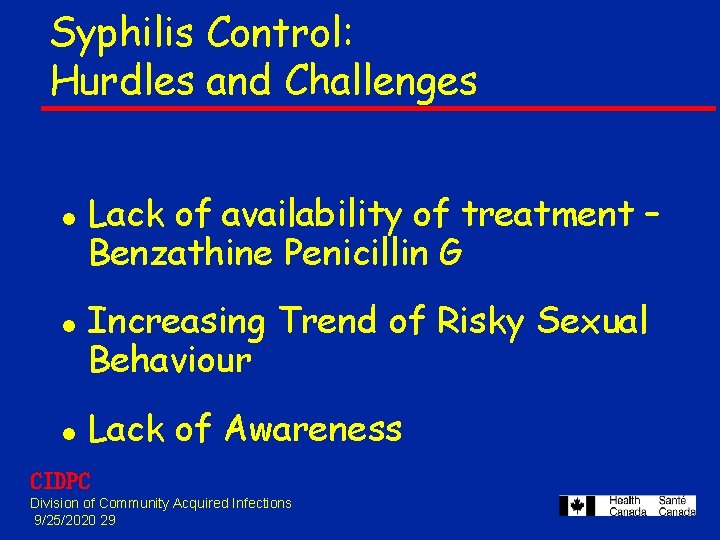
Syphilis Control: Hurdles and Challenges l l l Lack of availability of treatment – Benzathine Penicillin G Increasing Trend of Risky Sexual Behaviour Lack of Awareness CIDPC Division of Community Acquired Infections 9/25/2020 29
Syphilis Prevention and Control: Strategies l l l Intensify targeted prevention and health promotion Cyberprevention Enhance surveillance Enhance efforts for case finding and management Rapid outbreak response CIDPC Division of Community Acquired Infections 9/25/2020 30
Reportable Bacterial STI l l National rates of Chlamydia, Gonorrhea and Syphilis all rising WHY? ã ã Safe-sex burnout HAART and post-exposure prophylaxis Younger generation did not witness AIDS devastation Internet facilitating high risk partnering CIDPC Division of Community Acquired Infections 9/25/2020 31
Genital Herpes (HSV) l l l Not reportable at the federal level Prevalence in Canada not well known (therefore a priority) Caused by HSV types 1 and 2 Infection is life-long Predominantly asymptomatic Asymptomatic viral shedding leads to transmission CIDPC Division of Community Acquired Infections 9/25/2020 32
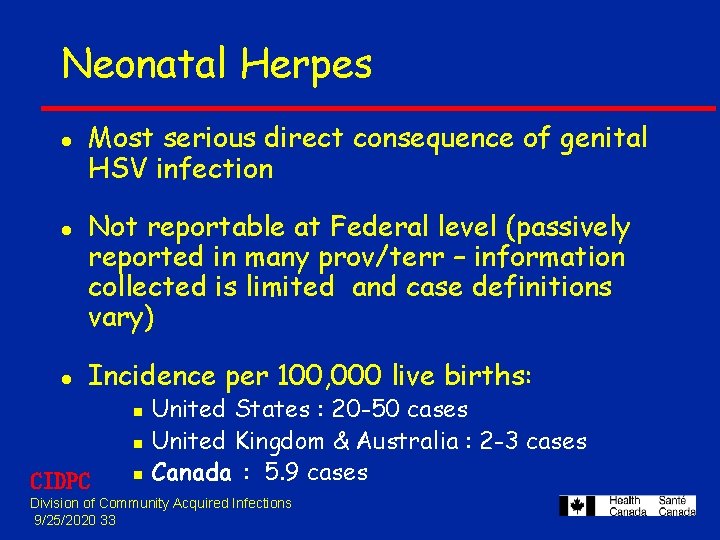
Neonatal Herpes l l l Most serious direct consequence of genital HSV infection Not reportable at Federal level (passively reported in many prov/terr – information collected is limited and case definitions vary) Incidence per 100, 000 live births: n n CIDPC n United States : 20 -50 cases United Kingdom & Australia : 2 -3 cases Canada : 5. 9 cases Division of Community Acquired Infections 9/25/2020 33
Neonatal Herpes Surveillance l Partnership between Canadian Paediatric Society (CPS) and Center for Infectious Diseases Prevention and Control of Health Canada CIDPC Division of Community Acquired Infections 9/25/2020 34
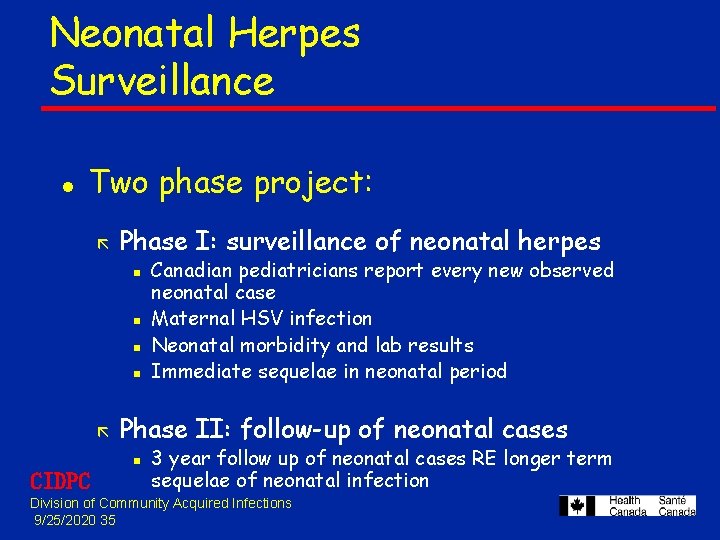
Neonatal Herpes Surveillance l Two phase project: ã Phase I: surveillance of neonatal herpes n n ã Phase II: follow-up of neonatal cases n CIDPC Canadian pediatricians report every new observed neonatal case Maternal HSV infection Neonatal morbidity and lab results Immediate sequelae in neonatal period 3 year follow up of neonatal cases RE longer term sequelae of neonatal infection Division of Community Acquired Infections 9/25/2020 35
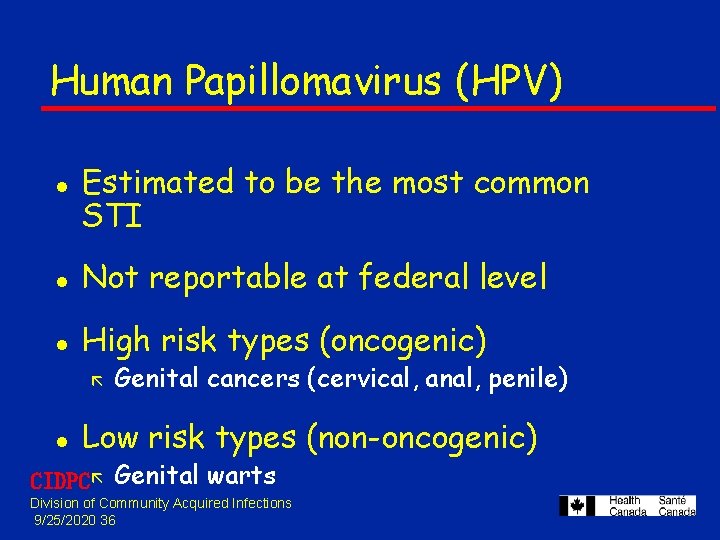
Human Papillomavirus (HPV) l Estimated to be the most common STI l Not reportable at federal level l High risk types (oncogenic) ã l Genital cancers (cervical, anal, penile) Low risk types (non-oncogenic) CIDPC ã Genital warts Division of Community Acquired Infections 9/25/2020 36
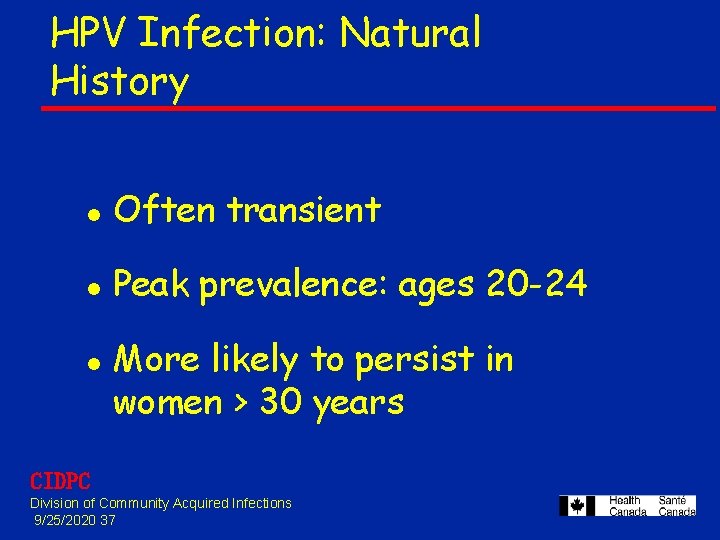
HPV Infection: Natural History l Often transient l Peak prevalence: ages 20 -24 l More likely to persist in women > 30 years CIDPC Division of Community Acquired Infections 9/25/2020 37
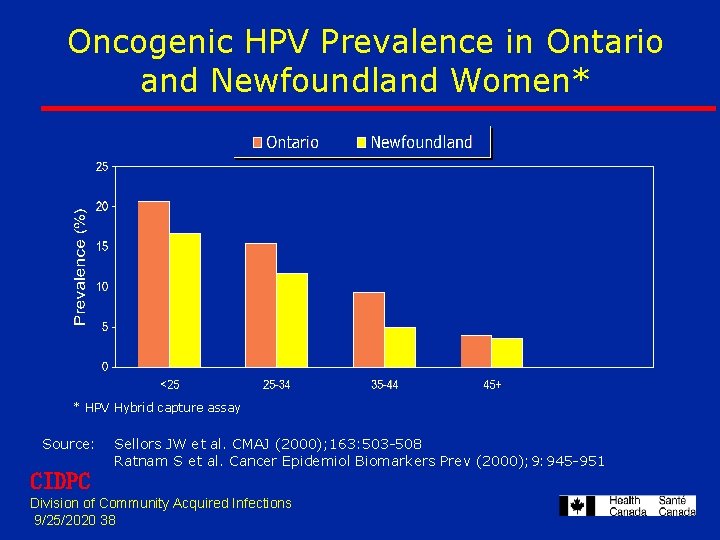
Oncogenic HPV Prevalence in Ontario and Newfoundland Women* * HPV Hybrid capture assay Source: CIDPC Sellors JW et al. CMAJ (2000); 163: 503 -508 Ratnam S et al. Cancer Epidemiol Biomarkers Prev (2000); 9: 945 -951 Division of Community Acquired Infections 9/25/2020 38
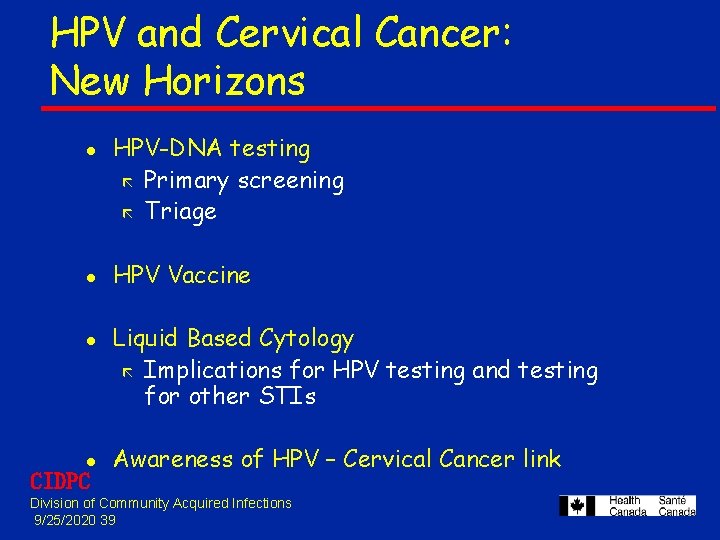
HPV and Cervical Cancer: New Horizons l l CIDPC HPV-DNA testing ã Primary screening ã Triage HPV Vaccine Liquid Based Cytology ã Implications for HPV testing and testing for other STIs Awareness of HPV – Cervical Cancer link Division of Community Acquired Infections 9/25/2020 39
STI Testing Issues l Culture vs. NAAT (PCR, LCR) l NAAT: Urine vs. Swab l Order of Swabs/Pap Test l Menstruation and testing l New and emerging tests CIDPC Division of Community Acquired Infections 9/25/2020 40
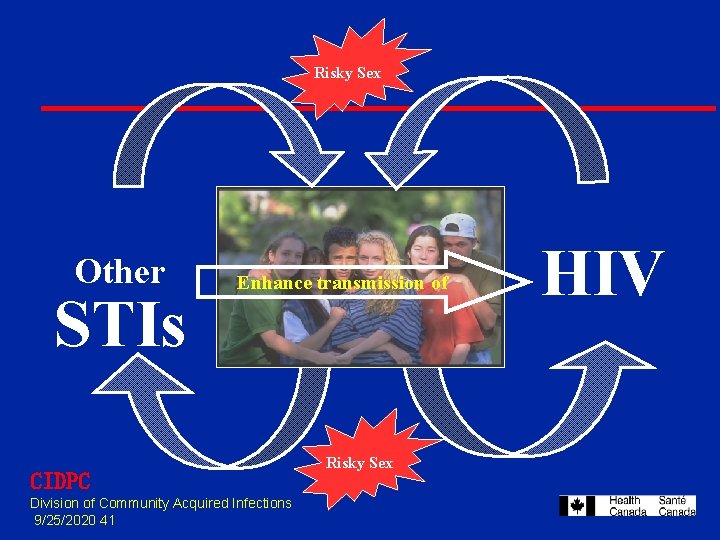
Risky Sex Other STIs Enhance transmission of CIDPC Division of Community Acquired Infections 9/25/2020 41 Risky Sex HIV
STI & HIV Synergy l l CIDPC STI increases HIV transmission & acquisition STI morbidity can be worse, and infection more difficult to treat, for HIV-infected individuals Rise in syphilis indicative of unsafe sexual practices; implications for rates of HIV STI incidence in HIV-infected individuals ã Can use as marker of unsafe sexual behaviors in HIV-positive population Division of Community Acquired Infections 9/25/2020 42
Conclusion l l l CIDPC Reportable STIs continue to rise Behavioural surveillance gap exists – hindering targeted awareness, prevention and promotion Lack of data on viral STIs, however efforts to address viral STIs are underway Division of Community Acquired Infections 9/25/2020 43
Acknowledgements l l l l Provincial and Territorial Partners Toronto Public Health Department AIDS Committee of Ottawa National Microbiology Lab Lai King Ng Janice Mann Rhonda Kropp Maureen Perrin CIDPC Division of Community Acquired Infections 9/25/2020 44