Guidelines for Prevention and Treatment of Opportunistic Infections
- Slides: 32
Guidelines for Prevention and Treatment of Opportunistic Infections among HIV-Infected Children Parasitic Infections Recommendations from Centers for Disease Control and Prevention, the National Institutes of Health, the HIV Medicine Association of the Infectious Diseases Society of America, the Pediatric Infectious Diseases Society, and the American Academy of Pediatrics July 2009 www. aidsetc. org
About This Presentation These slides were developed using the April 2008 Guidelines. The intended audience is clinicians involved in the care of patients with HIV. Users are cautioned that, because of the rapidly changing field of HIV care, this information could become out of date quickly. Finally, it is intended that these slides be used as prepared, without changes in either content or attribution. Users are asked to honor this intent. Expert opinion should be sought for complex treatment regimens. – AETC NRC 2 July 2009 www. aidsetc. org
Cryptosporidiosis/Microsporidio sis: Epidemiology § Protozoal parasites that cause enteric illness in humans and animals § Human infection primarily caused by C hominis, C parvum, C meleagridis § Microsporida include E bieneusi and E intestinalis § Infection results from ingestion of oocysts excreted in feces of humans or animals § Invade intestinal tract mucosa causing watery, nonbloody diarrhea, dehydration, malnutrition 3 July 2009 www. aidsetc. org
Cryptosporidiosis/Microsporidio sis: Epidemiology (2) § Person-to-person transmission in child care centers § Oocysts can contaminate water supplies § Outbreaks associated with contaminated drinking water and swimming pools § Incidence declined since advent of ART 4 July 2009 www. aidsetc. org
Cryptosporidiosis/Microsporidio sis: § Clinical Frequent Manifestations watery, nonbloody diarrhea § Abdominal cramps, fatigue, vomiting, anorexia, weight loss, poor weight gain § Fever and vomiting more common in children § Liver involvement causes abdominal pain and elevated alkaline phosphatase § Less common: myositis, cholangitis, sinusitis, hepatitis, CNS disease § Different species may cause different clinical syndromes (eg, Encephalitozoon hellem associated with keratoconjunctivitis, sinusitis, prostatic abscess) 5 July 2009 www. aidsetc. org
Cryptosporidiosis/Microsporidio sis: Diagnosis Cryptosporidiosis § Concentrated stool samples demonstrating oocysts § Evaluate at least 3 separate stool samples § Monoclonal antibody fluorescein stain and EIA for antigen have enhanced specificity and sensitivity 6 July 2009 www. aidsetc. org
Cryptosporidiosis/Microsporidio sis: Diagnosis (2) Microsporidia § Use thin smears of unconcentrated stoolformalin suspension or duodenal aspirates stained with trichrome or chemofluorescent agents § Consider endoscopy in all patients with diarrhea >2 months duration § PCR techniques still in research 7 July 2009 www. aidsetc. org
Cryptosporidiosis/Microsporidio sis: Prevention § Avoid direct contact with fecal material from adults, diaper-age children, and infected animals § Carefully investigate sources of drinking water and recreational activities involving water § HIV-infected children should not be allowed to drink water directly from lakes or rivers § Outbreaks of cryptosporidiosis occasionally have been linked to municipal water contamination § Some experts recommend that severely immunocompromised HIV-infected patients should not share a room with patients who have cryptosporidiosis 8 July 2009 www. aidsetc. org
Cryptosporidiosis/Microsporidio sis: Treatment § Immune restoration following antiretroviral treatment frequently results in clearing § Supportive care, hydration, electrolyte replenishment, nutritional supplements § Available treatment inconsistently effective 9 July 2009 www. aidsetc. org
Cryptosporidiosis: Treatment § No agents have been consistently effective § Nitazoxanide: effective for Cryptosporidium and Giardia lamblia (B I for children and C III for HIVinfected children) § Nitazoxanide dosage: 100 mg orally BID for children 1 -3 years; 200 mg BID for children 4 -11 years § Limited data: paromomycin, azithromycin 10 July 2009 www. aidsetc. org
Microsporidiosis: Treatment § Albendazole: 7. 5 mg/kg orally BID; maximum dosage 400 mg orally BID (A II) § Fumagillin: limited data for adults, no data for HIV-infected children 11 July 2009 www. aidsetc. org
Malaria: Epidemiology § Malaria is caused by the obligate intracellular protozoa Plasmodium § 4 species account for most human infections: P falciparum (60%), P vivax (25 -30%), P ovale and P malariae § In the United States, 1, 200 to 1, 400 cases are reported annually § Most cases of malaria infection in U. S. citizens are a result of not taking appropriate malaria chemoprophylaxis § Over 30% of malaria cases in children are found in newly arrived immigrants 12 July 2009 www. aidsetc. org
Malaria: Clinical Manifestations § Clinical studies of malaria present differing conclusions on whether parasitemia, frequency of malaria, recurrence, and severity of infection differ in HIV-infected vs HIV-uninfected children § Fever is the most common symptom of malaria, accompanied by chills, sweating, headache, myalgias, malaise, nausea, vomiting, diarrhea, and cough § Chronic symptoms include splenomegaly, fever, thrombocytopenia, and anemia § Congenital malaria is rare § Malaria may be misdiagnosed as a viral infection or HIV (HIV also may be misdiagnosed as malaria) 13 July 2009 www. aidsetc. org
Malaria: Diagnosis § Thick blood smears are the most sensitive technique for detecting infection but are not helpful in determining the infectious species § Giemsa-stained thin blood smear gives the malaria parasite’s distinctive appearance § Blood smear examination taken at 12 -24 hour intervals may be needed to rule out a diagnosis § A rapid malaria antigen capture assay (Binax Now) has been approved by the FDA § The test is less sensitive for asymptomatic individuals 14 July 2009 www. aidsetc. org
Malaria: Prevention § HIV-infected children who travel to regions of endemic malaria should use clothing impregnated with permethrin § DEET mosquito repellent (30 -50% concentration) is practical and effective § Insecticide-treated bed nets should be provided § Recommendations for chemoprophylaxis are the same for HIV-infected children and HIVuninfected children 15 July 2009 www. aidsetc. org
Malaria: Prevention (2) § Prevention includes mefloquine (Lariam) and Malarone § Mefloquine chemoprophylaxis is less expensive and more convenient (once a week) but may be associated with central nervous system effects § Doxycycline is an alternative chemoprophylaxis agent § Emerging evidence suggests that TMP-SMX may protect against new or recurrent cases of malaria 16 July 2009 www. aidsetc. org
Malaria: Treatment § HIV infection status should not determine the choice of treatment (A II) § Chloroquine-sensitive P falciparum should be treated with chloroquine § In the United States, resistant P falciparum treatment choices include atovaquoneproguanil, quinine with clindamycin, or doxycycline or mefloquine 17 July 2009 www. aidsetc. org
Malaria: Treatment (2) § Severe P falciparum should be treated with IV quinidine gluconate (or IV quinine when available) § Ritonavir inhibits quinidine metabolism and is contraindicated § Artemisinin, artesunate and other derivatives combined with additional antimalarial drugs have not been approved in the United States but may be available through the CDC 18 July 2009 www. aidsetc. org
Malaria: Treatment (3) P vivax, P ovale, P malariae § The drug of choice for non-P falciparum is chloroquine § The drug is well tolerated and side effects are usually limited to itching § Resistance to chloroquine may exist, warranting treatment with quinine plus clindamycin or doxycycline, atovaquoneproguanil, or mefloquine 19 July 2009 www. aidsetc. org
Malaria: Adverse Events § Severe malaria commonly induces hypoglycemia in children, especially when treated with IV quinine/quinidine § Cardiac monitoring and intensive care monitoring are recommended when using quinine/quinidine 20 July 2009 www. aidsetc. org
Toxoplasmosis: Epidemiology § Primarily perinatal transmission from primary infection of mothers during pregnancy § Older children acquire toxoplasmosis from poorly cooked food and from ingestion of sporulated oocysts in soil, water, or food 21 July 2009 www. aidsetc. org
Toxoplasmosis: Epidemiology (2) § Risk of transmission in HIV-uninfected mothers with primary infection during pregnancy = 29% (lower if maternal infection in 1 st trimester) § Perinatal toxoplasmosis infection may occur in HIV-positive women with chronic infection § <1% of AIDS-defining illnesses in children 22 July 2009 www. aidsetc. org
Toxoplasmosis: Clinical Manifestations § Non-immunocompromised infants are usually asymptomatic at birth but majority develop late manifestations: retinitis, neurologic impairment § Newborn symptoms can include: § Rash, lymphadenopathy, jaundice, hematologic abnormalities, seizures, microcephaly, chorioretinitis, hydrocephalus 23 July 2009 www. aidsetc. org
Toxoplasmosis: Clinical § § 24 Manifestations (2) Toxoplasmosis acquired after birth is initially asymptomatic, followed by infectious mononucleosis-like syndrome Chronic toxoplasmosis can reactivate in HIVinfected children Isolated ocular toxoplasmosis is rare is usually associate with CNS disease Less frequently observed presentations include pneumonitis, hepatitis, myocarditis July 2009 www. aidsetc. org
Toxoplasmosis: Diagnosis § Test all HIV-infected pregnant women for toxoplasmosis § If positive, evaluate infant for congenital toxoplasmosis § Use antibody assay to detect Ig. M-, Ig. A-, or Ig. Especific antibody in first 6 months or persistence of Ig. G antibody after 12 months 25 July 2009 www. aidsetc. org
Toxoplasmosis: Diagnosis (2) § Additional methods include isolation of toxoplasmosis from body fluids or blood § Negative antibody does not exclude toxoplasmosis – may require CT, MRI, or brain biopsy in case of encephalitis § In the United States, routine screening for Toxoplasma is not recommended in HIVinfected children when the mother does not have Toxoplasma infection 26 July 2009 www. aidsetc. org
Toxoplasmosis: Prevention § Council all HIV-infected children and their caregivers regarding sources of Toxoplasma gondii infection § Advise not to eat raw or undercooked meat § Hands should be washed after contact with raw meat or when gardening or in contact with soil § Vegetables should be washed well and never eaten raw § Stray cats should not be handled or adopted § Toxoplasma-seropositive adolescents and adult patients with CD 4 counts of <100 cells/µL and Toxoplasma-seropositive children with CD 4 percentage <15% should be administered prophylaxis with TMPSMX 27 July 2009 www. aidsetc. org
Toxoplasmosis: Treatment § If HIV-infected mother has symptomatic toxoplasmosis during pregnancy, infant should be treated (B III) § Preferred treatment – congenital toxoplasmosis: § Pyrimethamine loading dose of 2 mg/kg orally once daily for 2 days; then 1 mg/kg orally once daily for 2 -6 months; then 1 mg/kg orally 3 times/week with sulfadiazine 50 gm/kg/dose BID and with leucovorin (folinic acid) 10 mg orally with each dose of sulfadiazine (A II) § Optimal duration of treatment: 12 months 28 July 2009 www. aidsetc. org
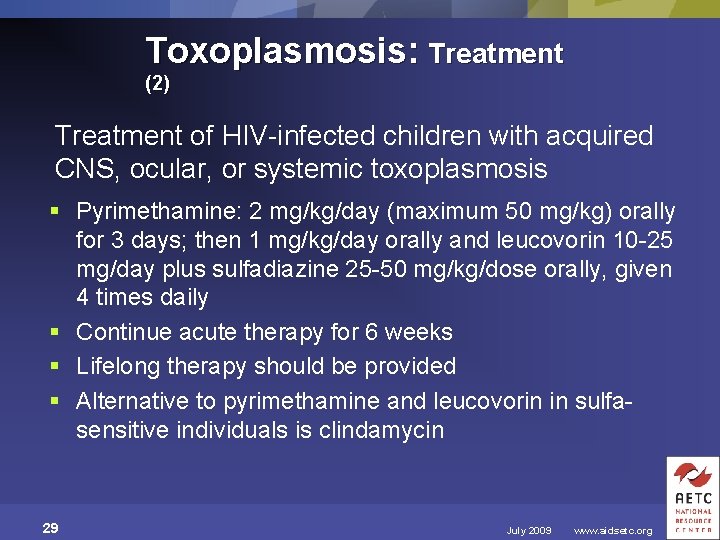
Toxoplasmosis: Treatment (2) Treatment of HIV-infected children with acquired CNS, ocular, or systemic toxoplasmosis § Pyrimethamine: 2 mg/kg/day (maximum 50 mg/kg) orally for 3 days; then 1 mg/kg/day orally and leucovorin 10 -25 mg/day plus sulfadiazine 25 -50 mg/kg/dose orally, given 4 times daily § Continue acute therapy for 6 weeks § Lifelong therapy should be provided § Alternative to pyrimethamine and leucovorin in sulfasensitive individuals is clindamycin 29 July 2009 www. aidsetc. org
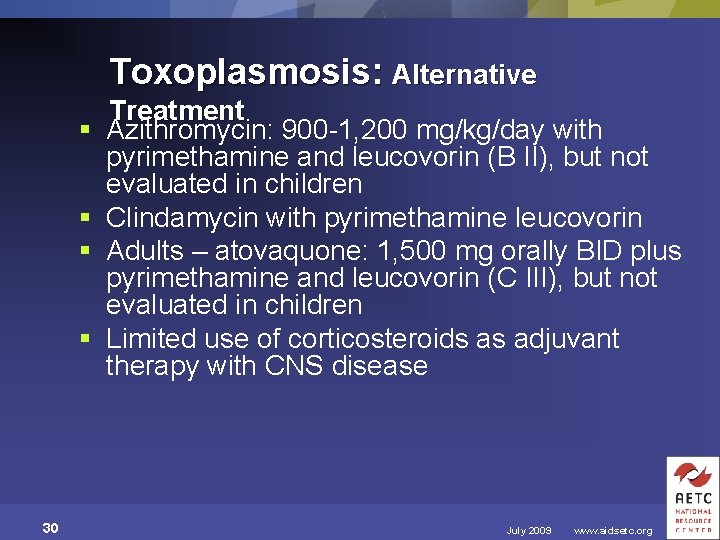
Toxoplasmosis: Alternative § § 30 Treatment Azithromycin: 900 -1, 200 mg/kg/day with pyrimethamine and leucovorin (B II), but not evaluated in children Clindamycin with pyrimethamine leucovorin Adults – atovaquone: 1, 500 mg orally BID plus pyrimethamine and leucovorin (C III), but not evaluated in children Limited use of corticosteroids as adjuvant therapy with CNS disease July 2009 www. aidsetc. org
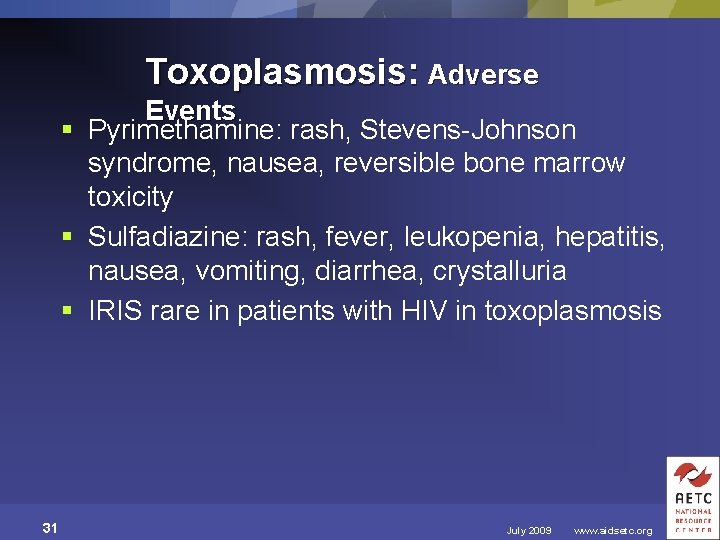
Toxoplasmosis: Adverse Events § Pyrimethamine: rash, Stevens-Johnson syndrome, nausea, reversible bone marrow toxicity § Sulfadiazine: rash, fever, leukopenia, hepatitis, nausea, vomiting, diarrhea, crystalluria § IRIS rare in patients with HIV in toxoplasmosis 31 July 2009 www. aidsetc. org
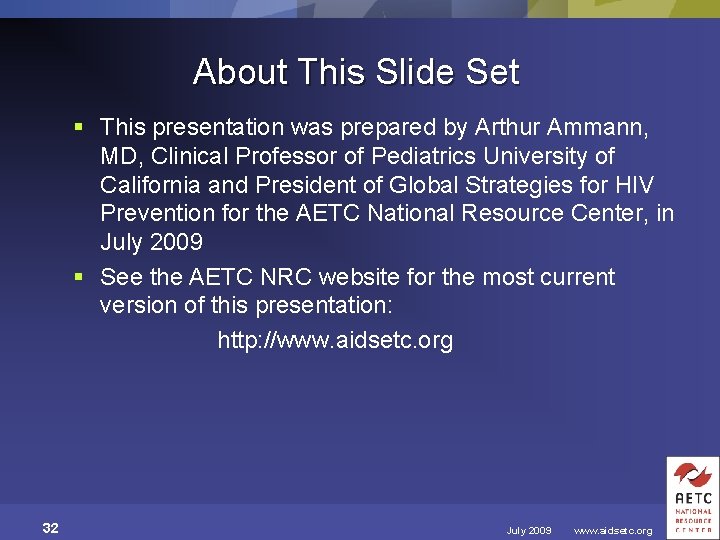
About This Slide Set § This presentation was prepared by Arthur Ammann, MD, Clinical Professor of Pediatrics University of California and President of Global Strategies for HIV Prevention for the AETC National Resource Center, in July 2009 § See the AETC NRC website for the most current version of this presentation: http: //www. aidsetc. org 32 July 2009 www. aidsetc. org