ALICE general results and upgrades Massimo Masera on

- Slides: 48
ALICE general results and upgrades Massimo Masera on behalf of the ALICE Collaboration University of Torino and I. N. F. N. - Italy masera@to. infn. it LISHEP 2011 - Workshop on LHC – Present and Future 4, 10 July 2011
Outline �The ALICE experiment �Present detector performance � Results from 2010 Pb-Pb run: ü Global event features ü Two particle correlation and flow I had to make choices: § Pb-Pb results: pp only as a baseline § Justa a (personal) selection of the available results ü Hard processes: heavy flavours and J/y �The future: plans for an upgrade of the ALICE detectors �Conclusions 2 LISHEP 2011 09/07/2011
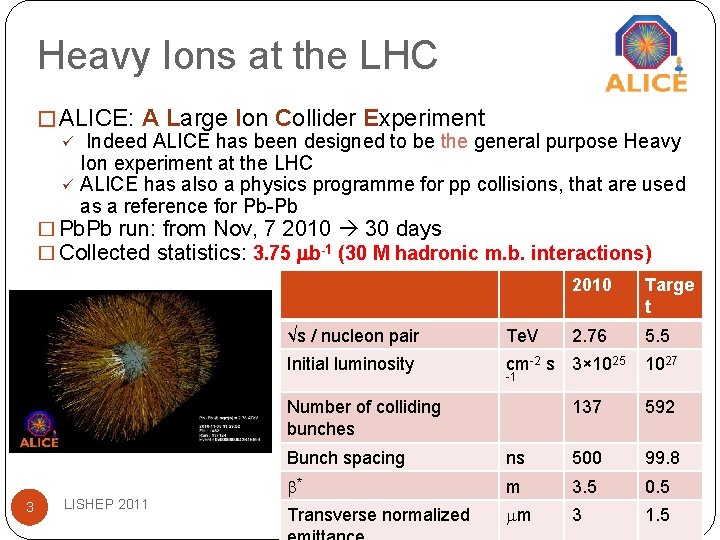
Heavy Ions at the LHC � ALICE: A Large Ion Collider Experiment ü Indeed ALICE has been designed to be the general purpose Heavy Ion experiment at the LHC ü ALICE has also a physics programme for pp collisions, that are used as a reference for Pb-Pb � Pb. Pb run: from Nov, 7 2010 30 days � Collected statistics: 3. 75 b-1 (30 M hadronic m. b. interactions) LISHEP 2011 Targe t 2. 76 5. 5 √s / nucleon pair Te. V Initial luminosity cm-2 s 3× 1025 -1 Number of colliding bunches 3 2010 1027 137 592 Bunch spacing ns 500 99. 8 * m 3. 5 0. 5 Transverse normalized m 3 09/07/2011 1. 5
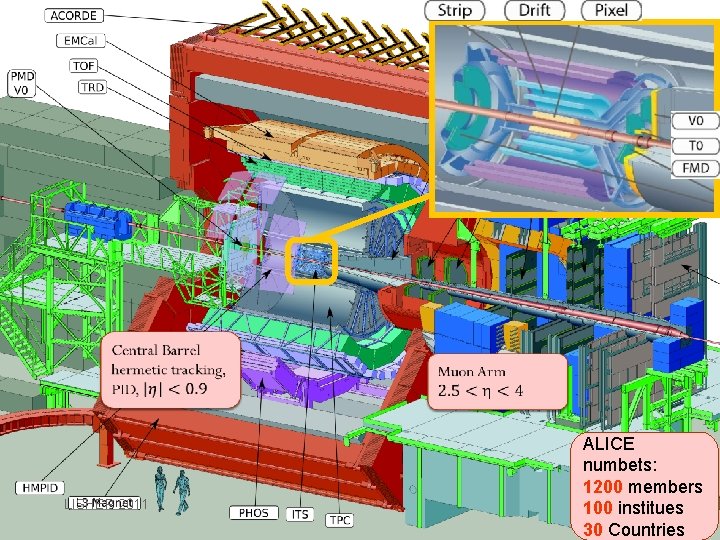
4 LISHEP 2011 ALICE numbets: 1200 members 09/07/2011 100 institues 30 Countries
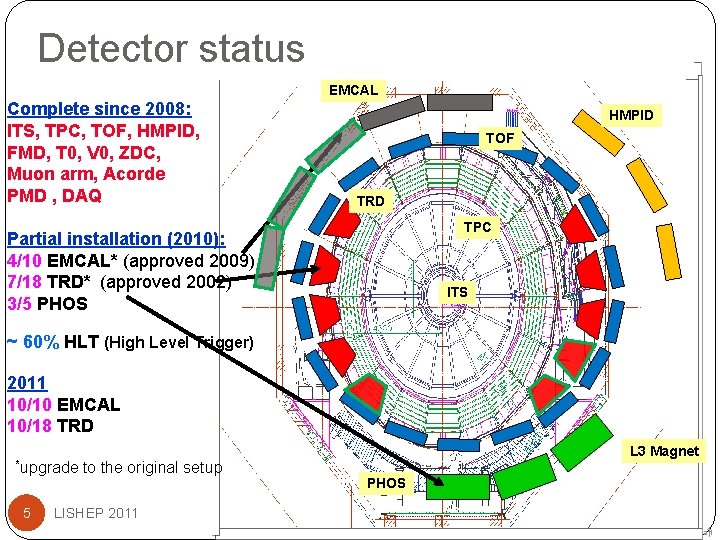
Detector status EMCAL Complete since 2008: ITS, TPC, TOF, HMPID, FMD, T 0, V 0, ZDC, Muon arm, Acorde PMD , DAQ HMPID TOF TRD TPC Partial installation (2010): 4/10 EMCAL* (approved 2009) 7/18 TRD* (approved 2002) 3/5 PHOS ITS ~ 60% HLT (High Level Trigger) 2011 10/10 EMCAL 10/18 TRD *upgrade to the original setup 5 L 3 Magnet PHOS LISHEP 2011 PLC 20 J. Schukraft 09/07/2011
Detector Performance § Tracking § Vertexing § PID 6 LISHEP 2011 09/07/2011
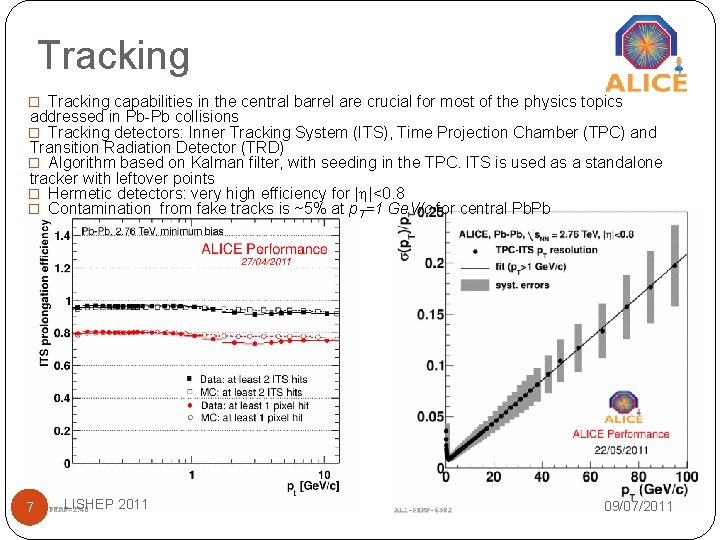
Tracking � Tracking capabilities in the central barrel are crucial for most of the physics topics addressed in Pb-Pb collisions � Tracking detectors: Inner Tracking System (ITS), Time Projection Chamber (TPC) and Transition Radiation Detector (TRD) � Algorithm based on Kalman filter, with seeding in the TPC. ITS is used as a standalone tracker with leftover points � Hermetic detectors: very high efficiency for | |<0. 8 � Contamination from fake tracks is ~5% at p. T=1 Ge. V/c for central Pb. Pb 7 LISHEP 2011 09/07/2011
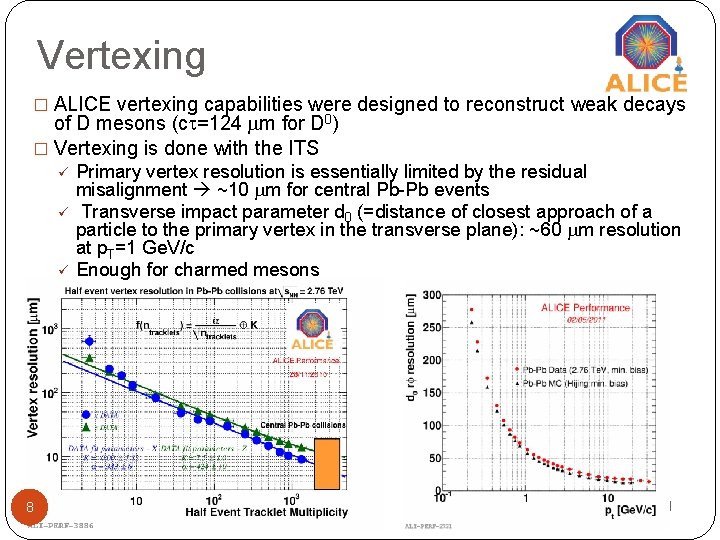
Vertexing � ALICE vertexing capabilities were designed to reconstruct weak decays of D mesons (ct=124 m for D 0) � Vertexing is done with the ITS ü ü ü 8 Primary vertex resolution is essentially limited by the residual misalignment ~10 m for central Pb-Pb events Transverse impact parameter d 0 (=distance of closest approach of a particle to the primary vertex in the transverse plane): ~60 m resolution at p. T=1 Ge. V/c Enough for charmed mesons 09/07/2011
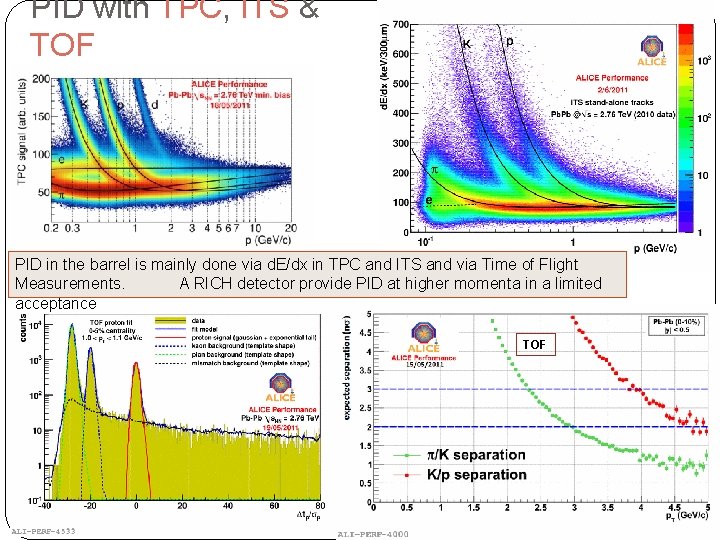
PID with TPC, ITS & TOF PID in the barrel is mainly done via d. E/dx in TPC and ITS and via Time of Flight Measurements. A RICH detector provide PID at higher momenta in a limited acceptance TOF 9 LISHEP 2011 09/07/2011
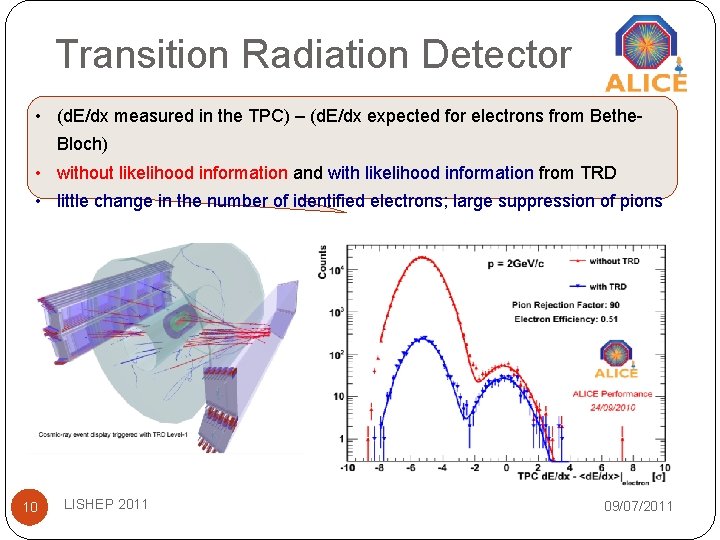
Transition Radiation Detector • (d. E/dx measured in the TPC) – (d. E/dx expected for electrons from Bethe. Bloch) • without likelihood information and with likelihood information from TRD • little change in the number of identified electrons; large suppression of pions 10 LISHEP 2011 09/07/2011
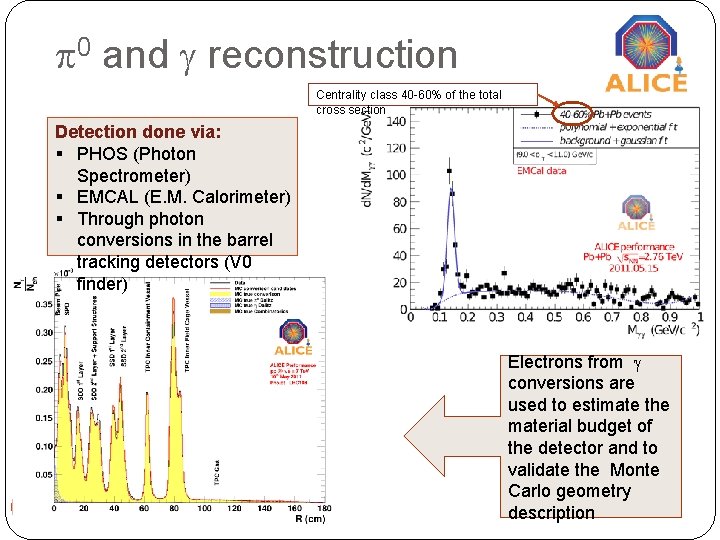
0 and reconstruction Centrality class 40 -60% of the total cross section Detection done via: § PHOS (Photon Spectrometer) § EMCAL (E. M. Calorimeter) § Through photon conversions in the barrel tracking detectors (V 0 finder) 11 LISHEP 2011 Electrons from conversions are used to estimate the material budget of the detector and to validate the Monte Carlo geometry description 09/07/2011
Global event features § Multiplicity § Energy density § Size of the fireball 12 LISHEP 2011 09/07/2011
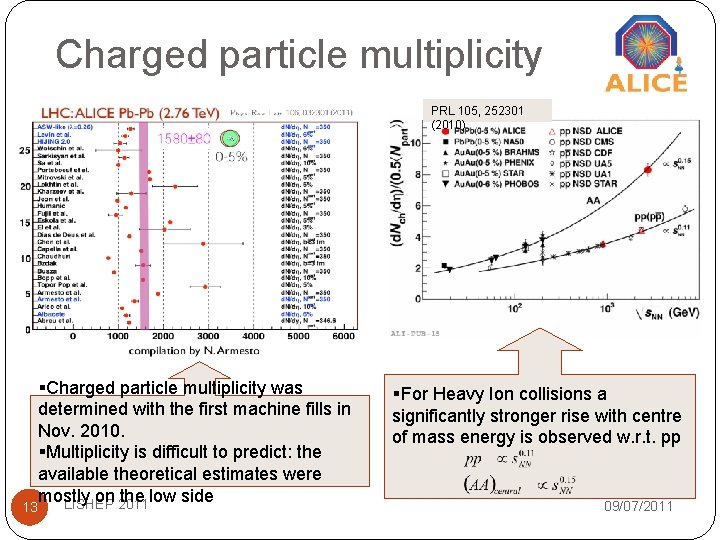
Charged particle multiplicity PRL 105, 252301 (2010) 13 §Charged particle multiplicity was determined with the first machine fills in Nov. 2010. §Multiplicity is difficult to predict: the available theoretical estimates were mostly on the low side LISHEP 2011 §For Heavy Ion collisions a significantly stronger rise with centre of mass energy is observed w. r. t. pp 09/07/2011
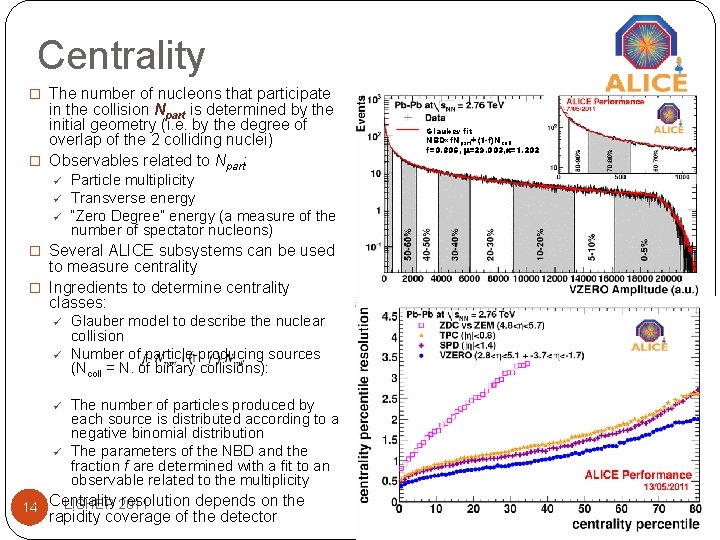
Centrality � The number of nucleons that participate in the collision Npart is determined by the initial geometry (i. e. by the degree of overlap of the 2 colliding nuclei) � Observables related to Npart: ü ü ü Glauber fit NBD f. Npart+(1 -f)Ncoll f=0. 806, =29. 003, k=1. 202 Particle multiplicity Transverse energy “Zero Degree” energy (a measure of the number of spectator nucleons) � Several ALICE subsystems can be used to measure centrality � Ingredients to determine centrality classes: ü ü Glauber model to describe the nuclear collision Number of particle-producing sources (Ncoll = N. of binary collisions): The number of particles produced by each source is distributed according to a negative binomial distribution The parameters of the NBD and the fraction f are determined with a fit to an observable related to the multiplicity � Centrality resolution depends on the LISHEP 2011 14 rapidity coverage of the detector 09/07/2011
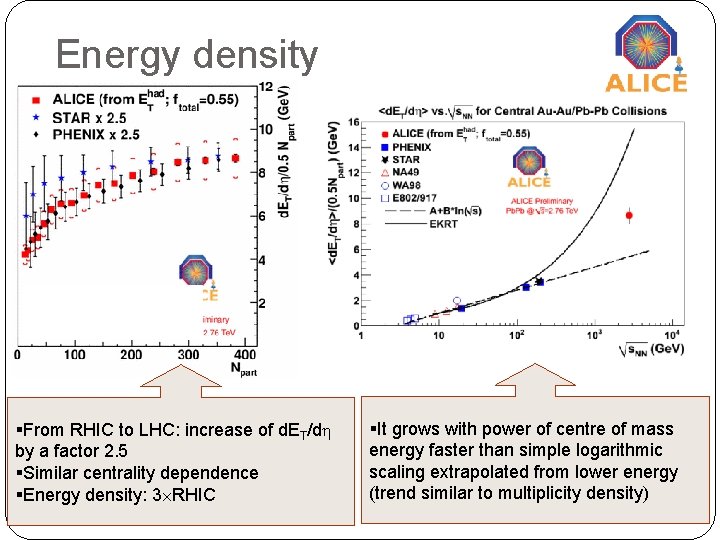
Energy density §It grows with power of centre of mass §From RHIC to LHC: increase of d. ET/d energy faster than simple logarithmic by a factor 2. 5 scaling extrapolated from lower energy §Similar centrality dependence (trend similar to multiplicity density) §Energy density: 3 RHIC LISHEP 2011 15 09/07/2011
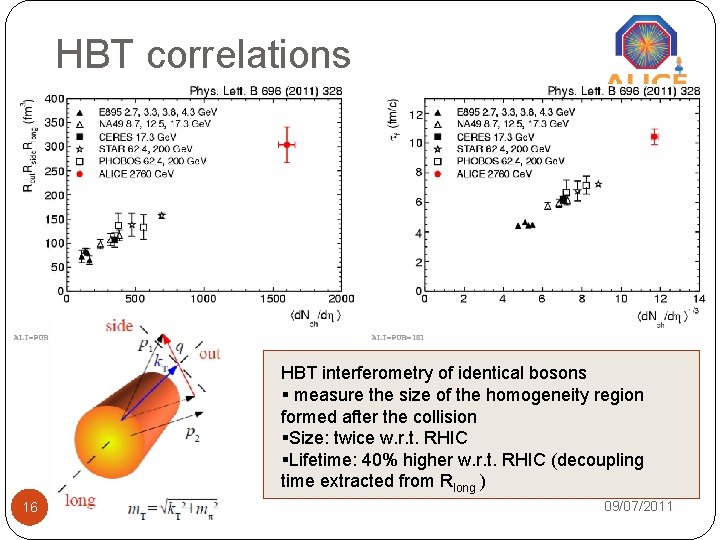
HBT correlations HBT interferometry of identical bosons § measure the size of the homogeneity region formed after the collision §Size: twice w. r. t. RHIC §Lifetime: 40% higher w. r. t. RHIC (decoupling time extracted from Rlong ) 16 09/07/2011
Assessing the nature of the medium: 2 particle correlations and transverse flow § Space-time evolution of the fireball § Collective phenomena § Effects of fluctuactions in the initial nucleon distributions 17 LISHEP 2011 09/07/2011
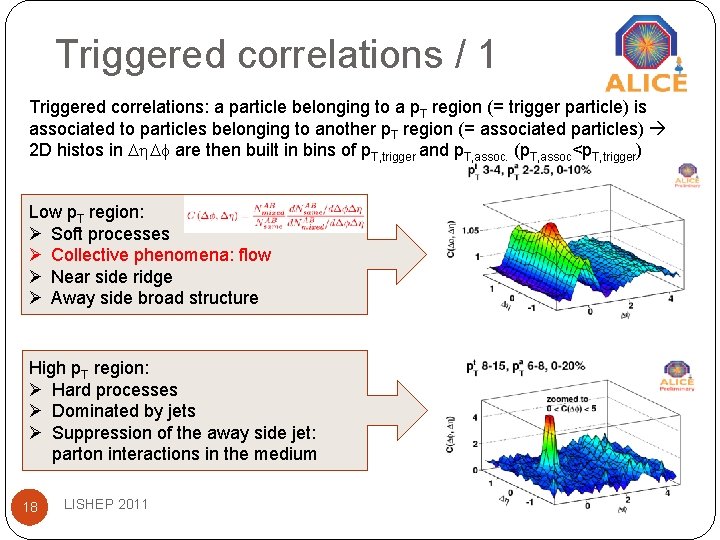
Triggered correlations / 1 Triggered correlations: a particle belonging to a p. T region (= trigger particle) is associated to particles belonging to another p. T region (= associated particles) 2 D histos in are then built in bins of p. T, trigger and p. T, assoc. (p. T, assoc<p. T, trigger) Low p. T region: Ø Soft processes Ø Collective phenomena: flow Ø Near side ridge Ø Away side broad structure High p. T region: Ø Hard processes Ø Dominated by jets Ø Suppression of the away side jet: parton interactions in the medium 18 LISHEP 2011 09/07/2011
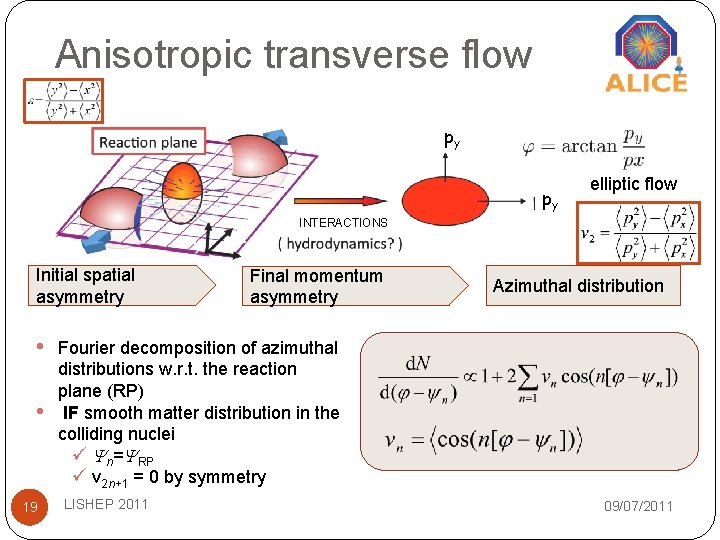
Anisotropic transverse flow py py elliptic flow INTERACTIONS Initial spatial asymmetry • • 19 Final momentum asymmetry Azimuthal distribution Fourier decomposition of azimuthal distributions w. r. t. the reaction plane (RP) IF smooth matter distribution in the colliding nuclei ü Yn=YRP ü v 2 n+1 = 0 by symmetry LISHEP 2011 09/07/2011
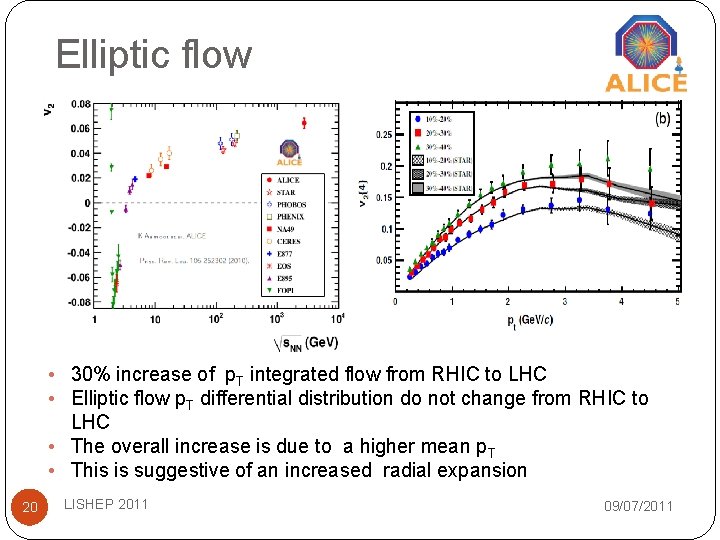
Elliptic flow • 30% increase of p. T integrated flow from RHIC to LHC • Elliptic flow p. T differential distribution do not change from RHIC to LHC • The overall increase is due to a higher mean p. T • This is suggestive of an increased radial expansion 20 LISHEP 2011 09/07/2011
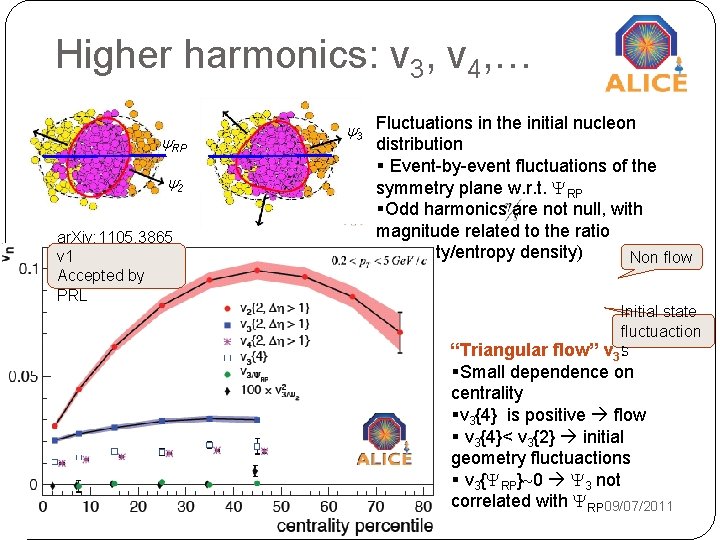
Higher harmonics: v 3, v 4, … y. RP y 2 ar. Xiv: 1105. 3865 v 1 Accepted by PRL 21 LISHEP 2011 y 3 Fluctuations in the initial nucleon distribution § Event-by-event fluctuations of the symmetry plane w. r. t. RP §Odd harmonics are not null, with magnitude related to the ratio (viscosity/entropy density) Non flow Initial state fluctuaction “Triangular flow” v 3: s §Small dependence on centrality §v 3{4} is positive flow § v 3{4}< v 3{2} initial geometry fluctuactions § v 3{ RP} 0 3 not correlated with RP 09/07/2011
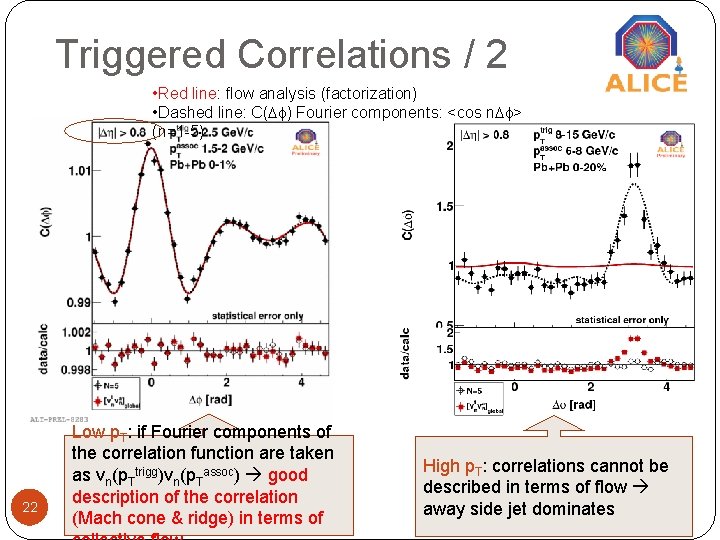
Triggered Correlations / 2 • Red line: flow analysis (factorization) • Dashed line: C( ) Fourier components: <cos n > (n=1 -5) 22 Low p. T: if Fourier components of the correlation function are taken as vn(p. Ttrigg)vn(p. Tassoc) good description of the correlation LISHEP 2011 (Mach cone & ridge) in terms of High p. T: correlations cannot be described in terms of flow 09/07/2011 away side jet dominates
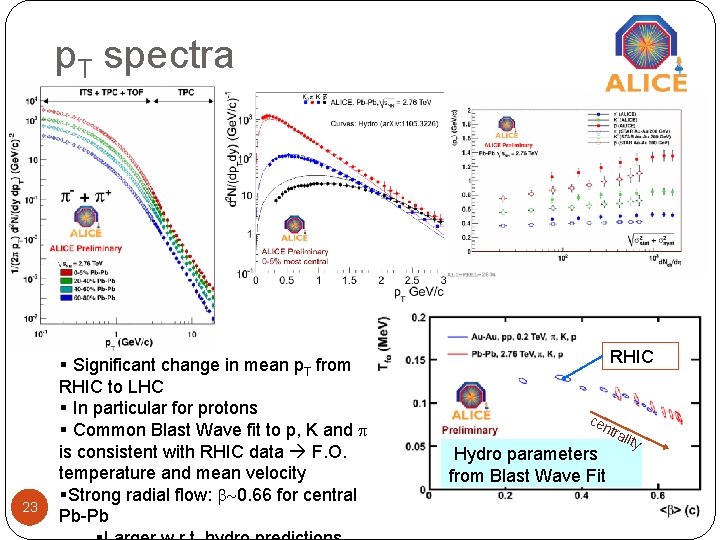
p. T spectra 23 § Significant change in mean p. T from RHIC to LHC § In particular for protons § Common Blast Wave fit to p, K and is consistent with RHIC data F. O. temperature and mean velocity §Strong radial flow: 0. 66 for central Pb-Pb RHIC cen tra Hydro parameters from Blast Wave Fit lity 09/07/2011
Probing the medium with hard processes § Nuclear modification Factor vs. p. T § Heavy Flavours § Quarkonia 24 LISHEP 2011 09/07/2011
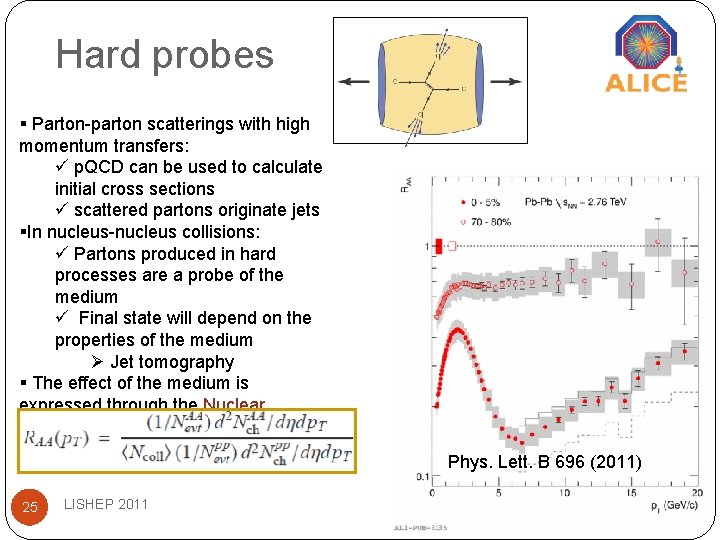
Hard probes § Parton-parton scatterings with high momentum transfers: ü p. QCD can be used to calculate initial cross sections ü scattered partons originate jets §In nucleus-nucleus collisions: ü Partons produced in hard processes are a probe of the medium ü Final state will depend on the properties of the medium Ø Jet tomography § The effect of the medium is expressed through the Nuclear Modification Factor RAA: Phys. Lett. B 696 (2011) 25 LISHEP 2011 09/07/2011
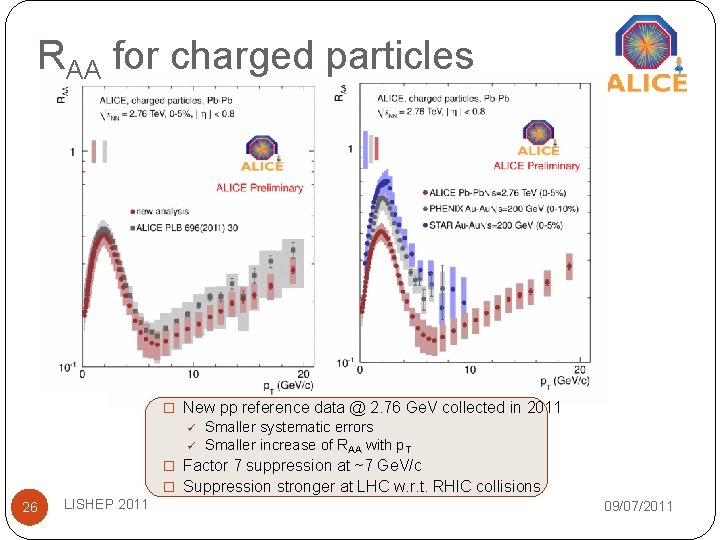
RAA for charged particles � New pp reference data @ 2. 76 Ge. V collected in 2011 ü ü Smaller systematic errors Smaller increase of RAA with p. T � Factor 7 suppression at ~7 Ge. V/c � Suppression stronger at LHC w. r. t. RHIC collisions 26 LISHEP 2011 09/07/2011
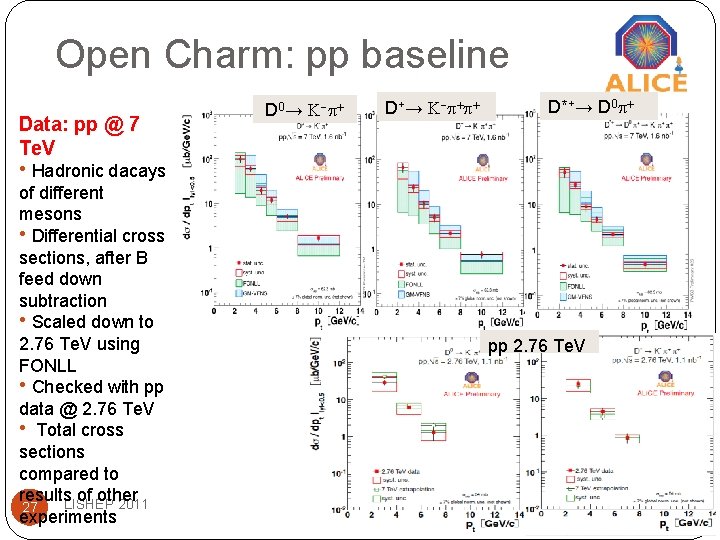
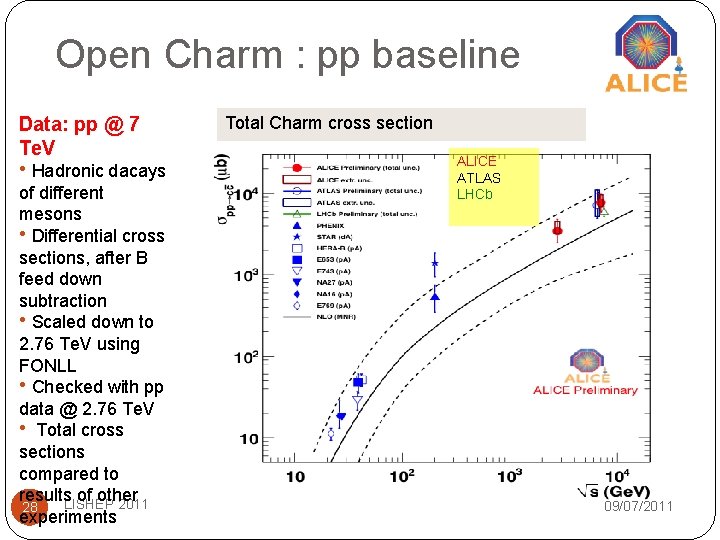
Open Charm: pp baseline Data: pp @ 7 Te. V D 0→ K- + D+→ K- + + D*+→ D 0 + • Hadronic dacays of different mesons • Differential cross sections, after B feed down subtraction • Scaled down to 2. 76 Te. V using FONLL • Checked with pp data @ 2. 76 Te. V • Total cross sections compared to results of other LISHEP 2011 27 experiments pp 2. 76 Te. V 09/07/2011
Open Charm : pp baseline Data: pp @ 7 Te. V • Hadronic dacays of different mesons • Differential cross sections, after B feed down subtraction • Scaled down to 2. 76 Te. V using FONLL • Checked with pp data @ 2. 76 Te. V • Total cross sections compared to results of other LISHEP 2011 28 experiments Total Charm cross section ALICE ATLAS LHCb 09/07/2011
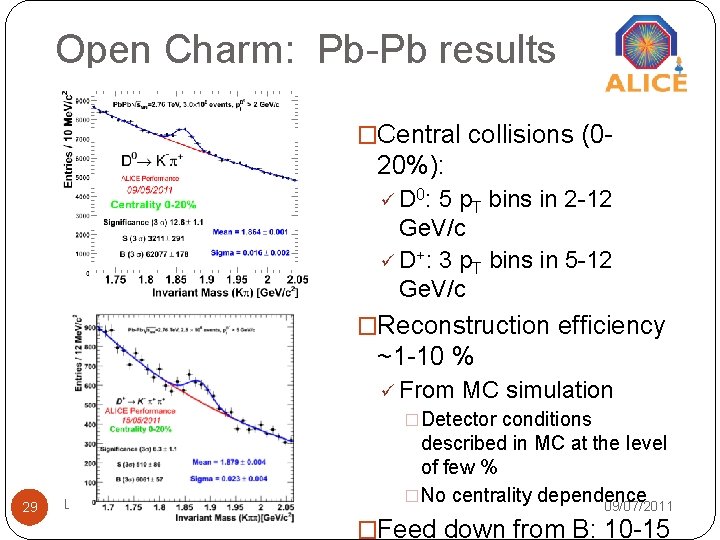
Open Charm: Pb-Pb results �Central collisions (0 - 20%): ü D 0: 5 p. T bins in 2 -12 Ge. V/c ü D+: 3 p. T bins in 5 -12 Ge. V/c �Reconstruction efficiency ~1 -10 % ü From MC simulation �Detector conditions 29 LISHEP 2011 described in MC at the level of few % �No centrality dependence 09/07/2011 �Feed down from B: 10 -15
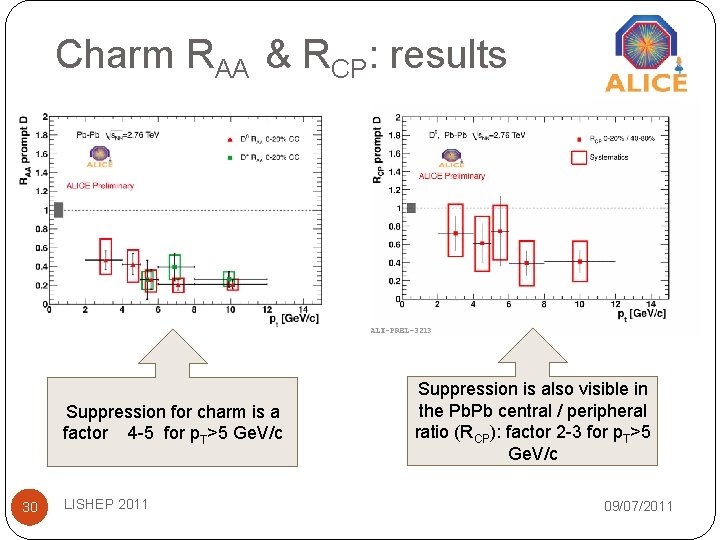
Charm RAA & RCP: results Suppression for charm is a factor 4 -5 for p. T>5 Ge. V/c 30 LISHEP 2011 Suppression is also visible in the Pb. Pb central / peripheral ratio (RCP): factor 2 -3 for p. T>5 Ge. V/c 09/07/2011
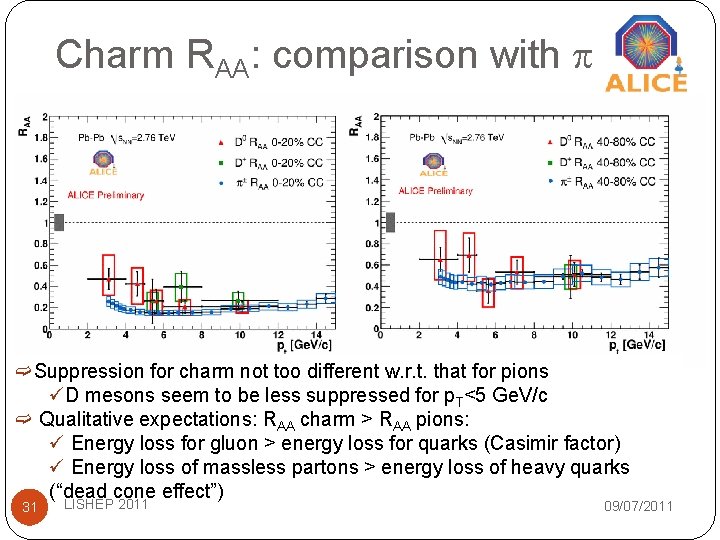
Charm RAA: comparison with ➫Suppression for charm not too different w. r. t. that for pions üD mesons seem to be less suppressed for p. T<5 Ge. V/c ➫ Qualitative expectations: RAA charm > RAA pions: ü Energy loss for gluon > energy loss for quarks (Casimir factor) ü Energy loss of massless partons > energy loss of heavy quarks (“dead cone effect”) 31 LISHEP 2011 09/07/2011
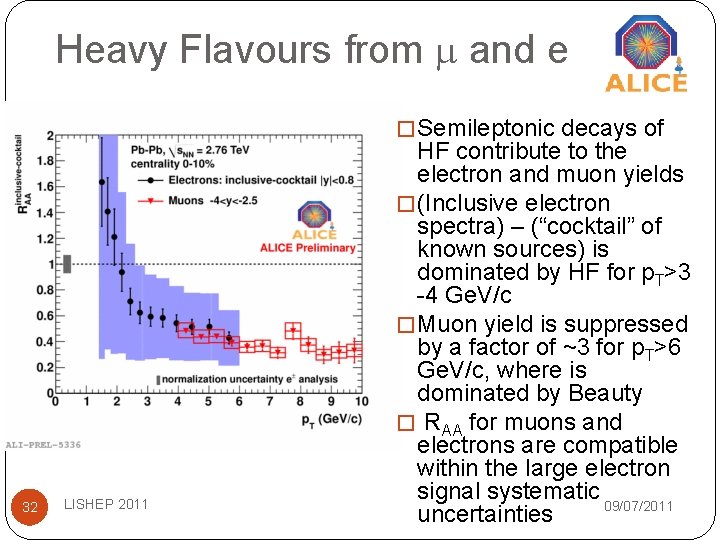
Heavy Flavours from and e � Semileptonic decays of 32 LISHEP 2011 HF contribute to the electron and muon yields � (Inclusive electron spectra) – (“cocktail” of known sources) is dominated by HF for p. T>3 -4 Ge. V/c � Muon yield is suppressed by a factor of ~3 for p. T>6 Ge. V/c, where is dominated by Beauty � RAA for muons and electrons are compatible within the large electron signal systematic 09/07/2011 uncertainties
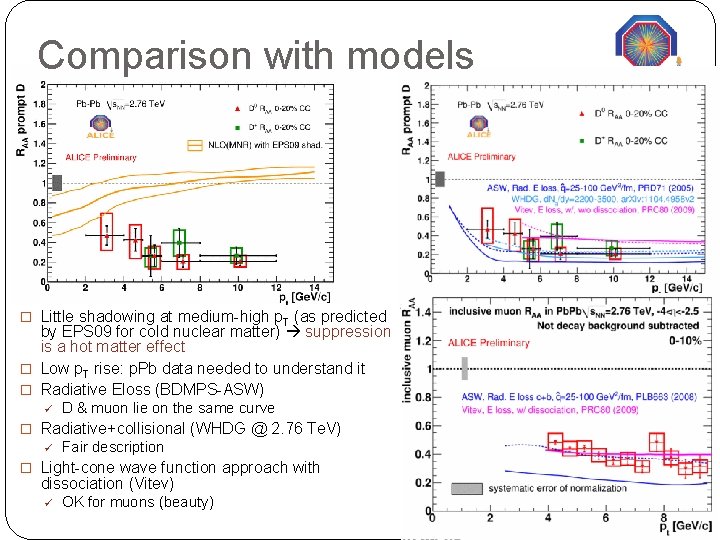
Comparison with models � Little shadowing at medium-high p. T (as predicted by EPS 09 for cold nuclear matter) suppression is a hot matter effect � Low p. T rise: p. Pb data needed to understand it � Radiative Eloss (BDMPS-ASW) ü D & muon lie on the same curve � Radiative+collisional (WHDG @ 2. 76 Te. V) ü Fair description � Light-cone wave function approach with dissociation (Vitev) LISHEP 2011 33 ü OK for muons (beauty) 09/07/2011
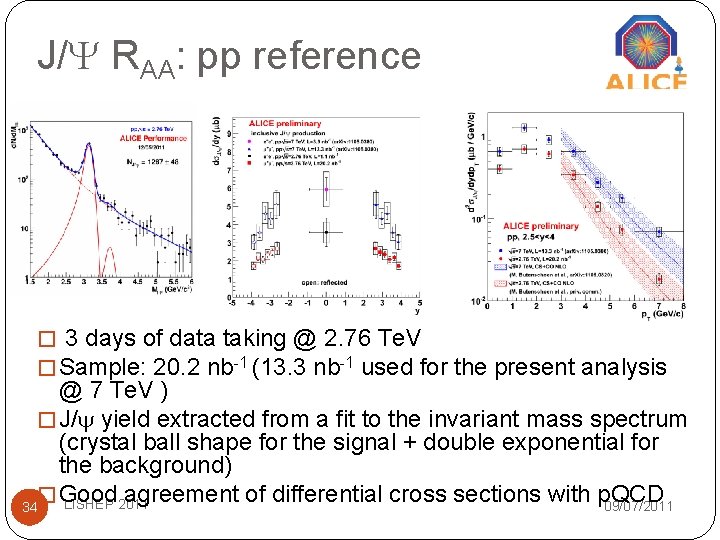
J/ RAA: pp reference � 3 days of data taking @ 2. 76 Te. V � Sample: 20. 2 nb-1 (13. 3 nb-1 used for the present analysis @ 7 Te. V ) � J/y yield extracted from a fit to the invariant mass spectrum (crystal ball shape for the signal + double exponential for the background) � Good agreement of differential cross sections with p. QCD LISHEP 2011 09/07/2011 34
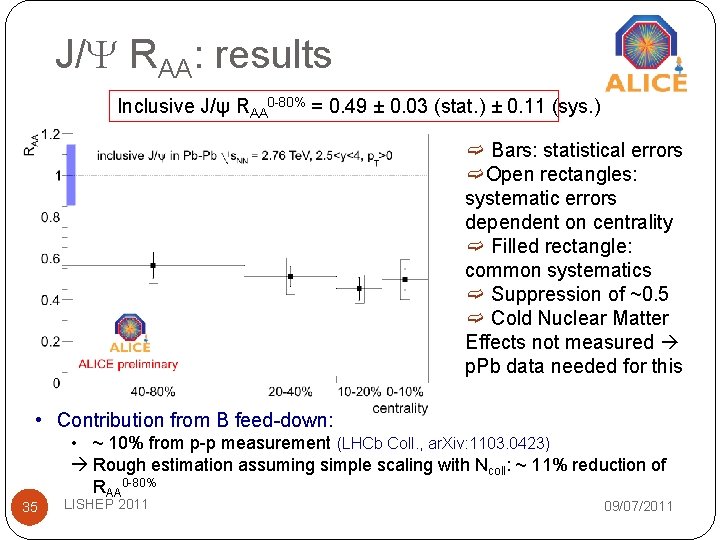
J/ RAA: results Inclusive J/ψ RAA 0 -80% = 0. 49 ± 0. 03 (stat. ) ± 0. 11 (sys. ) ➫ Bars: statistical errors ➫Open rectangles: systematic errors dependent on centrality ➫ Filled rectangle: common systematics ➫ Suppression of ~0. 5 ➫ Cold Nuclear Matter Effects not measured p. Pb data needed for this • Contribution from B feed-down: 35 • ~ 10% from p-p measurement (LHCb Coll. , ar. Xiv: 1103. 0423) Rough estimation assuming simple scaling with Ncoll: ~ 11% reduction of RAA 0 -80% LISHEP 2011 09/07/2011
J/ RAA: comparison with RHIC � ALICE data plotted as a function of <Npart> � J/y less suppressed at LHC (2. 5<y<4) than at RHIC (1. 2<|y|<2. 2) � RAA for ALICE and Phenix are similar if Phenix data are restricted 36 to |y|<0. 35 LISHEP 2011 09/07/2011
J/ RAA: comparison with RHIC � ALICE data plotted as a function of <Npart> � J/y less suppressed at LHC (2. 5<y<4) than at RHIC (1. 2<|y|<2. 2) � RAA for ALICE and Phenix are similar if Phenix data are restricted 37 to |y|<0. 35 LISHEP 2011 09/07/2011
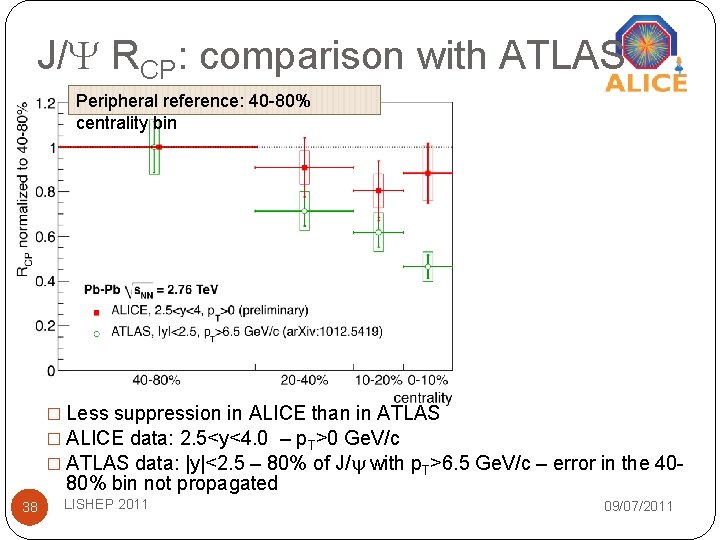
J/ RCP: comparison with ATLAS Peripheral reference: 40 -80% centrality bin � Less suppression in ALICE than in ATLAS � ALICE data: 2. 5<y<4. 0 – p. T>0 Ge. V/c � ATLAS data: |y|<2. 5 – 80% of J/y with p. T>6. 5 Ge. V/c – error in the 40 - 80% bin not propagated 38 LISHEP 2011 09/07/2011
ALICE upgrades 39 LISHEP 2011 09/07/2011
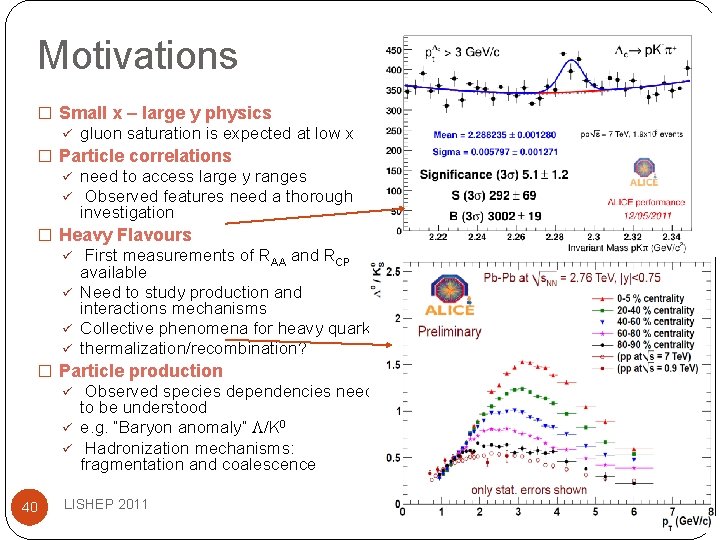
Motivations � Small x – large y physics ü gluon saturation is expected at low x � Particle correlations ü ü need to access large y ranges Observed features need a thorough investigation � Heavy Flavours ü ü First measurements of RAA and RCP available Need to study production and interactions mechanisms Collective phenomena for heavy quarks thermalization/recombination? � Particle production ü ü ü 40 Observed species dependencies need to be understood e. g. “Baryon anomaly” L/K 0 Hadronization mechanisms: fragmentation and coalescence LISHEP 2011 09/07/2011
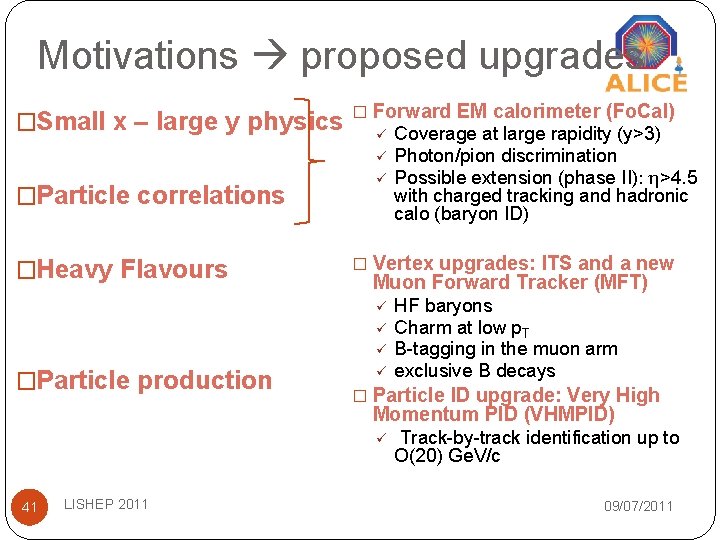
Motivations proposed upgrades �Small x – large y physics � Forward EM calorimeter (Fo. Cal) ü ü �Particle correlations �Heavy Flavours ü � Vertex upgrades: ITS and a new Muon Forward Tracker (MFT) ü ü ü �Particle production Coverage at large rapidity (y>3) Photon/pion discrimination Possible extension (phase II): >4. 5 with charged tracking and hadronic calo (baryon ID) ü HF baryons Charm at low p. T B-tagging in the muon arm exclusive B decays � Particle ID upgrade: Very High Momentum PID (VHMPID) ü 41 LISHEP 2011 Track-by-track identification up to O(20) Ge. V/c 09/07/2011
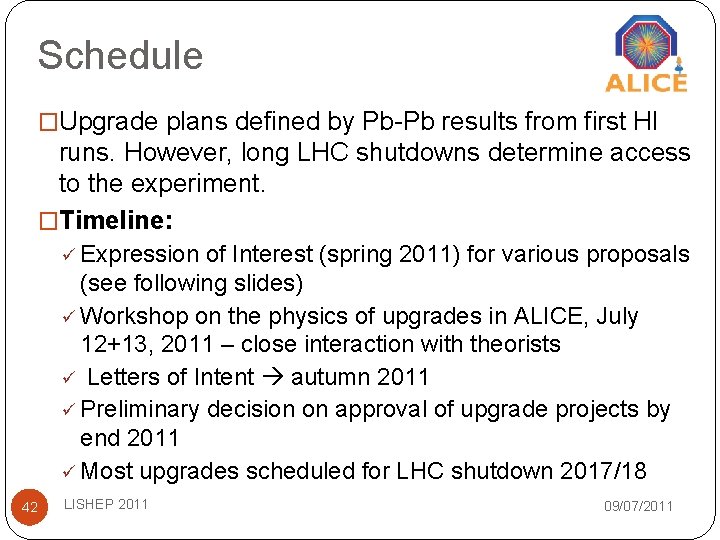
Schedule �Upgrade plans defined by Pb-Pb results from first HI runs. However, long LHC shutdowns determine access to the experiment. �Timeline: ü Expression of Interest (spring 2011) for various proposals (see following slides) ü Workshop on the physics of upgrades in ALICE, July 12+13, 2011 – close interaction with theorists ü Letters of Intent autumn 2011 ü Preliminary decision on approval of upgrade projects by end 2011 ü Most upgrades scheduled for LHC shutdown 2017/18 42 LISHEP 2011 09/07/2011
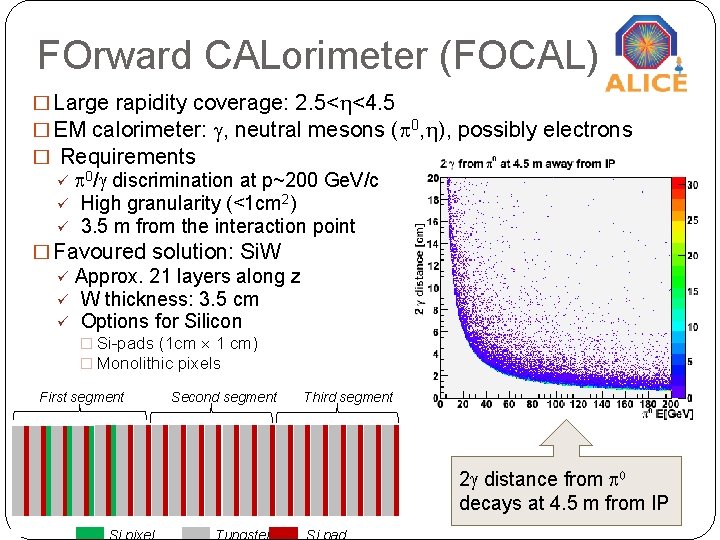
FOrward CALorimeter (FOCAL) � Large rapidity coverage: 2. 5< <4. 5 � EM calorimeter: , neutral mesons ( 0, ), possibly electrons � Requirements ü 0/ discrimination at p~200 Ge. V/c ü High granularity (<1 cm 2) ü 3. 5 m from the interaction point � Favoured solution: Si. W ü Approx. 21 layers along z ü W thickness: 3. 5 cm ü Options for Silicon � Si-pads (1 cm 1 cm) � Monolithic pixels First segment 43 LISHEP 2011 Second segment Third segment 2 distance from 0 decays at 4. 5 m from IP 09/07/2011
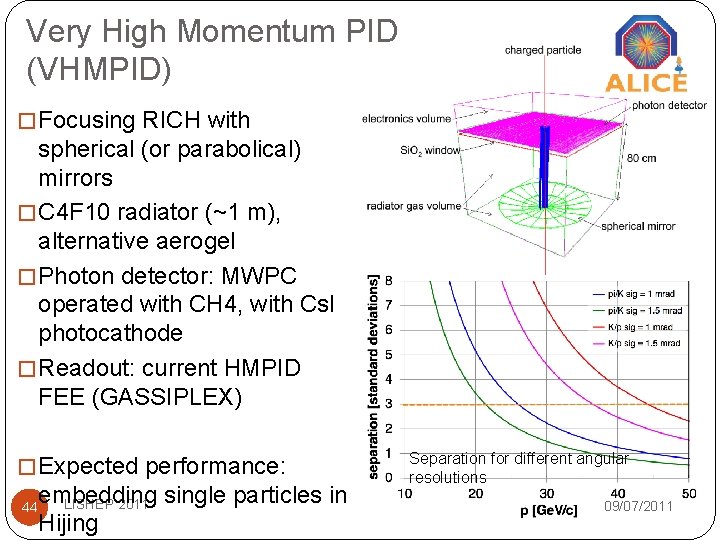
Very High Momentum PID (VHMPID) � Focusing RICH with spherical (or parabolical) mirrors � C 4 F 10 radiator (~1 m), alternative aerogel � Photon detector: MWPC operated with CH 4, with Cs. I photocathode � Readout: current HMPID FEE (GASSIPLEX) � Expected performance: 44 embedding single particles in LISHEP 2011 Hijing Separation for different angular resolutions 09/07/2011
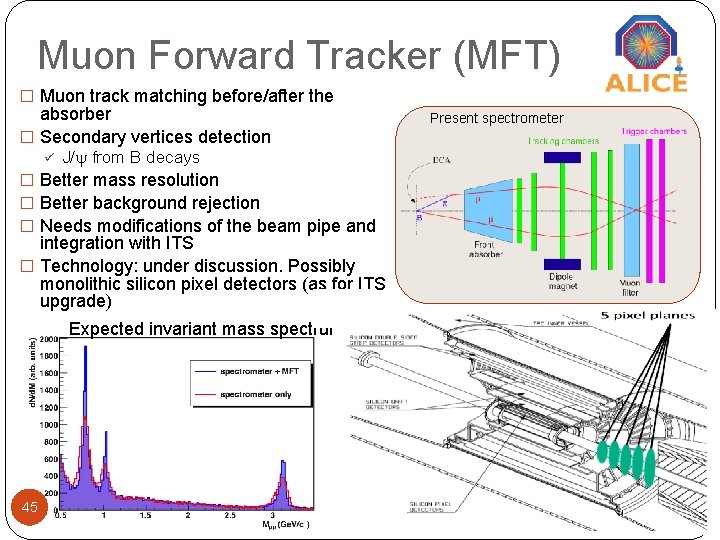
Muon Forward Tracker (MFT) � Muon track matching before/after the absorber � Secondary vertices detection ü Present spectrometer J/y from B decays � Better mass resolution � Better background rejection � Needs modifications of the beam pipe and integration with ITS � Technology: under discussion. Possibly monolithic silicon pixel detectors (as for ITS upgrade) Expected invariant mass spectrum 45 LISHEP 2011 09/07/2011
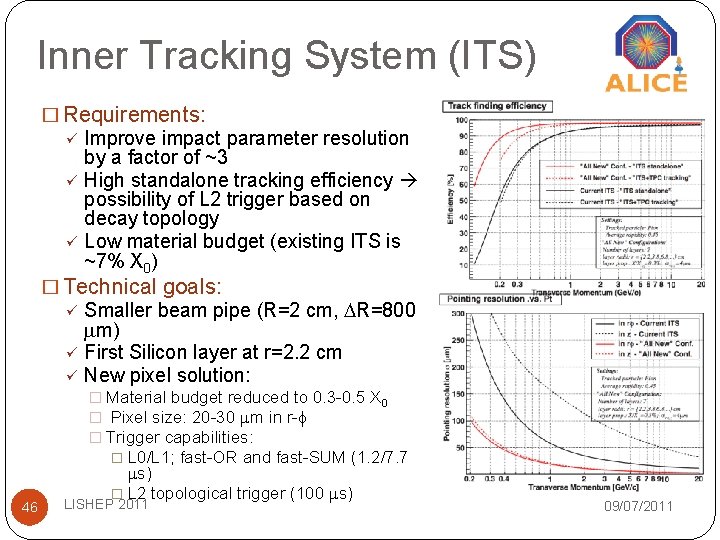
Inner Tracking System (ITS) � Requirements: ü Improve impact parameter resolution by a factor of ~3 ü High standalone tracking efficiency possibility of L 2 trigger based on decay topology ü Low material budget (existing ITS is ~7% X 0) � Technical goals: ü Smaller beam pipe (R=2 cm, R=800 m) ü First Silicon layer at r=2. 2 cm ü New pixel solution: � Material budget reduced to 0. 3 -0. 5 X 0 � Pixel size: 20 -30 m in r- � Trigger capabilities: � L 0/L 1; fast-OR and fast-SUM (1. 2/7. 7 46 s) � L 2 topological trigger (100 s) LISHEP 2011 09/07/2011
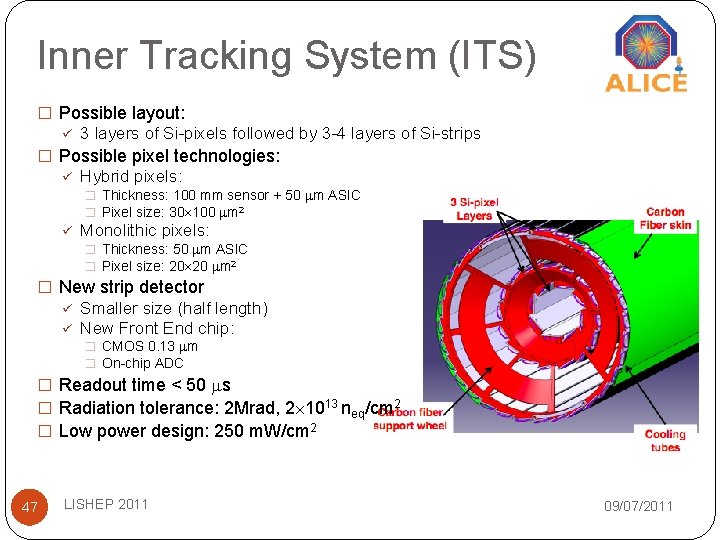
Inner Tracking System (ITS) � Possible layout: ü 3 layers of Si-pixels followed by 3 -4 layers of Si-strips � Possible pixel technologies: ü Hybrid pixels: � Thickness: 100 mm sensor + 50 m ASIC � Pixel size: 30 100 m 2 ü Monolithic pixels: � Thickness: 50 m ASIC � Pixel size: 20 20 m 2 � New strip detector ü ü Smaller size (half length) New Front End chip: � CMOS 0. 13 m � On-chip ADC � Readout time < 50 s � Radiation tolerance: 2 Mrad, 2 1013 neq/cm 2 � Low power design: 250 m. W/cm 2 47 LISHEP 2011 09/07/2011
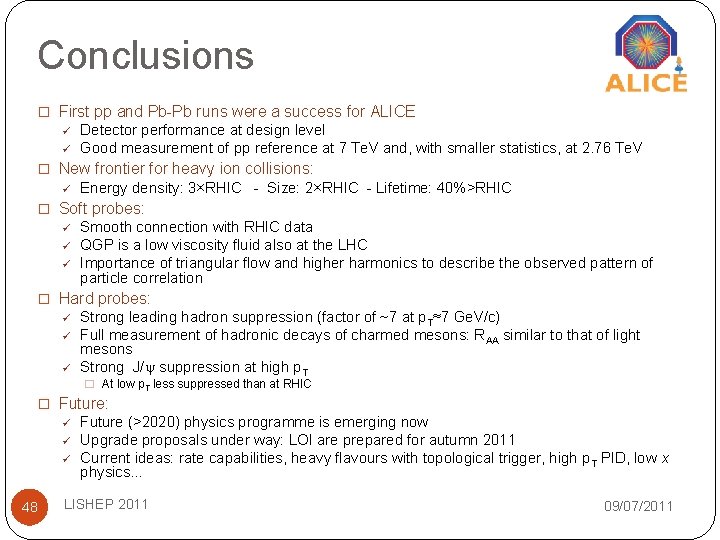
Conclusions � First pp and Pb-Pb runs were a success for ALICE ü ü Detector performance at design level Good measurement of pp reference at 7 Te. V and, with smaller statistics, at 2. 76 Te. V � New frontier for heavy ion collisions: ü Energy density: 3×RHIC - Size: 2×RHIC - Lifetime: 40%>RHIC � Soft probes: ü ü ü Smooth connection with RHIC data QGP is a low viscosity fluid also at the LHC Importance of triangular flow and higher harmonics to describe the observed pattern of particle correlation � Hard probes: ü ü ü Strong leading hadron suppression (factor of ~7 at p. T≈7 Ge. V/c) Full measurement of hadronic decays of charmed mesons: RAA similar to that of light mesons Strong J/y suppression at high p. T � At low p. T less suppressed than at RHIC � Future: ü ü ü 48 Future (>2020) physics programme is emerging now Upgrade proposals under way: LOI are prepared for autumn 2011 Current ideas: rate capabilities, heavy flavours with topological trigger, high p. T PID, low x physics… LISHEP 2011 09/07/2011