String Lessons for Higher Spins Massimo Taronna Scuola
- Slides: 18
String Lessons for Higher Spins Massimo Taronna Scuola Normale Superiore & INFN, Pisa Based on: Master Thesis(2009)[hep-th/1005. 3061](M. T. advisor: Prof. A. Sagnotti) & hep-th/1006. 5242: A. Sagnotti and M. T. 1
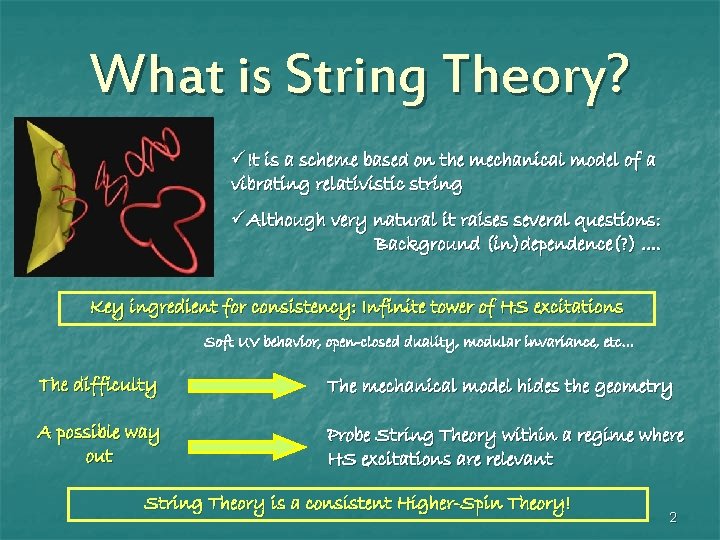
What is String Theory? üIt is a scheme based on the mechanical model of a vibrating relativistic string üAlthough very natural it raises several questions: Background (in)dependence(? ). . Key ingredient for consistency: Infinite tower of HS excitations Soft UV behavior, open-closed duality, modular invariance, etc… The difficulty The mechanical model hides the geometry A possible way out Probe String Theory within a regime where HS excitations are relevant String Theory is a consistent Higher-Spin Theory! 2
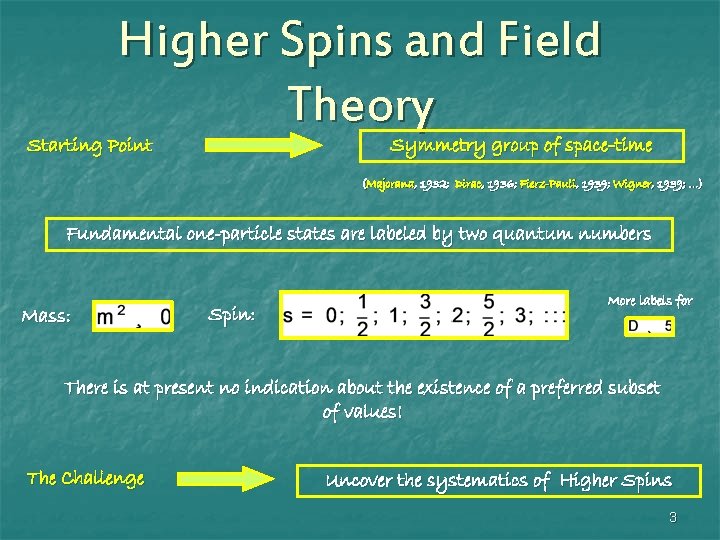
Higher Spins and Field Theory Symmetry group of space-time Starting Point (Majorana, 1932; Dirac, 1936; Fierz-Pauli, 1939; Wigner, 1939; …) Fundamental one-particle states are labeled by two quantum numbers Mass: Spin: More labels for There is at present no indication about the existence of a preferred subset of values! The Challenge Uncover the systematics of Higher Spins 3
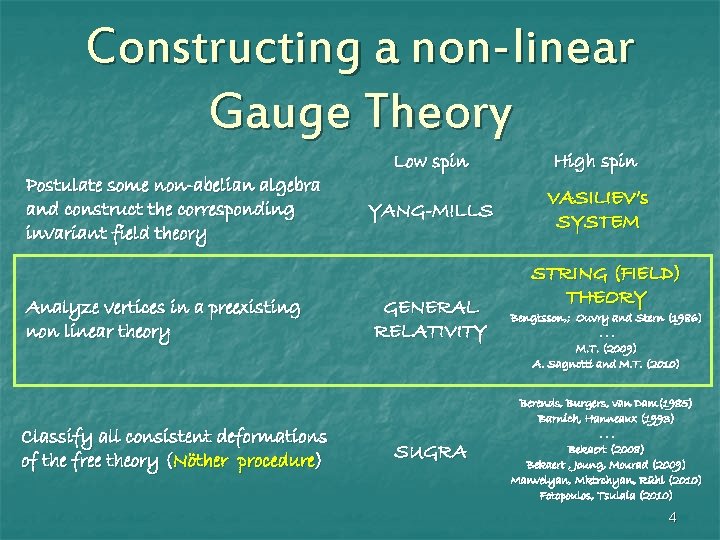
Constructing a non-linear Gauge Theory Postulate some non-abelian algebra and construct the corresponding invariant field theory Analyze vertices in a preexisting non linear theory Classify all consistent deformations of the free theory (Nöther procedure) Low spin High spin YANG-MILLS VASILIEV’s SYSTEM GENERAL RELATIVITY SUGRA STRING (FIELD) THEORY Bengtsson, ; Ouvry and Stern (1986). . . M. T. (2009) A. Sagnotti and M. T. (2010) Berends, Burgers, van Dam(1985) Barnich, Hanneaux (1993). . . Bekaert (2008) Bekaert , Joung, Mourad (2009) Manvelyan, Mktrchyan, Rühl (2010) Fotopoulos, Tsulaia (2010) 4
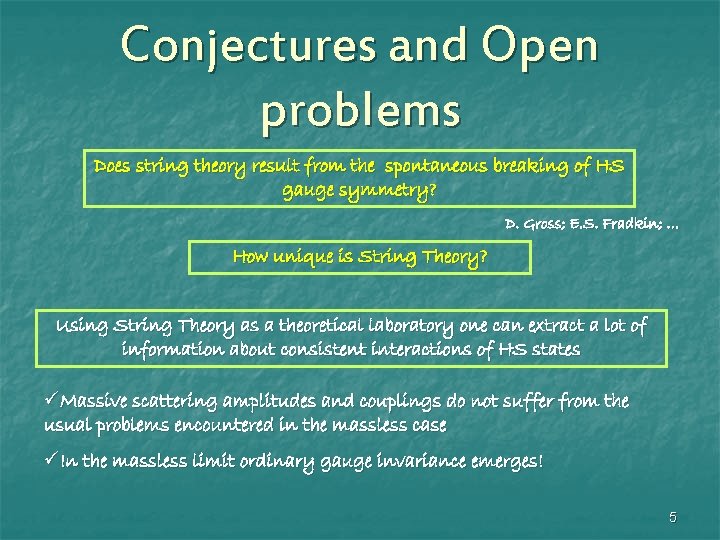
Conjectures and Open problems Does string theory result from the spontaneous breaking of HS gauge symmetry? D. Gross; E. S. Fradkin; … How unique is String Theory? Using String Theory as a theoretical laboratory one can extract a lot of information about consistent interactions of HS states üMassive scattering amplitudes and couplings do not suffer from the usual problems encountered in the massless case üIn the massless limit ordinary gauge invariance emerges! 5
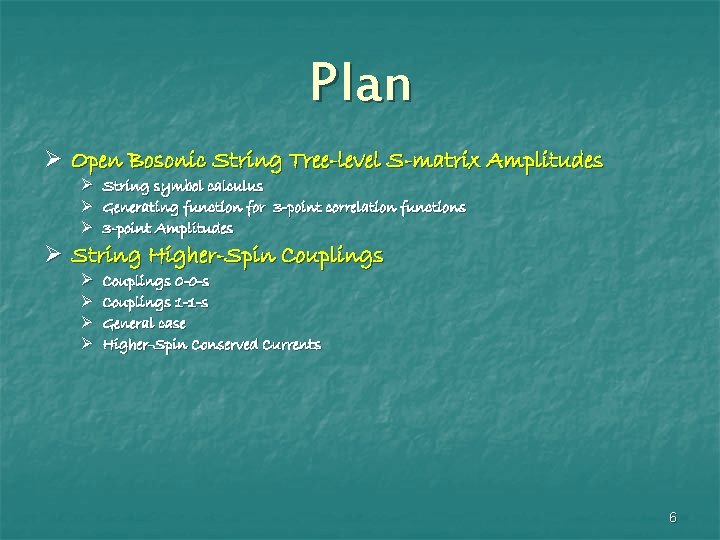
Plan Ø Open Bosonic String Tree-level S-matrix Amplitudes Ø Ø Ø String symbol calculus Generating function for 3 -point correlation functions 3 -point Amplitudes Ø String Higher-Spin Couplings Ø Ø Couplings 0 -0 -s Couplings 1 -1 -s General case Higher-Spin Conserved Currents 6
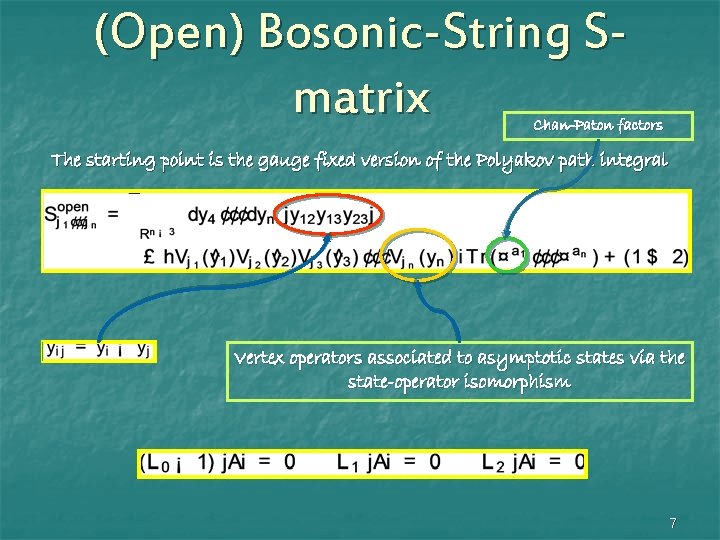
(Open) Bosonic-String Smatrix Chan-Paton factors The starting point is the gauge fixed version of the Polyakov path integral Vertex operators associated to asymptotic states via the state-operator isomorphism 7
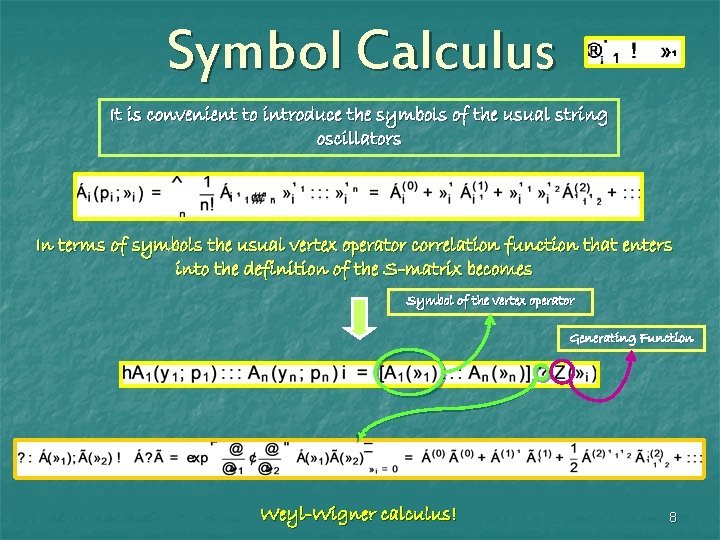
Symbol Calculus It is convenient to introduce the symbols of the usual string oscillators In terms of symbols the usual vertex operator correlation function that enters into the definition of the S-matrix becomes Symbol of the vertex operator Generating Function Weyl-Wigner calculus! 8
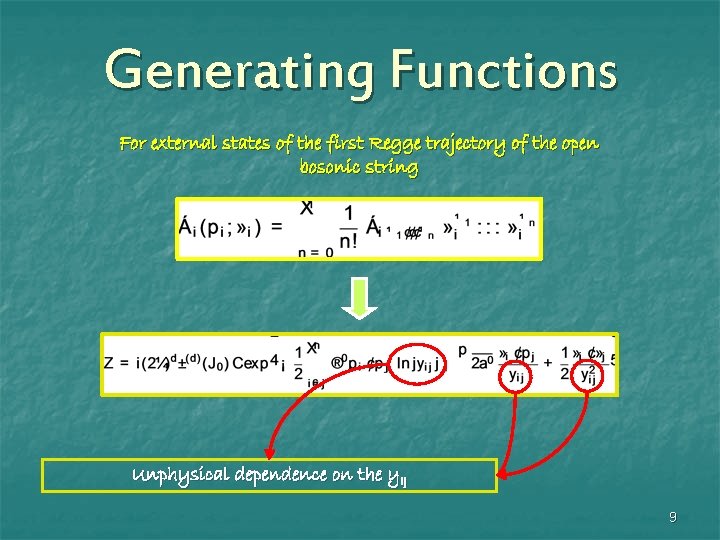
Generating Functions For external states of the first Regge trajectory of the open bosonic string Unphysical dependence on the yij 9
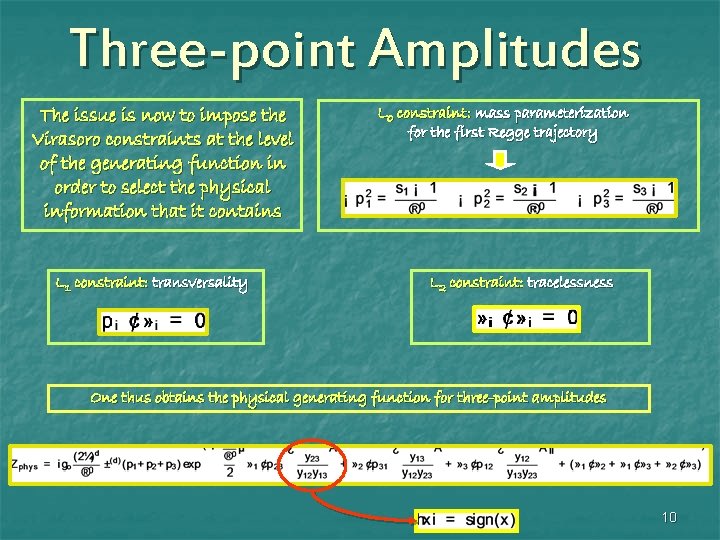
Three-point Amplitudes The issue is now to impose the Virasoro constraints at the level of the generating function in order to select the physical information that it contains L 1 constraint: transversality L 0 constraint: mass parameterization for the first Regge trajectory L 2 constraint: tracelessness One thus obtains the physical generating function for three-point amplitudes 10
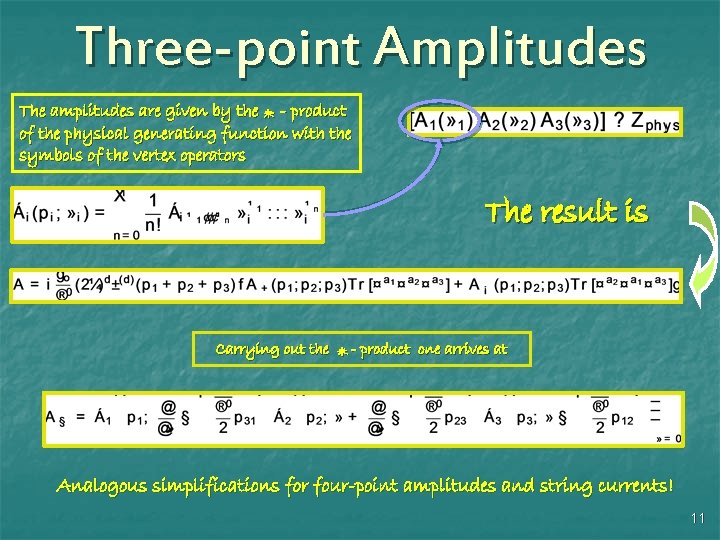
Three-point Amplitudes The amplitudes are given by the * - product of the physical generating function with the symbols of the vertex operators The result is Carrying out the * - product one arrives at Analogous simplifications for four-point amplitudes and string currents! 11
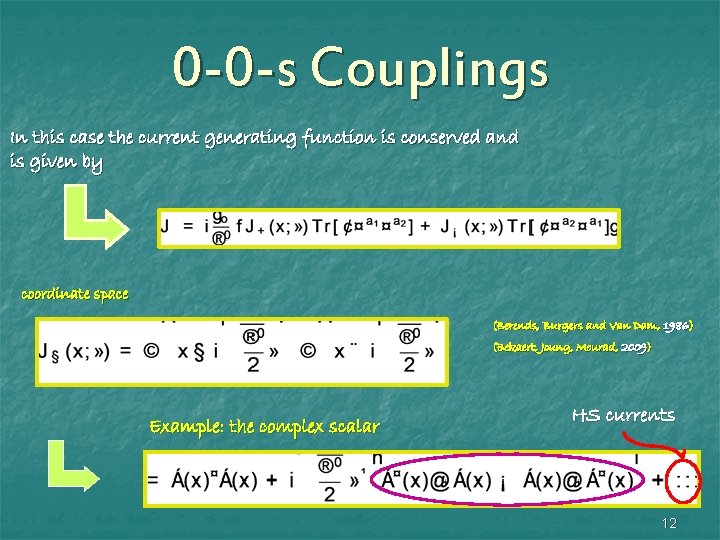
0 -0 -s Couplings In this case the current generating function is conserved and is given by coordinate space (Berends, Burgers and Van Dam, 1986) (Bekaert, Joung, Mourad, 2009) Example: the complex scalar HS currents 12
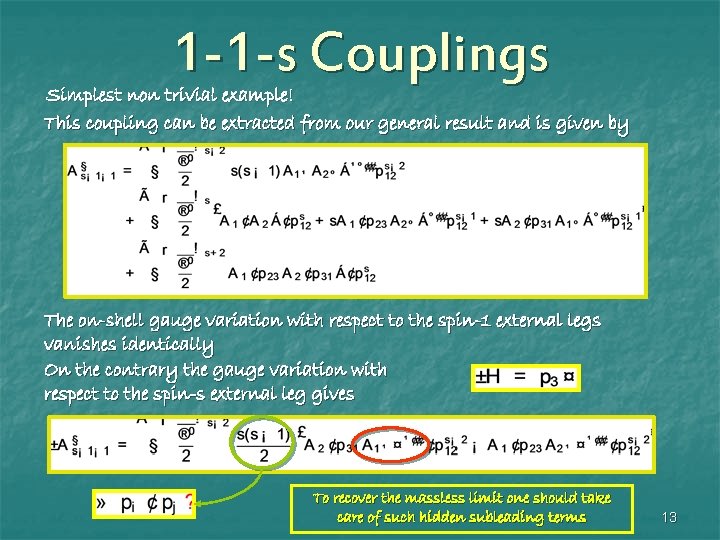
1 -1 -s Couplings Simplest non trivial example! This coupling can be extracted from our general result and is given by The on-shell gauge variation with respect to the spin-1 external legs vanishes identically On the contrary the gauge variation with respect to the spin-s external leg gives To recover the massless limit one should take care of such hidden subleading terms 13
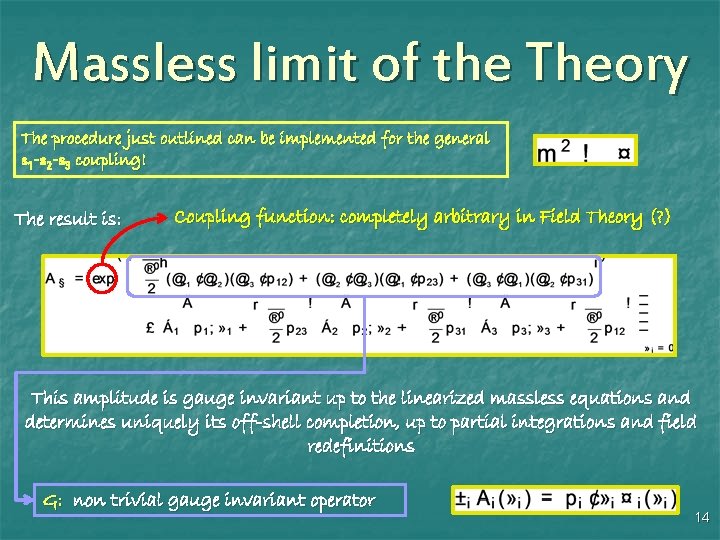
Massless limit of the Theory The procedure just outlined can be implemented for the general s 1 -s 2 -s 3 coupling! The result is: Coupling function: completely arbitrary in Field Theory (? ) This amplitude is gauge invariant up to the linearized massless equations and determines uniquely its off-shell completion, up to partial integrations and field redefinitions G: non trivial gauge invariant operator 14
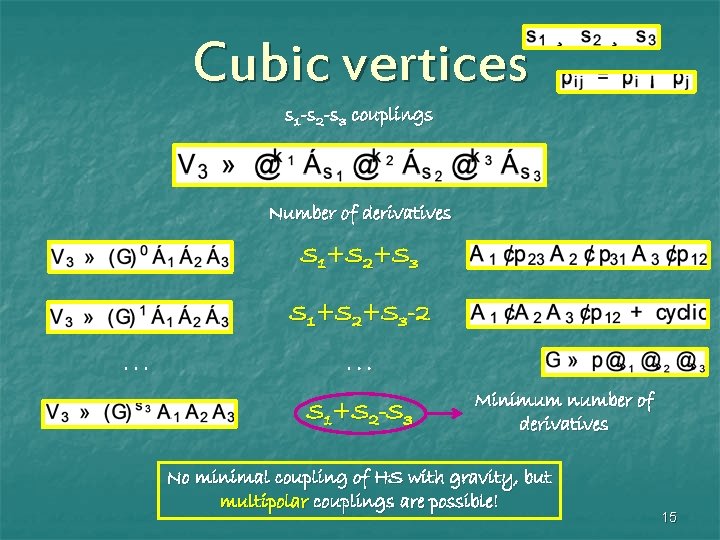
Cubic vertices s 1 -s 2 -s 3 couplings Number of derivatives S 1+S 2+S 3 -2. . . S 1+S 2 -S 3 Minimum number of derivatives No minimal coupling of HS with gravity, but multipolar couplings are possible! 15
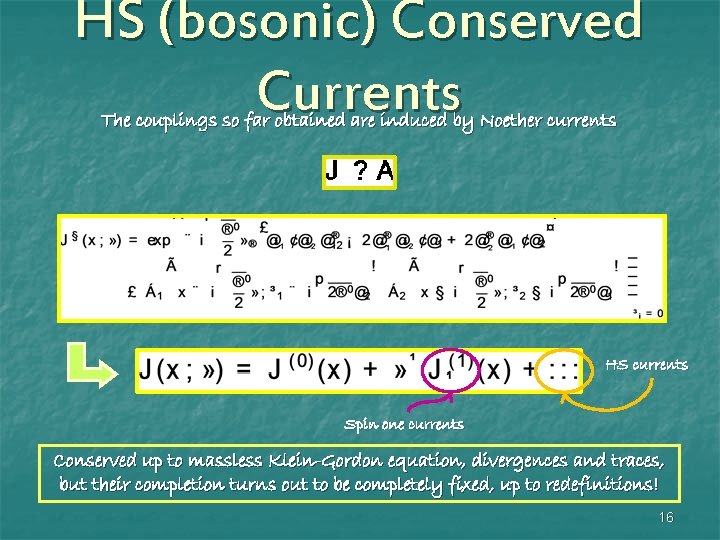
HS (bosonic) Conserved Currents The couplings so far obtained are induced by Noether currents HS currents Spin one currents Conserved up to massless Klein-Gordon equation, divergences and traces, but their completion turns out to be completely fixed, up to redefinitions! 16
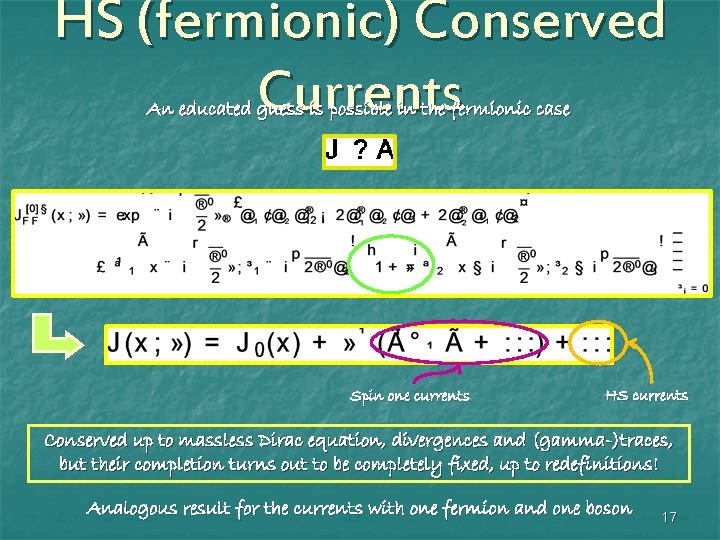
HS (fermionic) Conserved Currents An educated guess is possible in the fermionic case Spin one currents HS currents Conserved up to massless Dirac equation, divergences and (gamma-)traces, but their completion turns out to be completely fixed, up to redefinitions! Analogous result for the currents with one fermion and one boson 17
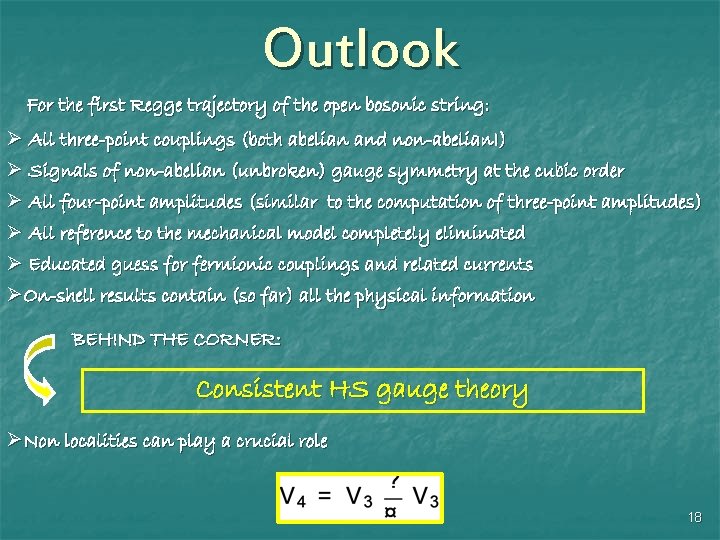
Outlook For the first Regge trajectory of the open bosonic string: Ø All three-point couplings (both abelian and non-abelian!) Ø Signals of non-abelian (unbroken) gauge symmetry at the cubic order Ø All four-point amplitudes (similar to the computation of three-point amplitudes) Ø All reference to the mechanical model completely eliminated Ø Educated guess for fermionic couplings and related currents ØOn-shell results contain (so far) all the physical information BEHIND THE CORNER: Consistent HS gauge theory ØNon localities can play a crucial role 18