
Plancks Dusty GEMS Massimo Pascale Undergraduate at the
- Slides: 11
Planck’s Dusty GEMS Massimo Pascale Undergraduate at the University of Arizona Mentor: Dr. Brenda Frye
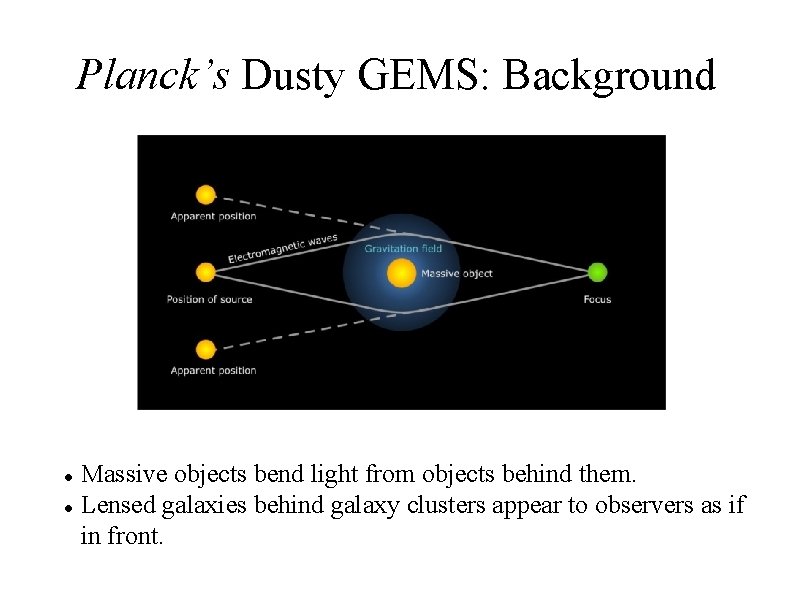
Planck’s Dusty GEMS: Background Massive objects bend light from objects behind them. Lensed galaxies behind galaxy clusters appear to observers as if in front.
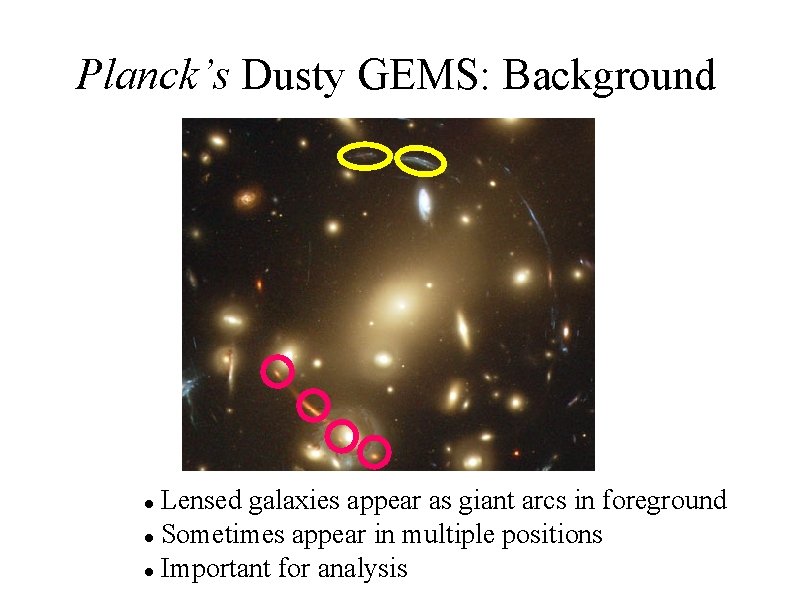
Planck’s Dusty GEMS: Background Lensed galaxies appear as giant arcs in foreground Sometimes appear in multiple positions Important for analysis
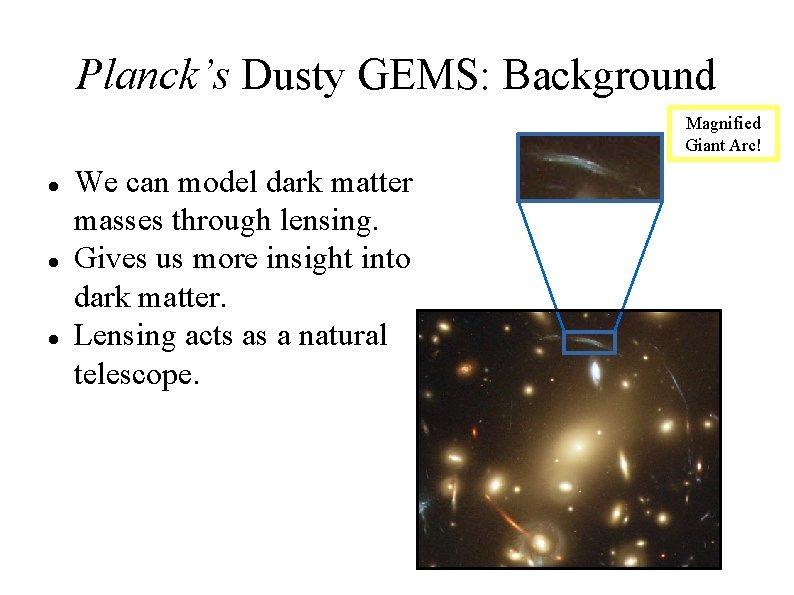
Planck’s Dusty GEMS: Background Magnified Giant Arc! We can model dark matter masses through lensing. Gives us more insight into dark matter. Lensing acts as a natural telescope.
Planck’s Dusty GEMS: Background Powerful lenses are difficult to find. Referred to as having strong lensing features. Some current methods include: Searching optical data Sunyaev-Zeldovich Effect We present a new method: Uses existing data Can find lenses current methods cannot
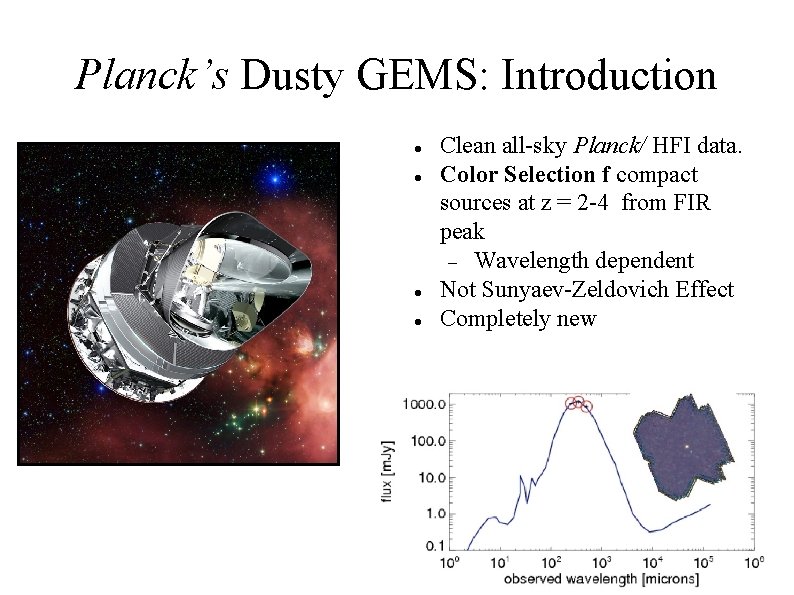
Planck’s Dusty GEMS: Introduction Clean all-sky Planck/ HFI data. Color Selection f compact sources at z = 2 -4 from FIR peak Wavelength dependent Not Sunyaev-Zeldovich Effect Completely new
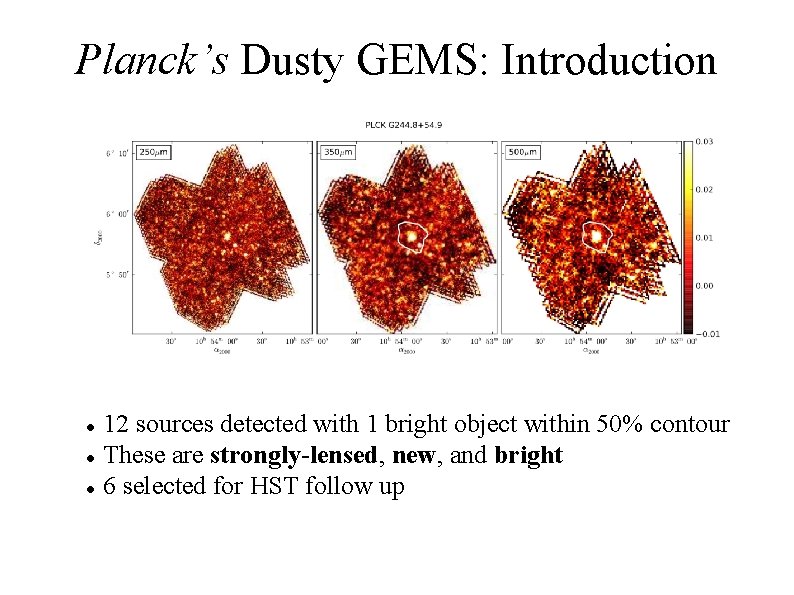
Planck’s Dusty GEMS: Introduction 12 sources detected with 1 bright object within 50% contour These are strongly-lensed, new, and bright 6 selected for HST follow up
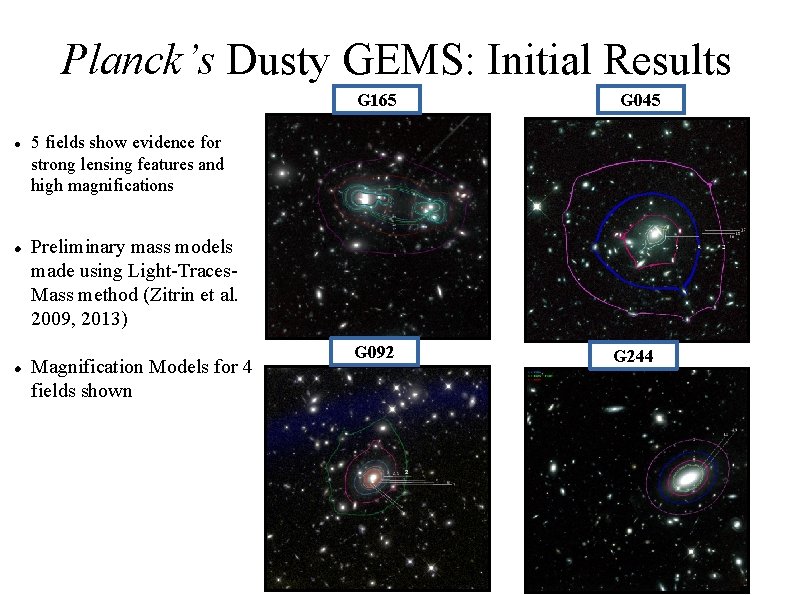
Planck’s Dusty GEMS: Initial Results G 165 G 045 5 fields show evidence for strong lensing features and high magnifications Preliminary mass models made using Light-Traces. Mass method (Zitrin et al. 2009, 2013) Magnification Models for 4 fields shown G 092 G 244
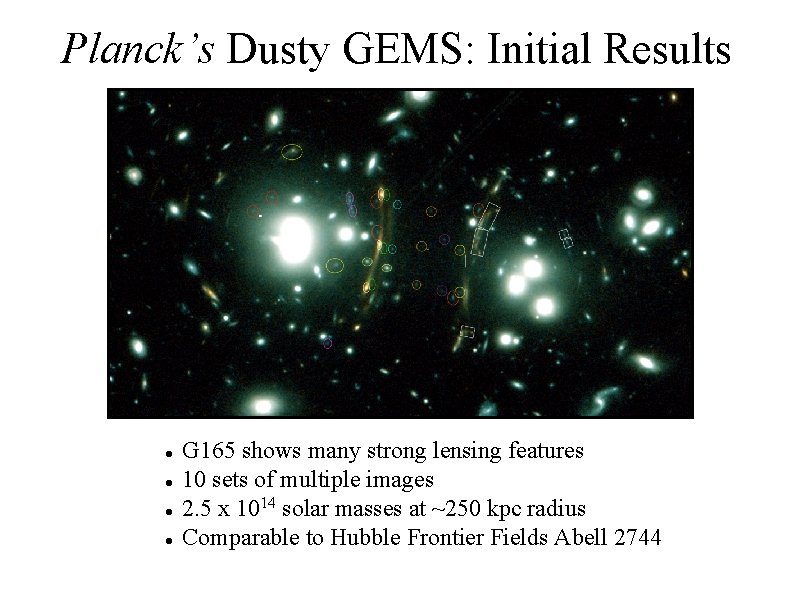
Planck’s Dusty GEMS: Initial Results Before After G 165 shows many strong lensing features 10 sets of multiple images 2. 5 x 10¹⁴ solar masses at ~250 kpc radius Comparable to Hubble Frontier Fields Abell 2744
Planck’s Dusty GEMS: Conclusion ● ● G 165 shows promise for Planck selection method Large Binocular Telescope + Spitzer data coming Improve accuracy and find more arcs Thanks To: – Dr. Brenda Frye – University of Arizona – UA/NASA Space Grant
Planck’s Dusty GEMS: References Canameras, et al. “Planck’s Dusty GEMS: Gravitationally Lensed High. Redshift Galaxies Discovered with the Planck Survey”. Astronomy and Astrophysics, Vol. 581, 2015. Planck Collaboration, et al. “Planck 2015 Results XXVII. The Second Planck Catalog of Sunyaev-Zeldovich Sources”. Astronomy and Astrophysics, Vol. 594, 2015. Qin, Frye, Pascale et al. 2017, APJ, in Preparation. Zitrin, et al. “New Multiple-Lensed Galaxies Identified in ACS/NIC 3 Observations of C 10024+1654 Using an Improved Mass Model”. MNRAS, Vol. 396, 2009