Aldehid dan Keton Pyridoxal phosphate PLP is common


- Slides: 31
Aldehid dan Keton
• Pyridoxal phosphate (PLP) is common coenzyme • Hydrocortisone is steroid hormone secreted by adrenal glands • Penicillin G : an antibiotic
Carbonyl Compounds
Nomenclature of Aldehydes
Naming Aldehydes and Ketones
Nomenclature of Ketones
Naming Aldehydes and Ketones Some common names accepted by IUPAC
Boiling Points • More polar, so higher boiling point than comparable alkane or ether. • Cannot H-bond to each other, so lower boiling point than comparable alcohol.
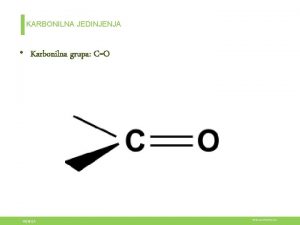
Carbonyl Structure • Carbon is sp 2 hybridized. • C=O bond is shorter, stronger, and more polar than C=C bond in alkenes.
Preparation of Aldehydes and Ketones • Aldehydes from oxidation of primary alcohols using pyridinium chlorochromate (PCC) • Aldehydes from reduction of carboxylic esters using diisobutylaluminum hydride (DIBAH)
Aldehydes and ketones react with nucleophiles to form addition products: nucleophile addition reactions Tetrahedral intermediate Acid catalyst
All carboxylic acid derivatives react by the same general mechanism The tetrahedral intermediate eliminates the weakest base
Nucleophilic Addition Reactions of Aldehydes and Ketones
Nucleophilic Addition of H 2 O: Hydration Aldehydes and ketones react reversibly with water to give 1, 1 -diols, or geminal (gem) diols • Equilibrium favors carbonyl compound for steric reasons with the exception of formaldehyde
Formation of a New Carbon–Carbon Bond Using Grignard Reagents
Reduction by Hydride Ion
Aldehydes and ketones react with a primary amine to form an imine This is a nucleophilic addition–elimination reaction The p. H of the reaction must be controlled
Aldehydes and ketones react with secondary amines to form enamines
Water adds to an aldehyde or ketone to form a hydrate
Addition of an Alcohol to an Aldehyde or a Ketone
Addition of Sulfur Nucleophiles
Oxidation of Aldehydes Tollens Test silver mirror
The reactivity of carbonyl compounds resides in the polarity of the carbonyl group in a nucleophilic acyl substitution reaction
The a-Hydrogen is Acidic the anion is stabilized by resonance
Keto–Enol Tautomerism The enol tautomer can be stabilized by intramolecular hydrogen bonding
One molecule of a carbonyl compound acts as a nucleophile and the other carbonyl compound acts as an electrophile
Ketones are less susceptible than aldehydes to attack by nucleophiles
An aldol addition product loses water to form an aldol condensation product
The Mixed Aldol Addition