
FEATHERSTONE HIGH SCHOOL A Leading Edge School Science
- Slides: 34
FEATHERSTONE HIGH SCHOOL A Leading Edge School Science Department Lesson plan Teacher information Lesson title: Cells Resources/Equipment (e- learning): 1) 2) Provision: 1) EAL: 2) SEN: Role of TA: Technicians list: Predator prey game (worksheet and resources) – 1) optional 2) Interdependence worksheet 3) • 13: 57
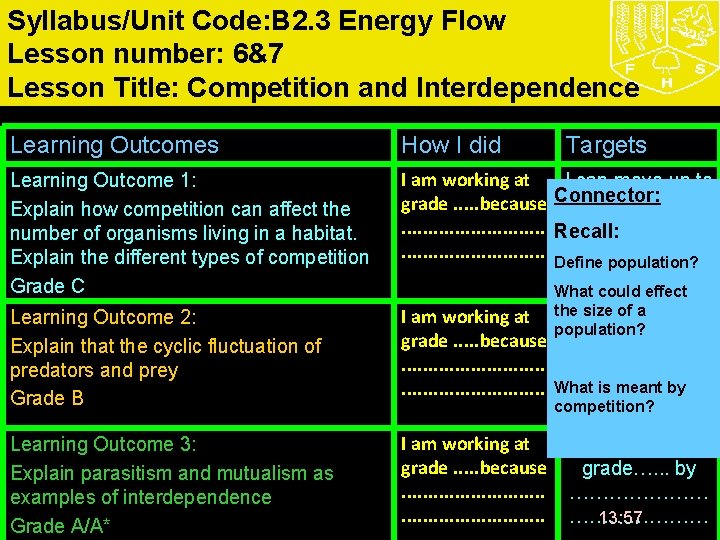
Syllabus/Unit Code: B 2. 3 Energy Flow Lesson number: 6&7 Lesson Title: Competition and Interdependence Learning Outcomes How I did Targets Learning Outcome 1: Explain how competition can affect the number of organisms living in a habitat. Explain the different types of competition Grade C I am working at I can move up to grade. . . because Connector: grade…. . . by. . . . Recall: …………………. . . . Define ………………… population? …… Learning Outcome 2: Explain that the cyclic fluctuation of predators and prey Grade B I am working at grade. . . because. . . . Learning Outcome 3: Explain parasitism and mutualism as examples of interdependence Grade A/A* I am working at I can move up to grade. . . because grade…. . . by. . . . ………………… 13: 57 What could effect the size move of a up I can population? to grade…. . . by ………………… What is meant by ………………… competition? ……
Extended Learning • Due date: • Next lesson • Research Report Criteria (6 marks total = Grade A): • 1) Range of different reliable sources used and references included (books/internet/survey etc), • 2) Information written in own words • 3) Clear and logical structure to research report including pictures/diagrams which have been referenced • 4) No evidence of copy and paste! 13: 57
BIG picture Key Question: what do plants and animals compete for? • What skills will you be developing this lesson? • Literacy- by writing well structured sentences and paragraphs • Personal skills- team work, leadership • Thinking and Learning- organisation, logic, participation, memory, exploration, creativity, judgement, planning, practice. • Quick Discussion: • What do you already know? • Reflection- through self or peer assessment of each Learning Outcome 13: 57
Keywords: • • • Competition Ecological niches Interspecific Intraspecific Population Cyclical fluctuations Mutualism Parasite Predator Prey Population Here are some of the words we will be using this lesson… 1) Put your hand up if there is any key word from the list that you don’t know the meaning of. 13: 57
New Information for Learning Outcome 1 Explore and Discover: • Visual: • Kinaesthetic: 13: 57
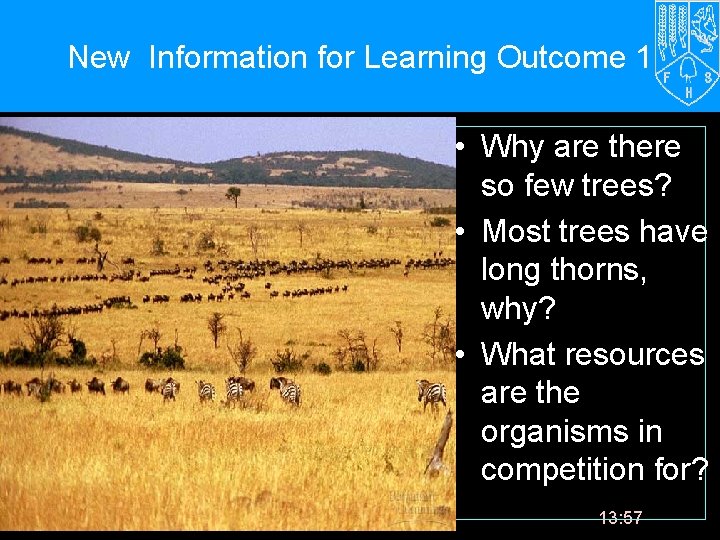
New Information for Learning Outcome 1 • Why are there so few trees? • Most trees have long thorns, why? • What resources are the organisms in competition for? 13: 57
New Information for Learning Outcome 1 • Too dry/hot for most trees. Young trees are grazed down and old trees not replaced. • Thorns stop many of the herbivores eating them. • water, mates, shelter, food, space, 13: 57
New Information for Learning Outcome 1 There is a limited supply of recourses for animals and plants. All living things are in a battle to get material and resources which they need to survive This is known as competition The availability of resources can affect the distribution of an organism Discuss what animals and plants complete for? http: //www. bbc. co. uk/schools/gcsebitesize/science/ 13: 57 ocr_gateway/understanding_environment/interde
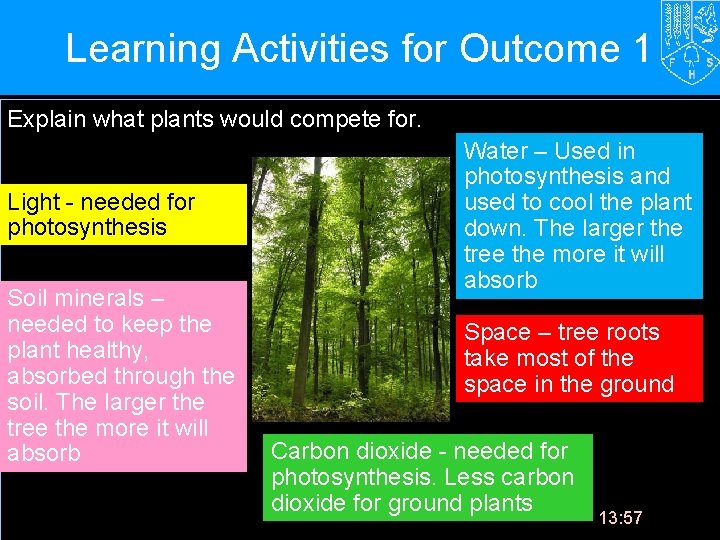
Learning Activities for Outcome 1 Explain what plants would compete for. Light - needed for photosynthesis Soil minerals – needed to keep the plant healthy, absorbed through the soil. The larger the tree the more it will absorb Water – Used in photosynthesis and used to cool the plant down. The larger the tree the more it will absorb Space – tree roots take most of the space in the ground Carbon dioxide - needed for photosynthesis. Less carbon dioxide for ground plants 13: 57
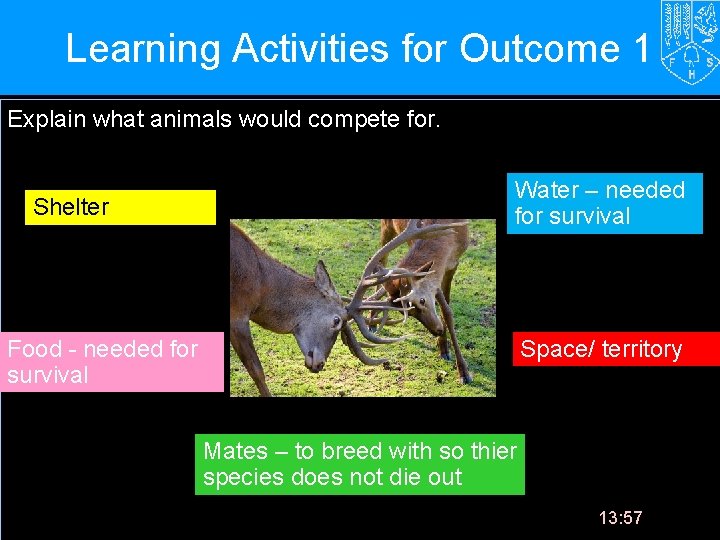
Learning Activities for Outcome 1 Explain what animals would compete for. Shelter Water – needed for survival Food - needed for survival Space/ territory Mates – to breed with so thier species does not die out 13: 57
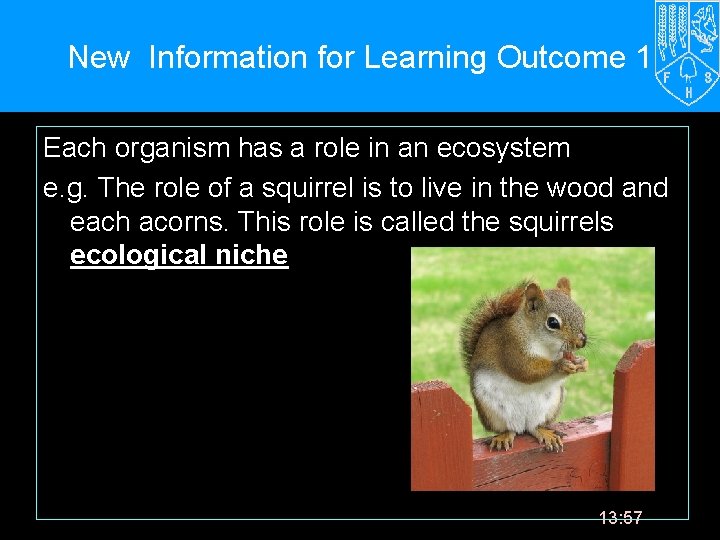
New Information for Learning Outcome 1 Each organism has a role in an ecosystem e. g. The role of a squirrel is to live in the wood and each acorns. This role is called the squirrels ecological niche 13: 57
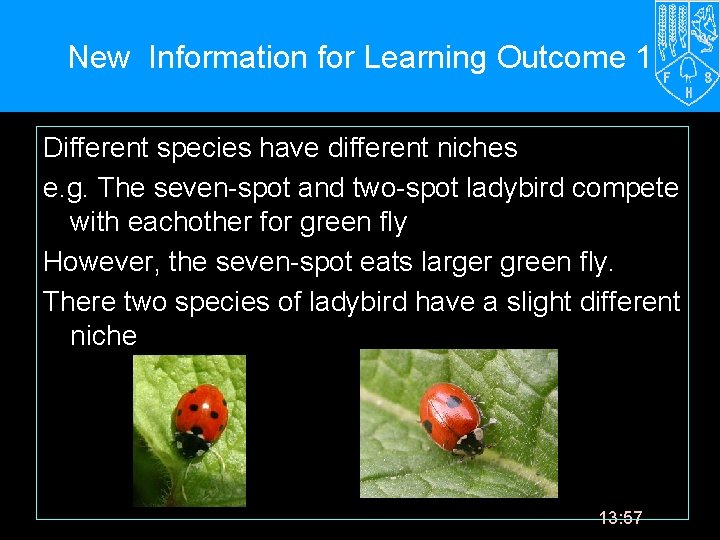
New Information for Learning Outcome 1 Different species have different niches e. g. The seven-spot and two-spot ladybird compete with eachother for green fly However, the seven-spot eats larger green fly. There two species of ladybird have a slight different niche 13: 57
New Information for Learning Outcome 1 Types of competition Inter species/ inter specific = different species (red and grey squirrel or a zebra and lion) Intra species/ intra specific = within same species (two troops of baboons or two grey squirrel) The same applies to species or a group of similar animals and plants. Organisms belong to a Species when they interbreed and give birth to fertile Offspring. 13: 57
Learning Activities for Outcome 1 Complete worksheet B 2 d: Interdependence 13: 57
Keywords: Demonstrate your Learning for Outcome 1 Create Evaluate (A) How is the niche of a giraffe and zebra different, which allows them both to survive together on the African savannah Apply (C) What is meant by the term ecological niche 13: 57 Which Evaluate task(s) will you choose Analyseto complete? Try to Apply target a grade higher Understand than your current Remember grade. Analyse (B) Explain why introducing the grey squirrel to Britain caused a fall in the red squirrel population Analyse (B) What would happen to the ground plants in w woodland when a large tree dies and falls?
Learning Outcome 1: Review Go back to your Learning Outcome grid and fill out the ‘How I did’ and the ‘Targets’ column. Learning Outcome How I did Targets I am working at grade. . . because. . . . I can move up to grade…. . . by …………………… Learning Outcome 1: Grade C 13: 58
New Information for Learning Outcome 2 Explore and Discover: • Visual: • HTTP: //WWW. BBC. CO. UK/LEARNINGZONE/CLIPS/PREDATOR-PREYRELATIONSHIPS-BARN-OWLS/202. HTML 13: 58
Learning activity for Outcome 2 Define the following and give examples of each: Predator Prey Scavanger Predators are hunters that kill and eat other animals The animals that are hunted are called prey. Scavengers are animals which eat the ‘left overs’ of animals killed by predators. 13: 58
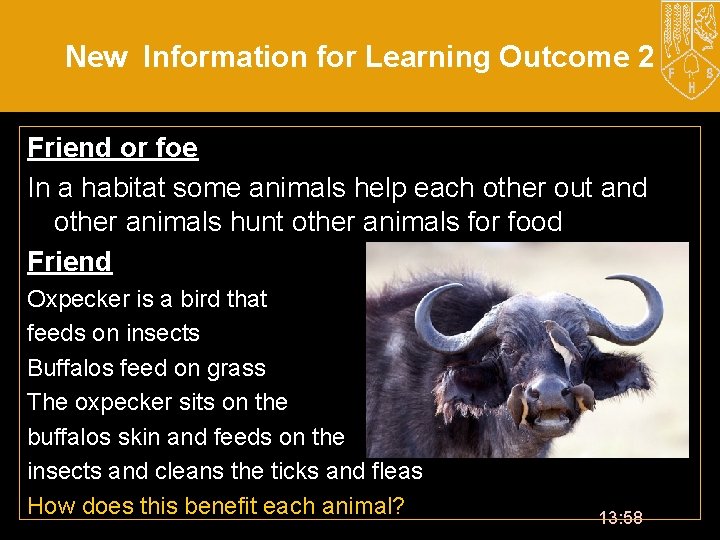
New Information for Learning Outcome 2 Friend or foe In a habitat some animals help each other out and other animals hunt other animals for food Friend Oxpecker is a bird that feeds on insects Buffalos feed on grass The oxpecker sits on the buffalos skin and feeds on the insects and cleans the ticks and fleas How does this benefit each animal? 13: 58
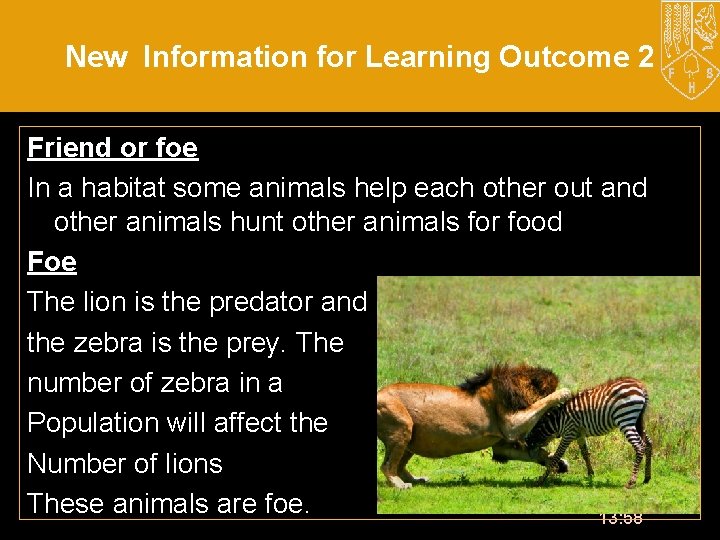
New Information for Learning Outcome 2 Friend or foe In a habitat some animals help each other out and other animals hunt other animals for food Foe The lion is the predator and the zebra is the prey. The number of zebra in a Population will affect the Number of lions These animals are foe. 13: 58
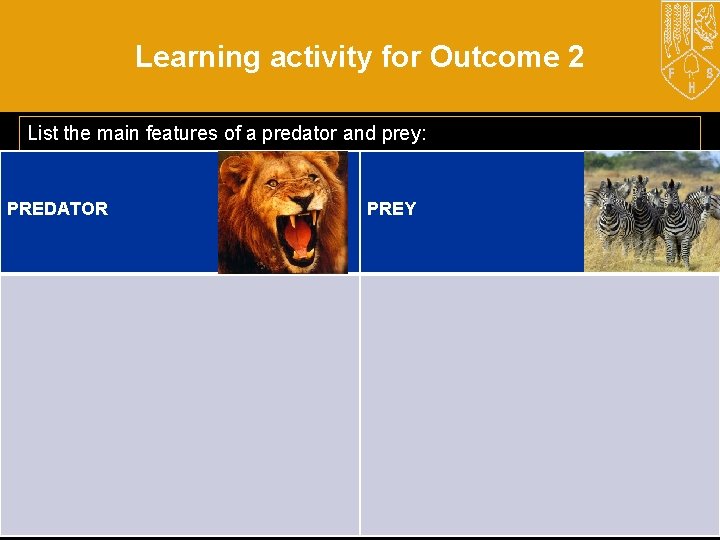
Learning activity for Outcome 2 List the main features of a predator and prey: PREDATOR PREY 13: 58
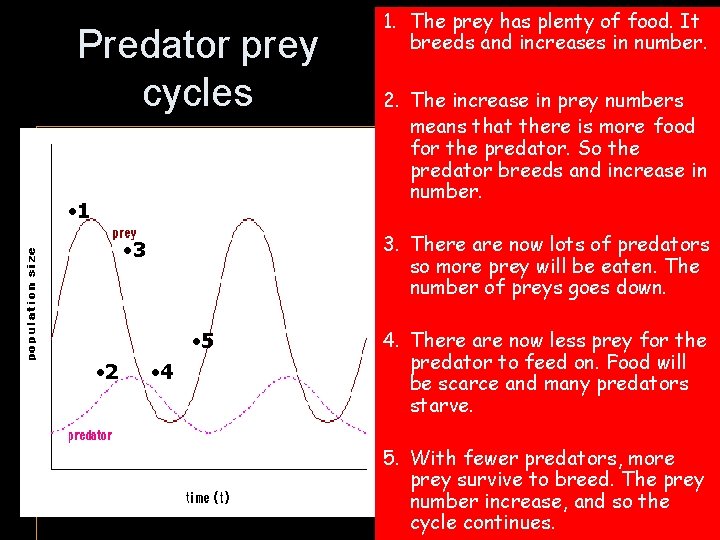
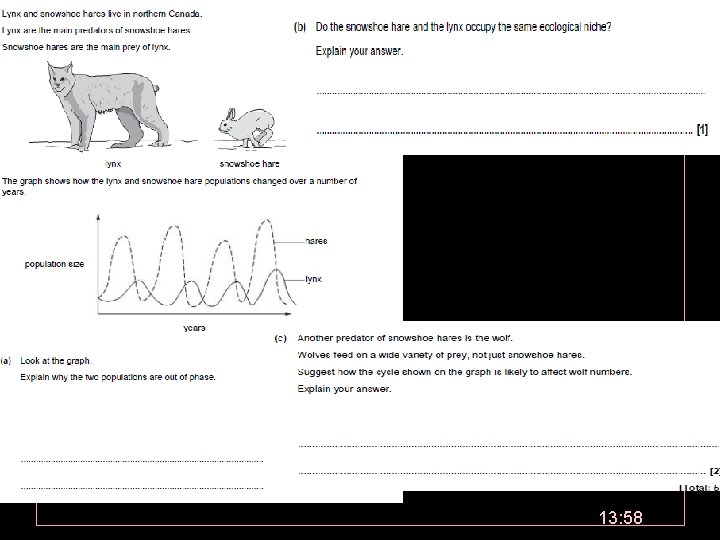
Predator prey cycles • 1 2. The increase in prey numbers means that there is more food for the predator. So the predator breeds and increase in number. 3. There are now lots of predators so more prey will be eaten. The number of preys goes down. • 3 • 5 • 2 1. The prey has plenty of food. It breeds and increases in number. • 4 4. There are now less prey for the predator to feed on. Food will be scarce and many predators starve. 5. With fewer predators, more prey survive to breed. The prey number increase, and so the cycle continues.
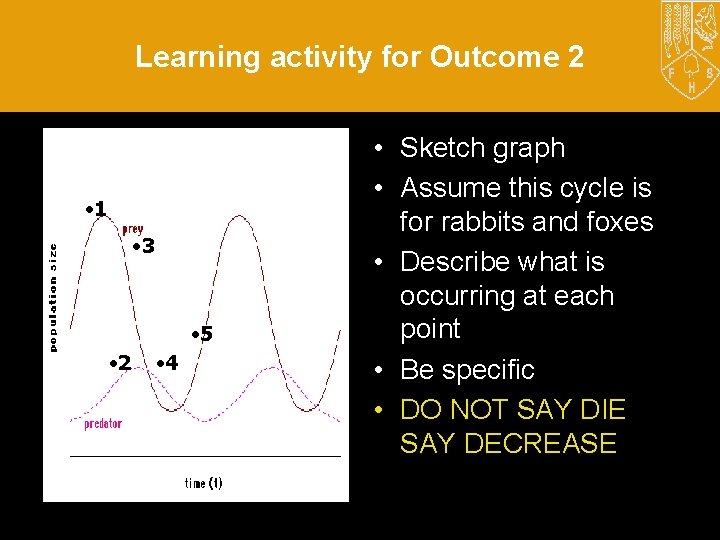
Learning activity for Outcome 2 • 1 • 3 • 5 • 2 • 4 • Sketch graph • Assume this cycle is for rabbits and foxes • Describe what is occurring at each point • Be specific • DO NOT SAY DIE SAY DECREASE
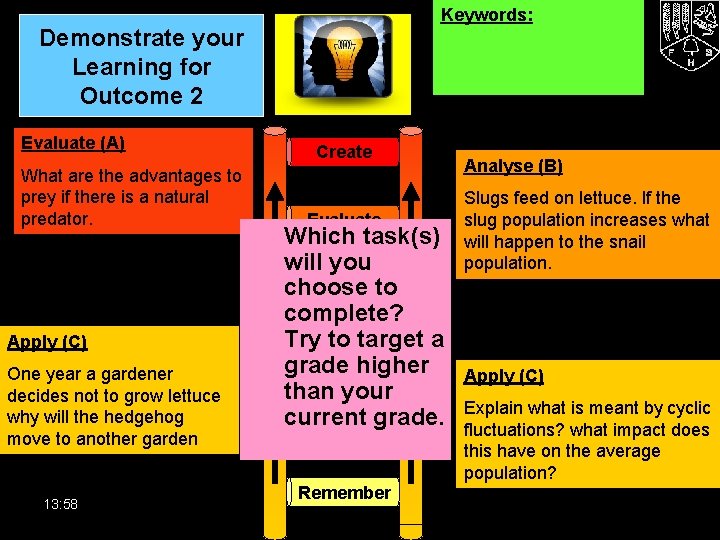
Keywords: Demonstrate your Learning for Outcome 2 Evaluate (A) What are the advantages to prey if there is a natural predator. Apply (C) One year a gardener decides not to grow lettuce why will the hedgehog move to another garden 13: 58 Create Evaluate Which task(s) will you Analyseto choose complete? Try to target a Apply grade higher than your current grade. Understand Remember Analyse (B) Slugs feed on lettuce. If the slug population increases what will happen to the snail population. Apply (C) Explain what is meant by cyclic fluctuations? what impact does this have on the average population?
Learning Outcome 2: Review Go back to your Learning Outcome grid and fill out the ‘How I did’ and the ‘Targets’ column. Learning Outcome How I did Targets I am working at grade. . . because. . . . I can move up to grade…. . . by …………………… Learning Outcome 2: Grade B 13: 58
New Information for Learning Outcome 3 Other types of relationships: Mutalism http: //www. youtube. com/watch? v=z 3 b. Wql. PLp. Mg http: //www. youtube. com/watch? v=LVRL_MIr 7 Rs 13: 58
Learning Activities for Outcome 3 Other types of relationships: Mutalism- where both organisms benefit http: //www. youtube. com/watch? v=z 3 b. Wql. PLp. Mg http: //www. youtube. com/watch? v=LVRL_MIr 7 Rs Parasitism – where one organism benefits at the cost of another http: //www. youtube. com/watch? v=_-9 Yq 9 CEqkw 13: 58
Learning Activities for Outcome 3 Tape worm is a parasite, it lives in the digestive system of other animals including humans. The tapeworm feed off the host (human) so it can grow It is unlikely to kill as it would die but can cause weight loss 13: 58
Learning Activities for Outcome 3 Explain mutualism and parasitism using examples. Extension: Fleas are parasites which live on the skin of other animals. Explain how they survive? 13: 58
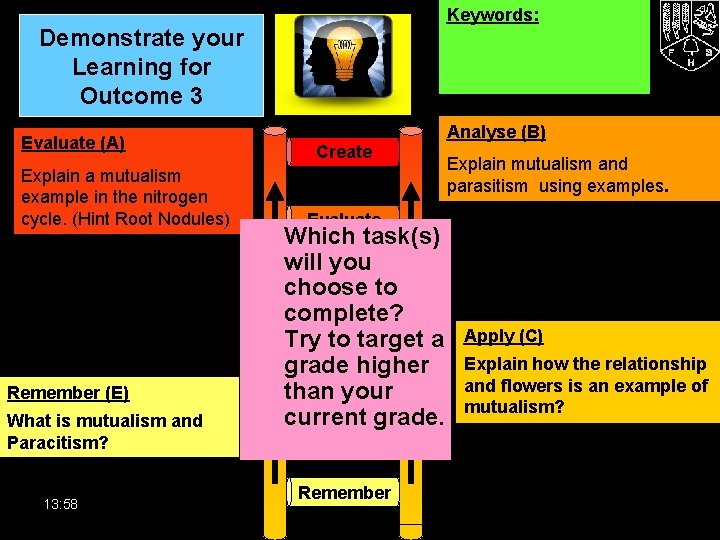
Keywords: Demonstrate your Learning for Outcome 3 Evaluate (A) Explain a mutualism example in the nitrogen cycle. (Hint Root Nodules) Remember (E) What is mutualism and Paracitism? 13: 58 Analyse (B) Create Explain mutualism and parasitism using examples. Evaluate Which task(s) will you Analyseto choose complete? Try to target a Apply grade higher than your current grade. Understand Remember Apply (C) Explain how the relationship and flowers is an example of mutualism?
Learning Outcome 3: Review Go back to your Learning Outcome grid and fill out the ‘How I did’ and the ‘Targets’ column. Learning Outcomes How I did Targets I am working at grade. . . because. . . . I can move up to grade…. . . by …………………… Learning Outcome 3: Grade A/A* 13: 58
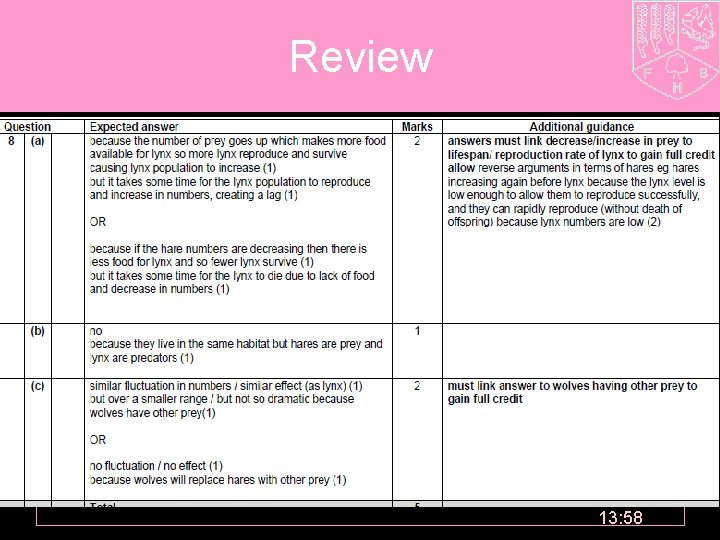
Review • If this is the answer what is the question? 13: 58
Review • If this is the answer what is the question? 13: 58