AIR SelfDetermination Scale Center for Change in Transition


- Slides: 36
AIR Self-Determination Scale Center for Change in Transition Services Improving post-school outcomes for students with disabilities in Washington state www. seattleu. edu/ccts Unless otherwise noted, this presentation by Center for Change in Transition Services at Seattle University is licensed under CC BY 4. 0. Center for Change in Transition Services
Let’s Get Started! • Welcome • Discuss the importance of self-determination • Describe the purpose, measures, and results of the AIR Self-Determination Scale • Provide instructions for use and interpretation of the results Unless otherwise noted, this presentation by Center for Change in Transition Services at Seattle University is licensed under CC BY 4. 0. Center for Change in Transition Services
OSPI State Needs Projects There are five state needs projects that are funded with IDEA state discretionary dollars. These projects collectively provide: • Professional development at little to no cost to districts or participants (clock hours/credit hours available) • Technical Assistance with IEP development, compliance, evaluation, planning, learning interventions, and assessment for students with disabilities • Consultation and training for parents and families Unless otherwise noted, this presentation by Center for Change in Transition Services at Seattle University is licensed under CC BY 4. 0. Center for Change in Transition Services
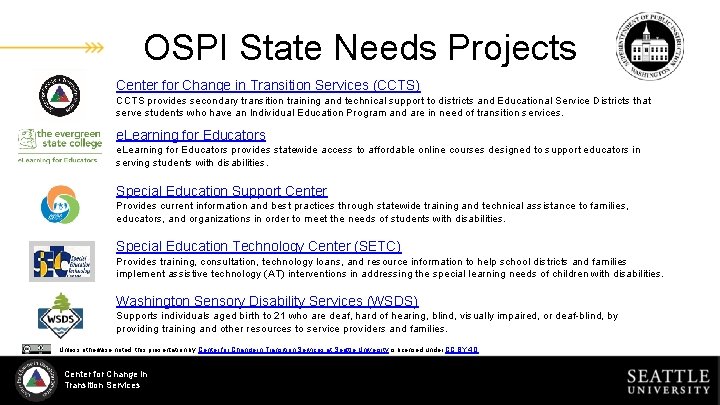
OSPI State Needs Projects Center for Change in Transition Services (CCTS) CCTS provides secondary transition training and technical support to districts and Educational Service Districts that serve students who have an Individual Education Program and are in need of transition services. e. Learning for Educators provides statewide access to affordable online courses designed to support educators in serving students with disabilities. Special Education Support Center Provides current information and best practices through statewide training and technical assistance to families, educators, and organizations in order to meet the needs of students with disabilities. Special Education Technology Center (SETC) Provides training, consultation, technology loans, and resource information to help school districts and families implement assistive technology (AT) interventions in addressing the special learning needs of children with disabilities. Washington Sensory Disability Services (WSDS) Supports individuals aged birth to 21 who are deaf, hard of hearing, blind, visually impaired, or deaf-blind, by providing training and other resources to service providers and families. Unless otherwise noted, this presentation by Center for Change in Transition Services at Seattle University is licensed under CC BY 4. 0. Center for Change in Transition Services
Center for Change in Transition Services • Improving post-school outcomes for students with disabilities. • CCTS provides secondary transition training and technical assistance to Washington state partnering agencies, Educational Service Districts (ESDs), Local Educational Agencies (LEAs), and public schools that serve high school-age students. • CCTS has responsibility for analyzing the district-reported post-school outcome data, using the data to make informed decisions related to training and technical assistance development needs, and submitting the results of the data analysis to OSPI to be included in the state’s Annual Performance Report. Unless otherwise noted, this presentation by Center for Change in Transition Services at Seattle University is licensed under CC BY 4. 0. Center for Change in Transition Services
Collaboration with DVR • Seattle University’s Center for Change in Transition Services (CCTS) supports the Division of Vocational Rehabilitation (DVR) to improve the transition outcomes of students with disabilities from school to postsecondary education or employment. • In collaboration with DVR, CCTS will facilitate partnerships with the Educational Service Districts (ESDs) and the Local Education Agencies (LEAs; i. e. , school districts) to provide activities that address the authorized activities as outlined in Title IV of WIOA, as well as to support and enhance the required activities listed in the WIOA Scope of Work. Unless otherwise noted, this presentation by Center for Change in Transition Services at Seattle University is licensed under CC BY 4. 0. Center for Change in Transition Services
Objectives for Today After today’s session, participants will: • Be able to define self-determination and its importance • Be able to administer and score the American Institute for Research (AIR) Self-Determination Assessments • Be able to write goals for increasing self-determination, capacity, and opportunity • Take a self-determination survey Unless otherwise noted, this presentation by Center for Change in Transition Services at Seattle University is licensed under CC BY 4. 0. Center for Change in Transition Services
What is Self-Determination? “Quite simply, being self-determined means making things happen in a person’s own life, instead of having others do things to, or for them. People who are self-determined know what they want and how to get it. They choose and set goals, then work to reach them. They advocate on their own behalf, and are involved in solving problems and making decisions about their lives. They don’t have to do everything for themselves, but instead, they make or cause things to happen in their lives that improve the quality of their lives. ” (Palmer & Wehmeyer, "What is Self-Determination and Why Is It Important? ") Unless otherwise noted, this presentation by Center for Change in Transition Services at Seattle University is licensed under CC BY 4. 0. Center for Change in Transition Services
Self-Determined Self-determined people can: – – – Know and express needs, interests, and abilities Set appropriate goals and expectations Make choices and plans Follow through with actions Change course or adjust when necessary (Wolman, Campeau, Du. Bois, Mithaug, & Stolarski, "AIR Self-Determination Scale and User Guide", 1994, p. 5) Unless otherwise noted, this presentation by Center for Change in Transition Services at Seattle University is licensed under CC BY 4. 0. Center for Change in Transition Services
Why is Self-Determination Important? • Being more self-determined enables people to have more of a voice in living in their own communities. • Research shows that people who are more self-determined have higher rates of employment and earn more money, as well as having better benefits like vacation, sick leave, and health care. • Self-determination means making things happen in your own life, instead of others doing things for you. But perhaps the most important supports a person can have to live a self-determined life are friends and family members. (Palmer & Wehmeyer) Unless otherwise noted, this presentation by Center for Change in Transition Services at Seattle University is licensed under CC BY 4. 0. Center for Change in Transition Services
Why is Self-Determination Important? • Self-determined people make choices about their behaviors and actions to care for their health and lead healthy lifestyles. • People who are self-determined advocate for themselves and others. (Palmer & Wehmeyer) Unless otherwise noted, this presentation by Center for Change in Transition Services at Seattle University is licensed under CC BY 4. 0. Center for Change in Transition Services
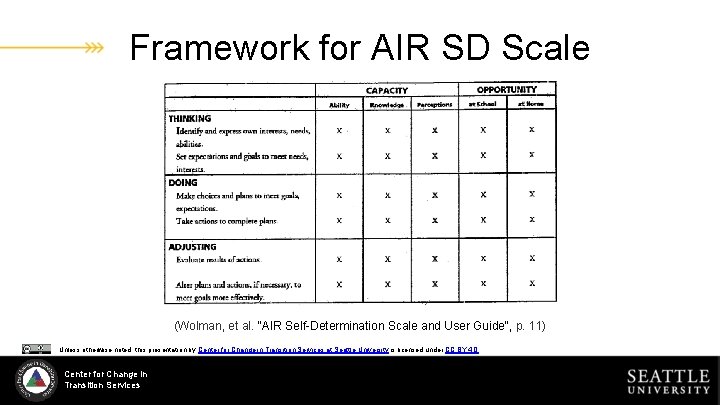
AIR Self-Determination Scale The AIR Self-Determination Scale focuses on two main components: 1. Capacity refers to the knowledge, abilities, and perceptions which allow the student to be self-determined. 2. Opportunity refers to the student's chances to use their knowledge and abilities. The AIR Self-Determination Scale is available free of charge in a variety of forms: student (in English, French, and Spanish), parent, and educator. ("AIR Self-Determination Assessments", 2017) Unless otherwise noted, this presentation by Center for Change in Transition Services at Seattle University is licensed under CC BY 4. 0. Center for Change in Transition Services
AIR Self-Determination Scale Purpose: • Assess and develop a profile of self-determination (SD) • Identify areas of strength and needs • Identify educational goals • Develop strategies to build capacity (Wolman, et al. "AIR Self-Determination Scale and User Guide", p. 9) Unless otherwise noted, this presentation by Center for Change in Transition Services at Seattle University is licensed under CC BY 4. 0. Center for Change in Transition Services
SD process is broken down • Thinking – Identify and express own needs, interests, and abilities – Set expectations and goals • Doing – Make choices and plans – Take actions • Adjusting – Evaluate outcomes – Alter plans and actions (Wolman, et al. "AIR Self-Determination Scale and User Guide", p. 10) Unless otherwise noted, this presentation by Center for Change in Transition Services at Seattle University is licensed under CC BY 4. 0. Center for Change in Transition Services
Framework for AIR SD Scale (Wolman, et al. "AIR Self-Determination Scale and User Guide", p. 11) Unless otherwise noted, this presentation by Center for Change in Transition Services at Seattle University is licensed under CC BY 4. 0. Center for Change in Transition Services
Capacity - Ability Beyond knowledge comes ability: – – Act upon the knowledge to set goals Make choices, decisions, and plans Follow up with actions designed to meet goals Recognize when they need assistance (Wolman, et al. "AIR Self-Determination Scale and User Guide", p. 13) Unless otherwise noted, this presentation by Center for Change in Transition Services at Seattle University is licensed under CC BY 4. 0. Center for Change in Transition Services
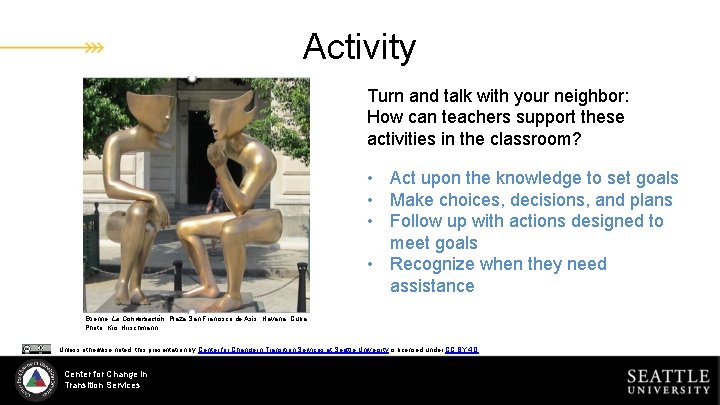
Activity Turn and talk with your neighbor: How can teachers support these activities in the classroom? • Act upon the knowledge to set goals • Make choices, decisions, and plans • Follow up with actions designed to meet goals • Recognize when they need assistance Etienne. La Conversación. Plaza San Francisco de Asís, Havana, Cuba. Photo: Kris Hirschmann. Unless otherwise noted, this presentation by Center for Change in Transition Services at Seattle University is licensed under CC BY 4. 0. Center for Change in Transition Services
Capacity - Knowledge Level of understanding the student has about SD and the behaviors it requires: – – Understanding own needs, interests, abilities, and limitations How to set goals, make choices and plans to reach the goals Importance of taking action How to evaluate the result of the actions (Wolman, et al. "AIR Self-Determination Scale and User Guide", p. 11 -12) Unless otherwise noted, this presentation by Center for Change in Transition Services at Seattle University is licensed under CC BY 4. 0. Center for Change in Transition Services
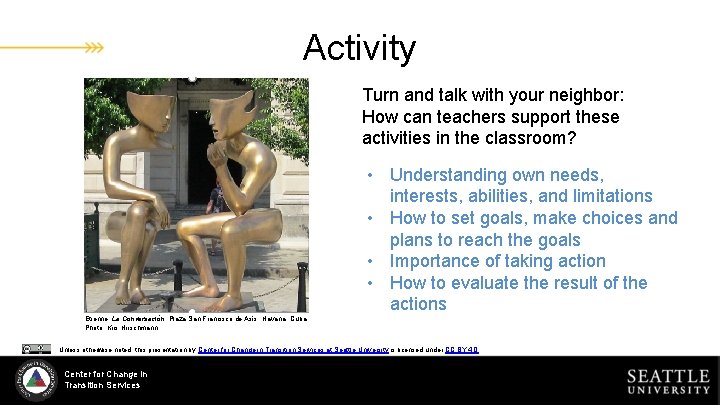
Activity Turn and talk with your neighbor: How can teachers support these activities in the classroom? • Understanding own needs, interests, abilities, and limitations • How to set goals, make choices and plans to reach the goals • Importance of taking action • How to evaluate the result of the actions Etienne. La Conversación. Plaza San Francisco de Asís, Havana, Cuba. Photo: Kris Hirschmann. Unless otherwise noted, this presentation by Center for Change in Transition Services at Seattle University is licensed under CC BY 4. 0. Center for Change in Transition Services
Capacity - Perceptions are based on behavioral and cognitive experiences – – Feel positively about interests, needs, and abilities Be motivated to set personal goals Be optimistic about achievement Be willing to take risks (Wolman, et al. "AIR Self-Determination Scale and User Guide", p. 15) Unless otherwise noted, this presentation by Center for Change in Transition Services at Seattle University is licensed under CC BY 4. 0. Center for Change in Transition Services
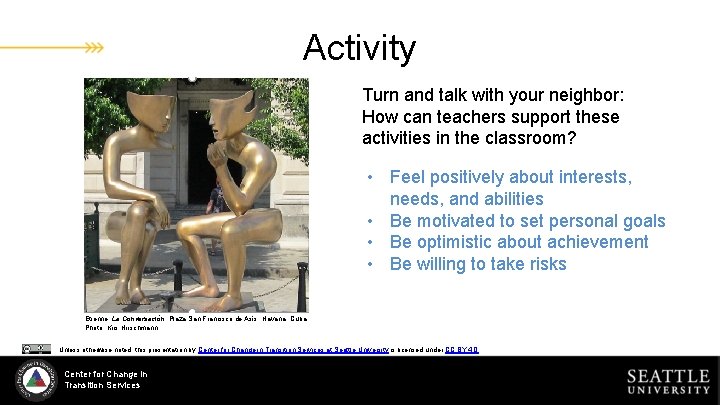
Activity Turn and talk with your neighbor: How can teachers support these activities in the classroom? • Feel positively about interests, needs, and abilities • Be motivated to set personal goals • Be optimistic about achievement • Be willing to take risks Etienne. La Conversación. Plaza San Francisco de Asís, Havana, Cuba. Photo: Kris Hirschmann. Unless otherwise noted, this presentation by Center for Change in Transition Services at Seattle University is licensed under CC BY 4. 0. Center for Change in Transition Services
Capacity – Opportunities Students must be given the opportunity to learn and practice these skills: – Provide an environment that promotes and supports student’s self-determination – Create linkages in the community for students – Encourage families to promote self-determination in the home (Wolman, et al. "AIR Self-Determination Scale and User Guide", p. 17) Unless otherwise noted, this presentation by Center for Change in Transition Services at Seattle University is licensed under CC BY 4. 0. Center for Change in Transition Services
Completion of the Profiles • Educator form: for special education teachers to use with other IEP team members, classroom teachers, rehabilitation counselors, or other educators • Student form: to use with students who have the requisite reading and comprehension skills • Parent form: to use with parents who could benefit from considering the self-determination skills of their children (Wolman, et al. "AIR Self-Determination Scale and User Guide", p. 21) Unless otherwise noted, this presentation by Center for Change in Transition Services at Seattle University is licensed under CC BY 4. 0. Center for Change in Transition Services
Educator • Educator form has 5 areas: – – – Knowledge of SD Ability to perform SD behaviors Perception of knowledge and abilities Opportunities to perform SD at school Opportunities to perform SD at home. • 6 questions in each area • 5 -point scale (never, almost never, sometimes, almost always, and always) Unless otherwise noted, this presentation by Center for Change in Transition Services at Seattle University is licensed under CC BY 4. 0. Center for Change in Transition Services
Student • Student form has 4 areas and changes the wording to: – – “What I do” “How I feel” “What happens at school” “What happens at home” • 6 questions in each area • 5 -point scale (never, almost never, sometimes, almost always, and always) Unless otherwise noted, this presentation by Center for Change in Transition Services at Seattle University is licensed under CC BY 4. 0. Center for Change in Transition Services
Family • Parent form has 3 areas and changes the wording of capacities to: – “Things my child does” – “What happens at school” – “What happens at home” • 6 questions in each area • 5 -point scale (never, almost never, sometimes, almost always, and always) Unless otherwise noted, this presentation by Center for Change in Transition Services at Seattle University is licensed under CC BY 4. 0. Center for Change in Transition Services
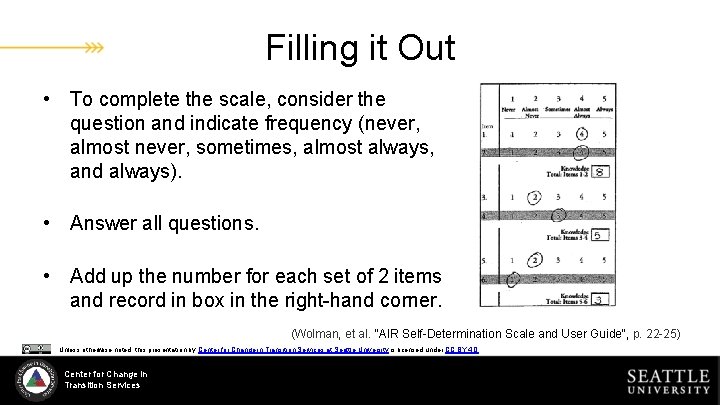
Filling it Out • To complete the scale, consider the question and indicate frequency (never, almost never, sometimes, almost always, and always). • Answer all questions. • Add up the number for each set of 2 items and record in box in the right-hand corner. (Wolman, et al. "AIR Self-Determination Scale and User Guide", p. 22 -25) Unless otherwise noted, this presentation by Center for Change in Transition Services at Seattle University is licensed under CC BY 4. 0. Center for Change in Transition Services
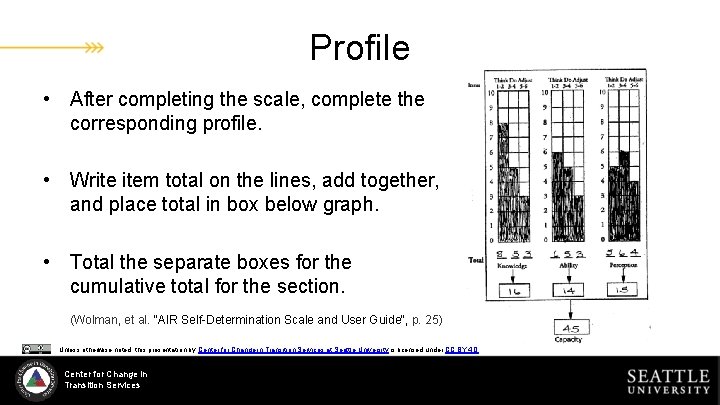
Profile • After completing the scale, complete the corresponding profile. • Write item total on the lines, add together, and place total in box below graph. • Total the separate boxes for the cumulative total for the section. (Wolman, et al. "AIR Self-Determination Scale and User Guide", p. 25) Unless otherwise noted, this presentation by Center for Change in Transition Services at Seattle University is licensed under CC BY 4. 0. Center for Change in Transition Services
Take a Survey • • Take the student survey Answer it as yourself Score and fill out the profile form Discuss how you will use this with your students/clients Unless otherwise noted, this presentation by Center for Change in Transition Services at Seattle University is licensed under CC BY 4. 0. Center for Change in Transition Services
Translating the Data • The numbers are not “magic” • They represent a basis for comparison – – Pre/post test analysis Comparison to other’s input Individual question response review Comparison of categories such as capacity and opportunity (Wolman, et al. "AIR Self-Determination Scale and User Guide", p. 29) Unless otherwise noted, this presentation by Center for Change in Transition Services at Seattle University is licensed under CC BY 4. 0. Center for Change in Transition Services
Translating the Data • Information can be used to: – – Create goals Communicate with families Collaborate with others who work with the student Create opportunities to expand student growth in the areas surveyed (Wolman, et al. "AIR Self-Determination Scale and User Guide", p. 29) Unless otherwise noted, this presentation by Center for Change in Transition Services at Seattle University is licensed under CC BY 4. 0. Center for Change in Transition Services
Bank of Goal Suggestions • Educational goals that correspond to the profile are listed in the User Guide pages 32 and 33. • AND, there are examples of activities for elementary, middle, and high school students (pages 36 and 37) (Wolman, et al. "AIR Self-Determination Scale and User Guide", p. 32 -33, 36 -37) Unless otherwise noted, this presentation by Center for Change in Transition Services at Seattle University is licensed under CC BY 4. 0. Center for Change in Transition Services
CCTS Contact Kris Hirschmann hirschmk@seattleu. edu ccts@seattleu. edu 206 -296 -6494 www. seattleu. edu/ccts www. facebook. com/waccts www. twitter. com/waccts www. pinterest. com/waccts/ Unless otherwise noted, this presentation by Center for Change in Transition Services at Seattle University is licensed under CC BY 4. 0. Center for Change in Transition Services
References AIR Self-Determination Assessments (2017, June 16). Retrieved from https: //www. ou. edu/content/education/centers-and-partnerships/zarrow/self-determination-assessment-tools/airself-determination-assessment. html Palmer, S. , & Wehmeyer, M. (n. d. ). What is Self-Determination and Why Is It Important? [PDF]. National Gateway to Self-Determination Project. http: //buildingalife. ku. edu/sites/default/files/Self-Determination_Wehmeyer. pdf Wolman, J. M. , Campeau, P. I. , Du. Bois, P. A. , Mithaug, D. E. , & Stolarski, V. S. (1994, December). AIR Self. Determination Scale and User Guide [PDF]. American Institutes for Research and Teachers College, Columbia University. https: //www. ou. edu/content/dam/Education/documents/miscellaneous/air-self-determination-userguide. pdf Unless otherwise noted, this presentation by Center for Change in Transition Services at Seattle University is licensed under CC BY 4. 0. Center for Change in Transition Services
Additional Resources Bremer, C. D. , Kachgal, M. , & Schoeller, K. (2003, April). Self-Determination: Supporting Successful Transition. Retrieved from http: //www. ncset. org/publications/viewdesc. asp? id=962 Self-Determination Inventory: Self-Report (SDI: SR) Student Report Guide. Lawrence, KS: Kansas University Center on Developmental Disabilities. Retrieved from http: //www. selfdetermination. dept. ku. edu/wpcontent/uploads/2016/03/SDI-Student-Report-Guide_small. Final_. pdf Shogren, K. A. , Wehmeyer, M. L. , Burke, K. M. , & Palmer, S. B. (2017). The Self-Determination Learning Model of Instruction: Teacher’s Guide [PDF]. Lawrence, KS: Kansas University Beach Center on Disability and Kansas University Center on Developmental Disabilities. Retrieved from http: //www. selfdetermination. dept. ku. edu/wpcontent/uploads/2017/04/SDLMI-Teachers-Guide_4 -2017. pdf Center for Change in Transition Services
Disclaimer Training provided today is meant to supplement and not supplant reading bulletins and accompanying documents; guidance from the U. S. Department of Education; chapter 392 -172 A WAC; Part 300 of the federal regulations; and, the Individuals with Disabilities Act. This presentation and/or materials should be viewed and applied by users according to their specific needs. The presentation should be used as guidance and is not intended as legal advice. Unless otherwise noted, this presentation by Center for Change in Transition Services at Seattle University is licensed under CC BY 4. 0. Center for Change in Transition Services