
Burger Transition Center Tier 3 Wraparound a summary
Burger Transition Center Tier 3 Wrap-around a summary and case studies Center-PBIS forum 3/22/16 Derek Nowka Behavior Specialist Burger Transition Center nowkad@gardencityschools. com
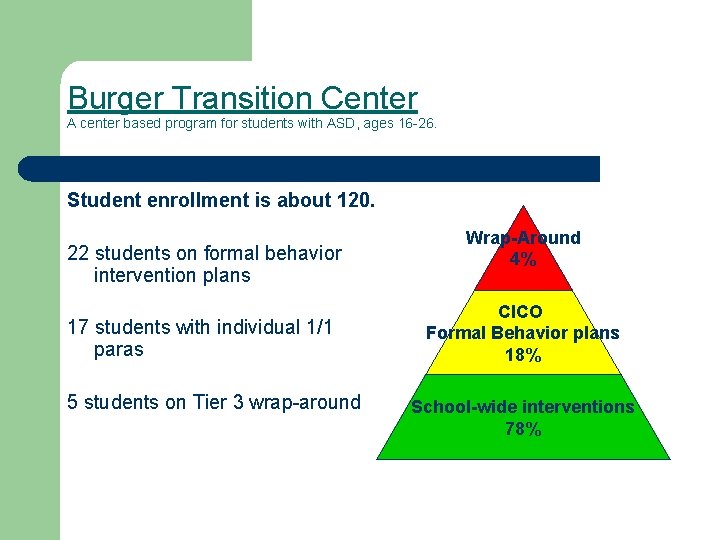
Burger Transition Center A center based program for students with ASD, ages 16 -26. Student enrollment is about 120. 22 students on formal behavior intervention plans 17 students with individual 1/1 paras 5 students on Tier 3 wrap-around Wrap-Around 4% CICO Formal Behavior plans 18% School-wide interventions 78%
The BTC wrap-around l Wraparound is a philosophy of care with defined planning process used to build constructive relationships and support networks among students with significant challenges and their families. l Wraparound is based on the belief that services and supports should be flexibly arranged to meet the unique needs of the students and their families. In other words, wrap-around is fluid and can be modified frequently.

How does wrap-around differ from other Tier 3 interventions & why use it? What made us start using Tier 3 wrap-around? l We had a student whose behavior was very dangerous l Lesser restrictive interventions had been tried, but proved unsuccessful l We were planning and making decisions “in a vacuum” l We needed an outside perspective. l The school team was highly concerned that students and staff members would be injured.
Case Study 1 Our first true wrap-around l l 19 year-old student (15 years old at the time the process began) Fully implemented wrap-around has been in place for the past 3 years. Members of our team – – – – Parents BTC staff (teacher, paras, admin. , SSW, speech, OT, behavior specialist). Personal agent (CLS) Psychologist Resident district representatives RESA behavior consultant We meet monthly to review data, programming, make changes to the plan. We also assign tasks/responsibilities to members before we adjourn each meeting.

Results 1 – What we can do as a Team!
Case Study 2 “We’re in it together” l l Student begins attending BTC after being out of school for 1 year. Dangerous behaviors begin to present around the start of the second semester. – – – Multiple interventions are implemented without much success. Relationship between school and home starts to become tense. Accusations are being made, and staff members are starting to get “burned out”
Results 2 The process is ongoing l A wrap-around team is established. Although meetings don’t occur monthly, and there aren’t many agency supports, some of the benefits from this wrap-around have been: – Through the wrap-around process, it was agreed that the student needed a 1/1 para, which has been in place for the past 2 years. – The BTC team meets weekly to review programming, and all incident reports for this student. – An equal share of responsibility is spread across many team members. The teacher is not alone, on an island.
Case Study 3 Wrap-around as part of our PBIS model l Student has a history of aggression, and has not attended school since September. Was receiving instruction on a homebound basis, through Skype. Student begins attending BTC this past January. The wrap-around process is recommended to the parents before the student even starts attending. – – – Parent BTC staff (teacher, paras, admin. , SSW, speech, OT, behavior specialist). Resident district representatives Therapist RESA behavior consultant
Results 3 l Student began on a ½ day schedule with an individual teacher and para. l Zero incidents of aggression. l Student is making friends, and participating in social activities. l Student has advocated for an increase in his day; A change that was made at the last wrap-around, in which he participated.
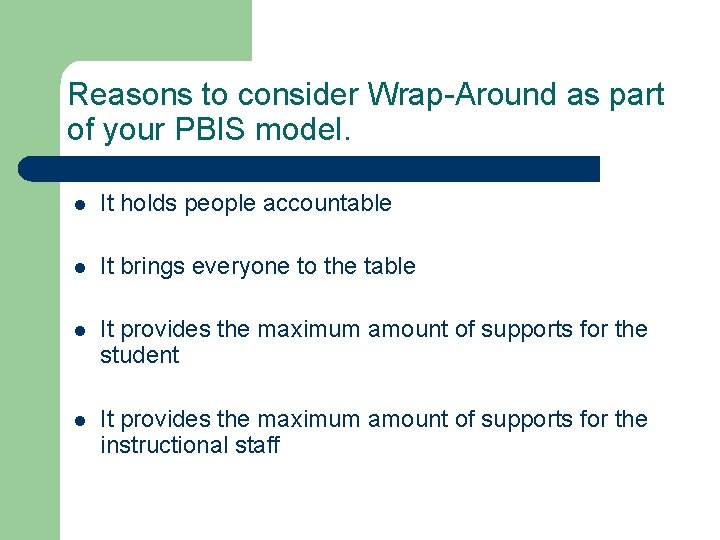
Reasons to consider Wrap-Around as part of your PBIS model. l It holds people accountable l It brings everyone to the table l It provides the maximum amount of supports for the student l It provides the maximum amount of supports for the instructional staff
- Slides: 11