Achievement Information Evening Year 7 Welcome A Threeway


- Slides: 63
Achievement Information Evening Year 7 Welcome
A Three-way Partnership More important than ever before School staff: • Quality of teaching • Interventions • Support & guidance Parents: • Support & guidance Students: • Work ethic • Independence and maturity • Organisation • Resilience
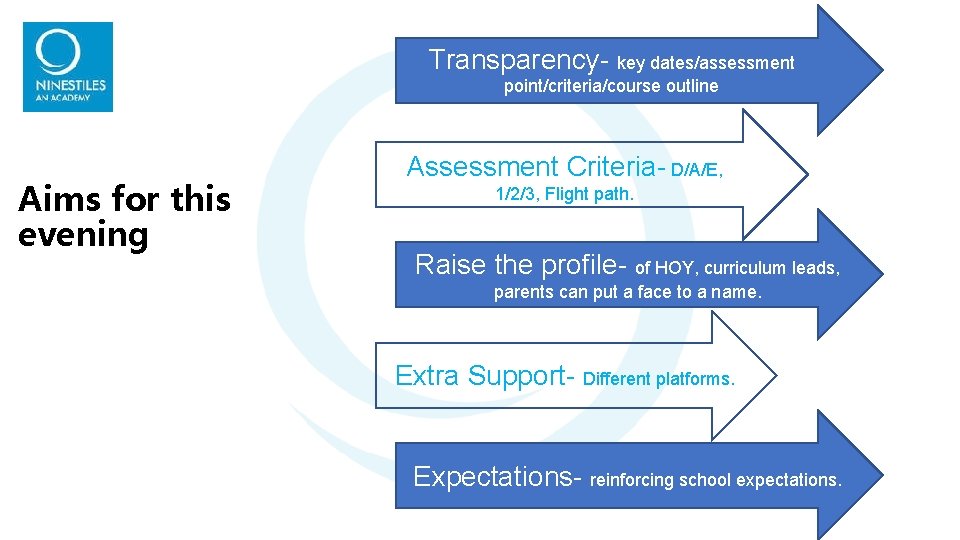
Transparency- key dates/assessment point/criteria/course outline Aims for this evening Assessment Criteria- D/A/E, 1/2/3, Flight path. Raise the profile- of HOY, curriculum leads, parents can put a face to a name. Extra Support- Different platforms. Expectations- reinforcing school expectations.
Head of Year 7: Miss Simpson My role • To monitor your child’s progress and achievement across all subjects. • To monitor your child’s wellbeing and break down any barriers which may be impacting on their day to day school experience. • Make students aware of how to forge links across subjects in order to strengthen their learning overall. • Implement strategies which support your child to meet their end of year targets. • Suggest new ways for students to be independent learners outside the classroom. • Ensure that students are clear on the school’s high expectations.
The Importance of Year 7 • Students explore new surroundings, form friendships, discover which subjects they enjoy/struggle with. • The curriculum in year 7 is broad and exciting, and sets the foundations for the years ahead. • Year 7 is also a fantastic opportunity for students to get involved in extracurricular activities, working with students they may not know and learning from their peers. • They will develop skills and qualities which will be vital for success during their school experience. • It is our aim to encourage students to develop a love of learning, preparing them for independence, and for them to achieve success with the highest outcomes.
Attendance, Punctuality and Behaviour • Minimum of 97% • Today’s lesson depends on the understanding of yesterday’s learning • Affects current performance as well as future achievement • Full access to learning and the curriculum • Maturity & independence
Attendance & Punctuality
The Importance of Reading • It is part of the essential equipment list in order to ‘BE READY’ for learning in the classroom. • Drop Everything And Read Fridays in tutor. • OLA has lots of books available to borrow and a librarian who will take the time to help your child discover what their passions are and therefore a suitable book based on this.
Impact of Reading Read for five minutes a day = 282, 000 words per year = 12 extra school days per year Read for twenty minutes a day = 1. 8 million words per year = 60 extra school days per year
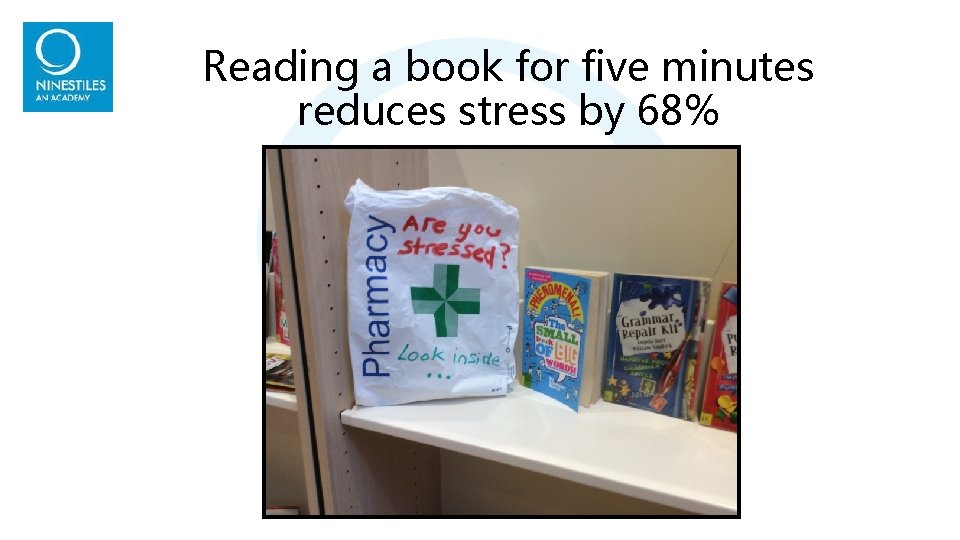
Reading a book for five minutes reduces stress by 68%
Resilience: encouraging students to aim high(er) • Aim for the best that you can possibly be. You may not get to the very top but you will certainly do better than if you aim for what you think you can do easily • It is a bit like having to stretch to reach something on the top shelf. Small children always seem to find a way to reach the sweet jar that has been placed out of reach because they don't give up! • You need to apply the same sort of thinking to your grades!
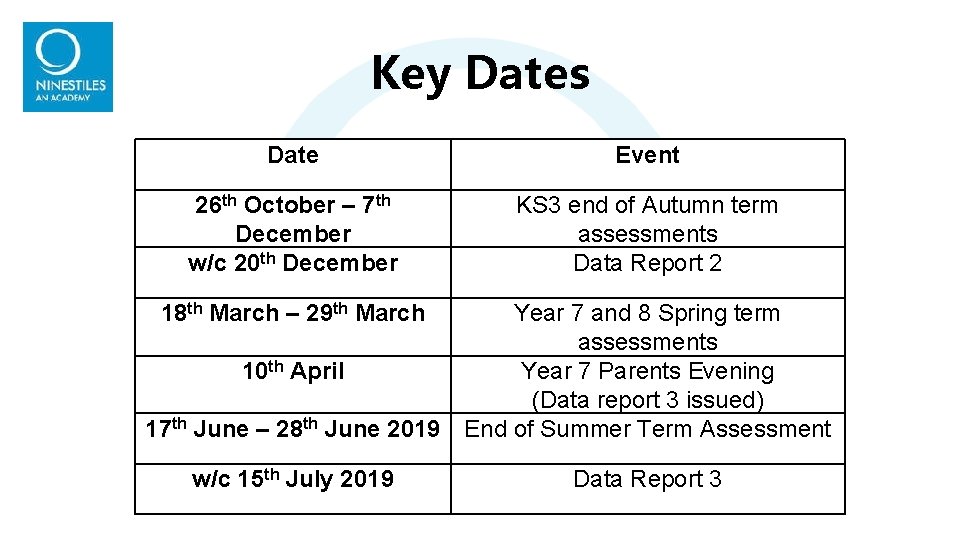
Key Dates Date Event 26 th October – 7 th December w/c 20 th December KS 3 end of Autumn term assessments Data Report 2 18 th March – 29 th March Year 7 and 8 Spring term assessments 10 th April Year 7 Parents Evening (Data report 3 issued) 17 th June – 28 th June 2019 End of Summer Term Assessment w/c 15 th July 2019 Data Report 3
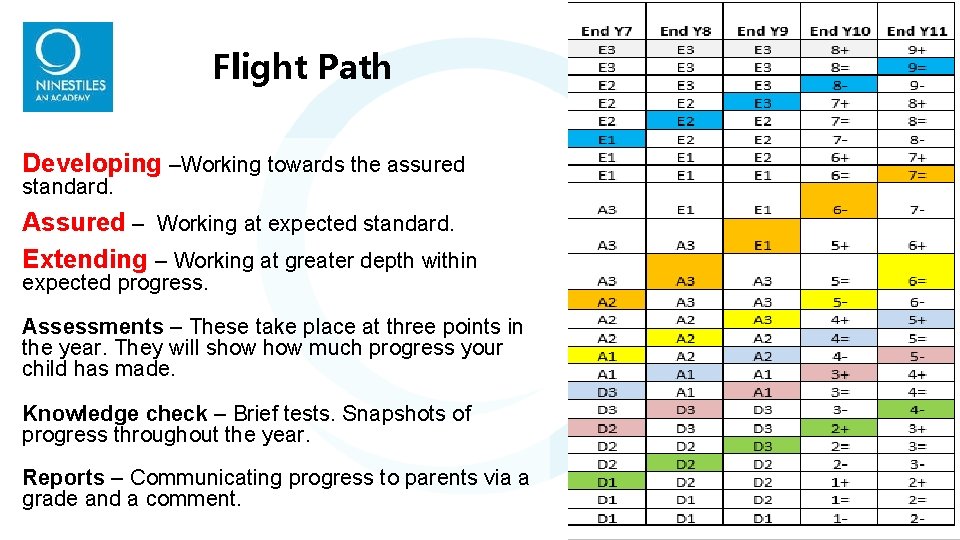
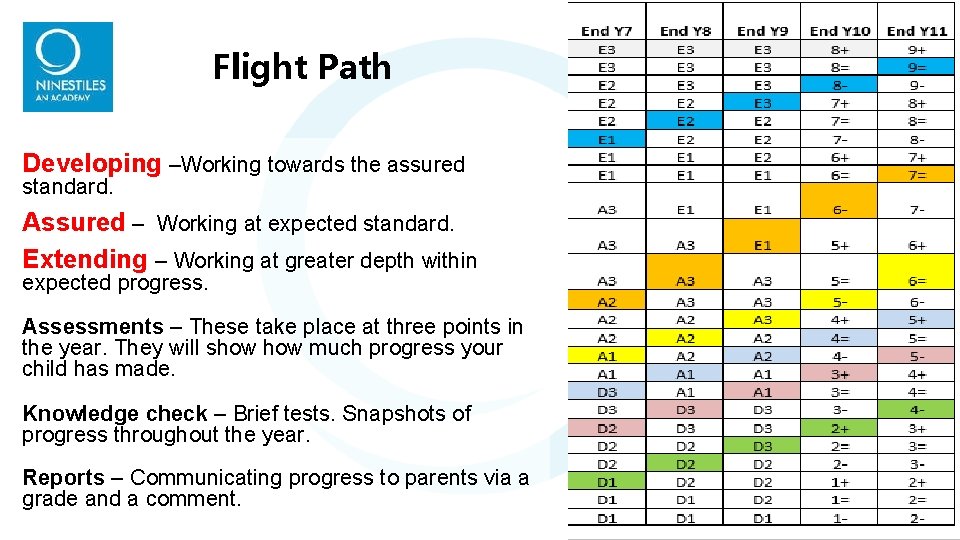
Flight Path Developing –Working towards the assured standard. Assured – Working at expected standard. Extending – Working at greater depth within expected progress. Assessments – These take place at three points in the year. They will show much progress your child has made. Knowledge check – Brief tests. Snapshots of progress throughout the year. Reports – Communicating progress to parents via a grade and a comment.
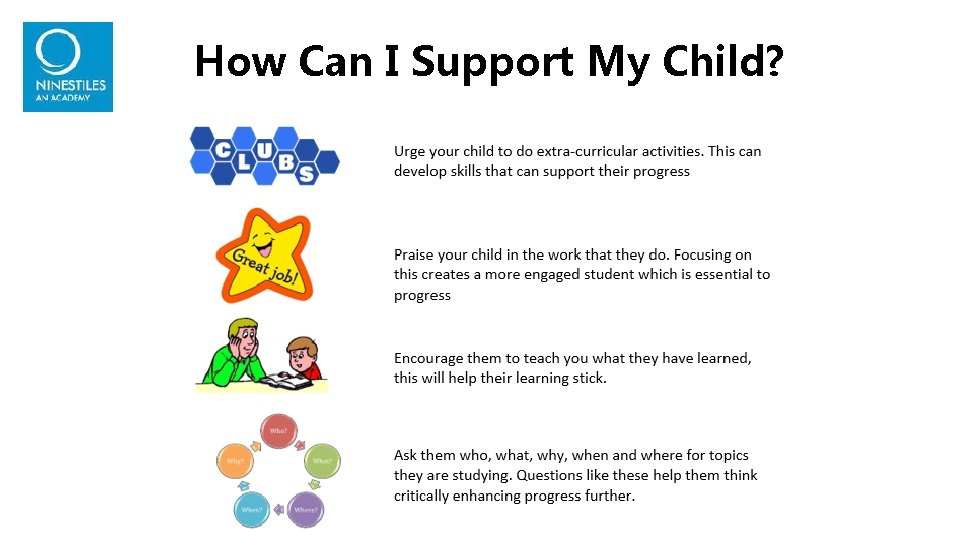
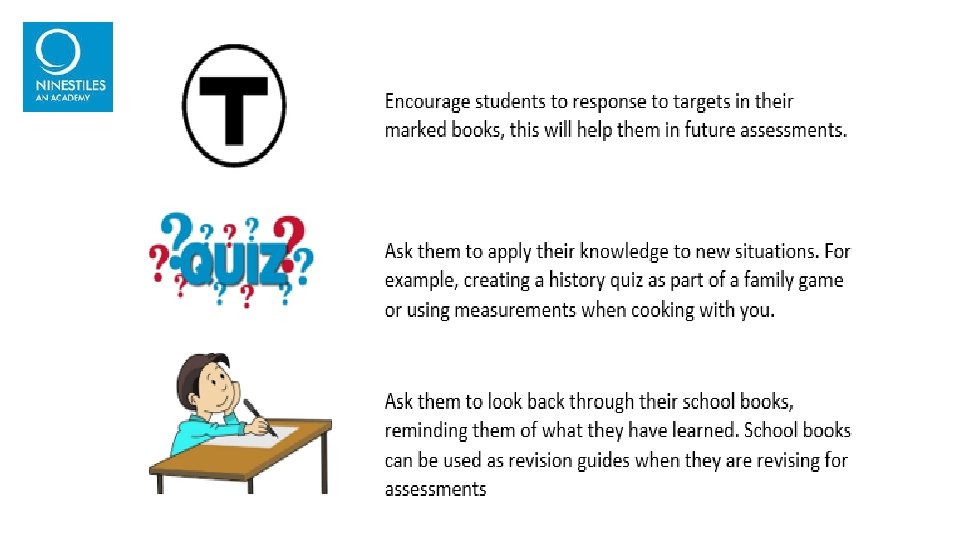
How Can I Support My Child?
Head of Year 7: Miss Simpson sian. simpson@ninestiles. org. uk Any questions?
English at Key Stage Three Year 9
Key Contacts • Vicki Mc. Cracken: Head of English: vicki. mccracken@ninestiles. org. uk • Caroline Hirons: Second in English: caroline. hirons@ninestiles. org. uk • Claire Jones: Key Stage 3 Lead: claire. jones@ninestiles. org. uk
What will my child study in Year 7? • We aim to provide a fun, engaging curriculum in Year 7 with a broad range of reading and writing schemes which ensure your child is exposed to a number of different fiction and non-fiction texts. • All of the skills your child will learn in Year 7 have clear links to the skills they will use at G. C. S. E level. • This curriculum will include sources from nineteenth, twentieth and twenty-first century authors and will include a range of writing for different purposes.
Short Stories Students will study a number of short stories by writers from different cultures and eras and learn to start analysing language. Creative Writing In this fun module, students will explore their own writing, including learning how to write using an image as inspiration. Grammar Students will revise and extend their knowledge of grammar and will develop their writing on non-fiction texts. Novel In this reading scheme, students will study a complete novel and analyse the ways in which ideas and characters are presented. Non-Fiction Focus In this unit, students will study a number of non-fiction texts to learn the art of comparative summary and focus on their own non-fiction writing.
How will my child’s progress be assessed? • Students are assessed by their class teacher for specific skills through marking of targeted pieces of work throughout the year. • Half-termly predictions are used to indicate the students’ progress in a given scheme and formal assessment is made termly. • Students will sit an AQA English language paper 1 towards the end of this term, a Literature –style assessment at the Easter assessment point and then an AQA English language paper 2 in the summer term. • All assessment will reflect the format at G. C. S. E.
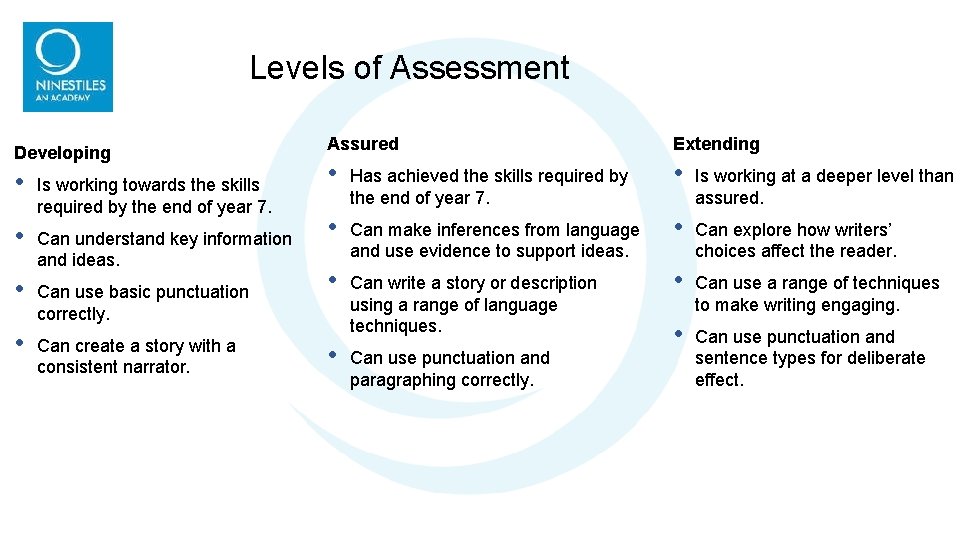
Levels of Assessment Developing • Is working towards the skills required by the end of year 7. • Can understand key information and ideas. • Can use basic punctuation correctly. • Can create a story with a consistent narrator. Assured Extending • Has achieved the skills required by the end of year 7. • Is working at a deeper level than assured. • Can make inferences from language and use evidence to support ideas. • Can explore how writers’ choices affect the reader. • Can write a story or description using a range of language techniques. • Can use a range of techniques to make writing engaging. • Can use punctuation and sentence types for deliberate effect. • Can use punctuation and paragraphing correctly.
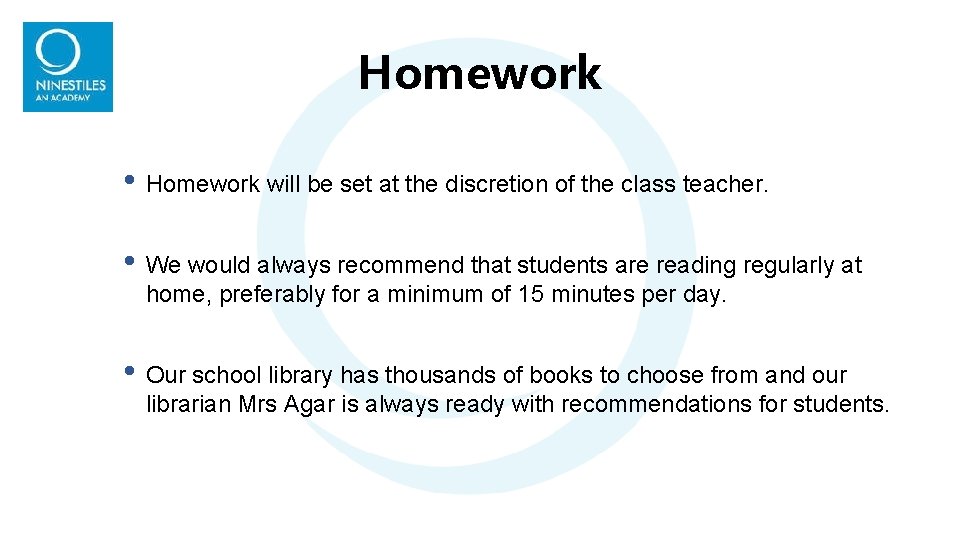
Homework • Homework will be set at the discretion of the class teacher. • We would always recommend that students are reading regularly at home, preferably for a minimum of 15 minutes per day. • Our school library has thousands of books to choose from and our librarian Mrs Agar is always ready with recommendations for students.
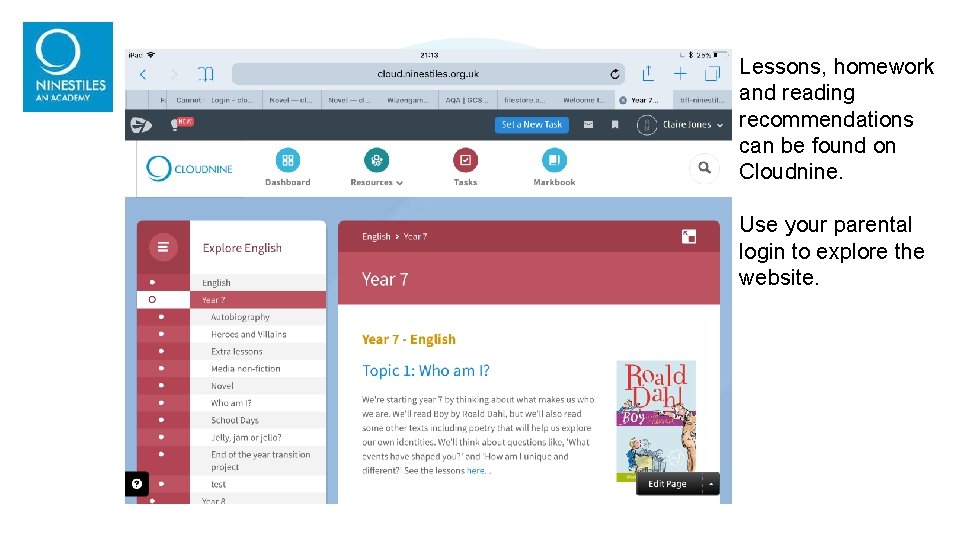
Lessons, homework and reading recommendations can be found on Cloudnine. Use your parental login to explore the website.
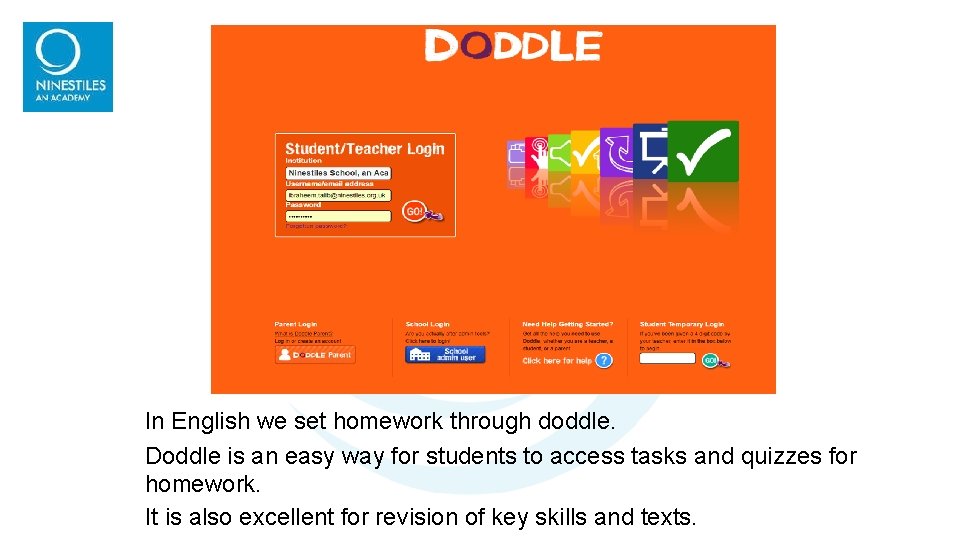
In English we set homework through doddle. Doddle is an easy way for students to access tasks and quizzes for homework. It is also excellent for revision of key skills and texts.
Welcome to year 7 Any questions?
Year 7 Scienc e
Head of Science – Jennifer Mace Jennifer. Mace@Ninestiles. org. uk The Science Team Deputy in Science – Hayley Rock Hayley. Rock@Ninestiles. org. uk Lead Practitioner – Science & KS 3 Lead - Teresa Middleton Teresa. Middleton@Ninestiles. org. uk Science & KS 4 Lead – Andrew Burden Andrew. Burden@Ninestiles. org. uk
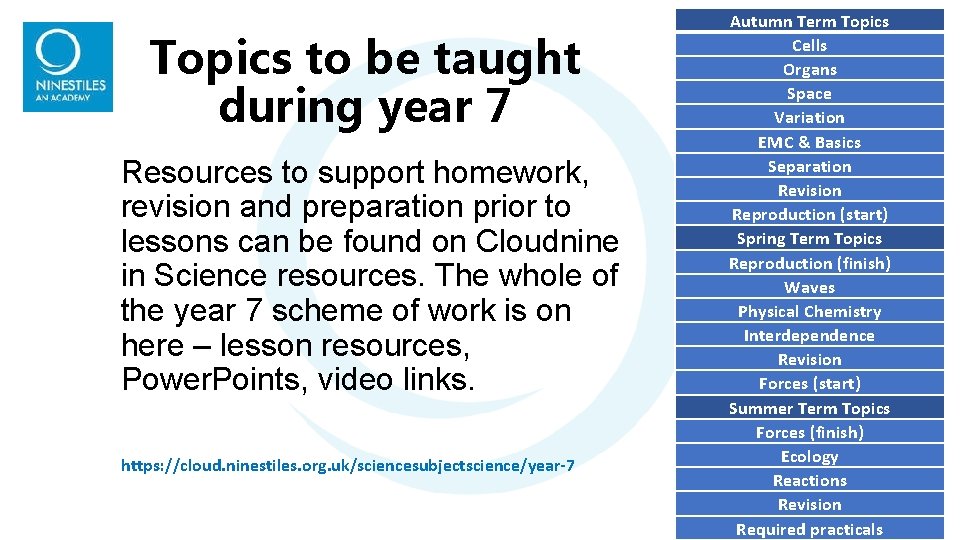
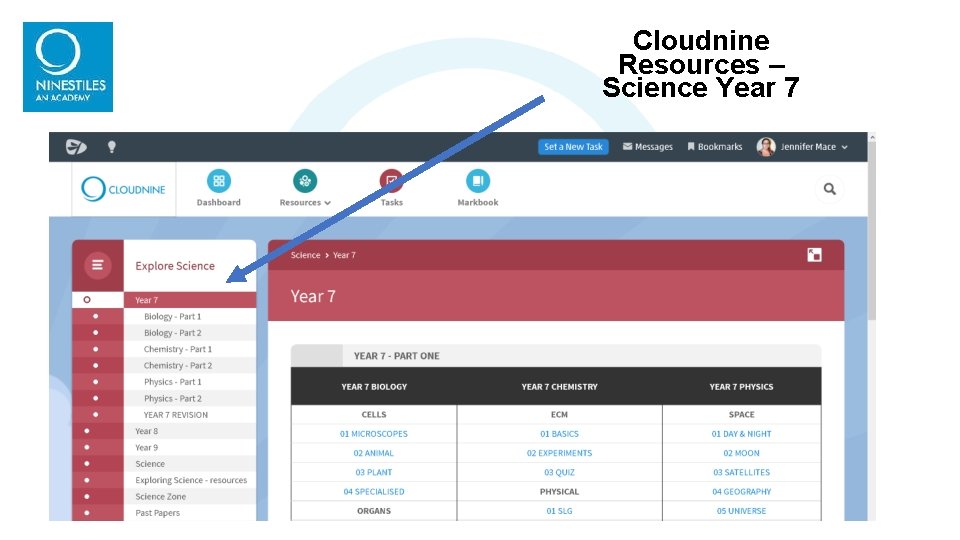
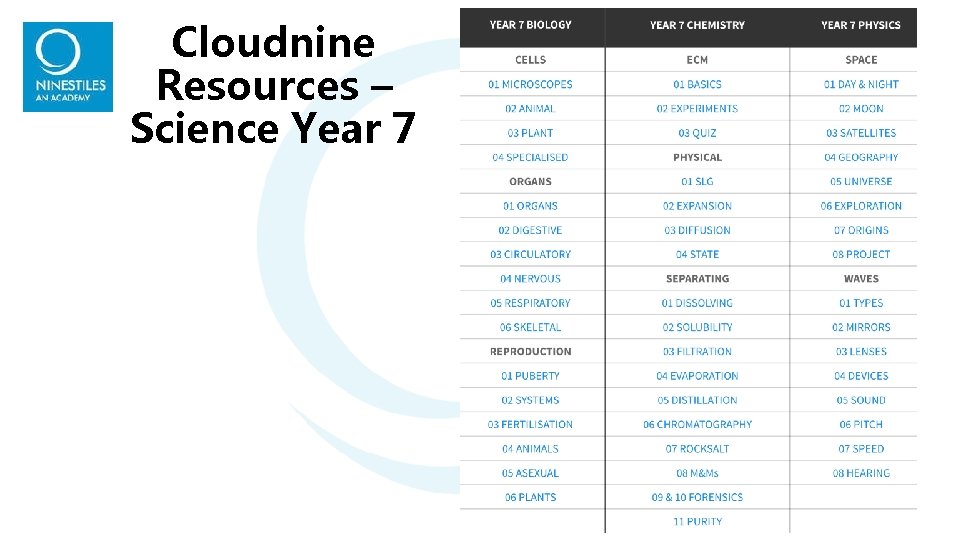
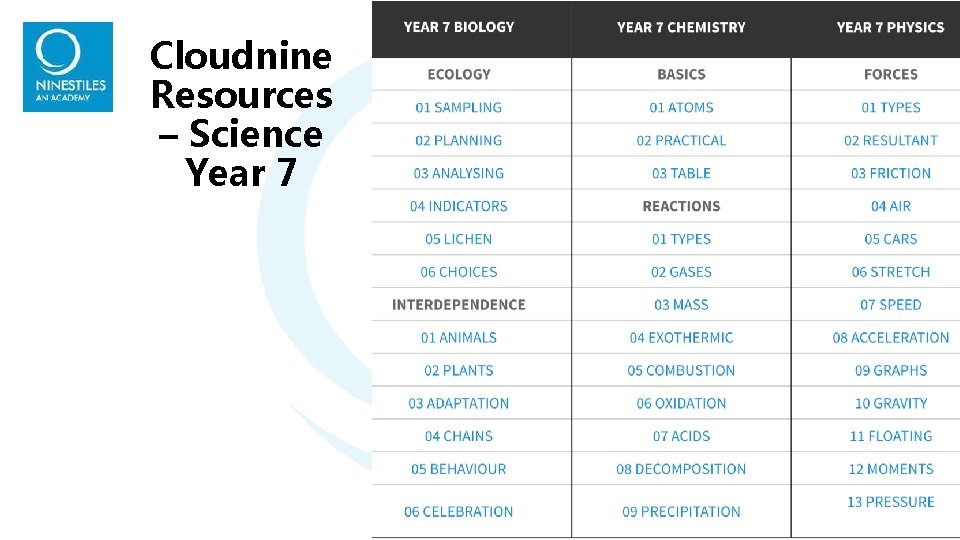
Topics to be taught during year 7 Resources to support homework, revision and preparation prior to lessons can be found on Cloudnine in Science resources. The whole of the year 7 scheme of work is on here – lesson resources, Power. Points, video links. https: //cloud. ninestiles. org. uk/sciencesubjectscience/year-7 Autumn Term Topics Cells Organs Space Variation EMC & Basics Separation Revision Reproduction (start) Spring Term Topics Reproduction (finish) Waves Physical Chemistry Interdependence Revision Forces (start) Summer Term Topics Forces (finish) Ecology Reactions Revision Required practicals
Cloudnine Resources – Science Year 7
Cloudnine Resources – Science Year 7
Cloudnine Resources – Science Year 7
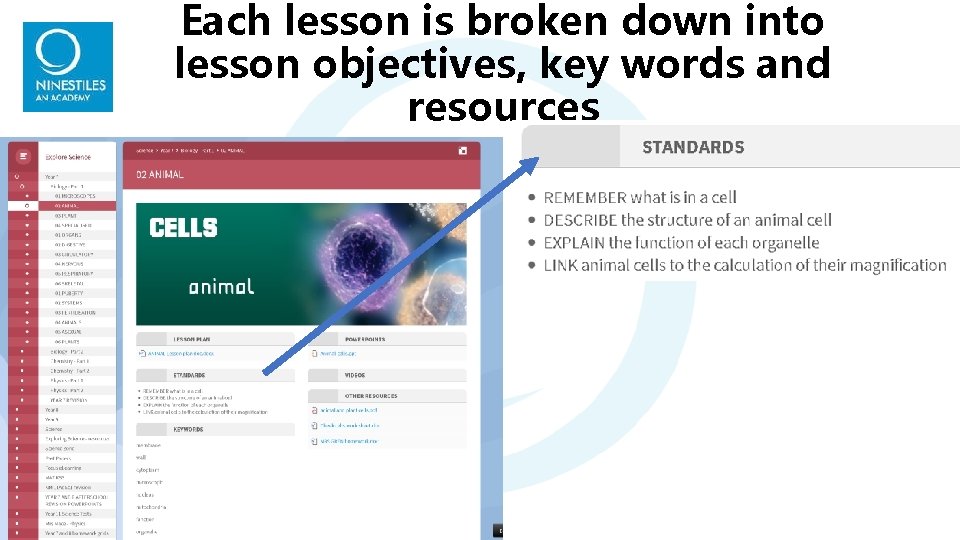
Each lesson is broken down into lesson objectives, key words and resources
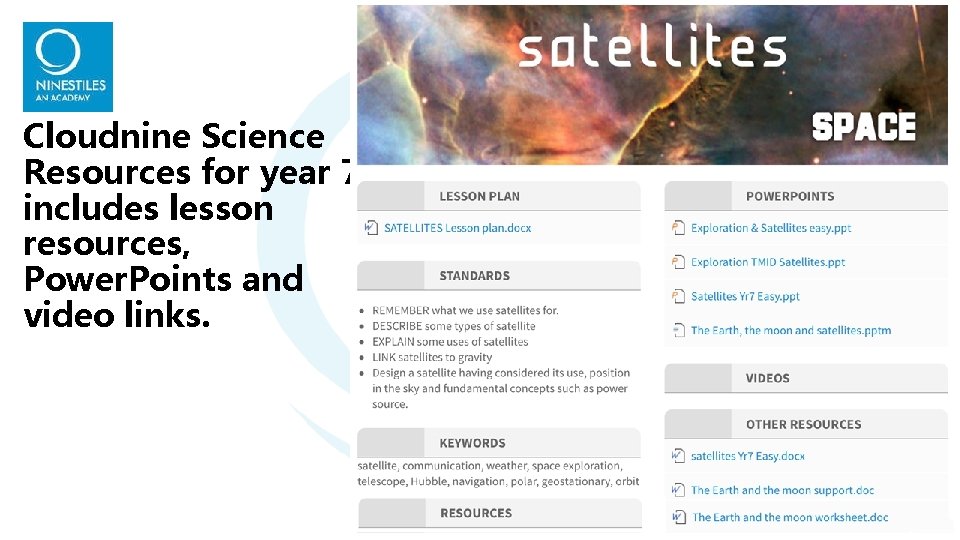
Cloudnine Science Resources for year 7 includes lesson resources, Power. Points and video links.
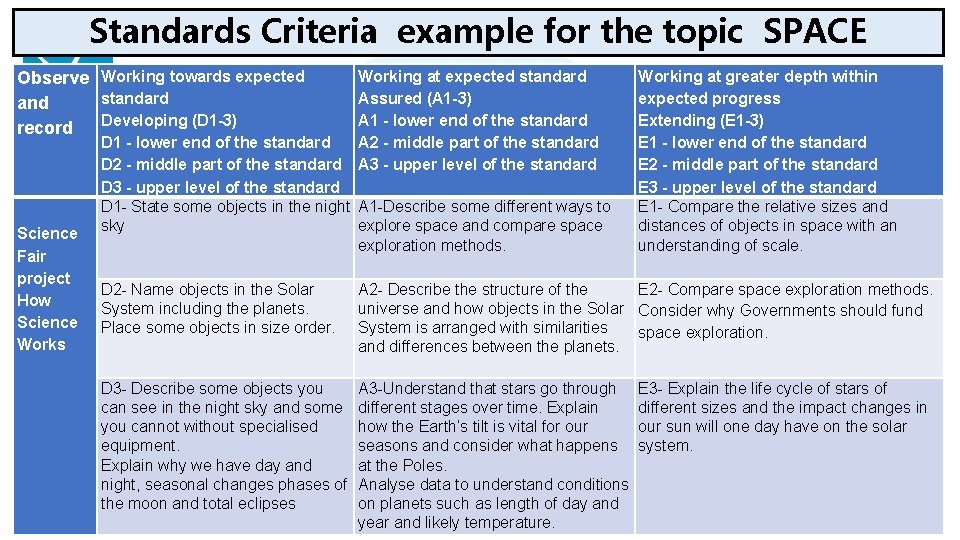
Standards Criteria example for the topic SPACE Observe Working towards expected standard and Developing (D 1 -3) record Science Fair project How Science Works Working at expected standard Assured (A 1 -3) A 1 - lower end of the standard A 2 - middle part of the standard A 3 - upper level of the standard Working at greater depth within expected progress Extending (E 1 -3) D 1 - lower end of the standard E 1 - lower end of the standard D 2 - middle part of the standard E 2 - middle part of the standard D 3 - upper level of the standard E 3 - upper level of the standard D 1 - State some objects in the night A 1 -Describe some different ways to E 1 - Compare the relative sizes and sky explore space and compare space distances of objects in space with an exploration methods. understanding of scale. D 2 - Name objects in the Solar A 2 - Describe the structure of the E 2 - Compare space exploration methods. System including the planets. universe and how objects in the Solar Consider why Governments should fund Place some objects in size order. System is arranged with similarities space exploration. and differences between the planets. D 3 - Describe some objects you A 3 -Understand that stars go through E 3 - Explain the life cycle of stars of can see in the night sky and some different stages over time. Explain different sizes and the impact changes in you cannot without specialised how the Earth’s tilt is vital for our sun will one day have on the solar equipment. seasons and consider what happens system. Explain why we have day and at the Poles. night, seasonal changes phases of Analyse data to understand conditions the moon and total eclipses on planets such as length of day and year and likely temperature.
Flight Path Developing –Working towards the assured standard. Assured – Working at expected standard. Extending – Working at greater depth within expected progress. Assessments – These take place at three points in the year. They will show much progress your child has made. Knowledge check – Brief tests. Snapshots of progress throughout the year. Reports – Communicating progress to parents via a grade and a comment.
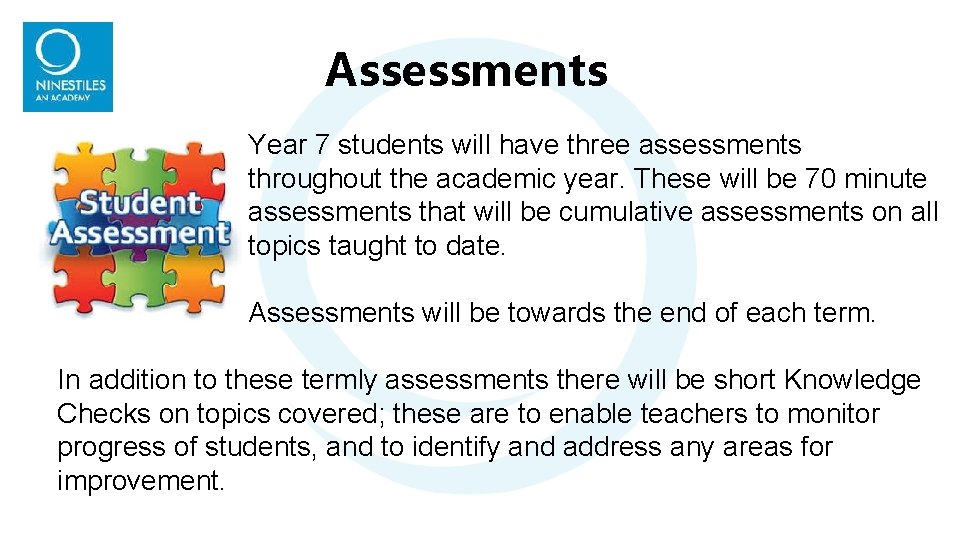
Assessments Year 7 students will have three assessments throughout the academic year. These will be 70 minute assessments that will be cumulative assessments on all topics taught to date. Assessments will be towards the end of each term. In addition to these termly assessments there will be short Knowledge Checks on topics covered; these are to enable teachers to monitor progress of students, and to identify and address any areas for improvement.
Assessment Levels DEVELOPING (D 1 -D 3) Has a basic understanding of the Science topics. Can recall key points and simple key words, but might struggle to explain things. ASSURED (A 1 -A 3) Can explain key topics and Science content using key words correctly. Can complete basic evaluations. Confidently uses ‘because’ in their explanations. EXTENDING (E 1 -E 3) Can make detailed explanations of Science concepts, using ‘because’ and incorporating key terms accurately. Can make links between different topics competently. Can confidently recall and apply large amounts of information, as well as applying their current theoretical knowledge to new situations and contexts.
Science Homework Expectations • Homework issued should be recorded in planners • Students need to log into Doddle to see homework tasks • There will be one piece of appropriate homework set at least every 4 th lesson on Doddle; it is expected that quizzes are not submitted until a score of at least 80% is obtained • There is a high expectation that homework will be done by everyone and that failure to do so will have an impact on learning • Students should complete all pieces of homework to the best of their ability • Parents can check planners for homework and sign them at the end of each week • Students who return homework that exceeds expectations will be awarded praise stamps • Exemplar high quality homework will be displayed • Homework will be marked promptly and marks will be recorded • Parents and tutors will be informed of poor or non-returned homework
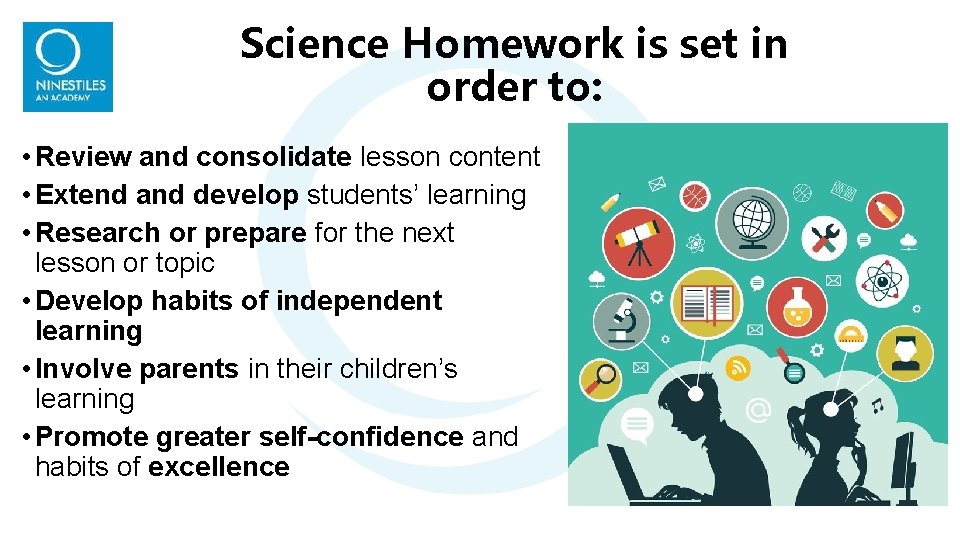
Science Homework is set in order to: • Review and consolidate lesson content • Extend and develop students’ learning • Research or prepare for the next lesson or topic • Develop habits of independent learning • Involve parents in their children’s learning • Promote greater self-confidence and habits of excellence
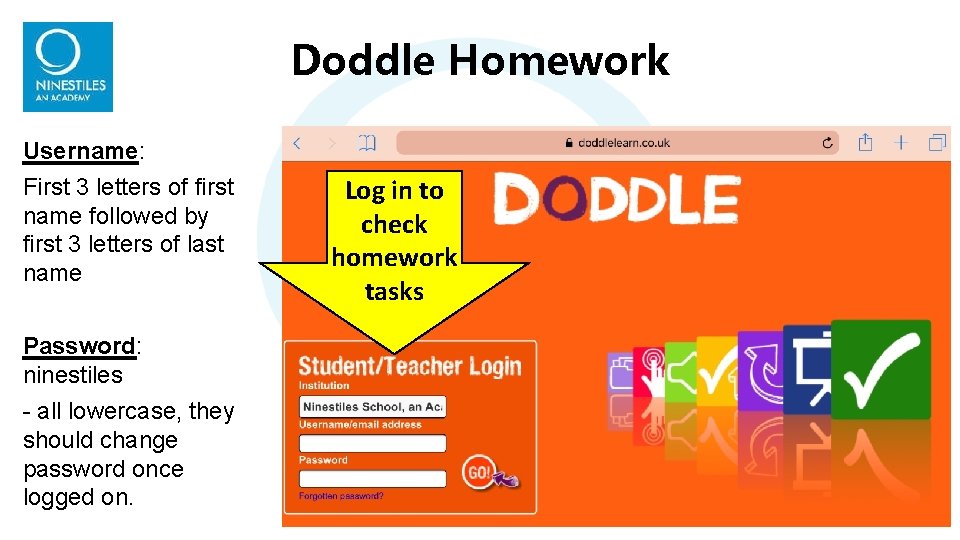
Doddle Homework Username: First 3 letters of first name followed by first 3 letters of last name Password: ninestiles - all lowercase, they should change password once logged on. Log in to check homework tasks
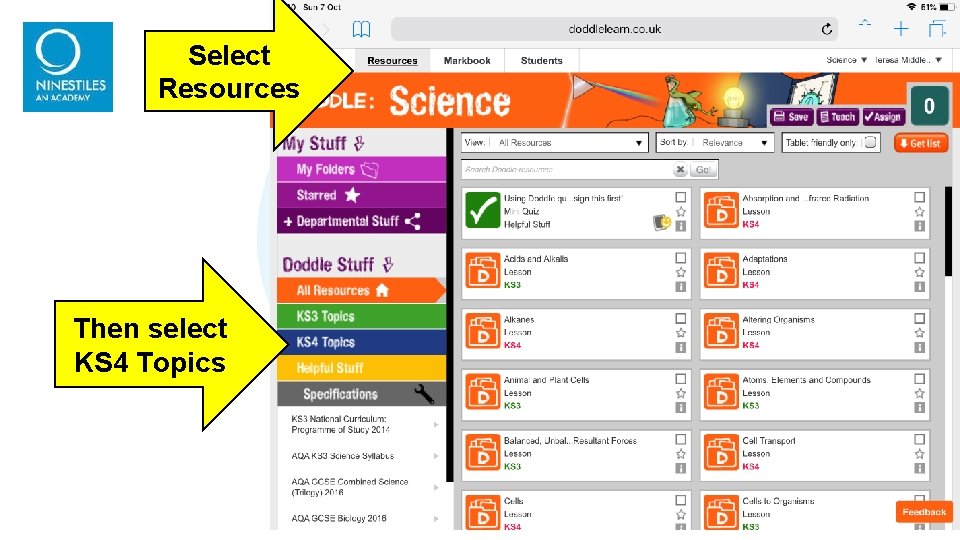
Select Resources Then select KS 4 Topics
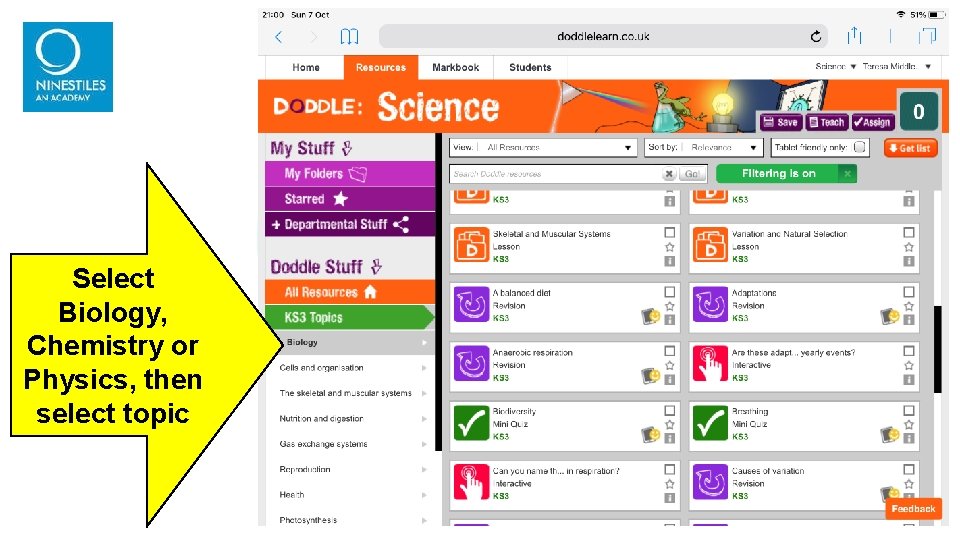
Select Biology, Chemistry or Physics, then select topic
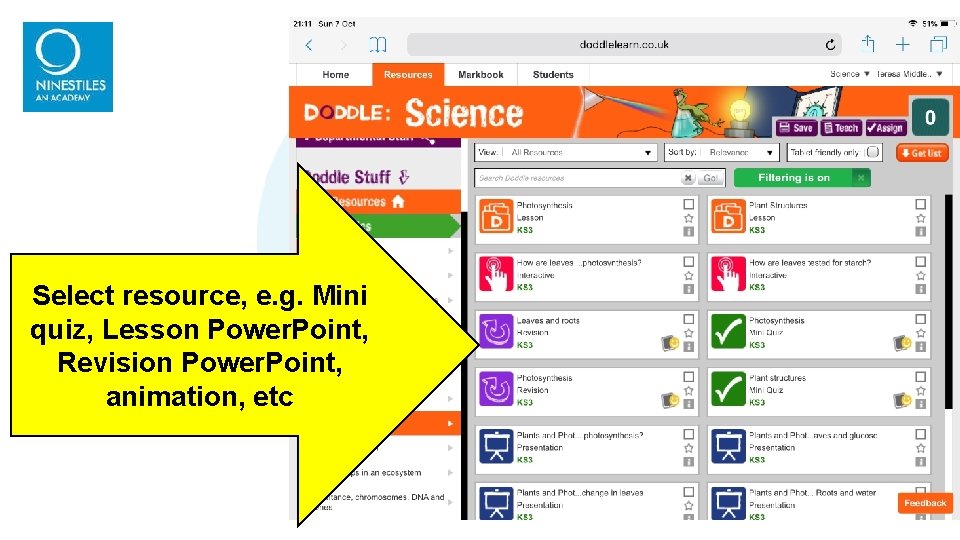
Select resource, e. g. Mini quiz, Lesson Power. Point, Revision Power. Point, animation, etc
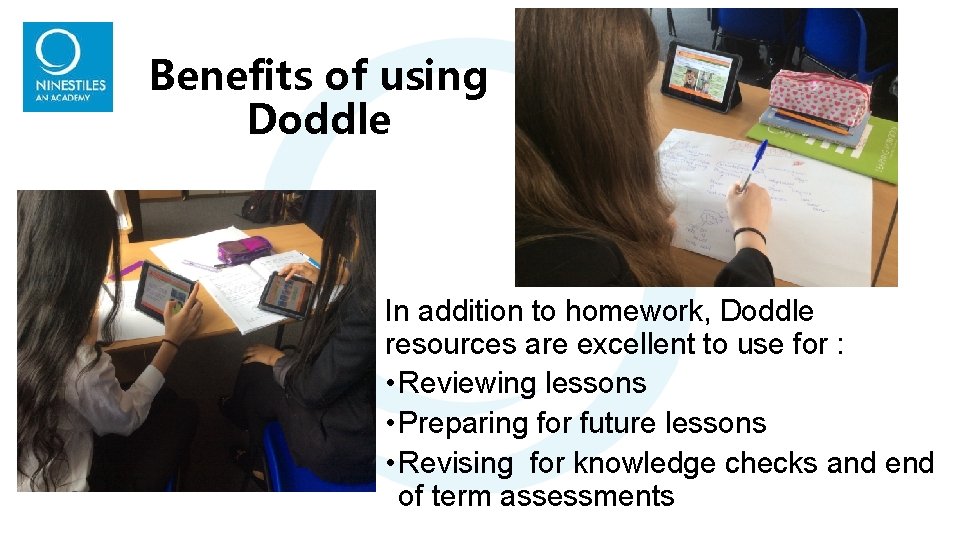
Benefits of using Doddle In addition to homework, Doddle resources are excellent to use for : • Reviewing lessons • Preparing for future lessons • Revising for knowledge checks and end of term assessments
Useful Websites Cloud 9 https: //cloud. ninestiles. org. uk/sciencesubjectscience/year-8 Doddle https: //www. doddlelearn. co. uk BBC Bitesize Biology - https: //www. bbc. co. uk/education/subjects/z 4882 hv Chemistry - https: //www. bbc. co. uk/education/subjects/znxtyrd Physics - https: //www. bbc. co. uk/education/subjects/zh 2 xsbk
Key Stage 3 Maths
KS 3 Coordinator for Mathematics– Shah Jalal Shah. Jalal@Ninestiles. org. uk The Team Head of Mathematics – Chris Guerin Christopher. guerin@Ninestiles. org. uk Deputy Head of Mathematics –Alice Douglas Alice. douglas@Ninestiles. org. uk Head of KS 4 – Rebecca Lynch Rebecca. Lynch@ninestiles. org. uk
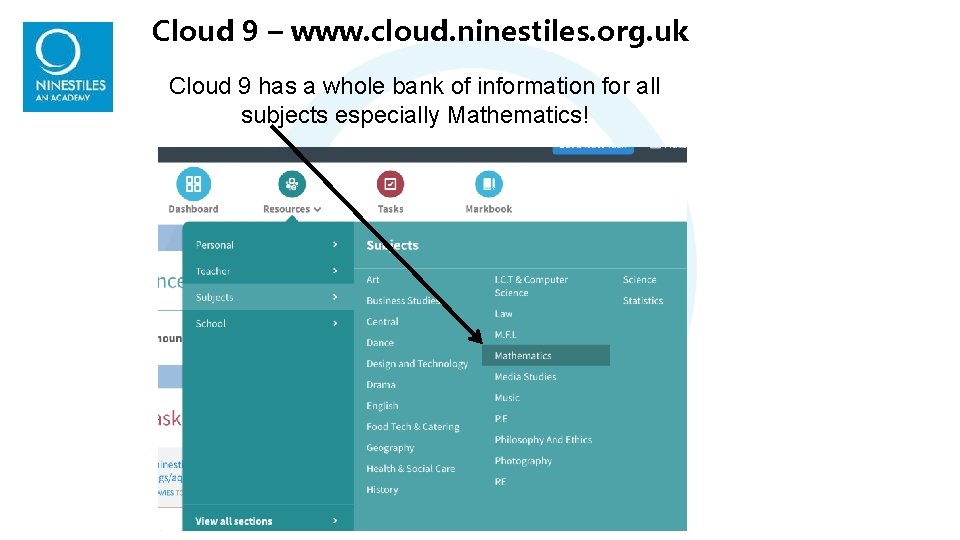
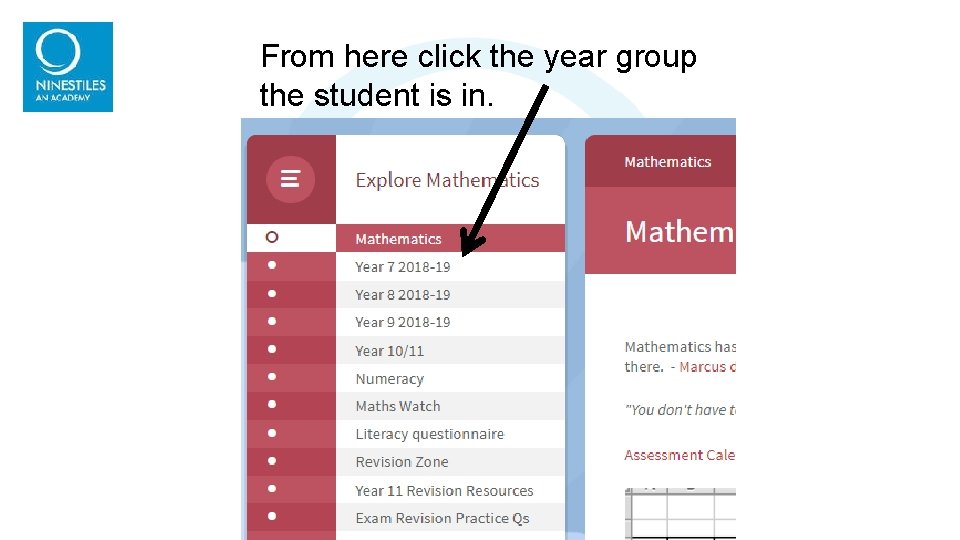
Cloud 9 – www. cloud. ninestiles. org. uk Cloud 9 has a whole bank of information for all subjects especially Mathematics!
From here click the year group the student is in.
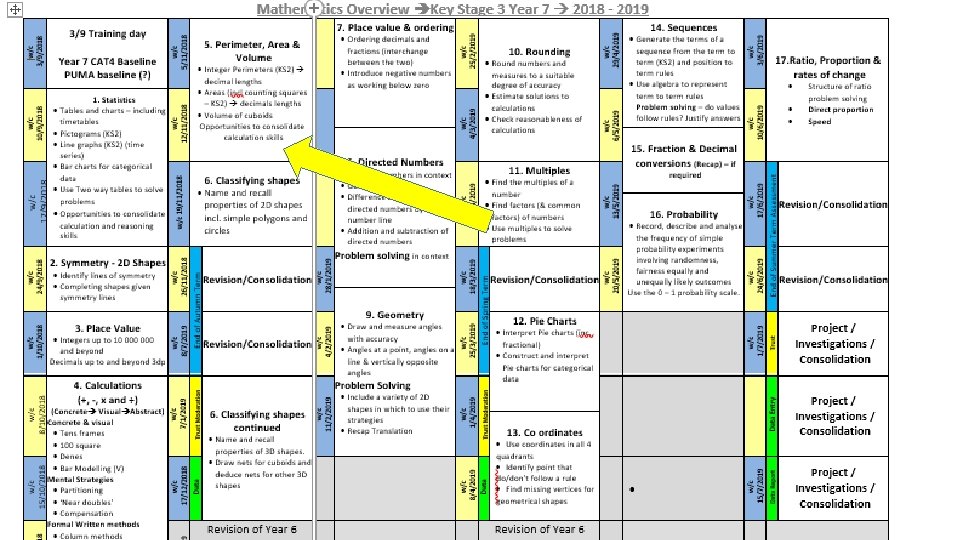
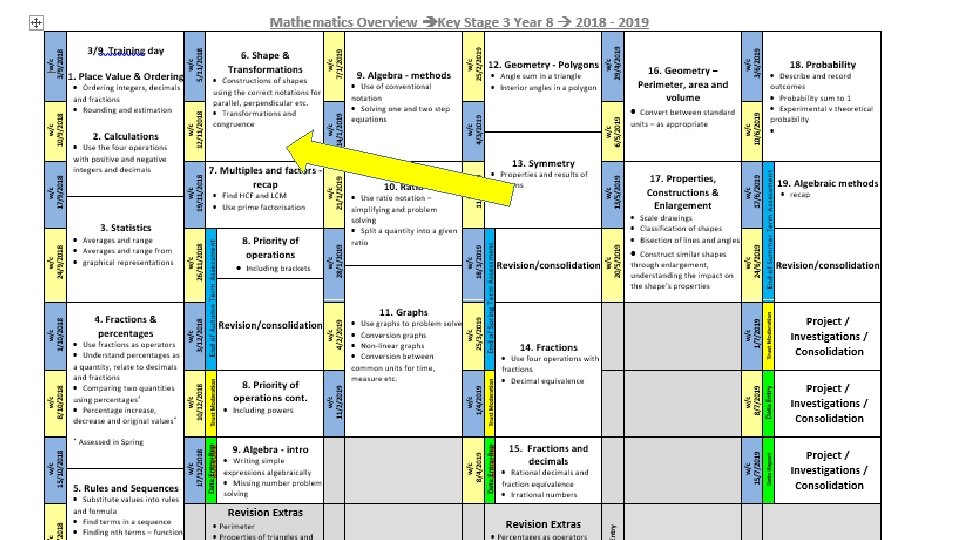
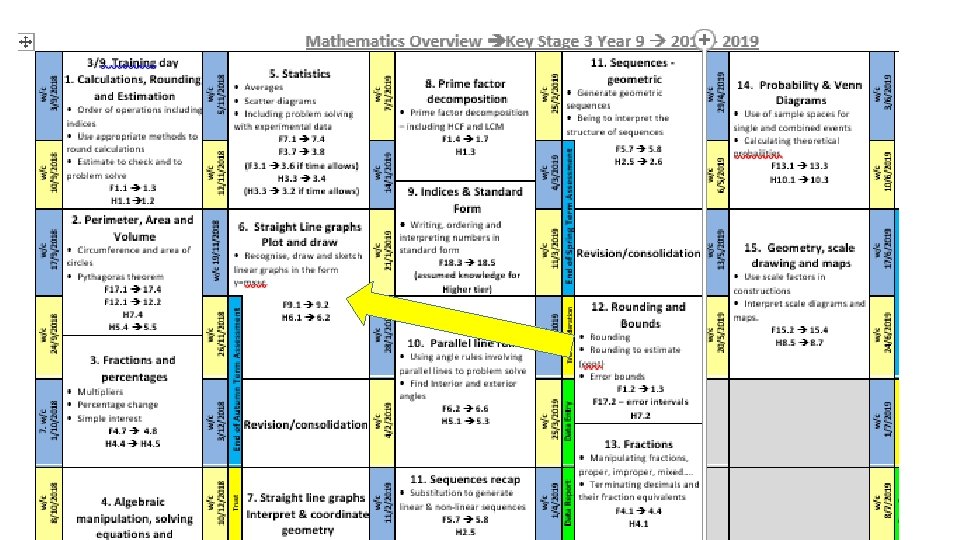
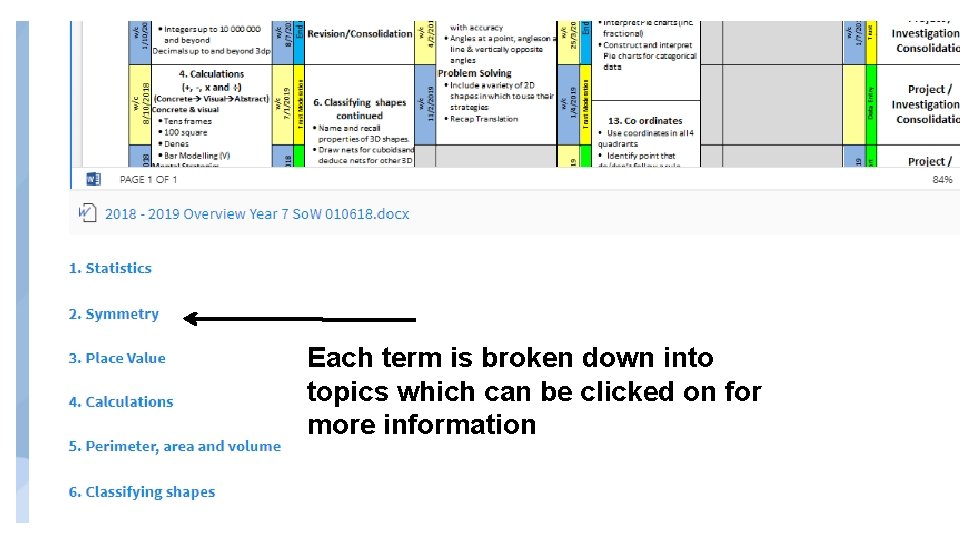
Each term is broken down into topics which can be clicked on for more information
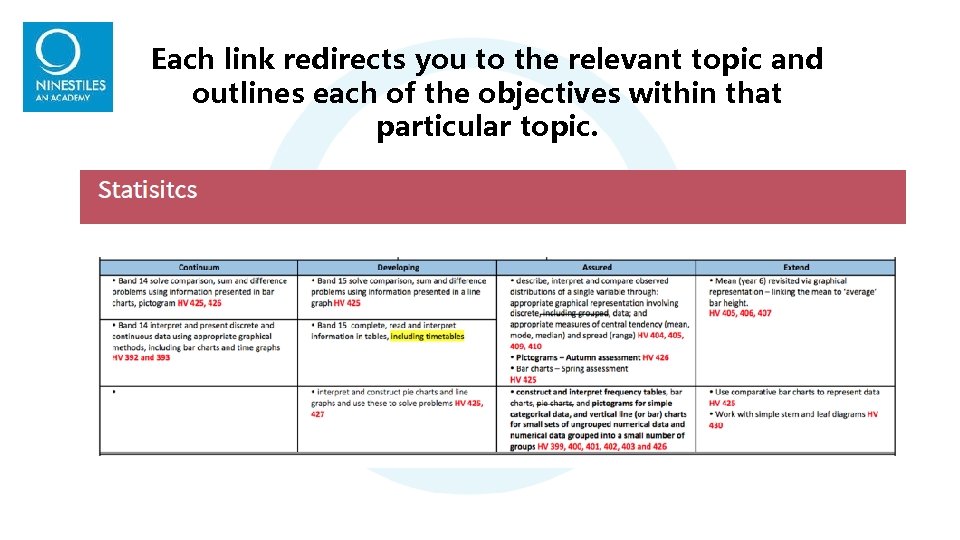
Each link redirects you to the relevant topic and outlines each of the objectives within that particular topic.
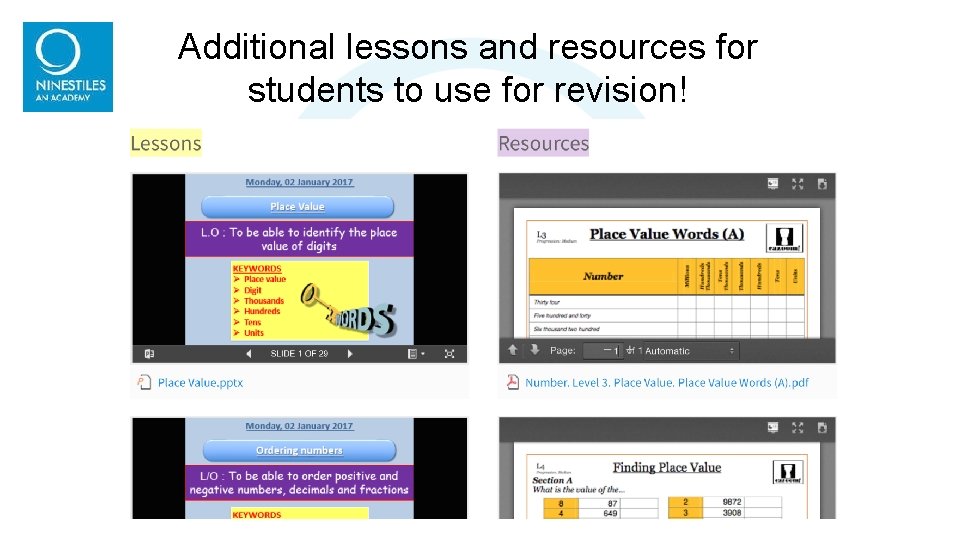
Additional lessons and resources for students to use for revision!
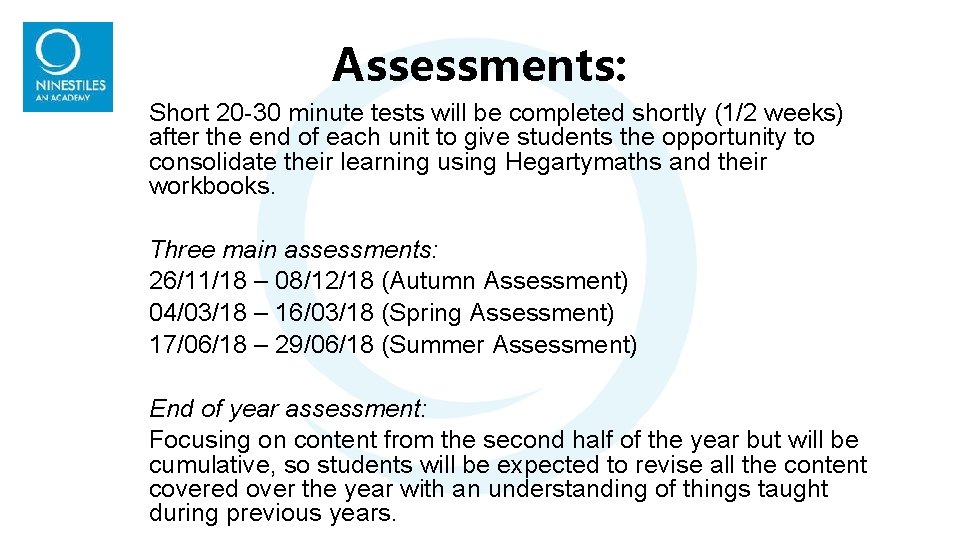
Assessments: Short 20 -30 minute tests will be completed shortly (1/2 weeks) after the end of each unit to give students the opportunity to consolidate their learning using Hegartymaths and their workbooks. Three main assessments: 26/11/18 – 08/12/18 (Autumn Assessment) 04/03/18 – 16/03/18 (Spring Assessment) 17/06/18 – 29/06/18 (Summer Assessment) End of year assessment: Focusing on content from the second half of the year but will be cumulative, so students will be expected to revise all the content covered over the year with an understanding of things taught during previous years.
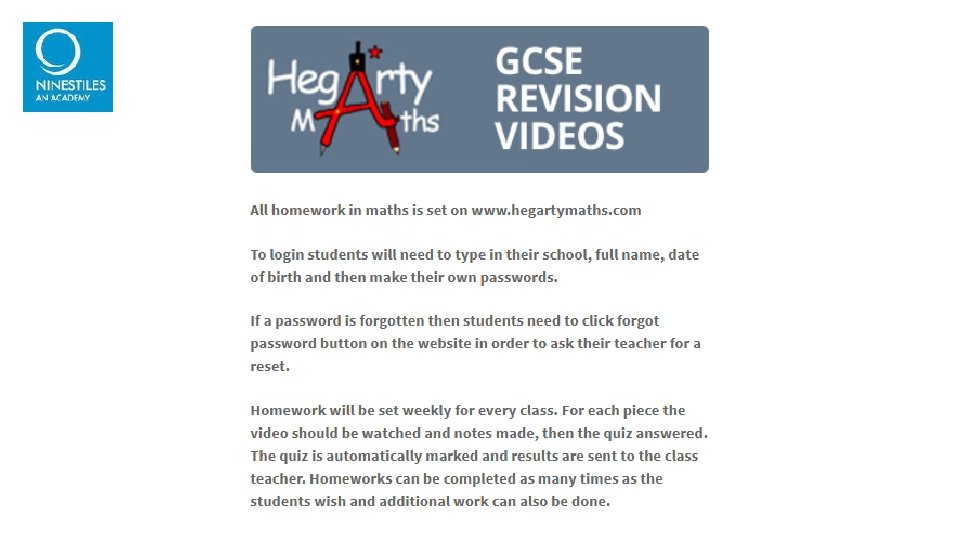
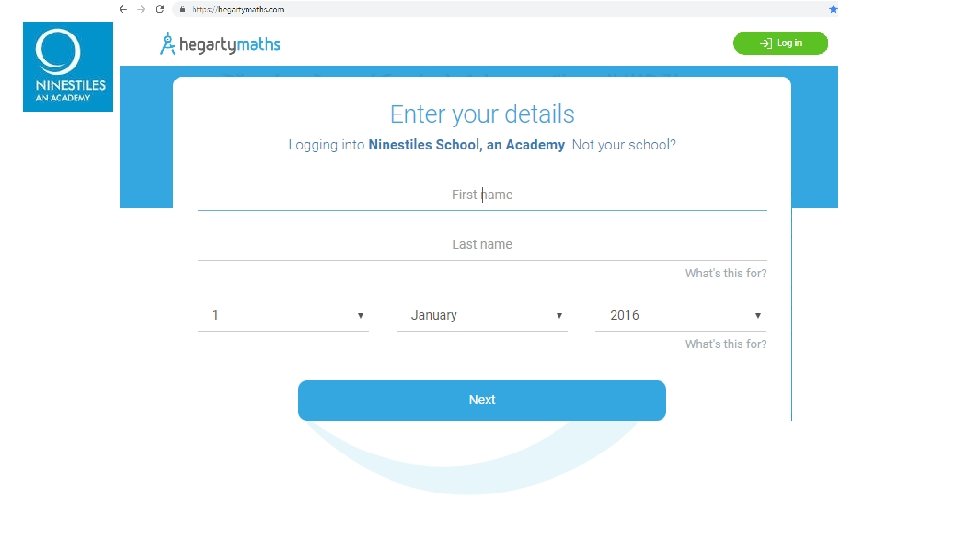
Homework www. hegartymaths. com Username: student full name along with their respective DOB Password: user set Other revision aids: Mathsapp. pixl. org. uk School ID: NS 126 Username: FULLNAME Password: Password 1 www. mrcartermaths. com - Lots of questions with answers. www. corbettmaths. com - videos and questions
Any Questions?