
Raising Pupil Achievement By Promoting a Growth Mindset

Raising Pupil Achievement By Promoting a Growth Mindset
Overview • Fixed versus Growth mindset • Research on how beliefs shape learning • How to change mindsets
Quick Survey You can learn new things, but you can’t really change your basic intelligence • • Some people are more naturally gifted than others
What Motivates Pupils to Try Hard in School? Some pupils are highly motivated and others are not. Why?
Growth Mindset and Achievement • Decades of research show a powerful relationship between mindset and achievement • Pupils’ beliefs about intelligence and learning have an effect on: • Motivation • Academic behaviours (e. g. , studying and seeking help) • Responses to challenges and setbacks • Academic achievement
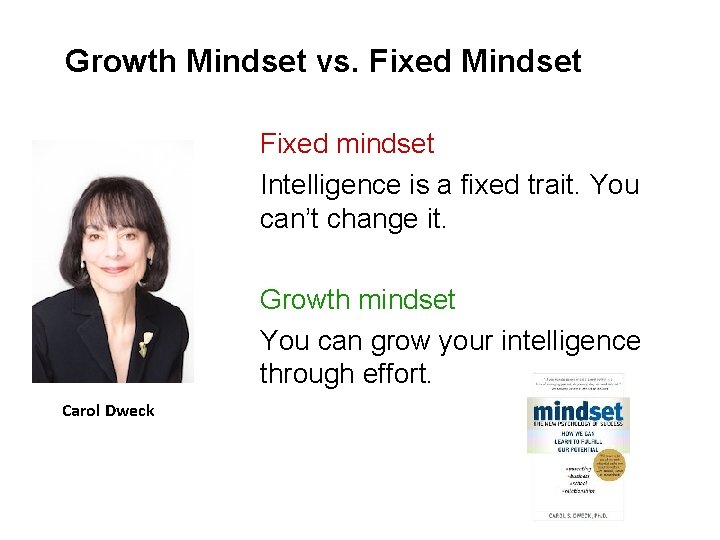
Growth Mindset vs. Fixed Mindset Fixed mindset Intelligence is a fixed trait. You can’t change it. Growth mindset You can grow your intelligence through effort. Carol Dweck
Mindsets These two beliefs lead pupils to very different conclusions about the meaning of events – especially times of difficulty Opportunity Threat A very important aspect of Dweck’s research is that no-one is totally fixed or totally growth mindset, but that we are all a mixture, often dependent on the environment we are in. So a person may generally show a growth mindset, but when taken out of their comfort zone may become more ‘fixed’.
Mindsets And the meaning they make – the narrative they construct – determines the behaviours in which they choose to engage Photo by Gregory Ewanowich
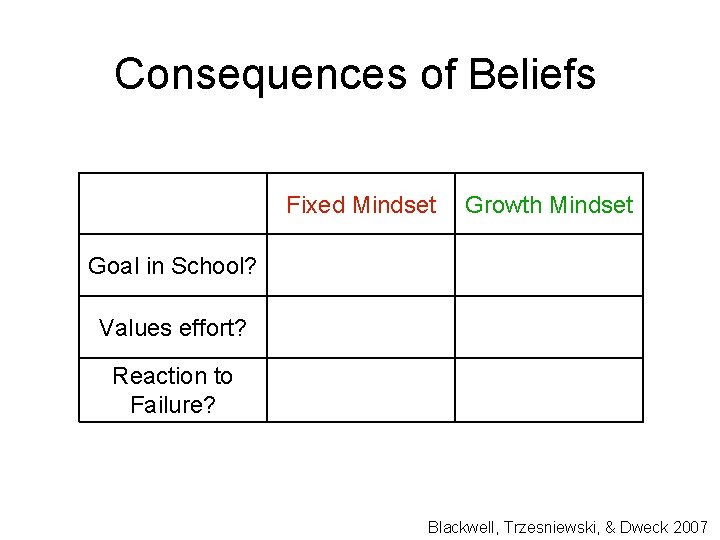
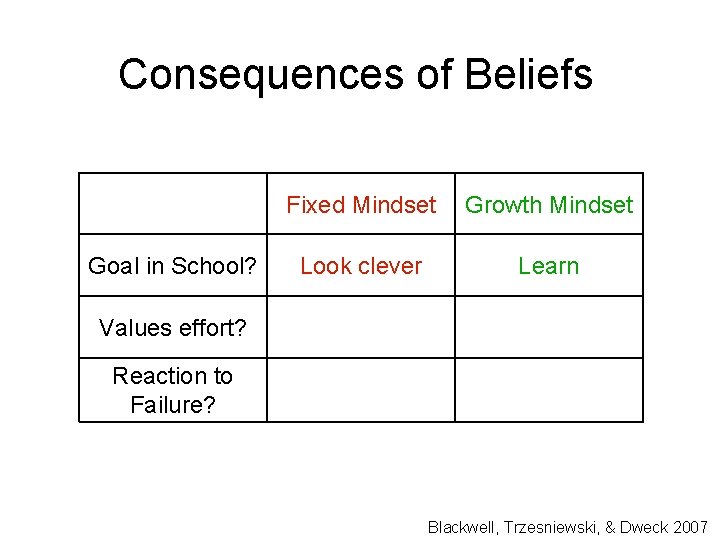
Consequences of Beliefs Fixed Mindset Growth Mindset Goal in School? Values effort? Reaction to Failure? Blackwell, Trzesniewski, & Dweck 2007
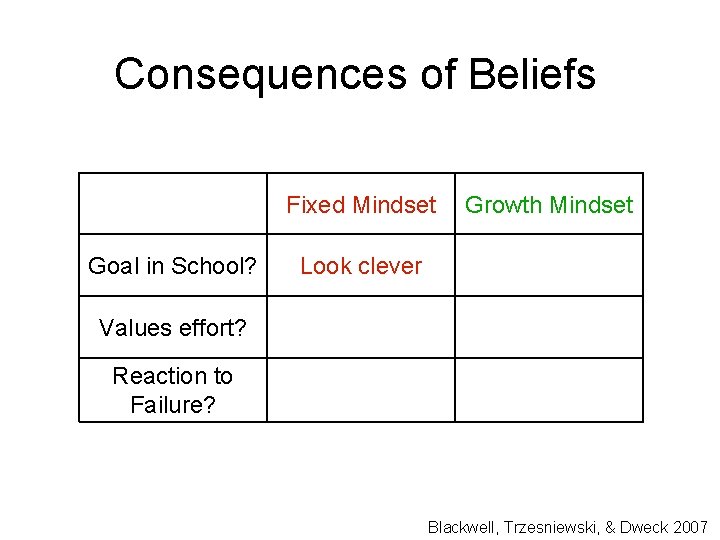
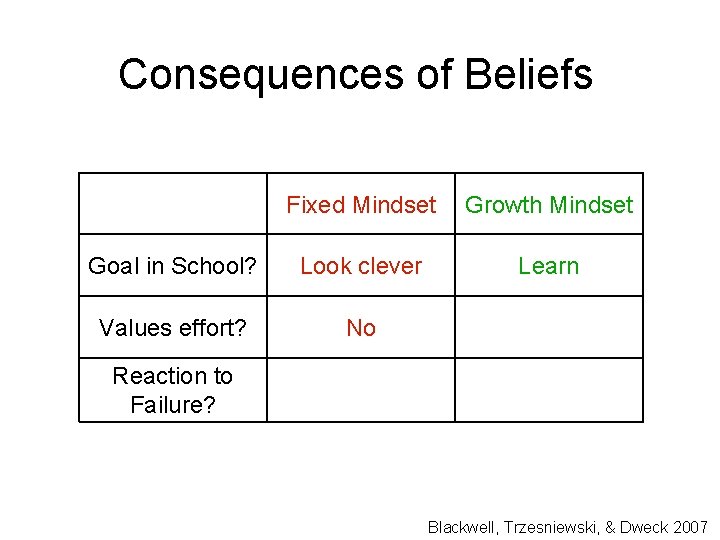
Consequences of Beliefs Fixed Mindset Goal in School? Growth Mindset Look clever Values effort? Reaction to Failure? Blackwell, Trzesniewski, & Dweck 2007
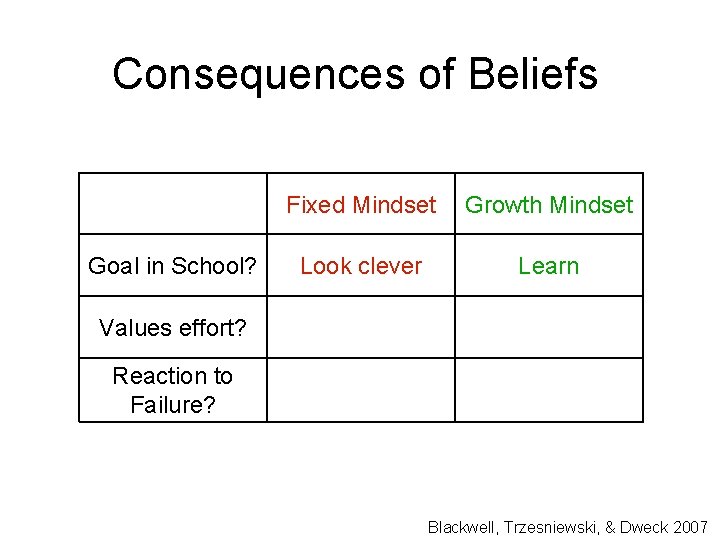
Consequences of Beliefs Goal in School? Fixed Mindset Growth Mindset Look clever Learn Values effort? Reaction to Failure? Blackwell, Trzesniewski, & Dweck 2007
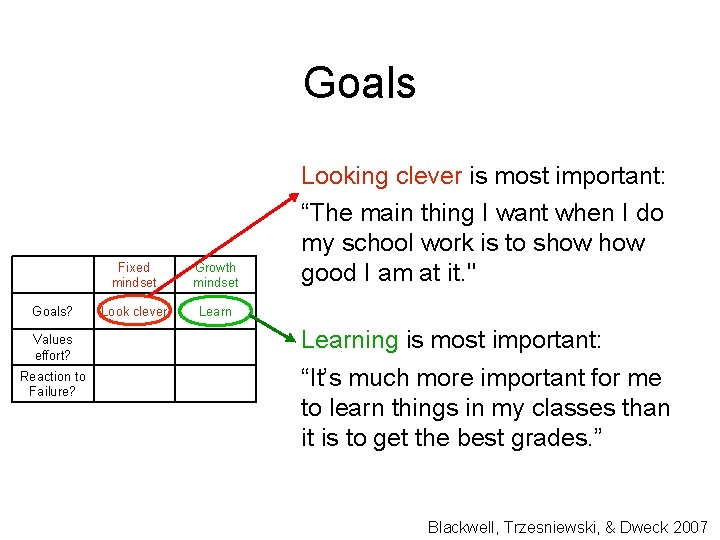
Goals? Values effort? Reaction to Failure? Fixed mindset Growth mindset Look clever Learn Looking clever is most important: “The main thing I want when I do my school work is to show good I am at it. " Learning is most important: “It’s much more important for me to learn things in my classes than it is to get the best grades. ” Blackwell, Trzesniewski, & Dweck 2007
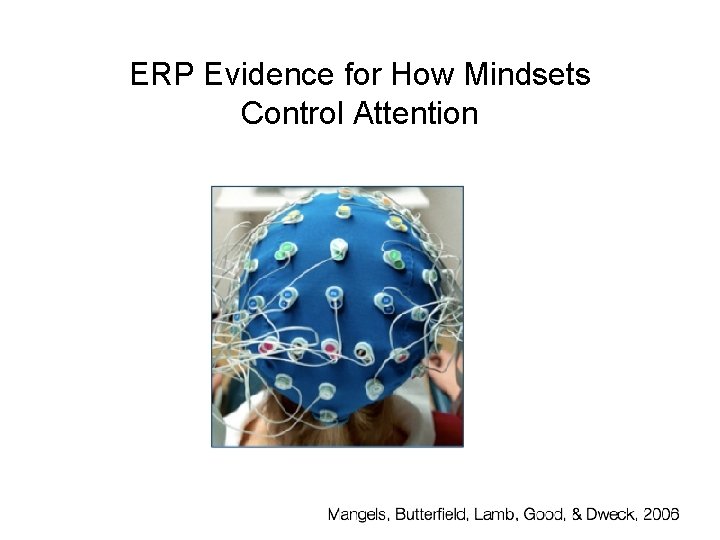
ERP Evidence for How Mindsets Control Attention
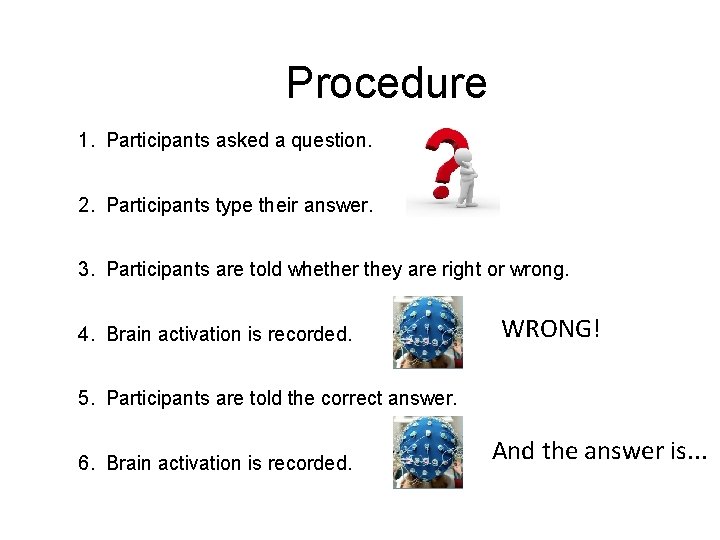
Procedure 1. Participants asked a question. 2. Participants type their answer. 3. Participants are told whether they are right or wrong. 4. Brain activation is recorded. WRONG! 5. Participants are told the correct answer. 6. Brain activation is recorded. And the answer is. . .
Consequences of Beliefs Goal in School? Fixed Mindset Growth Mindset Look clever Learn Values effort? Reaction to Failure? Blackwell, Trzesniewski, & Dweck 2007
Consequences of Beliefs Fixed Mindset Growth Mindset Goal in School? Look clever Learn Values effort? No Reaction to Failure? Blackwell, Trzesniewski, & Dweck 2007
Consequences of Beliefs Fixed Mindset Growth Mindset Goal in School? Look clever Learn Values effort? No Yes Reaction to Failure? Blackwell, Trzesniewski, & Dweck 2007
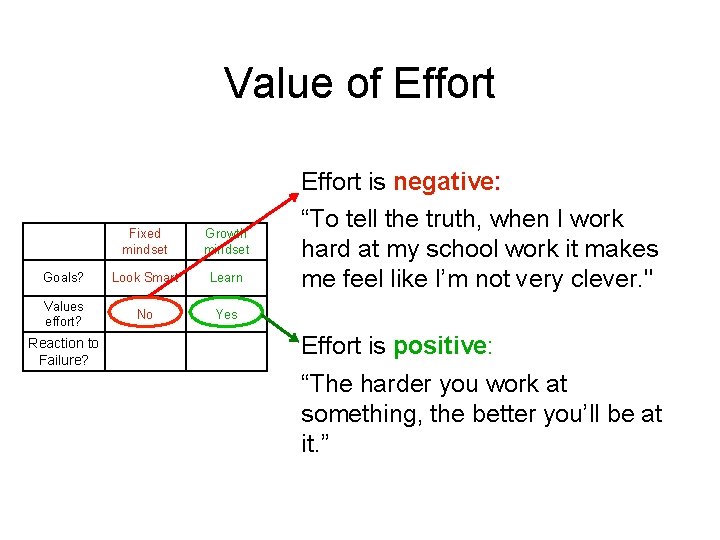
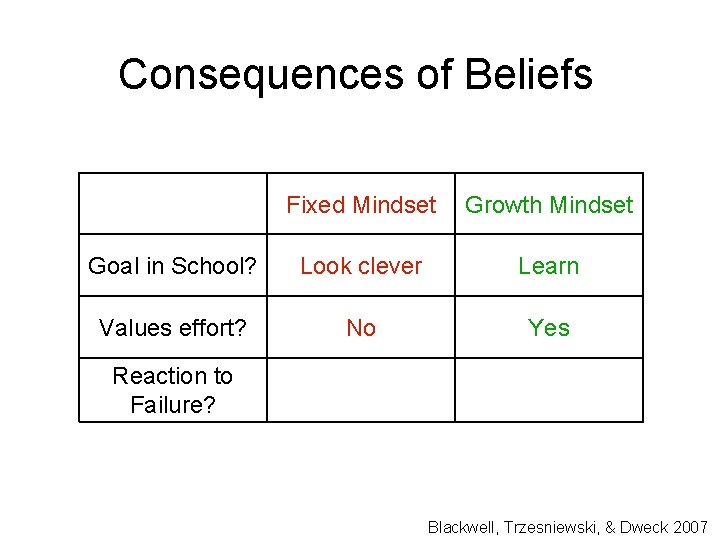
Value of Effort Fixed mindset Growth mindset Goals? Look Smart Learn Values effort? No Yes Reaction to Failure? Effort is negative: “To tell the truth, when I work hard at my school work it makes me feel like I’m not very clever. " Effort is positive: “The harder you work at something, the better you’ll be at it. ”
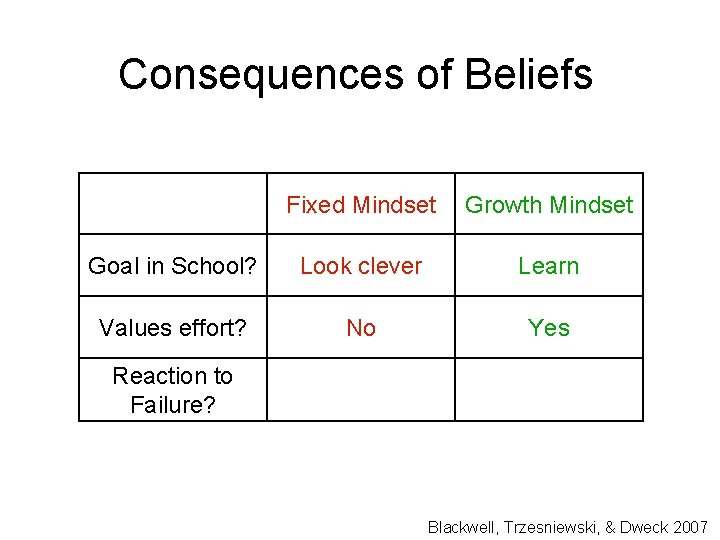
Consequences of Beliefs Fixed Mindset Growth Mindset Goal in School? Look clever Learn Values effort? No Yes Reaction to Failure? Blackwell, Trzesniewski, & Dweck 2007
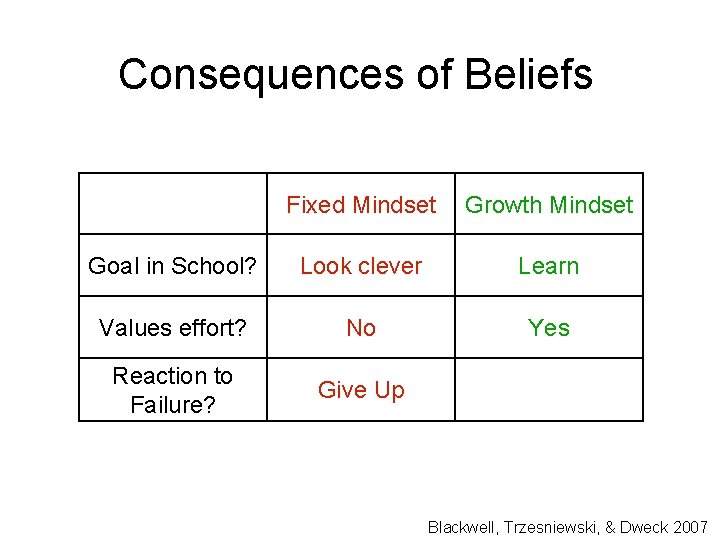
Consequences of Beliefs Fixed Mindset Growth Mindset Goal in School? Look clever Learn Values effort? No Yes Reaction to Failure? Give Up Blackwell, Trzesniewski, & Dweck 2007
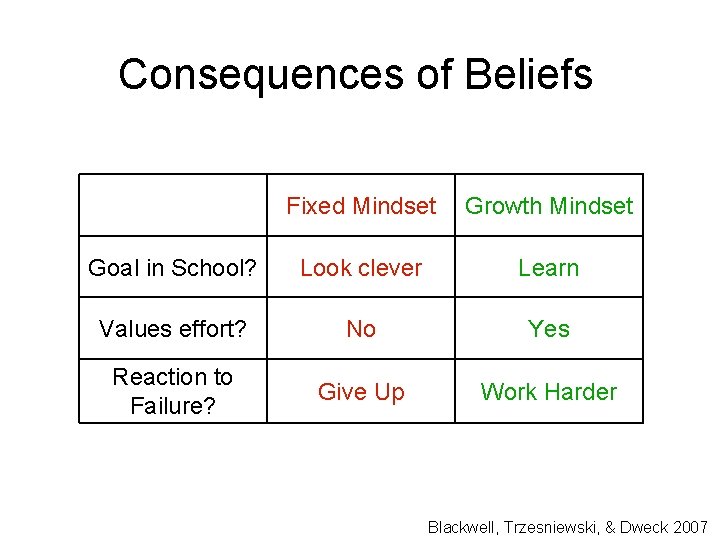
Consequences of Beliefs Fixed Mindset Growth Mindset Goal in School? Look clever Learn Values effort? No Yes Reaction to Failure? Give Up Work Harder Blackwell, Trzesniewski, & Dweck 2007
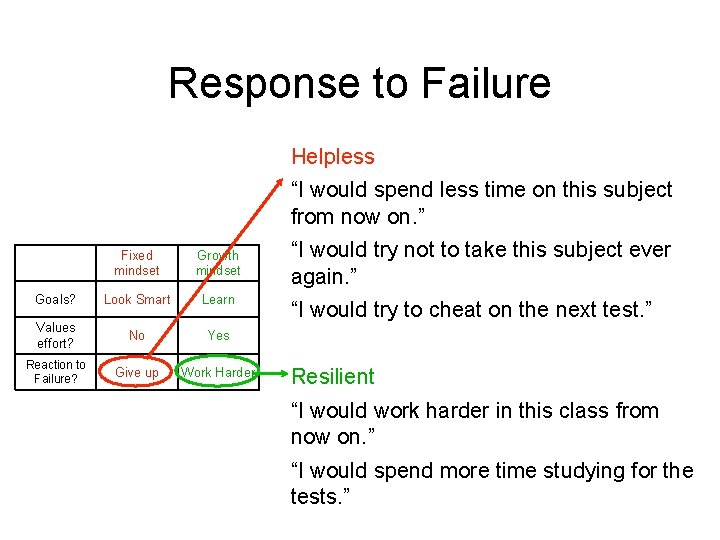
Response to Failure Helpless “I would spend less time on this subject from now on. ” Fixed mindset Growth mindset Goals? Look Smart Learn Values effort? No Yes Reaction to Failure? Give up Work Harder “I would try not to take this subject ever again. ” “I would try to cheat on the next test. ” Resilient “I would work harder in this class from now on. ” “I would spend more time studying for the tests. ”
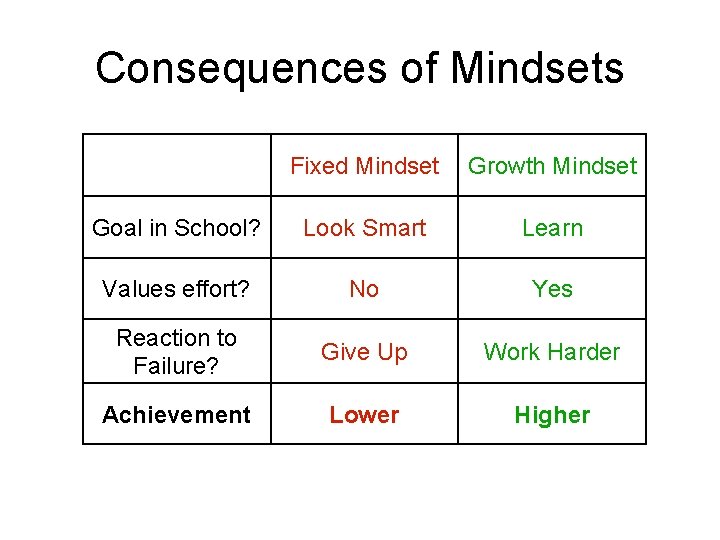
Consequences of Mindsets Fixed Mindset Growth Mindset Goal in School? Look Smart Learn Values effort? No Yes Reaction to Failure? Give Up Work Harder Achievement Lower Higher
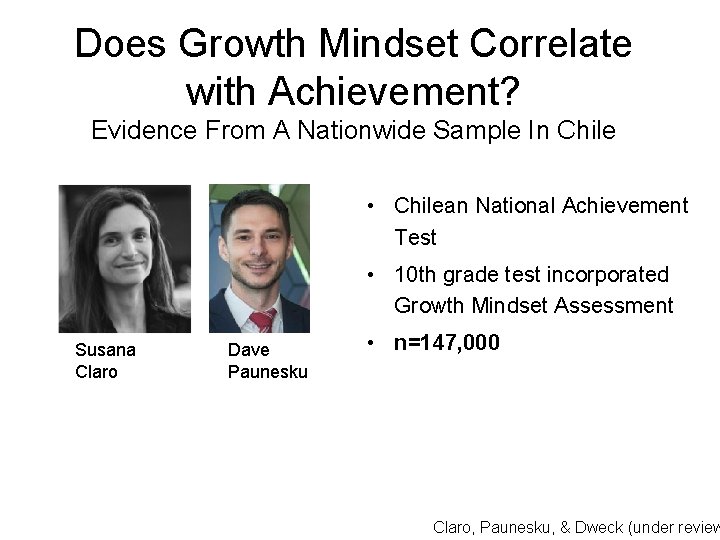
Does Growth Mindset Correlate with Achievement? Evidence From A Nationwide Sample In Chile • Chilean National Achievement Test • 10 th grade test incorporated Growth Mindset Assessment Susana Claro Dave Paunesku • n=147, 000 Claro, Paunesku, & Dweck (under review
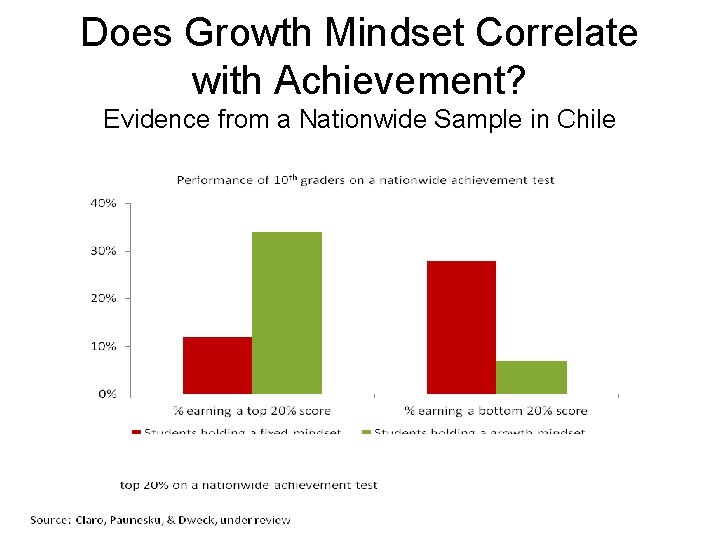
Does Growth Mindset Correlate with Achievement? Evidence from a Nationwide Sample in Chile
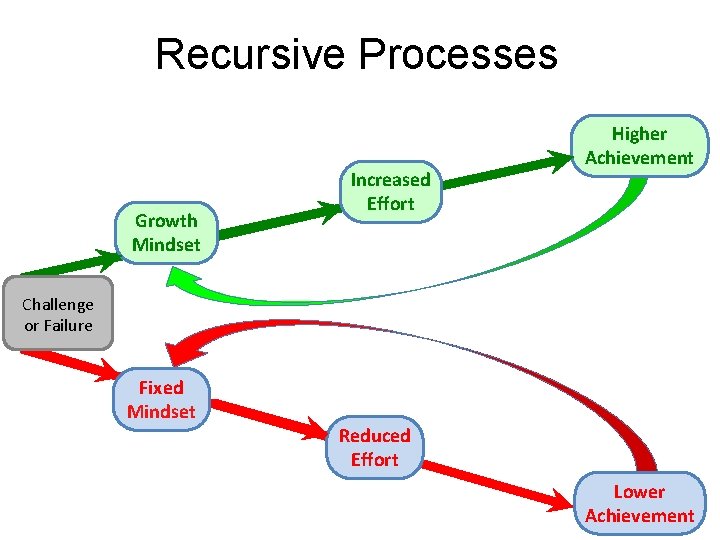
Recursive Processes Growth Mindset Increased Effort Higher Achievement Challenge or Failure Fixed Mindset Reduced Effort Lower Achievement
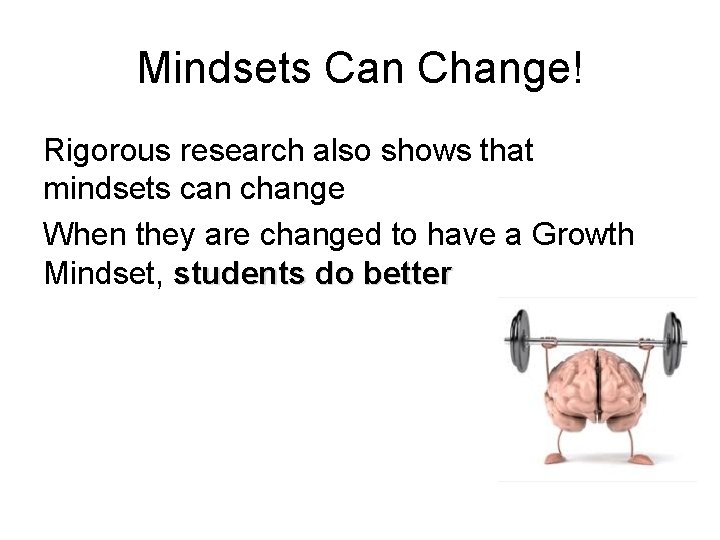
Mindsets Can Change! Rigorous research also shows that mindsets can change When they are changed to have a Growth Mindset, students do better
How Do Everyday Interactions Shape Mindsets? • The language we use tells others what we believe and what we value • Feedback tells us what is expected of us and what goals we should have
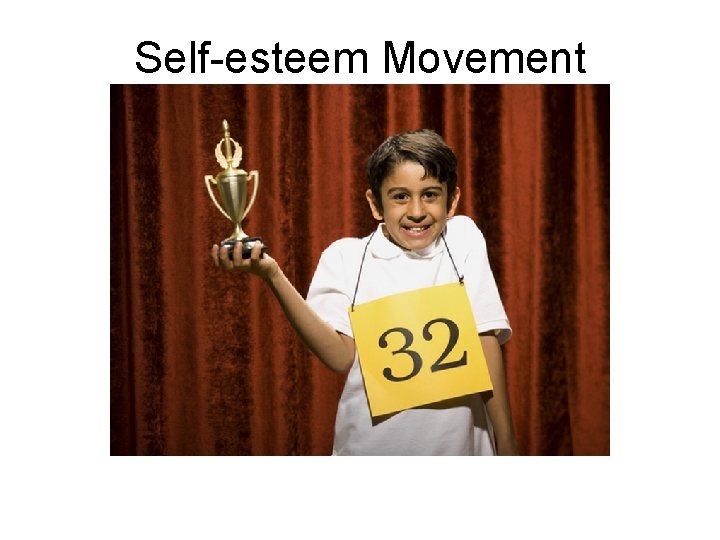
Self-esteem Movement
Praise • Research Question: Do different kinds of praise influence students’ response to failure? Claudia Mueller
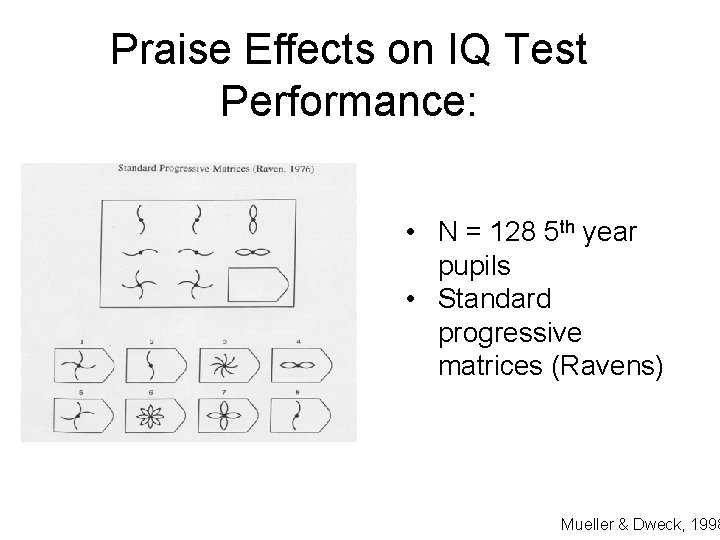
Praise Effects on IQ Test Performance: • N = 128 5 th year pupils • Standard progressive matrices (Ravens) Mueller & Dweck, 1998
Praise Effects on IQ Test Performance: • Control Group: “Wow, that’s a really good score. ” • Intelligence Praise: “Wow, that’s a really good score. You must be clever at this. ” • Effort (Process) Praise: “Wow, that’s a really good score. You must have tried really hard. ” Mueller & Dweck, 1998
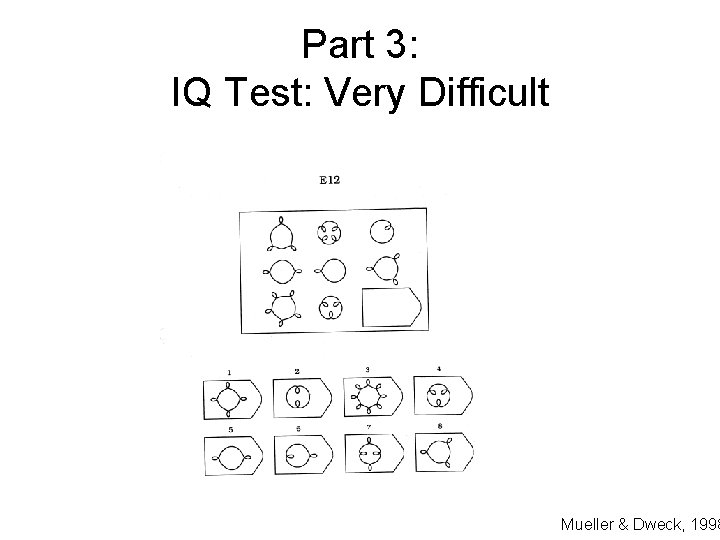
Part 3: IQ Test: Very Difficult Mueller & Dweck, 1998
After Setback “That’s a lot worse” Mueller & Dweck, 1998
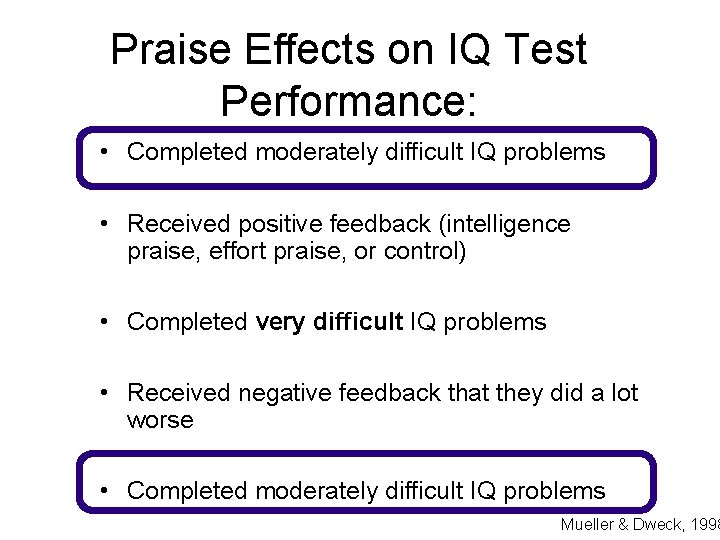
Praise Effects on IQ Test Performance: • Completed moderately difficult IQ problems • Received positive feedback (intelligence praise, effort praise, or control) • Completed very difficult IQ problems • Received negative feedback that they did a lot worse • Completed moderately difficult IQ problems Mueller & Dweck, 1998
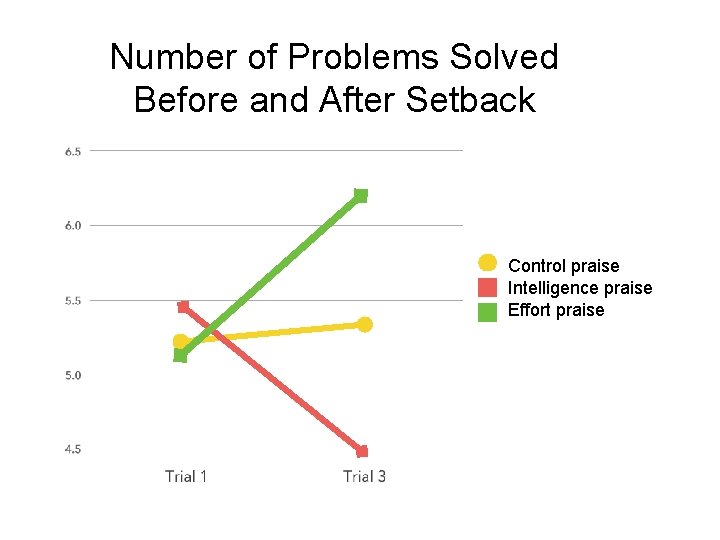
Number of Problems Solved Before and After Setback Control praise Intelligence praise Effort praise
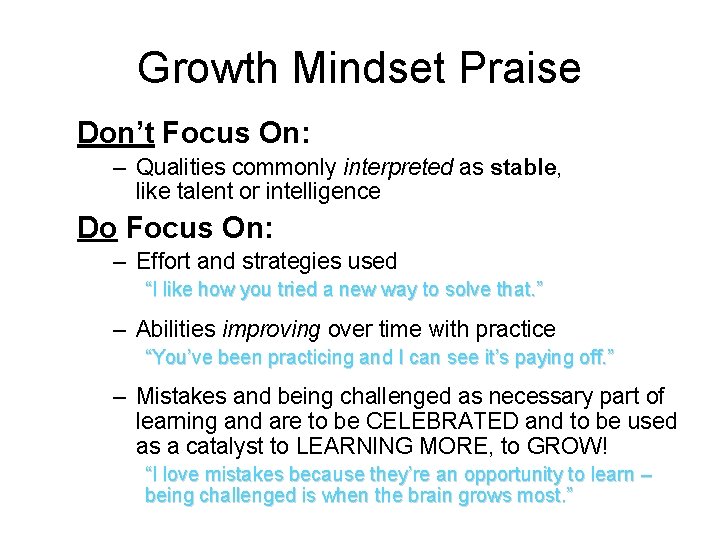
Growth Mindset Praise Don’t Focus On: – Qualities commonly interpreted as stable, like talent or intelligence Do Focus On: – Effort and strategies used “I like how you tried a new way to solve that. ” – Abilities improving over time with practice “You’ve been practicing and I can see it’s paying off. ” – Mistakes and being challenged as necessary part of learning and are to be CELEBRATED and to be used as a catalyst to LEARNING MORE, to GROW! “I love mistakes because they’re an opportunity to learn – being challenged is when the brain grows most. ”

Thank you for listening!
- Slides: 38