
Direct Practice in Social Work 2 e Scott
- Slides: 23
Direct Practice in Social Work, 2 e Scott W. Boyle Grafton H. Hull, Jr. Jannah Hurn Mather Larry Lorenzo Smith O. William Farley University of Utah, College of Social Work Power Points by Julie Emmer, University of Central Florida This multimedia product and its contents are protected under copyright law. The following are prohibited by law: any public performance or display, including transmission of any image over a network; Preparation of any derivative work, including the extraction, in whole or in part, of any images; Any rental, lease, or lending of the program. © 2009 Allyn & Bacon
Direct Practice in Social Work In Chapter 13, we will explore: n How evaluation applies to direct practice n Qualitative and quantitative evaluation designs n Threats to both internal and external validity n Cultural competence in evaluation © 2009 Allyn & Bacon
Evaluation: determining the effectiveness and accomplishment of outcomes n n n It allows us to determine what works It is an ethical obligation It provides accountability to our funding sources It encourages efficiency It motivates clients by providing positive feedback © 2009 Allyn & Bacon
Ethical concerns in evaluation n n n Confidentiality Conflicting loyalty Client influence Client consent Objectivity Accurate generalization of findings © 2009 Allyn & Bacon
Evaluation approaches for direct practice Quantitative vs. Qualitative Evaluation © 2009 Allyn & Bacon
Single system designs Social workers collect data from: n Clients n Family members n Organizational records (school, employer) n Behavioral observation n Rating scales © 2009 Allyn & Bacon
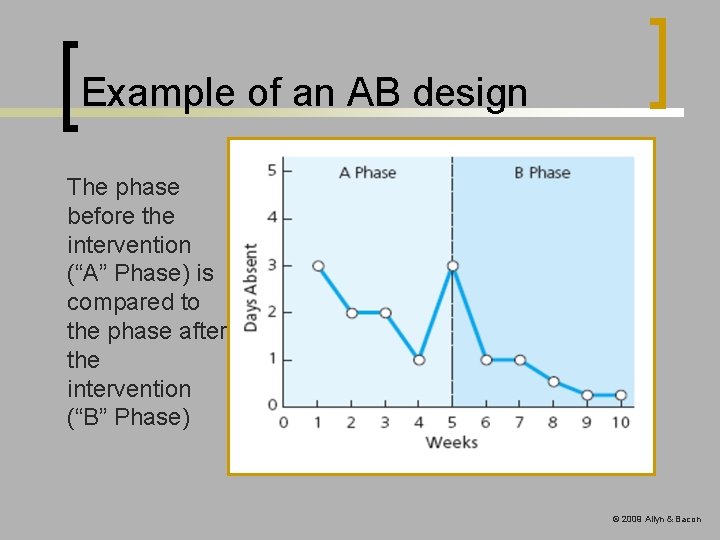
Example of an AB design The phase before the intervention (“A” Phase) is compared to the phase after the intervention (“B” Phase) © 2009 Allyn & Bacon
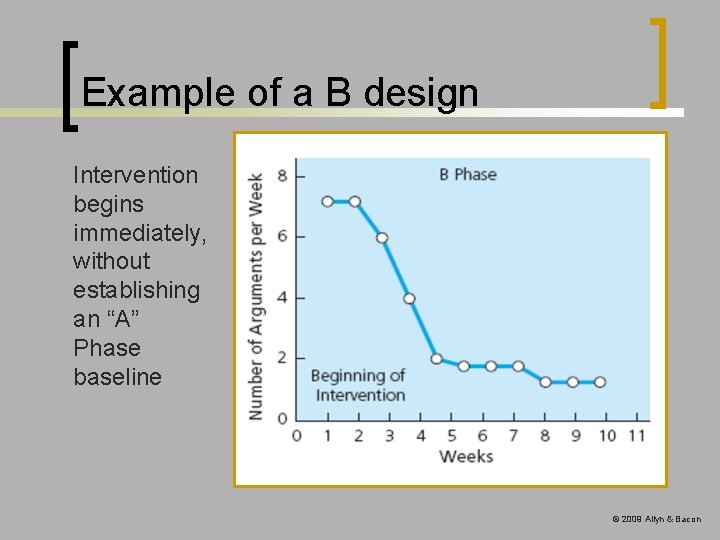
Example of a B design Intervention begins immediately, without establishing an “A” Phase baseline © 2009 Allyn & Bacon
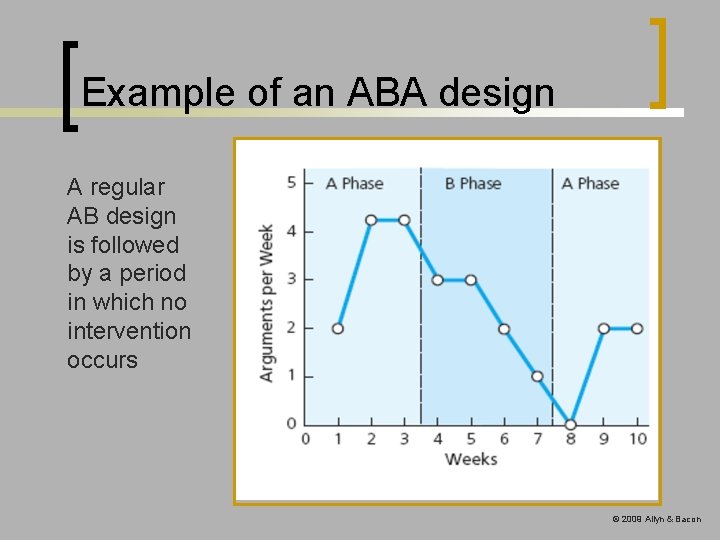
Example of an ABA design A regular AB design is followed by a period in which no intervention occurs © 2009 Allyn & Bacon
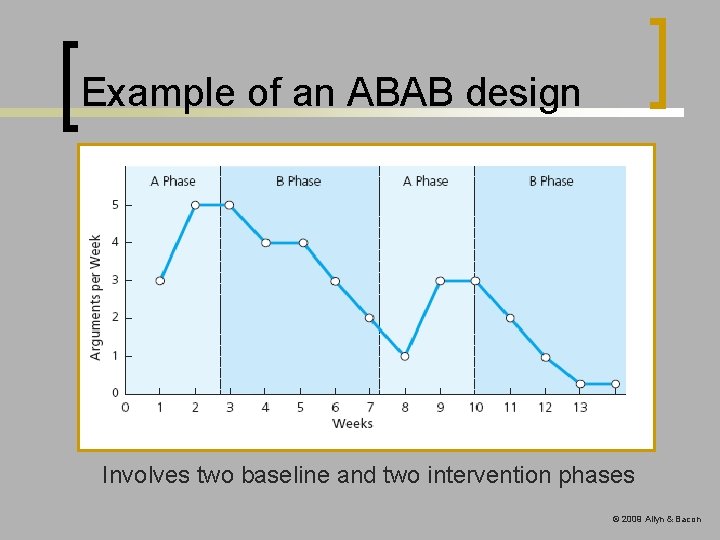
Example of an ABAB design Involves two baseline and two intervention phases © 2009 Allyn & Bacon
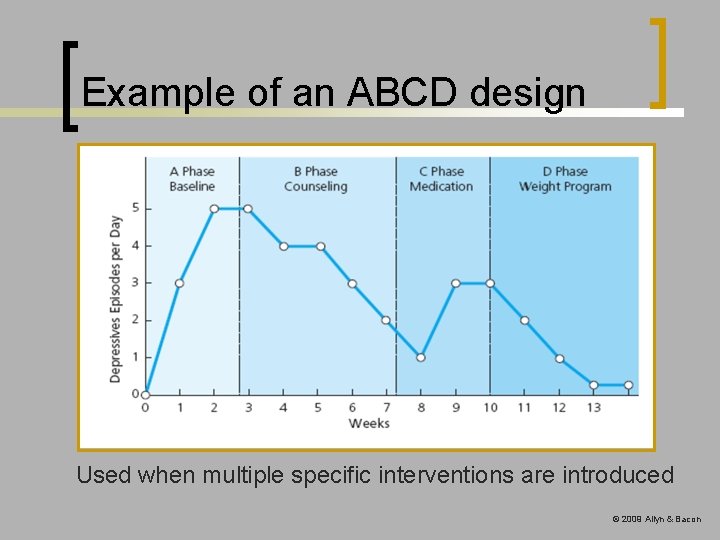
Example of an ABCD design Used when multiple specific interventions are introduced © 2009 Allyn & Bacon
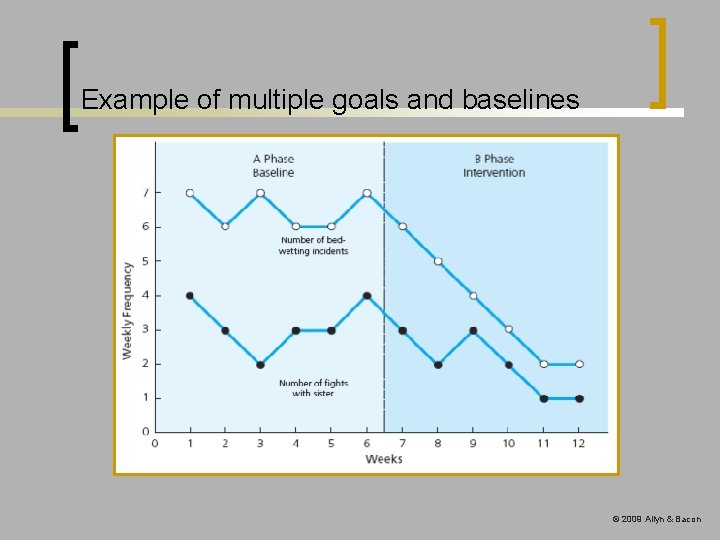
Example of multiple goals and baselines © 2009 Allyn & Bacon
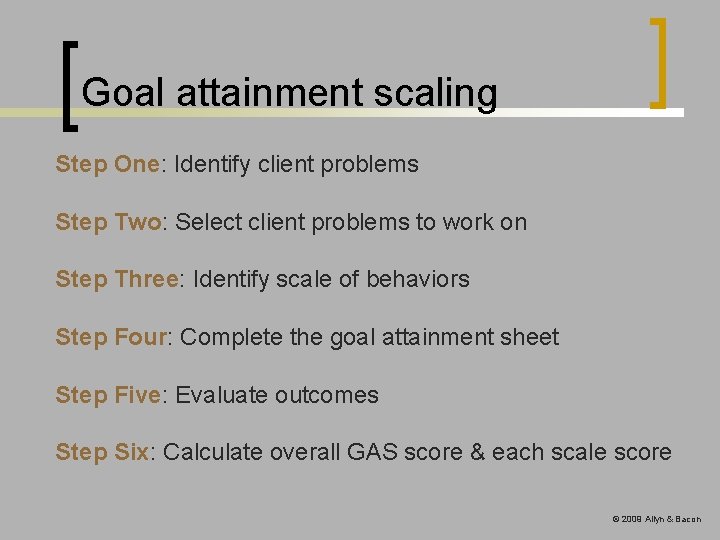
Goal attainment scaling Step One: Identify client problems Step Two: Select client problems to work on Step Three: Identify scale of behaviors Step Four: Complete the goal attainment sheet Step Five: Evaluate outcomes Step Six: Calculate overall GAS score & each scale score © 2009 Allyn & Bacon
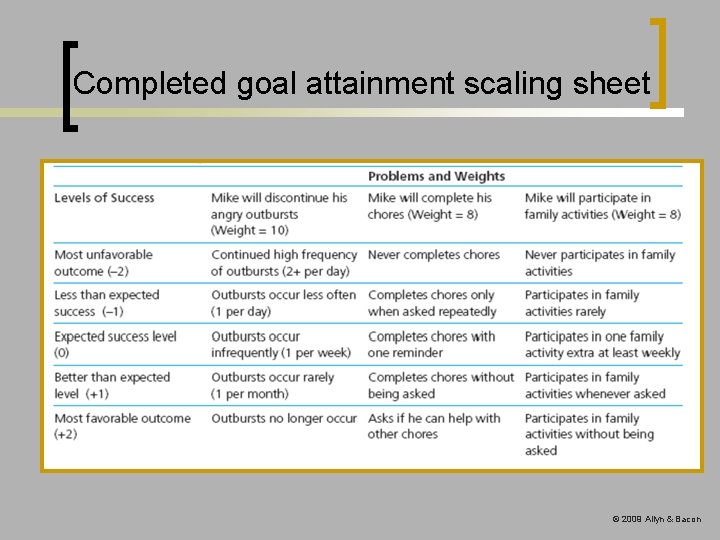
Completed goal attainment scaling sheet © 2009 Allyn & Bacon
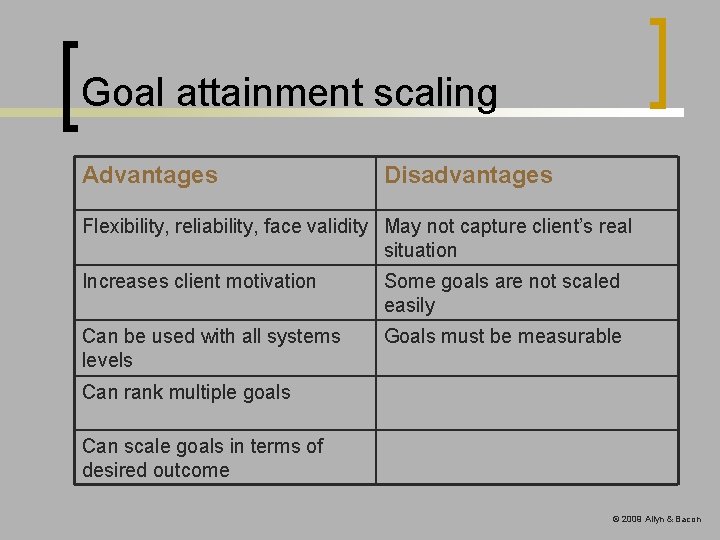
Goal attainment scaling Advantages Disadvantages Flexibility, reliability, face validity May not capture client’s real situation Increases client motivation Some goals are not scaled easily Can be used with all systems levels Goals must be measurable Can rank multiple goals Can scale goals in terms of desired outcome © 2009 Allyn & Bacon
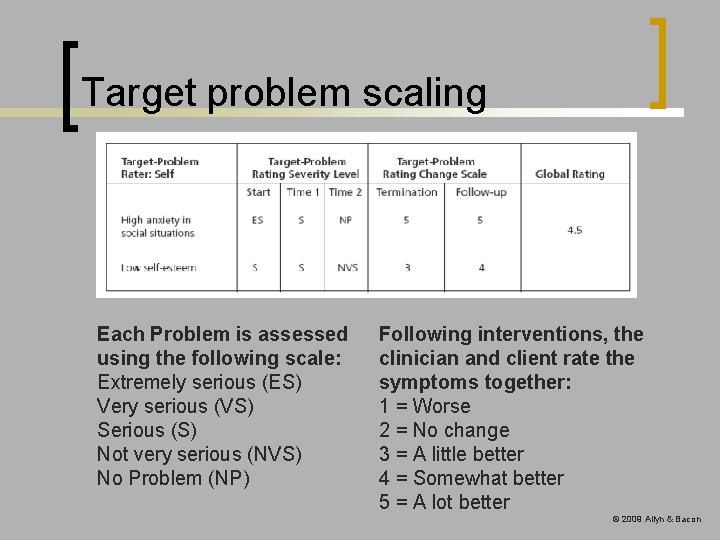
Target problem scaling Each Problem is assessed using the following scale: Extremely serious (ES) Very serious (VS) Serious (S) Not very serious (NVS) No Problem (NP) Following interventions, the clinician and client rate the symptoms together: 1 = Worse 2 = No change 3 = A little better 4 = Somewhat better 5 = A lot better © 2009 Allyn & Bacon
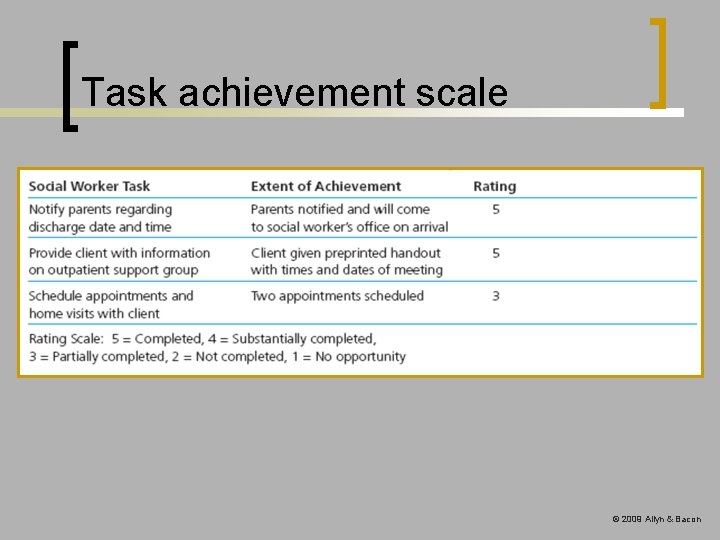
Task achievement scale © 2009 Allyn & Bacon
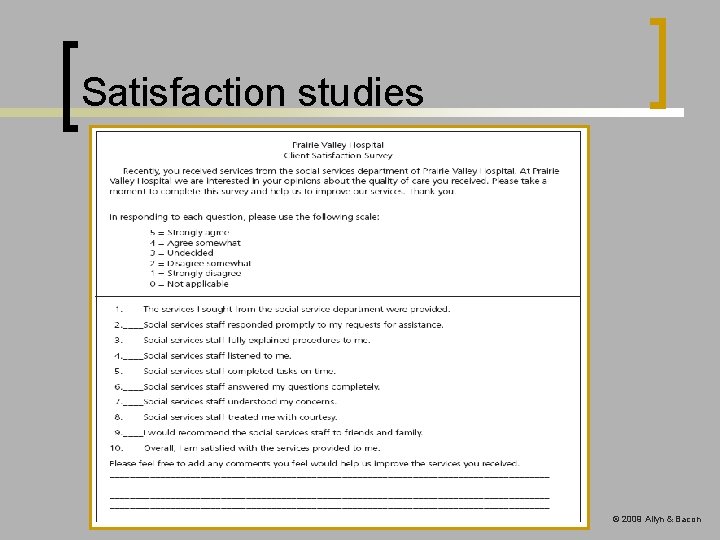
Satisfaction studies © 2009 Allyn & Bacon
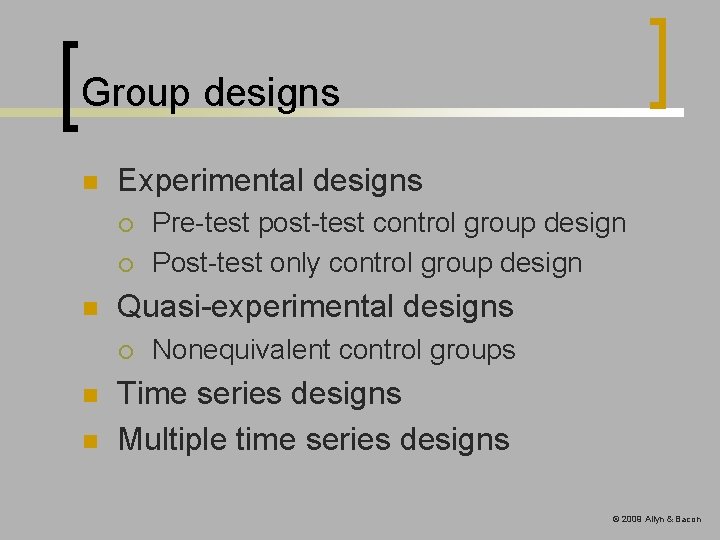
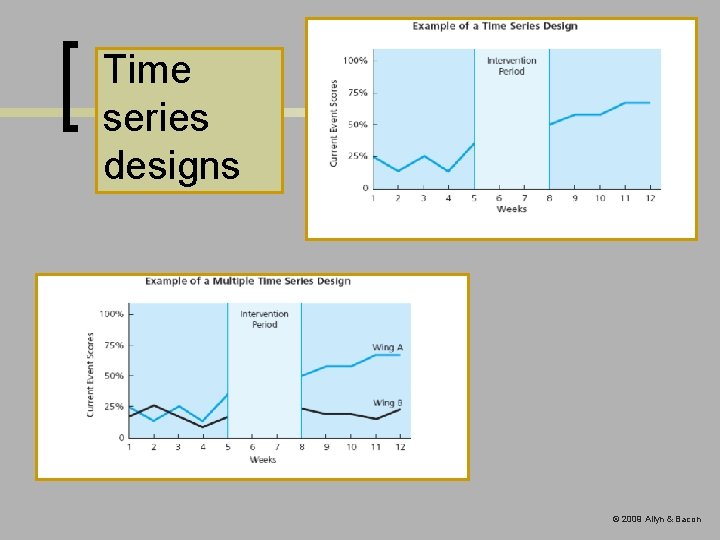
Group designs n Experimental designs ¡ ¡ n Quasi-experimental designs ¡ n n Pre-test post-test control group design Post-test only control group design Nonequivalent control groups Time series designs Multiple time series designs © 2009 Allyn & Bacon
Time series designs © 2009 Allyn & Bacon
Threats to internal validity n n n n Instrumentation Maturation Mortality Selection bias Statistical regression Diffusion of treatment Testing History © 2009 Allyn & Bacon
Threats to external validity n n n Differences in clients Practitioner effects Measurement differences Different dependent variables Interaction of history and intervention Different interventions © 2009 Allyn & Bacon
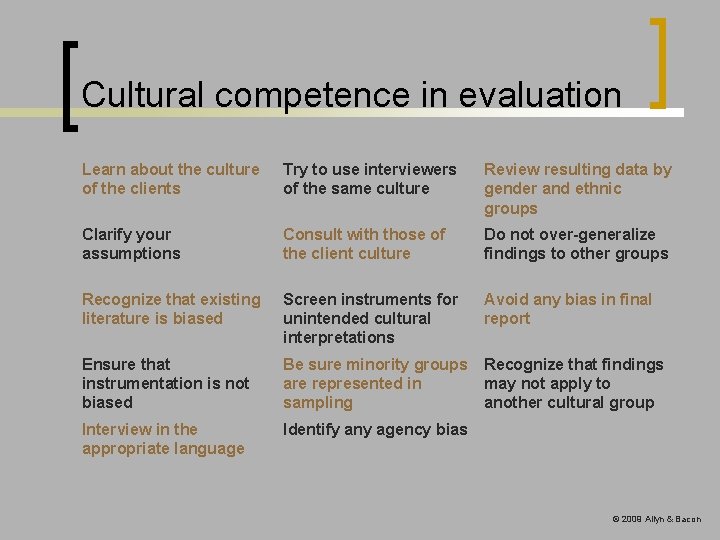
Cultural competence in evaluation Learn about the culture of the clients Try to use interviewers of the same culture Review resulting data by gender and ethnic groups Clarify your assumptions Consult with those of the client culture Do not over-generalize findings to other groups Recognize that existing literature is biased Screen instruments for unintended cultural interpretations Avoid any bias in final report Ensure that instrumentation is not biased Be sure minority groups are represented in sampling Recognize that findings may not apply to another cultural group Interview in the appropriate language Identify any agency bias © 2009 Allyn & Bacon