
A Guided Tour Through Arena Chapter 3 Last
- Slides: 70
A Guided Tour Through Arena Chapter 3 Last revision September 22, 2017 Simulation with Arena, 6 th ed. Chapter 3 – A Guided Tour Through Arena Slide 1 of 70
What We’ll Do. . . • • Start Arena Load, explore, run an existing model § § § • • • § Basically same as hand simulation in Chapter 2 Browse dialogs and menus Run model Look at results Construct same model from scratch Use just these basic building blocks in case study to address real operational question Tour menus, toolbars, drawing, printing Help system Options for running and control Simulation with Arena, 6 th ed. Chapter 3 – A Guided Tour Through Arena Slide 2 of 70
Behavior of Arena • Arena is a true Windows application § § § • Appearance, operation, functions, are standard Interoperability with other software (MS Office, CAD) Interact, communicate with other software (Chapter 10) Assume you already know basics of Windows: § § § § Disks, files, folders, paths Mousing, keyboarding Resizing, moving, maximizing, minimizing windows Menu operations Ctrl, Alt, Shift keys Cut, copy, paste Filling out dialog fields Simulation with Arena, 6 th ed. Chapter 3 – A Guided Tour Through Arena Slide 3 of 70
Starting Up • • Installing Arena – Appendix D Locate icon or shortcut; double-click § • • § See File, View, Tools, Help menus § Other menus present if a model file is open Toolbars with buttons § • • Or, Start > All Programs > Rockwell Software > Arena Licensed Mode vs. Training/Evaluation Mode (STUDENT) Unless a model file is open, only New model file, Open model file, Template Attach/Detach, Context Help (click it, then click on buttons or menu items) Tooltips – roll over toolbar buttons for names Quitting Arena: File > Exit, Alt+F 4, or top right Simulation with Arena, 6 th ed. Chapter 3 – A Guided Tour Through Arena Slide 4 of 70
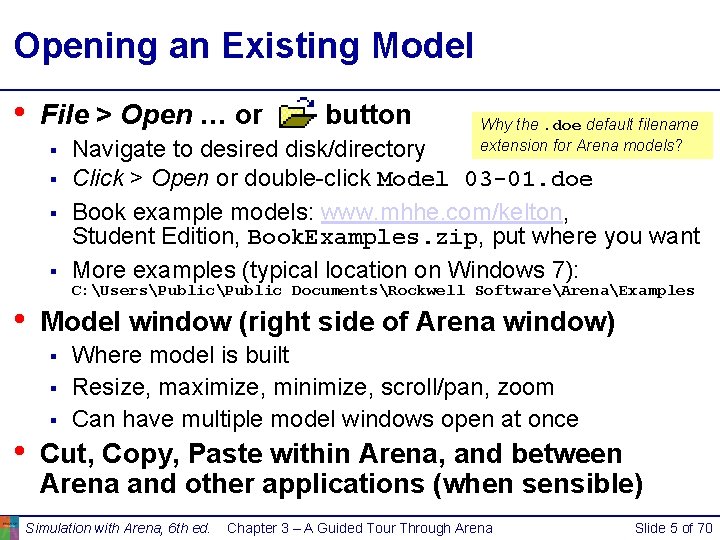
Opening an Existing Model • File > Open … or § § • Why the. doe default filename extension for Arena models? Navigate to desired disk/directory Click > Open or double-click Model 03 -01. doe Book example models: www. mhhe. com/kelton, Student Edition, Book. Examples. zip, put where you want More examples (typical location on Windows 7): C: UsersPublic DocumentsRockwell SoftwareArenaExamples Model window (right side of Arena window) § § § • button Where model is built Resize, maximize, minimize, scroll/pan, zoom Can have multiple model windows open at once Cut, Copy, Paste within Arena, and between Arena and other applications (when sensible) Simulation with Arena, 6 th ed. Chapter 3 – A Guided Tour Through Arena Slide 5 of 70
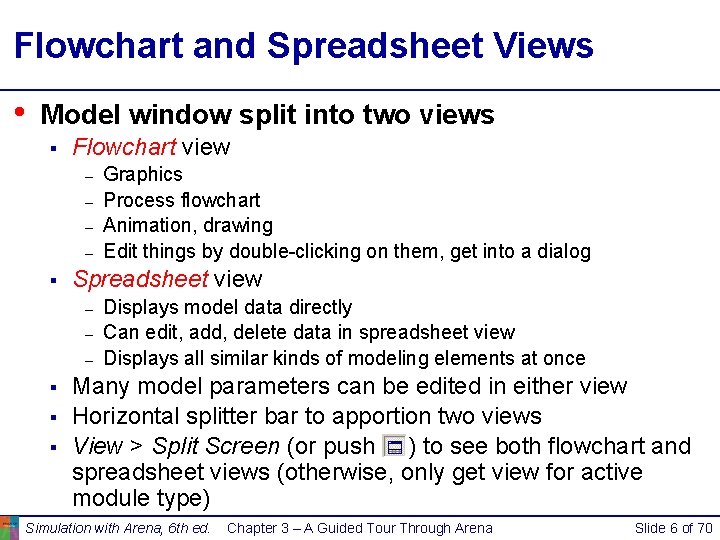
Flowchart and Spreadsheet Views • Model window split into two views § Flowchart view – – § Spreadsheet view – – – § § § Graphics Process flowchart Animation, drawing Edit things by double-clicking on them, get into a dialog Displays model data directly Can edit, add, delete data in spreadsheet view Displays all similar kinds of modeling elements at once Many model parameters can be edited in either view Horizontal splitter bar to apportion two views View > Split Screen (or push ) to see both flowchart and spreadsheet views (otherwise, only get view for active module type) Simulation with Arena, 6 th ed. Chapter 3 – A Guided Tour Through Arena Slide 6 of 70
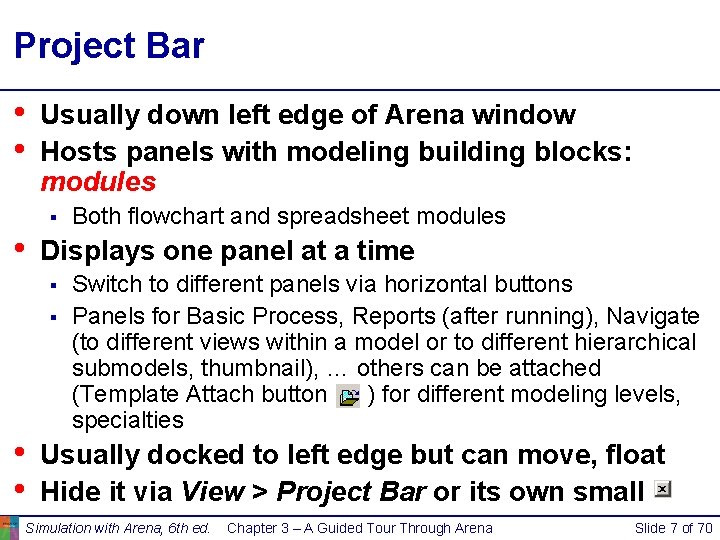
Project Bar • • Usually down left edge of Arena window Hosts panels with modeling building blocks: modules § • Displays one panel at a time § § • • Both flowchart and spreadsheet modules Switch to different panels via horizontal buttons Panels for Basic Process, Reports (after running), Navigate (to different views within a model or to different hierarchical submodels, thumbnail), … others can be attached (Template Attach button ) for different modeling levels, specialties Usually docked to left edge but can move, float Hide it via View > Project Bar or its own small Simulation with Arena, 6 th ed. Chapter 3 – A Guided Tour Through Arena Slide 7 of 70
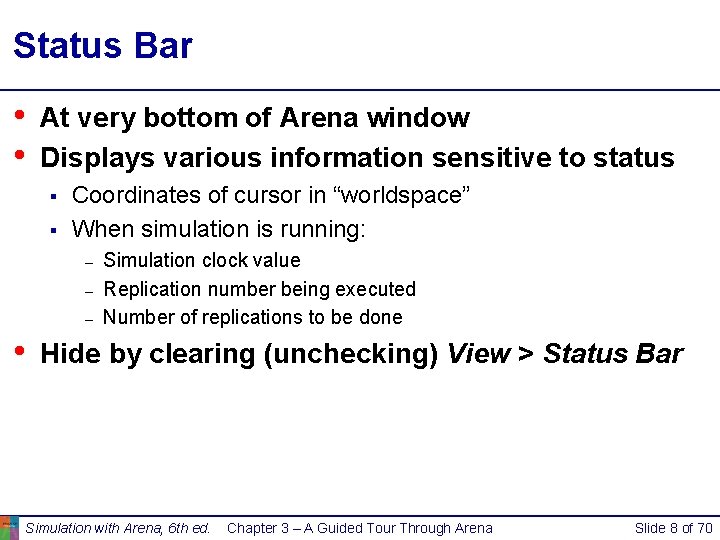
Status Bar • • At very bottom of Arena window Displays various information sensitive to status § § Coordinates of cursor in “worldspace” When simulation is running: – – – • Simulation clock value Replication number being executed Number of replications to be done Hide by clearing (unchecking) View > Status Bar Simulation with Arena, 6 th ed. Chapter 3 – A Guided Tour Through Arena Slide 8 of 70
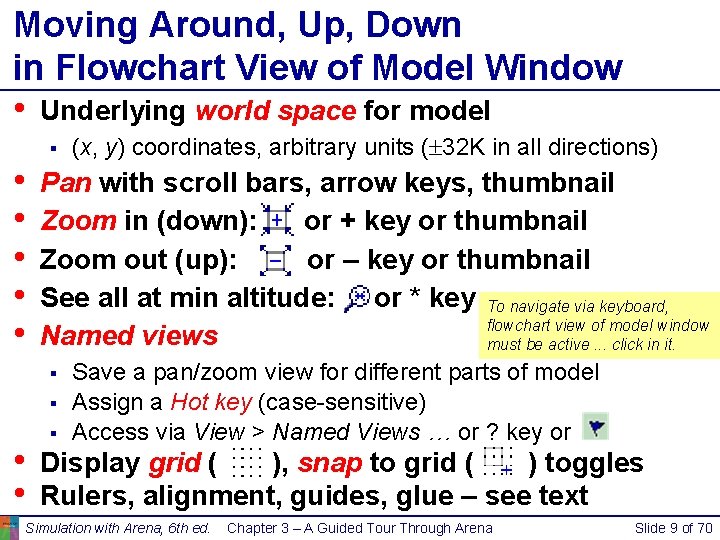
Moving Around, Up, Down in Flowchart View of Model Window • Underlying world space for model § • • • Pan with scroll bars, arrow keys, thumbnail Zoom in (down): or + key or thumbnail Zoom out (up): or – key or thumbnail See all at min altitude: or * key To navigate via keyboard, flowchart view of model window Named views must be active. . . click in it. § § • • (x, y) coordinates, arbitrary units ( 32 K in all directions) § Save a pan/zoom view for different parts of model Assign a Hot key (case-sensitive) Access via View > Named Views … or ? key or Display grid ( ), snap to grid ( ) toggles Rulers, alignment, guides, glue – see text Simulation with Arena, 6 th ed. Chapter 3 – A Guided Tour Through Arena Slide 9 of 70
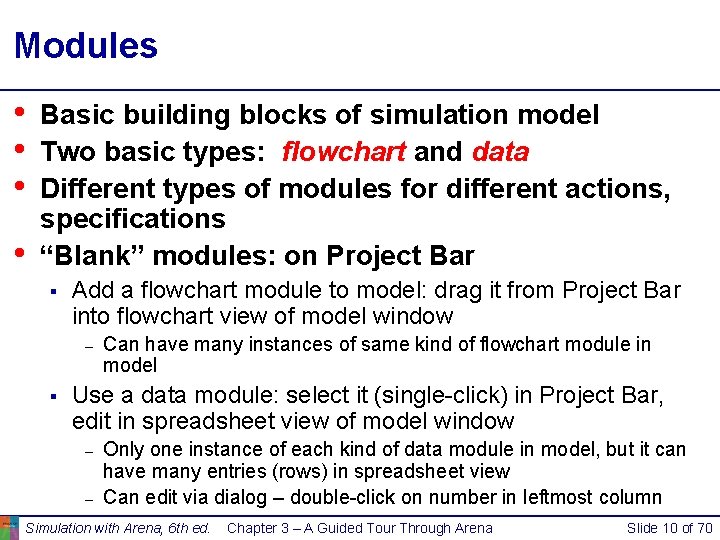
Modules • • Basic building blocks of simulation model Two basic types: flowchart and data Different types of modules for different actions, specifications “Blank” modules: on Project Bar § Add a flowchart module to model: drag it from Project Bar into flowchart view of model window – § Can have many instances of same kind of flowchart module in model Use a data module: select it (single-click) in Project Bar, edit in spreadsheet view of model window – – Only one instance of each kind of data module in model, but it can have many entries (rows) in spreadsheet view Can edit via dialog – double-click on number in leftmost column Simulation with Arena, 6 th ed. Chapter 3 – A Guided Tour Through Arena Slide 10 of 70
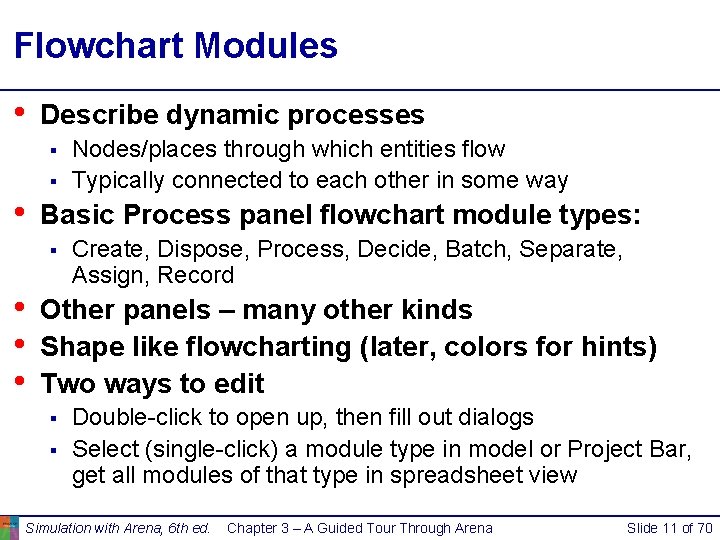
Flowchart Modules • Describe dynamic processes § § • Basic Process panel flowchart module types: § • • • Nodes/places through which entities flow Typically connected to each other in some way Create, Dispose, Process, Decide, Batch, Separate, Assign, Record Other panels – many other kinds Shape like flowcharting (later, colors for hints) Two ways to edit § § Double-click to open up, then fill out dialogs Select (single-click) a module type in model or Project Bar, get all modules of that type in spreadsheet view Simulation with Arena, 6 th ed. Chapter 3 – A Guided Tour Through Arena Slide 11 of 70
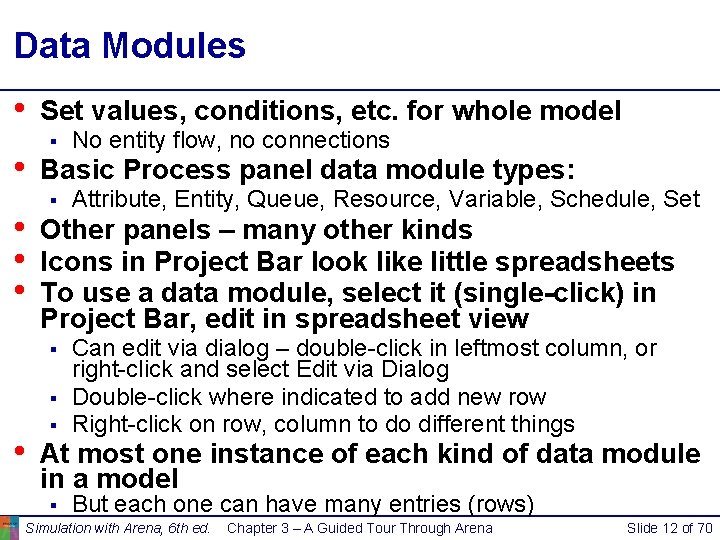
Data Modules • • • Set values, conditions, etc. for whole model § Basic Process panel data module types: § Attribute, Entity, Queue, Resource, Variable, Schedule, Set Other panels – many other kinds Icons in Project Bar look like little spreadsheets To use a data module, select it (single-click) in Project Bar, edit in spreadsheet view § • No entity flow, no connections § § Can edit via dialog – double-click in leftmost column, or right-click and select Edit via Dialog Double-click where indicated to add new row Right-click on row, column to do different things At most one instance of each kind of data module in a model § But each one can have many entries (rows) Simulation with Arena, 6 th ed. Chapter 3 – A Guided Tour Through Arena Slide 12 of 70
Relations Among Modules • Flowchart, data modules related via names for objects § • Arena keeps internal lists of different kinds of names § § • Queues, Resources, Entity types, Variables, Expressions, Sets, … many others Presents existing lists to you where appropriate Helps you remember names, protects you from typos All names you make up in a model must be unique across model, even across different types of modules Simulation with Arena, 6 th ed. Chapter 3 – A Guided Tour Through Arena Slide 13 of 70
Internal Model Documentation • Data Tips on modules, graphics – hover mouse over object to see § § § • • Default part – generic info on object (name, type) User-specified part – right-click on object, select Properties, enter text under Description Toggle display of Data tips via View > Data Tips Project Description – Run > Setup > Project Parameters, enter text under Project Description Model Documentation Report – Tools > Model Documentation Report § Generates HTML file with model details (can choose which kinds of details to include) Simulation with Arena, 6 th ed. Chapter 3 – A Guided Tour Through Arena Slide 14 of 70
Browsing Through Model 3 -1 • Open Model 03 -01. doe, Book Examples folder § • Three flowchart modules § • Create, Process, Dispose Entries in three data modules § • www. mhhe. com/kelton, Student Edition, Book. Examples. zip, unzip and put folder where you want on your system Entity, Queue, Resource Animation objects § § § Resource animation Two plots Some (passive) labels, “art” work Simulation with Arena, 6 th ed. Chapter 3 – A Guided Tour Through Arena Slide 15 of 70
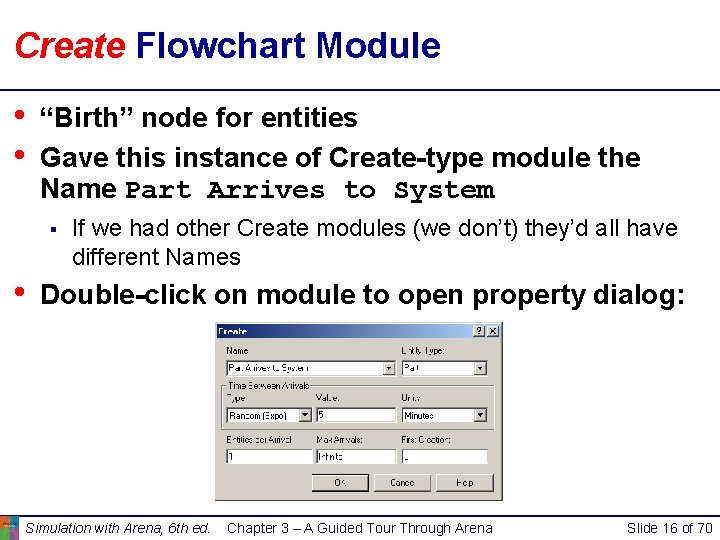
Create Flowchart Module • • “Birth” node for entities Gave this instance of Create-type module the Name Part Arrives to System § • If we had other Create modules (we don’t) they’d all have different Names Double-click on module to open property dialog: Simulation with Arena, 6 th ed. Chapter 3 – A Guided Tour Through Arena Slide 16 of 70
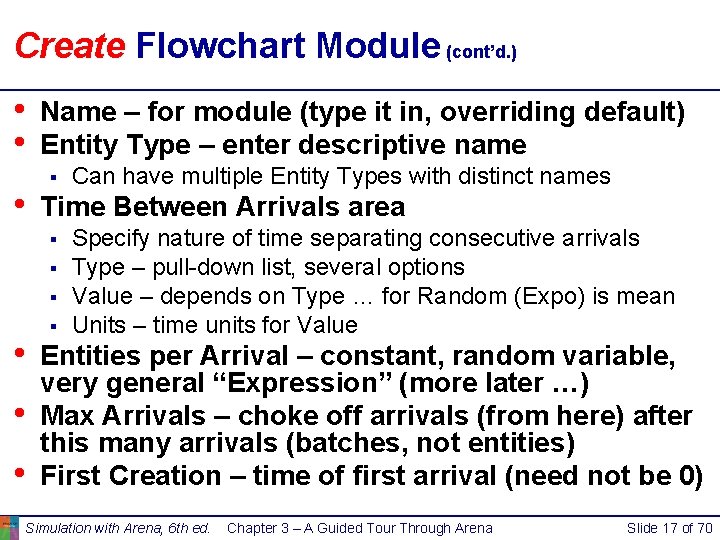
Create Flowchart Module (cont’d. ) • • • Name – for module (type it in, overriding default) Entity Type – enter descriptive name § Time Between Arrivals area § § § • • • Can have multiple Entity Types with distinct names § Specify nature of time separating consecutive arrivals Type – pull-down list, several options Value – depends on Type … for Random (Expo) is mean Units – time units for Value Entities per Arrival – constant, random variable, very general “Expression” (more later …) Max Arrivals – choke off arrivals (from here) after this many arrivals (batches, not entities) First Creation – time of first arrival (need not be 0) Simulation with Arena, 6 th ed. Chapter 3 – A Guided Tour Through Arena Slide 17 of 70
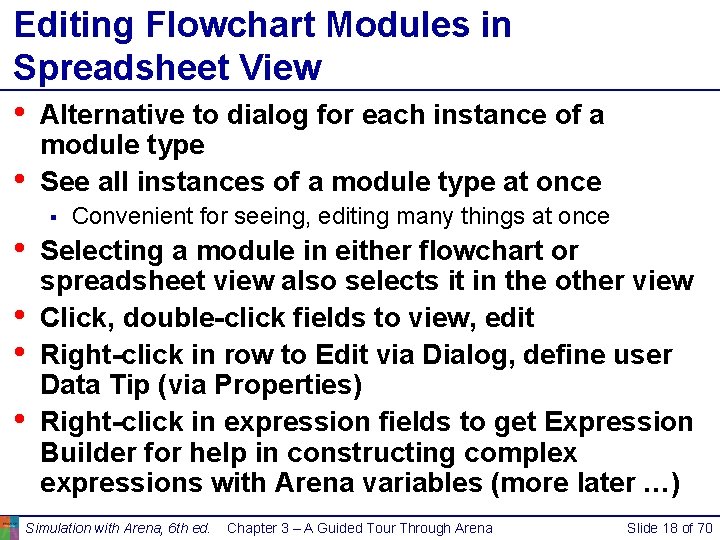
Editing Flowchart Modules in Spreadsheet View • Alternative to dialog for each instance of a • module type See all instances of a module type at once § • • Convenient for seeing, editing many things at once Selecting a module in either flowchart or spreadsheet view also selects it in the other view Click, double-click fields to view, edit Right-click in row to Edit via Dialog, define user Data Tip (via Properties) Right-click in expression fields to get Expression Builder for help in constructing complex expressions with Arena variables (more later …) Simulation with Arena, 6 th ed. Chapter 3 – A Guided Tour Through Arena Slide 18 of 70
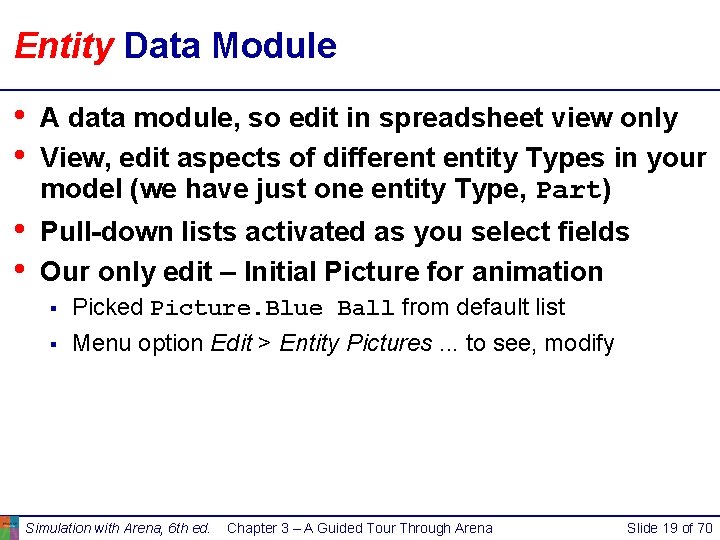
Entity Data Module • • A data module, so edit in spreadsheet view only View, edit aspects of different entity Types in your model (we have just one entity Type, Part) • • Pull-down lists activated as you select fields Our only edit – Initial Picture for animation § Picked Picture. Blue Ball from default list § Menu option Edit > Entity Pictures. . . to see, modify Simulation with Arena, 6 th ed. Chapter 3 – A Guided Tour Through Arena Slide 19 of 70
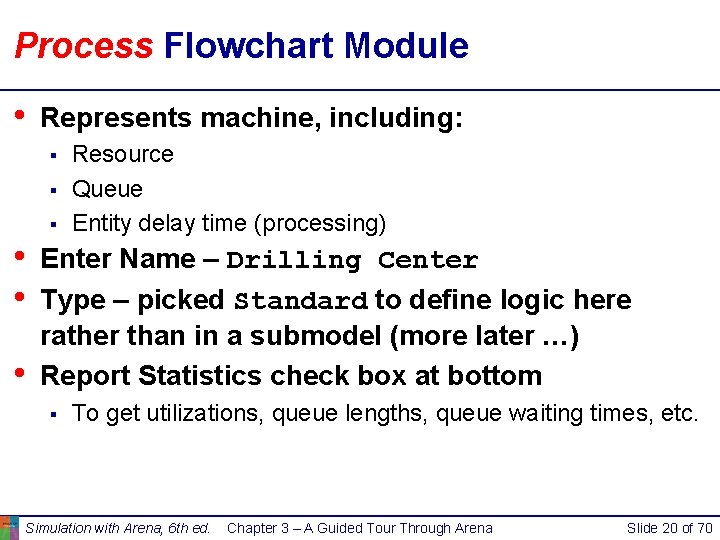
Process Flowchart Module • Represents machine, including: § § § • • • Resource Queue Entity delay time (processing) Enter Name – Drilling Center Type – picked Standard to define logic here rather than in a submodel (more later …) Report Statistics check box at bottom § To get utilizations, queue lengths, queue waiting times, etc. Simulation with Arena, 6 th ed. Chapter 3 – A Guided Tour Through Arena Slide 20 of 70
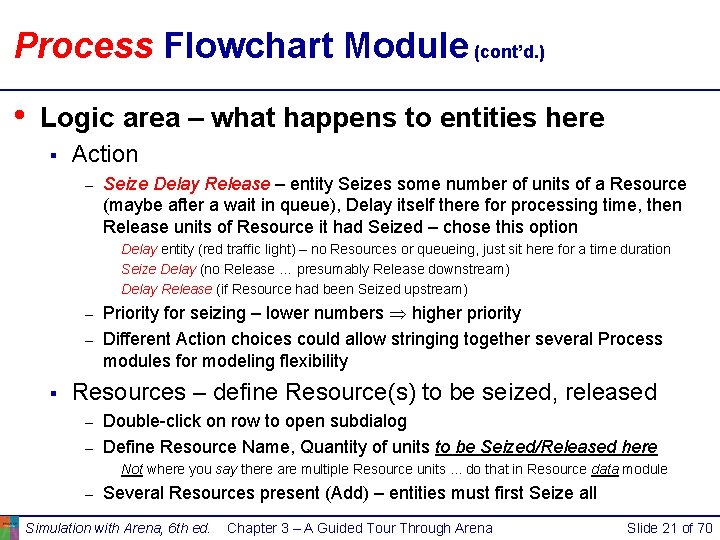
Process Flowchart Module (cont’d. ) • Logic area – what happens to entities here § Action – Seize Delay Release – entity Seizes some number of units of a Resource (maybe after a wait in queue), Delay itself there for processing time, then Release units of Resource it had Seized – chose this option Delay entity (red traffic light) – no Resources or queueing, just sit here for a time duration Seize Delay (no Release … presumably Release downstream) Delay Release (if Resource had been Seized upstream) – – § Priority for seizing – lower numbers higher priority Different Action choices could allow stringing together several Process modules for modeling flexibility Resources – define Resource(s) to be seized, released – – Double-click on row to open subdialog Define Resource Name, Quantity of units to be Seized/Released here Not where you say there are multiple Resource units. . . do that in Resource data module – Several Resources present (Add) – entities must first Seize all Simulation with Arena, 6 th ed. Chapter 3 – A Guided Tour Through Arena Slide 21 of 70
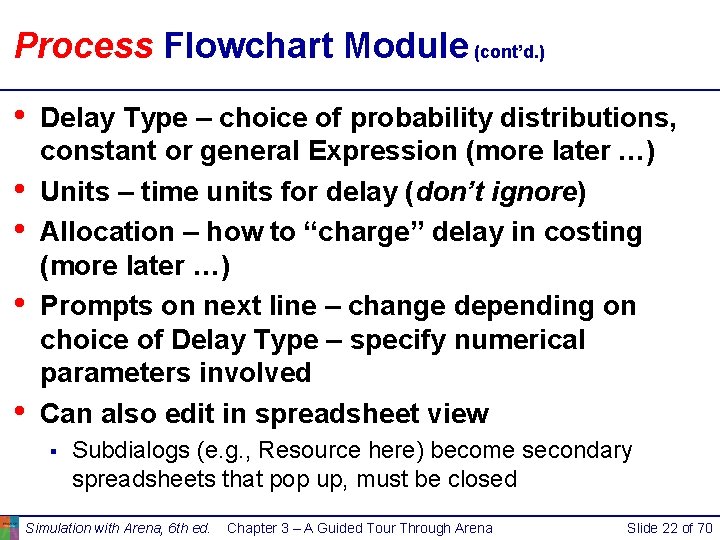
Process Flowchart Module (cont’d. ) • • • Delay Type – choice of probability distributions, constant or general Expression (more later …) Units – time units for delay (don’t ignore) Allocation – how to “charge” delay in costing (more later …) Prompts on next line – change depending on choice of Delay Type – specify numerical parameters involved Can also edit in spreadsheet view § Subdialogs (e. g. , Resource here) become secondary spreadsheets that pop up, must be closed Simulation with Arena, 6 th ed. Chapter 3 – A Guided Tour Through Arena Slide 22 of 70
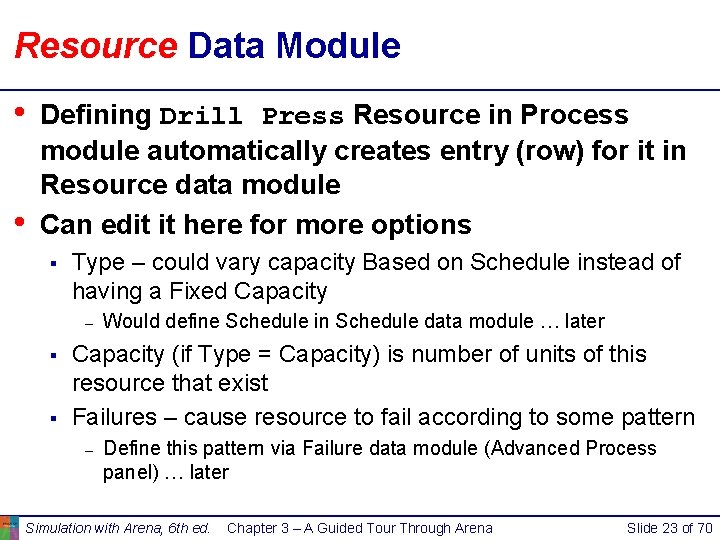
Resource Data Module • • Defining Drill Press Resource in Process module automatically creates entry (row) for it in Resource data module Can edit it here for more options § Type – could vary capacity Based on Schedule instead of having a Fixed Capacity – § § Would define Schedule in Schedule data module … later Capacity (if Type = Capacity) is number of units of this resource that exist Failures – cause resource to fail according to some pattern – Define this pattern via Failure data module (Advanced Process panel) … later Simulation with Arena, 6 th ed. Chapter 3 – A Guided Tour Through Arena Slide 23 of 70
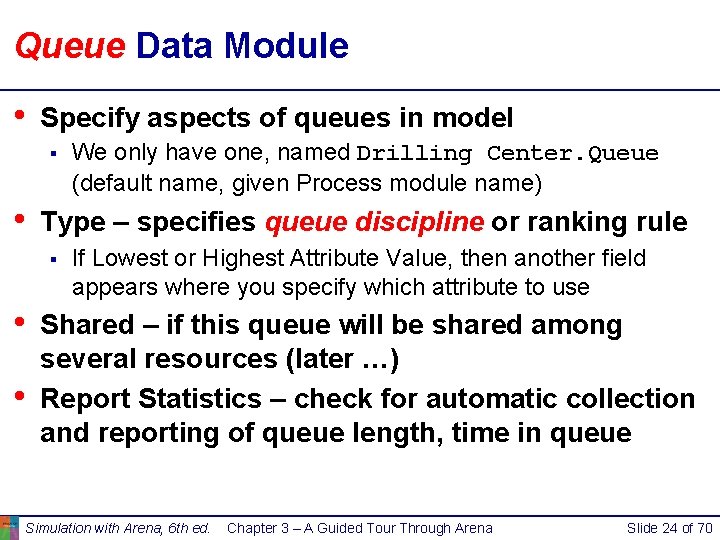
Queue Data Module • Specify aspects of queues in model § • Type – specifies queue discipline or ranking rule § • • We only have one, named Drilling Center. Queue (default name, given Process module name) If Lowest or Highest Attribute Value, then another field appears where you specify which attribute to use Shared – if this queue will be shared among several resources (later …) Report Statistics – check for automatic collection and reporting of queue length, time in queue Simulation with Arena, 6 th ed. Chapter 3 – A Guided Tour Through Arena Slide 24 of 70
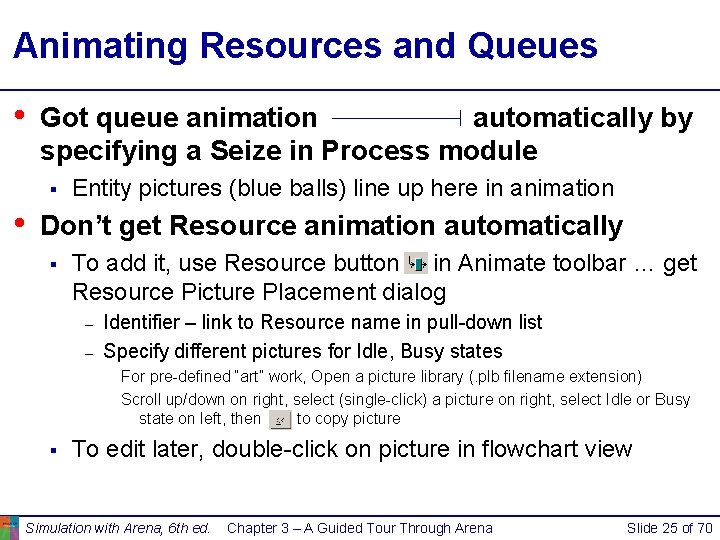
Animating Resources and Queues • Got queue animation automatically by specifying a Seize in Process module § • Entity pictures (blue balls) line up here in animation Don’t get Resource animation automatically § To add it, use Resource button in Animate toolbar … get Resource Picture Placement dialog – – Identifier – link to Resource name in pull-down list Specify different pictures for Idle, Busy states For pre-defined “art” work, Open a picture library (. plb filename extension) Scroll up/down on right, select (single-click) a picture on right, select Idle or Busy state on left, then to copy picture § To edit later, double-click on picture in flowchart view Simulation with Arena, 6 th ed. Chapter 3 – A Guided Tour Through Arena Slide 25 of 70
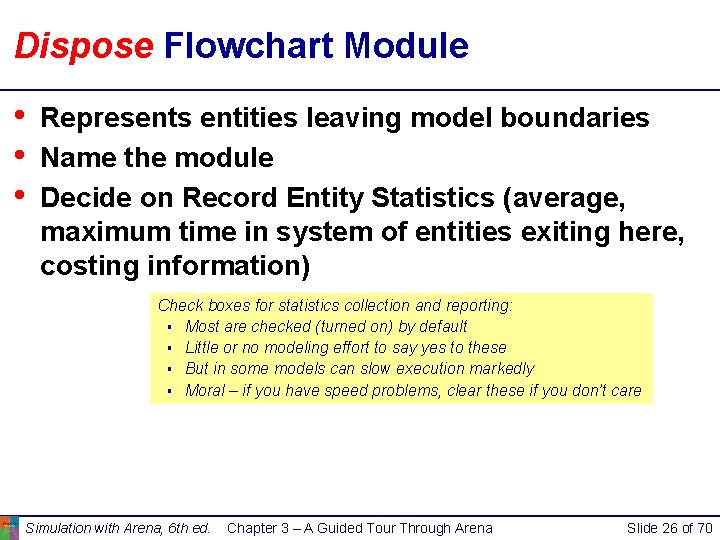
Dispose Flowchart Module • • • Represents entities leaving model boundaries Name the module Decide on Record Entity Statistics (average, maximum time in system of entities exiting here, costing information) Check boxes for statistics collection and reporting: § Most are checked (turned on) by default § Little or no modeling effort to say yes to these § But in some models can slow execution markedly § Moral – if you have speed problems, clear these if you don’t care Simulation with Arena, 6 th ed. Chapter 3 – A Guided Tour Through Arena Slide 26 of 70
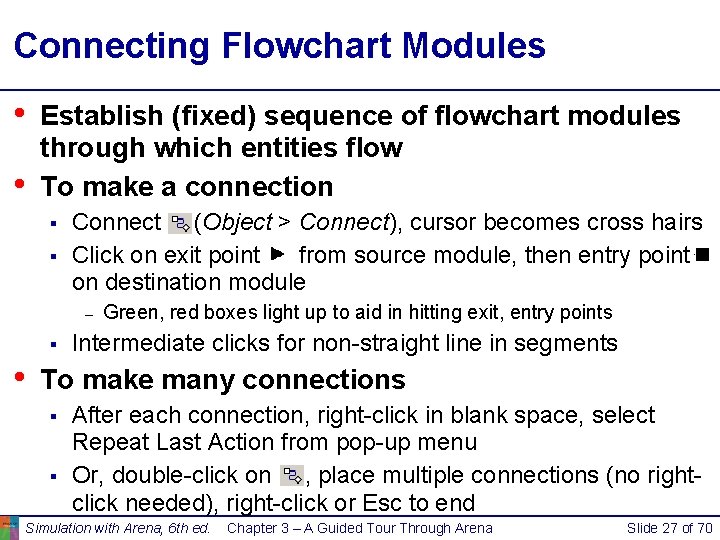
Connecting Flowchart Modules • • Establish (fixed) sequence of flowchart modules through which entities flow To make a connection § § Connect (Object > Connect), cursor becomes cross hairs Click on exit point from source module, then entry point on destination module – § • Green, red boxes light up to aid in hitting exit, entry points Intermediate clicks for non-straight line in segments To make many connections § § After each connection, right-click in blank space, select Repeat Last Action from pop-up menu Or, double-click on , place multiple connections (no rightclick needed), right-click or Esc to end Simulation with Arena, 6 th ed. Chapter 3 – A Guided Tour Through Arena Slide 27 of 70
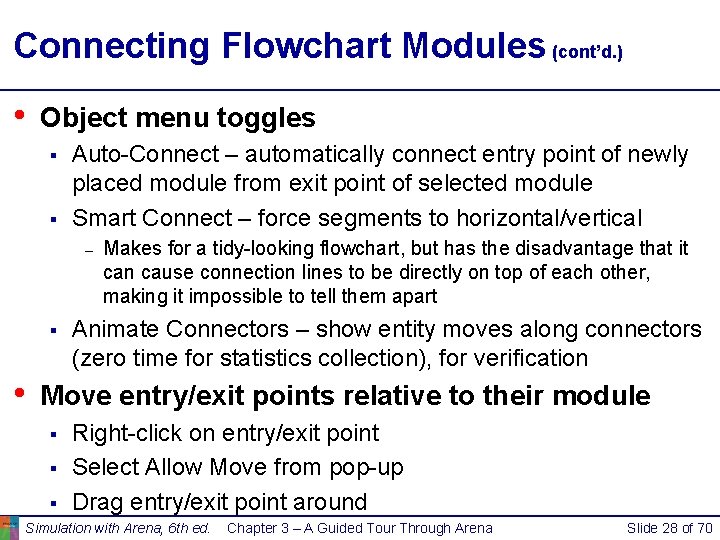
Connecting Flowchart Modules (cont’d. ) • Object menu toggles § § Auto-Connect – automatically connect entry point of newly placed module from exit point of selected module Smart Connect – force segments to horizontal/vertical – § • Makes for a tidy-looking flowchart, but has the disadvantage that it can cause connection lines to be directly on top of each other, making it impossible to tell them apart Animate Connectors – show entity moves along connectors (zero time for statistics collection), for verification Move entry/exit points relative to their module § § § Right-click on entry/exit point Select Allow Move from pop-up Drag entry/exit point around Simulation with Arena, 6 th ed. Chapter 3 – A Guided Tour Through Arena Slide 28 of 70
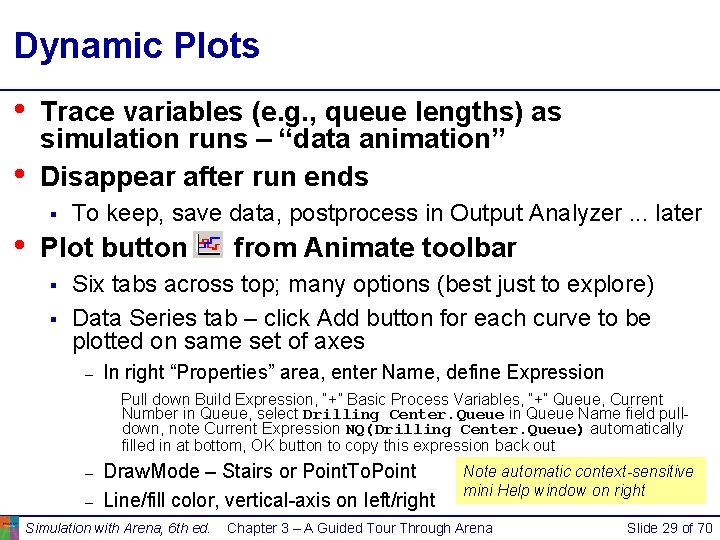
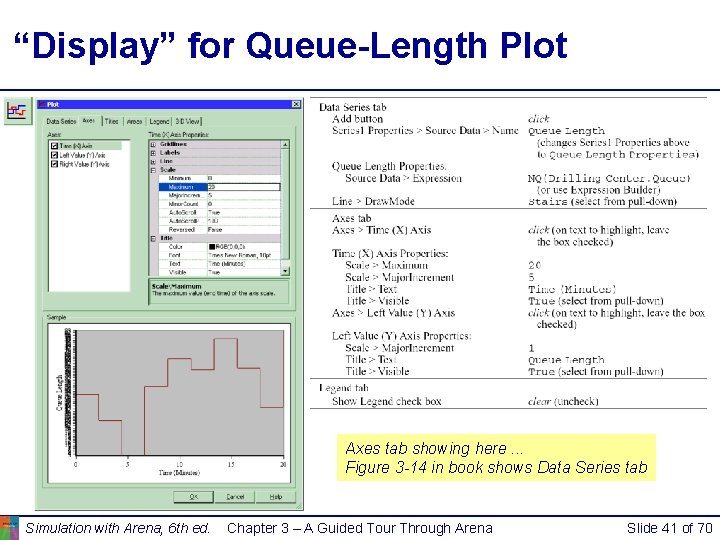
Dynamic Plots • • Trace variables (e. g. , queue lengths) as simulation runs – “data animation” Disappear after run ends § • To keep, save data, postprocess in Output Analyzer. . . later Plot button § § from Animate toolbar Six tabs across top; many options (best just to explore) Data Series tab – click Add button for each curve to be plotted on same set of axes – In right “Properties” area, enter Name, define Expression Pull down Build Expression, “+” Basic Process Variables, “+” Queue, Current Number in Queue, select Drilling Center. Queue in Queue Name field pulldown, note Current Expression NQ(Drilling Center. Queue) automatically filled in at bottom, OK button to copy this expression back out – – Draw. Mode – Stairs or Point. To. Point Line/fill color, vertical-axis on left/right Simulation with Arena, 6 th ed. Note automatic context-sensitive mini Help window on right Chapter 3 – A Guided Tour Through Arena Slide 29 of 70
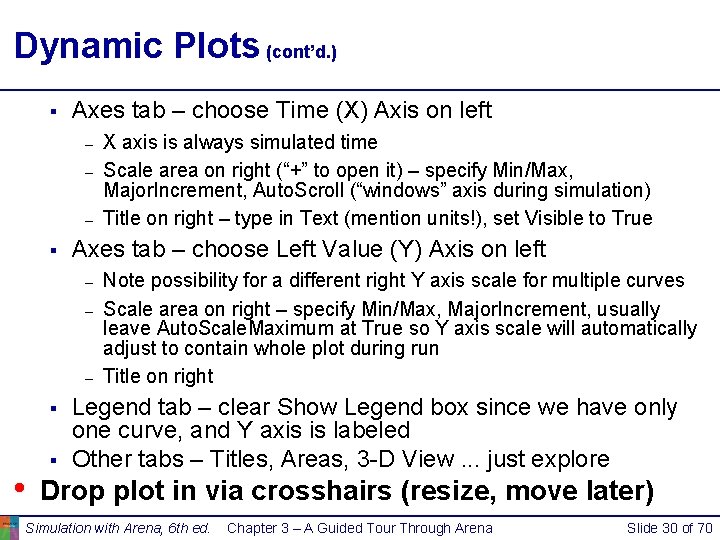
Dynamic Plots (cont’d. ) § Axes tab – choose Time (X) Axis on left – – – § Axes tab – choose Left Value (Y) Axis on left – – – § • § X axis is always simulated time Scale area on right (“+” to open it) – specify Min/Max, Major. Increment, Auto. Scroll (“windows” axis during simulation) Title on right – type in Text (mention units!), set Visible to True Note possibility for a different right Y axis scale for multiple curves Scale area on right – specify Min/Max, Major. Increment, usually leave Auto. Scale. Maximum at True so Y axis scale will automatically adjust to contain whole plot during run Title on right Legend tab – clear Show Legend box since we have only one curve, and Y axis is labeled Other tabs – Titles, Areas, 3 -D View. . . just explore Drop plot in via crosshairs (resize, move later) Simulation with Arena, 6 th ed. Chapter 3 – A Guided Tour Through Arena Slide 30 of 70
Dressing Things Up • Add drawing objects from Draw toolbar § § • Similar to other drawing, CAD packages Object-oriented drawing tools (layers, etc. ), not just a paint tool Add Text to annotate § Control font, size, color, orientation Simulation with Arena, 6 th ed. Chapter 3 – A Guided Tour Through Arena Slide 31 of 70
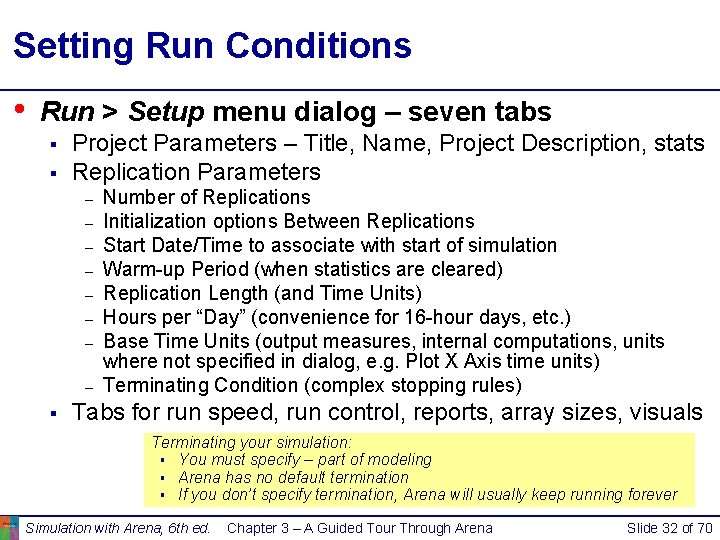
Setting Run Conditions • Run > Setup menu dialog – seven tabs § § Project Parameters – Title, Name, Project Description, stats Replication Parameters – – – – § Number of Replications Initialization options Between Replications Start Date/Time to associate with start of simulation Warm-up Period (when statistics are cleared) Replication Length (and Time Units) Hours per “Day” (convenience for 16 -hour days, etc. ) Base Time Units (output measures, internal computations, units where not specified in dialog, e. g. Plot X Axis time units) Terminating Condition (complex stopping rules) Tabs for run speed, run control, reports, array sizes, visuals Terminating your simulation: § You must specify – part of modeling § Arena has no default termination § If you don’t specify termination, Arena will usually keep running forever Simulation with Arena, 6 th ed. Chapter 3 – A Guided Tour Through Arena Slide 32 of 70
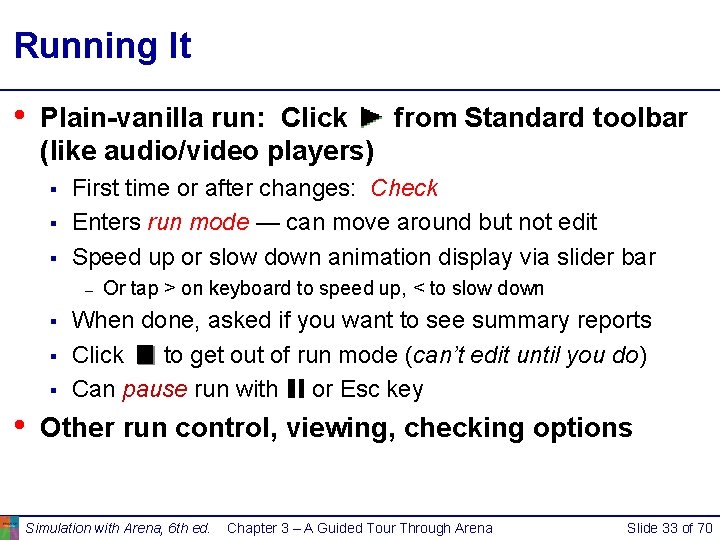
Running It • Plain-vanilla run: Click from Standard toolbar (like audio/video players) § § § First time or after changes: Check Enters run mode — can move around but not edit Speed up or slow down animation display via slider bar – § § § • Or tap > on keyboard to speed up, < to slow down When done, asked if you want to see summary reports Click to get out of run mode (can’t edit until you do) Can pause run with or Esc key Other run control, viewing, checking options Simulation with Arena, 6 th ed. Chapter 3 – A Guided Tour Through Arena Slide 33 of 70
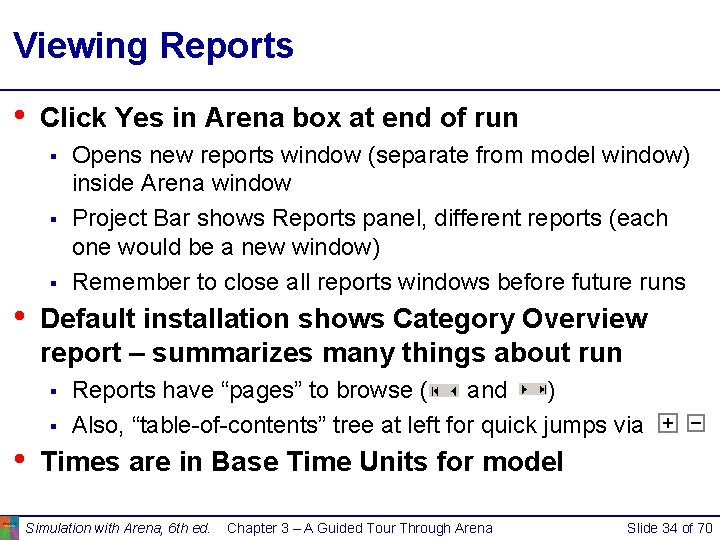
Viewing Reports • Click Yes in Arena box at end of run § § § • Default installation shows Category Overview report – summarizes many things about run § § • Opens new reports window (separate from model window) inside Arena window Project Bar shows Reports panel, different reports (each one would be a new window) Remember to close all reports windows before future runs Reports have “pages” to browse ( and ) Also, “table-of-contents” tree at left for quick jumps via Times are in Base Time Units for model Simulation with Arena, 6 th ed. Chapter 3 – A Guided Tour Through Arena Slide 34 of 70
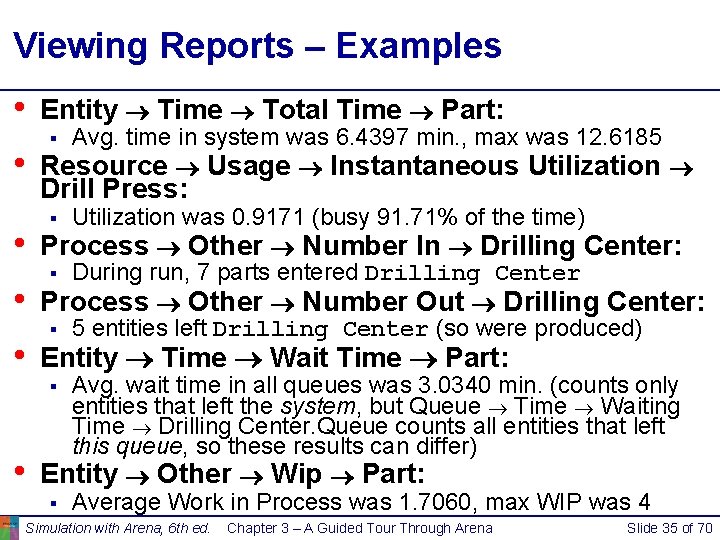
Viewing Reports – Examples • • • Entity Time Total Time Part: Avg. time in system was 6. 4397 min. , max was 12. 6185 Resource Usage Instantaneous Utilization § Drill Press: Utilization was 0. 9171 (busy 91. 71% of the time) Process Other Number In Drilling Center: § During run, 7 parts entered Drilling Center Process Other Number Out Drilling Center: § 5 entities left Drilling Center (so were produced) § Entity Time Wait Time Part: Avg. wait time in all queues was 3. 0340 min. (counts only entities that left the system, but Queue Time Waiting Time Drilling Center. Queue counts all entities that left this queue, so these results can differ) Entity Other Wip Part: § Average Work in Process was 1. 7060, max WIP was 4 § • Simulation with Arena, 6 th ed. Chapter 3 – A Guided Tour Through Arena Slide 35 of 70
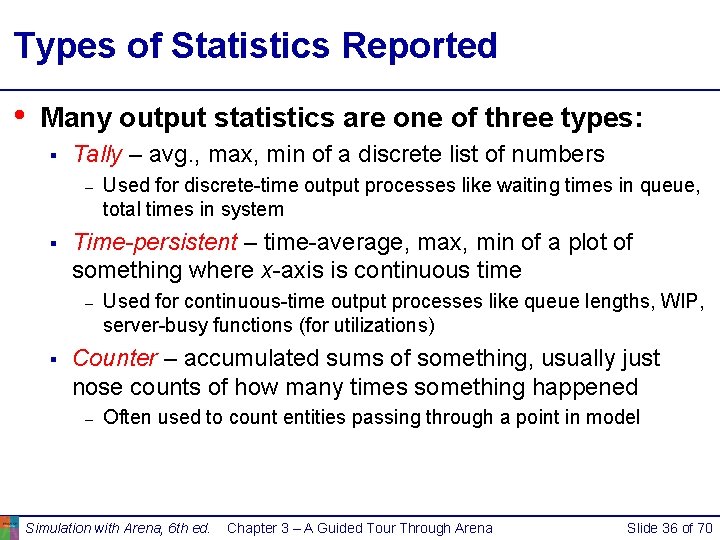
Types of Statistics Reported • Many output statistics are one of three types: § Tally – avg. , max, min of a discrete list of numbers – § Time-persistent – time-average, max, min of a plot of something where x-axis is continuous time – § Used for discrete-time output processes like waiting times in queue, total times in system Used for continuous-time output processes like queue lengths, WIP, server-busy functions (for utilizations) Counter – accumulated sums of something, usually just nose counts of how many times something happened – Often used to count entities passing through a point in model Simulation with Arena, 6 th ed. Chapter 3 – A Guided Tour Through Arena Slide 36 of 70
More on Reports and their Files • Reports we just saw – based on MS Access. mdb database that Arena actually writes as it runs § § • . mdb file is saved and can be viewed later Viewing within Arena via SAP Crystal Reports to query Access database, produce reports like Category Overview Arena also produces a plain-text summary report (. out filename extension) § § Previous versions of Arena, underlying SIMAN language Fairly cryptic, but gives quick view of lots of output data – § • Also contains a few things not in Access/Crystal Reports Multiple reports for multiple replications “Half Width” columns – 95% confidence intervals on outputs in long-run simulations … later Simulation with Arena, 6 th ed. Chapter 3 – A Guided Tour Through Arena Slide 37 of 70
Build It Yourself • • Build same model from scratch – details in text Handy user-interface tricks: § § • • Right-click in an empty spot in flowchart view – small box of options, including Repeat Last Action … useful in repetitive editing like placing lots of same module type Ctrl+D or Ins key – duplicates whatever’s selected in flowchart view, offsetting it a bit … drag elsewhere, edit Open new (blank) model window – name it, save it, maybe maximize it Attach modeling panels you’ll need to Project Bar if not there Simulation with Arena, 6 th ed. Chapter 3 – A Guided Tour Through Arena Slide 38 of 70
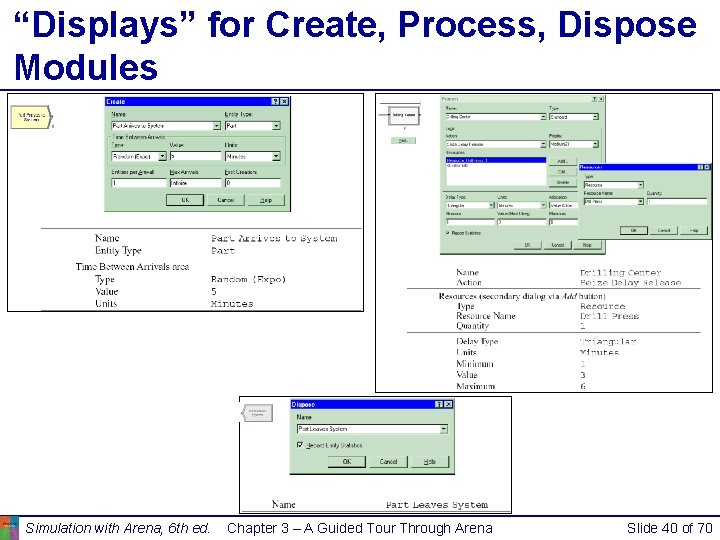
Build It Yourself (cont’d. ) • • Place, connect flowchart modules Edit flowchart, data modules as needed § • • Experiment with Expression Builder – right-click in expression field Add plots, animation, artwork Add named views (? key or View > Named Views or ), with hot key (case-sensitive) Edit Run > Setup dialog “Displays” in text § § § Compact way of saying what needs to be done in a dialog Omits Arena defaults Shows completed dialogs, table of actions needed Simulation with Arena, 6 th ed. Chapter 3 – A Guided Tour Through Arena Slide 39 of 70
“Displays” for Create, Process, Dispose Modules Simulation with Arena, 6 th ed. Chapter 3 – A Guided Tour Through Arena Slide 40 of 70
“Display” for Queue-Length Plot Axes tab showing here. . . Figure 3 -14 in book shows Data Series tab Simulation with Arena, 6 th ed. Chapter 3 – A Guided Tour Through Arena Slide 41 of 70
Case Study: Specialized Serial vs. Generalized Parallel Processing • Loan applications go through four steps § § § Check credit, prepare covenant, price loan, disburse funds Each step takes expo (1 hour) Applications arrive with expo (1. 25 hour) interarrival times – § § § • First application arrives at time 0 Run for 160 hours Watch avg, max no. applications in process (WIP); avg, max total time in system of applications Four employees, each can do any process step Serial specialized processing or generalized parallel processing? § What’s the effect of service-time variability on decision? Simulation with Arena, 6 th ed. Chapter 3 – A Guided Tour Through Arena Slide 42 of 70
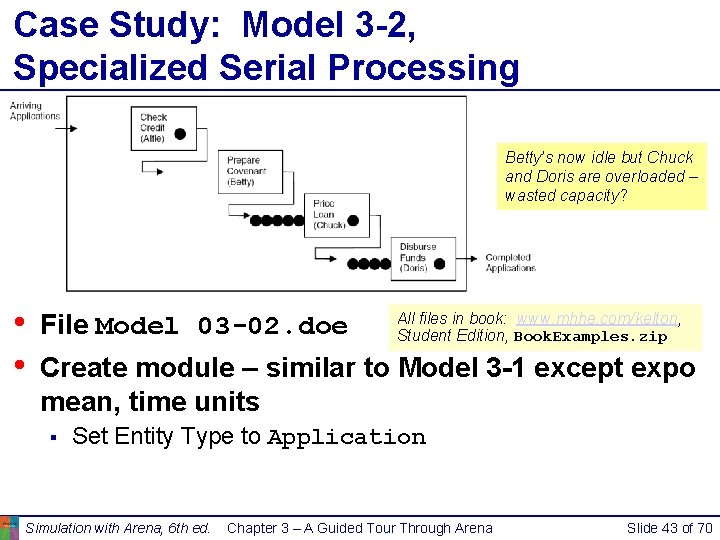
Case Study: Model 3 -2, Specialized Serial Processing Betty’s now idle but Chuck and Doris are overloaded – wasted capacity? • • File Model 03 -02. doe All files in book: www. mhhe. com/kelton, Student Edition, Book. Examples. zip Create module – similar to Model 3 -1 except expo mean, time units § Set Entity Type to Application Simulation with Arena, 6 th ed. Chapter 3 – A Guided Tour Through Arena Slide 43 of 70
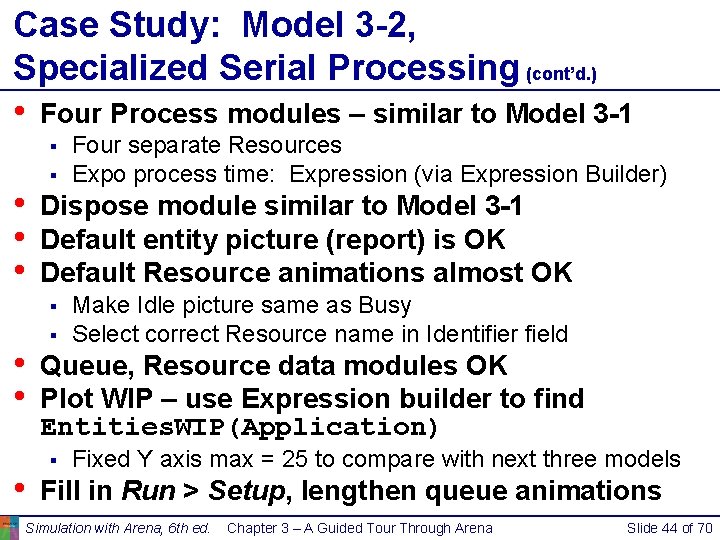
Case Study: Model 3 -2, Specialized Serial Processing (cont’d. ) • Four Process modules – similar to Model 3 -1 § • • • § Dispose module similar to Model 3 -1 Default entity picture (report) is OK Default Resource animations almost OK § • • • Four separate Resources Expo process time: Expression (via Expression Builder) § Make Idle picture same as Busy Select correct Resource name in Identifier field Queue, Resource data modules OK Plot WIP – use Expression builder to find Entities. WIP(Application) § Fixed Y axis max = 25 to compare with next three models Fill in Run > Setup, lengthen queue animations Simulation with Arena, 6 th ed. Chapter 3 – A Guided Tour Through Arena Slide 44 of 70
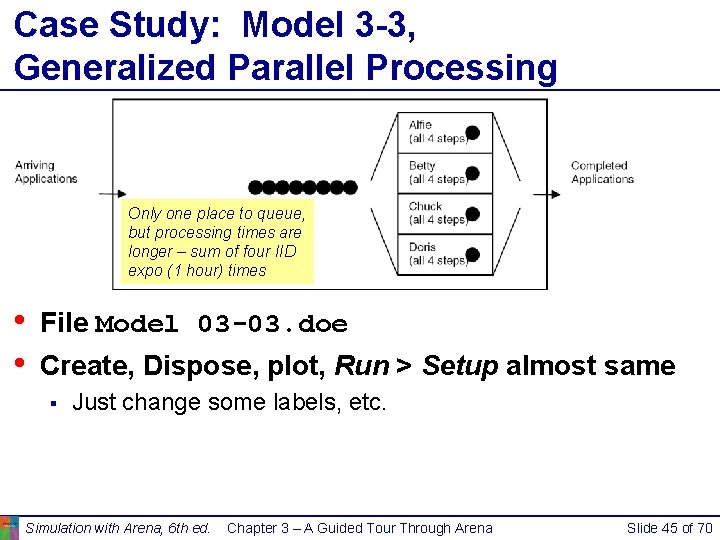
Case Study: Model 3 -3, Generalized Parallel Processing Only one place to queue, but processing times are longer – sum of four IID expo (1 hour) times • • File Model 03 -03. doe Create, Dispose, plot, Run > Setup almost same § Just change some labels, etc. Simulation with Arena, 6 th ed. Chapter 3 – A Guided Tour Through Arena Slide 45 of 70
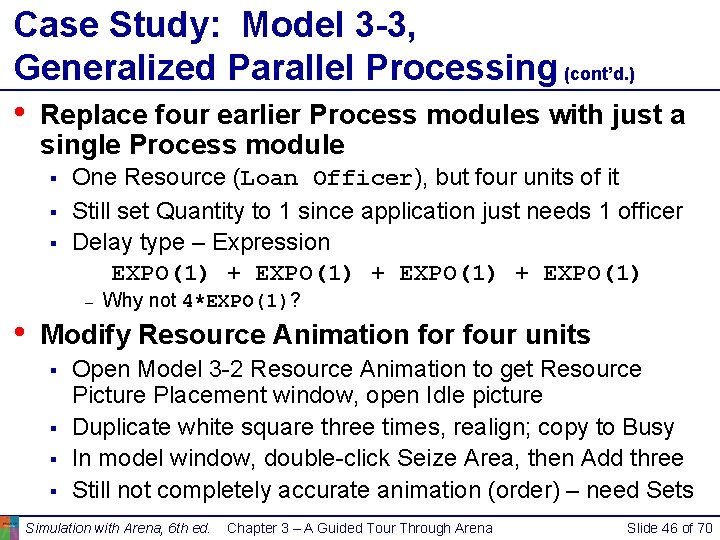
Case Study: Model 3 -3, Generalized Parallel Processing (cont’d. ) • Replace four earlier Process modules with just a single Process module § § § One Resource (Loan Officer), but four units of it Still set Quantity to 1 since application just needs 1 officer Delay type – Expression EXPO(1) + EXPO(1) – • Why not 4*EXPO(1)? Modify Resource Animation for four units § § Open Model 3 -2 Resource Animation to get Resource Picture Placement window, open Idle picture Duplicate white square three times, realign; copy to Busy In model window, double-click Seize Area, then Add three Still not completely accurate animation (order) – need Sets Simulation with Arena, 6 th ed. Chapter 3 – A Guided Tour Through Arena Slide 46 of 70
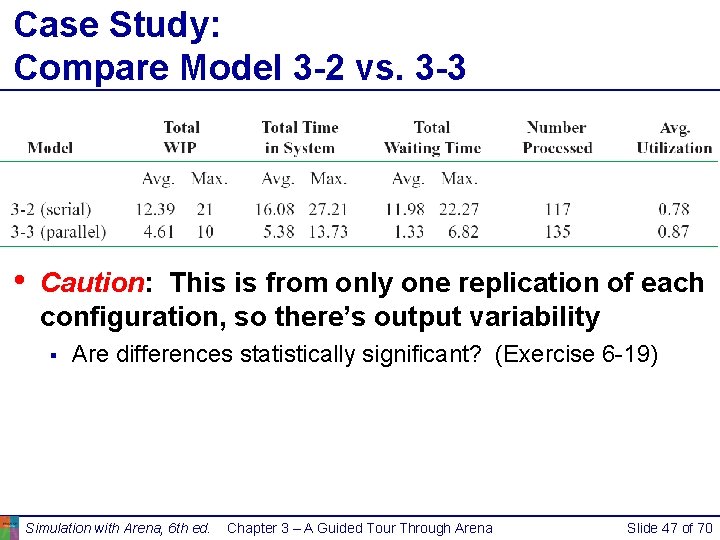
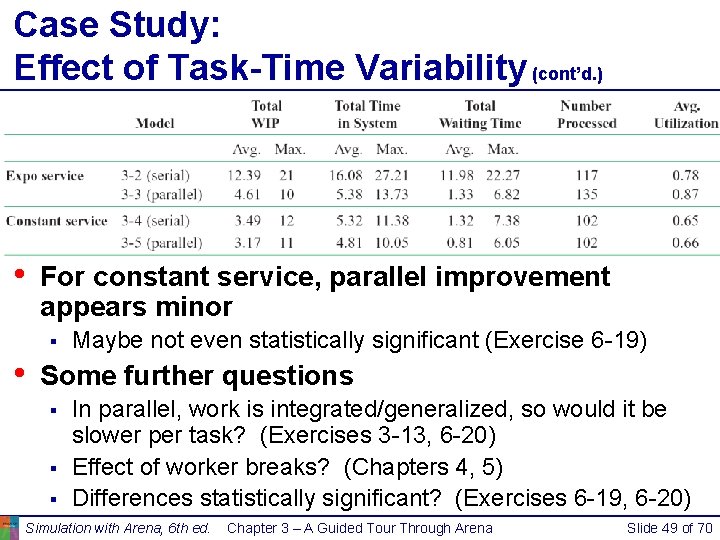
Case Study: Compare Model 3 -2 vs. 3 -3 • Caution: This is from only one replication of each configuration, so there’s output variability § Are differences statistically significant? (Exercise 6 -19) Simulation with Arena, 6 th ed. Chapter 3 – A Guided Tour Through Arena Slide 47 of 70
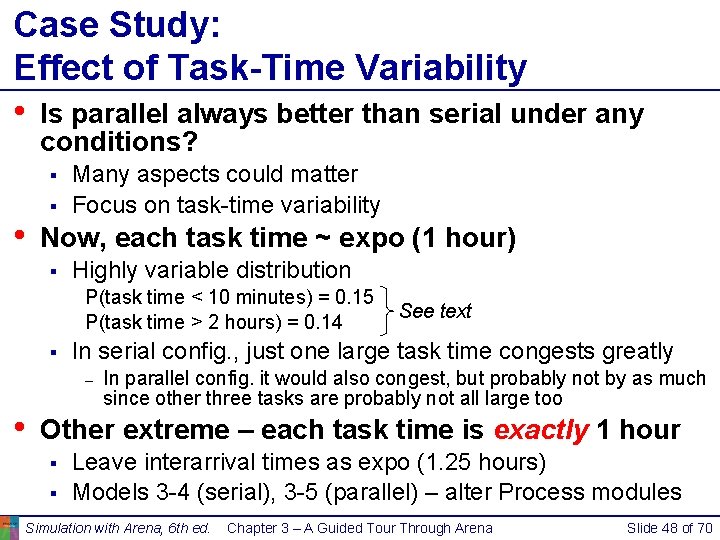
Case Study: Effect of Task-Time Variability • Is parallel always better than serial under any conditions? § • § Many aspects could matter Focus on task-time variability Now, each task time ~ expo (1 hour) § Highly variable distribution P(task time < 10 minutes) = 0. 15 P(task time > 2 hours) = 0. 14 § In serial config. , just one large task time congests greatly – • See text In parallel config. it would also congest, but probably not by as much since other three tasks are probably not all large too Other extreme – each task time is exactly 1 hour § § Leave interarrival times as expo (1. 25 hours) Models 3 -4 (serial), 3 -5 (parallel) – alter Process modules Simulation with Arena, 6 th ed. Chapter 3 – A Guided Tour Through Arena Slide 48 of 70
Case Study: Effect of Task-Time Variability (cont’d. ) • For constant service, parallel improvement appears minor § • Maybe not even statistically significant (Exercise 6 -19) Some further questions § § § In parallel, work is integrated/generalized, so would it be slower per task? (Exercises 3 -13, 6 -20) Effect of worker breaks? (Chapters 4, 5) Differences statistically significant? (Exercises 6 -19, 6 -20) Simulation with Arena, 6 th ed. Chapter 3 – A Guided Tour Through Arena Slide 49 of 70
More on Menus – File Menu • • Model-file management Template attach/detach DXF import (from CAD packages), Visio import Color palettes Printing Send (e-mail) open model file Recent models Exit from Arena Simulation with Arena, 6 th ed. Chapter 3 – A Guided Tour Through Arena Slide 50 of 70
Edit Menu • • Undo/Redo Cut/Copy/Paste Link (create OLE link) Duplicate, Delete selection Select/Deselect All Entity Pictures – change content, definition of pictures presented in Entity data module Find – searches all modules, animation objects for a text string … useful for finding wrong names, typos after an error message from Arena Simulation with Arena, 6 th ed. Chapter 3 – A Guided Tour Through Arena Slide 51 of 70
Edit Menu (cont’d. ) • • • Replace – replaces all instances of a text string with another text string Properties – display internal Arena object properties Links – to link to other files (spreadsheets, sounds, etc. ) Insert New Object/Control – from other applications (e. g. , graphics, VBA, Active. X) Object – edit object imported from another application Simulation with Arena, 6 th ed. Chapter 3 – A Guided Tour Through Arena Slide 52 of 70
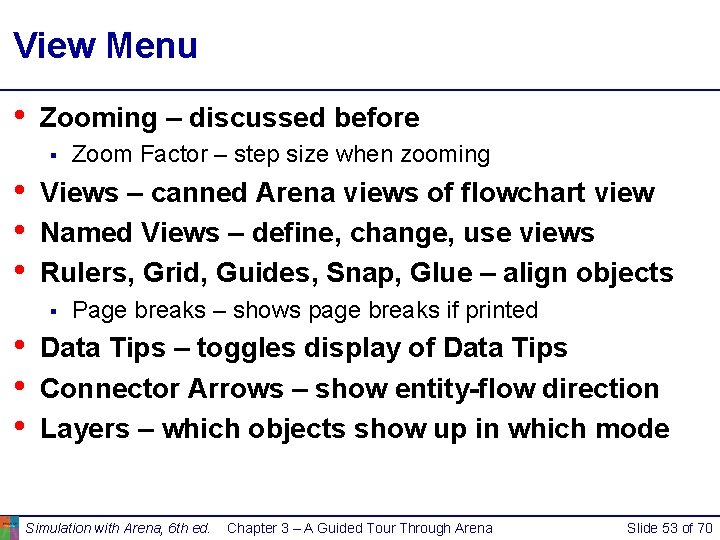
View Menu • Zooming – discussed before § • • • Views – canned Arena views of flowchart view Named Views – define, change, use views Rulers, Grid, Guides, Snap, Glue – align objects § • • • Zoom Factor – step size when zooming Page breaks – shows page breaks if printed Data Tips – toggles display of Data Tips Connector Arrows – show entity-flow direction Layers – which objects show up in which mode Simulation with Arena, 6 th ed. Chapter 3 – A Guided Tour Through Arena Slide 53 of 70
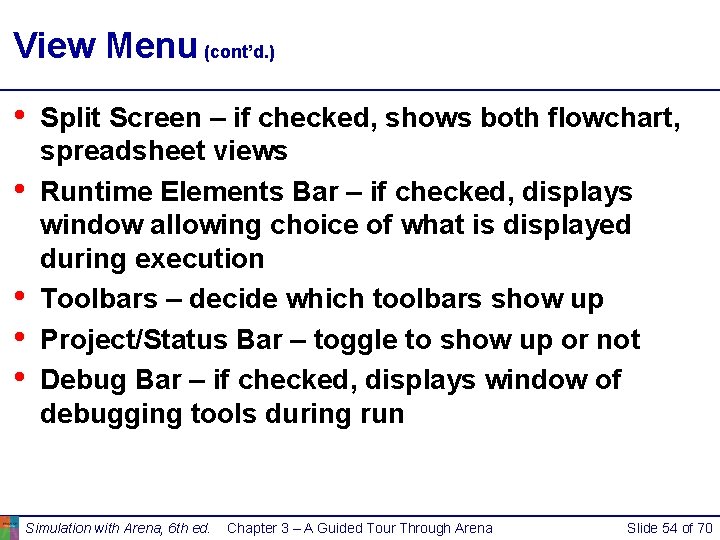
View Menu (cont’d. ) • • • Split Screen – if checked, shows both flowchart, spreadsheet views Runtime Elements Bar – if checked, displays window allowing choice of what is displayed during execution Toolbars – decide which toolbars show up Project/Status Bar – toggle to show up or not Debug Bar – if checked, displays window of debugging tools during run Simulation with Arena, 6 th ed. Chapter 3 – A Guided Tour Through Arena Slide 54 of 70
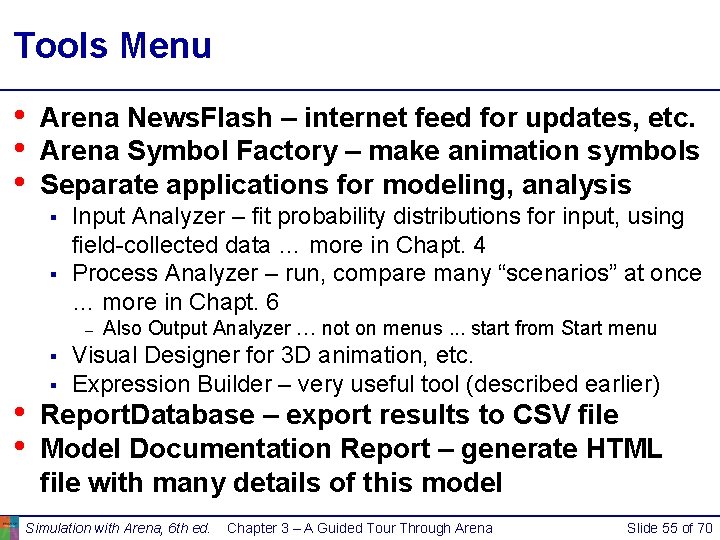
Tools Menu • • • Arena News. Flash – internet feed for updates, etc. Arena Symbol Factory – make animation symbols Separate applications for modeling, analysis § § Input Analyzer – fit probability distributions for input, using field-collected data … more in Chapt. 4 Process Analyzer – run, compare many “scenarios” at once … more in Chapt. 6 – § • • § Also Output Analyzer … not on menus. . . start from Start menu Visual Designer for 3 D animation, etc. Expression Builder – very useful tool (described earlier) Report. Database – export results to CSV file Model Documentation Report – generate HTML file with many details of this model Simulation with Arena, 6 th ed. Chapter 3 – A Guided Tour Through Arena Slide 55 of 70
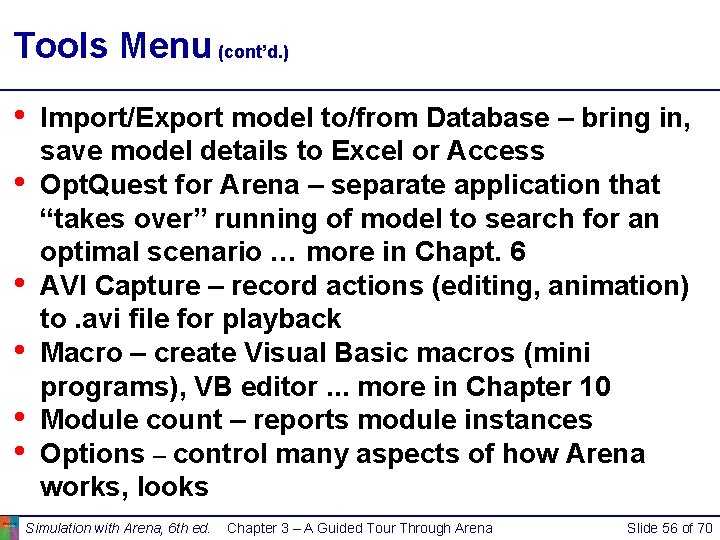
Tools Menu (cont’d. ) • • • Import/Export model to/from Database – bring in, save model details to Excel or Access Opt. Quest for Arena – separate application that “takes over” running of model to search for an optimal scenario … more in Chapt. 6 AVI Capture – record actions (editing, animation) to. avi file for playback Macro – create Visual Basic macros (mini programs), VB editor. . . more in Chapter 10 Module count – reports module instances Options – control many aspects of how Arena works, looks Simulation with Arena, 6 th ed. Chapter 3 – A Guided Tour Through Arena Slide 56 of 70
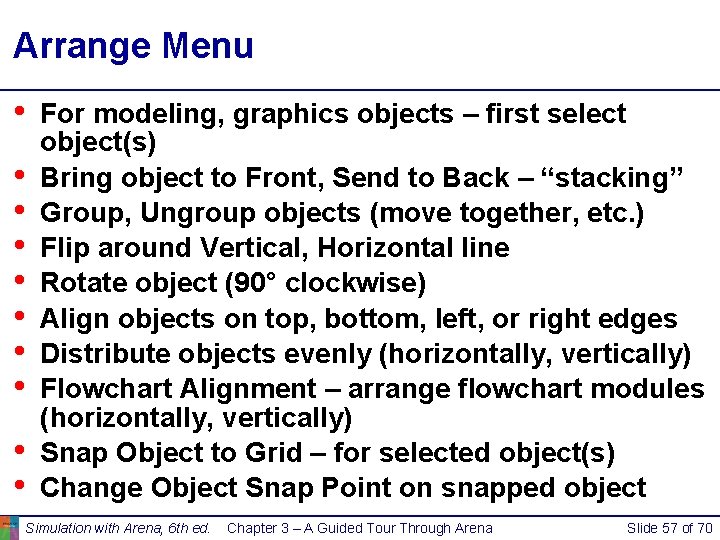
Arrange Menu • • • For modeling, graphics objects – first select object(s) Bring object to Front, Send to Back – “stacking” Group, Ungroup objects (move together, etc. ) Flip around Vertical, Horizontal line Rotate object (90° clockwise) Align objects on top, bottom, left, or right edges Distribute objects evenly (horizontally, vertically) Flowchart Alignment – arrange flowchart modules (horizontally, vertically) Snap Object to Grid – for selected object(s) Change Object Snap Point on snapped object Simulation with Arena, 6 th ed. Chapter 3 – A Guided Tour Through Arena Slide 57 of 70
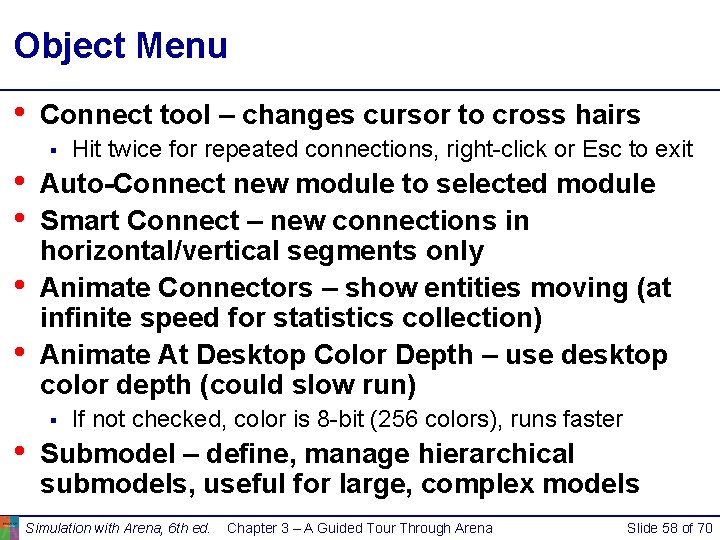
Object Menu • Connect tool – changes cursor to cross hairs § • • Auto-Connect new module to selected module Smart Connect – new connections in horizontal/vertical segments only Animate Connectors – show entities moving (at infinite speed for statistics collection) Animate At Desktop Color Depth – use desktop color depth (could slow run) § • Hit twice for repeated connections, right-click or Esc to exit If not checked, color is 8 -bit (256 colors), runs faster Submodel – define, manage hierarchical submodels, useful for large, complex models Simulation with Arena, 6 th ed. Chapter 3 – A Guided Tour Through Arena Slide 58 of 70
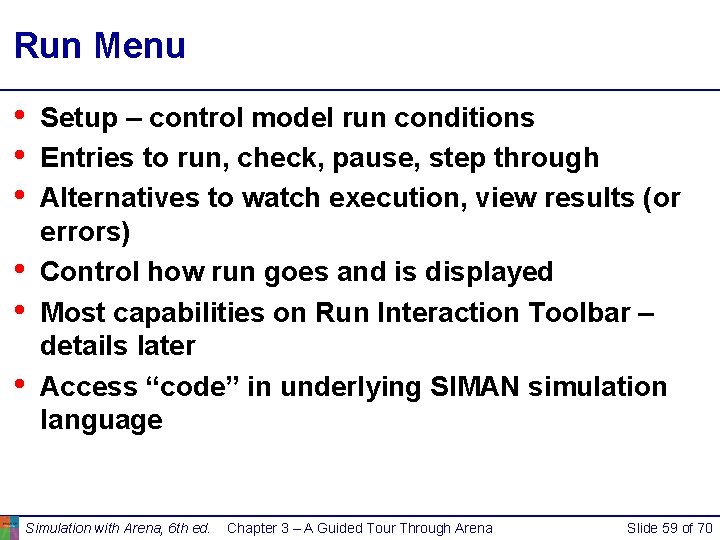
Run Menu • • • Setup – control model run conditions Entries to run, check, pause, step through Alternatives to watch execution, view results (or errors) Control how run goes and is displayed Most capabilities on Run Interaction Toolbar – details later Access “code” in underlying SIMAN simulation language Simulation with Arena, 6 th ed. Chapter 3 – A Guided Tour Through Arena Slide 59 of 70
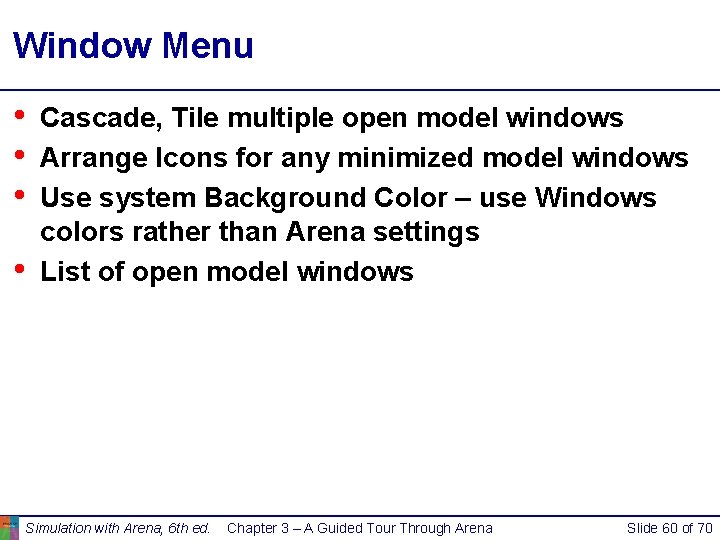
Window Menu • • Cascade, Tile multiple open model windows Arrange Icons for any minimized model windows Use system Background Color – use Windows colors rather than Arena settings List of open model windows Simulation with Arena, 6 th ed. Chapter 3 – A Guided Tour Through Arena Slide 60 of 70
Help Menu • • • One of several ways to get into Help system Arena Help – TOC, Index, Search What’s This? – adds ? to cursor, then click on things for brief description Release notes – recent changes, requirements Arena Smart Files – subject-based index to many small but complete models that illustrate specific modeling techniques (very useful) List of attached modeling panels – select to get Help on that one Simulation with Arena, 6 th ed. Chapter 3 – A Guided Tour Through Arena Slide 61 of 70
Help Menu (cont’d. ) • • Arena Product Manuals – detailed PDF reference documents on Arena components Activation – for licensing Copy protection information for commercial, research, and lab versions About Arena. . . – version number, licensing information, etc. Simulation with Arena, 6 th ed. Chapter 3 – A Guided Tour Through Arena Slide 62 of 70
More on Toolbars • Collections of buttons for “frequent” operations § § • • • Most are duplication of menu entries Standard, Draw, Animate, Integration, View, Arrange, Run Interaction, Record Macro, AVI Capture, Animate Transfer, Dialog Design, Project/Status/Debug Bars View > Toolbars (or right-click in a toolbar area) to decide which ones show up, which to hide Toolbars can be torn off (“floating” palettes), or “docked” to an edge of screen Arena remembers Toolbars for next time View > Toolbars > Customize to alter how toolbars and buttons are displayed See text for run-through description of toolbars and buttons (or, just experiment) Simulation with Arena, 6 th ed. Chapter 3 – A Guided Tour Through Arena Slide 63 of 70
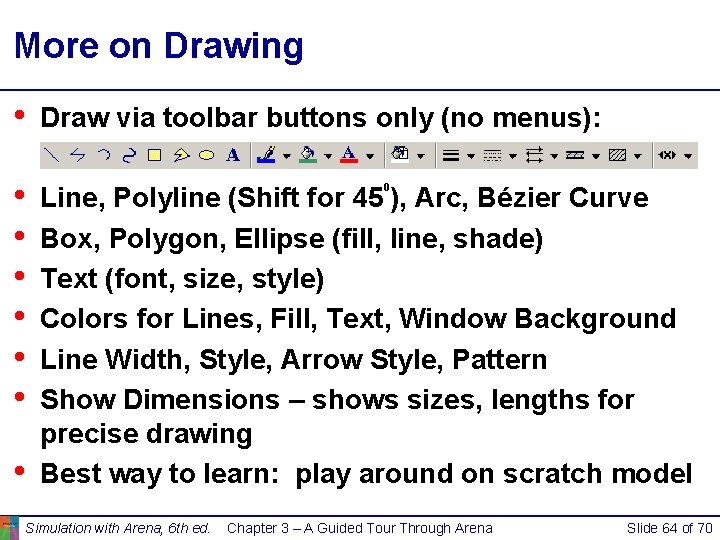
More on Drawing • • Draw via toolbar buttons only (no menus): 0 Line, Polyline (Shift for 45 ), Arc, Bézier Curve Box, Polygon, Ellipse (fill, line, shade) Text (font, size, style) Colors for Lines, Fill, Text, Window Background Line Width, Style, Arrow Style, Pattern Show Dimensions – shows sizes, lengths for precise drawing Best way to learn: play around on scratch model Simulation with Arena, 6 th ed. Chapter 3 – A Guided Tour Through Arena Slide 64 of 70
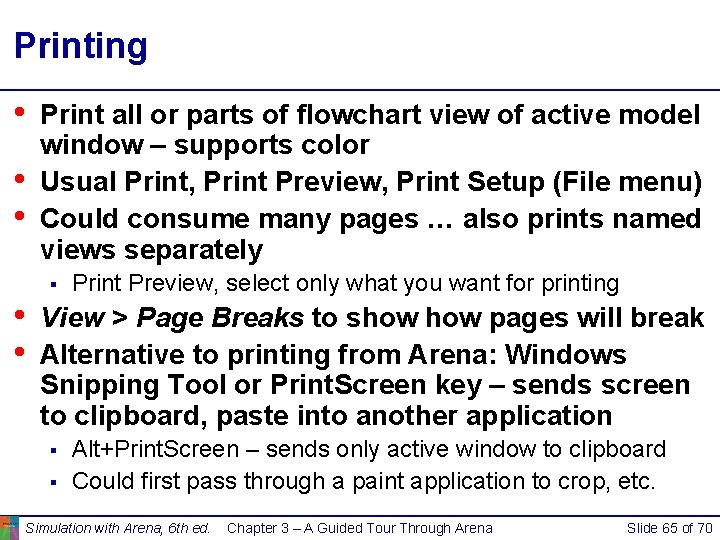
Printing • • • Print all or parts of flowchart view of active model window – supports color Usual Print, Print Preview, Print Setup (File menu) Could consume many pages … also prints named views separately § • • Print Preview, select only what you want for printing View > Page Breaks to show pages will break Alternative to printing from Arena: Windows Snipping Tool or Print. Screen key – sends screen to clipboard, paste into another application § § Alt+Print. Screen – sends only active window to clipboard Could first pass through a paint application to crop, etc. Simulation with Arena, 6 th ed. Chapter 3 – A Guided Tour Through Arena Slide 65 of 70
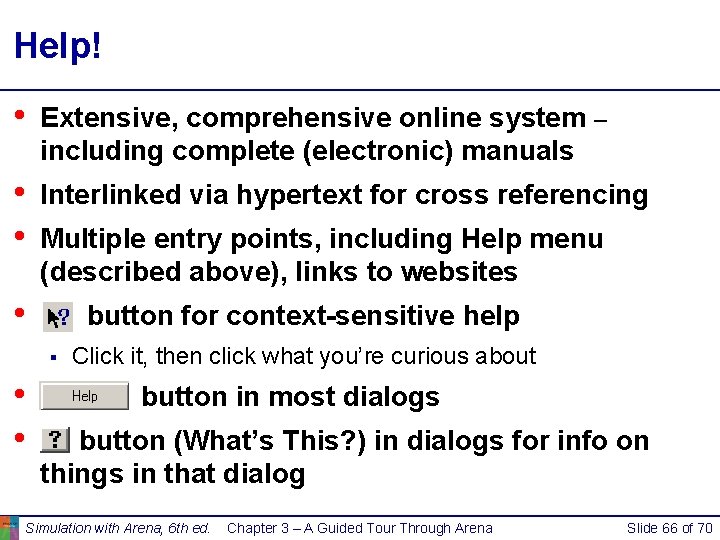
Help! • Extensive, comprehensive online system – including complete (electronic) manuals • • Interlinked via hypertext for cross referencing Multiple entry points, including Help menu (described above), links to websites • button for context-sensitive help § • • Click it, then click what you’re curious about button in most dialogs button (What’s This? ) in dialogs for info on things in that dialog Simulation with Arena, 6 th ed. Chapter 3 – A Guided Tour Through Arena Slide 66 of 70
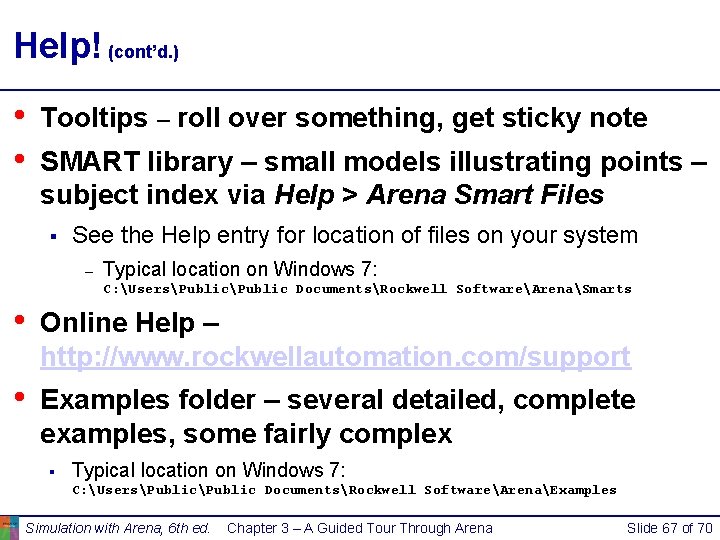
Help! (cont’d. ) • • Tooltips – roll over something, get sticky note SMART library – small models illustrating points – subject index via Help > Arena Smart Files § See the Help entry for location of files on your system – Typical location on Windows 7: C: UsersPublic DocumentsRockwell SoftwareArenaSmarts • Online Help – http: //www. rockwellautomation. com/support • Examples folder – several detailed, complete examples, some fairly complex § Typical location on Windows 7: C: UsersPublic DocumentsRockwell SoftwareArenaExamples Simulation with Arena, 6 th ed. Chapter 3 – A Guided Tour Through Arena Slide 67 of 70
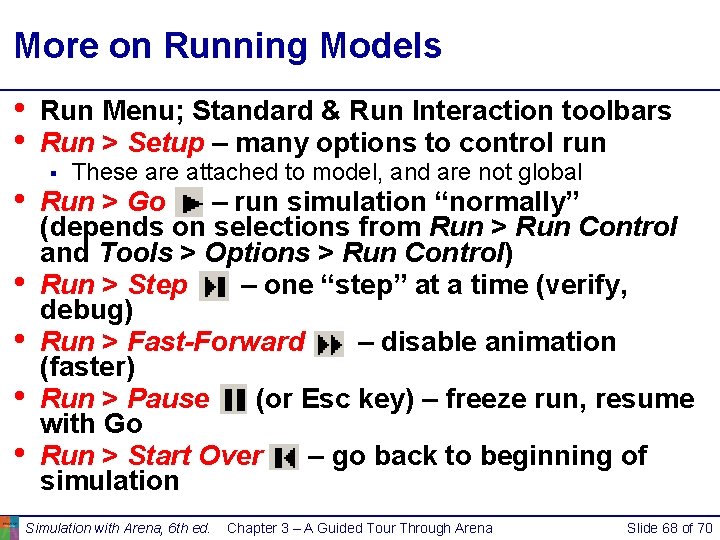
More on Running Models • • Run Menu; Standard & Run Interaction toolbars Run > Setup – many options to control run § These are attached to model, and are not global Run > Go – run simulation “normally” (depends on selections from Run > Run Control and Tools > Options > Run Control) Run > Step – one “step” at a time (verify, debug) Run > Fast-Forward – disable animation (faster) Run > Pause (or Esc key) – freeze run, resume with Go Run > Start Over – go back to beginning of simulation Simulation with Arena, 6 th ed. Chapter 3 – A Guided Tour Through Arena Slide 68 of 70
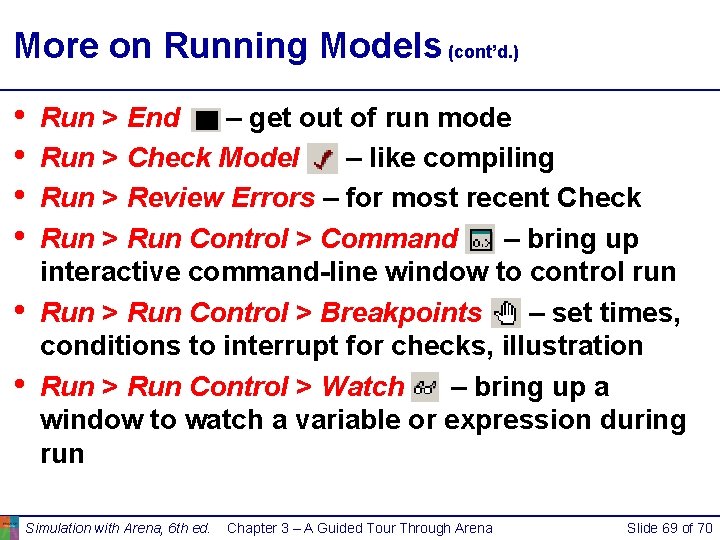
More on Running Models (cont’d. ) • • • Run > End – get out of run mode Run > Check Model – like compiling Run > Review Errors – for most recent Check Run > Run Control > Command – bring up interactive command-line window to control run Run > Run Control > Breakpoints – set times, conditions to interrupt for checks, illustration Run > Run Control > Watch – bring up a window to watch a variable or expression during run Simulation with Arena, 6 th ed. Chapter 3 – A Guided Tour Through Arena Slide 69 of 70
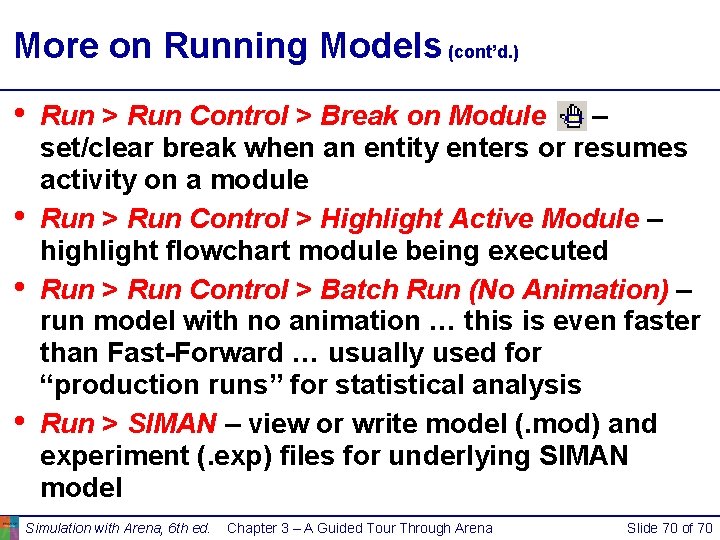
More on Running Models (cont’d. ) • • Run > Run Control > Break on Module – set/clear break when an entity enters or resumes activity on a module Run > Run Control > Highlight Active Module – highlight flowchart module being executed Run > Run Control > Batch Run (No Animation) – run model with no animation … this is even faster than Fast-Forward … usually used for “production runs” for statistical analysis Run > SIMAN – view or write model (. mod) and experiment (. exp) files for underlying SIMAN model Simulation with Arena, 6 th ed. Chapter 3 – A Guided Tour Through Arena Slide 70 of 70