
Filter Algorithms for Approximate String Matching Stefan Burkhardt
Filter Algorithms for Approximate String Matching Stefan Burkhardt
Outline · Motivation · Filter Algorithms · Gapped q-grams · Experimental Analysis
Problems and Motivation Why ? Approximate String Matching Edit and Hamming Distance Motivation Computational Biology: · EST Clustering · Assembly · Genome comparison (e. g. Human/Mouse) Information Retrieval · Phonebooks · Dictionaries · Search Engines Many more….
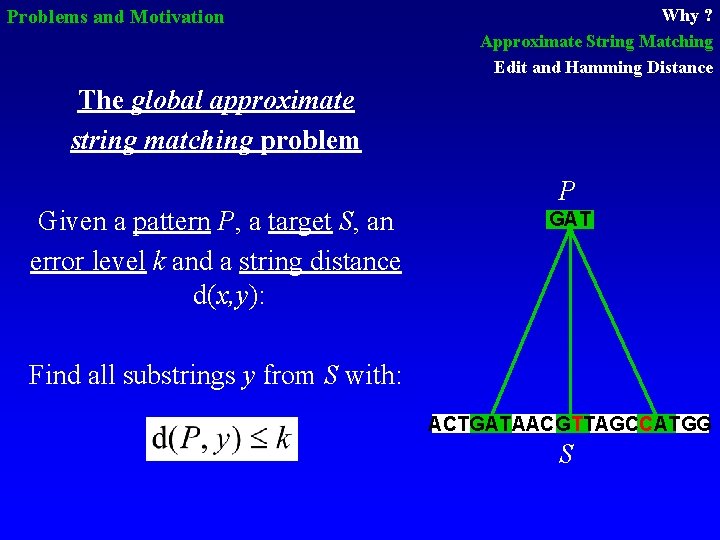
Problems and Motivation Why ? Approximate String Matching Edit and Hamming Distance The global approximate string matching problem Given a pattern P, a target S, an error level k and a string distance d(x, y): P GAT Find all substrings y from S with: ACTGATAACGTTAGCCATGG S
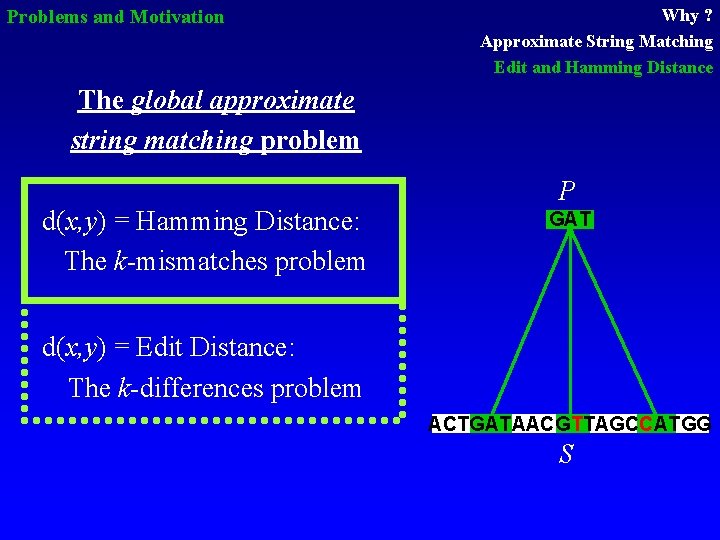
Problems and Motivation Why ? Approximate String Matching Edit and Hamming Distance The global approximate string matching problem d(x, y) = Hamming Distance: The k-mismatches problem P GAT d(x, y) = Edit Distance: The k-differences problem ACTGATAACGTTAGCCATGG S
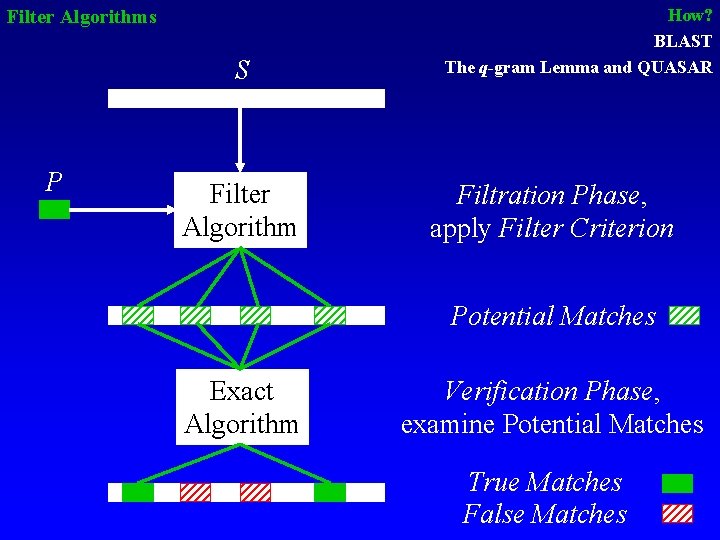
Filter Algorithms S P Filter Algorithm How? BLAST The q-gram Lemma and QUASAR Filtration Phase, apply Filter Criterion Potential Matches Exact Algorithm Verification Phase, examine Potential Matches True Matches False Matches
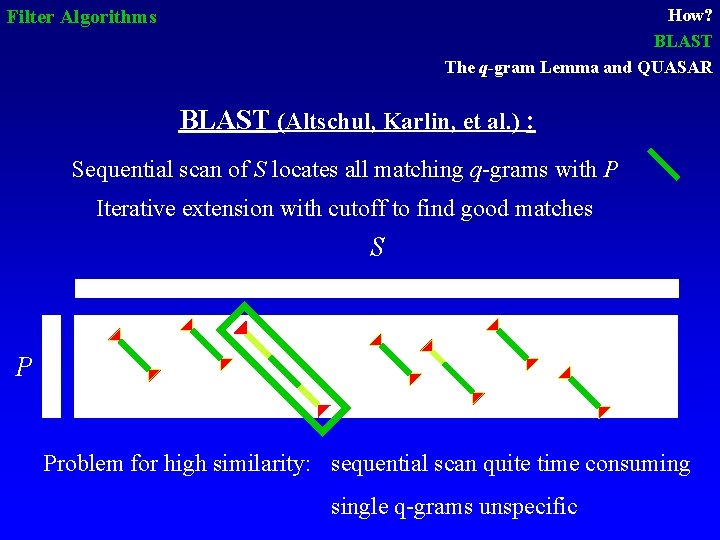
How? BLAST The q-gram Lemma and QUASAR Filter Algorithms BLAST (Altschul, Karlin, et al. ) : Sequential scan of S locates all matching q-grams with P Iterative extension with cutoff to find good matches S P Problem for high similarity: sequential scan quite time consuming single q-grams unspecific
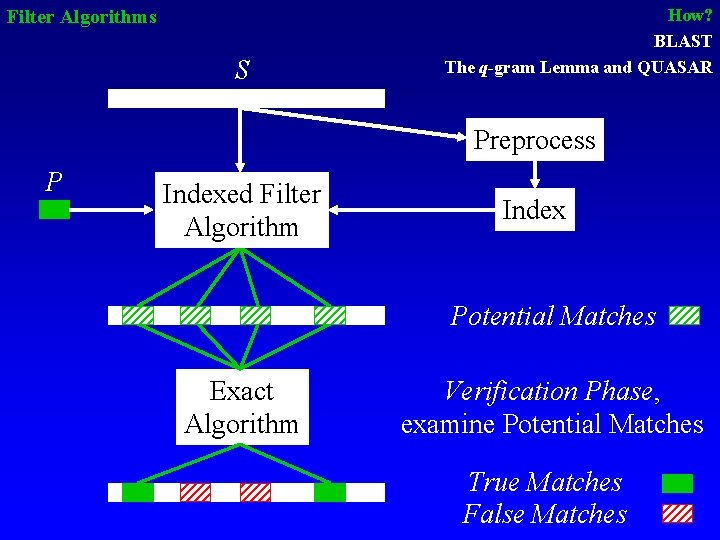
Filter Algorithms S How? BLAST The q-gram Lemma and QUASAR Preprocess P Indexed Filter Algorithm Index Potential Matches Exact Algorithm Verification Phase, examine Potential Matches True Matches False Matches
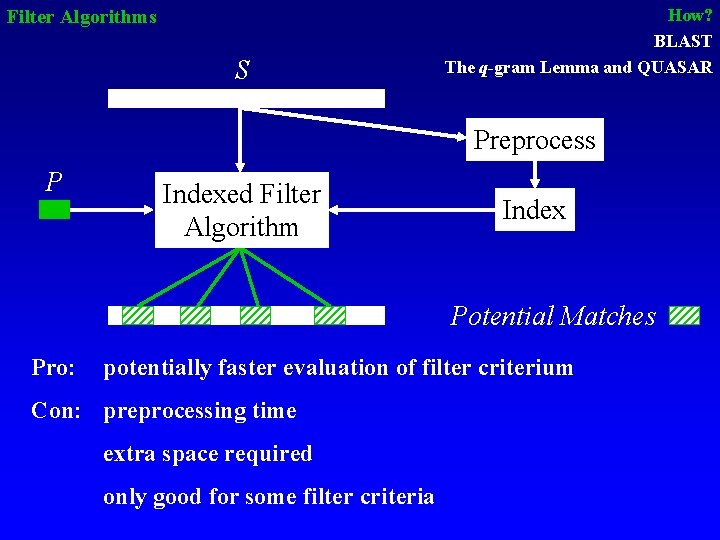
Filter Algorithms S How? BLAST The q-gram Lemma and QUASAR Preprocess P Indexed Filter Algorithm Index Potential Matches Pro: potentially faster evaluation of filter criterium Con: preprocessing time extra space required only good for some filter criteria
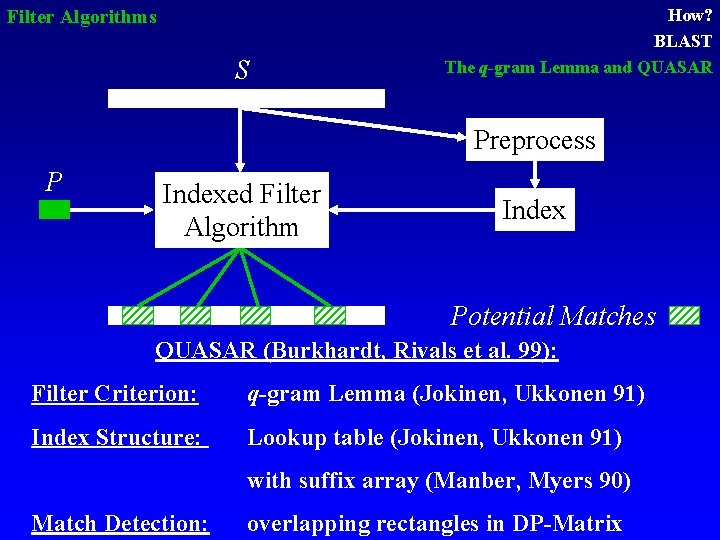
Filter Algorithms S How? BLAST The q-gram Lemma and QUASAR Preprocess P Indexed Filter Algorithm Index Potential Matches QUASAR (Burkhardt, Rivals et al. 99): Filter Criterion: q-gram Lemma (Jokinen, Ukkonen 91) Index Structure: Lookup table (Jokinen, Ukkonen 91) with suffix array (Manber, Myers 90) Match Detection: overlapping rectangles in DP-Matrix
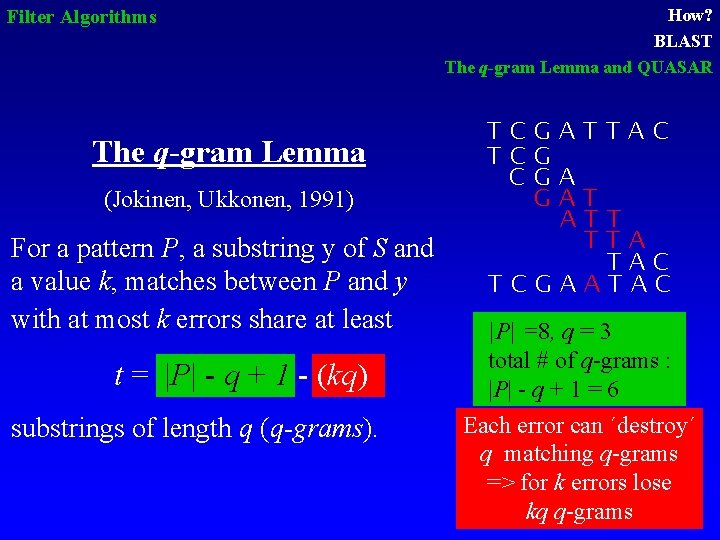
Filter Algorithms The q-gram Lemma (Jokinen, Ukkonen, 1991) For a pattern P, a substring y of S and a value k, matches between P and y with at most k errors share at least t = |P| - q + 1 - (kq) substrings of length q (q-grams). How? BLAST The q-gram Lemma and QUASAR TCGATTAC TCG CGA GAT ATT TTA TAC TCGAATAC |P| =8, q = 3 total # of q-grams : |P| - q + 1 = 6 Each error can ´destroy´ q matching q-grams => for k errors lose kq q-grams
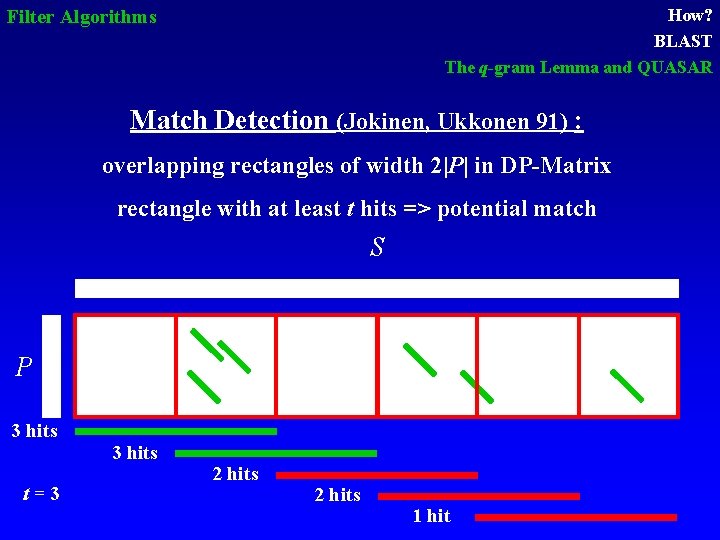
How? BLAST The q-gram Lemma and QUASAR Filter Algorithms Match Detection (Jokinen, Ukkonen 91) : overlapping rectangles of width 2|P| in DP-Matrix rectangle with at least t hits => potential match S P 3 hits t=3 3 hits 2 hits 1 hit
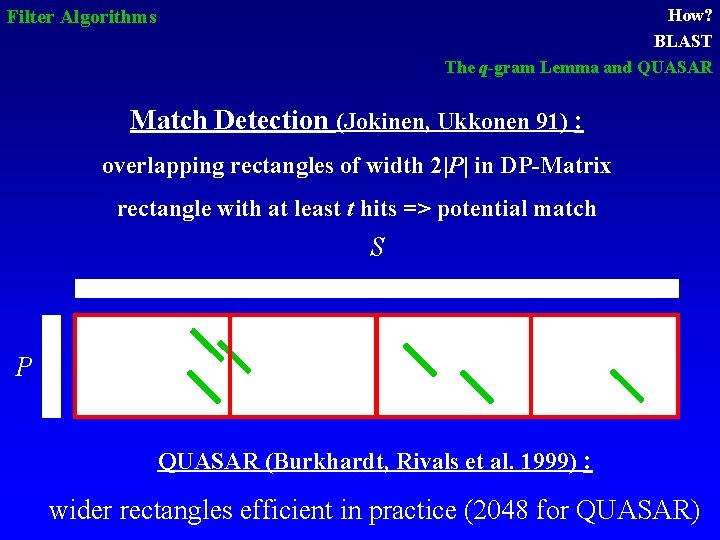
How? BLAST The q-gram Lemma and QUASAR Filter Algorithms Match Detection (Jokinen, Ukkonen 91) : overlapping rectangles of width 2|P| in DP-Matrix rectangle with at least t hits => potential match S P S QUASAR (Burkhardt, Rivals et al. 1999) : wider rectangles efficient in practice (2048 for QUASAR)
Filter Algorithms How? BLAST The q-gram Lemma and QUASAR (Burkhardt, Rivals et al. 1999) : · BLAST for the verification of the potential matches · wider Rectangles as Match Regions · Index is a combination of Lookup Table and Suffix Array · used for EST-Clustering at the DKFZ in Heidelberg · searches for EST-Clustering about 30 times faster than BLAST
Gapped q-grams · A new (old? ) idea · Hamming Distance · Finding good shapes
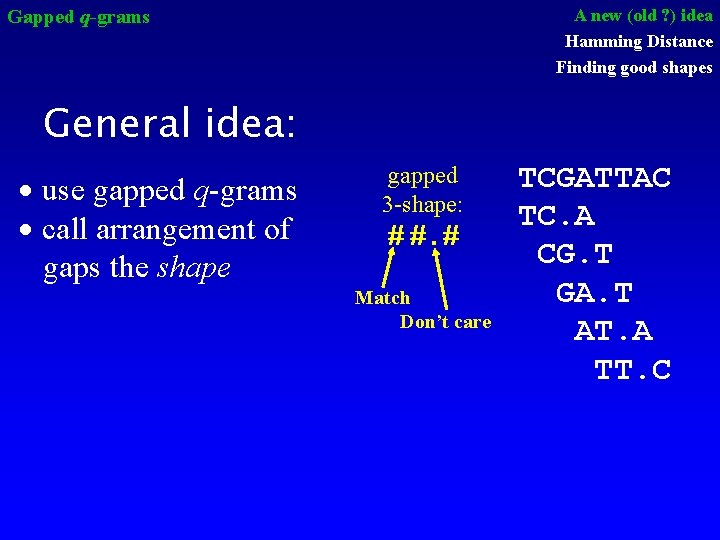
A new (old ? ) idea Hamming Distance Finding good shapes Gapped q-grams General idea: · use gapped q-grams · call arrangement of gaps the shape gapped 3 -shape: ##. # Match Don’t care TCGATTAC TC. A CG. T GA. T AT. A TT. C
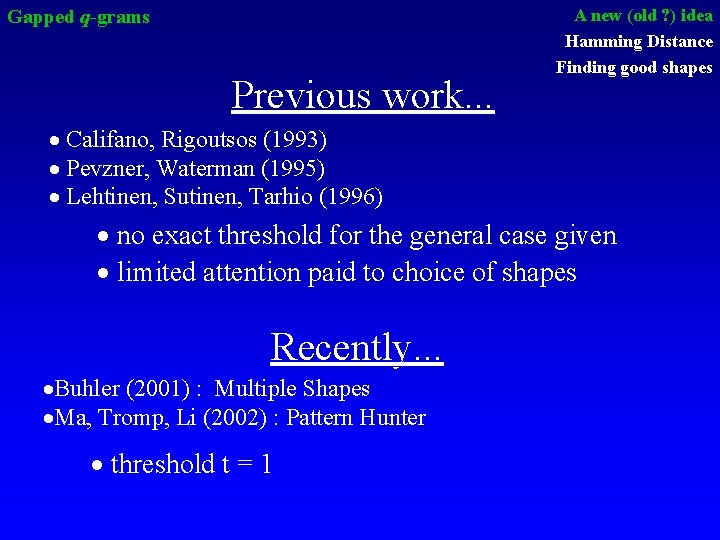
Gapped q-grams Previous work. . . A new (old ? ) idea Hamming Distance Finding good shapes · Califano, Rigoutsos (1993) · Pevzner, Waterman (1995) · Lehtinen, Sutinen, Tarhio (1996) · no exact threshold for the general case given · limited attention paid to choice of shapes Recently. . . ·Buhler (2001) : Multiple Shapes ·Ma, Tromp, Li (2002) : Pattern Hunter · threshold t = 1
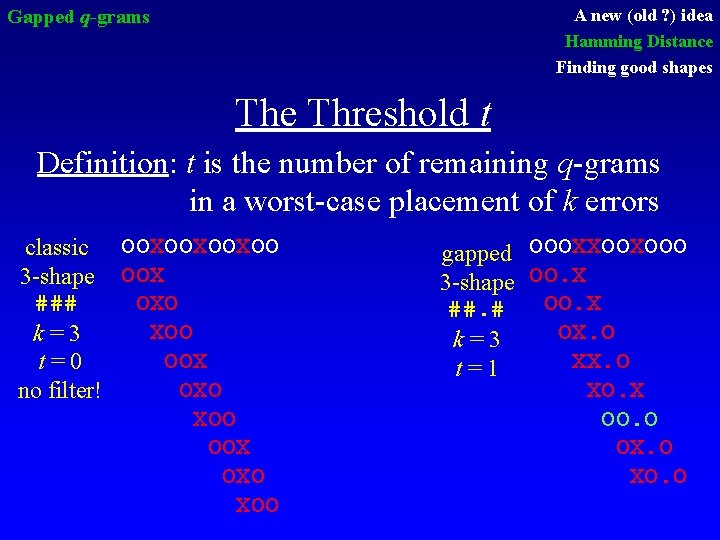
A new (old ? ) idea Hamming Distance Finding good shapes Gapped q-grams The Threshold t Definition: t is the number of remaining q-grams in a worst-case placement of k errors classic OOXOOXOOXOO 3 -shape OOX ### OXO XOO k=3 OOX t=0 OXO no filter! XOO OOX OXO XOO gapped OOOXXOOXOOO 3 -shape OO. X ##. # OX. O k=3 XX. O t=1 XO. X OO. O OX. O XO. O
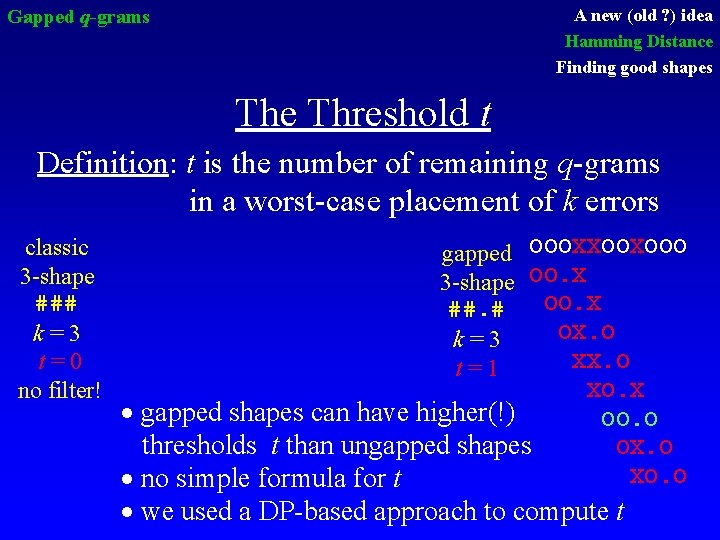
A new (old ? ) idea Hamming Distance Finding good shapes Gapped q-grams The Threshold t Definition: t is the number of remaining q-grams in a worst-case placement of k errors classic 3 -shape ### k=3 t=0 no filter! gapped OOOXXOOXOOO 3 -shape OO. X ##. # OX. O k=3 XX. O t=1 XO. X · gapped shapes can have higher(!) OO. O thresholds t than ungapped shapes OX. O XO. O · no simple formula for t · we used a DP-based approach to compute t
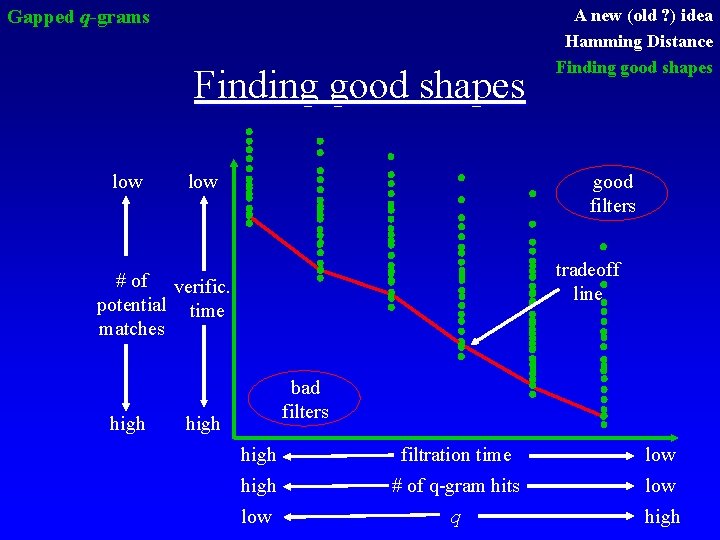
Gapped q-grams Finding good shapes low good filters tradeoff line # of verific. potential time matches high A new (old ? ) idea Hamming Distance Finding good shapes bad filters high filtration time low high # of q-gram hits low q high
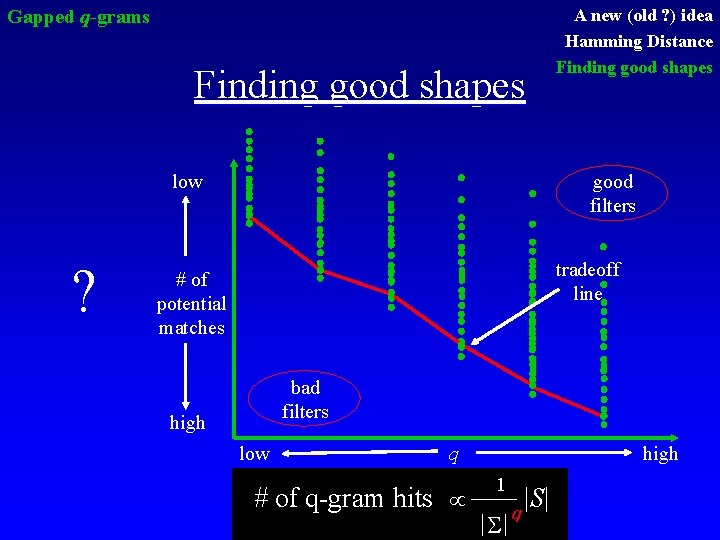
Gapped q-grams Finding good shapes low ? A new (old ? ) idea Hamming Distance Finding good shapes good filters tradeoff line # of potential matches bad filters high low q # of q-gram hits high 1 |S| q |S|
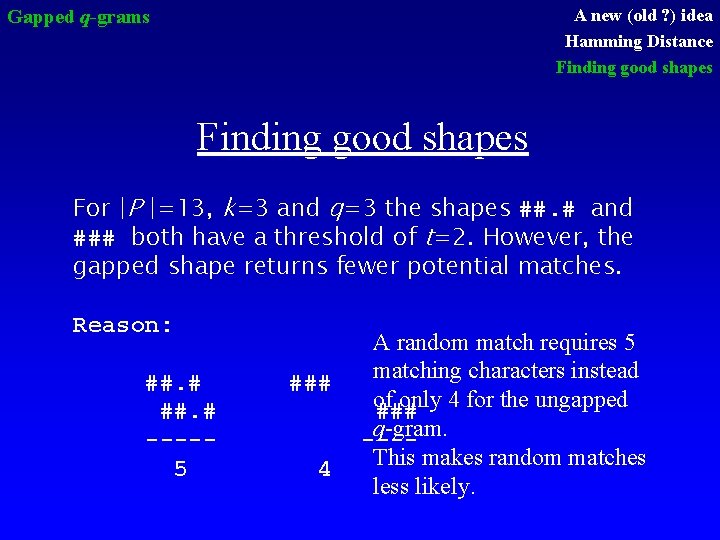
A new (old ? ) idea Hamming Distance Finding good shapes Gapped q-grams Finding good shapes For |P |=13, k=3 and q=3 the shapes ##. # and ### both have a threshold of t=2. However, the gapped shape returns fewer potential matches. Reason: ##. # ----5 ### 4 A random match requires 5 matching characters instead of only 4 for the ungapped ### q-gram. ---This makes random matches less likely.
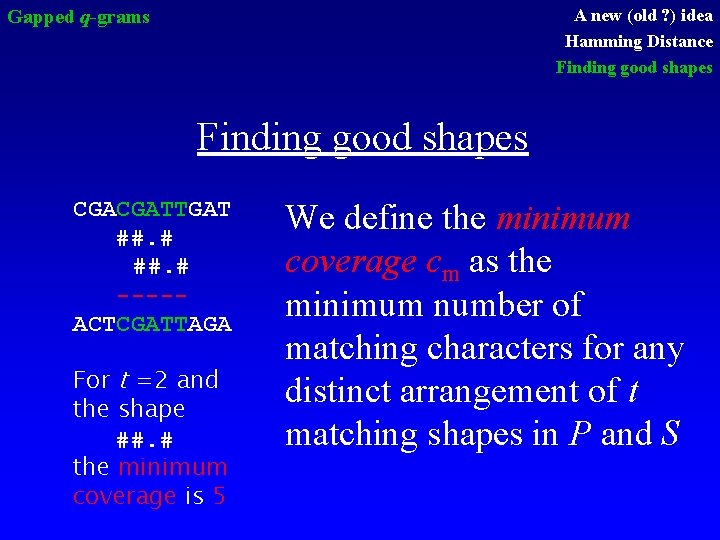
A new (old ? ) idea Hamming Distance Finding good shapes Gapped q-grams Finding good shapes CGACGATTGAT ##. # ----ACTCGATTAGA For t =2 and the shape ##. # the minimum coverage is 5 We define the minimum coverage cm as the minimum number of matching characters for any distinct arrangement of t matching shapes in P and S
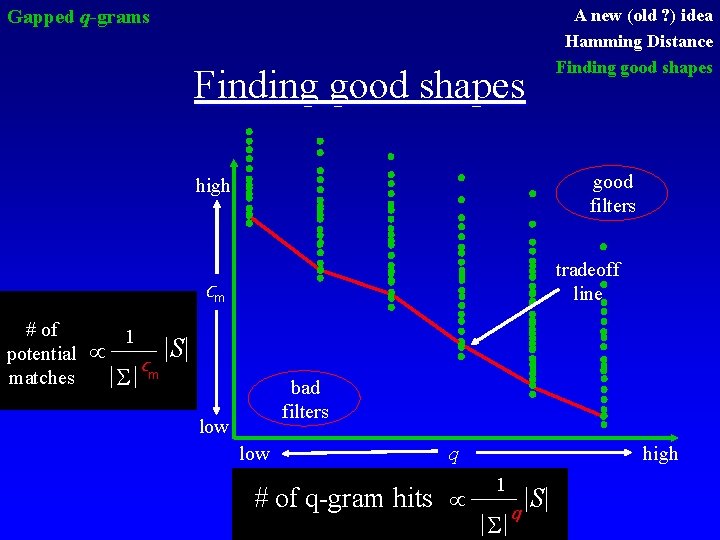
Gapped q-grams Finding good shapes good filters high tradeoff line cm # of potential matches 1 |S| c A new (old ? ) idea Hamming Distance Finding good shapes |S| m bad filters low q # of q-gram hits high 1 |S| q |S|
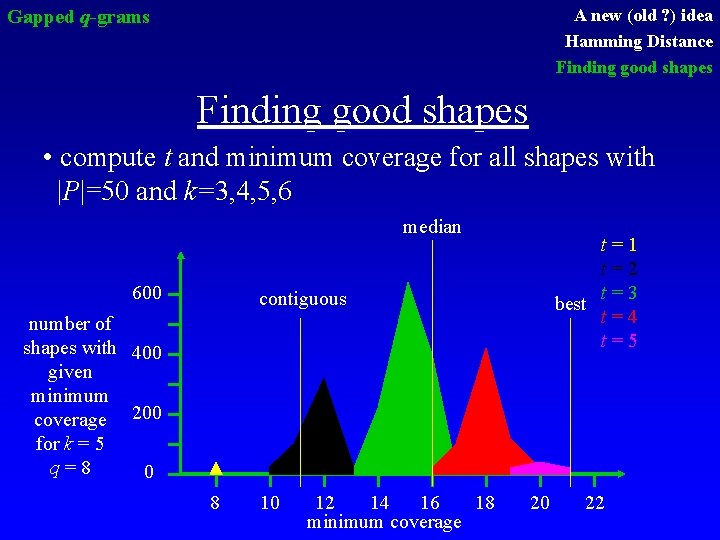
A new (old ? ) idea Hamming Distance Finding good shapes Gapped q-grams Finding good shapes • compute t and minimum coverage for all shapes with |P|=50 and k=3, 4, 5, 6 median 600 t=1 t=2 t=3 best t=4 t=5 contiguous number of shapes with 400 given minimum coverage 200 for k = 5 q=8 0 8 10 12 14 16 18 minimum coverage 20 22
Experimental Analysis · Speed and Filtration Efficiency · The Heuristic Zone
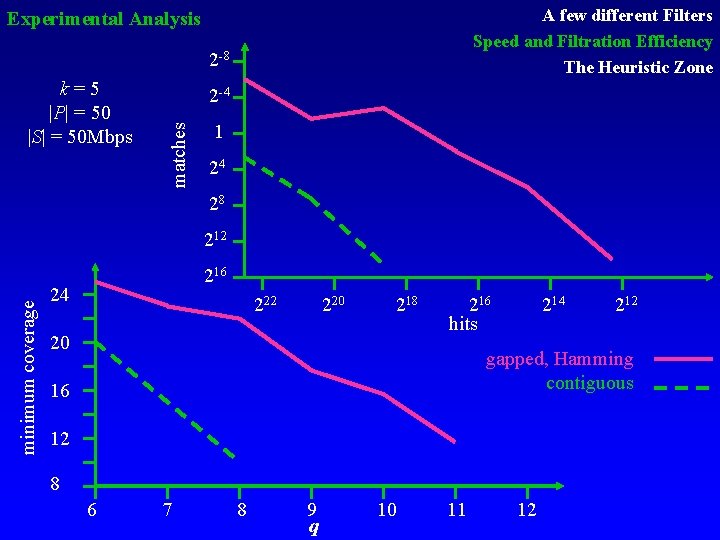
A few different Filters Speed and Filtration Efficiency The Heuristic Zone Experimental Analysis 2 -8 2 -4 matches k=5 |P| = 50 |S| = 50 Mbps 1 24 28 minimum coverage 212 216 24 222 220 218 20 216 hits 214 212 gapped, Hamming contiguous 16 12 8 6 7 8 9 q 10 11 12
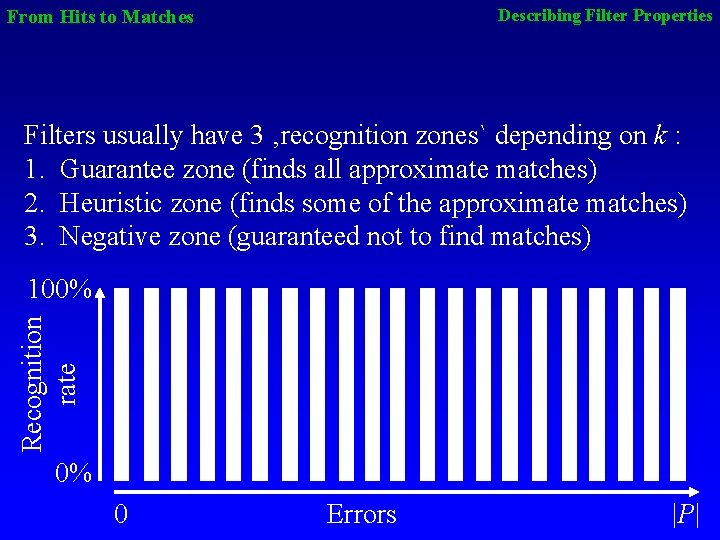
Describing Filter Properties From Hits to Matches Filters usually have 3 ‚recognition zones` depending on k : 1. Guarantee zone (finds all approximate matches) 2. Heuristic zone (finds some of the approximate matches) 3. Negative zone (guaranteed not to find matches) Recognition rate 100% 0% 0 Errors |P|
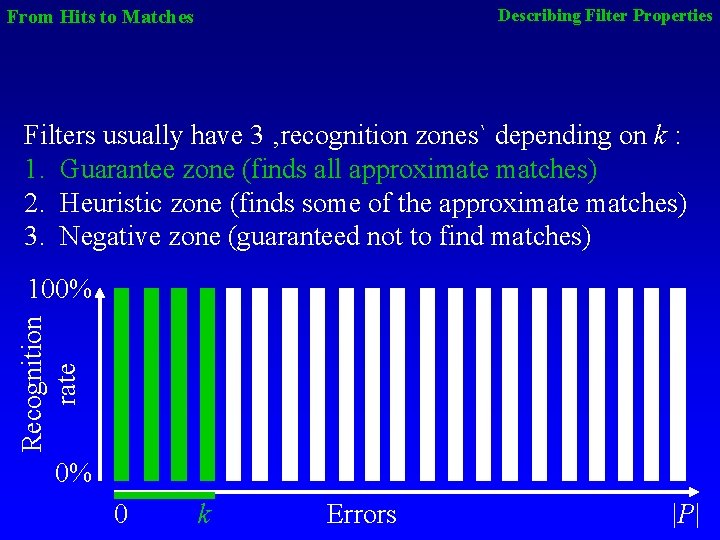
Describing Filter Properties From Hits to Matches Filters usually have 3 ‚recognition zones` depending on k : 1. Guarantee zone (finds all approximate matches) 2. Heuristic zone (finds some of the approximate matches) 3. Negative zone (guaranteed not to find matches) Recognition rate 100% 0% 0 k Errors |P|
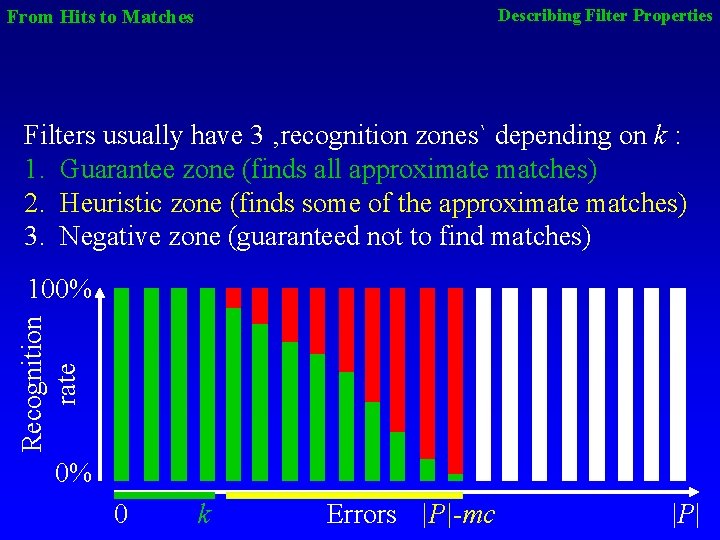
Describing Filter Properties From Hits to Matches Filters usually have 3 ‚recognition zones` depending on k : 1. Guarantee zone (finds all approximate matches) 2. Heuristic zone (finds some of the approximate matches) 3. Negative zone (guaranteed not to find matches) Recognition rate 100% 0% 0 k Errors |P|-mc |P|
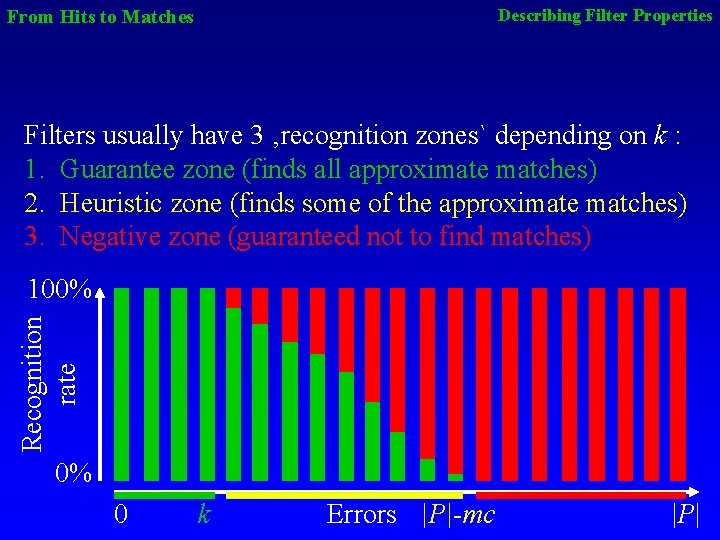
Describing Filter Properties From Hits to Matches Filters usually have 3 ‚recognition zones` depending on k : 1. Guarantee zone (finds all approximate matches) 2. Heuristic zone (finds some of the approximate matches) 3. Negative zone (guaranteed not to find matches) Recognition rate 100% 0% 0 k Errors |P|-mc |P|
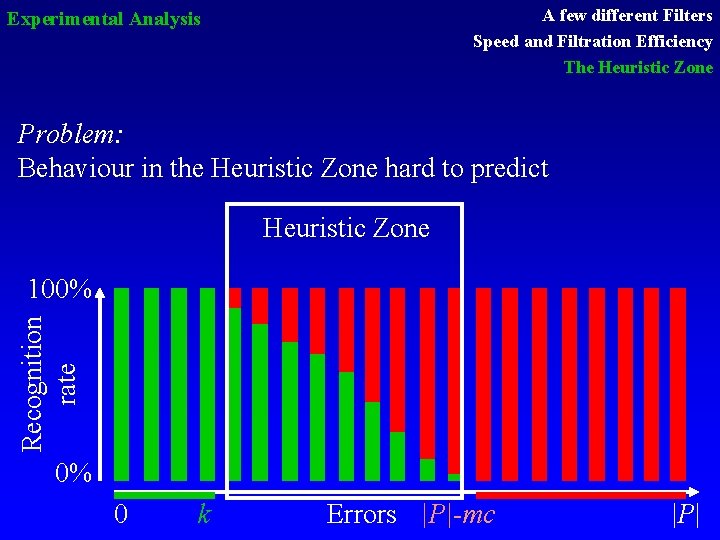
A few different Filters Speed and Filtration Efficiency The Heuristic Zone Experimental Analysis Problem: Behaviour in the Heuristic Zone hard to predict Heuristic Zone Recognition rate 100% 0% 0 k Errors |P|-mc |P|
A few different Filters Speed and Filtration Efficiency The Heuristic Zone Experimental Analysis A simple idea: Sampling! For a value i: 1. Generate s sample strings with i random errors each 2. Run a filter algorithm on these samples 3. Record how many strings were recognized (in percent) This allows an experimental evaluation of the Heuristic Zone
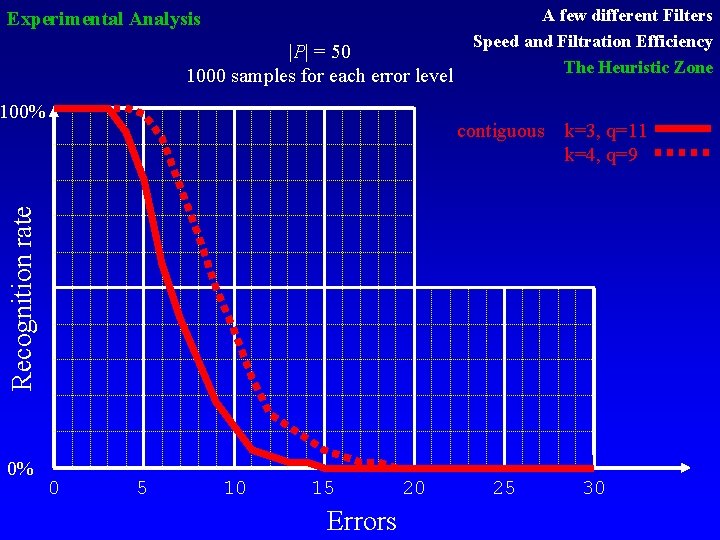
Experimental Analysis |P| = 50 1000 samples for each error level 100% A few different Filters Speed and Filtration Efficiency The Heuristic Zone k=3, q=11 k=4, q=9 Recognition rate contiguous 0% 0 5 10 15 Errors 20 25 30
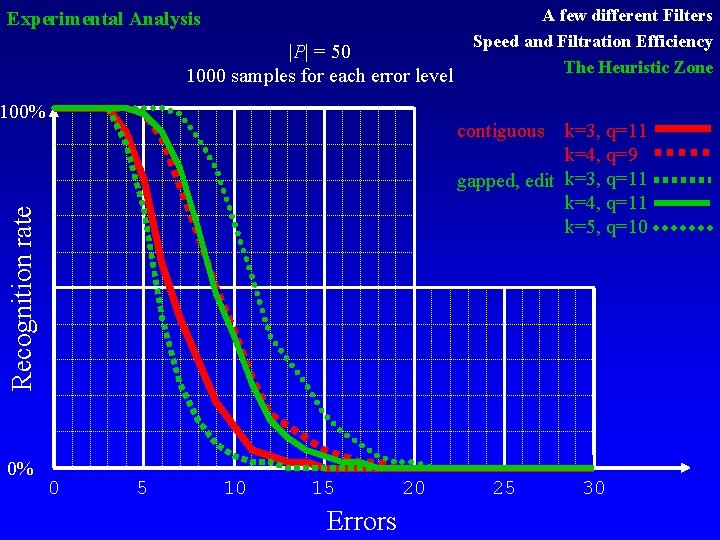
Experimental Analysis |P| = 50 1000 samples for each error level 100% contiguous k=3, q=11 k=4, q=9 gapped, edit k=3, q=11 k=4, q=11 k=5, q=10 Recognition rate 0% A few different Filters Speed and Filtration Efficiency The Heuristic Zone 0 5 10 15 Errors 20 25 30
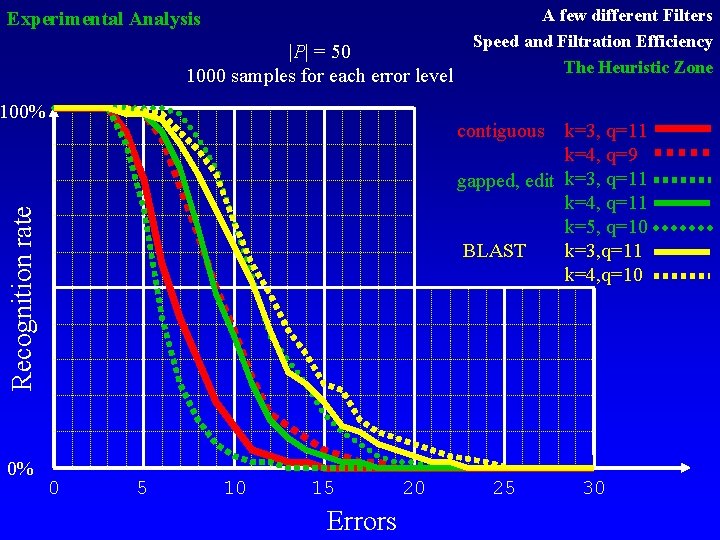
Experimental Analysis |P| = 50 1000 samples for each error level 100% contiguous k=3, q=11 k=4, q=9 gapped, edit k=3, q=11 k=4, q=11 k=5, q=10 k=3, q=11 BLAST k=4, q=10 Recognition rate 0% A few different Filters Speed and Filtration Efficiency The Heuristic Zone 0 5 10 15 Errors 20 25 30
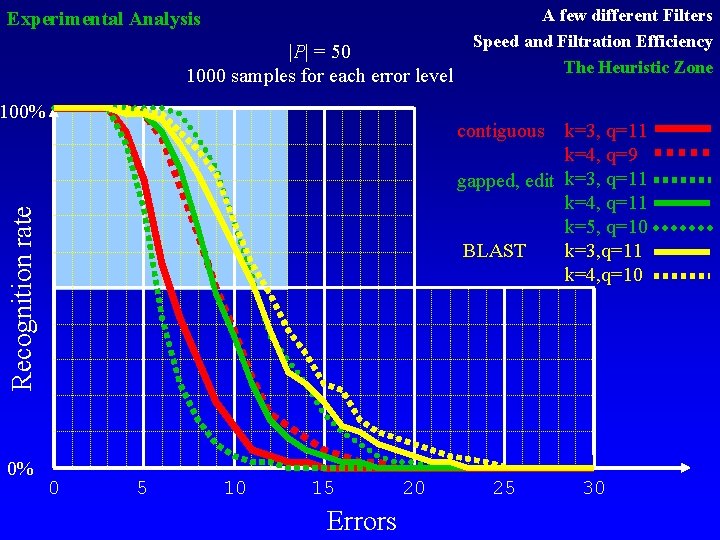
Experimental Analysis |P| = 50 1000 samples for each error level 100% contiguous k=3, q=11 k=4, q=9 gapped, edit k=3, q=11 k=4, q=11 k=5, q=10 k=3, q=11 BLAST k=4, q=10 Recognition rate 0% A few different Filters Speed and Filtration Efficiency The Heuristic Zone 0 5 10 15 Errors 20 25 30
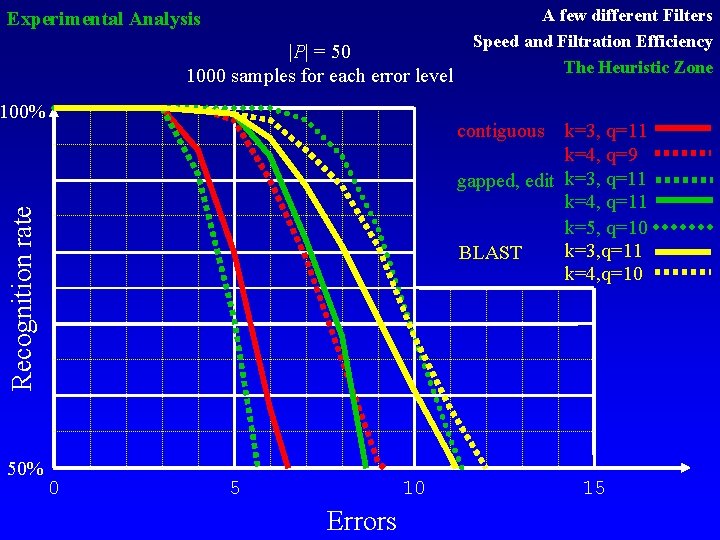
Experimental Analysis |P| = 50 1000 samples for each error level 100% contiguous k=3, q=11 k=4, q=9 gapped, edit k=3, q=11 k=4, q=11 k=5, q=10 k=3, q=11 BLAST k=4, q=10 Recognition rate 50% A few different Filters Speed and Filtration Efficiency The Heuristic Zone 0 5 10 Errors 15
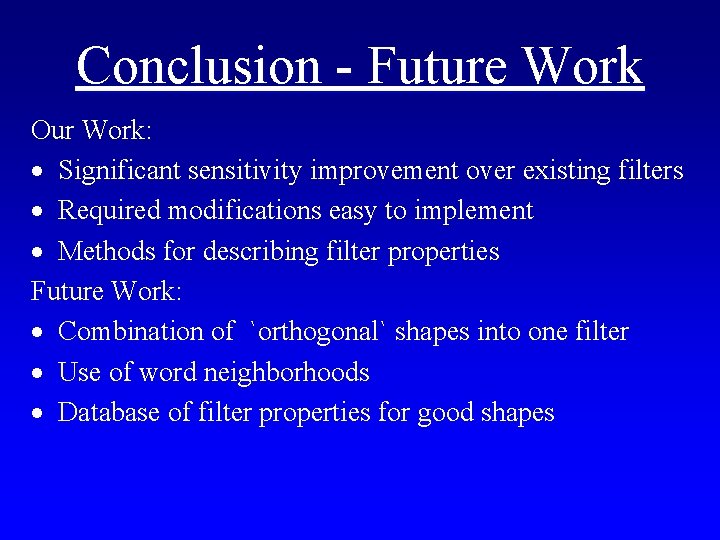
Conclusion - Future Work Our Work: · Significant sensitivity improvement over existing filters · Required modifications easy to implement · Methods for describing filter properties Future Work: · Combination of `orthogonal` shapes into one filter · Use of word neighborhoods · Database of filter properties for good shapes
- Slides: 39