A CDA Template for Continuity of Care Liora

- Slides: 31
A CDA Template for Continuity of Care Liora Alschuler, Roberto Ruggeri HIMSS 2005 Acapulco partners: Charlie Mc. Cay, Ted Blizzard
About us n Liora Alschuler ¨ ¨ ¨ n Roberto Ruggeri ¨ ¨ n alschuler. spinosa, consultants Co-chair HL 7 Structured Documents TC Co-editor, CDA member, 2005, HL 7 Board of Directors liora@the-word-electric. com Senior Healthcare Strategist Microsoft Member of the ASTM CCR Technical group and TAG Member of the HL 7 Structured Documents Committee rruggeri@microsoft. com Ted Blizzard Vice President of Information Technology for the Massachusetts Medical Society and New England Journal of Medicine ¨ Member of the ASTM CCR Steering group and TAG ¨ Member of the HL 7 Structured Documents Committee ¨ email: tblizzard@mms. org ¨ n Charlie Mc. Cay ¨ ¨ n n Ramsey Systems, UK charlie@ramseysystems. co. uk Also participating: Dr. Tom Sullivan, Massachusetts Medical Society; Bill Braithwaite, HL 7 Thanks to Bob Dolin for help in coding clinical statements
A CDA Template for Continuity of Care n n n n What is CCR? What is CDA? Relationship of CCR to CDA to CCR mapping CCR as CDA Conclusions Next Steps
Continuity of Care Record What is it? Core data set of the most relevant and timely facts about a patient’s healthcare. n Organized and transportable. n Prepared by a practitioner at the conclusion of a healthcare encounter. n To enable the next practitioner to readily access such information. n May be prepared, displayed, and transmitted on paper or electronically. n
History of the CCR n n Originally the MA Patient Care Referral Form (PCRF) Consortium of sponsoring organizations ¨ ¨ ¨ ¨ ¨ n n ASTM International Massachusetts Medical Society HIMSS American Academy of Family Physicians American Academy of Pediatrics American Medical Association Patient Safety Institute American Health Care Association National Association for the Support of LTC Additional sponsoring organizations pending Featured at HIMSS, TEPR, and … HL 7 ASTM MOU (CDA/CCR)
Sponsors represent: n n n ANSI-recognized standards development organization Over 400, 000 practitioners Over 13, 000 IT professionals Over 12, 000 institutions in the long-term care community that provide care to over 1. 5 million elderly and disabled Patients, patient advocates, data sources, corporations, provider institutions….
The effort is positioned to be n n n Patient-focused ¨ Not about what the system says to do but about what patient information is most relevant Provider-focused ¨ Practitioners determine what information is most relevant Content-focused ¨ Emphasis is on what providers need to know to deliver good patient care
Why So Much Interest in the CCR? n n It is intended to be simple to implement, use and explain It is not a top-down approach End-users, i. e. , practitioners have participated in its design ¨ The originator determines the relevant content ¨ n It has support and leadership from organizations representing end-users, who are ¨ n It allows options for implementation ¨ n Involving, advising, and assisting their constituents in its adoption Paper or electronic It has potential to reduce inefficiencies and costs Practitioners won’t have to search for relevant information ¨ Fewer repeat lab tests and other evaluations ¨
The CCR Is Not… n An EHR ¨ It is not a complete electronic health record of a patient’s lifelong health status and healthcare ¨ It is not universally accessible ¨ It does not have a universal patient identifier n A progress note, discharge summary, or consultation ¨ It n is not limited to information from a single encounter is not free-text based A loose dataset of health information ¨ It is a defined set of core data in specified XML code
What is CDA? An HL 7 Version 3 specification for any clinical document. A clinical document. . . has the following characteristics: · Persistence · Stewardship · Potential for authentication · Context · Wholeness · Human readability
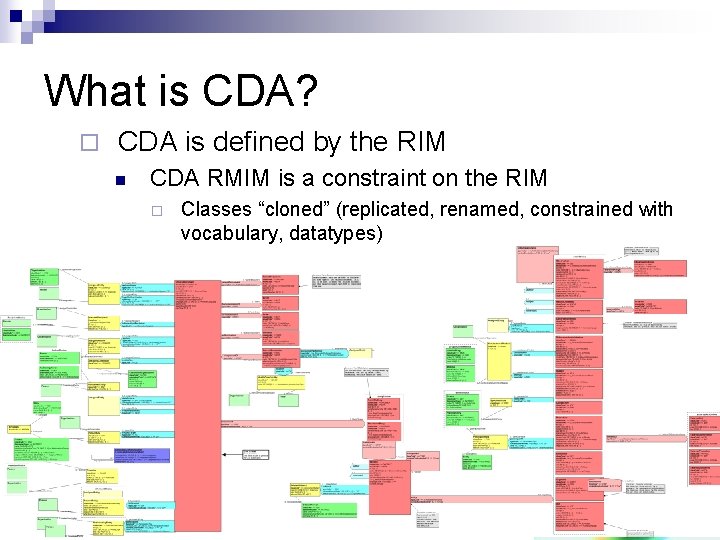
What is CDA? ¨ CDA is defined by the RIM n CDA RMIM is a constraint on the RIM ¨ Classes “cloned” (replicated, renamed, constrained with vocabulary, datatypes)
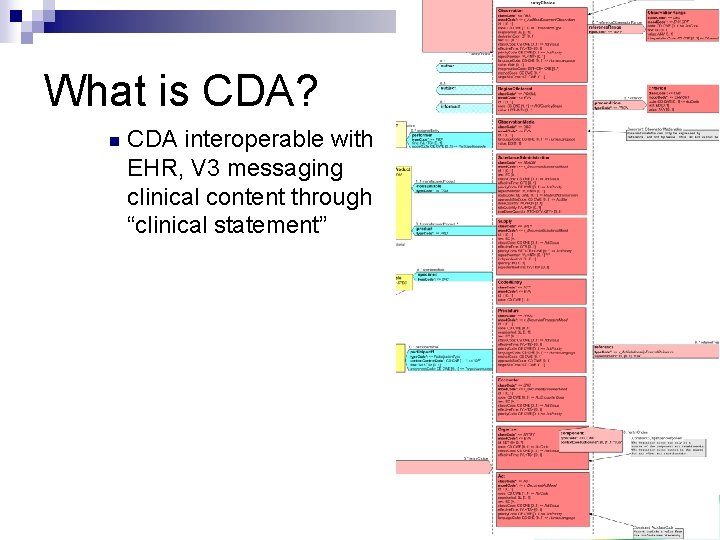
What is CDA? n CDA interoperable with EHR, V 3 messaging clinical content through “clinical statement”
What is CDA? n CDA complimentary to medical records messages and orders Message is the envelope ¨ CDA is the payload/contents/“letter” ¨ n CDA is persistent (WORM drive heuristic) ¨ n Cannot be relied on for distribution & routing beyond static contents of CDA header CDA is a snapshot in time, under signature ¨ Is not, itself, a birth-to-death, aggregate record
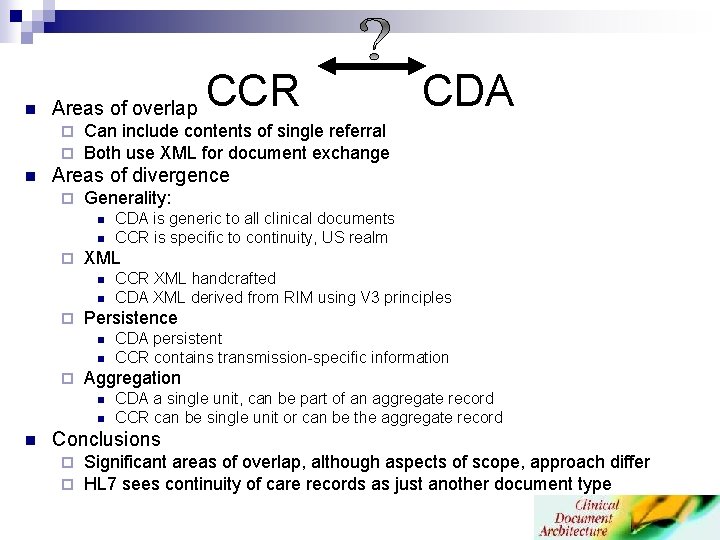
n Areas of overlap ¨ ¨ n CDA Can include contents of single referral Both use XML for document exchange Areas of divergence ¨ Generality: n n ¨ CCR XML handcrafted CDA XML derived from RIM using V 3 principles Persistence n n ¨ CDA is generic to all clinical documents CCR is specific to continuity, US realm XML n CDA persistent CCR contains transmission-specific information Aggregation n CCR CDA a single unit, can be part of an aggregate record CCR can be single unit or can be the aggregate record Conclusions ¨ ¨ Significant areas of overlap, although aspects of scope, approach differ HL 7 sees continuity of care records as just another document type
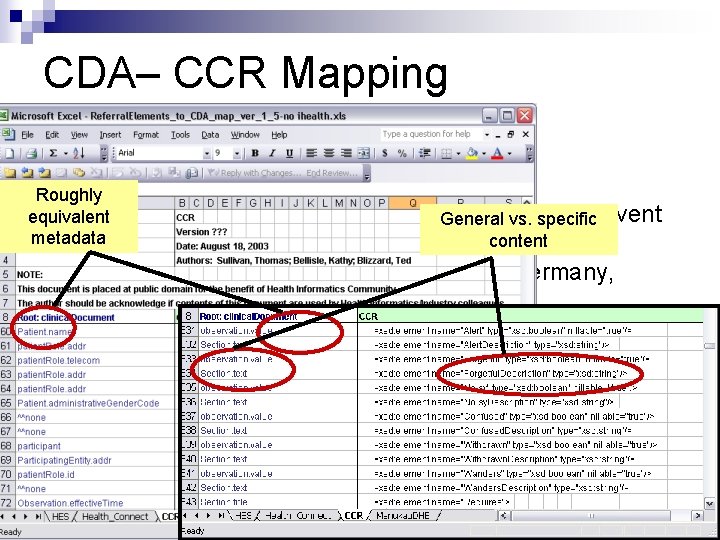
CDA– CCR Mapping ¨ Mapping project fall, 2003 Roughly equivalent n metadata Included CDA, CCR, New Zealand General vs. Health specific Event content Summary, Australian Health Connect, requirements & participation from Germany, Japan
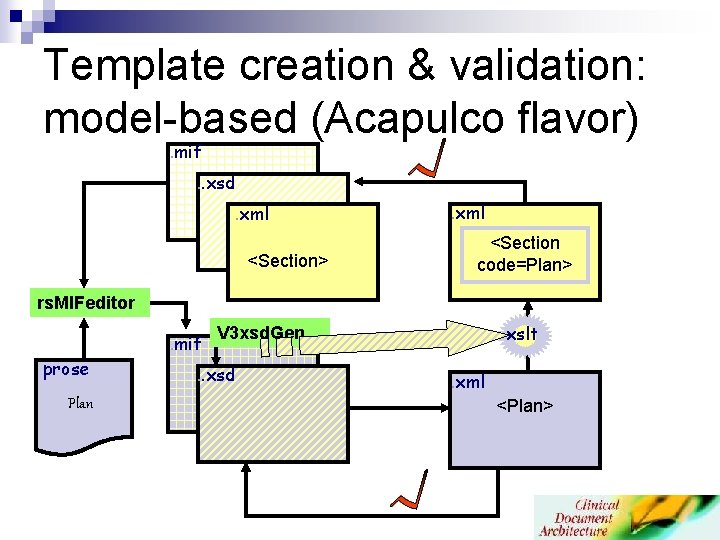
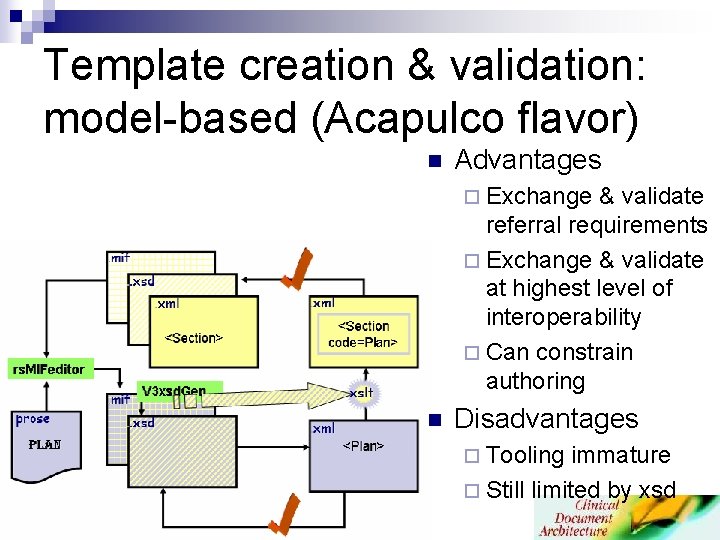
Template creation & validation: model-based (Acapulco flavor). mif . . xsd. xml <Section> . xml <Section code=Plan> rs. MIFeditor. mif prose Plan xslt V 3 xsd. Gen . . xsd . xml <Plan>
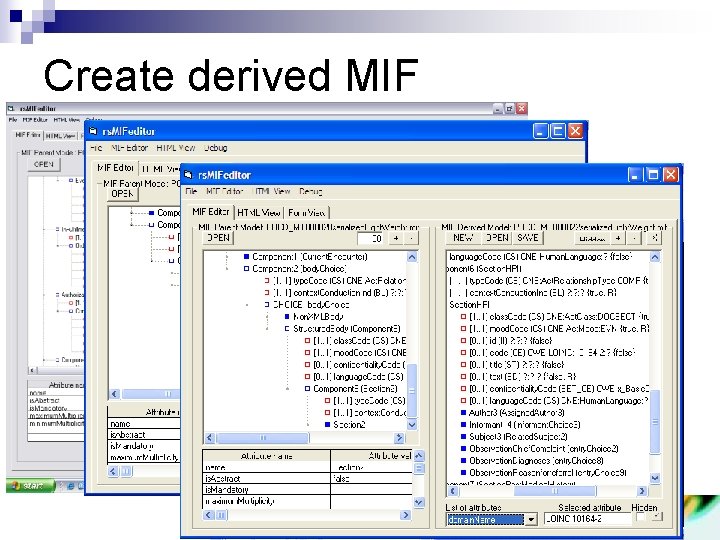
Create derived MIF
Template creation & validation: model-based (Acapulco flavor) n Advantages ¨ Exchange & validate referral requirements ¨ Exchange & validate at highest level of interoperability ¨ Can constrain authoring n Disadvantages ¨ Tooling immature ¨ Still limited by xsd
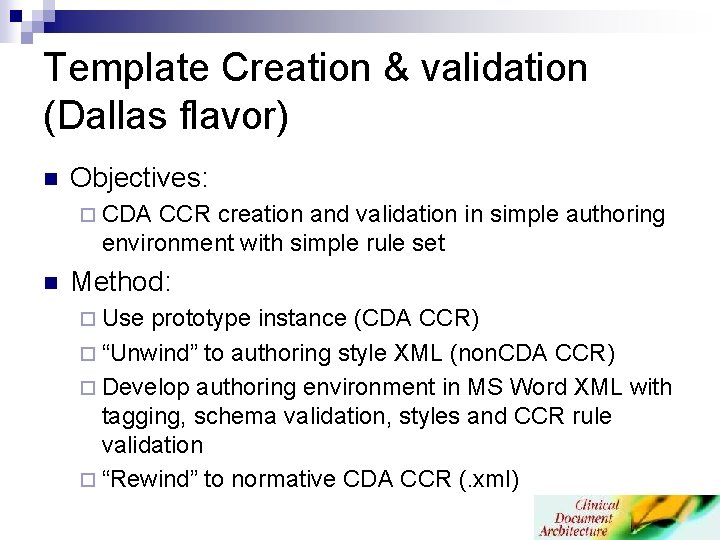
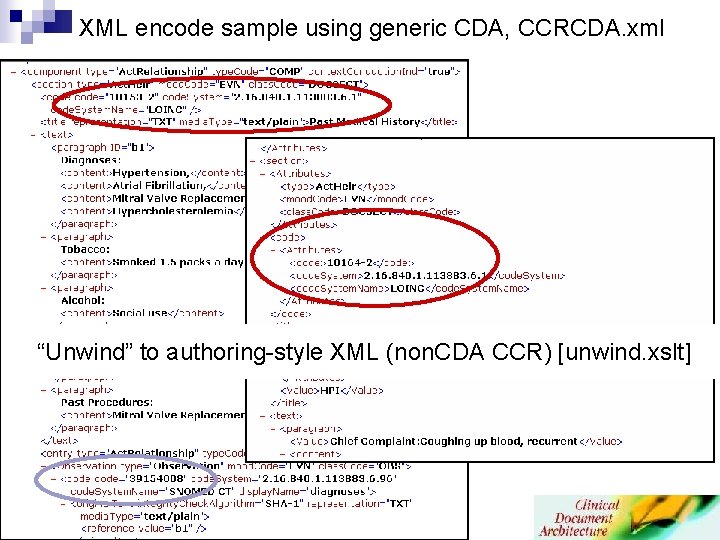
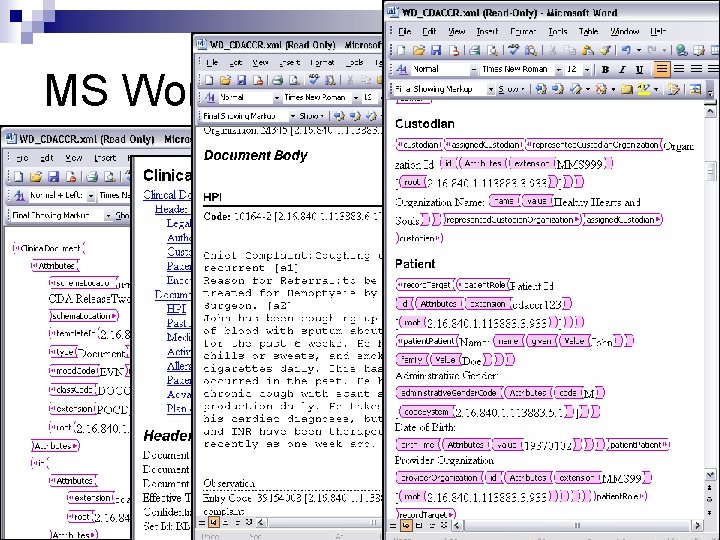
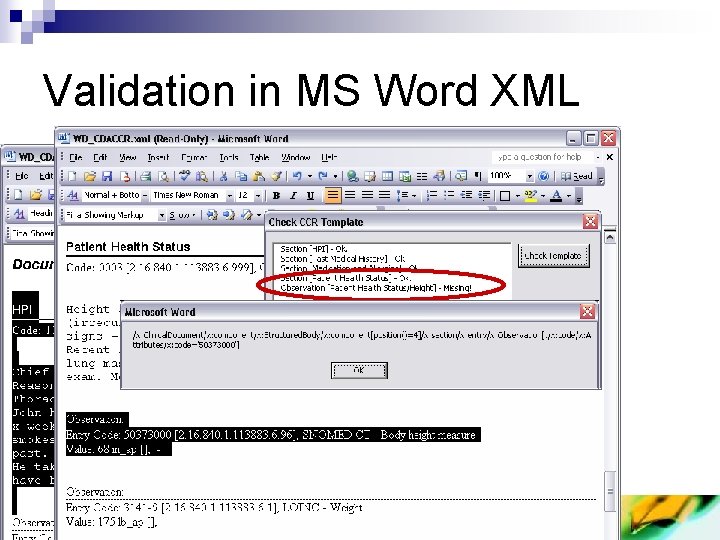
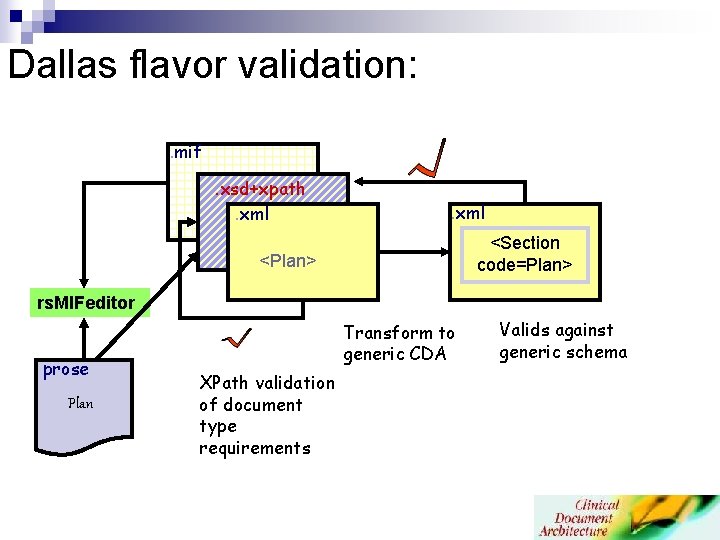
Template Creation & validation (Dallas flavor) n Objectives: ¨ CDA CCR creation and validation in simple authoring environment with simple rule set n Method: ¨ Use prototype instance (CDA CCR) ¨ “Unwind” to authoring style XML (non. CDA CCR) ¨ Develop authoring environment in MS Word XML with tagging, schema validation, styles and CCR rule validation ¨ “Rewind” to normative CDA CCR (. xml)
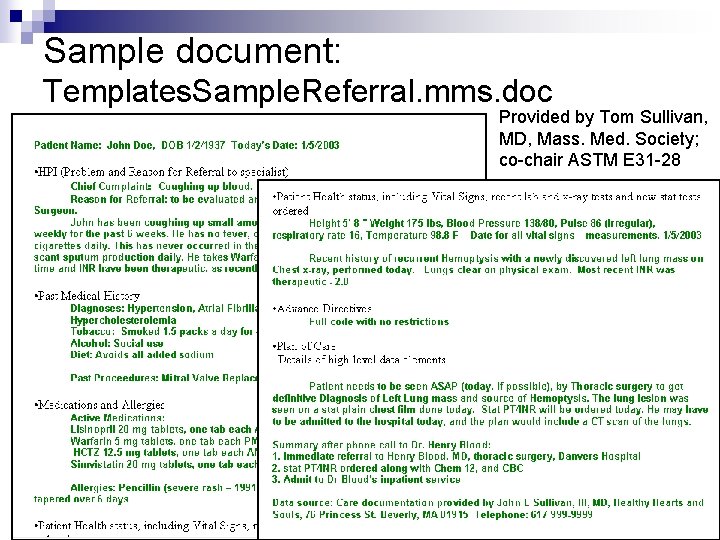
Sample document: Templates. Sample. Referral. mms. doc Provided by Tom Sullivan, MD, Mass. Med. Society; co-chair ASTM E 31 -28
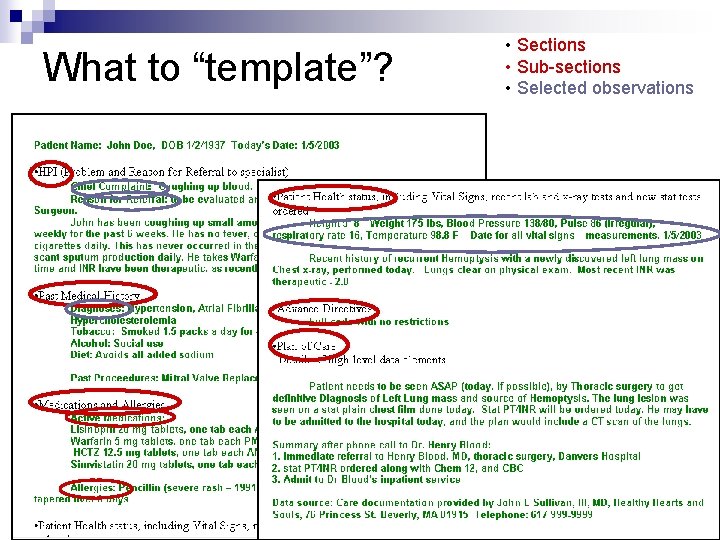
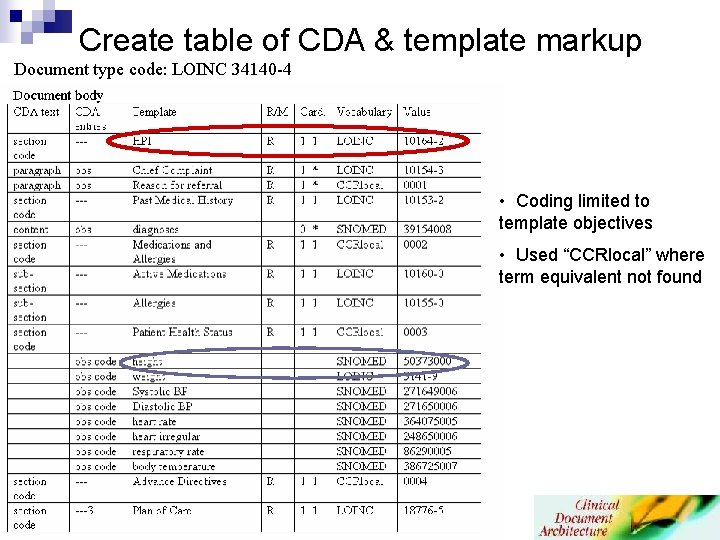
What to “template”? • Sections • Sub-sections • Selected observations
Create table of CDA & template markup Document type code: LOINC 34140 -4 • Coding limited to template objectives • Used “CCRlocal” where term equivalent not found
XML encode sample using generic CDA, CCRCDA. xml • Hand-crafted, • Narrative block complete • Coding limited to template table “Unwind” to authoring-style XML (non. CDA CCR) [unwind. xslt]
MS Word XML authoring
Validation in MS Word XML
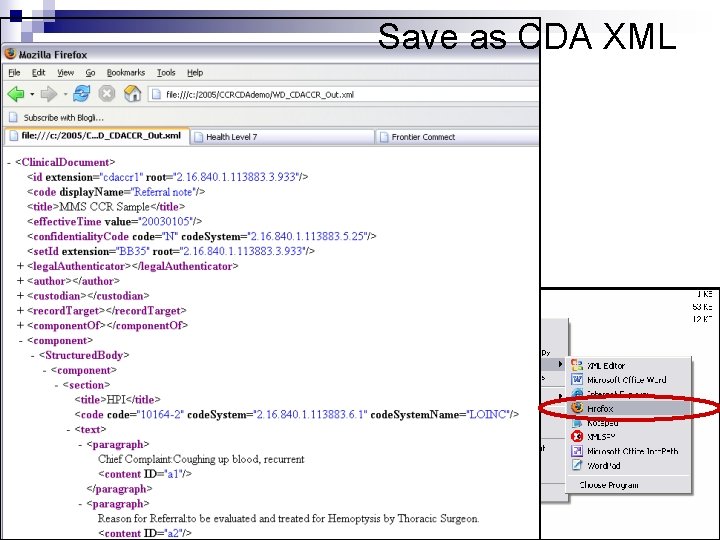
Save as CDA XML
Dallas flavor validation: . mif. xsd+xpath. xml <Section code=Plan> <Plan> rs. MIFeditor prose Plan Transform to generic CDA XPath validation of document type requirements Valids against generic schema
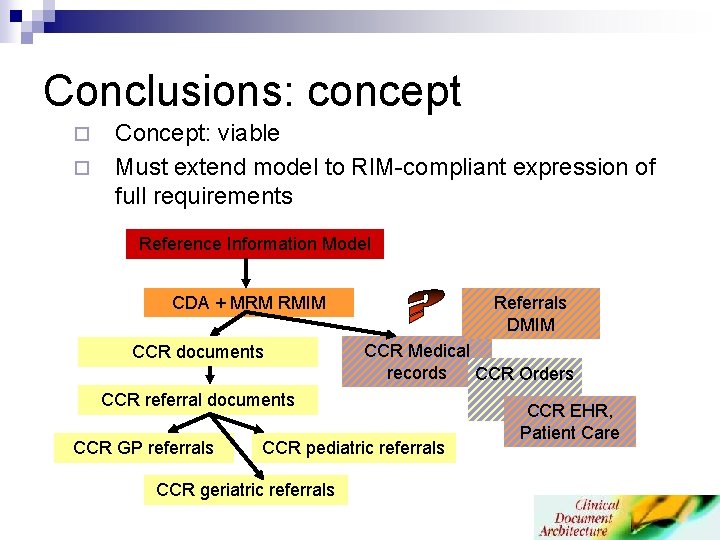
Conclusions: concept ¨ ¨ Concept: viable Must extend model to RIM-compliant expression of full requirements Reference Information Model CDA + MRM RMIM CCR documents Referrals DMIM CCR Medical records CCR Orders CCR referral documents CCR GP referrals CCR pediatric referrals CCR geriatric referrals CCR EHR, Patient Care
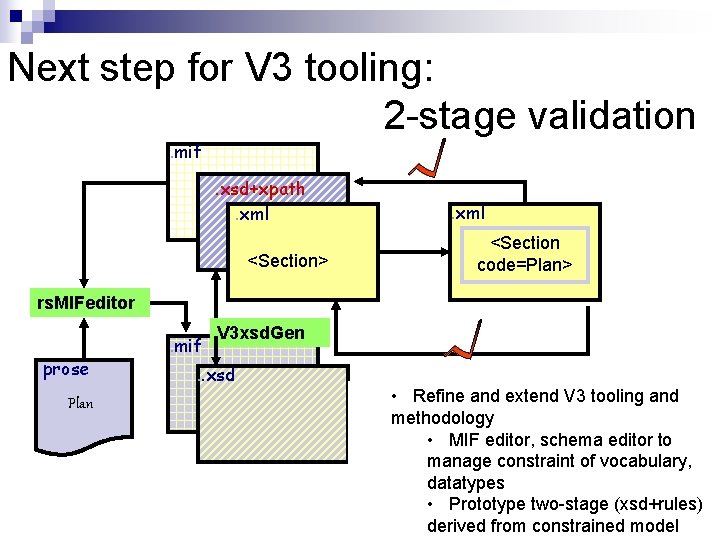
Next step for V 3 tooling: 2 -stage validation. mif. xsd+xpath. xml <Section> . xml <Section code=Plan> rs. MIFeditor prose Plan . mif V 3 xsd. Gen . . xsd • Refine and extend V 3 tooling and methodology • MIF editor, schema editor to manage constraint of vocabulary, datatypes • Prototype two-stage (xsd+rules) derived from constrained model
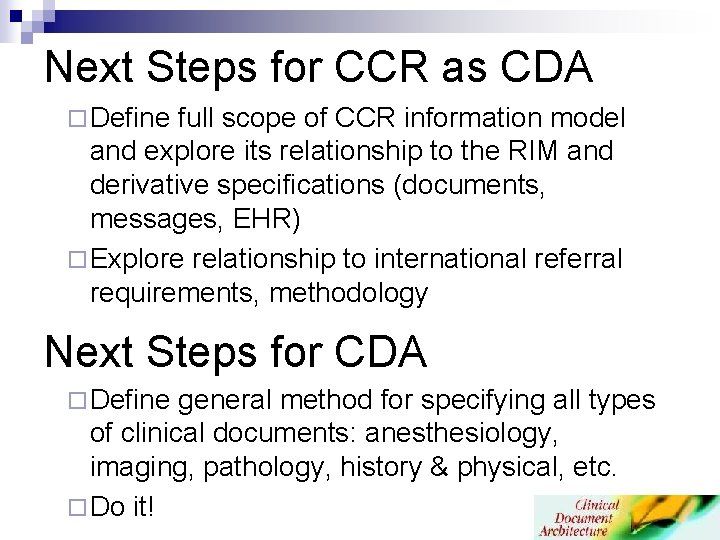
Next Steps for CCR as CDA ¨ Define full scope of CCR information model and explore its relationship to the RIM and derivative specifications (documents, messages, EHR) ¨ Explore relationship to international referral requirements, methodology Next Steps for CDA ¨ Define general method for specifying all types of clinical documents: anesthesiology, imaging, pathology, history & physical, etc. ¨ Do it!
Thank you! Questions?