2 Waste its origin its destination 2 1
- Slides: 64
2 – Waste, its origin, its destination 2. 1 – Characterization of Waste – its Origin Waste Threatens Sustainability, Characterization of Waste
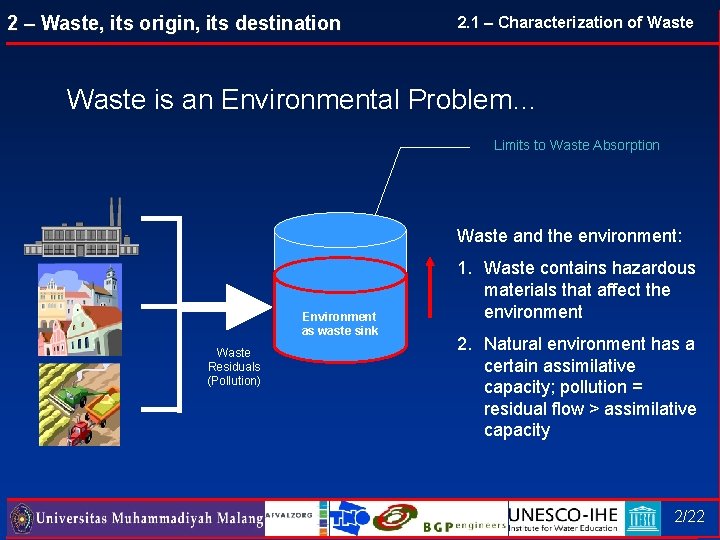
2 – Waste, its origin, its destination 2. 1 – Characterization of Waste is an Environmental Problem… Limits to Waste Absorption Waste and the environment: Environment: resource base Environment as waste sink Waste Residuals (Pollution) 1. Waste contains hazardous materials that affect the environment 2. Natural environment has a certain assimilative capacity; pollution = residual flow > assimilative capacity 2/22
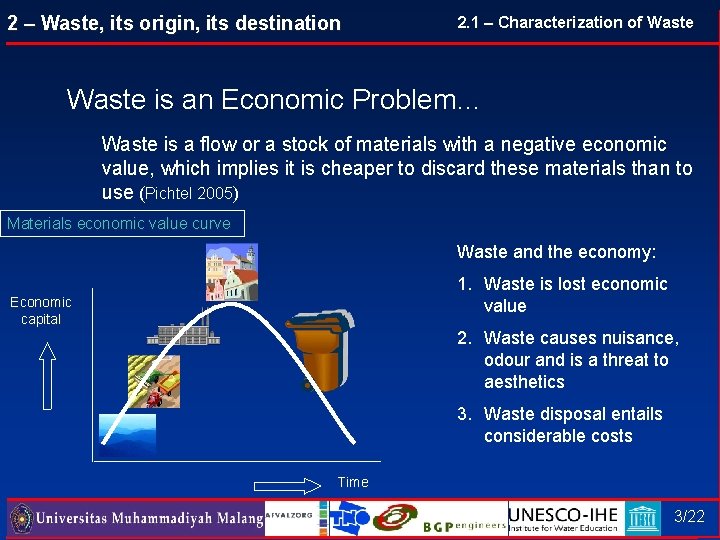
2 – Waste, its origin, its destination 2. 1 – Characterization of Waste is an Economic Problem… Waste is a flow or a stock of materials with a negative economic value, which implies it is cheaper to discard these materials than to use (Pichtel 2005) Materials economic value curve Waste and the economy: 1. Waste is lost economic value Economic capital 2. Waste causes nuisance, odour and is a threat to aesthetics 3. Waste disposal entails considerable costs Time 3/22
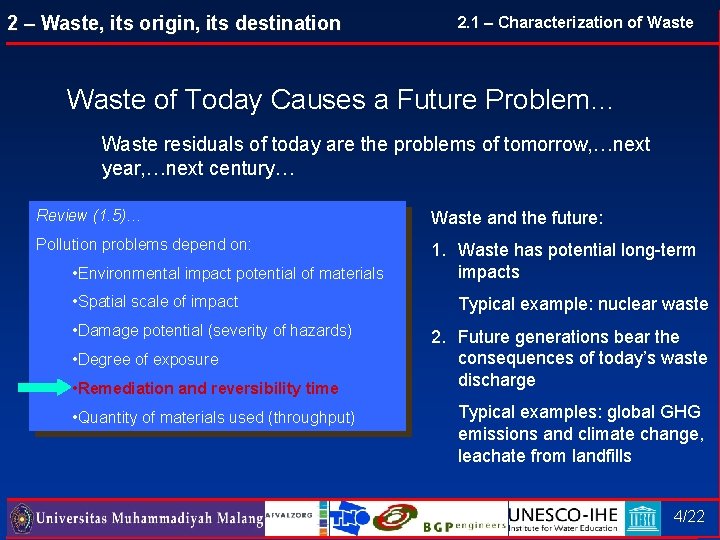
2 – Waste, its origin, its destination 2. 1 – Characterization of Waste of Today Causes a Future Problem… Waste residuals of today are the problems of tomorrow, …next year, …next century… Review (1. 5)… Waste and the future: Pollution problems depend on: 1. Waste has potential long-term impacts • Environmental impact potential of materials • Spatial scale of impact • Damage potential (severity of hazards) • Degree of exposure • Remediation and reversibility time • Quantity of materials used (throughput) Typical example: nuclear waste 2. Future generations bear the consequences of today’s waste discharge Typical examples: global GHG emissions and climate change, leachate from landfills 4/22
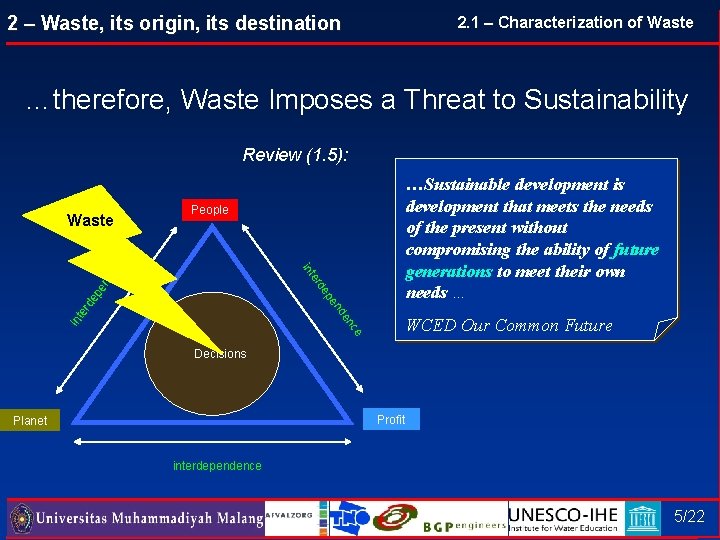
2 – Waste, its origin, its destination 2. 1 – Characterization of Waste …therefore, Waste Imposes a Threat to Sustainability Review (1. 5): People int er de pe en nd pe de er int nd en ce Waste …Sustainable development is development that meets the needs of the present without compromising the ability of future generations to meet their own needs … ce WCED Our Common Future Decisions Profit Planet interdependence 5/22
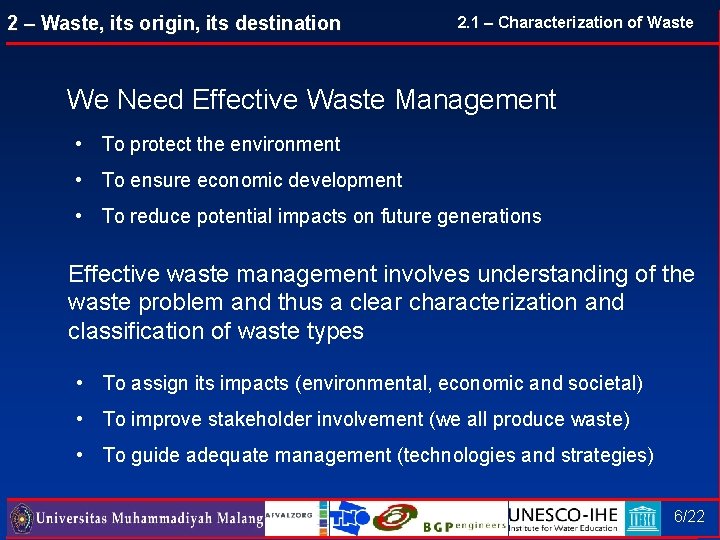
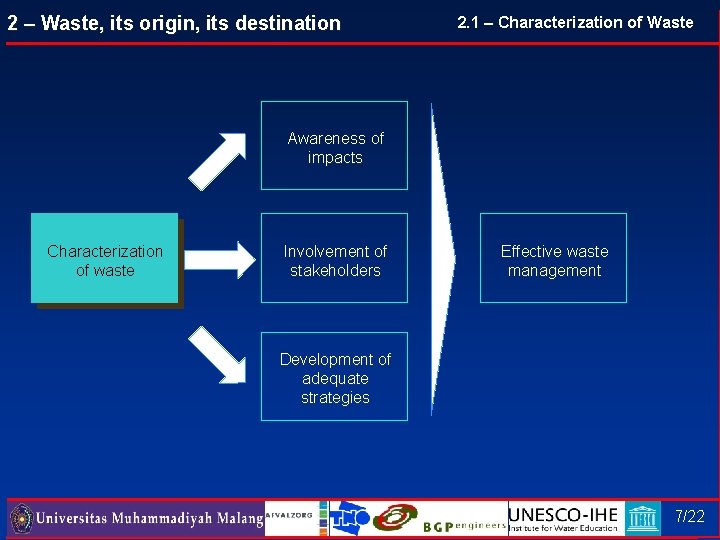
2 – Waste, its origin, its destination 2. 1 – Characterization of Waste We Need Effective Waste Management • To protect the environment • To ensure economic development • To reduce potential impacts on future generations Effective waste management involves understanding of the waste problem and thus a clear characterization and classification of waste types • To assign its impacts (environmental, economic and societal) • To improve stakeholder involvement (we all produce waste) • To guide adequate management (technologies and strategies) 6/22
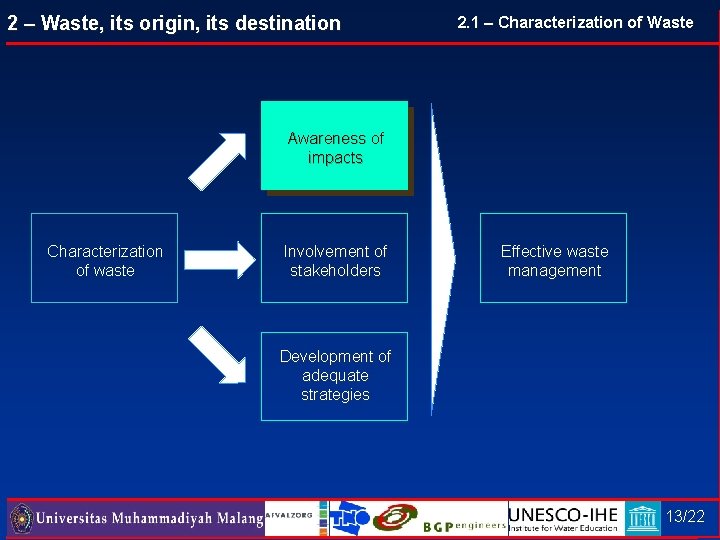
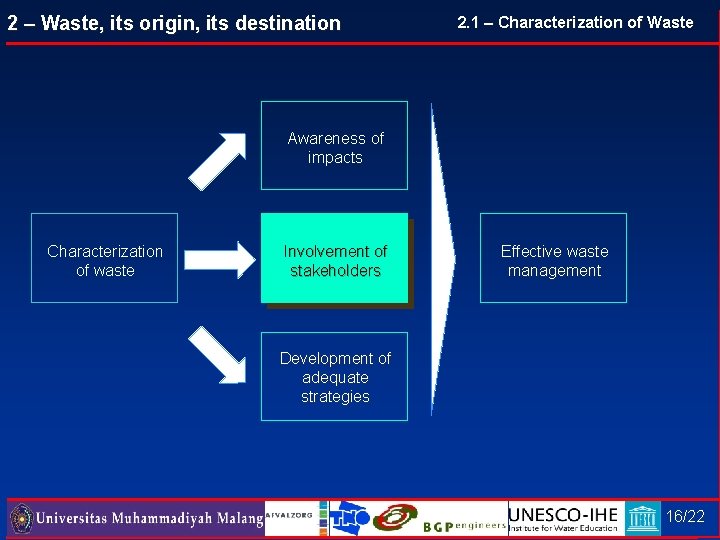
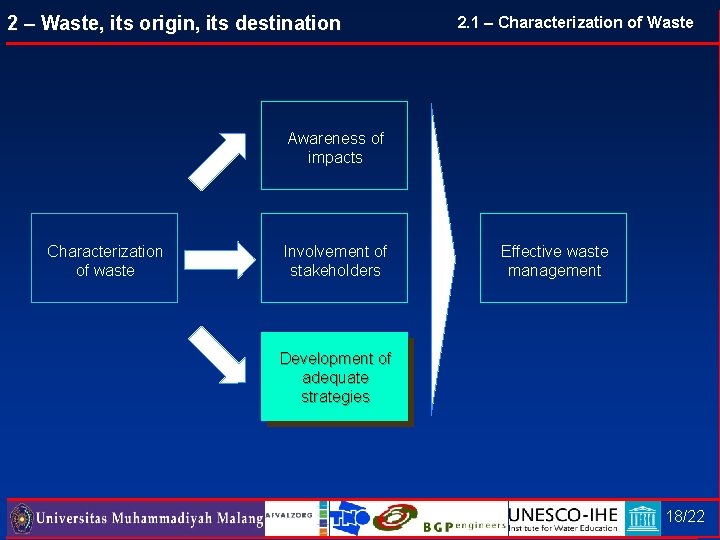
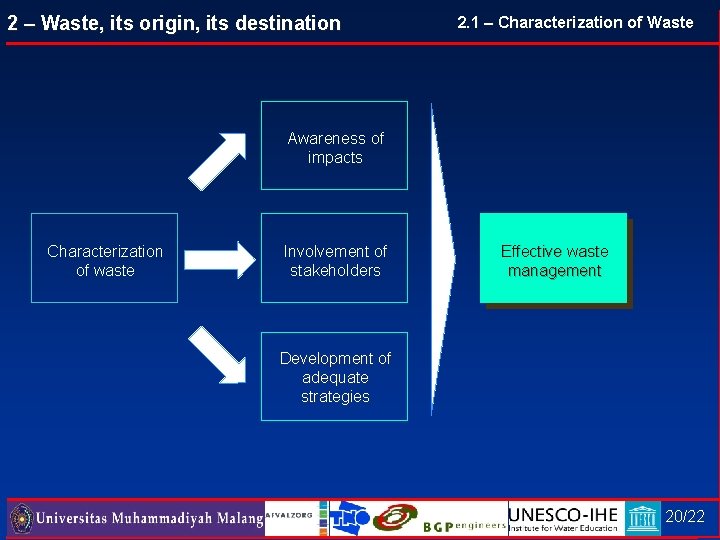
2 – Waste, its origin, its destination 2. 1 – Characterization of Waste Awareness of impacts Characterization of waste Involvement of stakeholders Effective waste management Development of adequate strategies 7/22
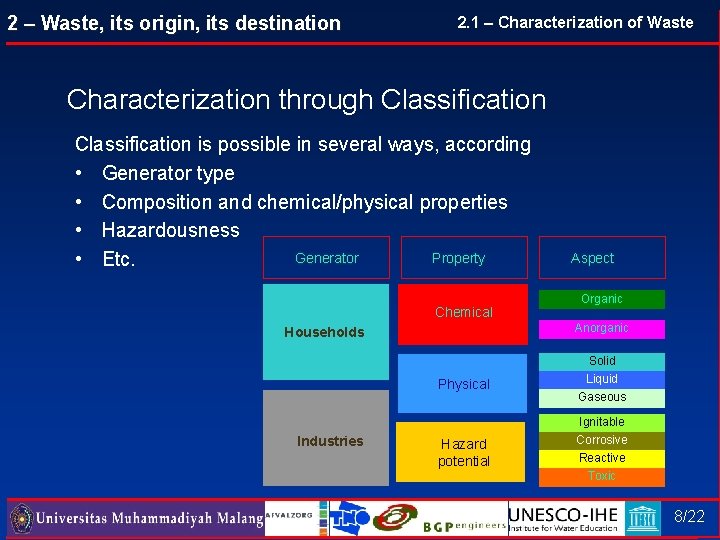
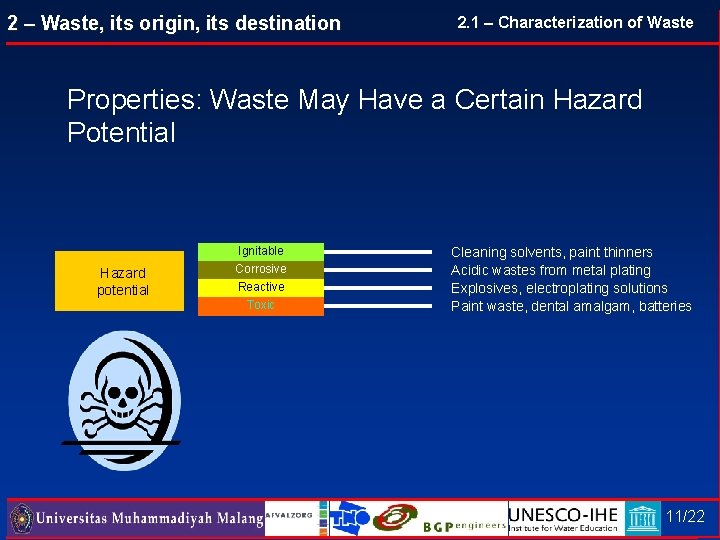
2 – Waste, its origin, its destination 2. 1 – Characterization of Waste Characterization through Classification is possible in several ways, according • Generator type • Composition and chemical/physical properties • Hazardousness Generator Property • Etc. Chemical Organic Anorganic Households Industries Aspect Physical Solid Liquid Gaseous Hazard potential Ignitable Corrosive Reactive Toxic 8/22
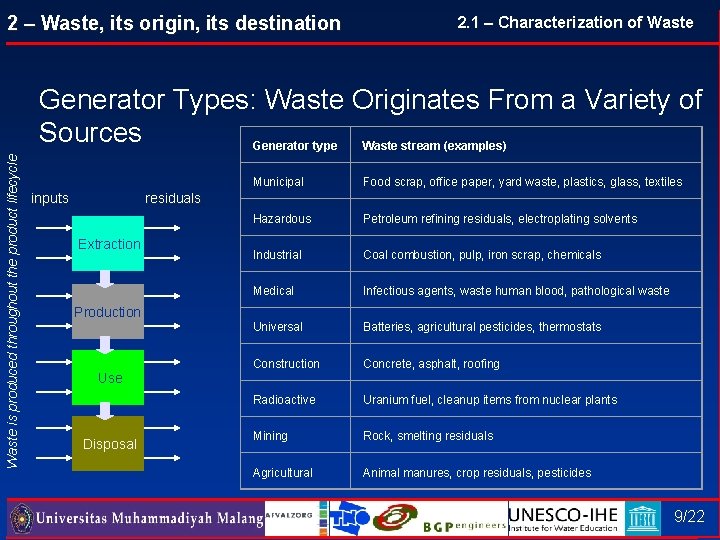
2 – Waste, its origin, its destination 2. 1 – Characterization of Waste is produced throughout the product lifecycle Generator Types: Waste Originates From a Variety of Sources Generator type Waste stream (examples) inputs Municipal Food scrap, office paper, yard waste, plastics, glass, textiles Hazardous Petroleum refining residuals, electroplating solvents Industrial Coal combustion, pulp, iron scrap, chemicals Medical Infectious agents, waste human blood, pathological waste Universal Batteries, agricultural pesticides, thermostats Construction Concrete, asphalt, roofing Radioactive Uranium fuel, cleanup items from nuclear plants Mining Rock, smelting residuals Agricultural Animal manures, crop residuals, pesticides residuals Extraction Production Use Disposal 9/22
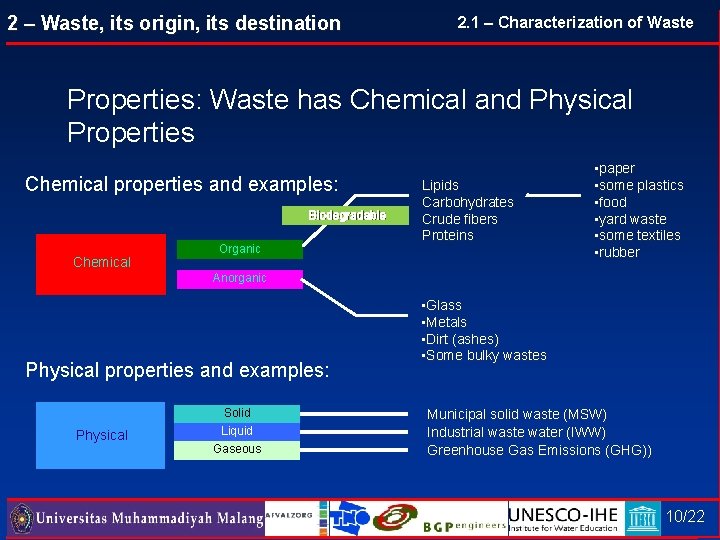
2 – Waste, its origin, its destination 2. 1 – Characterization of Waste Properties: Waste has Chemical and Physical Properties Chemical properties and examples: Biodegradable Chemical Organic Lipids Carbohydrates Crude fibers Proteins • paper • some plastics • food • yard waste • some textiles • rubber Anorganic Physical properties and examples: Physical Solid Liquid Gaseous • Glass • Metals • Dirt (ashes) • Some bulky wastes Municipal solid waste (MSW) Industrial waste water (IWW) Greenhouse Gas Emissions (GHG)) 10/22
2 – Waste, its origin, its destination 2. 1 – Characterization of Waste Properties: Waste May Have a Certain Hazard Potential Ignitable Hazard potential Corrosive Reactive Toxic Cleaning solvents, paint thinners Acidic wastes from metal plating Explosives, electroplating solutions Paint waste, dental amalgam, batteries 11/22
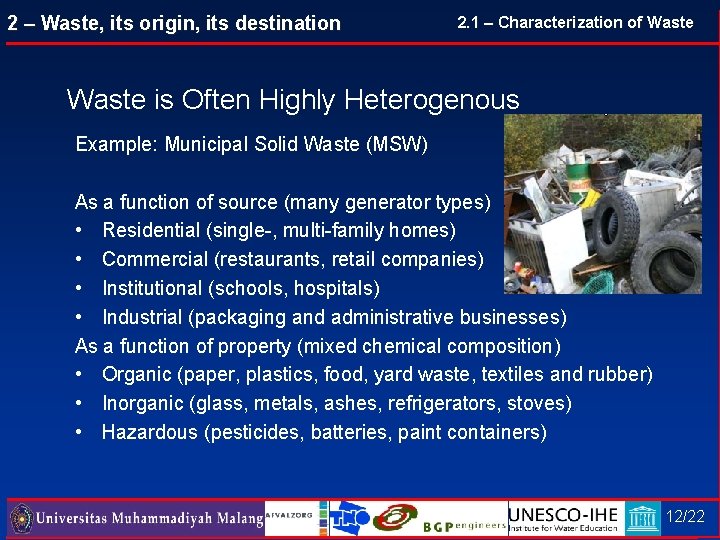
2 – Waste, its origin, its destination 2. 1 – Characterization of Waste is Often Highly Heterogenous Example: Municipal Solid Waste (MSW) As a function of source (many generator types) • Residential (single-, multi-family homes) • Commercial (restaurants, retail companies) • Institutional (schools, hospitals) • Industrial (packaging and administrative businesses) As a function of property (mixed chemical composition) • Organic (paper, plastics, food, yard waste, textiles and rubber) • Inorganic (glass, metals, ashes, refrigerators, stoves) • Hazardous (pesticides, batteries, paint containers) 12/22
2 – Waste, its origin, its destination 2. 1 – Characterization of Waste Awareness of impacts Characterization of waste Involvement of stakeholders Effective waste management Development of adequate strategies 13/22
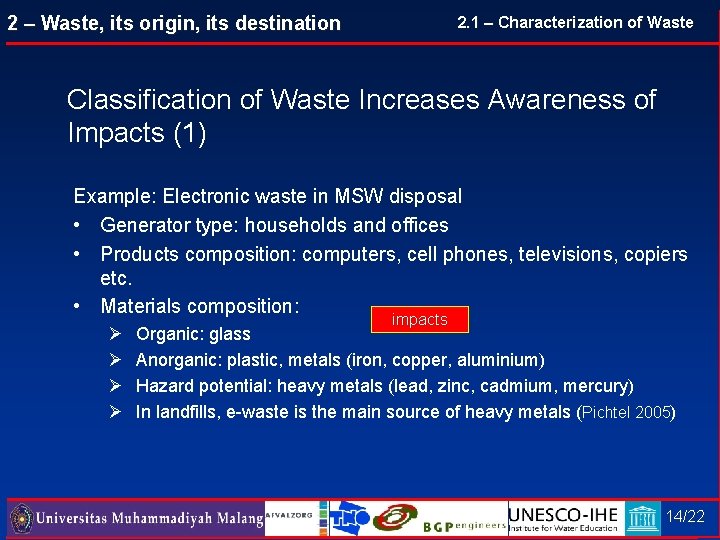
2 – Waste, its origin, its destination 2. 1 – Characterization of Waste Classification of Waste Increases Awareness of Impacts (1) Example: Electronic waste in MSW disposal • Generator type: households and offices • Products composition: computers, cell phones, televisions, copiers etc. • Materials composition: Ø Ø impacts Organic: glass Anorganic: plastic, metals (iron, copper, aluminium) Hazard potential: heavy metals (lead, zinc, cadmium, mercury) In landfills, e-waste is the main source of heavy metals (Pichtel 2005) 14/22
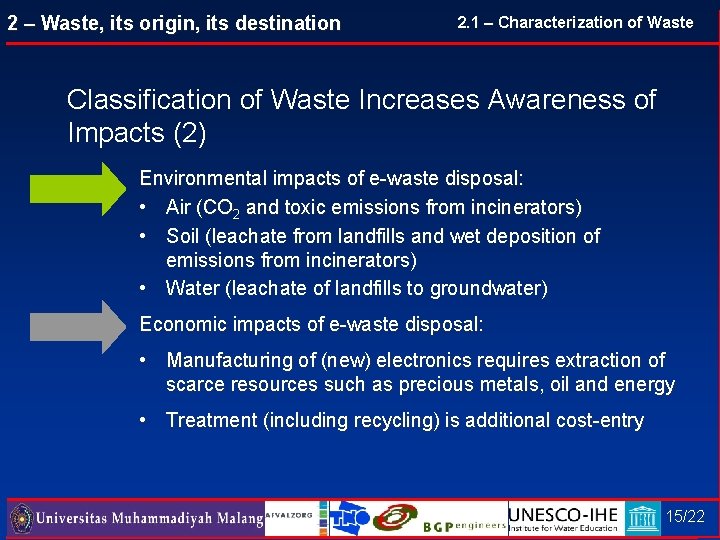
2 – Waste, its origin, its destination 2. 1 – Characterization of Waste Classification of Waste Increases Awareness of Impacts (2) Environmental impacts of e-waste disposal: • Air (CO 2 and toxic emissions from incinerators) • Soil (leachate from landfills and wet deposition of emissions from incinerators) • Water (leachate of landfills to groundwater) Economic impacts of e-waste disposal: • Manufacturing of (new) electronics requires extraction of scarce resources such as precious metals, oil and energy • Treatment (including recycling) is additional cost-entry 15/22
2 – Waste, its origin, its destination 2. 1 – Characterization of Waste Awareness of impacts Characterization of waste Involvement of stakeholders Effective waste management Development of adequate strategies 16/22
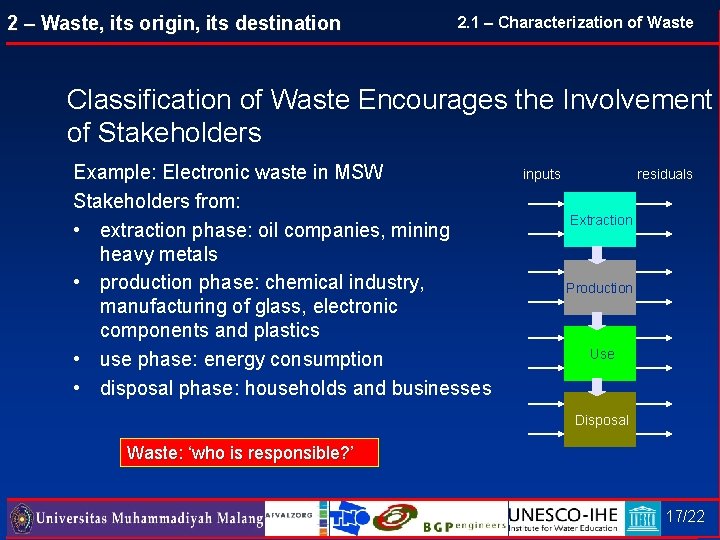
2 – Waste, its origin, its destination 2. 1 – Characterization of Waste Classification of Waste Encourages the Involvement of Stakeholders Example: Electronic waste in MSW Stakeholders from: • extraction phase: oil companies, mining heavy metals • production phase: chemical industry, manufacturing of glass, electronic components and plastics • use phase: energy consumption • disposal phase: households and businesses inputs residuals Extraction Production Use Disposal Waste: ‘who is responsible? ’ 17/22
2 – Waste, its origin, its destination 2. 1 – Characterization of Waste Awareness of impacts Characterization of waste Involvement of stakeholders Effective waste management Development of adequate strategies 18/22
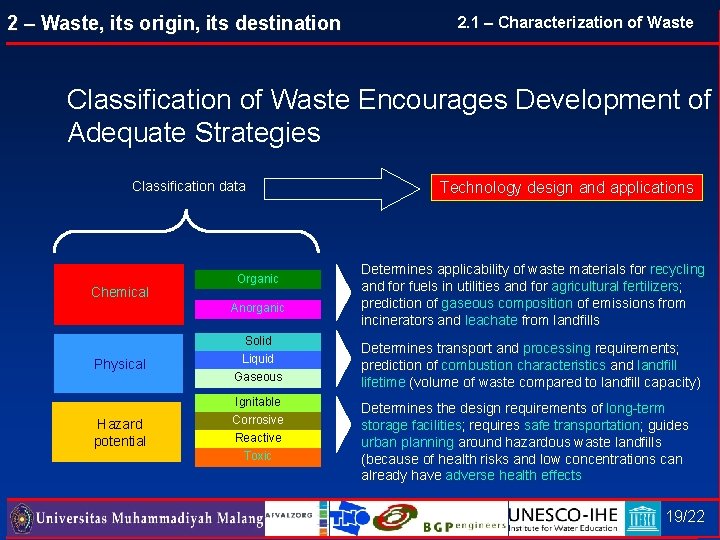
2 – Waste, its origin, its destination 2. 1 – Characterization of Waste Classification of Waste Encourages Development of Adequate Strategies Classification data Chemical Organic Anorganic Physical Solid Liquid Gaseous Hazard potential Ignitable Corrosive Reactive Toxic Technology design and applications Determines applicability of waste materials for recycling and for fuels in utilities and for agricultural fertilizers; prediction of gaseous composition of emissions from incinerators and leachate from landfills Determines transport and processing requirements; prediction of combustion characteristics and landfill lifetime (volume of waste compared to landfill capacity) Determines the design requirements of long-term storage facilities; requires safe transportation; guides urban planning around hazardous waste landfills (because of health risks and low concentrations can already have adverse health effects 19/22
2 – Waste, its origin, its destination 2. 1 – Characterization of Waste Awareness of impacts Characterization of waste Involvement of stakeholders Effective waste management Development of adequate strategies 20/22
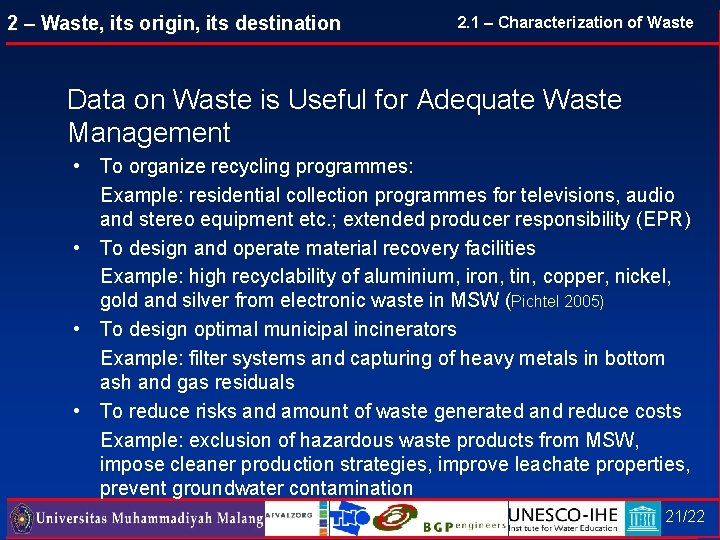
2 – Waste, its origin, its destination 2. 1 – Characterization of Waste Data on Waste is Useful for Adequate Waste Management • To organize recycling programmes: Example: residential collection programmes for televisions, audio and stereo equipment etc. ; extended producer responsibility (EPR) • To design and operate material recovery facilities Example: high recyclability of aluminium, iron, tin, copper, nickel, gold and silver from electronic waste in MSW (Pichtel 2005) • To design optimal municipal incinerators Example: filter systems and capturing of heavy metals in bottom ash and gas residuals • To reduce risks and amount of waste generated and reduce costs Example: exclusion of hazardous waste products from MSW, impose cleaner production strategies, improve leachate properties, prevent groundwater contamination 21/22
2 – Waste, its origin, its destination 2. 1 – Characterization of Waste More about adequate strategies in waste management: Section 2. 3: • Waste prevention: Cleaner production • Eco-efficiency • Industrial Ecology 22/22
2 – Waste, its origin, its destination 2. 2 – Waste-Environmental Threats Solid Waste – Environmental Threats Solid waste in relation to environmental threats - IPCC
2 – Waste, its origin, its destination 2. 2 – Waste-Environmental Threats Municipal Solid Waste Ø Biodegradable waste: food and kitchen waste, green waste, paper (can also be recycled). Ø Recyclable material: paper, glass, bottles, cans, metals, certain plastics, etc. Ø Inert waste: construction and demolition waste, dirt, rocks, debris. Ø Composite wastes: waste clothing, Tetra Packs, waste plastics such as toys. Ø Domestic hazardous waste (also called "household hazardous waste") & toxic waste: medication, paints, chemicals, light bulbs, fluorescent tubes, spray cans, fertilizer and pesticide containers, batteries, shoe polish.
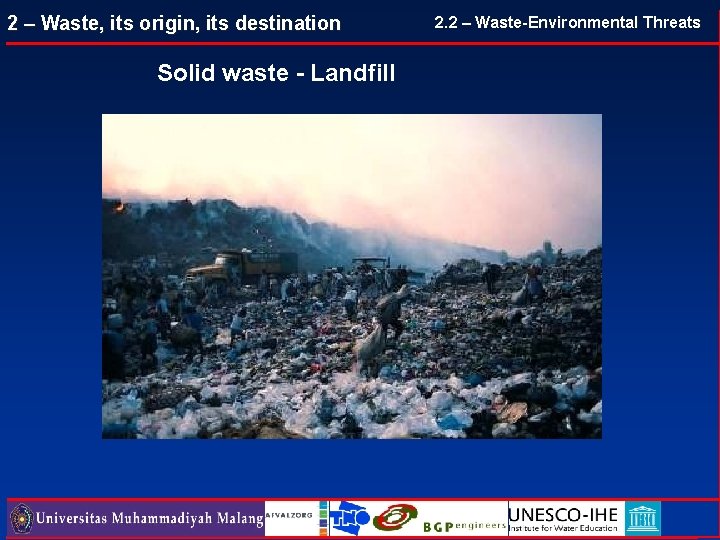
2 – Waste, its origin, its destination 2. 2 – Waste-Environmental Threats Solid waste - Landfill GHG Leachate
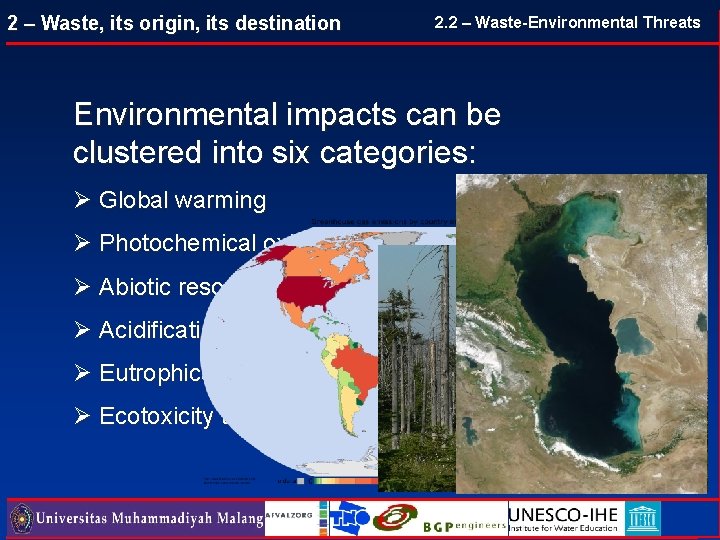
2 – Waste, its origin, its destination 2. 2 – Waste-Environmental Threats Environmental impacts can be clustered into six categories: Ø Global warming Ø Photochemical oxidant creation Ø Abiotic resource depletion Ø Acidification Ø Eutrophication Ø Ecotoxicity to water
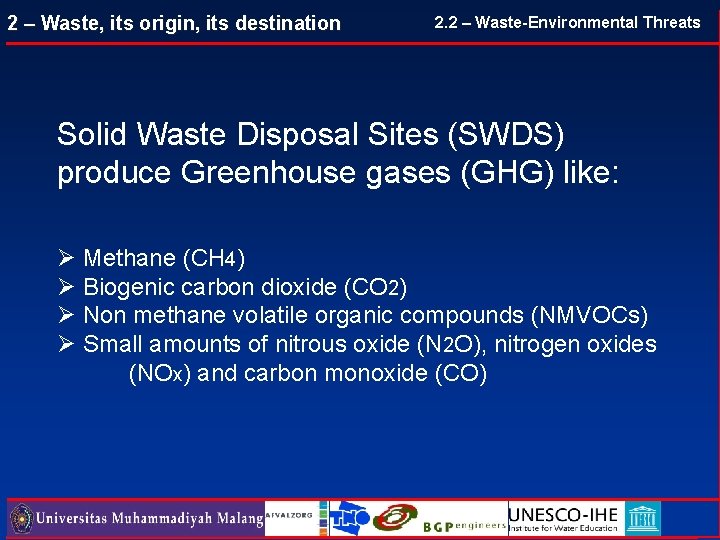
2 – Waste, its origin, its destination 2. 2 – Waste-Environmental Threats Solid Waste Disposal Sites (SWDS) produce Greenhouse gases (GHG) like: Ø Methane (CH 4) Ø Biogenic carbon dioxide (CO 2) Ø Non methane volatile organic compounds (NMVOCs) Ø Small amounts of nitrous oxide (N 2 O), nitrogen oxides (NOx) and carbon monoxide (CO)
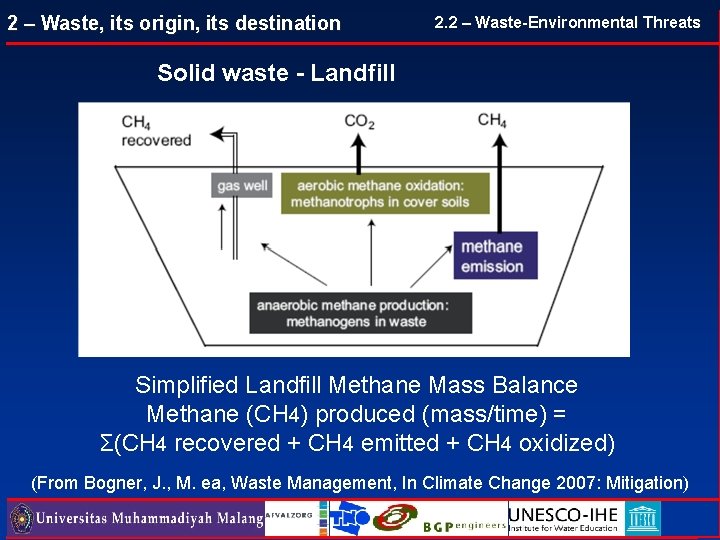
2 – Waste, its origin, its destination 2. 2 – Waste-Environmental Threats Solid waste - Landfill Simplified Landfill Methane Mass Balance Methane (CH 4) produced (mass/time) = Σ(CH 4 recovered + CH 4 emitted + CH 4 oxidized) (From Bogner, J. , M. ea, Waste Management, In Climate Change 2007: Mitigation)
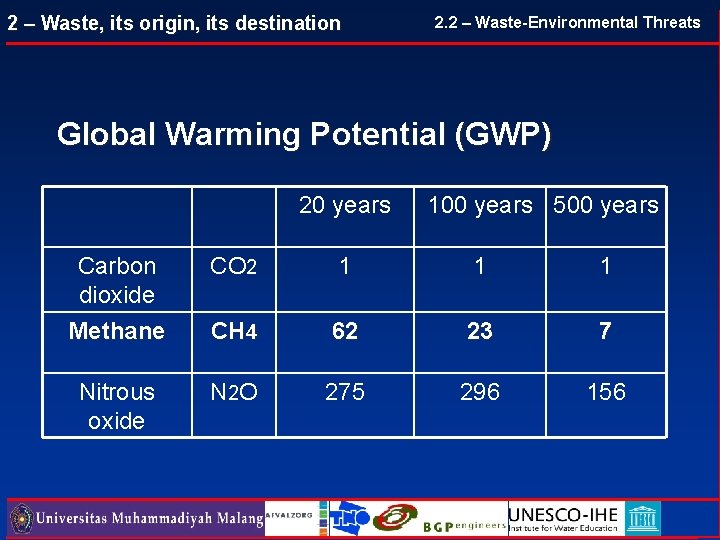
2 – Waste, its origin, its destination 2. 2 – Waste-Environmental Threats Global Warming Potential (GWP) 20 years 100 years 500 years Carbon dioxide CO 2 1 1 1 Methane CH 4 62 23 7 Nitrous oxide N 2 O 275 296 156
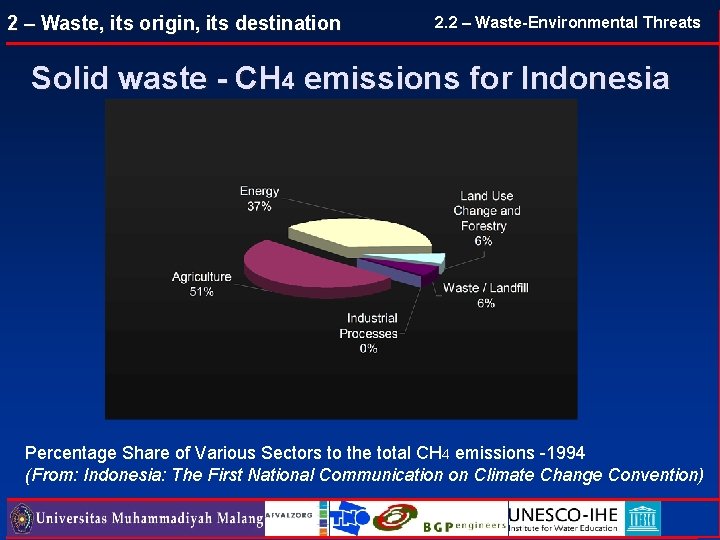
2 – Waste, its origin, its destination 2. 2 – Waste-Environmental Threats Solid waste - CH 4 emissions for Indonesia Percentage Share of Various Sectors to the total CH 4 emissions -1994 (From: Indonesia: The First National Communication on Climate Change Convention)
2 – Waste, its origin, its destination 2. 2 – Waste-Environmental Threats Leachate of landfill: Ø Dissolved organic matter (alcohols, acids, aldehydes, short chain sugars etc. ) Ø Inorganic macro components (common cations and anions including sulfate, chloride, Iron, aluminium, zinc and ammonia) Ø Heavy metals (Pb, Ni, Cu, Hg) Ø Xenobiotic organic compounds such as halogenated organics, (PCBs, dioxins etc. )
2 – Waste, its origin, its destination 2. 2 – Waste-Environmental Threats IPCC – background Ø Intergovernmental Panel on Climate Change Ø Founded 1988 by WMO (World Meteorological Organization) and UNEP (United Nations Environment Programme) Ø Objective source of information about climate change for decision makers and other interested http: //www. ipcc. ch/
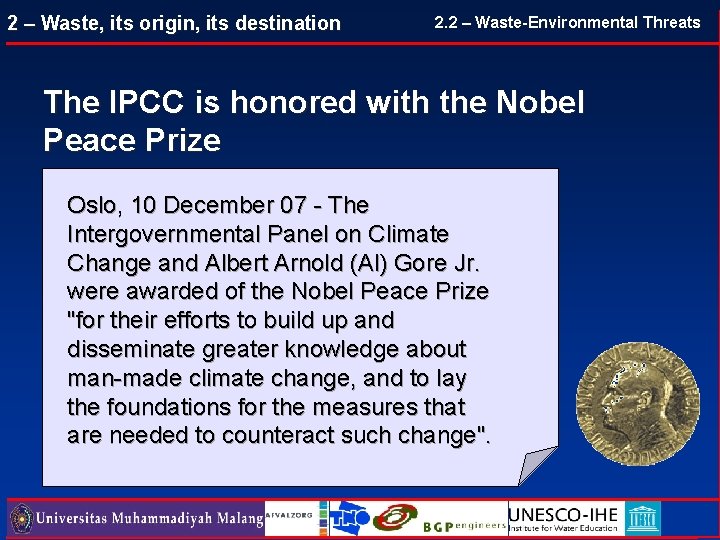
2 – Waste, its origin, its destination 2. 2 – Waste-Environmental Threats The IPCC is honored with the Nobel Peace Prize Oslo, 10 December 07 - The Intergovernmental Panel on Climate Change and Albert Arnold (Al) Gore Jr. were awarded of the Nobel Peace Prize "for their efforts to build up and disseminate greater knowledge about man-made climate change, and to lay the foundations for the measures that are needed to counteract such change".
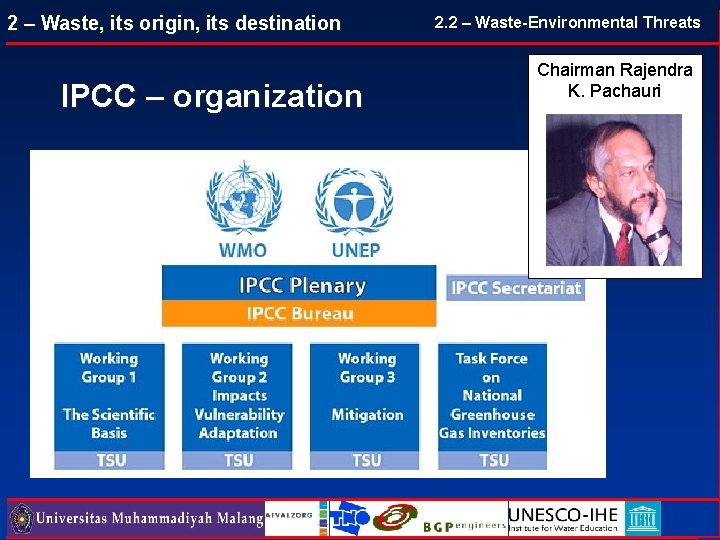
2 – Waste, its origin, its destination IPCC – organization 2. 2 – Waste-Environmental Threats Chairman Rajendra K. Pachauri
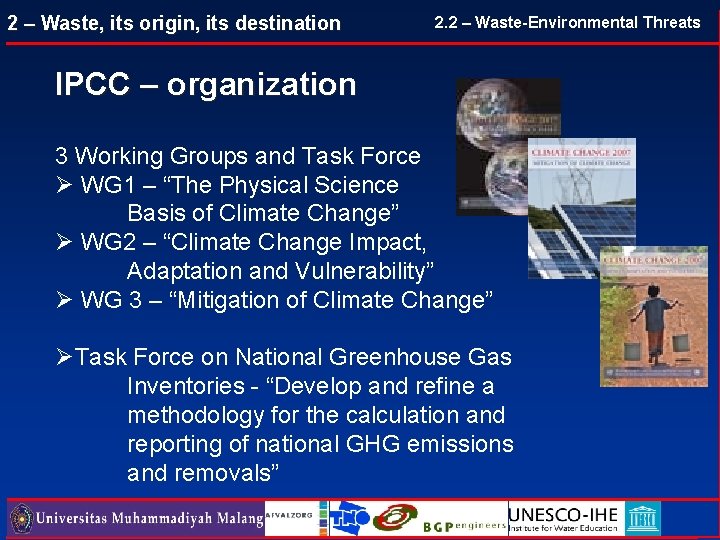
2 – Waste, its origin, its destination 2. 2 – Waste-Environmental Threats IPCC – organization 3 Working Groups and Task Force Ø WG 1 – “The Physical Science Basis of Climate Change” Ø WG 2 – “Climate Change Impact, Adaptation and Vulnerability” Ø WG 3 – “Mitigation of Climate Change” ØTask Force on National Greenhouse Gas Inventories - “Develop and refine a methodology for the calculation and reporting of national GHG emissions and removals”
2 – Waste, its origin, its destination 2. 2 – Waste-Environmental Threats IPCC - Waste Model • Relatively simple model as basis for the estimation of CH 4 emissions from SWDS • Calculates emissions generated in current inventory year from the waste deposited in previous years
2 – Waste, its origin, its destination 2. 3 – Waste-its Destination Waste – its destination End-of-pipe Treatment, Waste Prevention, Cleaner Production and Industrial Ecology
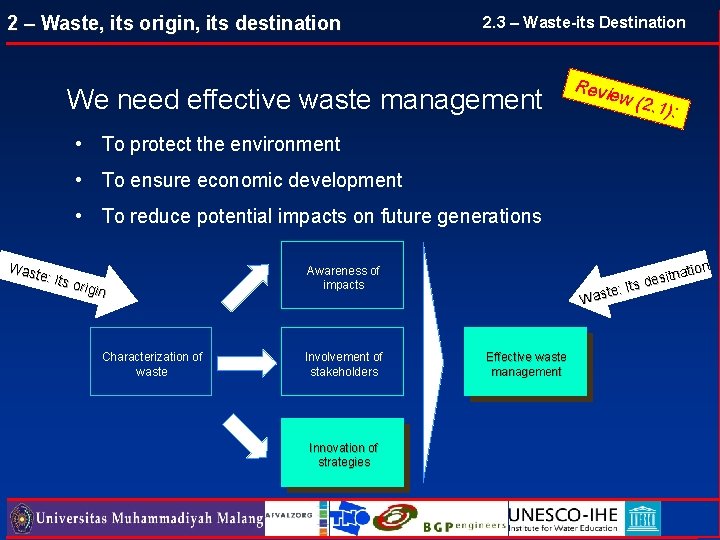
2 – Waste, its origin, its destination 2. 3 – Waste-its Destination We need effective waste management Revi ew (2. 1): • To protect the environment • To ensure economic development • To reduce potential impacts on future generations Was te: It s orig in Characterization of waste ation n t i s Its de : e t s Wa Awareness of impacts Involvement of stakeholders Innovation of strategies Effective waste management
2 – Waste, its origin, its destination 2. 3 – Waste-its Destination Contents • The Destination of Waste • Conventional waste management: end-of-pipe treatment • Modern waste management: prevention ØConcept of Eco-efficiency ØConcept of Cleaner Production ØConcept of Industrial Ecology
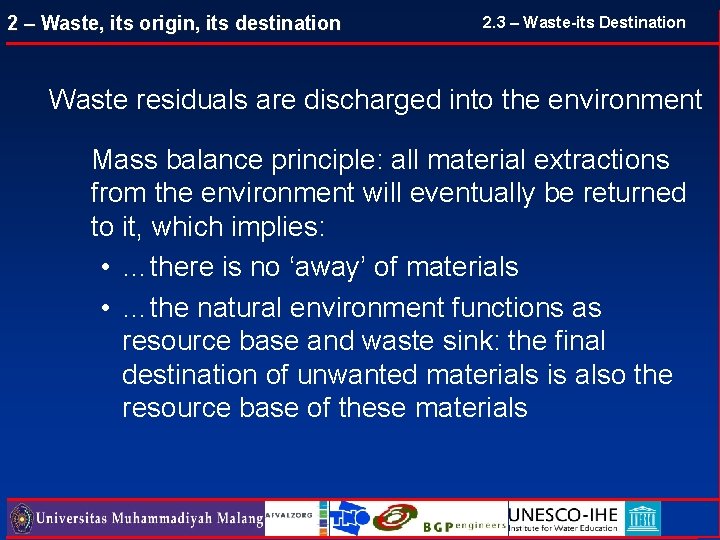
2 – Waste, its origin, its destination 2. 3 – Waste-its Destination Waste residuals are discharged into the environment Mass balance principle: all material extractions from the environment will eventually be returned to it, which implies: • …there is no ‘away’ of materials • …the natural environment functions as resource base and waste sink: the final destination of unwanted materials is also the resource base of these materials
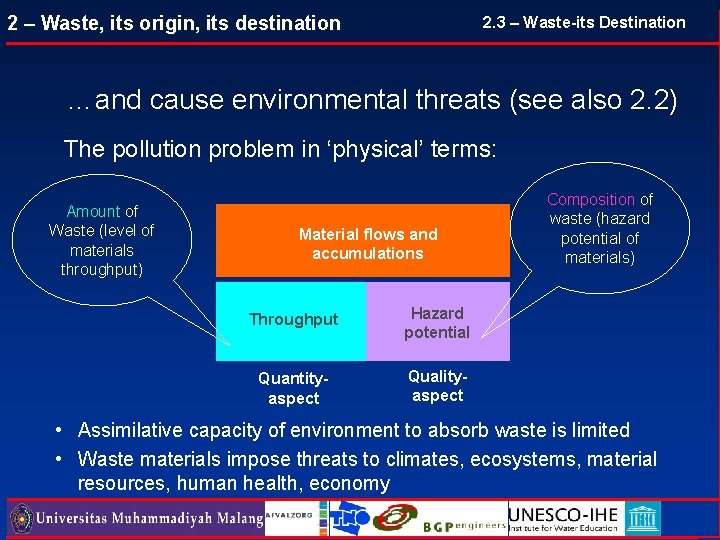
2 – Waste, its origin, its destination 2. 3 – Waste-its Destination …and cause environmental threats (see also 2. 2) The pollution problem in ‘physical’ terms: Amount of Waste (level of materials throughput) Material flows and accumulations Throughput Hazard potential Quantityaspect Qualityaspect Composition of waste (hazard potential of materials) • Assimilative capacity of environment to absorb waste is limited • Waste materials impose threats to climates, ecosystems, material resources, human health, economy
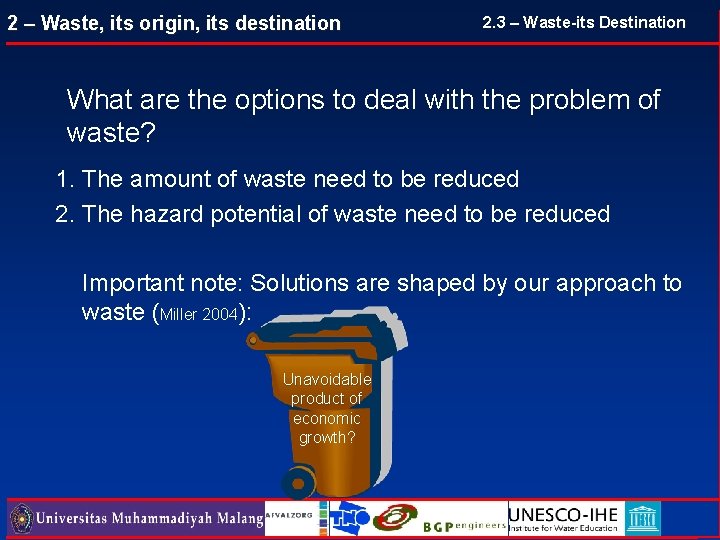
2 – Waste, its origin, its destination 2. 3 – Waste-its Destination What are the options to deal with the problem of waste? 1. The amount of waste need to be reduced 2. The hazard potential of waste need to be reduced Important note: Solutions are shaped by our approach to waste (Miller 2004): Unavoidable product of economic growth?
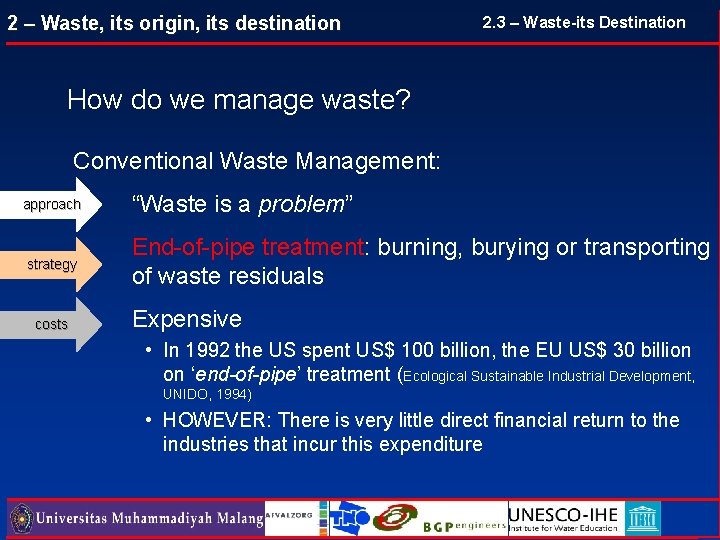
2 – Waste, its origin, its destination 2. 3 – Waste-its Destination How do we manage waste? Conventional Waste Management: approach strategy costs “Waste is a problem” End-of-pipe treatment: burning, burying or transporting of waste residuals Expensive • In 1992 the US spent US$ 100 billion, the EU US$ 30 billion on ‘end-of-pipe’ treatment (Ecological Sustainable Industrial Development, UNIDO, 1994) • HOWEVER: There is very little direct financial return to the industries that incur this expenditure
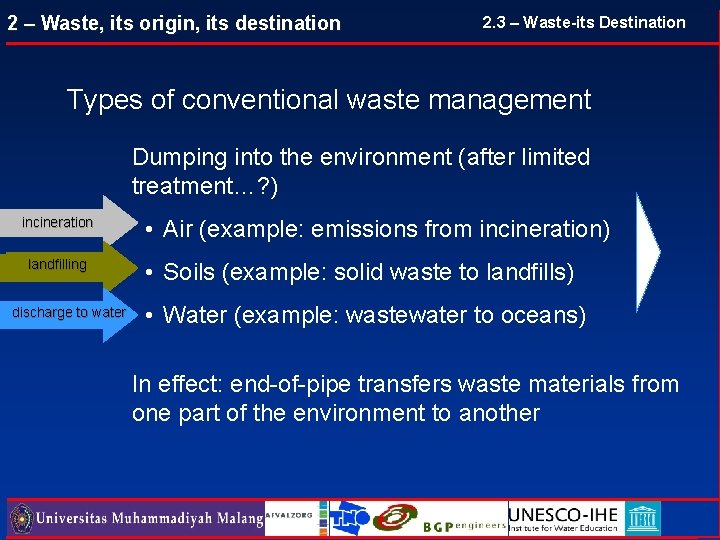
2 – Waste, its origin, its destination 2. 3 – Waste-its Destination Types of conventional waste management Dumping into the environment (after limited treatment…? ) incineration landfilling discharge to water • Air (example: emissions from incineration) • Soils (example: solid waste to landfills) • Water (example: wastewater to oceans) In effect: end-of-pipe transfers waste materials from one part of the environment to another
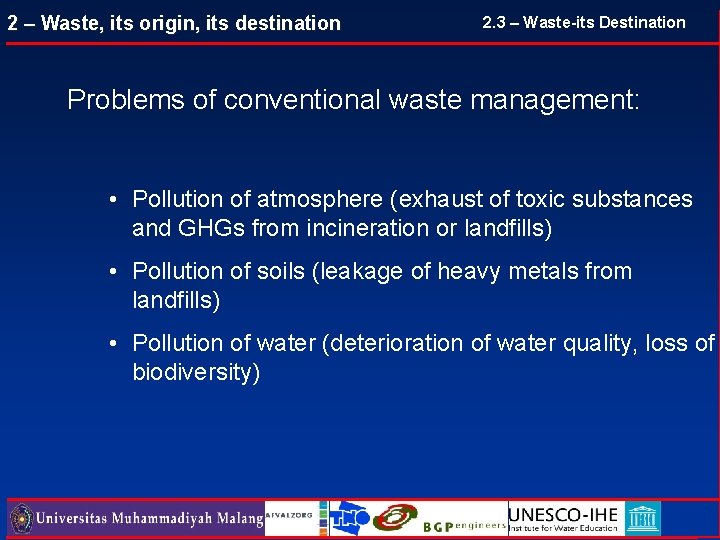
2 – Waste, its origin, its destination 2. 3 – Waste-its Destination Problems of conventional waste management: • Pollution of atmosphere (exhaust of toxic substances and GHGs from incineration or landfills) • Pollution of soils (leakage of heavy metals from landfills) • Pollution of water (deterioration of water quality, loss of biodiversity)
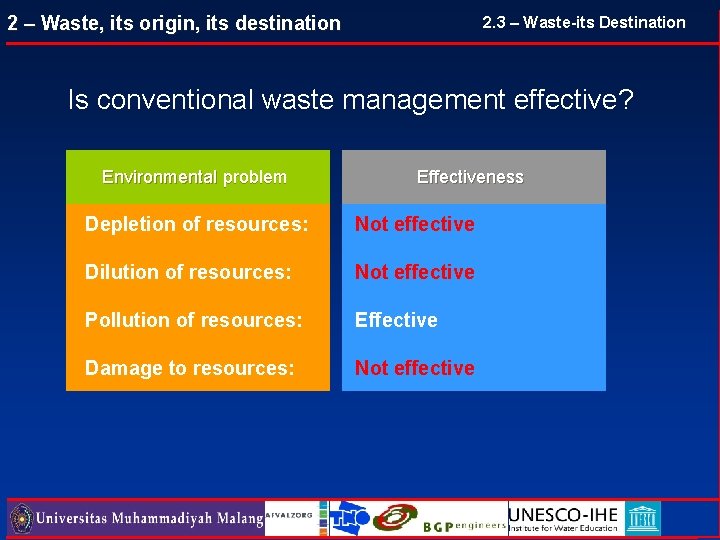
2 – Waste, its origin, its destination 2. 3 – Waste-its Destination Is conventional waste management effective? Environmental problem Effectiveness Depletion of resources: Not effective Dilution of resources: Not effective Pollution of resources: Effective Damage to resources: Not effective
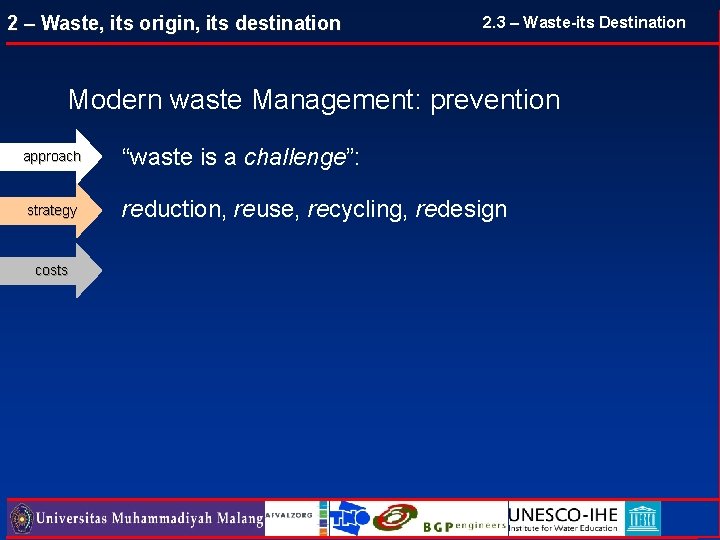
2 – Waste, its origin, its destination 2. 3 – Waste-its Destination Modern waste Management: prevention approach strategy costs “waste is a challenge”: reduction, reuse, recycling, redesign
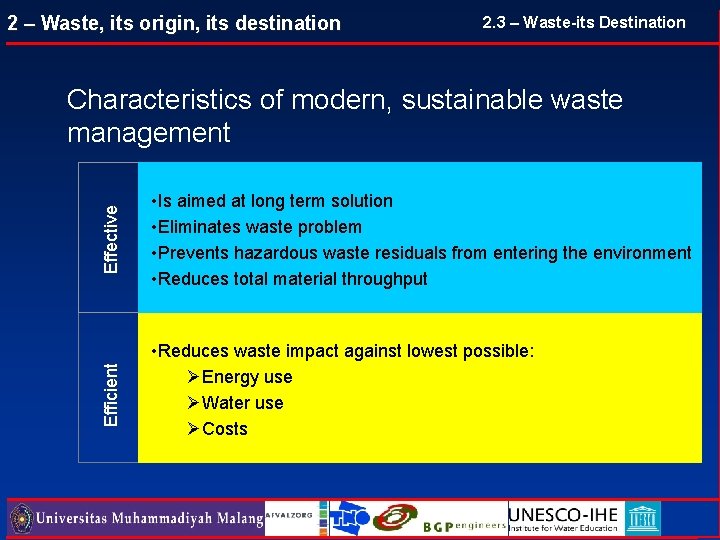
2 – Waste, its origin, its destination 2. 3 – Waste-its Destination Effective • Is aimed at long term solution • Eliminates waste problem • Prevents hazardous waste residuals from entering the environment • Reduces total material throughput Efficient Characteristics of modern, sustainable waste management • Reduces waste impact against lowest possible: ØEnergy use ØWater use ØCosts
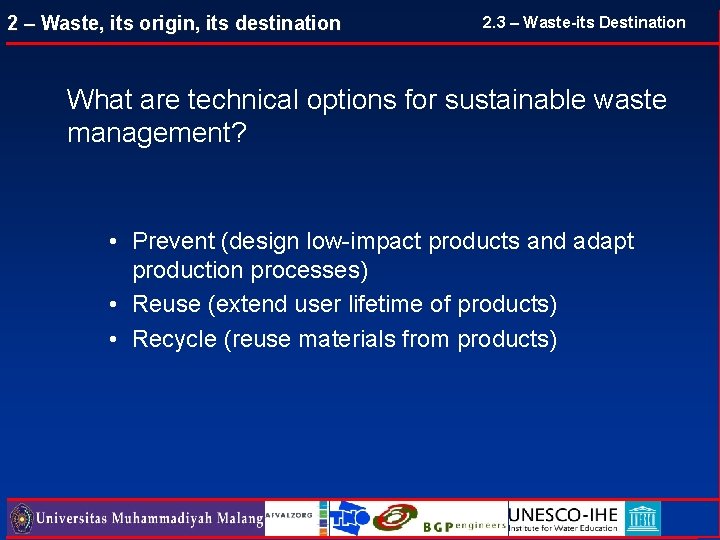
2 – Waste, its origin, its destination 2. 3 – Waste-its Destination What are technical options for sustainable waste management? • Prevent (design low-impact products and adapt production processes) • Reuse (extend user lifetime of products) • Recycle (reuse materials from products)
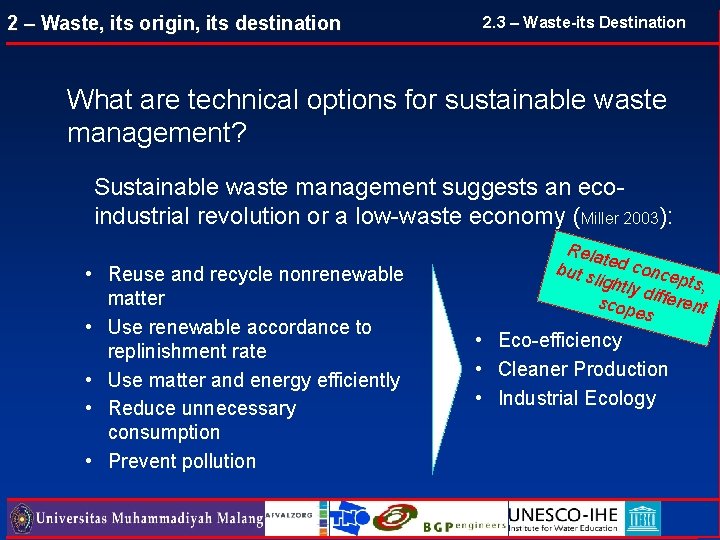
2 – Waste, its origin, its destination 2. 3 – Waste-its Destination What are technical options for sustainable waste management? Sustainable waste management suggests an ecoindustrial revolution or a low-waste economy (Miller 2003): • Reuse and recycle nonrenewable matter • Use renewable accordance to replinishment rate • Use matter and energy efficiently • Reduce unnecessary consumption • Prevent pollution Rela t but s ed conce lightl p y diff ts, eren scop t es • Eco-efficiency • Cleaner Production • Industrial Ecology
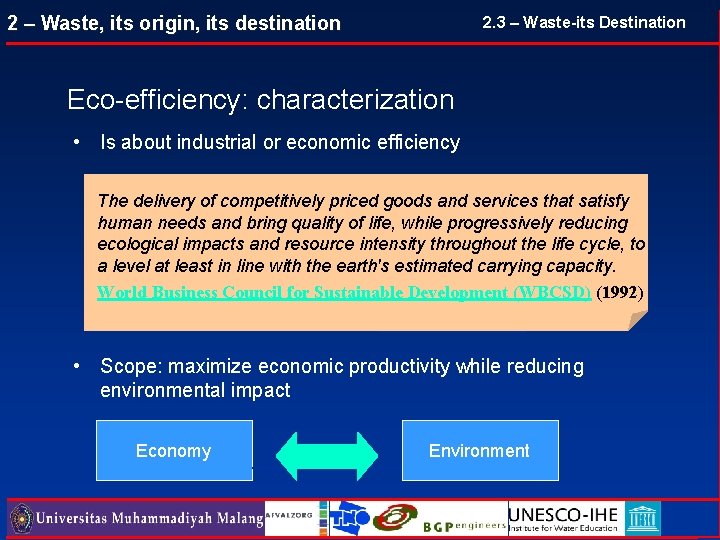
2 – Waste, its origin, its destination 2. 3 – Waste-its Destination Eco-efficiency: characterization • Is about industrial or economic efficiency The delivery of competitively priced goods and services that satisfy human needs and bring quality of life, while progressively reducing ecological impacts and resource intensity throughout the life cycle, to a level at least in line with the earth's estimated carrying capacity. World Business Council for Sustainable Development (WBCSD) (1992) Eco-efficiency • Scope: maximize economic productivity while reducing environmental impact Economy Environment
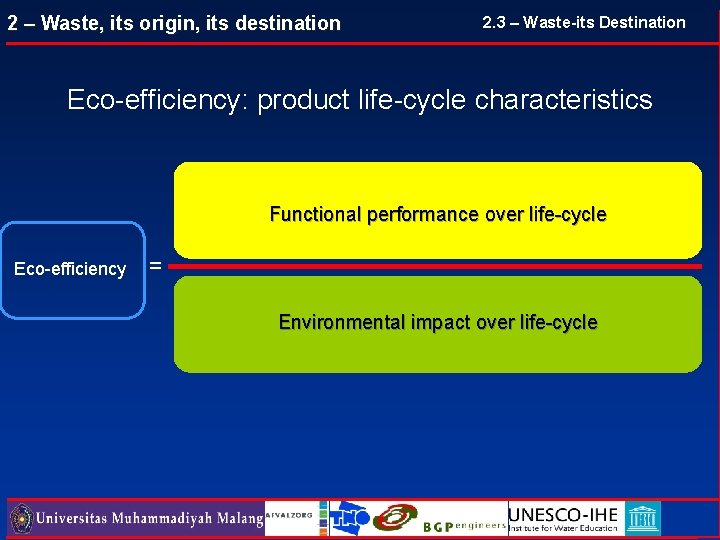
2 – Waste, its origin, its destination 2. 3 – Waste-its Destination Eco-efficiency: product life-cycle characteristics Functional performance over life-cycle Eco-efficiency = Environmental impact over life-cycle
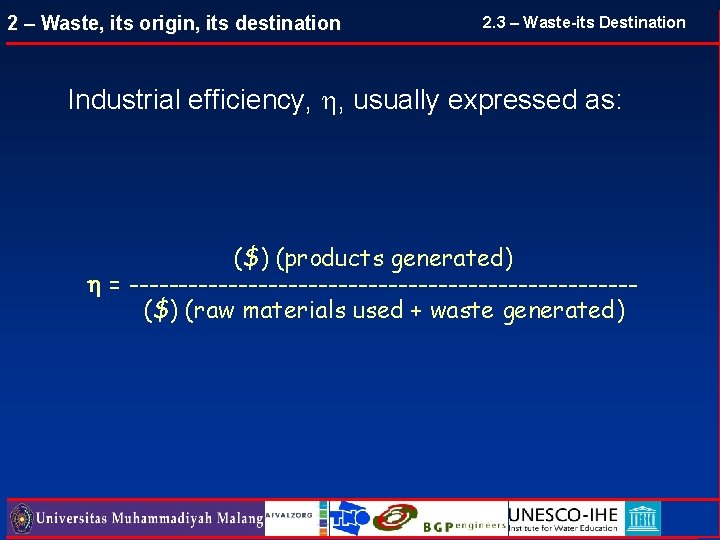
2 – Waste, its origin, its destination 2. 3 – Waste-its Destination Industrial efficiency, , usually expressed as: ($) (products generated) = -------------------------($) (raw materials used + waste generated)
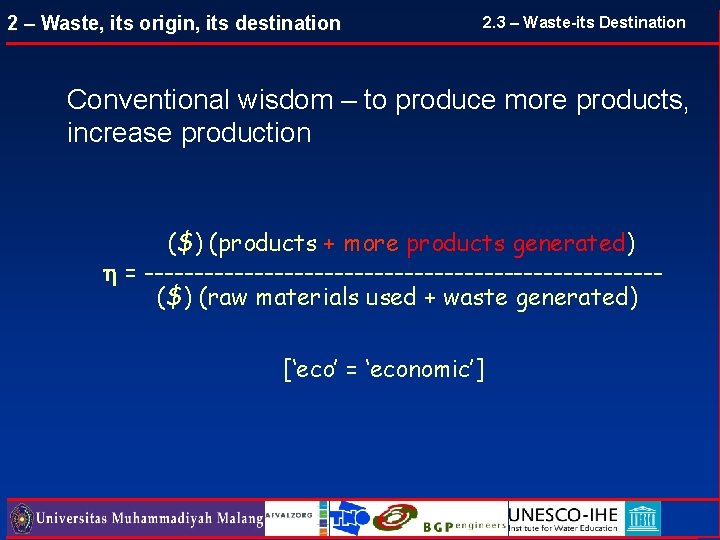
2 – Waste, its origin, its destination 2. 3 – Waste-its Destination Conventional wisdom – to produce more products, increase production ($) (products + more products generated) = --------------------------($) (raw materials used + waste generated) [‘eco’ = ‘economic’]
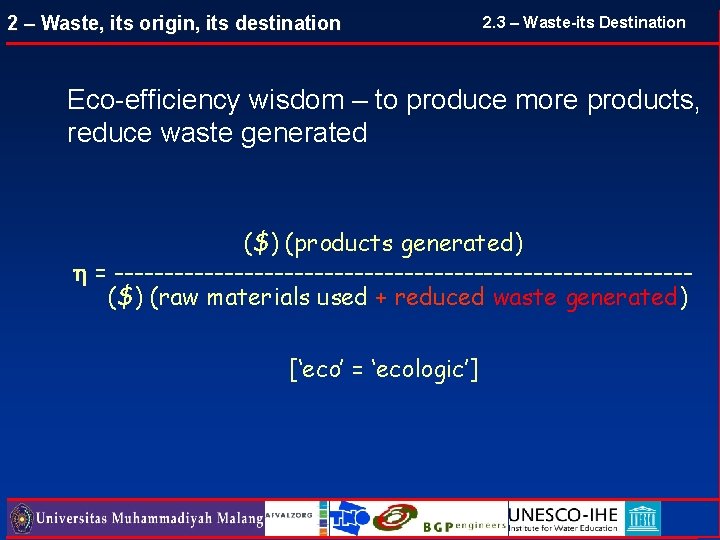
2 – Waste, its origin, its destination 2. 3 – Waste-its Destination Eco-efficiency wisdom – to produce more products, reduce waste generated ($) (products generated) = -----------------------------($) (raw materials used + reduced waste generated) [‘eco’ = ‘ecologic’]
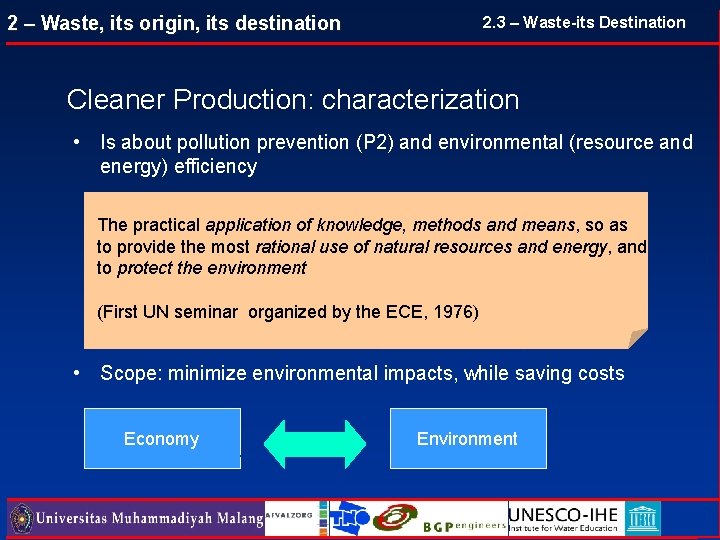
2 – Waste, its origin, its destination 2. 3 – Waste-its Destination Cleaner Production: characterization • Is about pollution prevention (P 2) and environmental (resource and energy) efficiency The practical application of knowledge, methods and means, so as to provide the most rational use of natural resources and energy, and to protect the environment (First UN seminar organized by the ECE, 1976) Eco-efficiency • Scope: minimize environmental impacts, while saving costs Economy Environment
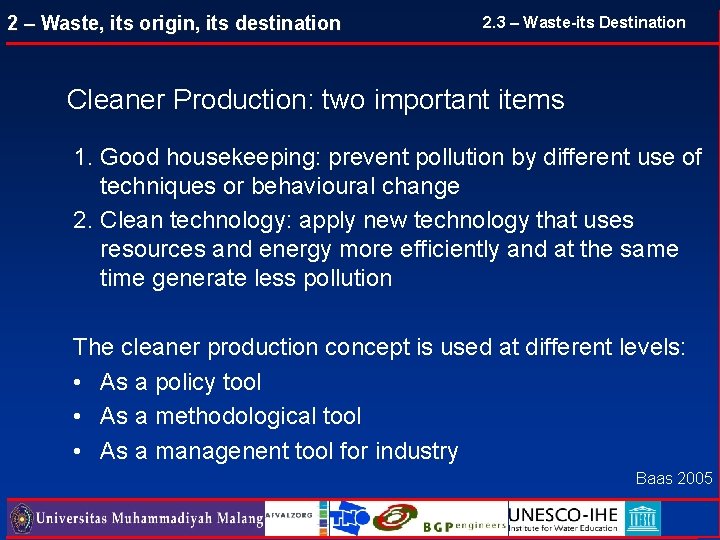
2 – Waste, its origin, its destination 2. 3 – Waste-its Destination Cleaner Production: two important items 1. Good housekeeping: prevent pollution by different use of techniques or behavioural change 2. Clean technology: apply new technology that uses resources and energy more efficiently and at the same time generate less pollution The cleaner production concept is used at different levels: • As a policy tool • As a methodological tool • As a managenent tool for industry Baas 2005
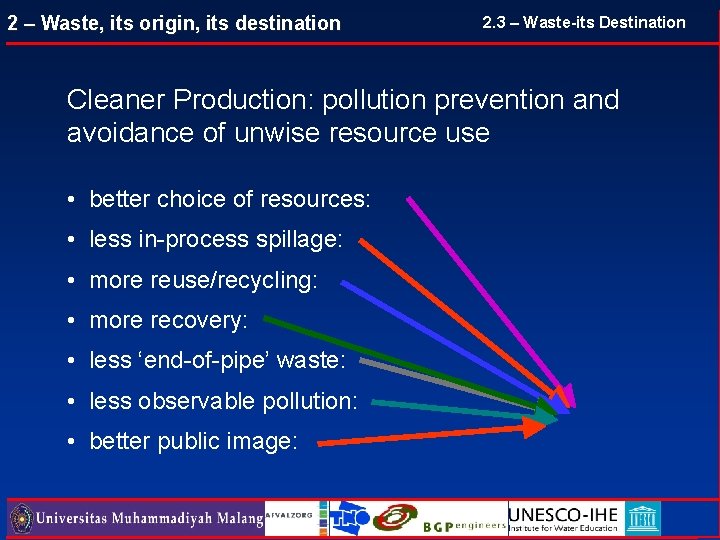
2 – Waste, its origin, its destination 2. 3 – Waste-its Destination Cleaner Production: pollution prevention and avoidance of unwise resource use • better choice of resources: • less in-process spillage: • more reuse/recycling: • more recovery: • less ‘end-of-pipe’ waste: • less observable pollution: • better public image:
2 – Waste, its origin, its destination 2. 3 – Waste-its Destination Cleaner Production leads also to good business Examples: 3 M Corporation - USA Printing firm - Norway Química y Textiles Proquindus - Peru Cerveceria Suramericana S. A. - Ecuador Plastigama S. A. - Ecuador
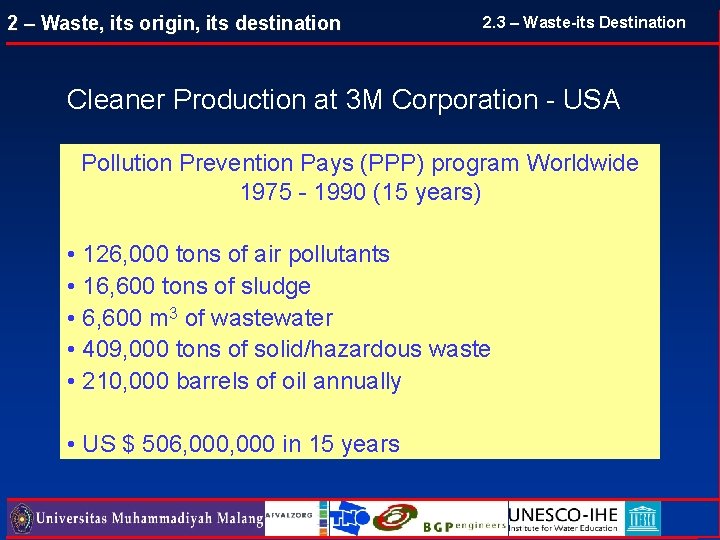
2 – Waste, its origin, its destination 2. 3 – Waste-its Destination Cleaner Production at 3 M Corporation - USA Pays (PPP) program Worldwide • Pollution Visibility: Prevention smog 1975 - 1990 (15 years) • 126, 000 tons of air pollutants • 16, 600 tons of sludge • 6, 600 m 3 of wastewater • 409, 000 tons of solid/hazardous waste • 210, 000 barrels of oil annually • US $ 506, 000 in 15 years
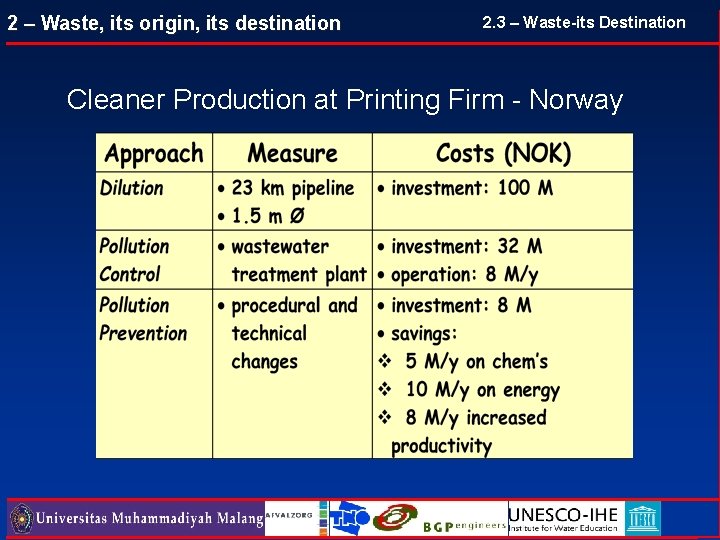
2 – Waste, its origin, its destination 2. 3 – Waste-its Destination Cleaner Production at Printing Firm - Norway
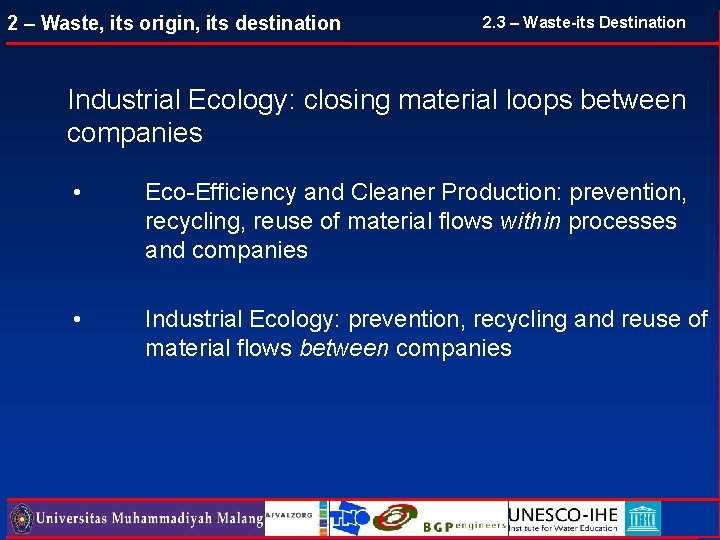
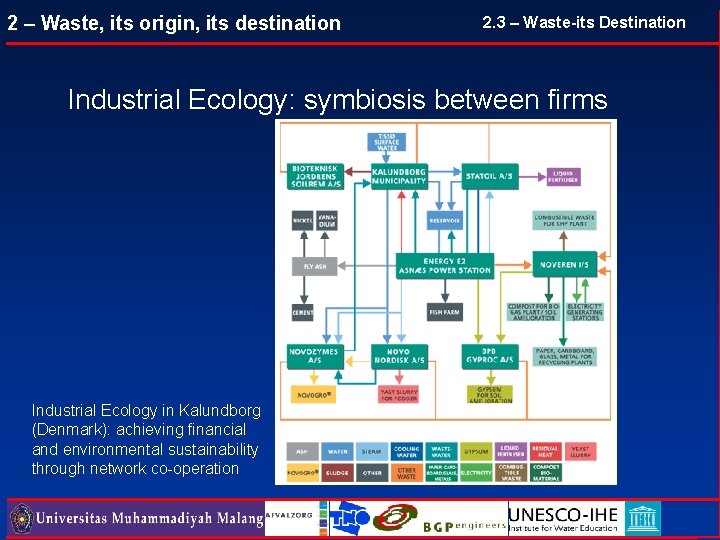
2 – Waste, its origin, its destination 2. 3 – Waste-its Destination Industrial Ecology: closing material loops between companies • Eco-Efficiency and Cleaner Production: prevention, recycling, reuse of material flows within processes and companies • Industrial Ecology: prevention, recycling and reuse of material flows between companies
2 – Waste, its origin, its destination 2. 3 – Waste-its Destination Industrial Ecology: symbiosis between firms Industrial Ecology in Kalundborg (Denmark): achieving financial and environmental sustainability through network co-operation
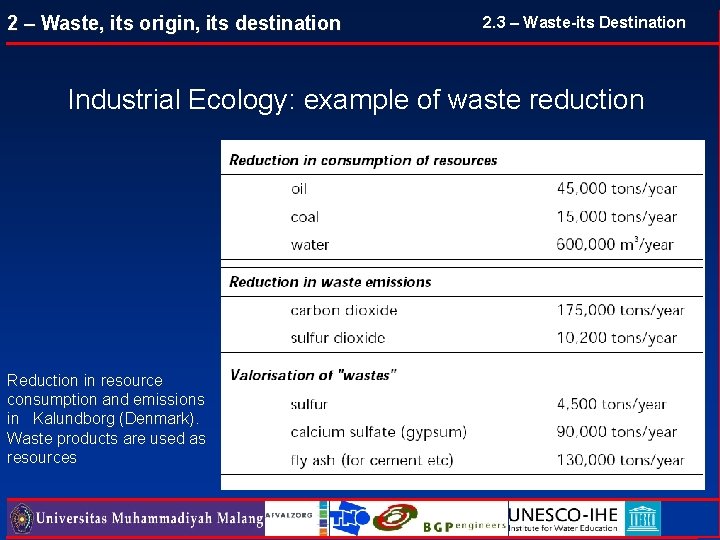
2 – Waste, its origin, its destination 2. 3 – Waste-its Destination Industrial Ecology: example of waste reduction Reduction in resource consumption and emissions in Kalundborg (Denmark). Waste products are used as resources