Workshop The Secrets of Reading in EFL Janina



- Slides: 38
Workshop: The Secrets of Reading in EFL Janina Kahn-Horwitz (Ph. D) Oranim College of Education
Outline 1. Components of a reading lesson. 2. Focus on phonemic awareness, orthographic (letter) patterns and vocabulary. 3. Planning across elementary school (implications for older students). 4. Novel sounds and letters. 5. Teaching a reading lesson. Seminar MITF 12/6/2020
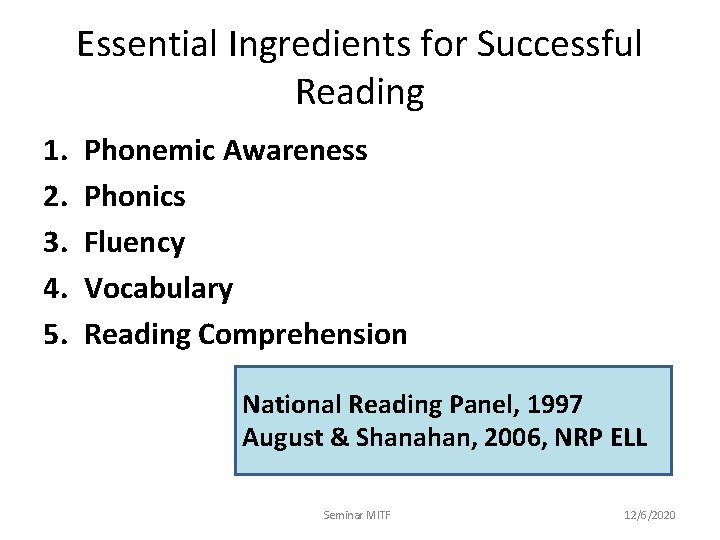
Essential Ingredients for Successful Reading 1. 2. 3. 4. 5. Phonemic Awareness Phonics Fluency Vocabulary Reading Comprehension National Reading Panel, 1997 August & Shanahan, 2006, NRP ELL Seminar MITF 12/6/2020
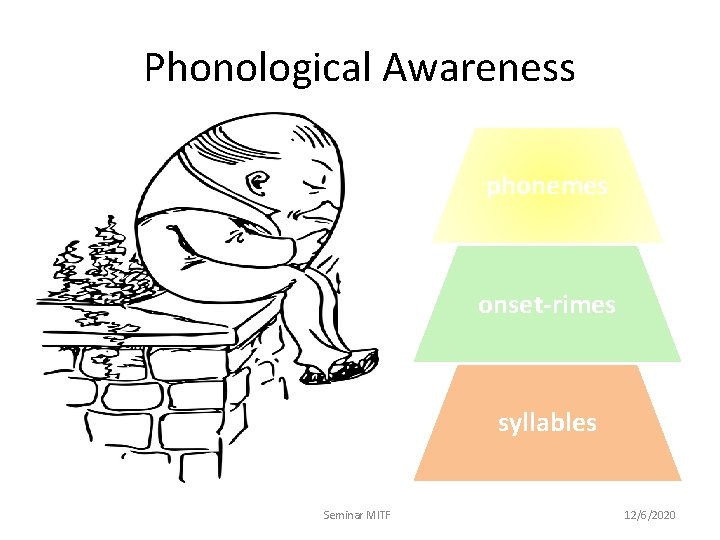
Phonological Awareness phonemes onset-rimes syllables Seminar MITF 12/6/2020
The English writing system takes time to acquire so we need to teach systematically and explicitly • 26 letters • 44 sounds Seminar MITF 12/6/2020
Band 1 vocabulary: Basics + Foundation Level • ~950 lexical items • ~160 conversational phrases and collocations Seminar MITF 12/6/2020
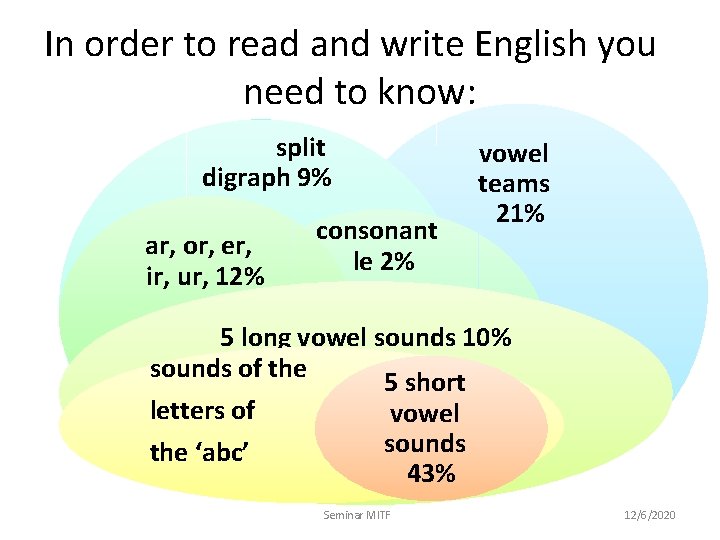
In order to read and write English you need to know: split digraph 9% ar, or, er, ir, ur, 12% consonant le 2% vowel teams 21% 5 long vowel sounds 10% sounds of the 5 short letters of vowel sounds the ‘abc’ 43% Seminar MITF 12/6/2020
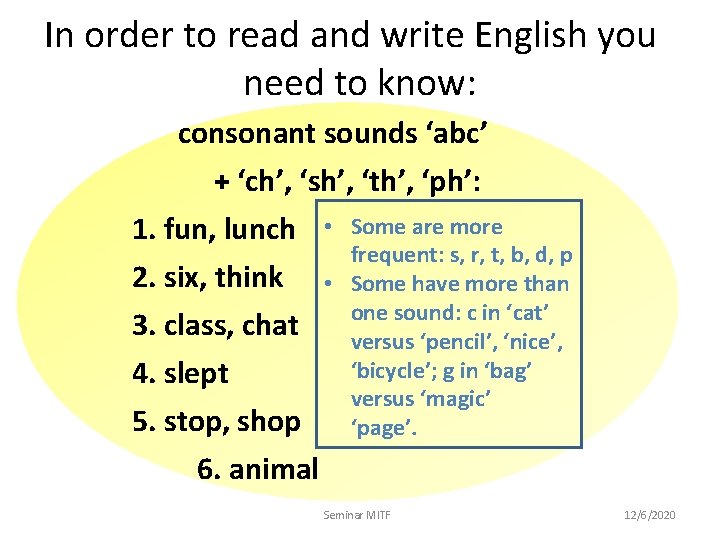
In order to read and write English you need to know: consonant sounds ‘abc’ + ‘ch’, ‘sh’, ‘th’, ‘ph’: 1. fun, lunch 2. six, think 3. class, chat 4. slept 5. stop, shop • Some are more frequent: s, r, t, b, d, p • Some have more than one sound: c in ‘cat’ versus ‘pencil’, ‘nice’, ‘bicycle’; g in ‘bag’ versus ‘magic’ ‘page’. 6. animal Seminar MITF 12/6/2020
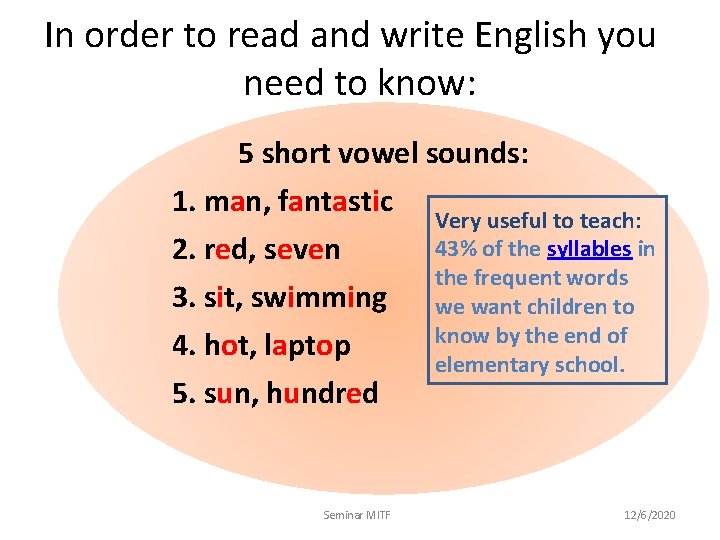
In order to read and write English you need to know: 5 short vowel sounds: 1. man, fantastic 2. red, seven 3. sit, swimming 4. hot, laptop 5. sun, hundred Seminar MITF Very useful to teach: 43% of the syllables in the frequent words we want children to know by the end of elementary school. 12/6/2020
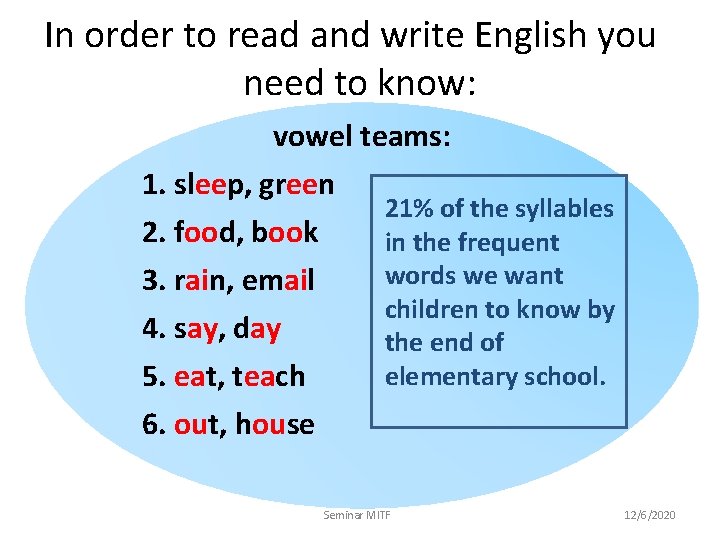
In order to read and write English you need to know: vowel teams: 1. sleep, green 2. food, book 3. rain, email 4. say, day 5. eat, teach 6. out, house 21% of the syllables in the frequent words we want children to know by the end of elementary school. Seminar MITF 12/6/2020
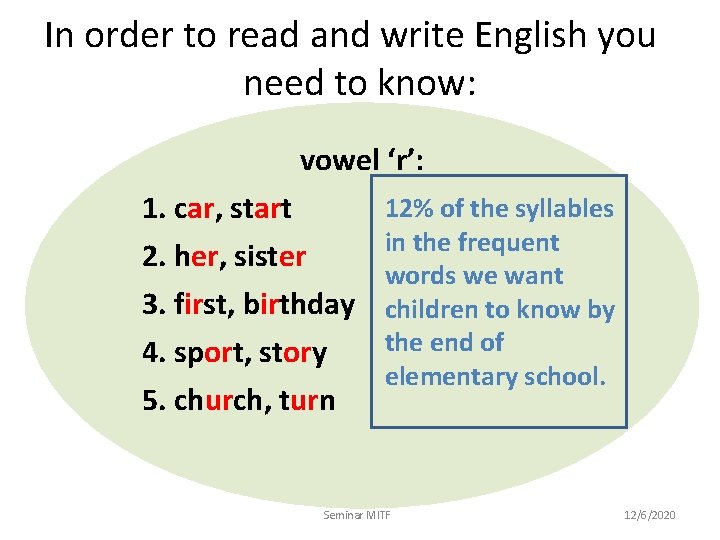
In order to read and write English you need to know: vowel ‘r’: 1. car, start 2. her, sister 3. first, birthday 4. sport, story 5. church, turn 12% of the syllables in the frequent words we want children to know by the end of elementary school. Seminar MITF 12/6/2020
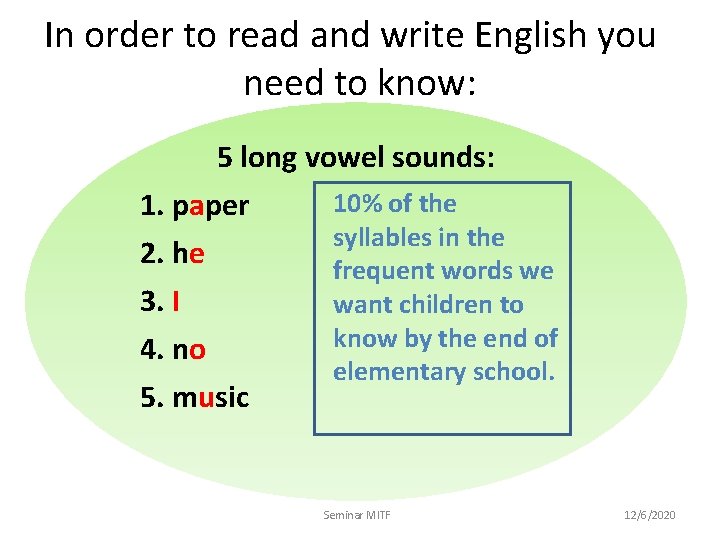
In order to read and write English you need to know: 5 long vowel sounds: 1. paper 2. he 3. I 4. no 5. music 10% of the syllables in the frequent words we want children to know by the end of elementary school. Seminar MITF 12/6/2020
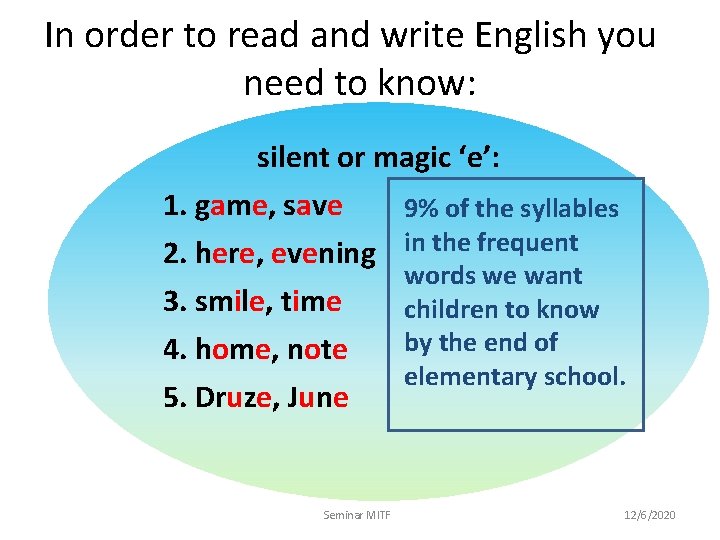
In order to read and write English you need to know: silent or magic ‘e’: 1. game, save 2. here, evening 3. smile, time 4. home, note 5. Druze, June Seminar MITF 9% of the syllables in the frequent words we want children to know by the end of elementary school. 12/6/2020
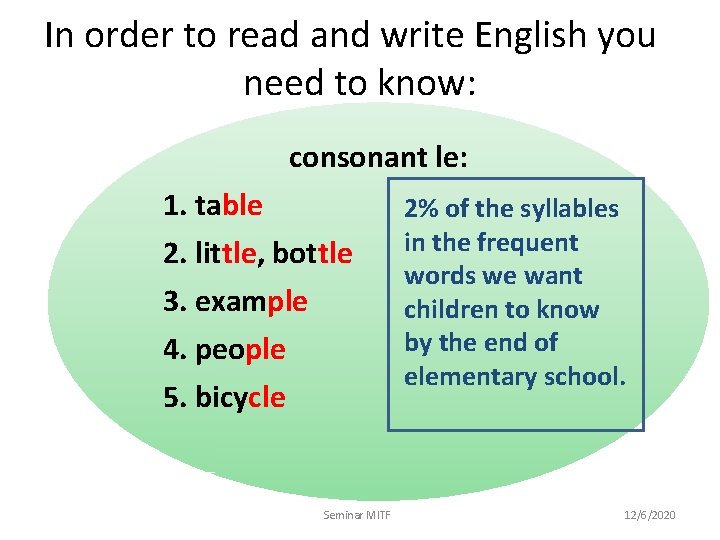
In order to read and write English you need to know: consonant le: 1. table 2. little, bottle 3. example 4. people 5. bicycle Seminar MITF 2% of the syllables in the frequent words we want children to know by the end of elementary school. 12/6/2020
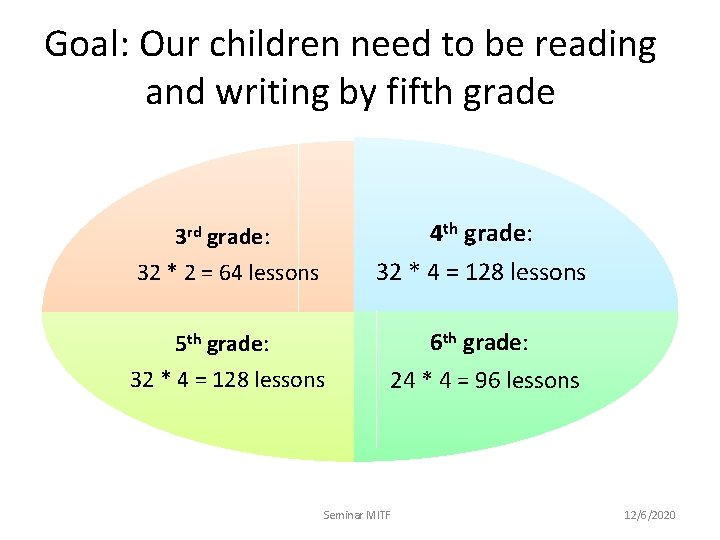
Goal: Our children need to be reading and writing by fifth grade 3 rd grade: 32 * 2 = 64 lessons 4 th grade: 32 * 4 = 128 lessons 5 th grade: 32 * 4 = 128 lessons 6 th grade: 24 * 4 = 96 lessons Seminar MITF 12/6/2020
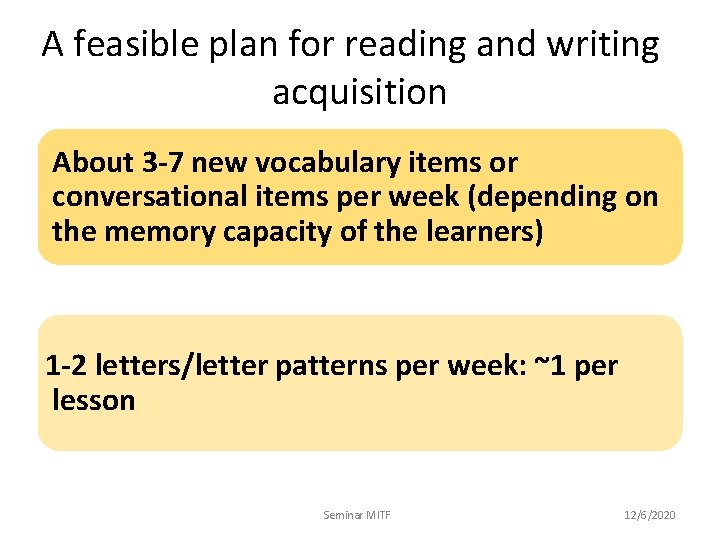
A feasible plan for reading and writing acquisition About 3 -7 new vocabulary items or conversational items per week (depending on the memory capacity of the learners) 1 -2 letters/letter patterns per week: ~1 per lesson Seminar MITF 12/6/2020
What about letters or sounds that don’t exist in a child’s repertoire? • Short versus long vowel sounds for Hebrew L 1 speakers or the short /a/? • /p/ for Arabic L 1 speakers • Voiced and voiceless <th> for Hebrew L 1 and Russian L 1 speakers • Vowel digraphs for all • Magic ‘e’ for all Seminar MITF 12/6/2020
Essential Ingredients for an EFL reading/writing lesson 1. Teach letter-sound correspondence 2. Teach sound-letter correspondence 3. Phonological awareness: Blend sounds to make words/ break words into individual sounds 4. Read frequent vocabulary words made up of previously learned letters. 5. Write frequent vocabulary words made up of previously learned letters. 6. Read (and write) a text made up of words. Seminar MITF 12/6/2020
Demonstration of a reading lesson - beginner level Background: The class has already learned the following phoneme-grapheme correspondences: s, a, m The class learned “I” as a sight word. Today, I will illustrate teaching “t”
Review previously taught graphemes: • s • a • m Dictate words + a sentence: Read words: • am • Sam I am Sam. Seminar MITF 12/6/2020
Brainstorm words that the class knows with “t” • • telephone television twenty teacher table tree ten Choose a key word and introduce the letter: t Seminar MITF 12/6/2020
Form the grapheme “t” in a multi sensory manner • visual • auditory • kinesthetic • tactile * trace on the table with fingers, in the air, create letter with your bodies, stickers, play dough, writing with pencils Seminar MITF 12/6/2020
Write a big “t” in personal notebooks. At the back of the “t” page, draw a picture of the key word. Label the picture. Give out handouts with “t” printed. Pupils should practice forming the “t” correctly. Whilst writing the “t”, they should pronounce the phoneme “t”. Seminar MITF 12/6/2020
Letter matrixes with s, a, m, t (cards) Read words with the above letters am, at, mat, sat, Sam Spell words with the above letters. Read a story with the above letters. Teach “on” as a sight word. Seminar MITF 12/6/2020
Word Reading am at mat sat Sam Seminar MITF 12/6/2020
Story Reading: Mat (see book) Mat sat. Sam sat. Mat sat on Sam sat on Mat sat. Sam sat. The End. Bob Books Seminar MITF 12/6/2020
Summary • Review new letter. What is this letter? What is your key word? Trace the letter. Pronounce the letter. • Homework: Read words with the new letter. Read story with new letter. Fill in missing words in a “cloze” format sentence. Seminar MITF 12/6/2020
What about JHS students who do not recognize letter patterns? • Mini-lessons of 10 -15 minutes integrated into your lessons. Seminar MITF 12/6/2020
Demonstration of a reading lesson – advanced level Background: In a 7 th grade class it becomes clear that a large percentage of children do not automatically identify many of the more advanced letter patterns. One of these is the “ou” (as in ‘out’, ‘house’)
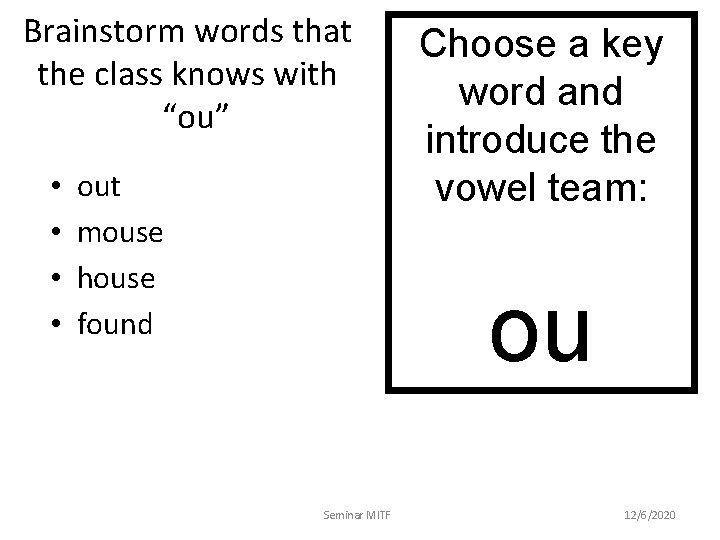
Brainstorm words that the class knows with “ou” • • out mouse house found Choose a key word and introduce the vowel team: ou Seminar MITF 12/6/2020
Work on the “ou” in a multi sensory manner • visual • auditory • kinesthetic • tactile * trace on the table with fingers, in the air, writing with pencils Seminar MITF 12/6/2020
Write “ou” in personal notebooks. At the back of the “ou” page, draw a picture of the key word. Label the picture. Practice forming the “ou” correctly. Whilst writing the “ou”, pupils should pronounce the “ou”. Seminar MITF 12/6/2020
Letter matrixes with ou - notebook Read words with the above letters sound, house, loud, outside, count, mouth, shout, about, round, without, our, out, thousand. Teach hour & flour. Spell words with the above letters. mouth, south, cloud, pound, house. Read a story with the above letters. Write sentences with the words (house, mouse, out etc. ) Seminar MITF 12/6/2020
Story Reading: e-mail to Helen (see Entry Point 2, p. 58) Dear Helen, Please come and visit us in our new house. I want you to see my room. I am very proud of it. I found a red couch and a round rug at the Flea Market. I found cool posters, too. Best of all, I can now tell my sister, “Go out and shut the door!” I am on cloud nine! Love, Jane Seminar MITF 12/6/2020
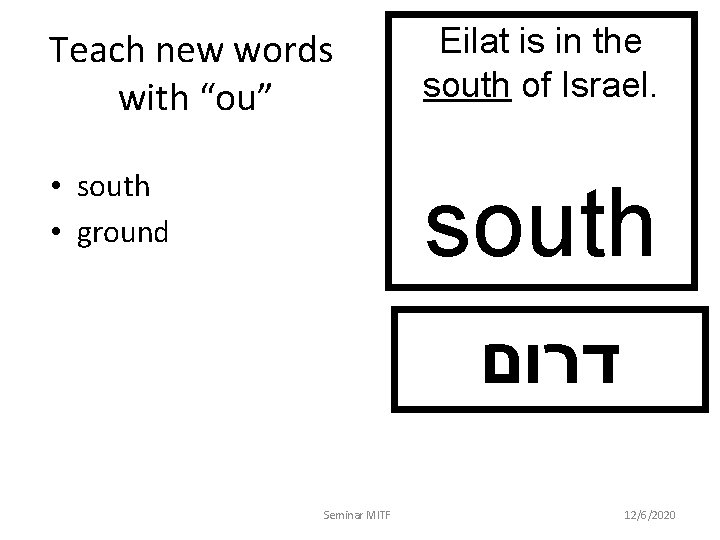
Teach new words with “ou” Eilat is in the south of Israel. • south • ground south דרום Seminar MITF 12/6/2020
Summary • Review ‘ou’. What is your key word? Trace ‘ou’. Pronounce it. • Homework: Read words and story including the ‘ou’. Write sentences with words containing ‘ou’. Seminar MITF 12/6/2020
What might we include in a kit bag to facilitate EFL literacy acquisition? • Phonemic awareness (including novel sounds) • Structured and explicit instruction of the letters, letter patterns. • “Marriage” of the letter conventions (orthography) and vocabulary. • Create a “party” for novel sounds. • Facilitate learning and teaching in a measured manner. Set goals for the group/class and gradually reach them. Seminar MITF 12/6/2020
Thank you for participating! janina_k@oranim. ac. il Seminar MITF 12/6/2020