
What is Weather Weather is the state of
- Slides: 20
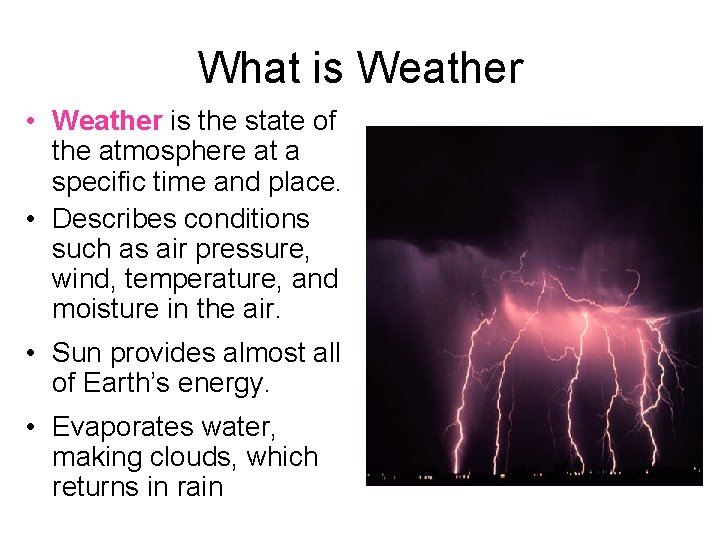
What is Weather • Weather is the state of the atmosphere at a specific time and place. • Describes conditions such as air pressure, wind, temperature, and moisture in the air. • Sun provides almost all of Earth’s energy. • Evaporates water, making clouds, which returns in rain
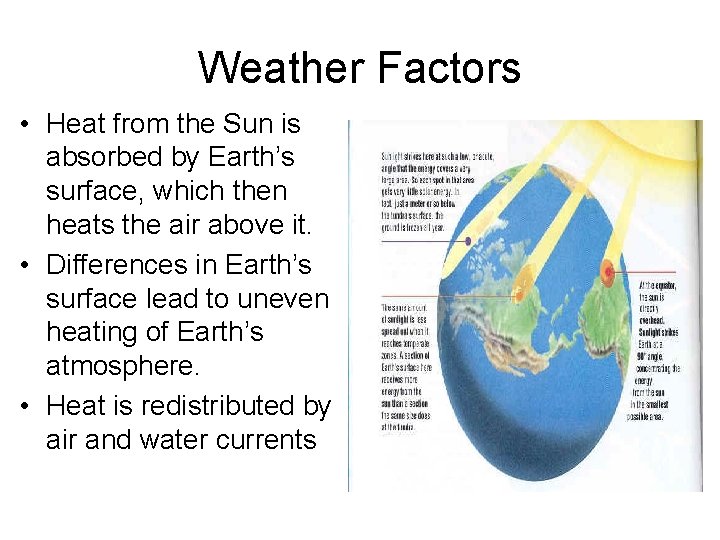
Weather Factors • Heat from the Sun is absorbed by Earth’s surface, which then heats the air above it. • Differences in Earth’s surface lead to uneven heating of Earth’s atmosphere. • Heat is redistributed by air and water currents
Air Temperatures • Air is made up of molecules that are always moving randomly. • Temperature is a measure of the average amount of motion of molecules. • Temperature is high, molecules in air move rapidly and it feels warm. • temperature is low, molecules in air move less rapidly, and it feels cold.
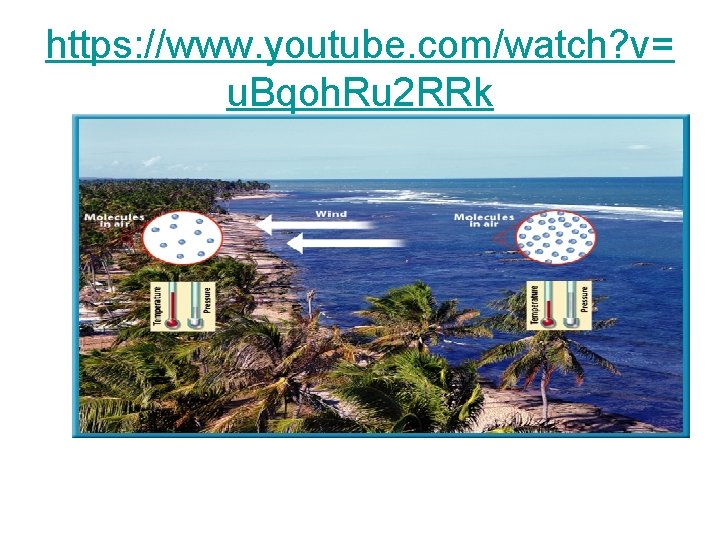
Wind • Air moving in a specific direction is called wind. • Sun warms the air, the air expands and becomes less dense. • Warm, expanding air has low atmospheric pressure. • Cooler air is denser and tends to sink, bringing about high atmospheric pressure • Wind results because air moves from regions of high pressure to regions of low pressure.
https: //www. youtube. com/watch? v= u. Bqoh. Ru 2 RRk
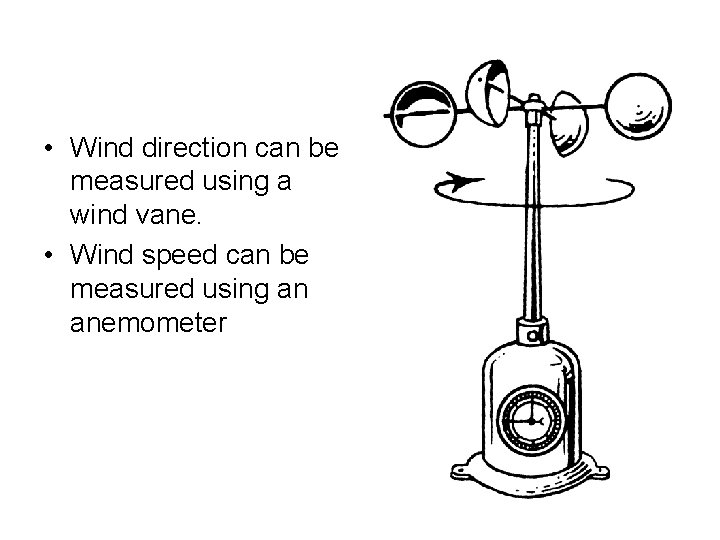
• Wind direction can be measured using a wind vane. • Wind speed can be measured using an anemometer
Humidity • Heat evaporates water into the atmosphere. • Water vapor molecules fit into spaces among the molecules that make up air. • The amount of water vapor present in the air is called humidity. • Relative humidity is a measure of the amount of water vapor present in the air compared to the amount needed for saturation at a specific temperature. • If you hear a weather forecaster say that the relative humidity is 50 percent, it means that the air contains 50 percent of the water needed for the air to be saturated. • https: //www. youtube. com/watch? v=7 GS 5 jl 4 n. Lek
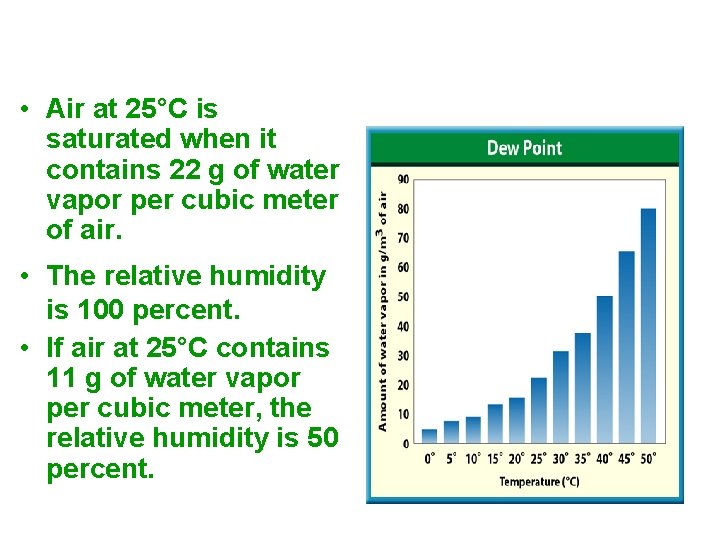
• Air at 25°C is saturated when it contains 22 g of water vapor per cubic meter of air. • The relative humidity is 100 percent. • If air at 25°C contains 11 g of water vapor per cubic meter, the relative humidity is 50 percent.
Dew Point • When the temperature drops, less water vapor can be present in air. • The water vapor in air will condense to a liquid or form ice crystals. • The temperature at which air is saturated and condensation forms is the dew point. • The dew point changes with the amount of water vapor in the air.
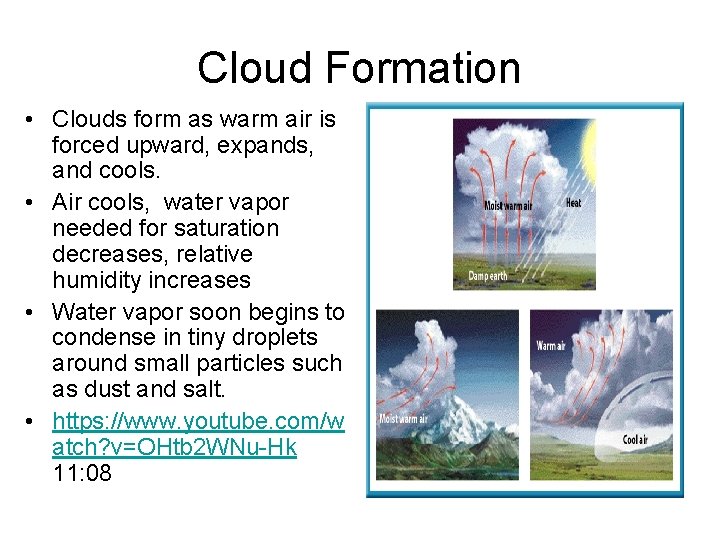
Cloud Formation • Clouds form as warm air is forced upward, expands, and cools. • Air cools, water vapor needed for saturation decreases, relative humidity increases • Water vapor soon begins to condense in tiny droplets around small particles such as dust and salt. • https: //www. youtube. com/w atch? v=OHtb 2 WNu-Hk 11: 08
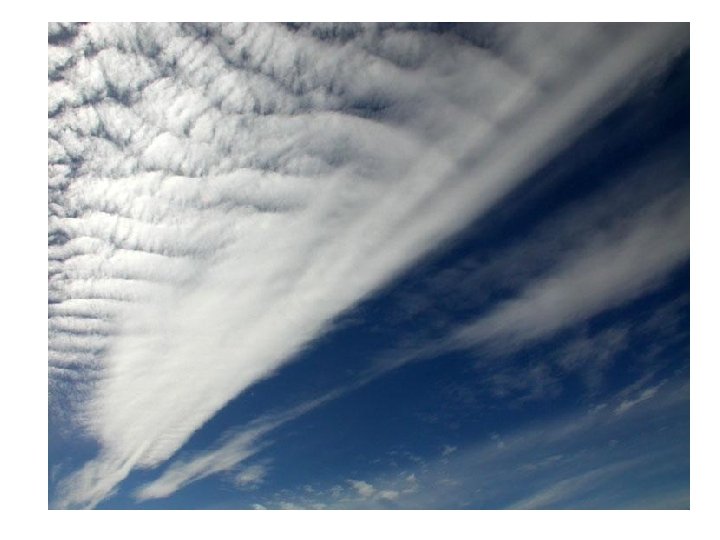
Classifying Clouds • Clouds are classified mainly by shape and height. • The shape and height of clouds vary with temperature, pressure, and the amount of water vapor in the atmosphere. • Three main cloud types are stratus, cumulus, and cirrus. • Stratus clouds form layers, or smooth, even sheets in the sky.
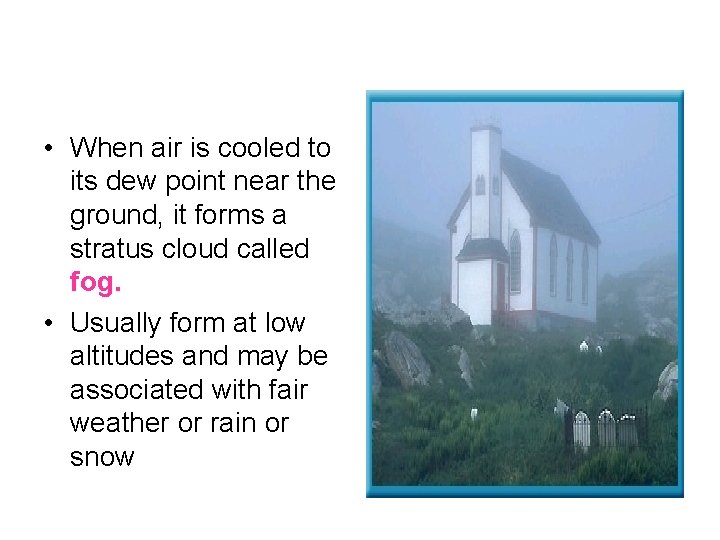
• When air is cooled to its dew point near the ground, it forms a stratus cloud called fog. • Usually form at low altitudes and may be associated with fair weather or rain or snow
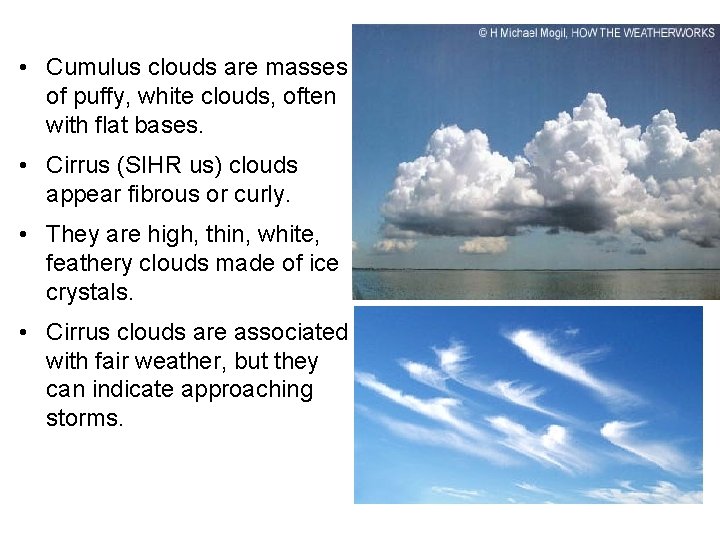
• Cumulus clouds are masses of puffy, white clouds, often with flat bases. • Cirrus (SIHR us) clouds appear fibrous or curly. • They are high, thin, white, feathery clouds made of ice crystals. • Cirrus clouds are associated with fair weather, but they can indicate approaching storms.
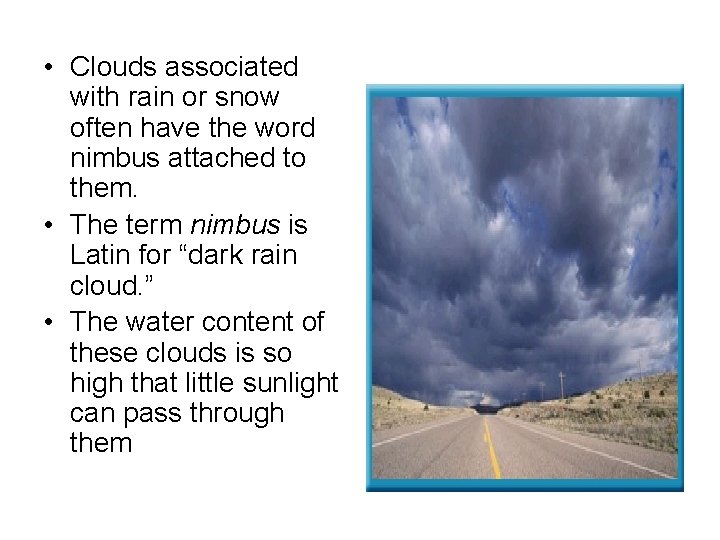
• Clouds associated with rain or snow often have the word nimbus attached to them. • The term nimbus is Latin for “dark rain cloud. ” • The water content of these clouds is so high that little sunlight can pass through them
• Water falling from clouds is called precipitation. • Precipitation occurs when cloud droplets combine and grow large enough to fall to Earth. • One factor is the strength of updrafts in a cloud, which can keep drops suspended in the air where they can grow larger • The rate of evaporation as a drop falls to Earth also can affect its size.
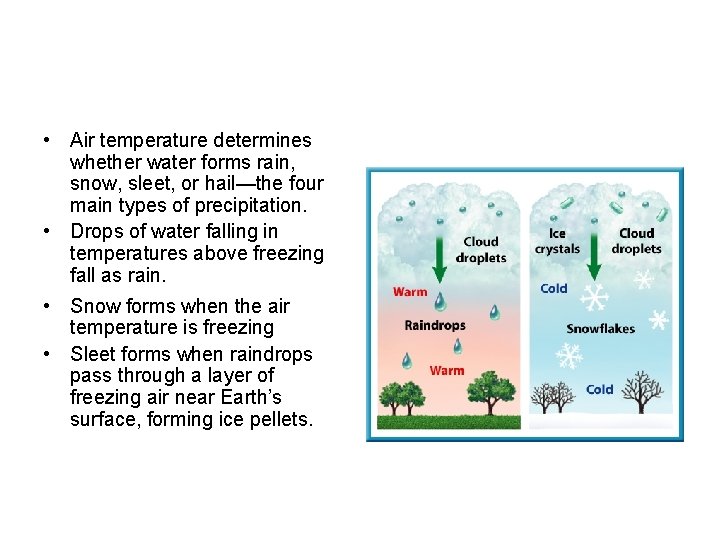
• Air temperature determines whether water forms rain, snow, sleet, or hail—the four main types of precipitation. • Drops of water falling in temperatures above freezing fall as rain. • Snow forms when the air temperature is freezing • Sleet forms when raindrops pass through a layer of freezing air near Earth’s surface, forming ice pellets.
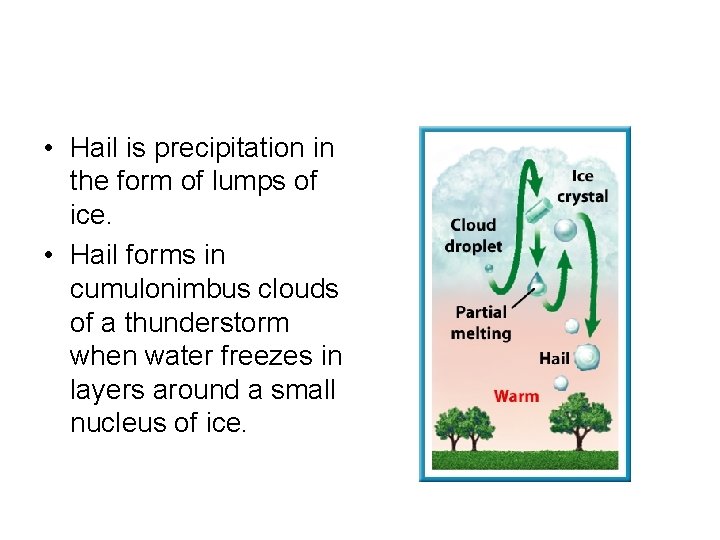
• Hail is precipitation in the form of lumps of ice. • Hail forms in cumulonimbus clouds of a thunderstorm when water freezes in layers around a small nucleus of ice.
The state of the atmosphere at a specific time and place is _____. • A. climate • B. meteorology • C. season • D. weather
The amount of water vapor present in the air is _____. • A. dew • B. condensation • C. fog • D. humidity