Vientiane Action Programme VAP 2004 2010 Outline of


- Slides: 40
Vientiane Action Programme (VAP) 2004 -2010
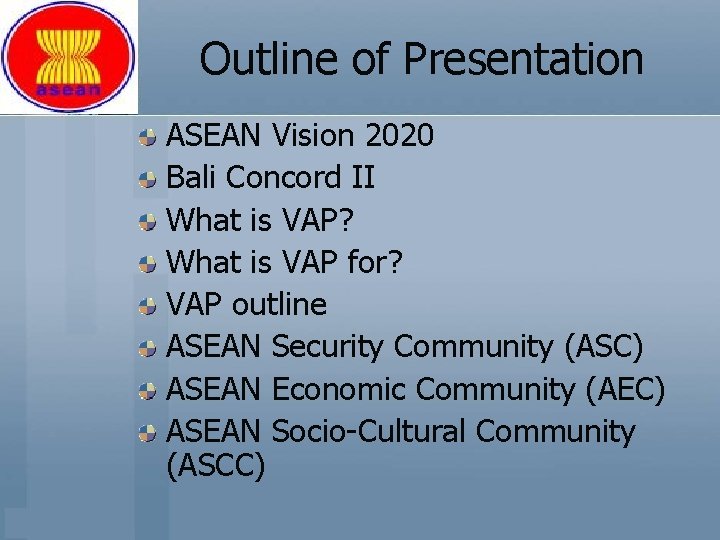
Outline of Presentation ASEAN Vision 2020 Bali Concord II What is VAP? What is VAP for? VAP outline ASEAN Security Community (ASC) ASEAN Economic Community (AEC) ASEAN Socio-Cultural Community (ASCC)
Outline of Presentation Continue. . Narrowing Development Gap (NDG) Annexes Implementation Mechanism Recent Developments
ASEAN Vision 2020 A concert of Southeast Asian nations, outward looking, living in peace, stability and prosperity, bonded together in partnership in dynamic development and in a community of caring societies.
Bali Concord II “An ASEAN Community shall be established comprising three pillars, namely political and security cooperation, economic cooperation, and socio-cultural cooperation that are closely intertwined and mutually reinforcing for the purpose of ensuring durable peace, stability and shared prosperity in the region”
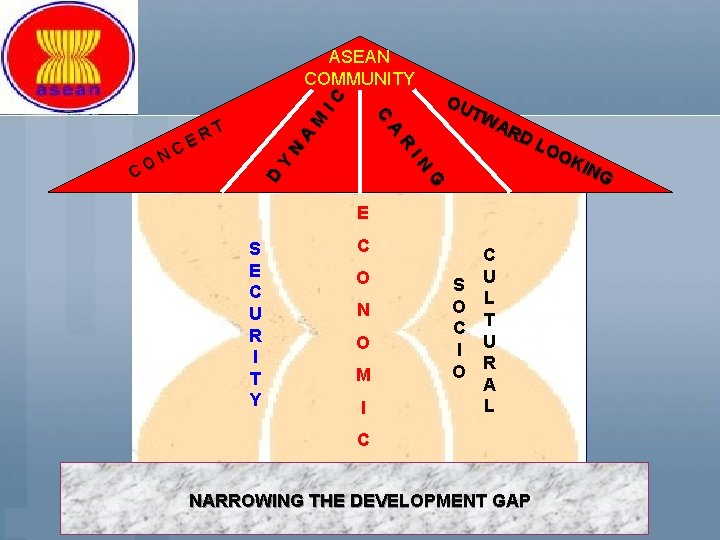
IC ASEAN COMMUNITY G D Y IN N R A A M C C C N O T R E OU TW AR DL OO KIN G E S E C U R I T Y C O N O M I S O C I O C U L T U R A L C NARROWING THE DEVELOPMENT GAP
What is VAP? The Vientiane Action Programme is: an instrument to unify and cross-link the strategies and goals of the three pillars of the ASEAN Community; an integral part of the action plans and programmes building up the realisation of the goals of ASEAN Vision 2020 and Bali Concord II. The VAP was signed during the 10 th ASEAN Summit in Vientiane on November 2004 by all the ASEAN Leaders. The VAP has listed over 300 targets and activities to be achieved and implemented by 2010.
What is VAP for? Successor to the HPA • A management tool to reach goals of the ASEAN Vision 2020 and the Bali Concord II Unifying instrument • To obtain political commitment in implementing the necessary cooperation activities Roadmap • To chart out the activities needed to attain the targets Management tool • To review progress of implementation of activities and assess levels of achievement Marketing tool • To promote cooperation with Dialogue Partners and other interested parties Public relations instrument • To publicise what ASEAN will do to realise the Vision 2020 and attain goals of Bali Concord II
The VAP Outline n n Preamble Goals and strategies towards realising the ASEAN Community ASEAN Security Community (ASC) q ASEAN Economic Community (AEC) q ASEAN Socio-Cultural Community (ASCC) q Narrowing the Development Gap (NDG) q n n Implementation Mechanisms Annexes of indicative activities
ASEAN Security Community (ASC) Theme: “Enhancing peace, stability, democracy and prosperity in the region through comprehensive political and security cooperation”
ASEAN Security Community (ASC) Political development: people-to-people contacts, human rights, good governance Shaping and sharing of norms: ASEAN Charter, ASEAN Mutual Legal Assistance Agreement, convention on counter-terrorism Conflict prevention: military officials exchanges; security outlook reports; combat transnational crime Conflict resolution: networking, joint research Post-conflict peace-building: humanitarian assistance, inter-communal harmony; culture of peace.
ASEAN Economic Community (AEC) Theme: “Enhancing competitiveness for economic growth and development through closer economic integration”
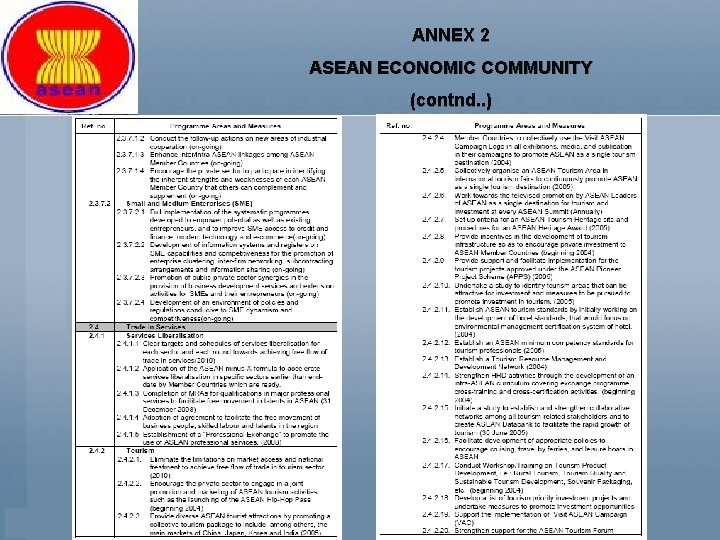
ASEAN Economic Community (AEC) Initial Eleven Priority Sectors for Integration: Agro -Based products, Automotive, Electronics, Fisheries, Rubber-Based products, Textiles and Apparels, Wood-Based products, Air Travel, e. ASEAN (ICT), Healthcare, and Tourism. ASEAN Investment Area: and facilitation Investment liberalisation Tariffs, NTBs, AISP, Trade in Minerals, Trade Facilitation, ROO, Standards and Conformance, IP, Industrial Cooperation and Enterprise Development. Trade in Goods: Trade in Services: tourism Services liberalisation and
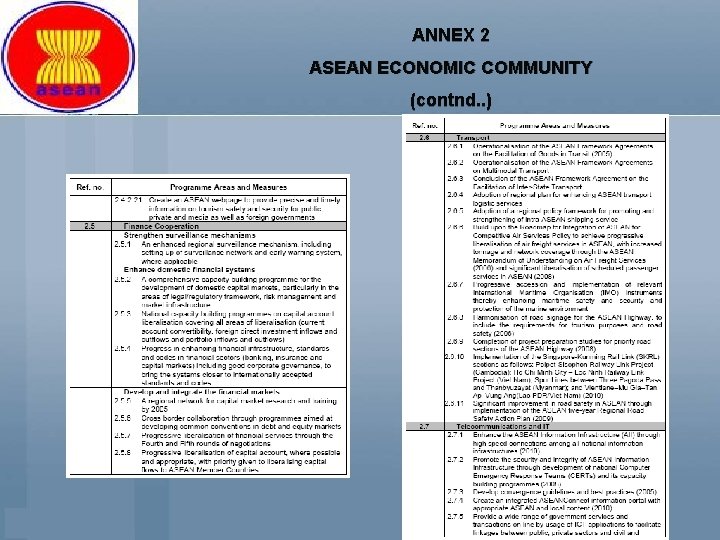
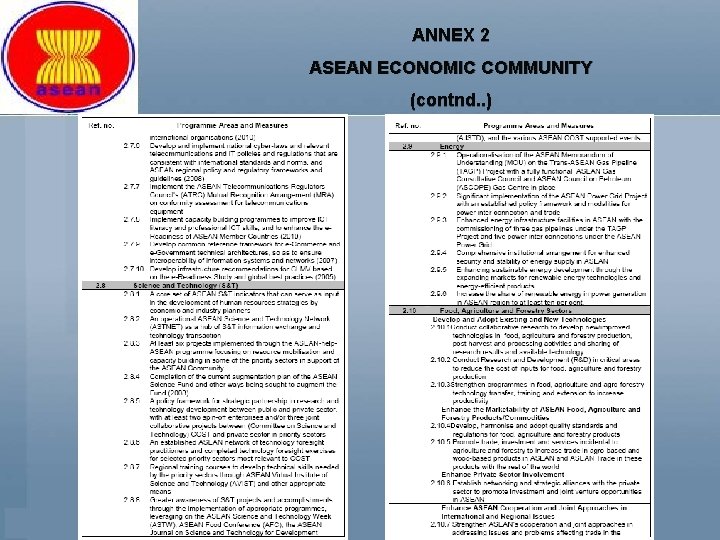
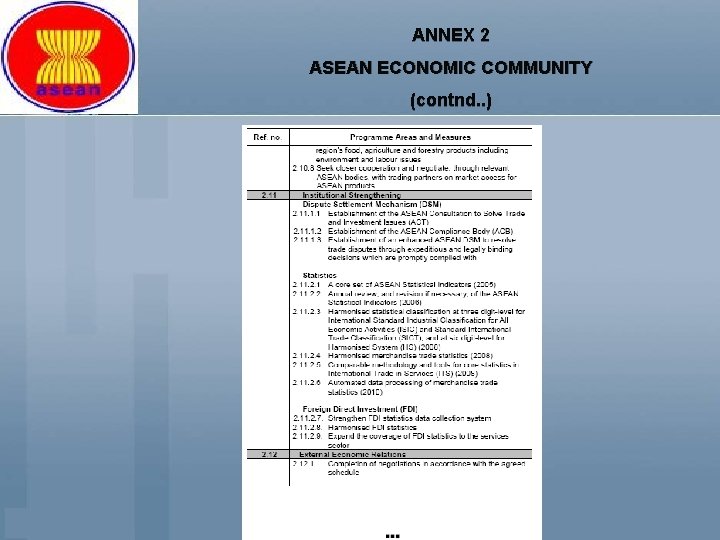
ASEAN Economic Community (AEC) Finance Cooperation Transport Telecommunications and IT Science and Technology (S&T) Energy Food, Agriculture and Forestry Sectors Institutional Strengthening: Dispute settlement mechanism, statistics Economic Relations with Dialogue Partners
ASEAN Socio-Cultural Community (ASCC) Theme: “Nurturing human, cultural and natural resources for sustained development in a harmonious and people-centred ASEAN”
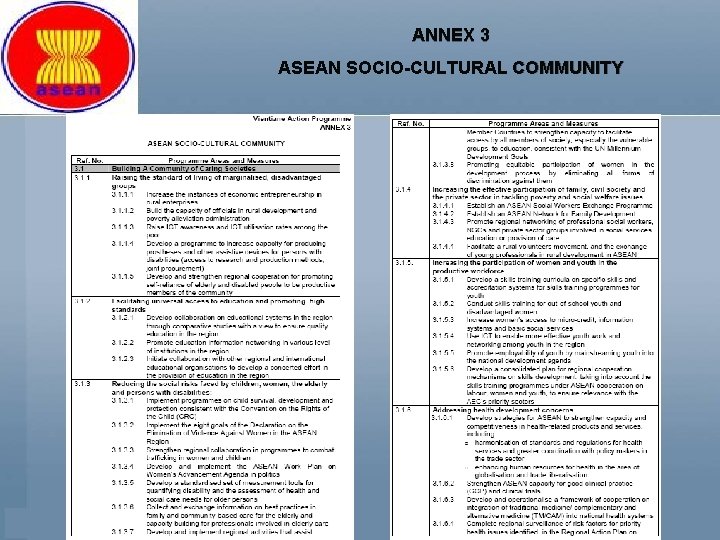
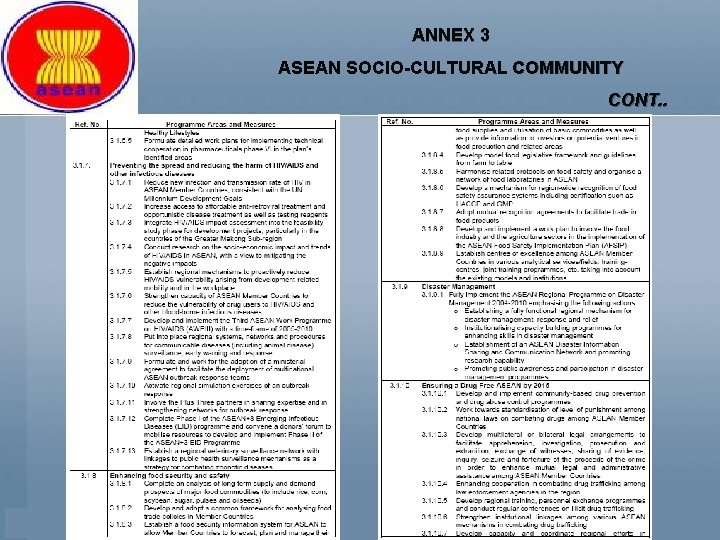
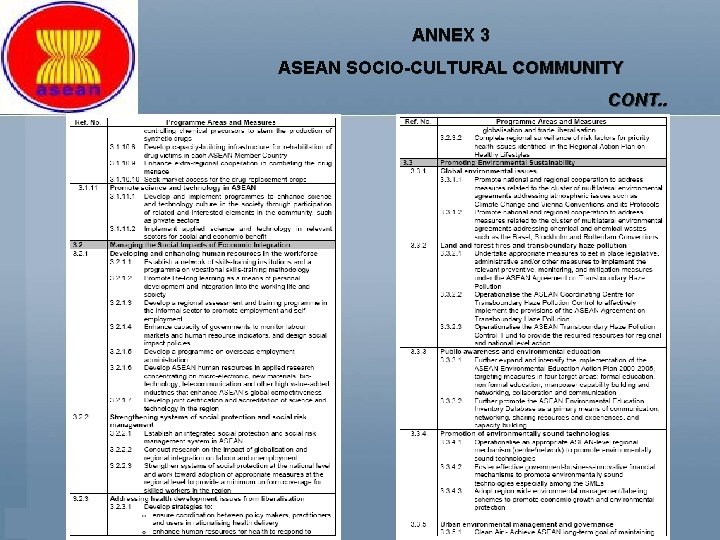
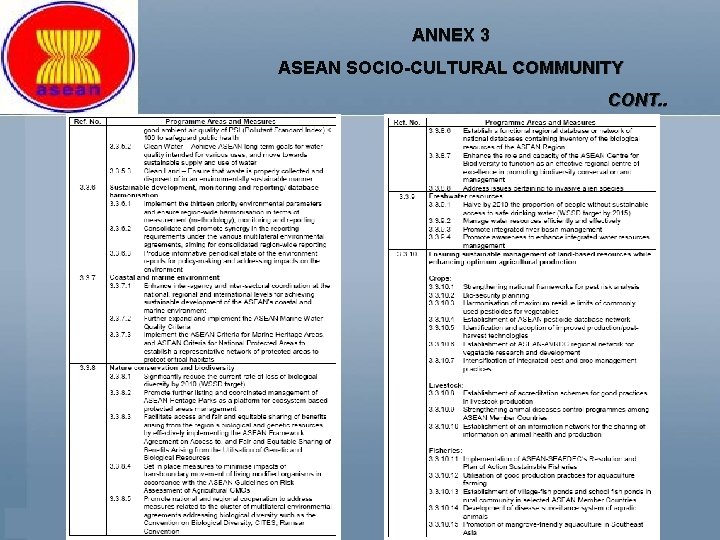
ASEAN Socio-Cultural Community (ASCC) Building a community of caring societies: rural development, women, youth, health concerns, food security, disaster management, drugs Managing the social impact of economic integration: HRD, labour, social protection Promoting environmental sustainability: haze, biodiversity, urban environment, natural resources Promoting an ASEAN identity: cultural exchanges, public awareness
Narrowing Development Gap (NDG) Theme: “Progressing together through cooperation in development”
Narrowing Development Gap (NDG) Enhancing IAI Sub-regional arrangements
Annexes n A listing of various programme areas, activities and targets under the four pillars and for narrowing the development gap. The list is considered non-exhaustive.
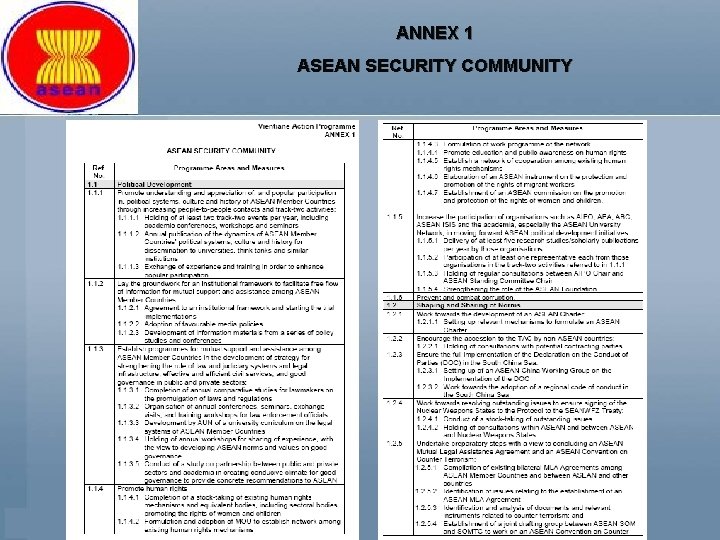
ANNEX 1 ASEAN SECURITY COMMUNITY
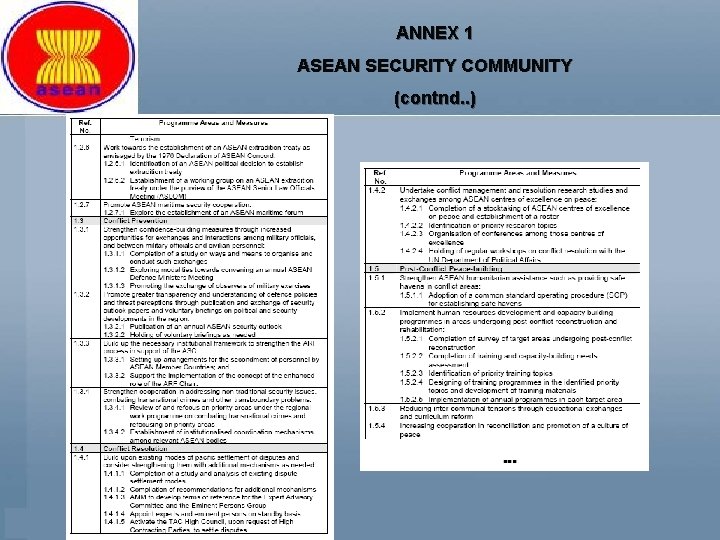
ANNEX 1 ASEAN SECURITY COMMUNITY (contnd. . )
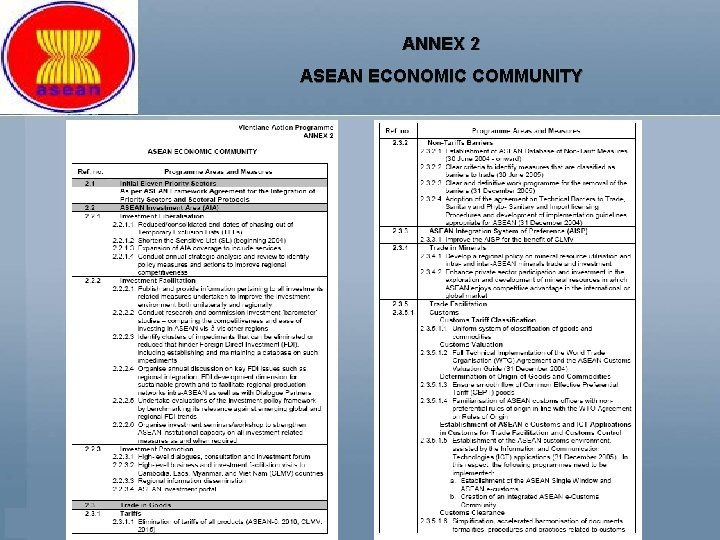
ANNEX 2 ASEAN ECONOMIC COMMUNITY
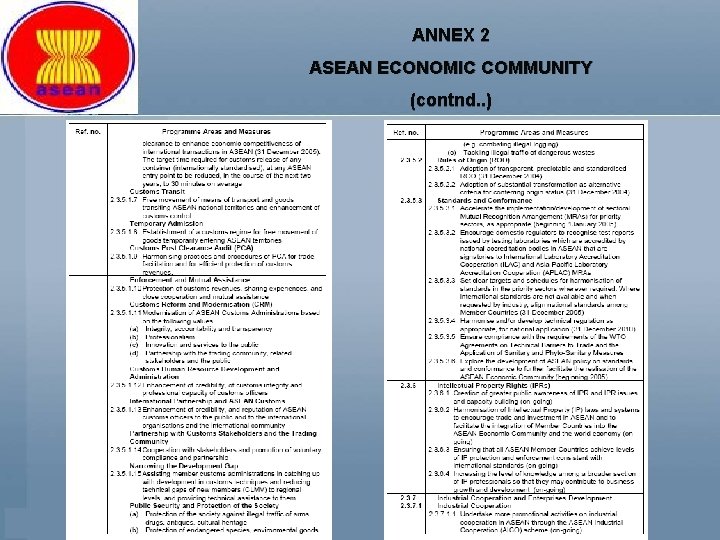
ANNEX 2 ASEAN ECONOMIC COMMUNITY (contnd. . )
ANNEX 2 ASEAN ECONOMIC COMMUNITY (contnd. . )
ANNEX 2 ASEAN ECONOMIC COMMUNITY (contnd. . )
ANNEX 2 ASEAN ECONOMIC COMMUNITY (contnd. . )
ANNEX 2 ASEAN ECONOMIC COMMUNITY (contnd. . )
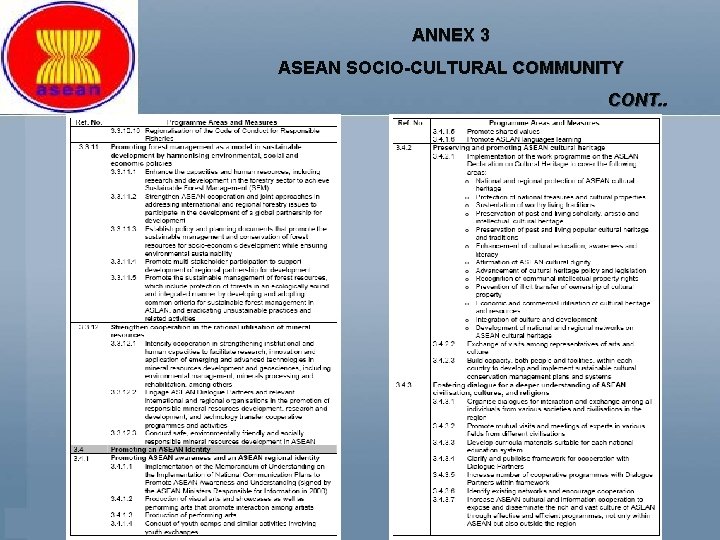
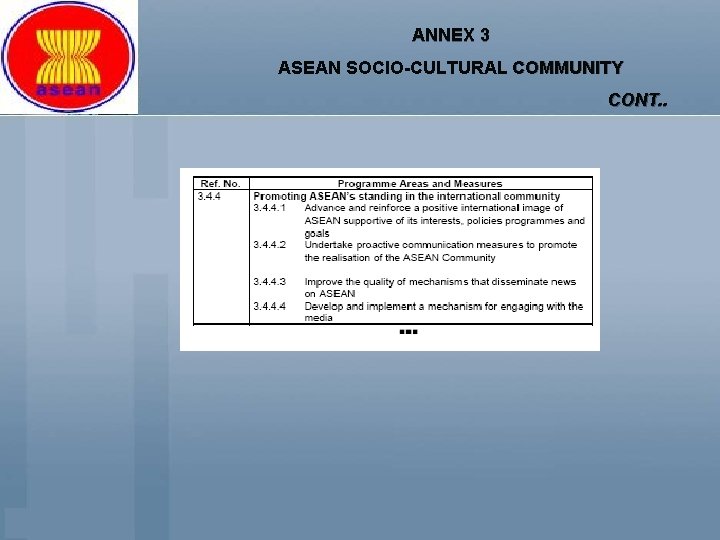
ANNEX 3 ASEAN SOCIO-CULTURAL COMMUNITY
ANNEX 3 ASEAN SOCIO-CULTURAL COMMUNITY CONT. .
ANNEX 3 ASEAN SOCIO-CULTURAL COMMUNITY CONT. .
ANNEX 3 ASEAN SOCIO-CULTURAL COMMUNITY CONT. .
ANNEX 3 ASEAN SOCIO-CULTURAL COMMUNITY CONT. .
ANNEX 3 ASEAN SOCIO-CULTURAL COMMUNITY CONT. .
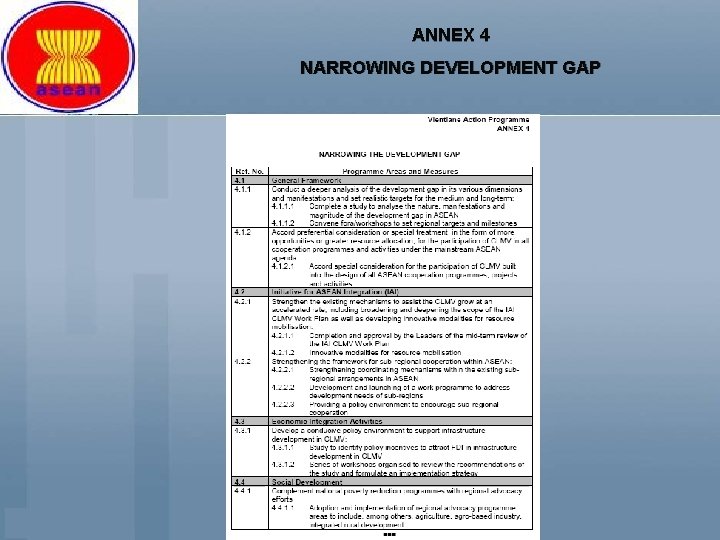
ANNEX 4 NARROWING DEVELOPMENT GAP
Implementation Mechanism Resource Mobilisation 1. 2. 3. Direct contributions from all or some AMCs ASEAN pooled resources External funding Institutional Arrangements n n n Projects that have to be implemented jointly by two or more ASEAN bodies, or multi-component programmes each ASEAN body is responsible for individual components. Strengthening the current mechanisms for closer coordination of inputs in project design and efficiency in joint management and implementation of projects to ensure better coherence, complementation, efficiency, flexibility, transparency and accountability, without unduly creating additional complexity to the overall ASEAN cooperation structure. The ASEAN Secretariat will facilitate the consultation process among ASEAN bodies and seek the most efficient modality in setting up the appropriate institutional arrangement at the programme/project level.
Implementation Mechanism Monitoring and Evaluation Ø Ensure achievement of target, timely corrective measures undertaken, consistency with the goals, responsiveness. Ø VAP scorecard as a basic tool quantitative ratings, qualitative assessment, aggregation across diverse sectors to form an overall picture of VAP performance.
Implementation Mechanism Three types of intervention: intervention 1. Policy initiatives 2. Establishment of implementation 3. mechanisms 3. Human capacity building
Implementation Mechanism Five levels of cooperation: 1. 2. 3. 4. 5. Confidence-building, an initial step characterised by understanding common problems, exploring common interests and identifying mutual gains of cooperating on a regional basis; Harmonisation, which aims to achieve compatible national approaches by ASEAN Member Countries; Special assistance, which focuses on capacity building to bridge development gaps across Member Countries, in particular, for less developed countries; Joint efforts, which are about developing regional approaches and regional institutions; and Regional integration and expansion, where regional institutions can act in unison to further the ASEAN cause on behalf of Member Countries to attain the intended goals and objectives.
Recent developments Prioritisation of projects for 20052006; n Implementation of projects carried over from the Hanoi Plan of Action; n Preparation of resource mobilisation kit; n First progress report by Secretary. General at the 38 th AMM, July 2005; n Uptake of VAP in Action Plans of Dialogue Partners n
THANK YOU www. aseansec. org