Utilizing Technology to Promote Active Learning in a
- Slides: 38
Utilizing Technology to Promote Active Learning in a Large Enrollment Course Ann C. Smith Cell Biology and Molecular Genetics
General Microbiology • • • Large lecture course (250/lecture) With associated lab (500 students in Fall) Sophomore level Pre-requisite General Biology University CORE program – Active learning – Writing – Process of science
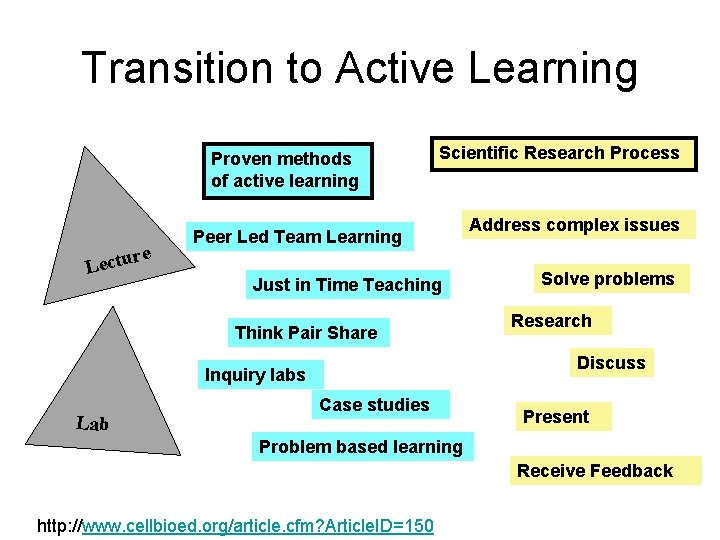
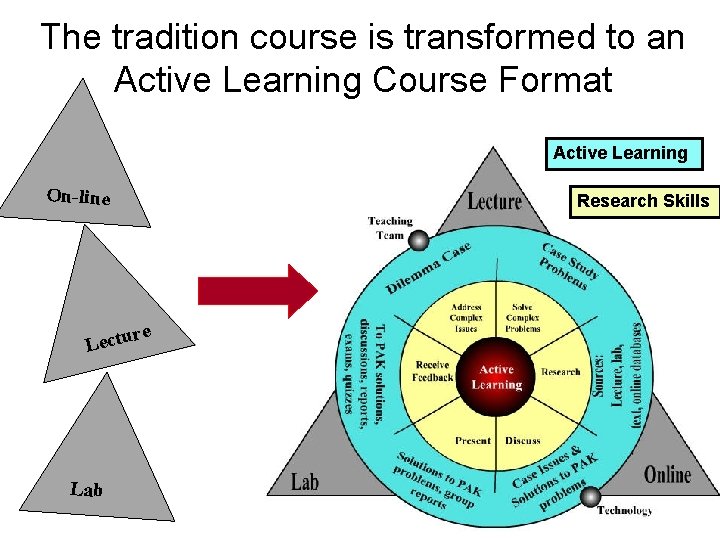
Transition to Active Learning Proven methods of active learning re Lectu Scientific Research Process Peer Led Team Learning Just in Time Teaching Think Pair Share Solve problems Research Discuss Inquiry labs Lab Address complex issues Case studies Present Problem based learning Receive Feedback http: //www. cellbioed. org/article. cfm? Article. ID=150
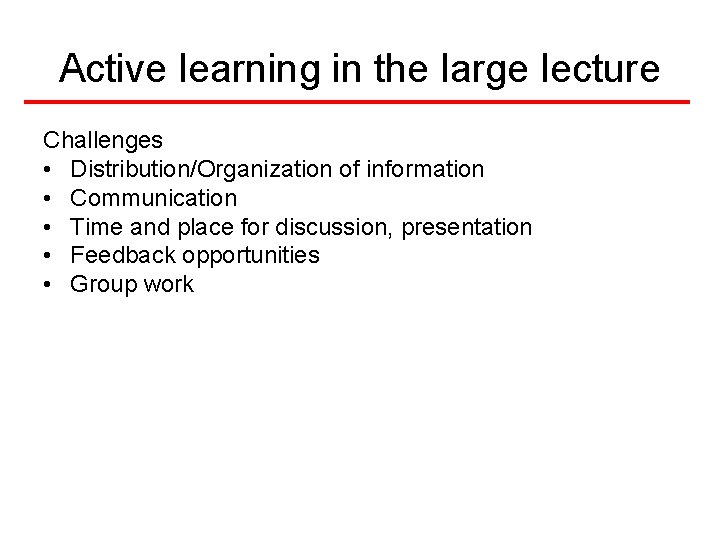
Active learning in the large lecture Challenges • Distribution/Organization of information • Communication • Time and place for discussion, presentation • Feedback opportunities • Group work
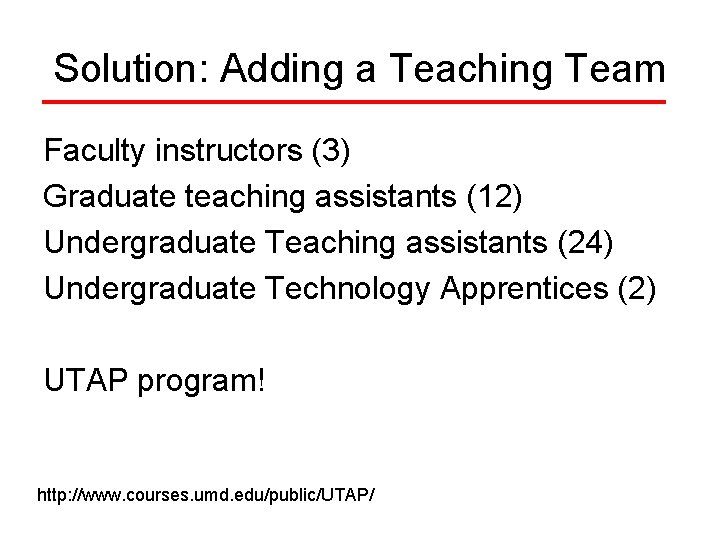
Solution: Adding a Teaching Team Faculty instructors (3) Graduate teaching assistants (12) Undergraduate Teaching assistants (24) Undergraduate Technology Apprentices (2) UTAP program! http: //www. courses. umd. edu/public/UTAP/
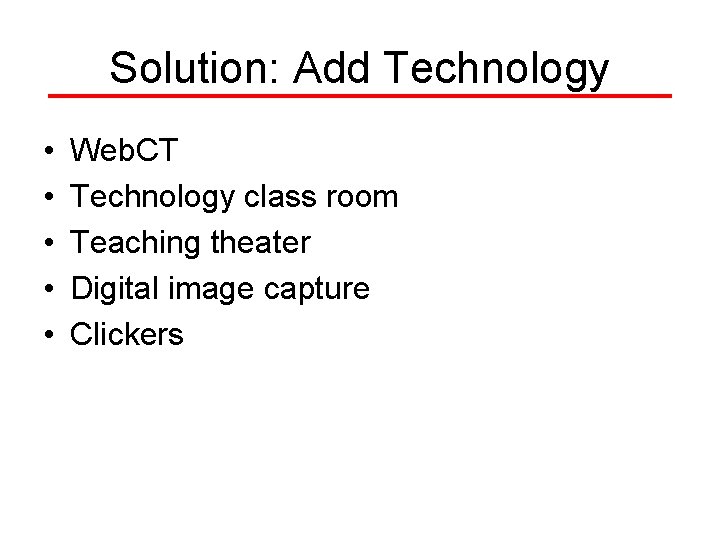
Solution: Add Technology • • • Web. CT Technology class room Teaching theater Digital image capture Clickers
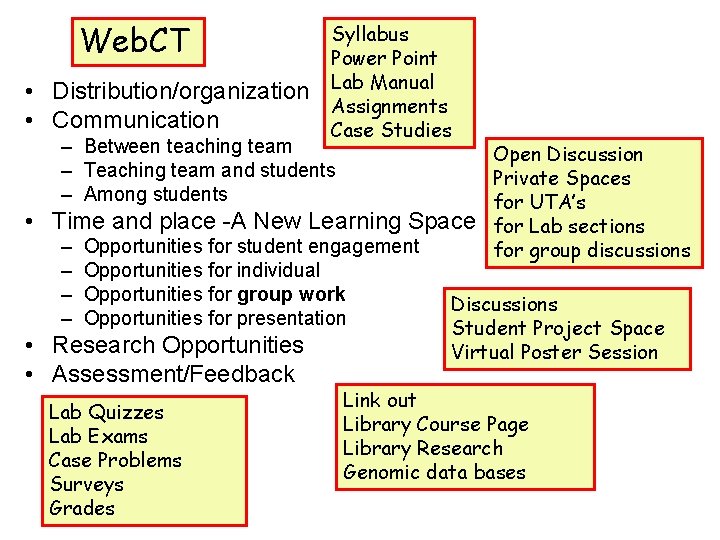
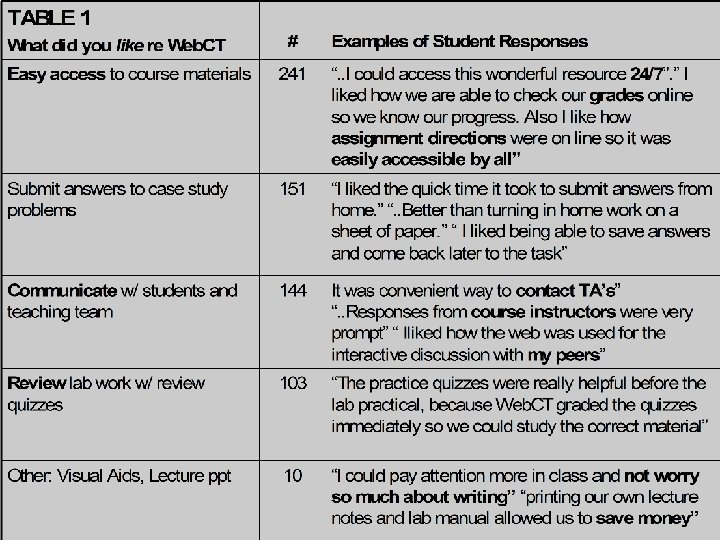
Web. CT • Distribution/organization • Communication Syllabus Power Point Lab Manual Assignments Case Studies – Between teaching team – Teaching team and students – Among students • Time and place -A New Learning Space – – Opportunities for student engagement Opportunities for individual Opportunities for group work Opportunities for presentation • Research Opportunities • Assessment/Feedback Lab Quizzes Lab Exams Case Problems Surveys Grades Open Discussion Private Spaces for UTA’s for Lab sections for group discussions Discussions Student Project Space Virtual Poster Session Link out Library Course Page Library Research Genomic data bases
The tradition course is transformed to an Active Learning Course Format Active Learning On-line re u t c e L Lab Research Skills
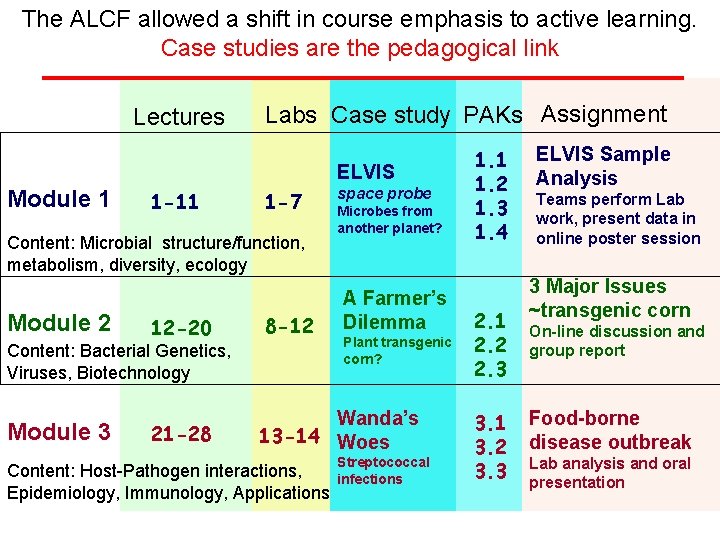
The ALCF allowed a shift in course emphasis to active learning. Case studies are the pedagogical link Lectures Labs Case study PAKs Assignment ELVIS Module 1 1 -11 1 -7 Content: Microbial structure/function, metabolism, diversity, ecology Module 2 12 -20 8 -12 Content: Bacterial Genetics, Viruses, Biotechnology Module 3 21 -28 space probe Microbes from another planet? A Farmer’s Dilemma Plant transgenic corn? Wanda’s 13 -14 Woes Content: Host-Pathogen interactions, Epidemiology, Immunology, Applications Streptococcal infections 1. 1 1. 2 1. 3 1. 4 2. 1 2. 2 2. 3 3. 1 3. 2 3. 3 ELVIS Sample Analysis Teams perform Lab work, present data in online poster session 3 Major Issues ~transgenic corn On-line discussion and group report Food-borne disease outbreak Lab analysis and oral presentation
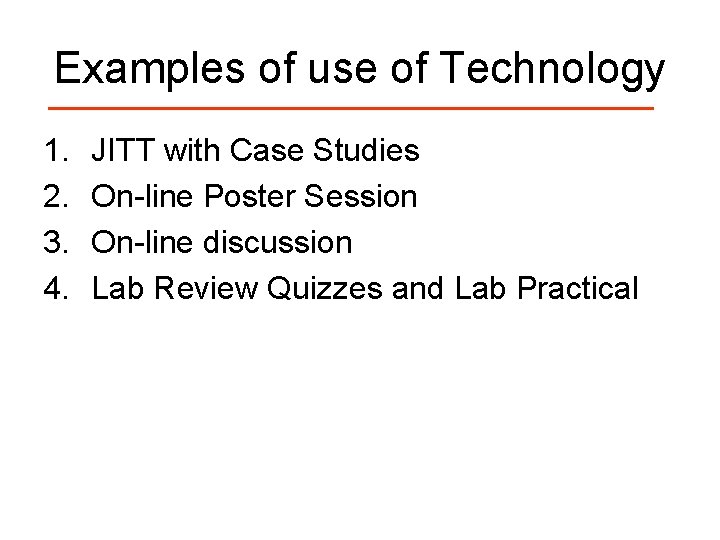
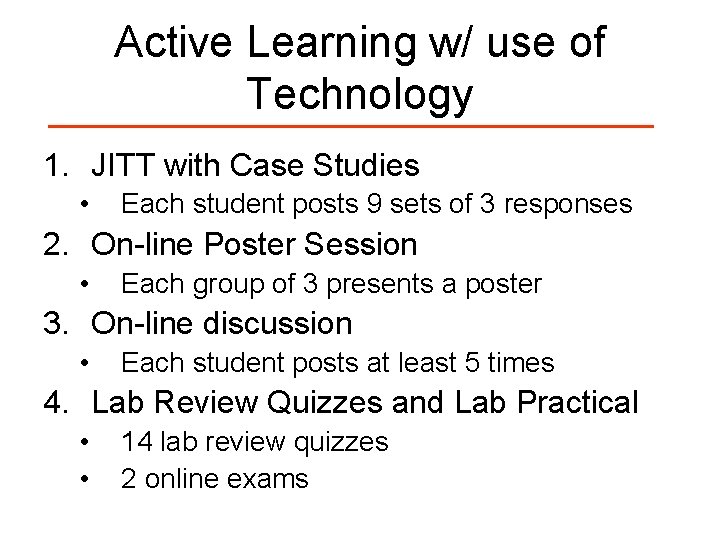
Examples of use of Technology 1. 2. 3. 4. JITT with Case Studies On-line Poster Session On-line discussion Lab Review Quizzes and Lab Practical
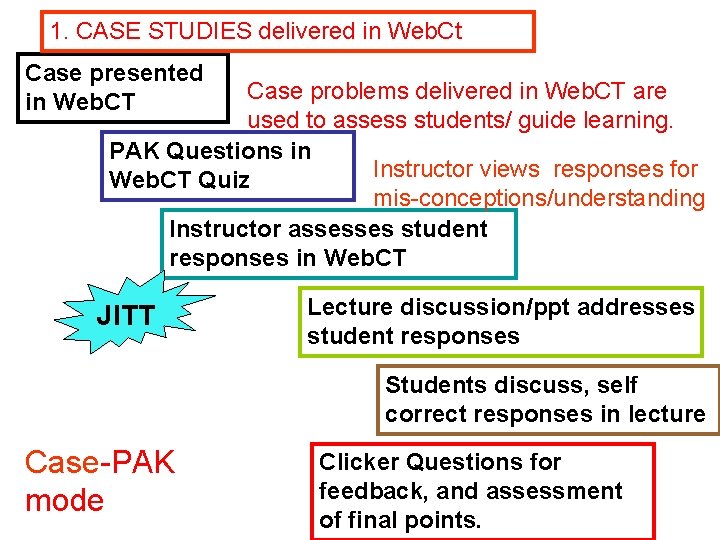
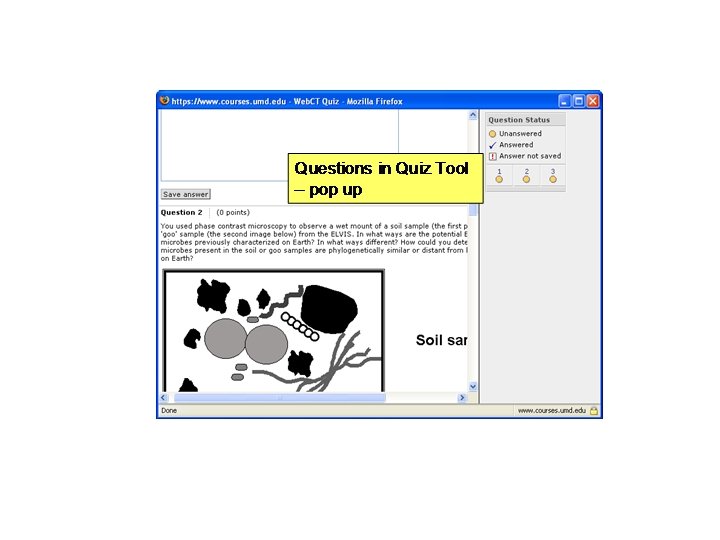
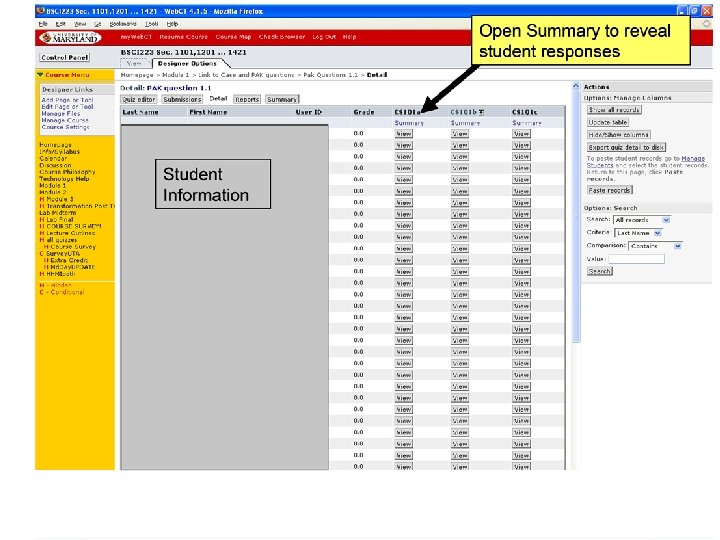
1. CASE STUDIES delivered in Web. Ct Case presented in Web. CT Case problems delivered in Web. CT are used to assess students/ guide learning. PAK Questions in Instructor views responses for Web. CT Quiz mis-conceptions/understanding Instructor assesses student responses in Web. CT JITT Lecture discussion/ppt addresses student responses Students discuss, self correct responses in lecture Case-PAK mode Clicker Questions for feedback, and assessment of final points.
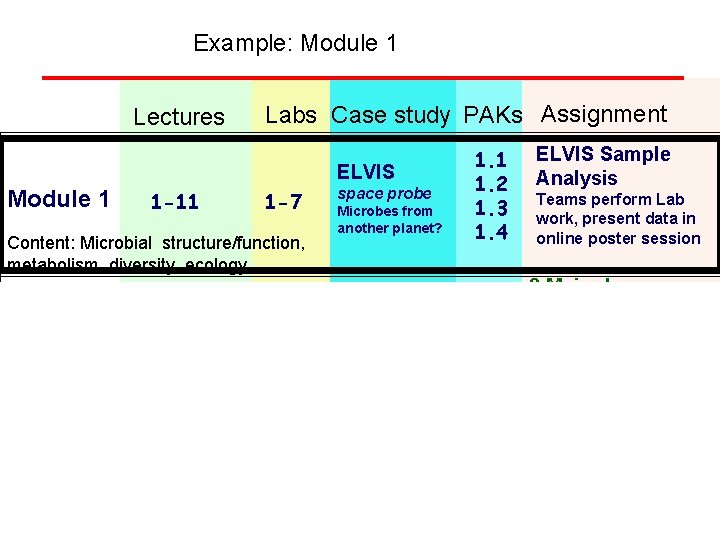
Example: Module 1 Lectures Labs Case study PAKs Assignment ELVIS Module 1 1 -11 1 -7 Content: Microbial structure/function, metabolism, diversity, ecology Module 2 12 -20 8 -12 Content: Bacterial Genetics, Viruses, Biotechnology Module 3 21 -28 space probe Microbes from another planet? A Farmer’s Dilemma Plant transgenic corn? Wanda’s 13 -14 Woes Content: Host-Pathogen interactions, Epidemiology, Immunology, Applications Streptococcal infections 1. 1 1. 2 1. 3 1. 4 2. 1 2. 2 2. 3 3. 1 3. 2 3. 3 ELVIS Sample Analysis Teams perform Lab work, present data in online poster session 3 Major Issues ~transgenic corn On-line discussion and group report Food-borne disease outbreak Lab analysis and oral presentation
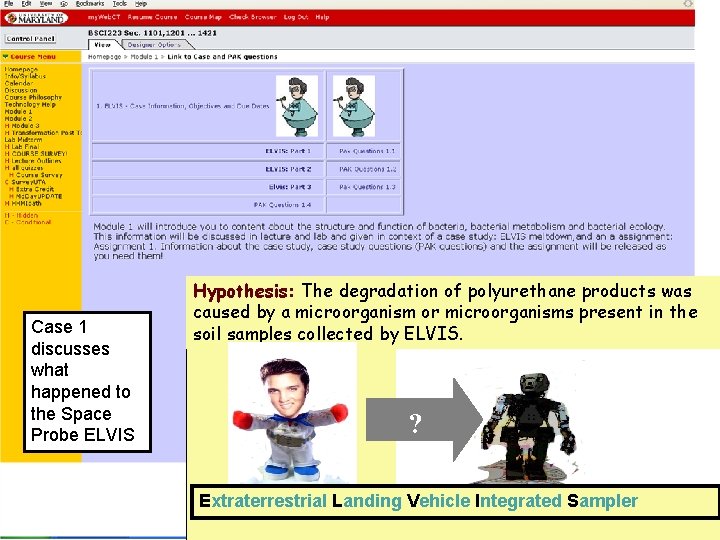
Case 1 discusses what happened to the Space Probe ELVIS Hypothesis: The degradation of polyurethane products was caused by a microorganism or microorganisms present in the soil samples collected by ELVIS. ? Extraterrestrial Landing Vehicle Integrated Sampler
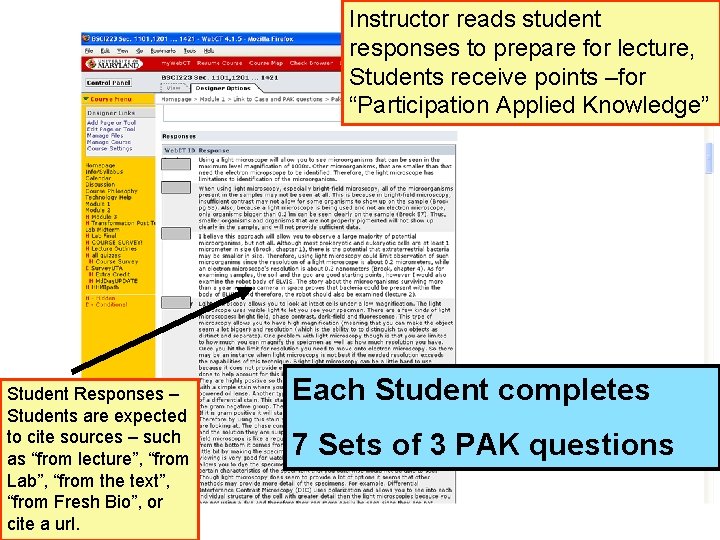
Instructor reads student responses to prepare for lecture, Students receive points –for “Participation Applied Knowledge” Student Responses – Students are expected to cite sources – such as “from lecture”, “from Lab”, “from the text”, “from Fresh Bio”, or cite a url. Each Student completes 7 Sets of 3 PAK questions
Just in Time Teaching • After reviewing PAK responses instructor addresses misconceptions in lecture • Use Think-Pair-Share • Or Clicker questions
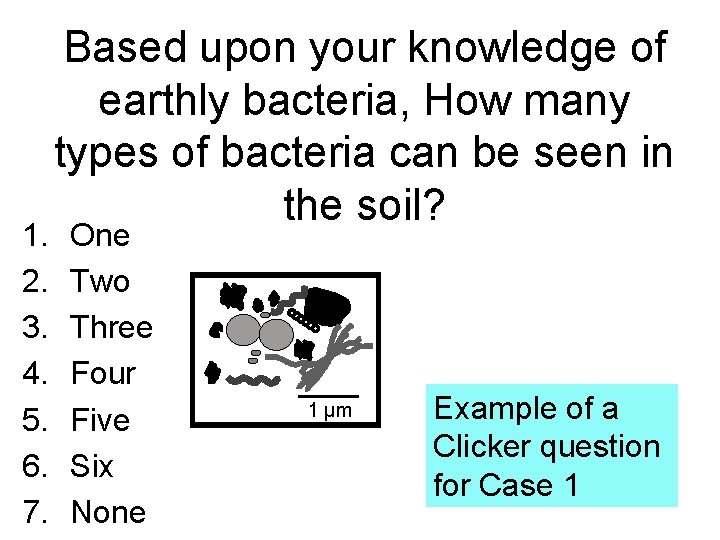
1. 2. 3. 4. 5. 6. 7. Based upon your knowledge of earthly bacteria, How many types of bacteria can be seen in the soil? One Two Three Four Five Six None 1 μm Example of a Clicker question for Case 1
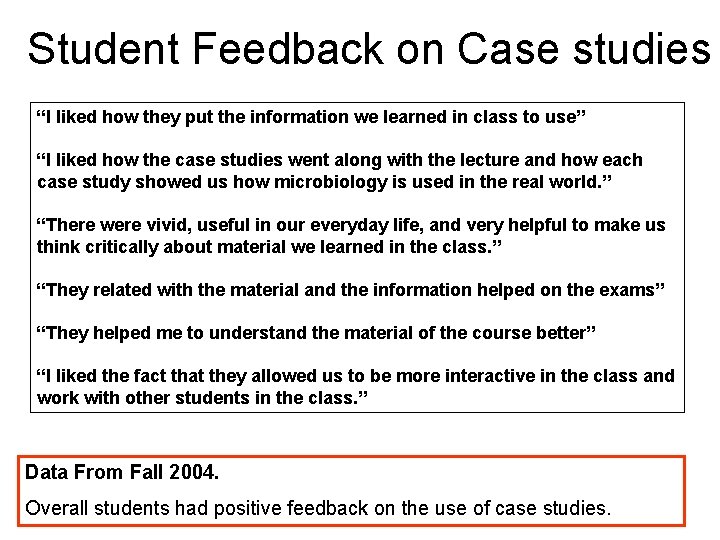
Student Feedback on Case studies “I liked how they put the information we learned in class to use” “I liked how the case studies went along with the lecture and how each case study showed us how microbiology is used in the real world. ” “There were vivid, useful in our everyday life, and very helpful to make us think critically about material we learned in the class. ” “They related with the material and the information helped on the exams” “They helped me to understand the material of the course better” “I liked the fact that they allowed us to be more interactive in the class and work with other students in the class. ” Data From Fall 2004. Overall students had positive feedback on the use of case studies.
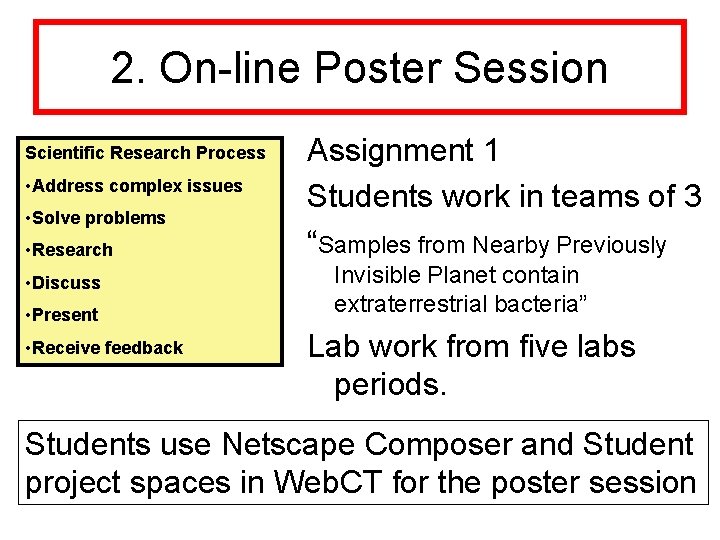
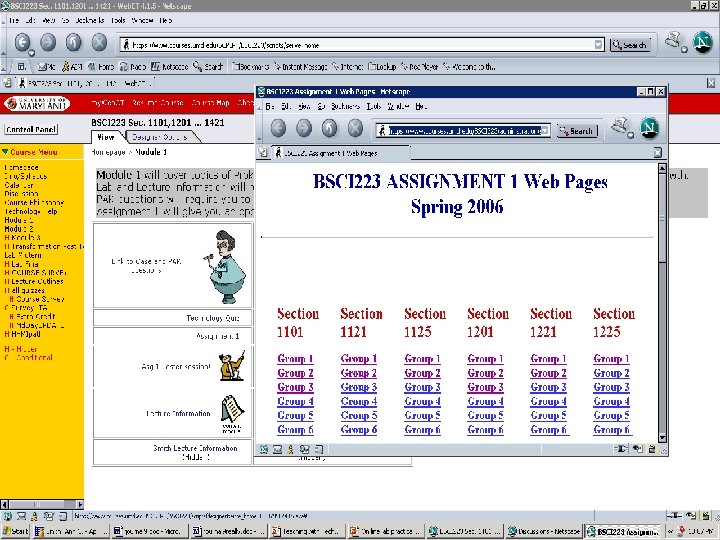
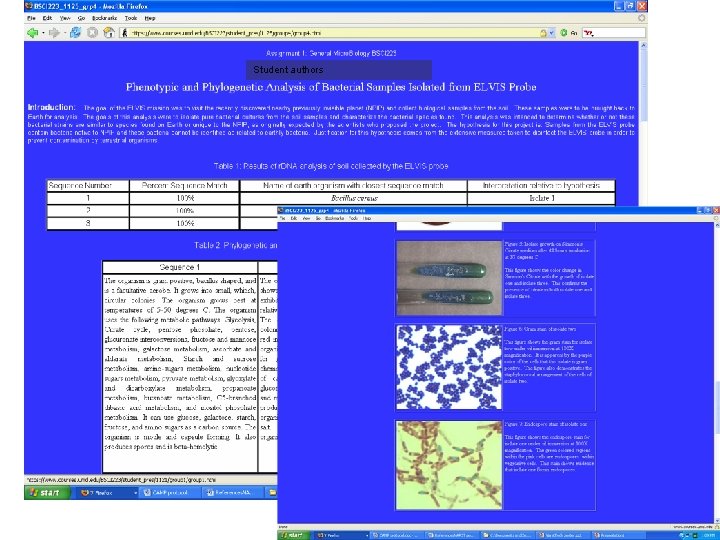
2. On-line Poster Session Scientific Research Process • Address complex issues • Solve problems • Research • Discuss • Present • Receive feedback Assignment 1 Students work in teams of 3 “Samples from Nearby Previously Invisible Planet contain extraterrestrial bacteria” Lab work from five labs periods. Students use Netscape Composer and Student project spaces in Web. CT for the poster session
See Poster Session Student authors
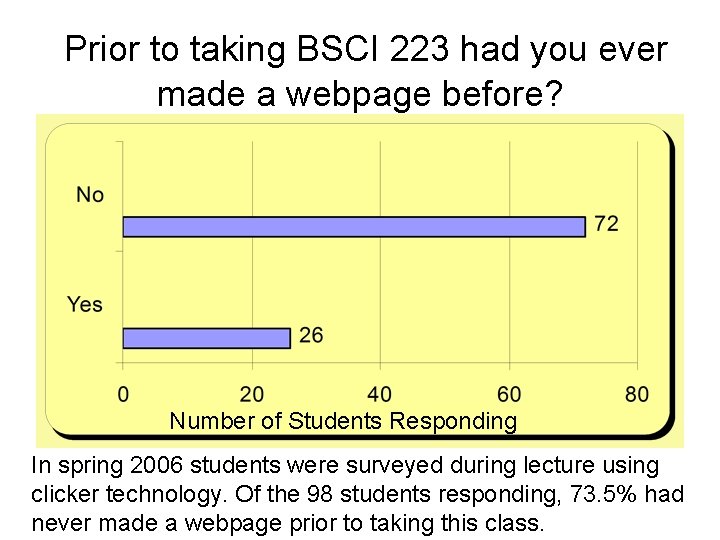
Prior to taking BSCI 223 had you ever made a webpage before? Number of Students Responding In spring 2006 students were surveyed during lecture using clicker technology. Of the 98 students responding, 73. 5% had never made a webpage prior to taking this class.
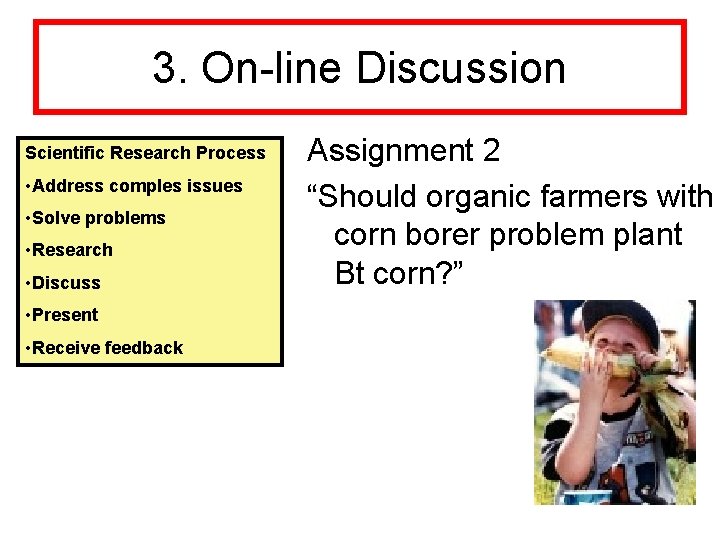
3. On-line Discussion Scientific Research Process • Address comples issues • Solve problems • Research • Discuss • Present • Receive feedback Assignment 2 “Should organic farmers with corn borer problem plant Bt corn? ”
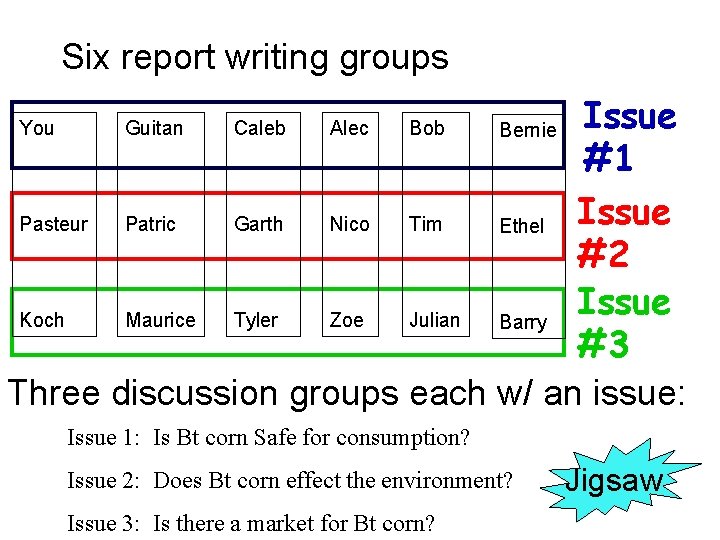
Six report writing groups Issue #1 Issue Pasteur Patric Garth Nico Tim Ethel #2 Issue Koch Maurice Tyler Zoe Julian Barry #3 Three discussion groups each w/ an issue: You Guitan Caleb Alec Bob Bernie Issue 1: Is Bt corn Safe for consumption? Issue 2: Does Bt corn effect the environment? Issue 3: Is there a market for Bt corn? Jigsaw
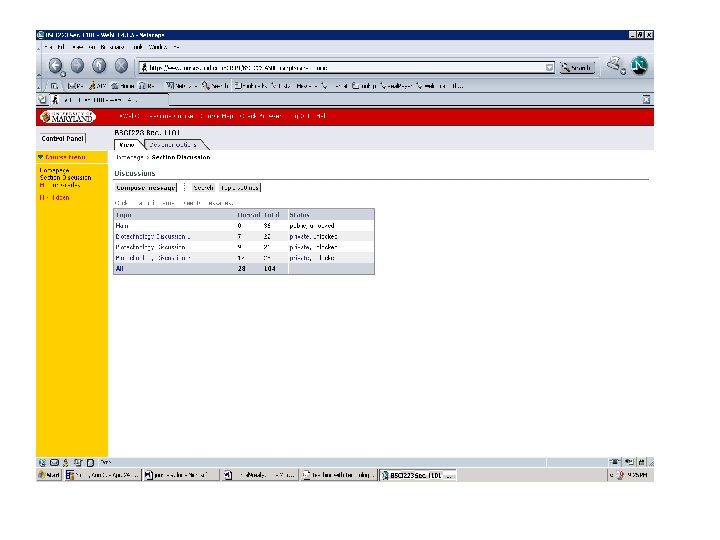
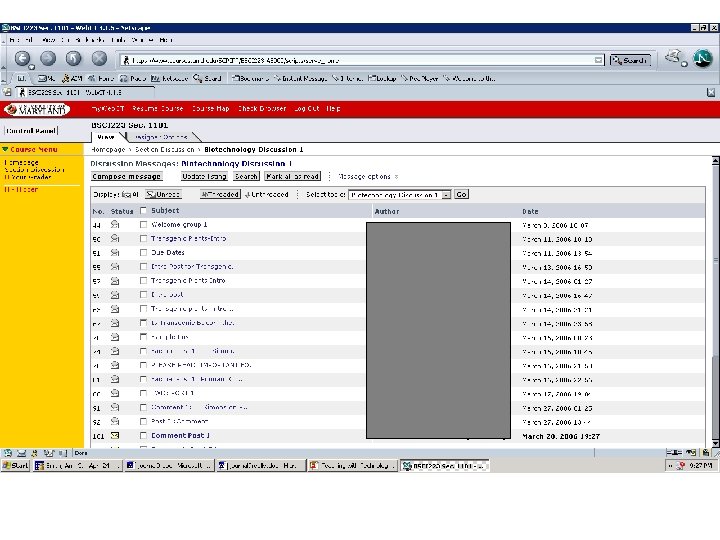
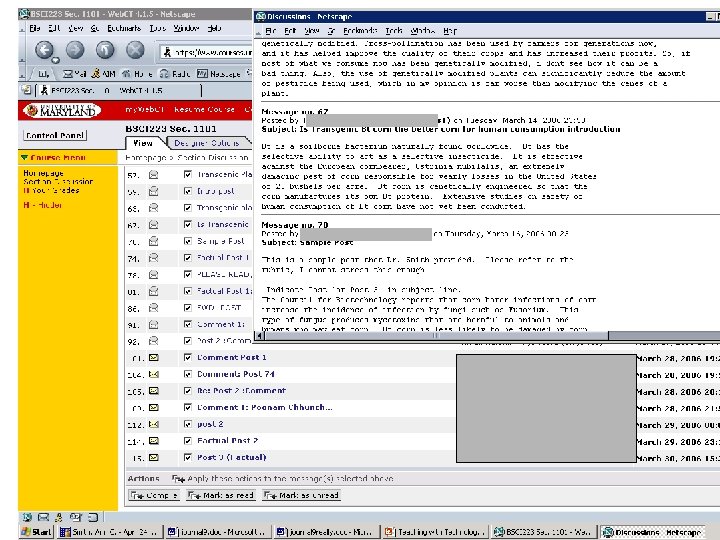
See Web. CT site
On-line Discussion • Physical space • Time • Record of work • Allows thoughtful responses • Review/assess online resources • Instructor can observe unobtrusively • Manageable Ø Small groups of 6 facilitated by a UTA PLTL
Student Comments on On-line Discussion: “We could interact with other students. ” “I think the most positive experience was how I was able to cross discuss ideas and get back together with my lab group for the final assembly and how at the end all the discussions were made available. ” “You saw everyone's opinions and research. ” “quickest way to communicate with all” “all of the information being put in one spot, rather than trying to track people and papers down” “productive discussion since all people did research before hand had knowledge on topic”
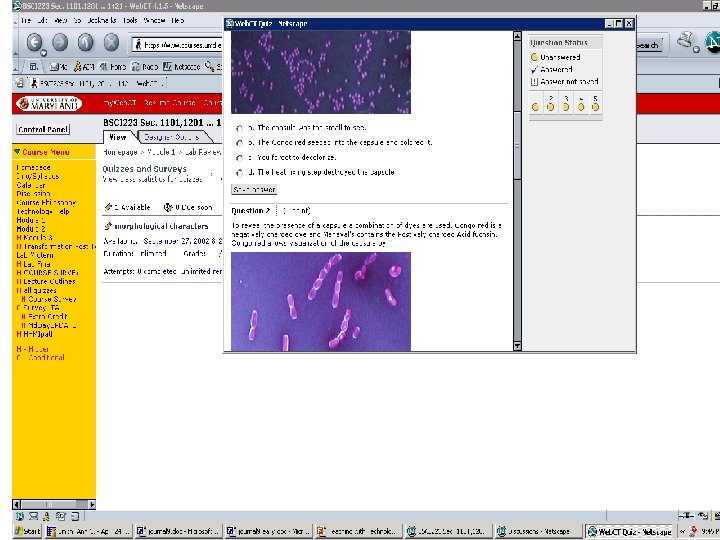
4. Lab Review Quizzes and Lab Practical • Review Quizzes – Limited time in lab – Lots of material to cover – Feedback • Lab Practical – Style of Review Quizzes – Easier to set up – Less stressful – Easy to grade!
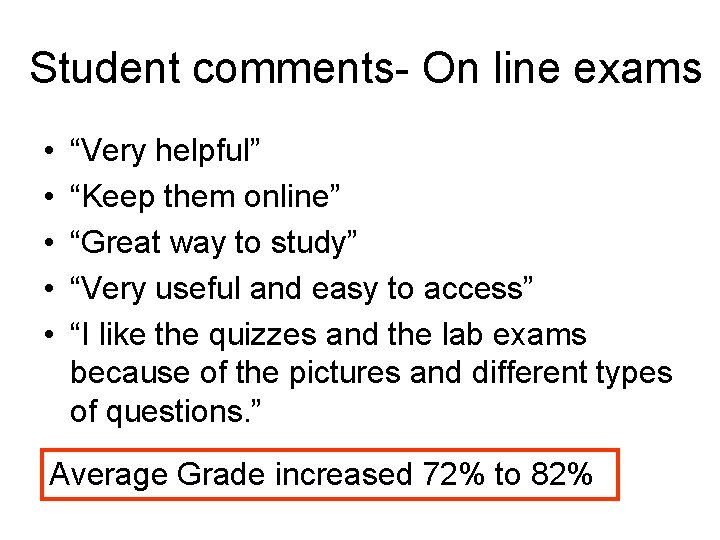
Student comments- On line exams • • • “Very helpful” “Keep them online” “Great way to study” “Very useful and easy to access” “I like the quizzes and the lab exams because of the pictures and different types of questions. ” Average Grade increased 72% to 82%
Active Learning w/ use of Technology 1. JITT with Case Studies • Each student posts 9 sets of 3 responses 2. On-line Poster Session • Each group of 3 presents a poster 3. On-line discussion • Each student posts at least 5 times 4. Lab Review Quizzes and Lab Practical • • 14 lab review quizzes 2 online exams
Technology has changed the way we teach! Our teaching team: CBMG faculty: Richard Stewart, Patricia Shields, Ann C. Smith, Daniel C. Stein, Robert Yuan Consultants from Science Education: Jennifer Hayes-Klosteridis, Gili Marbach-Ad Paulette Robinson, • • Contact: Ann C. Smith asmith@umd. edu Work has been Supported by Howard Hughes Medical Institute • Special thanks to all of the people in OIT – – – – – Ellen Borkowski Paulette Robinson Deb Mateik and Mike Landavere Chris Higgins Sharon Roushdy Mike Cains Jason White UTAP students: Anne Tsang, Karen Lew, Allyson Morman, Maria Panglao, Fasika Woreta, Kathy Shahrokh, and Sonia Sharma, Alex White, Aileen Pan CBMG IT support: Jimmy Church and Raju Shah
References Active Learning Course Format for Large Enrollment Courses Smith, A. C. , Stewart, R. , Shields, P. , Hayes-Klosteridis, J. , Robinson, P. , and Yuan, R. (2005). Introductory biology courses: a framework to support active learning in large enrollment introductory science courses. Cell Biol. Educ. 4, 143– 156. http: //www. cellbioed. org/article. cfm? Article. ID=150 Call for Active Learning in Science Teaching National Research Council (2003). Bio 2010: Transforming Undergraduate Education for Future Research Biologists. Committee on Undergraduate Biology Education to Prepare Research Scientists for the 21 st Century. National Academies Press, Washington, DC. (http: //www. nap. edu/books/0309085357/html) Use of Technology in course design Harasim, L. Ed. (1990). On-line education: Perspectives on a new medium, Praeger/Greenwood, New York. Active Learning Course Format for Large Enrollment Courses Smith, A. C. , Stewart, R. , Shields, P. , Hayes-Klosteridis, J. , Robinson, P. , and Yuan, R. (2005). Introductory biology courses: a framework to support active learning in large enrollment introductory science courses. Cell Biol. Educ. 4, 143– 156. Peer Led Team Learning The Peer-Led Team Learning (PLTL). (2004). Workshop Project. http: //www. sci. ccny. cuny. edu/~chemwksp/ (accessed 28 July 2004). Just in Time Teaching Marrs, K. A. , and Novak, G. (2004). Just-in-time teaching in biology: creating an active learner classroom using the Internet. Cell Biol. Educ. 3, 49– 61. 6 Tanner, K, Liesl, S. , Think-Pair-Share and Jigsaw Chatman, L. S. , and Allen D. E. (2003). Approaches to cell biology teaching: cooperative learning in the science classroom—beyond students working in groups. Cell Biology Education 2: 1– 5. Inquiry Labs Wood, W. B. (2003). Inquiry-based undergraduate teaching in the life sciences at large research universities: a perspective on the Boyer Commission Report. J. Cell Biol. Ed. 2, 112– 116. http: //www. cellbioed. org/articles/vol 2 no 2/article. cfm? article. ID=57 (accessed 28 July 2004). Case Studies Herreid, C. F. (1994). Case studies in science: a novel method for science education. J. Coll. Sci. Teach. 23(4), 221– 229. Also available online at http: //ublib. buffalo. edu/libraries/projects/cases/teaching/novel. html (accessed 28 July 2004). Problem Based Learning Allen, D. E. (1996). Bringing problem-based learning to the introductory biology classroom. In: Student-Active Science: Models of Innovation in College Science Teaching, ed. A. P. Mc. Neal and C. D'Avanzo. Philadelphia: Saunders College Publishing, 259– 278. •
Technology Resources: Course Management System Web. CT Campus Edition http: //www. webct. com/ Clickers Infrared Personal Response System. Turning Technologies http: //www. turningtechnologies. com/ Microscope and camera Olympus CX 41 Digital Camera Pixie Link High Resolution Digital Firewire Camera Sumsung SS-5500 DX Video Presenter Software SCION Visi Capture Thumbs Up Digital Image Management System Web. Page composer: Netscape 6. 2 or 7. 1