United Nations Janos Tisovszky Director United Nations Information





- Slides: 49
United Nations Janos Tisovszky Director, United Nations Information Service (UNIS) Vienna
United Nations: Introduction
What/who is the UN? n n Forum (Member States) Actor (Staff) Community - platform/umbrella (other actors) Ideal (set of expectations)
UN Secretariat n n Carries out day-to-day work of the Organization and services its principal organs Staffed by international civil servants Headquartered in New York, Geneva, Vienna, Nairobi, with offices and field missions around the world 44, 000 staff members
United Nations: Areas of Work Development n Peace and Security n Human Rights n Humanitarian Affairs n International Law n
Priorities and the way ahead n Secretary-General Ban Ki-moon has outlined five imperatives: ¨ Five generational opportunities to shape the world tomorrow by the decisions we make today
Five imperatives Sustainable development n Prevention n Building a safer and more secure world n Supporting nations in transition n Working for – and with – women and young people n
Working for the UN
Who we are n n n We are international civil servants. Our work touches lives in every corner of the globe, is complex and multifaceted, and extends directly and indirectly to our 193 Member States. In the last decade, the United Nations has increased its field-based operations Over 50 per cent of our 44, 000 staff work in field locations all over the world Over 100, 000 personnel in 16 peacekeeping and 11 political missions
Being part of the UN n n n Member States Staff (including interns, associate experts, consultants and volunteers) Civil society players (NGOs, private sector, academia, creative community, etc. )
Career Options Staff categories n Young professionals programme n Language competitive examinations n Associate expert programme n Volunteer programme n Internship programme n Temporary jobs n
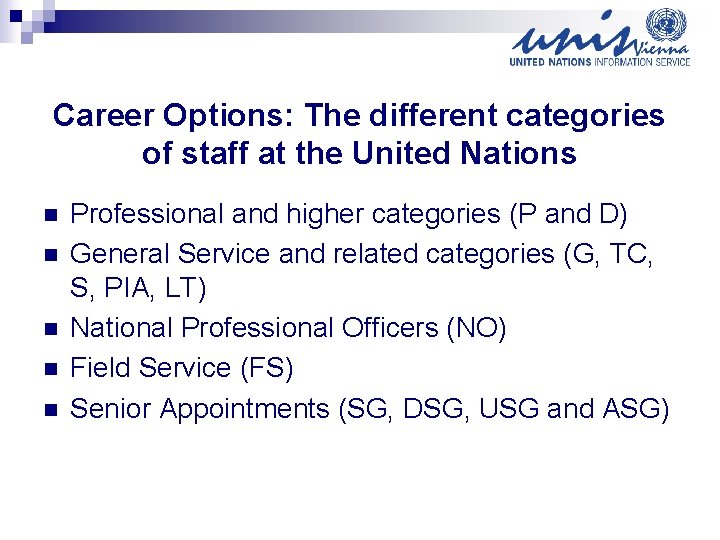
Career Options: The different categories of staff at the United Nations n n n Professional and higher categories (P and D) General Service and related categories (G, TC, S, PIA, LT) National Professional Officers (NO) Field Service (FS) Senior Appointments (SG, DSG, USG and ASG)
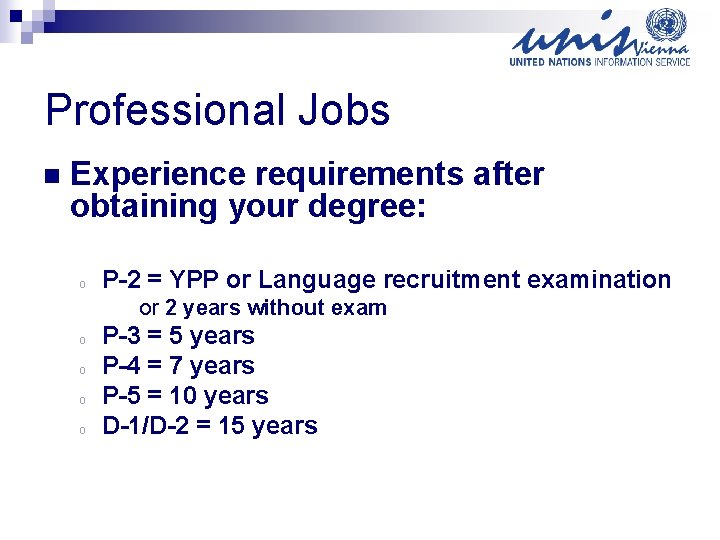
Professional Jobs n Experience requirements after obtaining your degree: o P-2 = YPP or Language recruitment examination or 2 years without exam o o P-3 = 5 years P-4 = 7 years P-5 = 10 years D-1/D-2 = 15 years
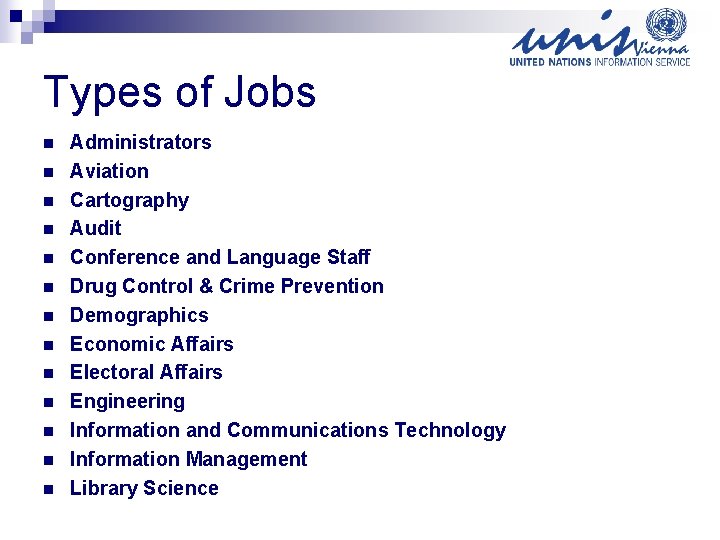
Types of Jobs n n n n Administrators Aviation Cartography Audit Conference and Language Staff Drug Control & Crime Prevention Demographics Economic Affairs Electoral Affairs Engineering Information and Communications Technology Information Management Library Science
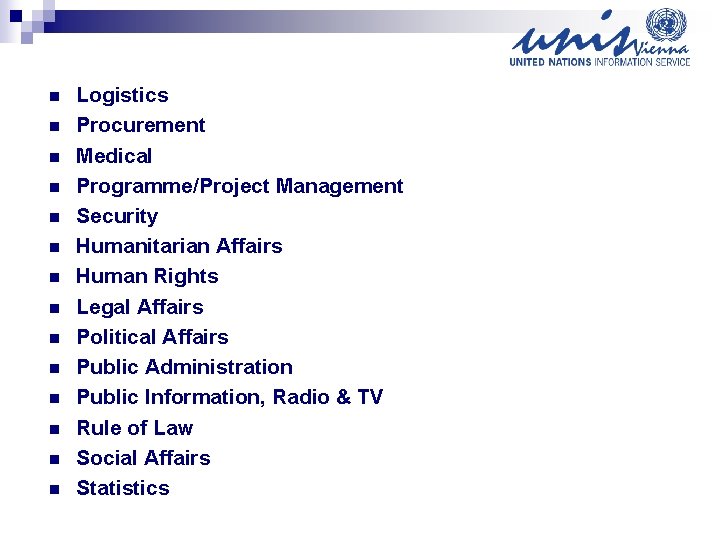
n n n n Logistics Procurement Medical Programme/Project Management Security Humanitarian Affairs Human Rights Legal Affairs Political Affairs Public Administration Public Information, Radio & TV Rule of Law Social Affairs Statistics
Expectations of UN staff n For expectations of UN Staff, see: ¨ Charter of the United Nations ¨ Staff Rules and Regulations
Values, Competencies, Mobility n Core values: ¨ Integrity, Professionalism, Respect for Diversity Core competencies and managerial competencies n Mobility: n ¨ Functional and geographic
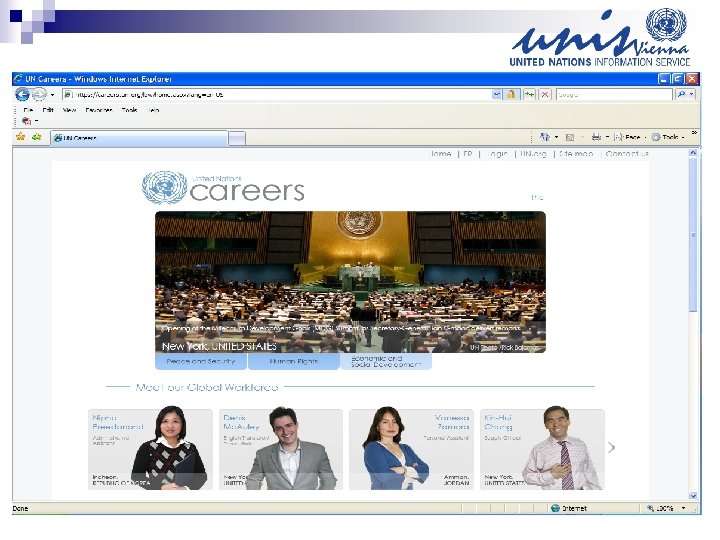
Staff selection Positions advertised on http: //careers. un. org n Open to external and internal candidates n Exception: entry-level professional positions (YPP) n
21
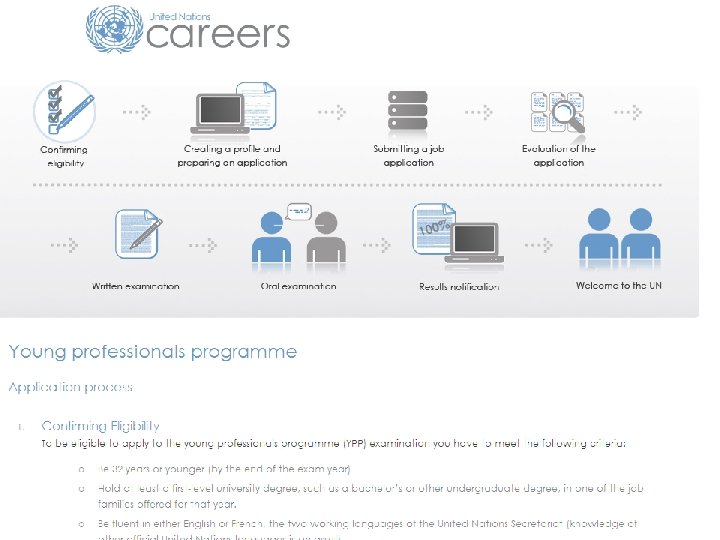
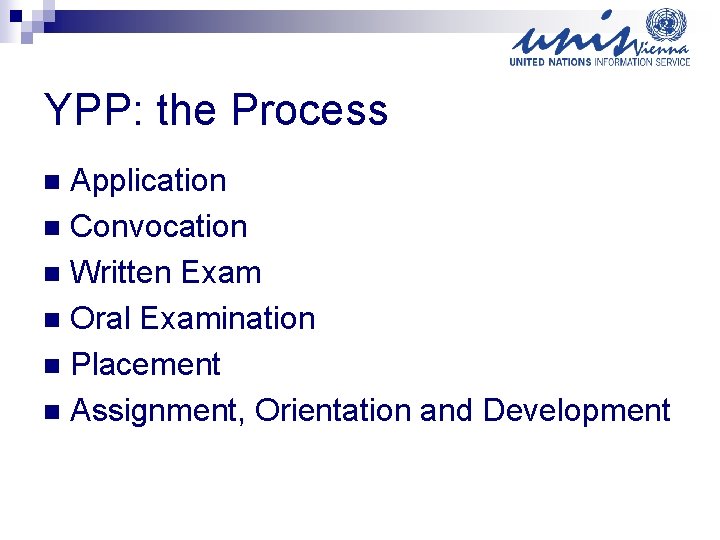
YPP: the Process Application n Convocation n Written Exam n Oral Examination n Placement n Assignment, Orientation and Development n
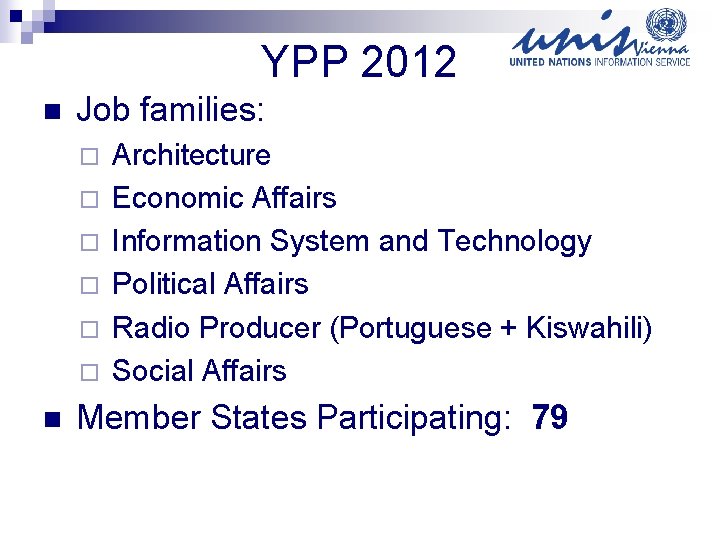
YPP 2012 n Job families: ¨ ¨ ¨ n Architecture Economic Affairs Information System and Technology Political Affairs Radio Producer (Portuguese + Kiswahili) Social Affairs Member States Participating: 79
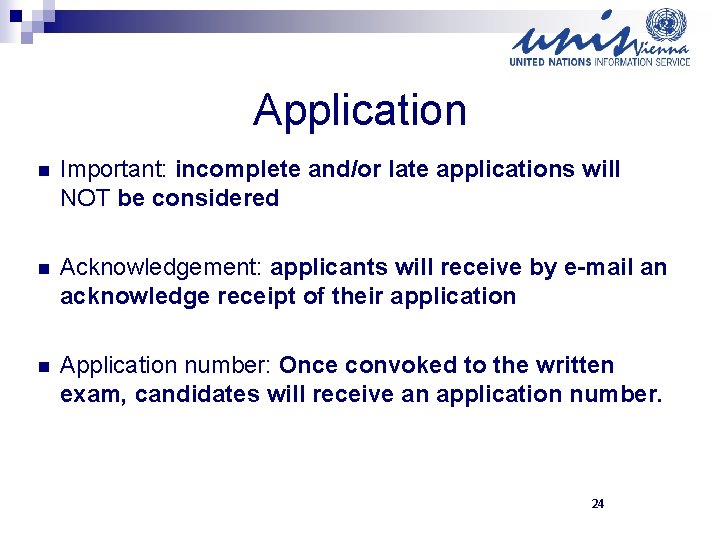
Application n Important: incomplete and/or late applications will NOT be considered n Acknowledgement: applicants will receive by e-mail an acknowledge receipt of their application n Application number: Once convoked to the written exam, candidates will receive an application number. 24
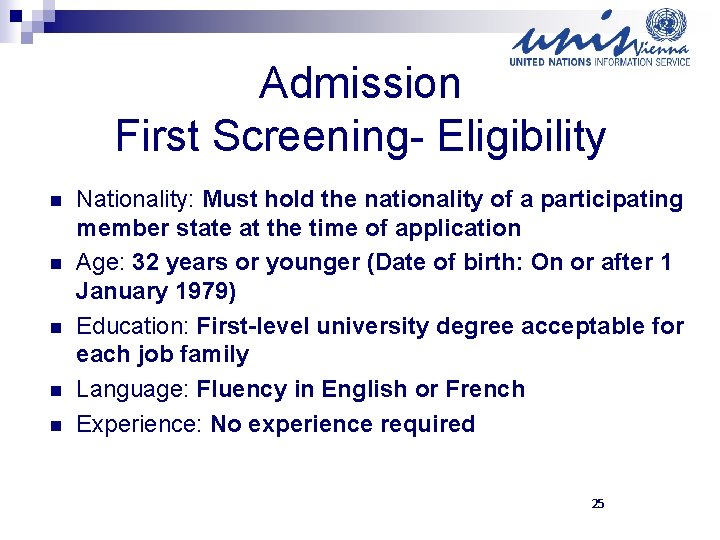
Admission First Screening- Eligibility n n n Nationality: Must hold the nationality of a participating member state at the time of application Age: 32 years or younger (Date of birth: On or after 1 January 1979) Education: First-level university degree acceptable for each job family Language: Fluency in English or French Experience: No experience required 25
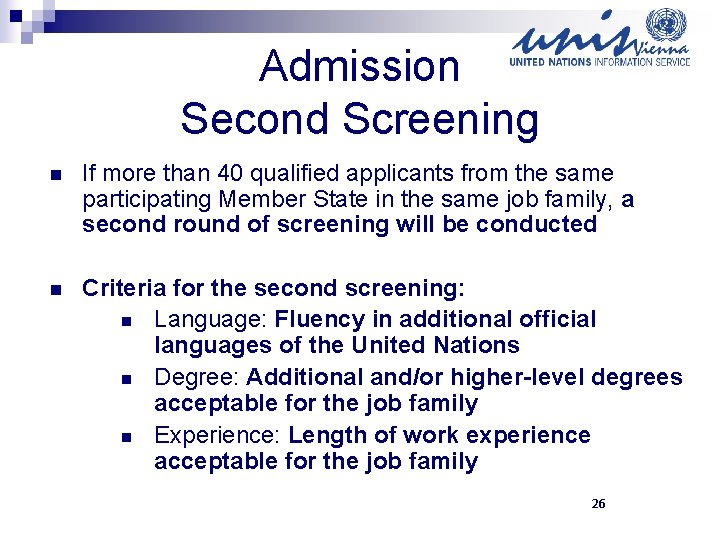
Admission Second Screening n If more than 40 qualified applicants from the same participating Member State in the same job family, a second round of screening will be conducted n Criteria for the second screening: n Language: Fluency in additional official languages of the United Nations n Degree: Additional and/or higher-level degrees acceptable for the job family n Experience: Length of work experience acceptable for the job family 26
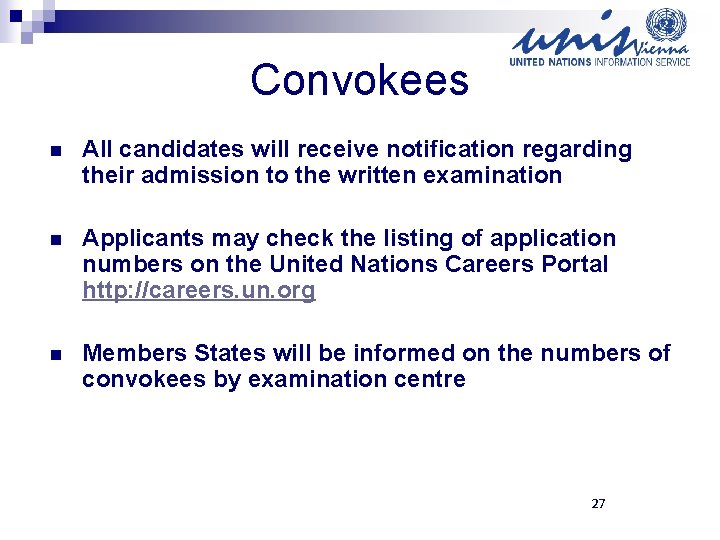
Convokees n All candidates will receive notification regarding their admission to the written examination n Applicants may check the listing of application numbers on the United Nations Careers Portal http: //careers. un. org n Members States will be informed on the numbers of convokees by examination centre 27
Written Examination n Wednesday, 5 December 2012 Overall time for the written examination: 4. 5 hours Structure: ¨ General paper ¨ Specialized paper n Examinees are fully responsible for any expenses related to their travel to the examination centre
General Paper Summary and several questions in International Affairs, n To be answered in either English or French; n Eliminatory n
Specialized Paper n Essays and short questions in the substantive area n To be answered in any of the UN official languages. n The essay part of this paper is eliminatory
The Examination: Oral Part n Competency-based interview and possibly an oral presentation. n UN Secretariat will cover the travel expenses of examinees invited to the oral examination
Core values and competencies n Core values: ¨ Integrity, Diversity n Professionalism, Respect for Core competencies: ¨ Communication, Teamwork, Planning and Organizing, Accountability, Creativity, Client Orientation, Commitment to Continuous Learning, Technological Awareness
Competency-based interviews “Past, demonstrated behavior is the best indicator of future performance” n Questions ask about past professional experiences that can demonstrate that the applicant is competent
Successful Candidates Placement n To be placed in positions at the P-1 or P-2 level in any Secretariat duty station or peacekeeping operation.
Reserve List n n n Only those who cannot be placed will be kept on a reserve list, from which future vacancies will be filled. The reserve list has a lifespan of two years after the conclusion of the examination. Candidates who refuse one invitation to interview or one official offer of employment will be removed from the reserve list.
Assignment, Orientation & Development Initial assignment: Two years n Second assignment: In a different duty station n Two-week orientation programme prior to first assignment n Dedicated training budget to ensure professional development n
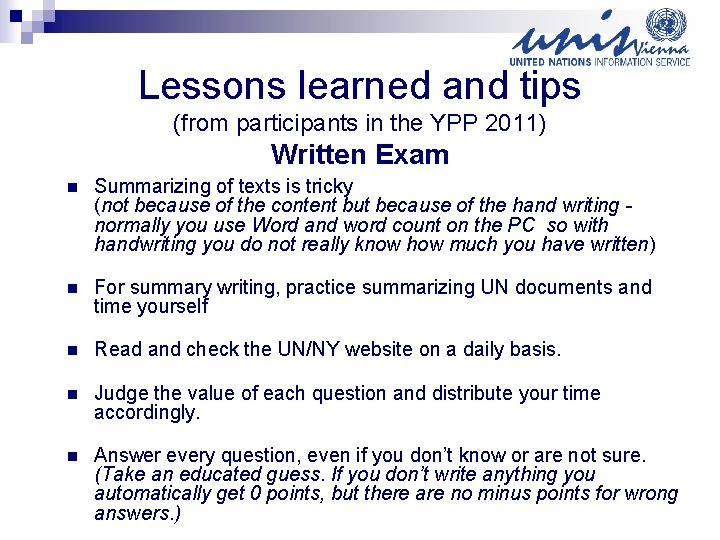
Lessons learned and tips (from participants in the YPP 2011) Written Exam n Time-keeping is extremely important (4. 5 hours seems long, but it is a lot of writing. There is a lot to writeyou tend to spend too much time with the topic you are familiar with or where you know a lot. ) n Practice hand writing ahead of time. Practice time keeping. (Do a full 4. 5 hour written exam with all four parts to check how much time you need for each, and to get a feeling for it. this helps to practice handwriting as well. ) n Concentrate on the general part and try to do it really well (It is eliminatory!)
Lessons learned and tips (from participants in the YPP 2011) Written Exam n Summarizing of texts is tricky (not because of the content but because of the hand writing normally you use Word and word count on the PC so with handwriting you do not really know how much you have written) n For summary writing, practice summarizing UN documents and time yourself n Read and check the UN/NY website on a daily basis. n Judge the value of each question and distribute your time accordingly. n Answer every question, even if you don’t know or are not sure. (Take an educated guess. If you don’t write anything you automatically get 0 points, but there are no minus points for wrong answers. )
Lessons learned and tips (from participants in the YPP 2011) Oral Exam n know the UN Core Competencies as detailed as possible
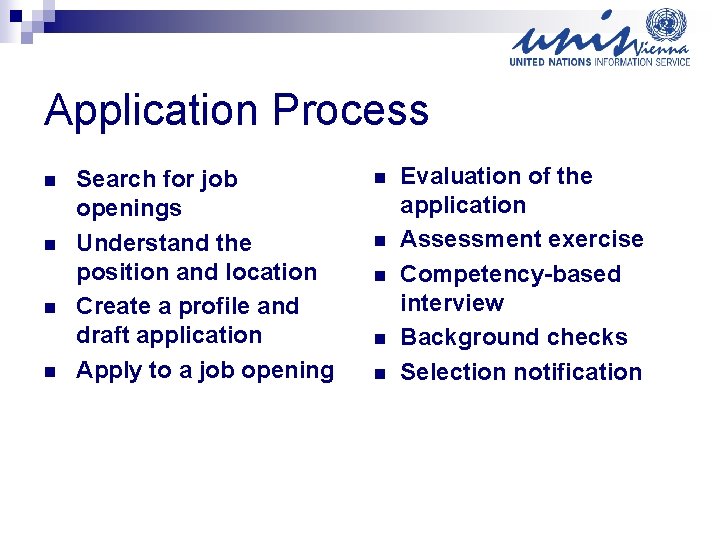
Application Process n n Search for job openings Understand the position and location Create a profile and draft application Apply to a job opening n n n Evaluation of the application Assessment exercise Competency-based interview Background checks Selection notification
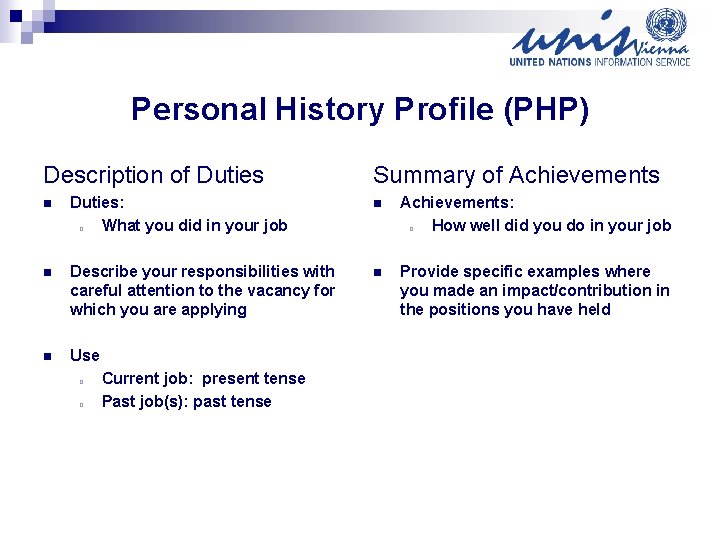
Personal History Profile (PHP) Description of Duties Summary of Achievements n Duties: o What you did in your job n Achievements: o How well did you do in your job n Describe your responsibilities with careful attention to the vacancy for which you are applying n Provide specific examples where you made an impact/contribution in the positions you have held n Use o o Current job: present tense Past job(s): past tense
Cover Letter n Describe how your experience, qualifications and competencies match the specific position n You can distinguish yourself from other candidates by highlighting what makes you a good match for the position n Structure o o o n Open with a statement of interest Summarize your qualifications, experience and competencies relating to the specific positions Close with a brief recapitulation Make it impressive and customize it
Additional Tips n n n The UN will first get to know you through your application/PHP Be truthful, accurate and specific Make your words count Prepare application/PHP offline using a word processor application (e. g. MS Word) Print application/PHP on screen or paper to proofread and review Save your applications
The International Working Environment (1) ¨ Realization ¨ and that challenges are truly global interdependent (nexus approach) ¨ Need for engaging all possible actors ¨ Need for predictable/permanent mechanisms ¨ Need for certain principles to be in place for legitimacy.
The International Working Environment (2) ¨ UN has a comparative advantage in all ¨ UN role and necessity is less questioned ¨ Increase ¨ The in operational tasks issue is to prove its effectiveness (not vis-àvis other actors but as regards getting the job done)
UN Working Environment: Demand on Results orientation means need for: ¨ more capable organization ¨ better operating structures ¨ better management and ¨ ultimately more capable staff ¨ more accountability – down to the level of the individual
How will those changes impact on your work and possible career (1)? ¨ More operational → more stress on delivering ¨ Mobility ¨ Flexibility ¨ Versatility ¨ Integrity ¨ Accountability
How will those changes impact on your work and possible career (2)? ¨ At times also dangerous with more operational tasks (as UN has become a target for terrorists and insurgents) ¨ Frustration (bureaucracy + want to do results + judged against ideals/expectations) ¨ BUT: also offers more variety – more interesting things to do – a real chance to make a difference – also be part of a unique community
Thank you for your attention! www. un. org careers. un. org www. unis. unvienna. org