Today A Few things linked loosely through persuasion






- Slides: 76
Today: A Few things linked loosely through persuasion. Deception, Visual Communication Strategies, and Persuasion in Interpersonal Relationships
Deception n Can you detect a liar? Sometimes. – Stereotypical behavior… Key: Speakers try to control some of their nonverbal behaviors when deceiving n Ekman & Friesen – Channels high in sending capacity are less likely to reveal deception n – High capacity: Some parts of our body are monitored more closely; used more extensively in communication (face) • These are the easiest to control – Low capacity: Adaptors –leg/foot movements, random hand-to-face movements are rarely, intentionally used in communication n Leakage can occur in paralanguage as well as body language
Visual Communication Question of the Day: Would pictures or words be easier to encode into memory?
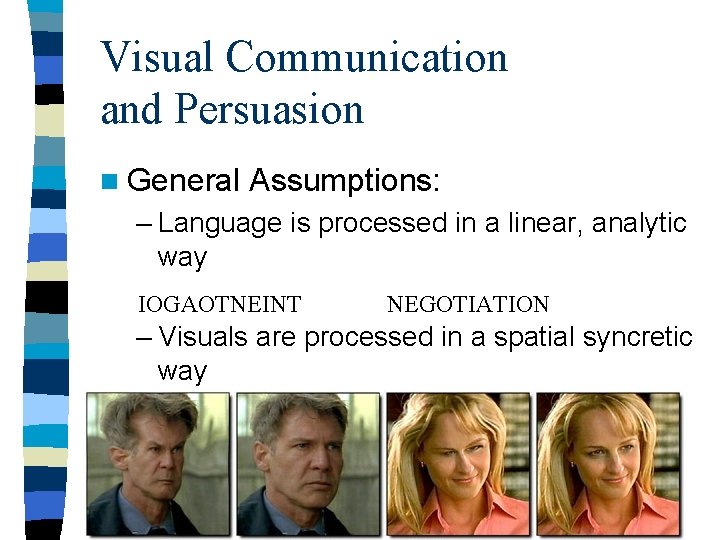
Visual Communication and Persuasion n General Assumptions: – Language is processed in a linear, analytic way IOGAOTNEINT NEGOTIATION – Visuals are processed in a spatial syncretic way
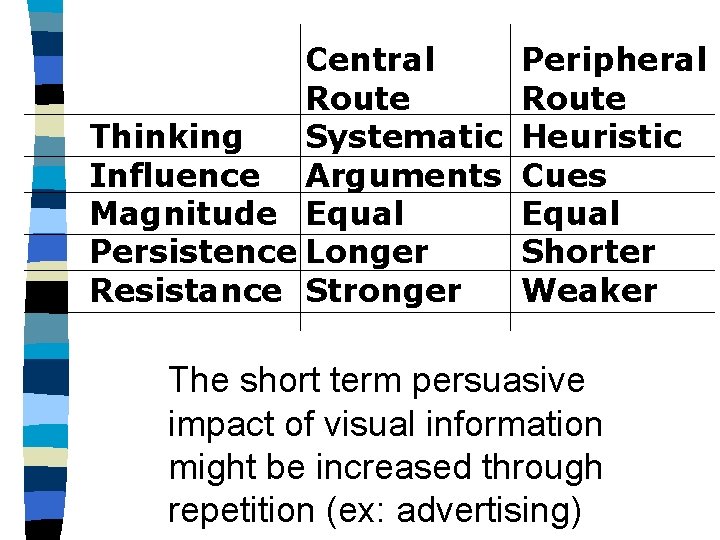
Central Route Thinking Systematic Influence Arguments Magnitude Equal Persistence Longer Resistance Stronger Peripheral Route Heuristic Cues Equal Shorter Weaker The short term persuasive impact of visual information might be increased through repetition (ex: advertising)
Repetition over time would move the information of product attributes from short-term memory to longterm memory. Ad from: http: //www. adbusters. org/spoofads/
Emotional arousal and mood are found to affect long term memory (ex. Flashbulb memory)
Cueing: Shortcuts to conveying meaning, calling to mind past experiences or teaching associations
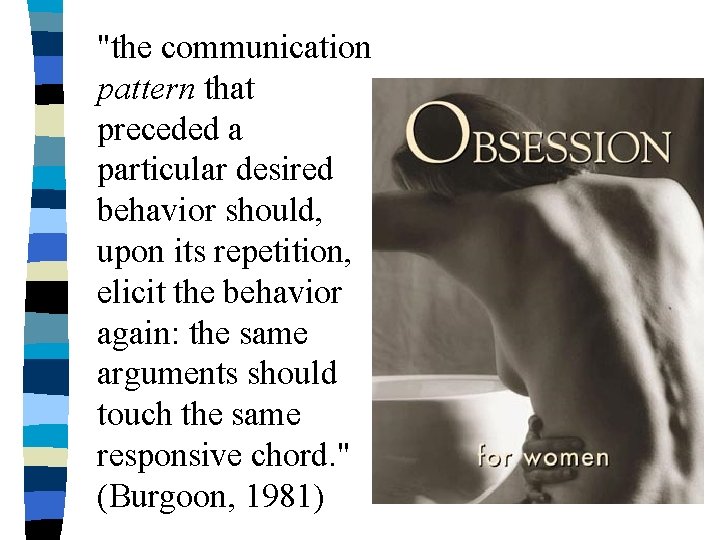
"the communication pattern that preceded a particular desired behavior should, upon its repetition, elicit the behavior again: the same arguments should touch the same responsive chord. " (Burgoon, 1981)
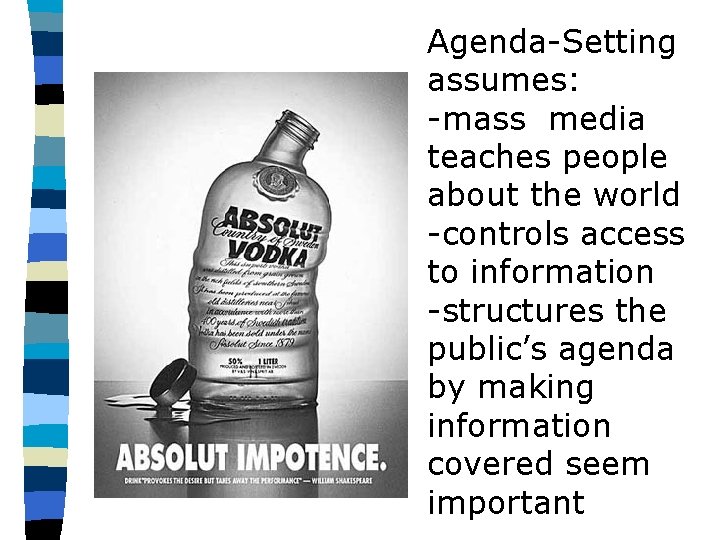
Agenda-Setting assumes: -mass media teaches people about the world -controls access to information -structures the public’s agenda by making information covered seem important
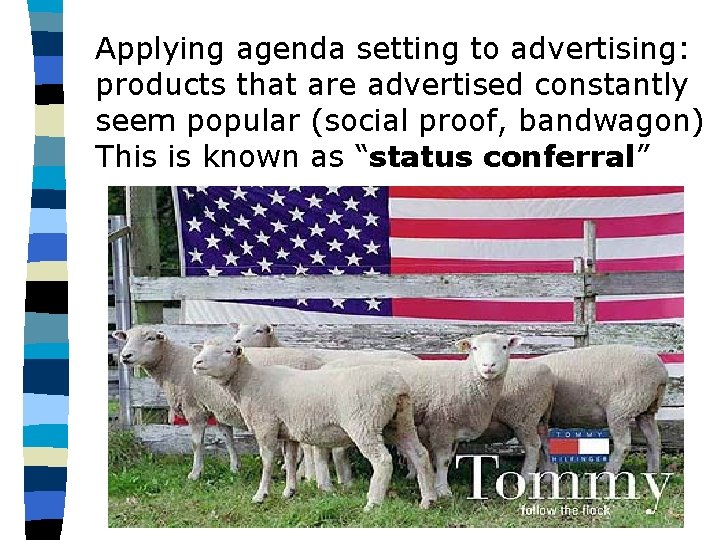
Applying agenda setting to advertising: products that are advertised constantly seem popular (social proof, bandwagon) This is known as “status conferral”
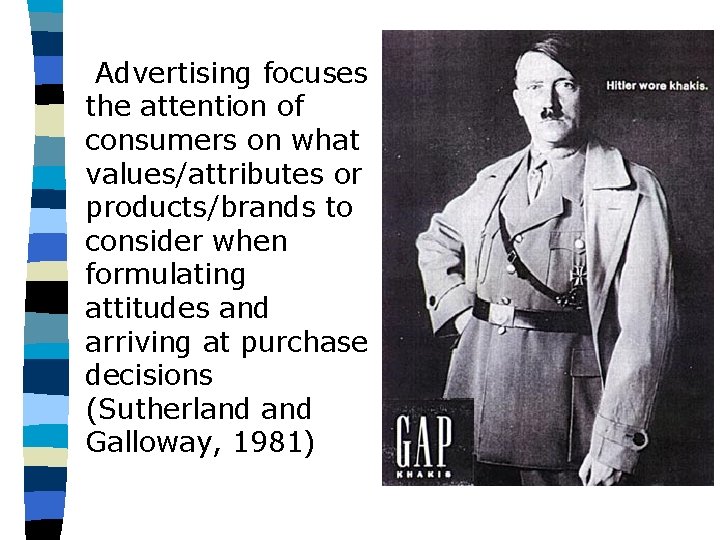
Advertising focuses the attention of consumers on what values/attributes or products/brands to consider when formulating attitudes and arriving at purchase decisions (Sutherland Galloway, 1981)
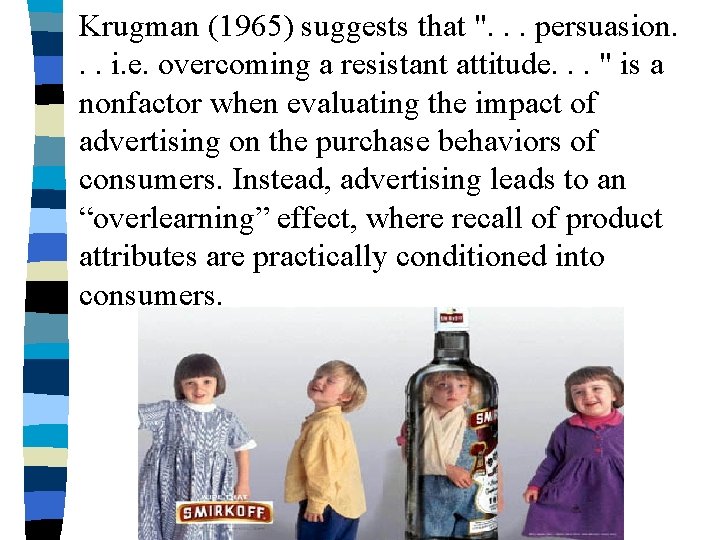
Krugman (1965) suggests that ". . . persuasion. . . i. e. overcoming a resistant attitude. . . " is a nonfactor when evaluating the impact of advertising on the purchase behaviors of consumers. Instead, advertising leads to an “overlearning” effect, where recall of product attributes are practically conditioned into consumers. j; lkn; lnnkj
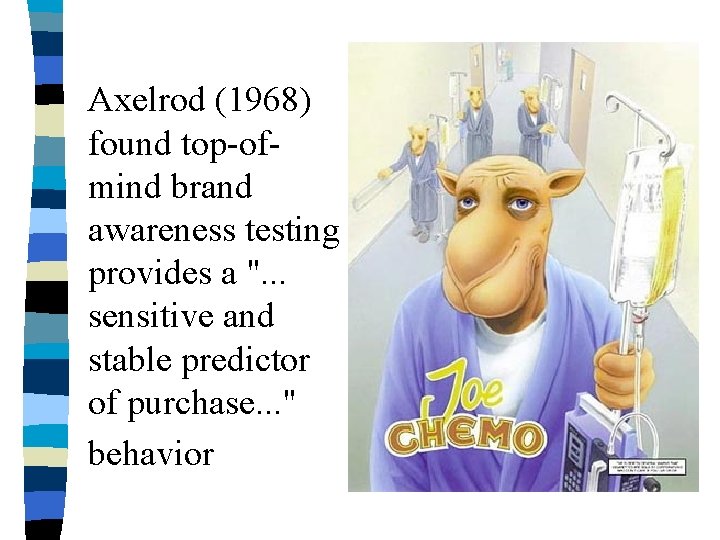
Axelrod (1968) found top-ofmind brand awareness testing provides a ". . . sensitive and stable predictor of purchase. . . " behavior
Image Vividness • Increases attention and retention • Use of vivid, saturated colors, shocking photos. • Image Salience • Positions main object near less interesting objects, so it stands out by contrast. •
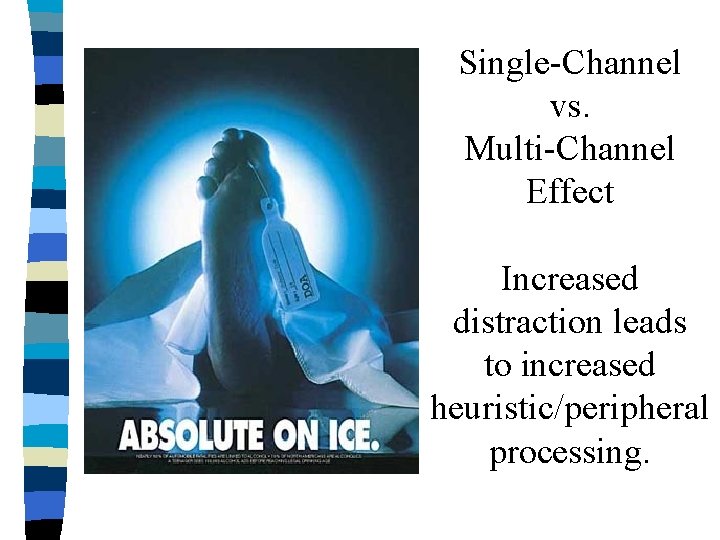
Single-Channel vs. Multi-Channel Effect Increased distraction leads to increased heuristic/peripheral processing.
Persuasion in Interpersonal Relationships
CLARCCS Cues (Cialdini, 1980) n CLARCCS is an acronym comprised of 7 heuristics (peripheral route) that impact the persuasion process n Comparison (Social proof) Liking Authority Reciprocity Commitment/Consistency Scarcity n n n
CLARCCS: Comparison (social proof) n Comparing your behavior to that of others and adopting the group norms n Can manifest in two types of effects: – Anchoring and Contrasting n Works best when: – People are unaware they are being influenced – People are not knowledgeable in the area
CLARCCS: Comparison (social proof; cont’d) n People continuously scan the environment to see what norms apply n Norms can be: – Descriptive: what is the normal thing to do? – Injunctive: what is the morally correct thing to do?
CLARCCS: Liking Doing what someone asks because you like them, even if they take advantage of you n Works best if you think the person likes you n Works better with attractive people; but not if they have abrasive (dislikable personalities) n How does this “liking” heuristic relate to ingratiation? n
Ingratiation – strategies for increasing likeability n 4 Types of Ingratiation: – Complimentary; “other enhancements” (flattery) – Selective Self-presentation – Opinion Conformity – Rendering Favors
Ingratiation Strategies (cont’d) With flattery, the ingratiator must control the types of attributions the target is likely to make about why the praise was given n Unwanted Attributions: n – You have ulterior motives – You always compliment people – The compliment is normative for the social setting n The 2 nd Best attribution to hope for? – You are making the compliment because you are a nice person – This leads to only moderate increases in liking n The Most Desired Attribution? – The target believes your praise is actually sincere
Ingratiation Strategies (cont’d) n Jones and Wortman (1973) found five ways to increase the probability that people will believe the praise is sincere – Make the praise credible • Reduce the perceived dependency on the target person to reduce the suspicion of sought benefits • Have the praise delivered by a third party, and appear unaware that the praise was repeated • Make the praise plausible – you have to find a quality in the person where praise would be believed – Praise an attribute that the target is insecure about • This will increase their self-esteem, resulting in bonus liking points for you
Ingratiation Strategies (cont’d) n Jones and Wortman 5 ways to make praise seem sincere (cont’d) – Appear Discerning • There are three strategies you can use to appear more discerning: – You can use a two-sided message (with positive comments in an area where the target is insecure, and some negative comments; BUT NO negative comments in an area of insecurity) – Make the target believe that you have high standards in the area where you are praising them – Appear neutral or even aloof when meeting people, and act friendlier to them over time. They will believe that they won and deserve your admiration rather than thinking you are just friendly to everyone
Ingratiation Strategies (cont’d) n Jones and Wortman 5 ways to make praise seem sincere (cont’d) – Make sure the praise does not seem merely normative • Key: Make praise as unique and different as possible – Avoid other negative effects • Don’t make the target feel awkward if the praise sets up a difficult social situation • Don’t let praise imply a low level of expected performance • Praise may lead to apprehension about future interactions if the praise leads to the target’s belief that you are constantly evaluating them n And now… back to CLARRCS cues… this was part of liking (#2)
CLARCCS: Authority n Complying with a source because it holds a position of authority – Keep in mind this would have peripheral route impact unless someone were to stress this feature of the source within the context of the message n Example: Milgram Experiments
CLARCCS: Reciprocity n Based on societies’ norm that you are obliged to give something back to someone when they give you something – surveys – The “That’s not all you get” technique • I’m doing my part, I’m knocking down the cost of that phone—even though I’m not supposed to… now it is your turn… sign up for a measly 2 year contract
CLARCCS: Reciprocity n Other option is less obvious: The “Door-in-the -Face” Technique – Takes advantage of the fact that people are generally uncomfortable saying no – 7 Steps: • The original request must be rejected (make it a big one; difficult to comply) • The target should not make a self-attribution after the rejection (why did I do that? TOO LATE) • The original request should not cause resentment, anger or hostility • The second request must be clearly smaller • There should be no time delay between the two requests • The cause should be a legitimate one (e. g. prosocial, to cause psychological stress—Imbalance) • The same source should make both requests
CLARCCS: Commitment/Consistency Once you take a public stand, advocating a position or supporting a cause, you are likely to maintain your support in the future n Works because of our need to be consistent and maintain consonance n Examples: n – Foot-in-the-door – Lowball and Bait and Switch
CLARCCS: Commitment/Consistency (cont’d) n The “Foot-in-the-door” Technique works best when: – The first request is much smaller, it induces compliance and commitment – The second request cannot be too large (few will comply) or too small (first request would be unnecessary) – If self-perception attributions occur then different people can make the second request – If the targets feel they were externally pressured, the effect will not occur
CLARCCS: Commitment/Consistency (cont’d) n The “Foot-in-the-door” Technique works best when (cont’d): – The effect is larger for legitimate causes – Timing is important for the success of the effect – Any method which increases self-perception and personality attributions will facilitate the effect – Face-to-face requests will be more successful – Likeable, polite and positive sources will be more effective – Offering less ground for excuses increases success (social legitimacy, credible, committed solicitor)
CLARCCS: Commitment/Consistency (cont’d) n “The Lowball Technique” – Gets the target to commit to a decision before they learn the full cost of the compliance (they may feel committed and responsible to their obligation) – Ex. Telemarketers—I just wanted to verify a little information; “You get one free month of service” – Related to the Bait and Switch • Sign out front advertising a sale; advertising foreclosed lots in the newspaper
CLARCCS: Scarcity n Our behavior can be shaped by: – The desirability of scarce objects • The case of planned scarcity n Works on our belief that rare is good – Related to “false uniqueness bias” in Attribution Theory – Related to Psychological Reactance Theory… how?
Persuasion in Conflict Management
Conflict Management n The Four most commonly used forms: – Negotiation – a communication situation in which two or more parties make a series of concessions to forge a mutually agreed upon settlement – Mediation – a third party manages the communication so the disputants can reach a settlement – Arbitration – disputants agree to have a third party hear each side, and then make a judgment about the dispute – Litigation – lawyers represent the disputing parties and then a jury or judge makes a ruling n We will primarily focus on Negotiation
Definitions and Key Concepts n Negotiation = Bargaining – A communicative process between independent parties with differing goals who are attempting to produce a joint decision n Bargaining Structure (components) – Resistance Point = maximum amount a party will concede (possibly the point just before net loss) – Bargaining Range = difference between the parties’ resistance points – Status Quo Point = when parties cannot reach a settlement, cease bargaining and return to their initial stances – Aspiration Level = a party’s realistic preferred outcome – Utility Schedule = comprised of resistance point, status quo point, and aspiration level
Prisoner’s Dilemma n Groups of Four n Take out a piece of paper n The Rules n Talk to eachother for a few minutes, develop strategy n Ready?
The Winner’s Choice… Which one will you choose? 1 2 3
Let’s Continue…
Let’s Continue…
Let’s Continue…
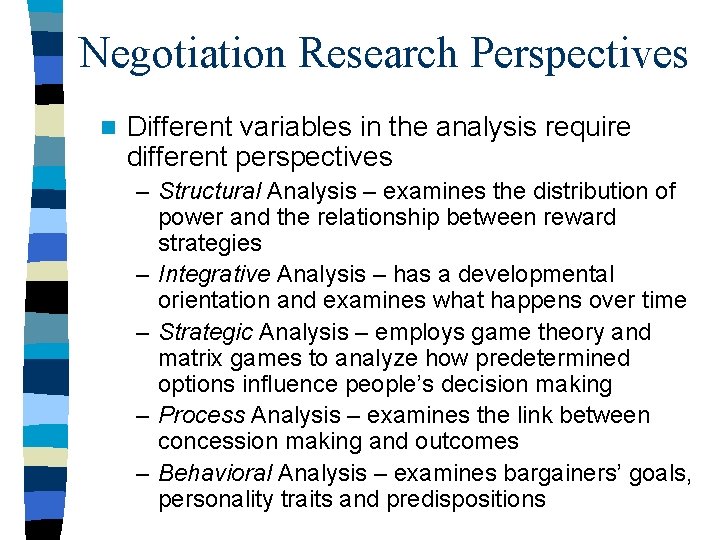
Negotiation Research Perspectives n Different variables in the analysis require different perspectives – Structural Analysis – examines the distribution of power and the relationship between reward strategies – Integrative Analysis – has a developmental orientation and examines what happens over time – Strategic Analysis – employs game theory and matrix games to analyze how predetermined options influence people’s decision making – Process Analysis – examines the link between concession making and outcomes – Behavioral Analysis – examines bargainers’ goals, personality traits and predispositions
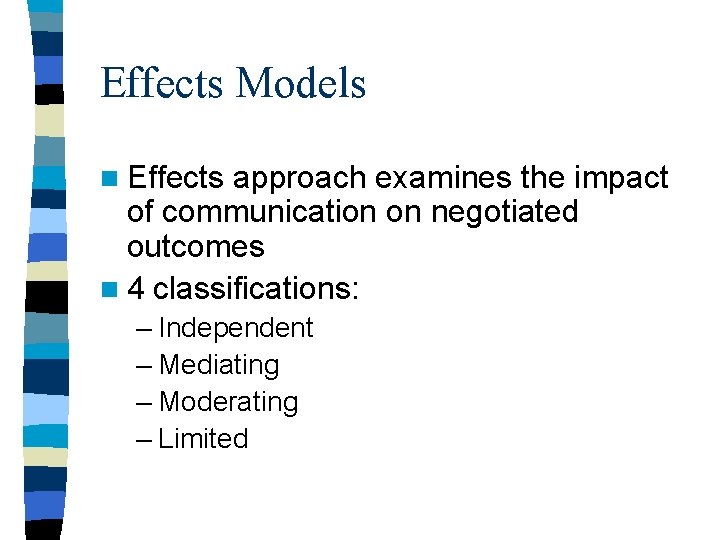
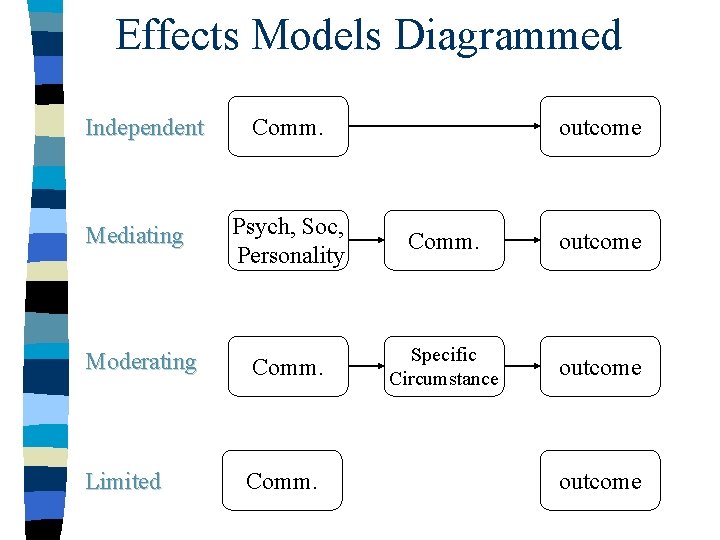
Effects Models n Effects approach examines the impact of communication on negotiated outcomes n 4 classifications: – Independent – Mediating – Moderating – Limited
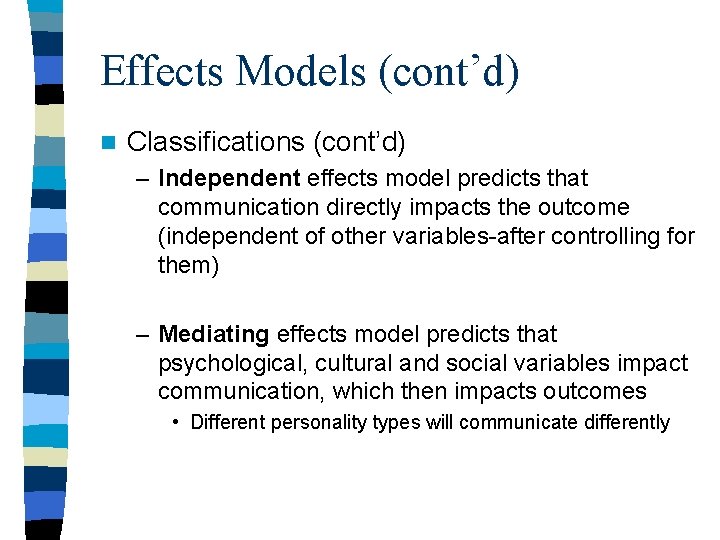
Effects Models (cont’d) n Classifications (cont’d) – Independent effects model predicts that communication directly impacts the outcome (independent of other variables-after controlling for them) – Mediating effects model predicts that psychological, cultural and social variables impact communication, which then impacts outcomes • Different personality types will communicate differently
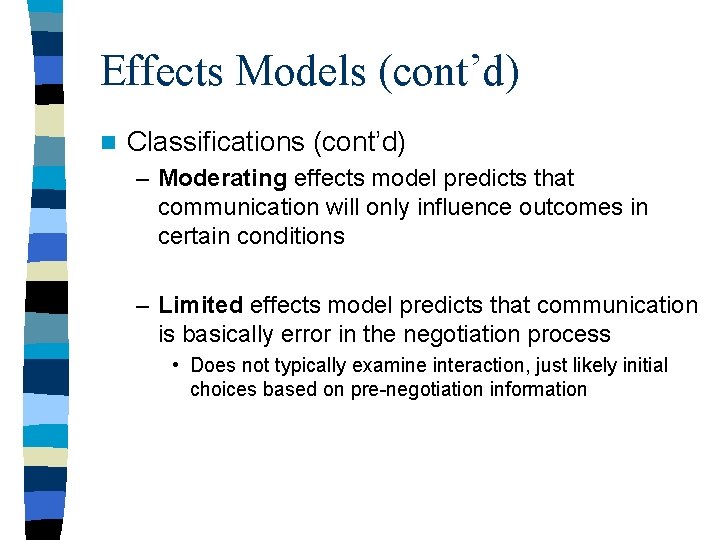
Effects Models (cont’d) n Classifications (cont’d) – Moderating effects model predicts that communication will only influence outcomes in certain conditions – Limited effects model predicts that communication is basically error in the negotiation process • Does not typically examine interaction, just likely initial choices based on pre-negotiation information
Effects Models Diagrammed Independent Comm. outcome Mediating Psych, Soc, Personality Comm. outcome Moderating Comm. Specific Circumstance outcome Limited Comm. outcome
Bargaining Strategies and Tactics n Negotiation Plans n Prenegotiation Accounts n Arguments n Threats, Promises, Commitments n Initial Bids, Concession Rates
Strategies and Tactics: Negotiation Plans n Literally, a plan providing strategies for action that will overcome perceived obstacles – Pop tart commercial n Can be: – Adaptive: revising the initial plan to strengthen it • May include lowering one’s aspiration level, shifting to coercive actions, and creating time pressures for the opponents – Interactive: offense and defense • Considers needs, expectations and desires of opponent • Allows development of counterstrategies to expected objections, Allows development of obstacles to prevent opponent from achieving goals – Collaborative: all parties jointly construct the plan • Typically only deals with procedural details (metanegotiation)
Strategies and Tactics: Negotiation Plans (cont’d) n 3 main goals of most bargainers – Commodity goals – resource gains • 4 Components to examine for successful returns: – Goals should be defined as interests, not singular positions – Goals should be operationalized (quantifiable range) – Goals should be flexible when considering type and number of commodities – Goals should be challenging (to retain commitment) » If the goals are simple, why try hard?
Strategies and Tactics: Negotiation Plans (cont’d) n 3 main goals of most bargainers (cont’d) – Commodity goals (cont’d) • 3 common Obstacles to commodity goals – Bargainer’s perceptions of the opponent » Negotiation plan may be based on incorrect perceptions – The bargainer – Pressures of the negotiation context
Strategies and Tactics: Negotiation Plans (cont’d) n 3 main goals of most bargainers (cont’d) – Relational goals • necessary when productive relationship must remain afterward – Parent-child, husband-wife, etc. • Difficult to achieve when bargainers do not like each other, have more attractive alternative relationships available or perceive little in common – To overcome, must present friendliness, cooperative bargaining moves, expressions of similarity and minimizing appeal of other relationship options
Strategies and Tactics: Negotiation Plans (cont’d) n 3 main goals of most bargainers (cont’d) – Face goals • Positive face goals can maintain or restore positive self-image and opponent-image • Negative face goals can be used to make the other person feel guilty about the negative consequences – Using accountability (judgment by the group)
Strategies and Tactics: Prenegotiation Accounts n Such accounts are used to diffuse conflict, but are preemptively planned n 3 Key components in effective accounts: – Timing of delivery – Perceived adequacy of the account – Perceived sincerity of the account giver • Baseball singing
Strategies and Tactics: Prenegotiation Accounts (cont’d) n One typology (Bies) describes accounts used by superiors to reduce reaction by subordinate: – Causal Accounts • Placing blame elsewhere (external locus of control) • This course is not a W. – Referential Accounts • Referring to social, temporal or aspirational factors – Others got the same answer; this is not the time; you should rethink your career – Ideological Accounts • Appeal to shared values, belief systems • Increase common ground, while decreasing perceived differences • Emphasizing normative component
Strategies and Tactics: Arguments Argumentative form (types of claims, reasons and qualifiers) is adaptive n Can study arguments and/or process n Largely based on: n – Argumentativeness • Personality trait that predisposes people to recognize controversial topics and take a strong stance – Verbal Aggressiveness • Predisposition to attack opponent’s self-concept rather than their position (like which logical fallacy? )
Strategies and Tactics: Threats, Promises and Commitments n Threat – communicates an intention to punish the target if it fails to concede n Promise – a pledge to do, or not to do something for the target n Commitment – tells the opponent that the bargainer will not budge, so the opponent must do so
Strategies and Tactics: Threats, Promises & Commitments (cont’d) n Credibility influences likelihood of success when using threats and promises – Consistent enforcement of threats/promises (follow -through) will make future threats/promises more credible – A high status source will be more credible – Credibility decreases when the threat/promise is perceived by the opponent to be too costly to the source • I promise I will buy you all a trip to WDW • I promise I will send you a postcard from WDW • Monopoly
Strategies and Tactics: Initial Bids and Concession Rates n What do I offer? What do I accept? – Largely based on utility schedule • Resistance points/aspiration level – Influenced by image loss • Bargainers who are concerned with image loss (in eyes of constituents) will exhibit face-saving behavior (higher demands, lower concessions) – Time pressure and amount of elapsed time • MLB lockout. S / WNBA – Also influenced by opponent’s reaction to your demands/concessions • The Plumbers
Strategies and Tactics: Initial Bids and Concession Rates (cont’d) n Effects of Demands and Concessions – Lower initial demands and faster concession rates by one or both parties will increase timeliness of agreement • Unless opponent doesn’t reciprocate moves – Large initial demand slower concession rates will modify the opponent’s aspiration level – Inverted U-shaped relationship between initial demands and average outcomes
Conflict Management n ADR = alternative dispute resolution – You probably don’t want this; you’d rather solve the dispute without lawyers, right? n Always start by trying to negotiate a cooperative (win-win) solution – Sometimes the “win” for the other party costs nothing to you, such as building self-esteem n Two factors that make cooperation more likely: – Central Authority Figure (who can reward or punish both parties) – Shared ownership in the outcome • (create a “straw man” to attack together and build trust)
Conflict Management (cont’d) n Two general types of bargaining: – Competitive – Cooperative n Competitive Bargaining – Do competitive bargaining approaches always result in one party “losing”? – How do you compete without destroying the relational goals? 4 suggestions : • Use competitive tactics to defend basic interests rather than a particular solution • Signal concern and flexibility to the opponent along with your competitive intentions • Insulate competitive tactics from cooperative – Good cop – bad cop • Employ deterrent threats rather than compellent threats – This connotes dissatisfaction for opponent’s position, without implying necessity of a specific solution
Conflict Management (cont’d) n Cooperative Bargaining – 5 suggestions (Fisher and Ury, 1981): • Separate the people from the problem – Address the person, not your people – Listen to your opponent (do not prepare your next point) – Misunderstanding/Misinterpreting can decrease success • Focus on Interests rather than positions – Again, the refrigerator • Invent options for mutual gain – Cuban Missile Crisis… (Thirteen Days) • Employ objective criteria (standards) to measure each party’s success by • When opponent is more powerful… develop a BATNA
Conflict Management (cont’d) n BATNA stands for Best Alternative To a Negotiated Agreement – Before you begin a negotiation, know what your options are • Can you walk away from the deal? • If so, when should you? What other choices do you have? • Consider the BATNA of your opponent
Persuasion in Organizational Contexts
Influence Tactics n Why comply with your superior? – People report perceptions of legitimacy and expertise highest (and coercion lowest) – Expert power shows the most consistent relationship with high performance – Coercive power was related to low productivity and unrelated to performance
Three Types of Managers n Shotgun n Bystanders n Tacticians
Three Types of Managers (cont’d) n Shotgun – Utilize an above-average amount of each type of tactic (assertiveness, ingratiating, upward appeals) – They want to get a great deal out of others in an organization – Might come across as impetuous
Three Types of Managers (cont’d) n Bystanders – Try not to get in the way of work (this can be good) – In extreme instances, they risk being seen as lacking power or competence n Tacticians – Rely solely on reason – Use facts and data in logical arguments – Project an image of being rational and reasonable
Which supervisor is most effective? Tactician approach is usually the best n Major reasons why some supervisors are more effective than others (Jablin, 1979) n – Better supervisors are more “communication minded, ” enjoy conversing in meetings and with subordinates – Better supervisors are willing, empathic listeners; they are approachable – Better supervisors tend to ask or persuade rather than tell, or demand – Better supervisors are predisposed to give subordinates more information; explanations for decisions – Better supervisors are considerate
Feedback and the Superior. Subordinate relationship n Jablin (1978) examined such feedback with 5 general types of messages: – Confirmation (providing the source with positive content and positive relational feedback) – Disagreement (negative content feedback positive relational feedback) – Accedence (positive content feedback – negative relational feedback) – Repudiation (negative content feedback – negative relational feedback) – Disconfirmation (irrelevant content feedback and irrelevant relational feedback)
Feedback and the Superior. Subordinate relationship n General Conclusions from Jablin: – Disconfirming messages were not acceptable in these relationships – Subordinates preferred message responses from superiors that provided positive relational feedback – Reciprocity generally exists for confirming messages, regardless of the openness of the relationship
Upward Influence The typical employee attempting to have influence on the organization communicates directly with the supervisor n Both subordinates and superiors believe that logic is the most common method of influence n Superiors prove quite resistant to subordinates who threaten or challenge the authority of the superior (going over their head, etc. ) n Subordinates believe that because of their ideas, they were successful, while superiors believe it was because of their relational dynamics and their open-mindedness n
Upward Distortion n Less Likely to occur in “autonomous” situation n More likely to occur in “heteronomous” situation n Less distortion if subordinate and superior depend on each other n To decrease, use increased trust and openness
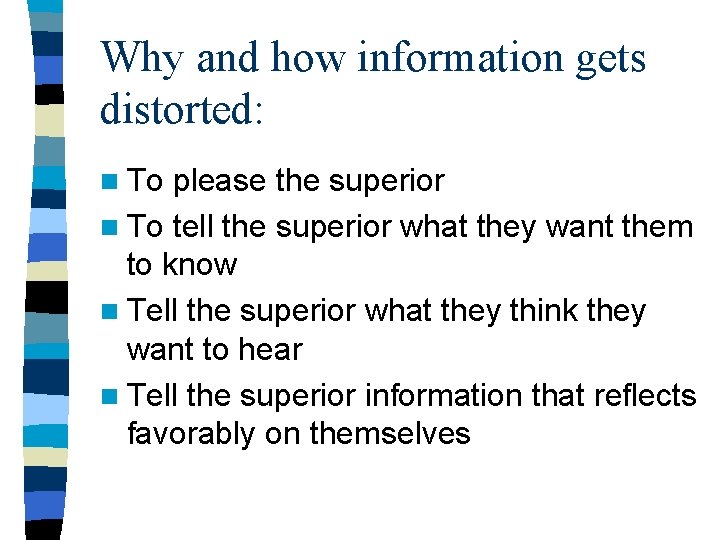
Why and how information gets distorted: n To please the superior n To tell the superior what they want them to know n Tell the superior what they think they want to hear n Tell the superior information that reflects favorably on themselves
Next Time… Projects DUE. Do not email me Sunday and expect an answer back before class.