
Persuasion Theoretical and practical concerns Persuasion Attempts to
- Slides: 40
Persuasion Theoretical and practical concerns
Persuasion • Attempts to persuade you are everywhere all the time – That is, wherever you go now, someone is trying to influence you – The attempts don’t stop—they go on day and night • Advanced industrial countries rely heavily on persuasion for social influence – Less emphasis on brute force – Mass communication available • Persuasion is more efficient and may be more effective
Persuasion • Persuasion is the use of communication to influence beliefs, attitudes and/or behavior – If the persuasive communication is meant first and foremost to advance the interests of the speaker/author ahead of other considerations, it is propaganda • The study of persuasion has been one of the main foci of media studies
Applied research • Most persuasion research is meant to test specific persuasive communications strategies or tactics rather than to build theory – Advertising research • Copytesting • Campaigns studies – Propaganda studies – Educational/persuasive campaigns • Public health interventions
Theory development • Theory may be developed and tested using scientific research methods – Experimental studies, usually • More often, the results of advertising, educational campaigns reviewed and theory is induced from real-world experience – Advertising effectiveness monitoring
Hovland colleagues • First recruited to study the effectiveness of the U. S. government’s attempts to educate soldiers and boost morale during World War II – The Why We Fight series • Followed up the American Soldiers studies with a program of research on persuasion – Yale School of persuasion research
Hovland et al. • Applied Lasswell’s paradigm for study: – Who? – Says What? – To Whom? – In Which Channel? – With what effect?
Who? • Hovland et al. looked at the effects of credibility of source on the effectiveness of attitude change messages. – Controlled experimental designs – Presented identical messages but varied the source of the message • News stories and editorials supposedly written by sources of greater or lesser credibility, or from more or less credible news organizations
Hovland et al. • The researchers found that credibility of the source was an important determinant of the persuasiveness of the message – However, the impact of message source seemed to decay over time • Sleeper effect – Credibility of the source was tied to a number of characteristics • Expertise • Trustworthiness • Likeability
Expertise • Does the source appear to be knowledgeable on the topic? – A source may be perceived to have expertise even if he doesn’t • “I‘m not a doctor, but I play one on TV” • All sorts of actors dressed up as doctors in early commercials – FCC restricted representations of sources—cannot be misleading or false
Trustworthiness • If the source seems honest and straightforward we are more likely to be convinced by what she says – The audience has some reason to believe the source is honest • Newsperson’s commitment to objectivity – Walter Cronkite • A history of openness and honesty (self-disclosure) – Oprah
Trustworthiness • Another source of trustworthiness is situational. – If the speaker or author is perceived to be arguing in favor of a position that is in her self -interest she will be less persuasive – If you overhear someone talking you are more likely to be influenced than if they know you are listening • An experiment with a supposedly overheard discussion led to greater attitude change
– When the speaker argues against his own self-interest, he is more persuasive • Joe “The Shoulder” Napolitano arguing for more stringent sentencing • A group of wealthy people opposed to the repeal of the inheritance tax
Charisma • Personal charm or likeability – Ronald Reagan • “Teflon president” – Celebrity endorsements • Not really clear why some people are appealing • Physical attractiveness – Physically attractive people are liked, trusted
Homophily • If the speaker is a lot like the audience member, he is more likely to be persuasive – Probably a combination of expertise (she understands me and my situation) likeability (people like those who share their view of the world) and trustworthiness (I can trust someone like me) • In propaganda studies, this is called “Just Plain Folks” • Candidates try to portray themselves as resembling the group they are targeting – Eating ethnic foods – Wearing work clothes
Sources • Heavy use of celebrities – Positive affect prior to advertising, etc. – Natural on-air presentation – Physical attractiveness – Association with certain image, roles
Says what? (content) • Structure of arguments – One-sided v. two-sided – Primacy v. recency – Conclusive v. non-conclusive • Rational v. emotional appeals – Fear – Humor • Visual v. semantic appeals
Fear appeals • Fear appeals have been heavily studied – Hovland et al. concluded that moderate fear was the most effective • Too little fear does not motivate • Too much fear causes target to avoid message or implications – More recent findings have led to conclusion that high levels of fear work well if a sense of efficacy is generated and clear means of dealing with the fear provided
Content • Emotional content – Pathos – Humor – Love – Desire – Jealousy • Cultural symbolism – Flags – Weddings – Cars
Framing • • Loss v. gain Episode v general trend Examples v. statistics False comparisons
To whom? • Personality factors – Self-esteem • Curvilinear effect • Education – Two-sided messages are more effective with more formally educated while one-sided are more effective with less formally educated – Rational appeals relatively more effective with more formally educated • Interest – Topical interest predicts topical knowledge and preexisting attitudes (varies with demographics)
• Gender – Women are more persuadable • May no longer be true • Social norms/beliefs • Active participation
Audience • Targeting – Choice of media based on the ability to reach a target audience • Target is usually “low hanging fruit” • Fish where the fish are • Fish when the fish are biting – Messages written for particular audience rather than for everyone • “Tailored” messages are now possible—evidence indicates they are more effective
Audience • Audience feedback is used to improve messages, further communicate with likely purchasers
With what effect? • Learning – Most common/easiest change • Attitude change – Especially when existing attitudes are not strongly held • Behavior intention – Most predictive of actual behavior • Behavior – Changing behavior is very difficult because of the multiple influences that determine behavior • Biological, psychological, situational, cultural influences
With what effect? • Sleeper effect • Selectivity • Interaction with education/demographics – One-sided v. two-sided • ‘Boomerang effects’
Effect • Varies across topics/products, audiences, campaigns – Information – Attitude change – Positioning/branding
What problems with the experimental method are there? • One-time exposure – Compared with campaigns people experience on a regular basis • Forced exposure – Negates selectivity • Demand characteristics of experimental method – Especially when carried out with students • Overuse of available samples – “Students may not be people”
What problems with the experimental method are there? • Lack of competing messages • Usually choose topics the audience knows little about
Campaigns • Studies of the effectiveness of campaigns – Advertising – Political campaigns – Propaganda campaigns – Public health campaigns
Campaigns analysis • The massive use of advertising allows for the testing of real-world media persuasion across a wide range of topics – Meta-analyses of marketing/advertising campaigns – Meta-analyses of copy tests – Reviews of public health campaigns – Comparison of political or propaganda campaigns and public opinion
General findings • Memory for campaigns is low – Recognition scores are better • Attitude change is not often very great • However, change does occur and can be significant under certain circumstances – Topic is relatively unknown – Media are consonant – Topic is emotionally charged
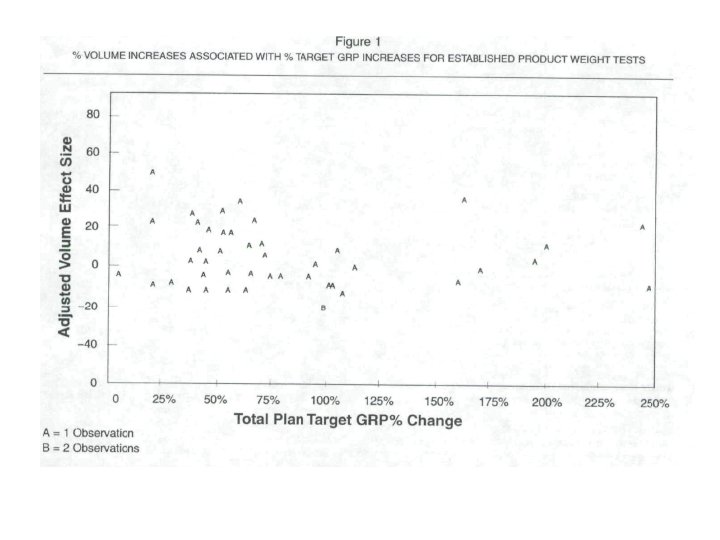
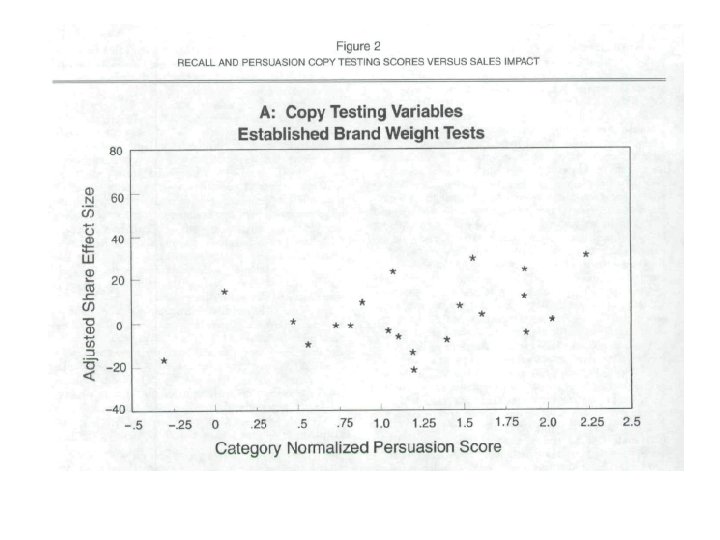
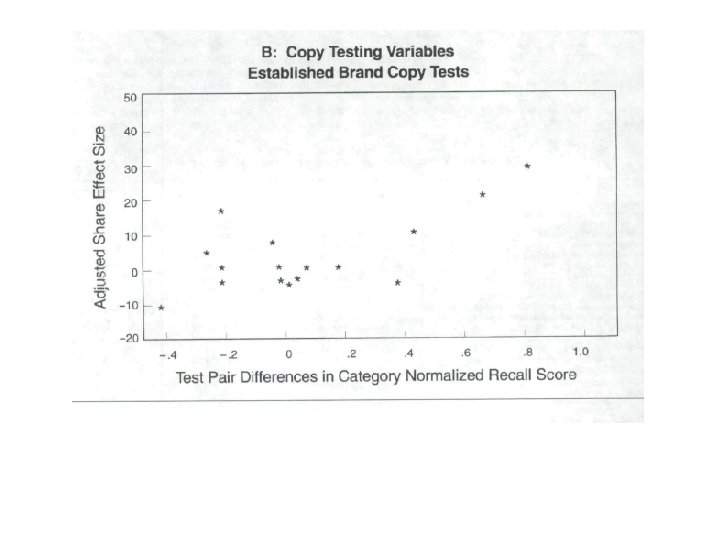
Meta-analysis • Lodish et al. “Advertising works: A metaanalysis of 389 real world split cable T. V. advertising experiments” – TV advertising weight alone is not enough – The status quo is not enough – It is unlikely that there is a strong relationship between standard measures of TV commercial recall and persuasion for established brands and the sales impact of the copy
– New brands or line extensions tend to be more responsive to alternative TV advertising plans than established products – These data support the importance of introductory weight and prime time for new products – Concentration of higher TV advertising weight is related to increases in brand sales
Dual-processing theory • Dual-processing theories argue that we process persuasive messages differently if we are motivated to attend to them and are capable of processing them than if we just monitor them at a very low level or are unable to process them – Central v. peripheral processing
Central processing • If we are motivated and capable of processing we will carefully review the arguments made to see if they are convincing according to rational argument – Appropriate evidence – Strength of argument, logic
Peripheral processing • If we just give slight attention to a persuasive message, are not motivated enough to dedicate the effort to evaluate the logic and strength of argument, then we will tend to process according to ‘peripheral cues’ – Attractiveness of the source • May be sexual – Visual cues/attractiveness of the setting – Music – Emotion