Thermodynamics 10302020 CIDERITP Summer School How does Earth


- Slides: 27
Thermodynamics 10/30/2020 CIDER/ITP Summer School
How does Earth respond? • To changes in energy – Change in temperature (Heat Capacity) – Change in Density (thermal expansivity – Phase Transformations (Gibbs free energy) • To hydrostatic stress – Compression (bulk modulus) – Adiabatic heating (Grüneisen parameter) • To deviatoric stress – Elastic deformation (elastic constants) – Flow (viscosity) – Failure (state and rate dependent friction) • Rates of Transport of – – Mass (chemical diffusivity) Energy (thermal diffusivity) Momentum (viscosity, attenuation) Charge (electrical conductivity)
Mantle Phases Wadsleyite (wa); Ringwoodite (ri); akimotoite (ak); Mg-perovskite (mgpv); Ca-perovskite (capv); Ferropericlase (fp)
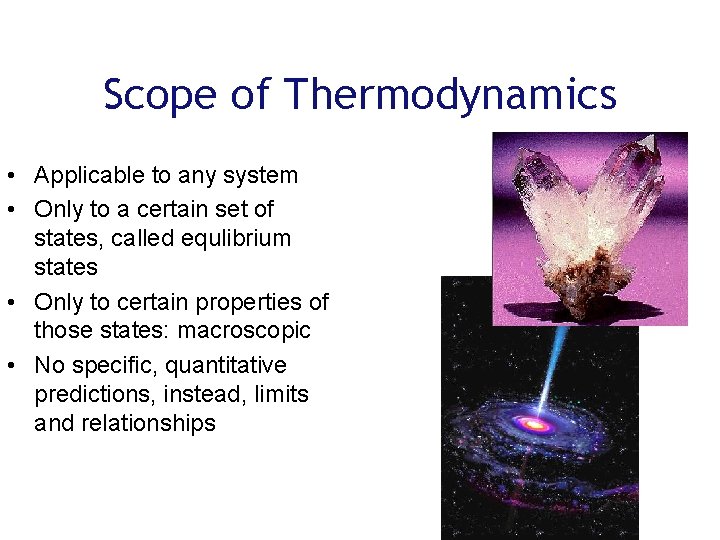
Scope of Thermodynamics • Applicable to any system • Only to a certain set of states, called equlibrium states • Only to certain properties of those states: macroscopic • No specific, quantitative predictions, instead, limits and relationships
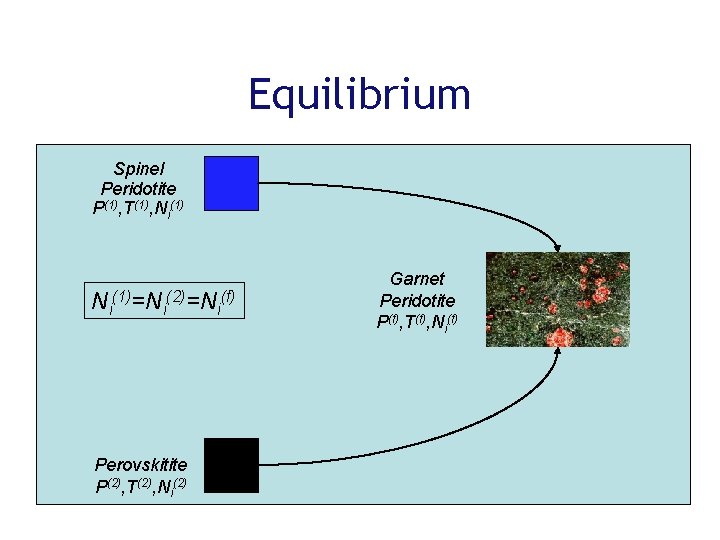
Equilibrium Spinel Peridotite P(1), T(1), Ni(1)=Ni(2)=Ni(f) Perovskitite P(2), T(2), Ni(2) Garnet Peridotite P(f), T(f), Ni(f)
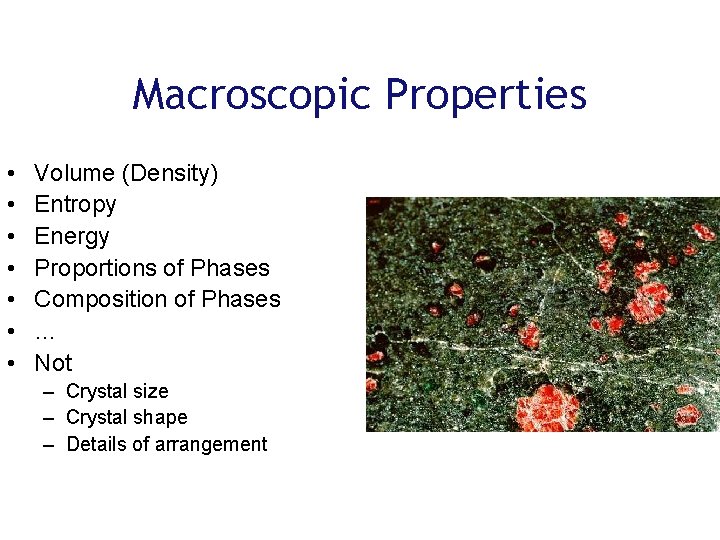
Macroscopic Properties • • Volume (Density) Entropy Energy Proportions of Phases Composition of Phases … Not – Crystal size – Crystal shape – Details of arrangement
Thermodynamic Variables • Second Order – Heat capacity – Thermal expansivity – Bulk modulus – Grüneisen parameter • First Order – – – V: Volume, S: Entropy Ni: Amount of components P: Pressure T: Temperature I : Chemical Potential
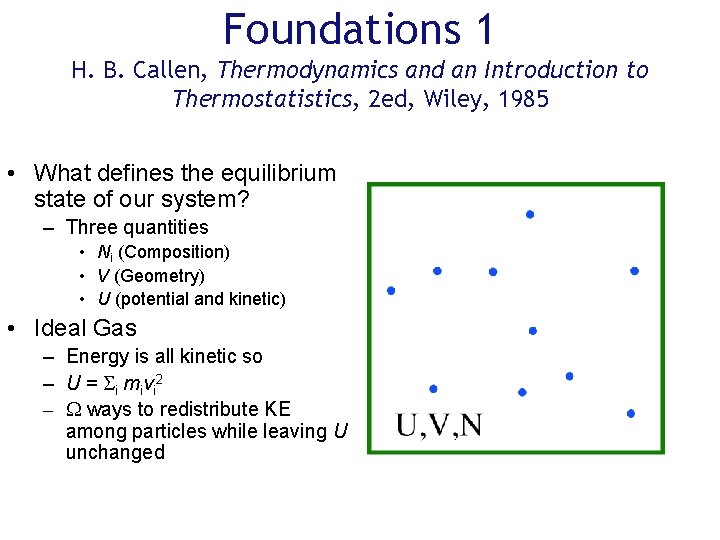
Foundations 1 H. B. Callen, Thermodynamics and an Introduction to Thermostatistics, 2 ed, Wiley, 1985 • What defines the equilibrium state of our system? – Three quantities • Ni (Composition) • V (Geometry) • U (potential and kinetic) • Ideal Gas – Energy is all kinetic so – U = i mivi 2 – ways to redistribute KE among particles while leaving U unchanged
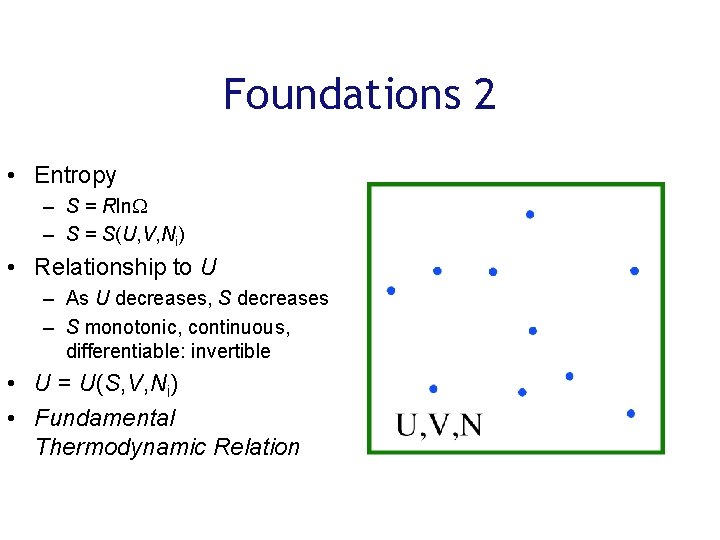
Foundations 2 • Entropy – S = Rln – S = S(U, V, Ni) • Relationship to U – As U decreases, S decreases – S monotonic, continuous, differentiable: invertible • U = U(S, V, Ni) • Fundamental Thermodynamic Relation
Properties of Internal Energy, U • Complete First Law
Fundamental Relation • U = U(S, V, Ni) • Complete information of all properties of all equilibrium states • S, V, Ni are natural variables of U • U = U(T, V, Ni) not fundamental
Legendre Transformations y • Two equivalent representations – y=f(x) – =y-px – i. e. =g(p) • Identify – y U, x V, S, p P, T, G • G = U - d. U/d. V V - d. U/d. S S or • G(P, T, Ni) = U(V, S, Ni) + PV - TS • G(P, T, Ni) is also fundamental! x
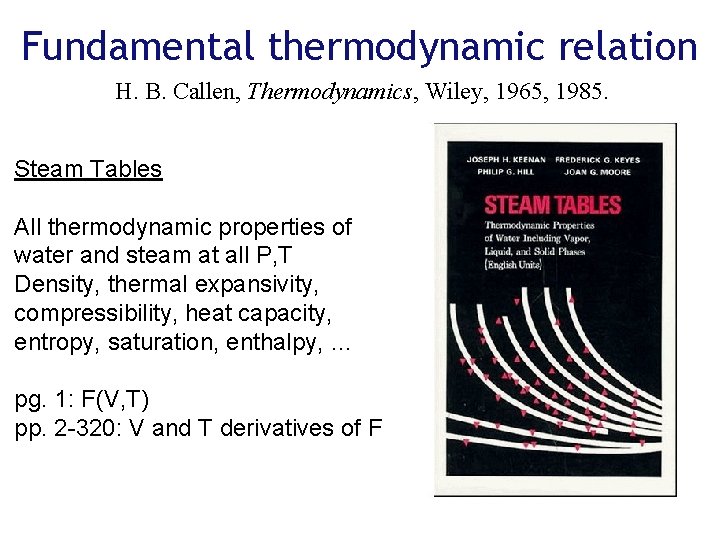
Fundamental thermodynamic relation H. B. Callen, Thermodynamics, Wiley, 1965, 1985. Steam Tables All thermodynamic properties of water and steam at all P, T Density, thermal expansivity, compressibility, heat capacity, entropy, saturation, enthalpy, … pg. 1: F(V, T) pp. 2 -320: V and T derivatives of F
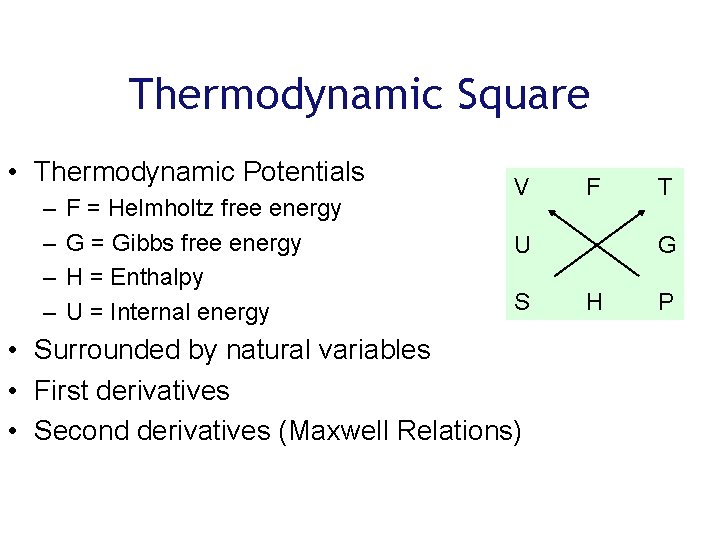
Thermodynamic Square • Thermodynamic Potentials – – F = Helmholtz free energy G = Gibbs free energy H = Enthalpy U = Internal energy V F U S • Surrounded by natural variables • First derivatives • Second derivatives (Maxwell Relations) T G H P
Summary of Properties
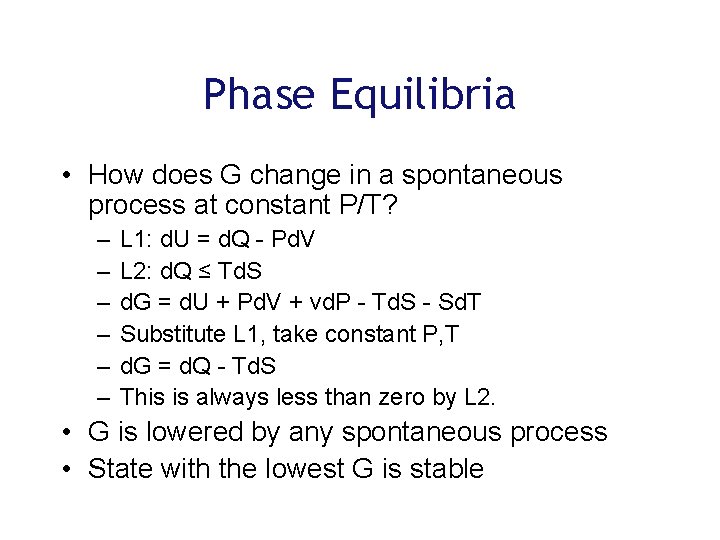
Phase Equilibria • How does G change in a spontaneous process at constant P/T? – – – L 1: d. U = d. Q - Pd. V L 2: d. Q ≤ Td. S d. G = d. U + Pd. V + vd. P - Td. S - Sd. T Substitute L 1, take constant P, T d. G = d. Q - Td. S This is always less than zero by L 2. • G is lowered by any spontaneous process • State with the lowest G is stable
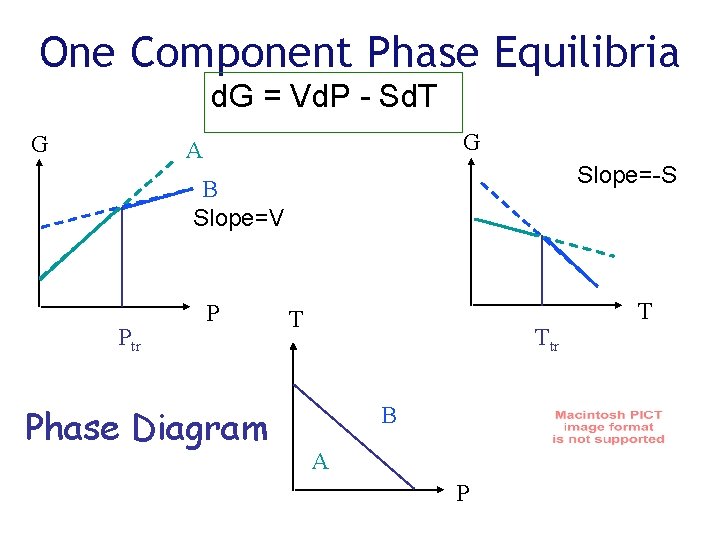
One Component Phase Equilibria d. G = Vd. P - Sd. T G G A Slope=-S B Slope=V Ptr P Phase Diagram T Ttr B A P T
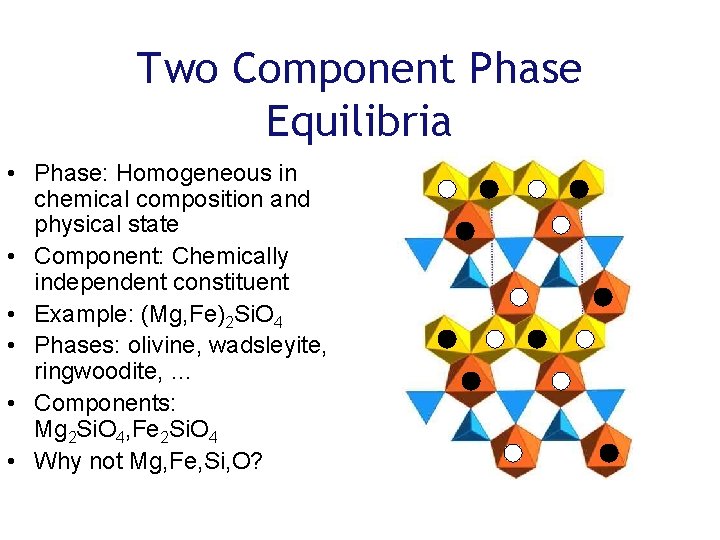
Two Component Phase Equilibria • Phase: Homogeneous in chemical composition and physical state • Component: Chemically independent constituent • Example: (Mg, Fe)2 Si. O 4 • Phases: olivine, wadsleyite, ringwoodite, … • Components: Mg 2 Si. O 4, Fe 2 Si. O 4 • Why not Mg, Fe, Si, O?
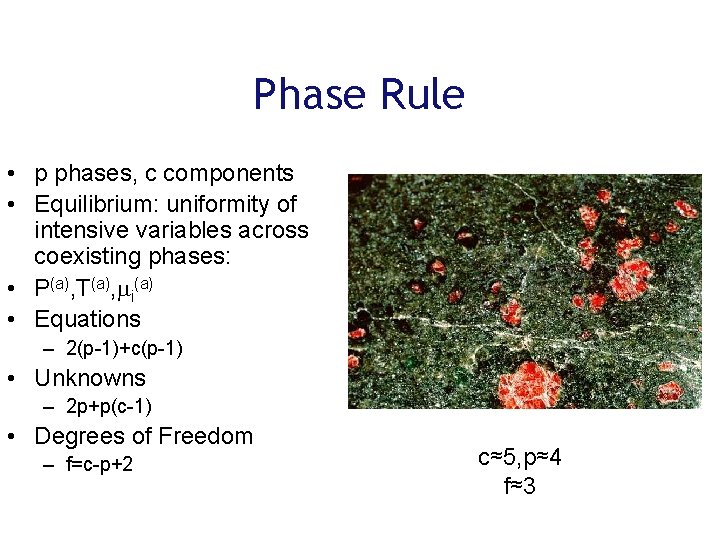
Phase Rule • p phases, c components • Equilibrium: uniformity of intensive variables across coexisting phases: • P(a), T(a), i(a) • Equations – 2(p-1)+c(p-1) • Unknowns – 2 p+p(c-1) • Degrees of Freedom – f=c-p+2 c≈5, p≈4 f≈3
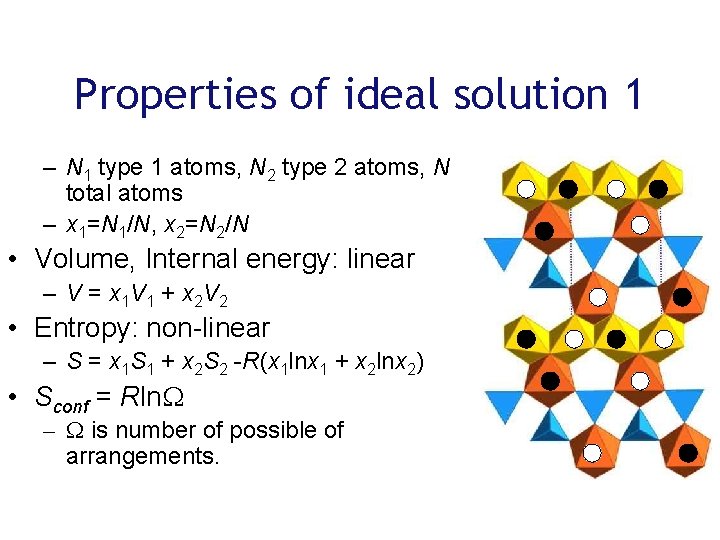
Properties of ideal solution 1 – N 1 type 1 atoms, N 2 type 2 atoms, N total atoms – x 1=N 1/N, x 2=N 2/N • Volume, Internal energy: linear – V = x 1 V 1 + x 2 V 2 • Entropy: non-linear – S = x 1 S 1 + x 2 S 2 -R(x 1 lnx 1 + x 2 lnx 2) • Sconf = Rln – is number of possible of arrangements.
Properties of Ideal Solution 2 • Gibbs free energy – G = x 1 G 1 + x 2 G 2 + RT(x 1 lnx 1 + x 2 lnx 2) • Re-arrange – G = x 1(G 1 + RTlnx 1) + x 2(G 2 + RTlnx 2) • G = x 1 1 + x 2 2 • i = Gi + RTlnxi
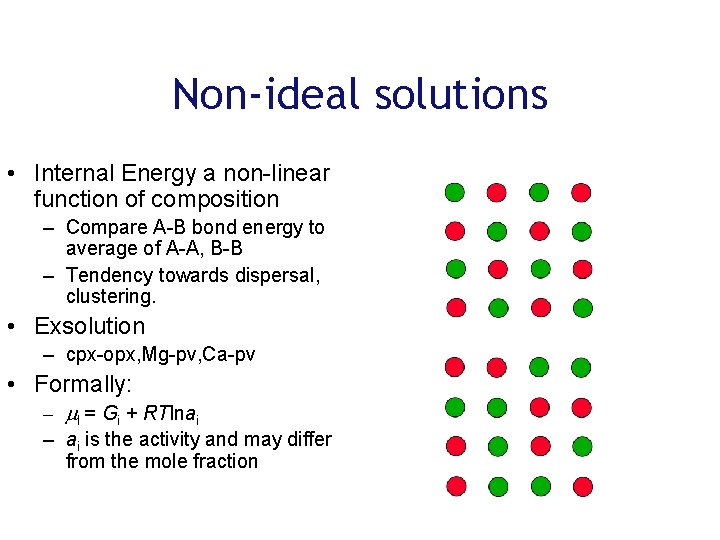
Non-ideal solutions • Internal Energy a non-linear function of composition – Compare A-B bond energy to average of A-A, B-B – Tendency towards dispersal, clustering. • Exsolution – cpx-opx, Mg-pv, Ca-pv • Formally: – I = Gi + RTlnai – ai is the activity and may differ from the mole fraction
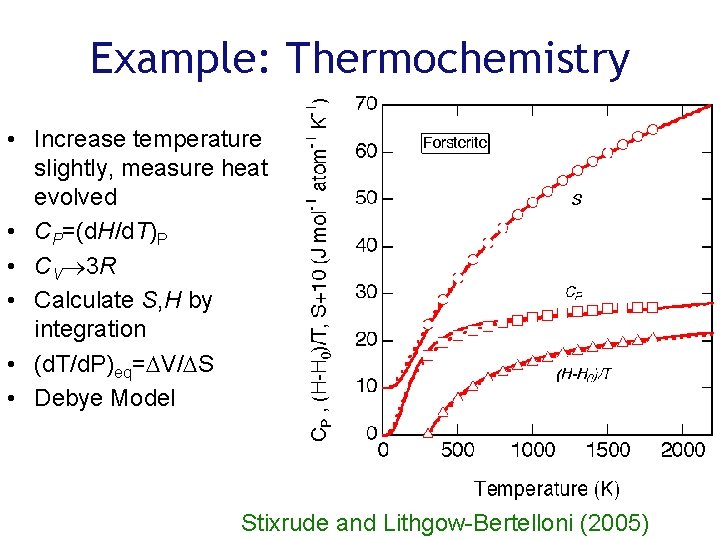
Example: Thermochemistry • Increase temperature slightly, measure heat evolved • CP=(d. H/d. T)P • CV 3 R • Calculate S, H by integration • (d. T/d. P)eq= V/ S • Debye Model Stixrude and Lithgow-Bertelloni (2005)
Equation of State • Start from fundamental relation • Helmholtz free energy – F=F(V, T, Ni) • Isotherm, fixed composition – F=F(V) • Taylor series expansion • Expansion variable must be V or function of V – F = af 2 + bf 3 + … • f = f(V) Eulerian finite strain • a = 9 K 0 V 0
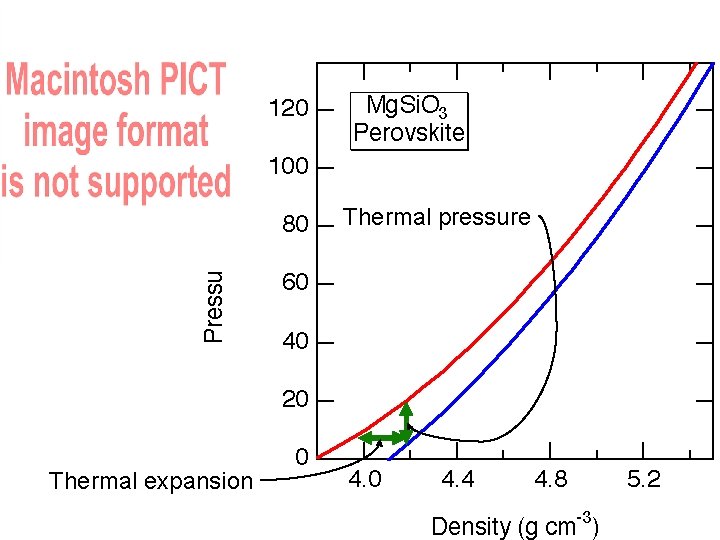
Grüneisen Parameter • Thermal pressure • Adiabatic Gradient • Dimensionless • 1 -2 for most mantle phases • Decreases on compression Note: =1/V=density
Thermal pressure Thermal expansion