The CEPOD Theatre CENOD Confidential Enquiry into NON
- Slides: 22
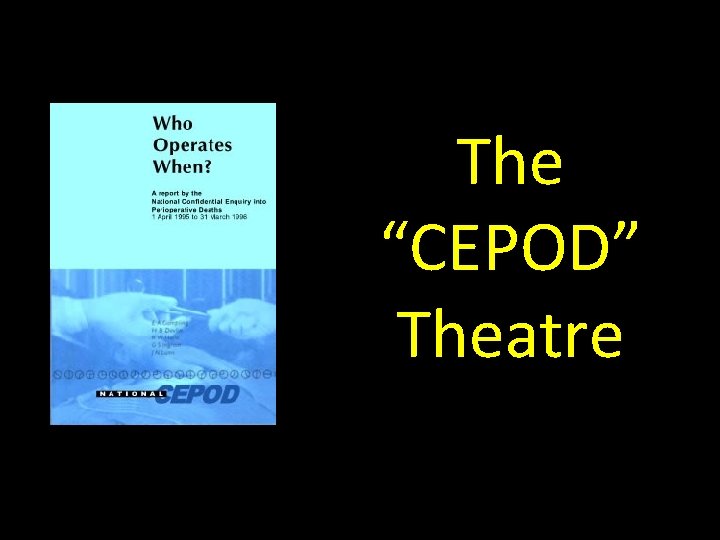
The “CEPOD” Theatre
CENOD Confidential Enquiry into NON Operative Death
No Operation l A proportion of patients were admitted under a surgical specialty and died without undergoing surgery. l There were cases where, for a variety of reasons, an operation from which the patient might potentially benefit was not performed
Death certification and autopsies l Half of these deaths were reported to the coroner, but only a third of those had an autopsy. l Of the rest, only 19 out of 623 cases had an autopsy. l More than a third of autopsies gave unanticipated information.
Decontamination l Almost a third of sites had off site decontamination facilities. l Where decontamination facilities were only available off site, there were more likely to be operational problems l Problems include postponement, prolonged anaesthetic time, and technical difficulty
Venous Thromboembolism l Orthopaedic surgeons gave prophylaxis to 73. 1%, indicating awareness. l Only 51. 6% of general surgical patients received prophylaxis. l Only 34% of medical patients received prophylaxis.
Continuity of Care l Change in the hospital team structure over recent years has seen individual clinicians become transient acquaintances during a patient’s illness rather than having responsibility for continuity of care.
Continuity of Care l Staffing arrangements and shift working have also been shown to be disruptive and with the implementation of the European Working Time Directive, this disruption is likely to continue and impact on the training of tomorrow’s doctors.
Decision Making l There was a clinically important delay in consultant review in 24. 9% of cases
Management Plan l. A clear management plan is important with the fragmentation of clinical teams, and the loss of the traditional “Firm” structure and continuity of care
Communication l In a number of cases there was evidence of poor communication at all levels. l The communication problem is not only horizontal, between different clinical teams and professional groups, but also vertically between different grades of staff within clinical teams.
Communication l Advisors expressed concern that the modernisation of working patterns, including shift work, cross cover between clinical teams and the reduction in direct contact between trainees and consultants during the working week might all contribute to less efficient communication
Communication l The reliance upon multi-specialty cross cover combined with lack of dedicated time for co-ordinated handover is likely to be an important factor in poor communications l A coordinated handover of patients only occurred in 24. 2% of multispecialty teams.
Delays between admission and operation l Lack of sufficient theatre time l Delay in consultant review l Delay by junior doctors in reaching the correct diagnosis l Delay in recognising the need for surgery because of a failure to recognise the seriousness of the patient’s condition
Health care professionals in theatre l Advisors noted the relative infrequency with which specialist registrars were present in theatre. l There now appears to be a shift away from trainees operating without a consultant present to consultants operating without any trainees present.
Health care professionals in theatre l It is important to draw the distinction here between the undesirable practice of junior trainees operating alone out of hours, and beyond their own level of competence, and the desirable practice of trainees operating under appropriate supervision
Health care professionals in theatre l This raises the question whether surgical trainees are getting sufficient exposure and training in the management of surgical emergencies.
The European Working Time Directive l There is a great deal of debate about the implications on continuity of care, patient safety versus training and fatigue considerations. l At least one Royal College is of the view that somewhere closer to 65 hours is a more appropriate balance.
The European Working Time Directive l There is likely to be a crossing point l Ideally well conducted research should be undertaken to ascertain where that cross-over point is. l It is likely that there is no one ideal figure which is optimal for all specialties
Recommendations • Systems of communication between doctors and other health professionals must improve. • There must be consultant input at an early stage to assist in the clinical management of emergency patients irrespective of the time of day. • The risks and benefits to patients safety of reduced working hours should be fully assessed.
Recommendations • All trainees need to be exposed in an appropriate learning environment to the management of emergency patients. • Clinical services must be organised to allow appropriately supervised trainee involvement. • Organisation of services must address training needs and this will vary from specialty to specialty.
“Caring to the End? ” makes an irrefutable argument for: 1. A consultant delivered surgical service 2. An opt-out from the EWTD for surgery