SVQ Social Services Children and Young People SVQ





















- Slides: 97
SVQ Social Services (Children and Young People) SVQ Social Services and Healthcare Wednesday 28 November 2018 – Dundee Thursday 29 November 2018 – Glasgow
Presenter David Watt Qualifications Manager Humanities, Care and Services Tel – 0345 -213 -5577 Email – David. Watt@sqa. org. uk
Welcome and Introduction Ø Domestic Arrangements Ø Overview of the Day
SVQ Care and Child Care Update Presenter – John Currie Senior External Verifier SVQ Care (82) and SVQ Child Care (84)
SSSC Update Presenter – Kerry Cannon Learning and Development Adviser Scottish Social Services Council (SSSC)
SSSC Update Presenter – Kerry Cannon Learning and Development Adviser Scottish Social Services Council (SSSC)
#lifechangingwork in social services Qualifications and career pathways
A trusted, skilled and valued workforce What is the Scottish Social Services Council? We are the regulator for the social service workforce in Scotland. Our work means the people of Scotland can count on social services being provided by a trusted, skilled and confident workforce. What do we do? We protect the public by registering social service workers, setting standards for their practice, conduct, training and education and by supporting their professional development. Where people fall below the standards of practice and conduct we can investigate and take action.
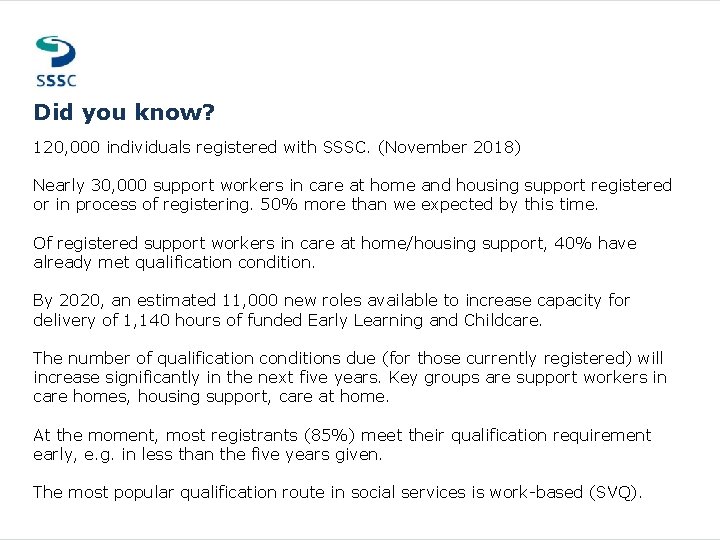
Did you know? 120, 000 individuals registered with SSSC. (November 2018) Nearly 30, 000 support workers in care at home and housing support registered or in process of registering. 50% more than we expected by this time. Of registered support workers in care at home/housing support, 40% have already met qualification condition. By 2020, an estimated 11, 000 new roles available to increase capacity for delivery of 1, 140 hours of funded Early Learning and Childcare. The number of qualification conditions due (for those currently registered) will increase significantly in the next five years. Key groups are support workers in care homes, housing support, care at home. At the moment, most registrants (85%) meet their qualification requirement early, e. g. in less than the five years given. The most popular qualification route in social services is work-based (SVQ).
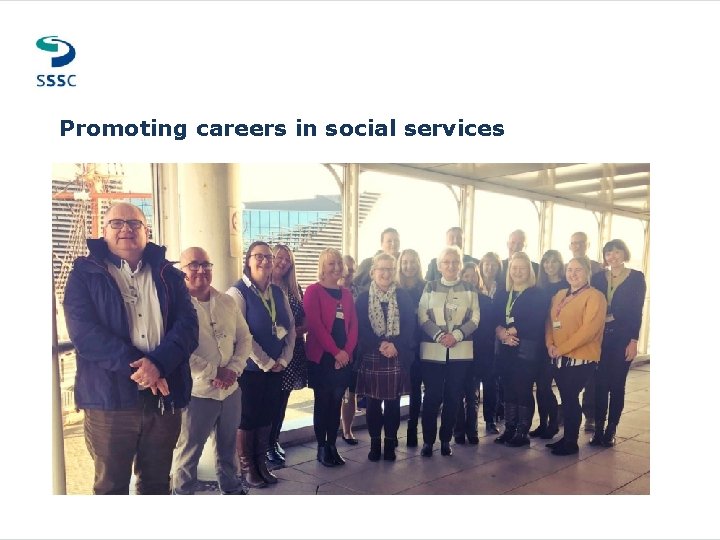
Promoting careers in social services
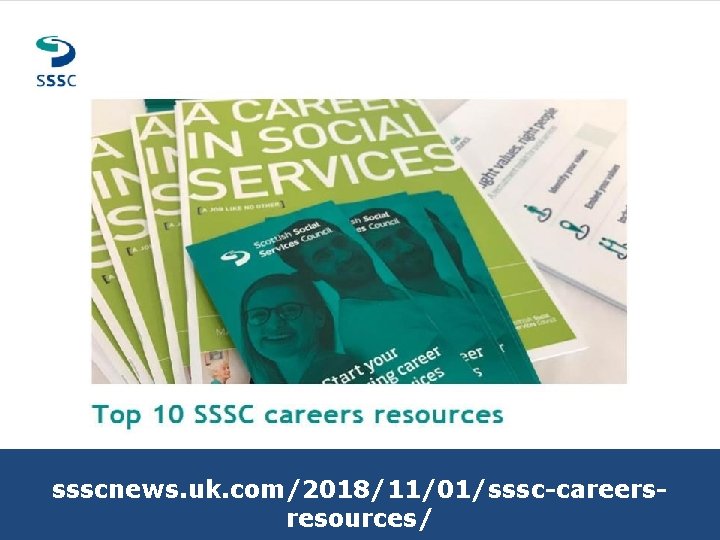
ssscnews. uk. com/2018/11/01/sssc-careersresources/
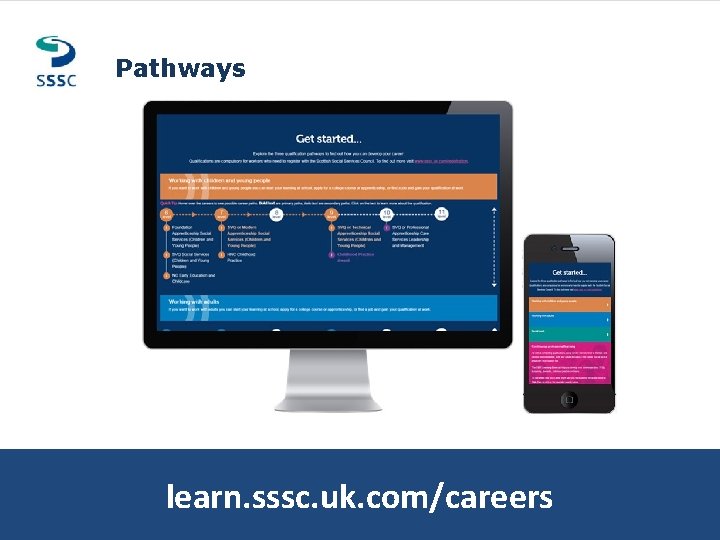
A better understanding of career pathways in social services “How we understand plan for our social care workforce is critical to the whole ambition of integrated high-quality services, to the staff we value and the outcomes for our citizens. ” National Health and Social Care Workforce Plan, Part 2 Recommendation 6: Develop proposals for enhanced career pathways recognising the context of the developing multidisciplinary, integrated workforce environment.
Pathways learn. sssc. uk. com/careers
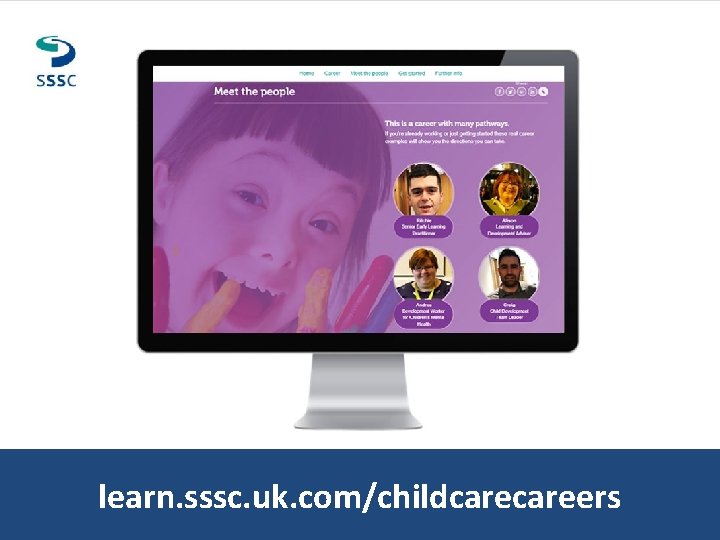
learn. sssc. uk. com/childcareers
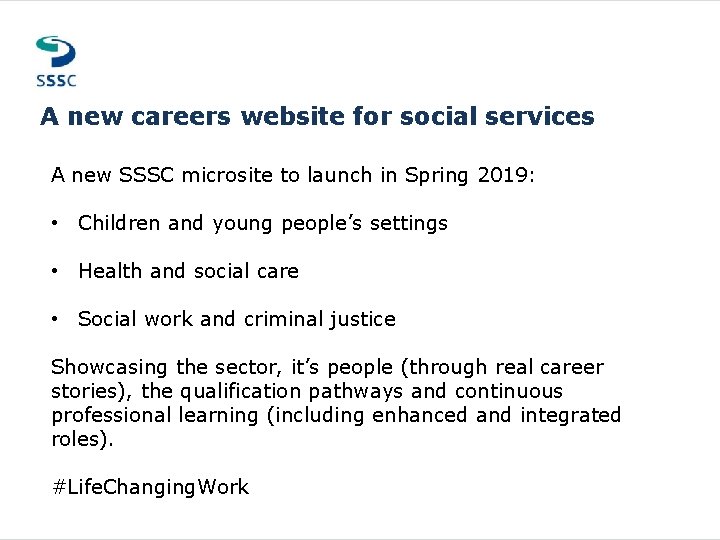
A new careers website for social services A new SSSC microsite to launch in Spring 2019: • Children and young people’s settings • Health and social care • Social work and criminal justice Showcasing the sector, it’s people (through real career stories), the qualification pathways and continuous professional learning (including enhanced and integrated roles). #Life. Changing. Work
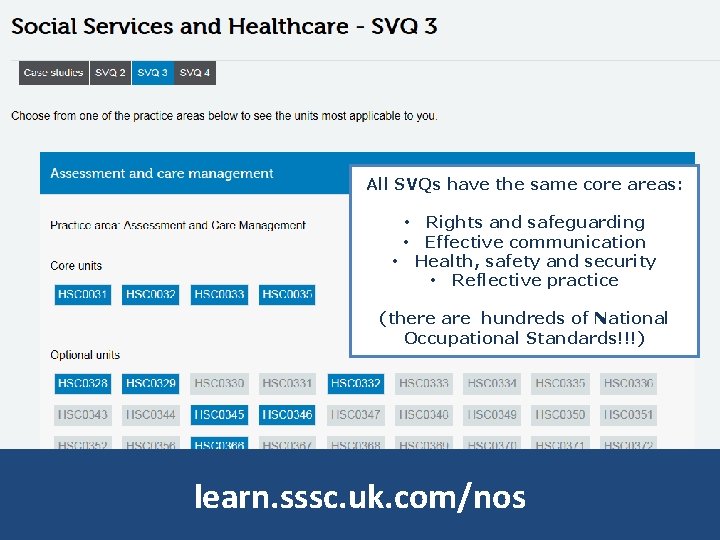
All SVQs have the same core areas: • Rights and safeguarding • Effective communication • Health, safety and security • Reflective practice (there are hundreds of National Occupational Standards!!!) learn. sssc. uk. com/nos
Professional Development Awards Some examples: PDA Health and Social Care Supervision at SCQF level 7 PDA Health and Social Care: Administration of Medication at SCQF level 7 PDA in Scrutiny and Improvement Practice (Social Services) at SCQF level 10 – for Care Inspectors Explore the full range on the SQA Care pages - www. sqa. org. uk/sqa/45285
Kerry. Cannon@sssc. uk. com 01382 346189 @Kerry. Cannon
Care as a Career … Fiona Gleghorn Interim Manager ©The Care Training Consortium
Care as a Career …
Aim …… Ø To encourage individuals to choose CARE as a career Ø Increase the retention of current workforce within CARE Ø Promote CARE positively
Where we came from Ø 2002 company was founded – Local recognition of a need to upskill and train carers – Variety of training needs were identified Ø Personal care Ø Mandatory training – Known as The Care at Home Training Consortium Ltd and is a charity and social enterprise Ø Expanded in 2006 – – Workforce expanded Working now with Care homes, voluntary and independent sector Now also offering wider training portfolio SQA centre offering SVQ Health & Social Care level 2 – LMA Ø Company continues to expand – Team of assessors and trainers working across D&G and other parts of Scotland – Also a 2 year post funded by Carers Strategy to look at Care Aware Training Ø Raising awareness with healthcare providers of the role Unpaid Carers play in providing care to our communities
A National problem Ø The shape of Scottish society and the health and care needs of our communities locally are changing. People are living longer, healthier lives and as the needs of our society change, so too must the nature and form of our public services. Ø In the next 10 years, the number of people in Scotland aged over 75 is likely to have increased by over 25%. Ø In the same period, it’s also estimated that nearly twothirds of people will have developed a long-term condition by the age of 65.
Local Problem Ø For Dumfries & Galloway, the crucial difference is that in tandem with the projected drop in the 0 - 29 age group from 48. 1 K to 36. 1 K, Ø The projected overall population will also drop from 145. 8 K to 131. 7 K. Ø However, the 60+ age group is projected to rise from 36. 6 K ( 36%of general pop. ) to 48 K ( 38% of general pop) by 2020 Ø (Integration Board Carers Strategy 2017, D&G Age Concern Forum Report 2017)
So, what do we do ?
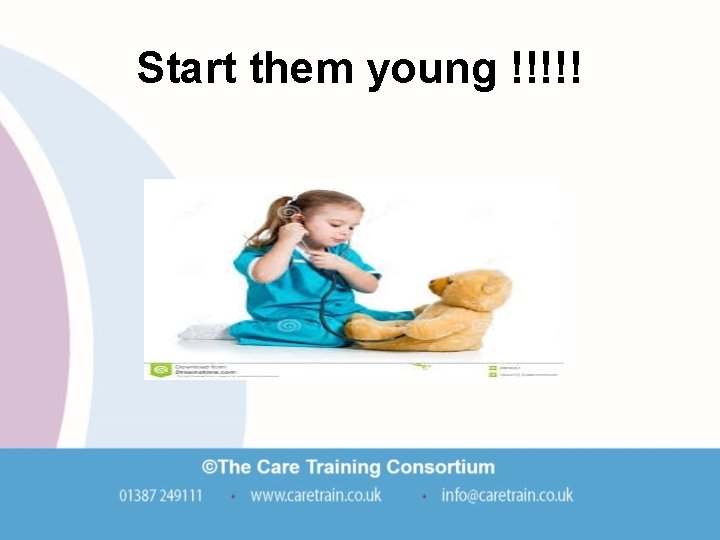
Start them young !!!!!
CTC Care Roadshow Ø CTC is promoting Care as a career within schools across the region by delivering “Care Roadshows” in schools, Ø We hope this may then lead to increasing the number of carers for the future, Ø By planting the seeds early and promoting care as a career. Ø CTC has provided the roadshow to a number of schools in Dumfries and Galloway. Ø Include service partners to tell some of their stories about a career in care
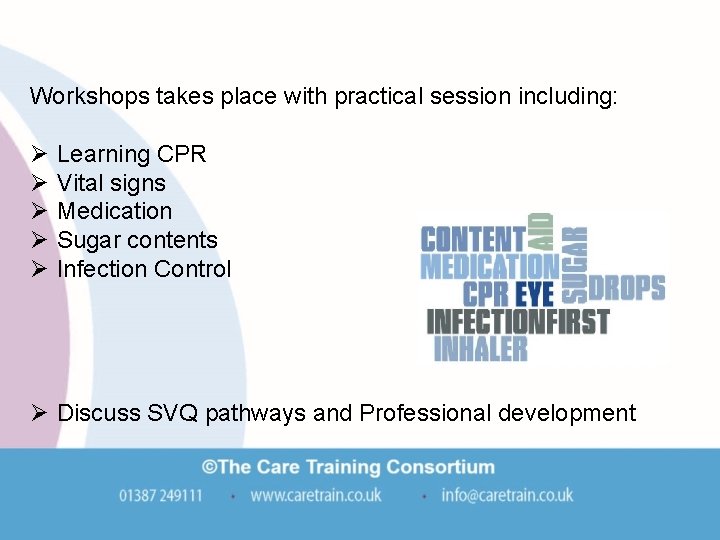
Workshops takes place with practical session including: Ø Ø Ø Learning CPR Vital signs Medication Sugar contents Infection Control Ø Discuss SVQ pathways and Professional development
Duke of Edinburgh Award CTC are actively promoting that students undertaking their Duke of Edinburgh Awards and could undertake their service part in a care environment. Our service partners are encouraging this and have facilitated placements
Grow their own Ø We encourage providers to take on younger staff. ØThey are often reluctant Ø Provide mentorship and good role modelling Ø Provide a structured induction/ professional development pathway
Those choosing a Career Change
Step in to Care is a programme that has been delivered by CTC on several occasions previously when funding has been available. – partnership working with an other training agency, Job Centre, Holywood Trust The course is for unemployed people who are looking to either change careers or learn new skill to enable them to gain employment in the care sector. The course can be delivered over two weeks or 10 days over a number of weeks
The course consists of 10 days training including: Ø Roles and Responsibilities & Record Keeping Ø Support and Protection of Vulnerable Groups Ø Working with Challenging Behaviour Ø Personal Hygiene and Skin Care Ø First Aid Ø Looking After Someone with Dementia Ø Chronic Conditions Ø Food Safety Ø Communication Skills Ø Confidence Building Ø Health and Safety & Risk Assessment Ø Moving and Handling
Harnessing The Unpaid Workforce. .
Training for Unpaid Carers Since 2014 CTC has been given funding from the Carers Strategy. (via NHS commissioning) To deliver free short courses for the Unpaid Carer. Region wide via the network of Carers Centres This project has been extremely successful across Dumfries and Galloway.
Topics so far Ø Dementia Awareness Ø Safer Moving and Handling Ø Stress Awareness Ø Epilepsy Awareness Ø Managing Challenging Behaviour Ø Ø Changing Relationships First Aid Medication Awareness Coping with Difficult Situations Ø Assertiveness Ø Reiki
Delivery Model Ø Delivery Can be – Group delivery in a workshop format – Individualised / bespoke – One to one Ø Part of the funding for Unpaid Carers has been reserved to provide emergency Moving and Handling training to allow families to be trained in the use of moving and handling equipment, to allow the person they care for to be discharged from hospital sooner if a health professional has not been available. – Evaluation so far is good …
The wider community Ø CTC also works with the local LGBT Plus Community – bespoke training particularly in relation to LGBT communities as well as similar sessions to other Unpaid carer programme – Reacting to local surveys of this community and its unpaid Carers – Sessions were well attended , well evaluated around meeting their needs
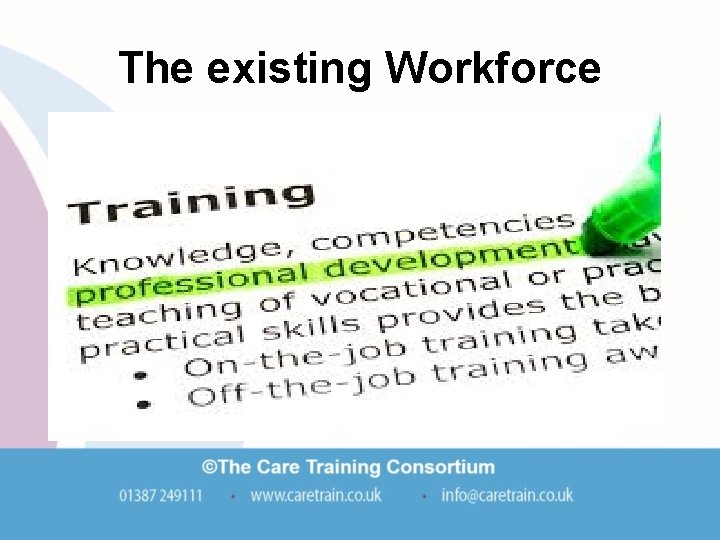
The existing Workforce
Oh but … I'm just a carer Ø Need to feel valued … Ø Not in a dead end job Ø Investment in development
Step Up Step Down Carers are a vital partner in the delivery in Health and Social Care in people in Residential Care. As we all know traditional care services are overwhelmed, hospital beds are full and not enough people are training within the medical/nursing professions to support the future health needs of our growing elderly population. We MUST invest in those established in the profession to retain this valuable resource
The Brief …… Ø To develop the existing workforce Ø. CTC provided a Step Up/Step Down programme using funding from Putting You First. Ø A test of change in the form of a structured competency based training programme took place to support the long term sustainable model of Step Up/Step Down
Our Vision for Step Up/Step Down Ø Our vision is that all the training delivered under this programme will build a knowledgeable workforce Ø that can detect deterioration in service users by monitoring their vital signs i. e. blood pressure, pulse, temperature, respiratory rate, blood sugars, urinalysis and saturation levels. Ø The workforce taking part will gain confidence, competency and knowledge in identifying the deterioration of the Service Users health and wellbeing and being able to take appropriate action.
The programme offered carers the opportunity to be trained to undertake physiological measurements of vital signs of service users whose clinical condition appears to be deteriorating and suffer from any of the following: - Ø Chronic Obstructive Pulmonary Disease (COPD), Ø Diabetes Ø Stroke Ø Coronary Heart Disease Ø Urinary Tract Infection and those who have a highpressure area risk score.
Expected outcomes? Ø The training will prevent unnecessary admissions to hospital shifting the focus of institutionalised care to the Home and community based services. This will enable the service user to have more choice and control of their health outcomes and care. Ø The workforce will be well informed and knowledgeable in relation to the six chronic conditions as detailed in the summary above. The workforce will be confident and competent to undertake physiological measurements. Ø Work alongside Community Nursing who ‘signed off’ the competencies
Story so far … Ø East of our region has embraced the concept Ø 3 residential homes have taken part, training 3 separate cohorts of 12 staff Ø Working with Community Nurses to gain competence / confidence Ø Monthly practice of baseline Vital signs Ø Reduced numbers of unnecessary hospital admissions
And the rest ………. . Ø SVQ Ø Wide training Portfolio
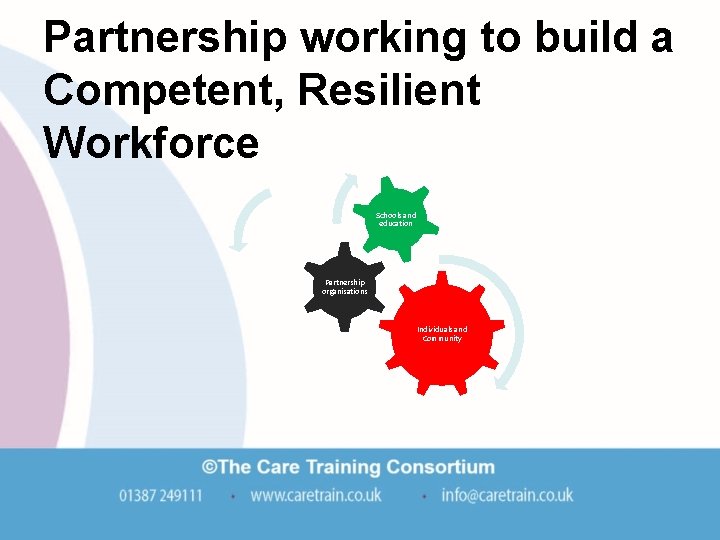
Partnership working to build a Competent, Resilient Workforce Schools and education Partnership organisations Individuals and Community
Common Knowledge Presenter – Bert Lawrie External Verifier SVQ Care (82) and SVQ Child Care (84)
Common Knowledge Starting point is the SQA Guidance that should be read in conjunction with the Assessment Strategy.
Assessors Role Ø In line with the L&D 9 Di Unit, it is the responsibility of the assessor to work with candidates to identify gaps in knowledge and skills before starting assessment. Ø Are your candidates in the appropriate job role? Ø What if any extra support do candidates need to reach the right level of competence?
Planning and Holistic Assessment Ø Integration of knowledge and practice is fundamental. Ø Identify opportunities for “integration” through careful planning. Ø Integration of workplace activities and knowledge is critical to success. Ø Essential that assessors adopt a range of methods in the evidence gathering process.
Assessing the Common Knowledge Ø Emphasis must be in candidates reflective accounts of practice for the majority of evidence. Ø When unable to do so then use “focused, pieces of work. However, candidates MUST be able to apply the focused work to their “real work” practice. Ø Knowledge CANNOT be inferred from direct observation. You must use other assessment methods.
What works well? Ø Candidate is well prepared at the outset, perhaps through a “Readiness for Assessment” tool. Ø Candidates training has been matched to the standards and linked to real work activities. Ø Following observation the assessor checks and confirms knowledge through oral questioning and professional discussion. Ø Assessors written feedback, directs candidate to future opportunities to meet gaps in common and/or specific knowledge.
Qualification Verifiers Findings 1 Ø Over assessment is commonplace and never challenged by Internal Verifier. Ø Candidates/assessors provide multiple/numerous examples for each knowledge point. Ø Assessors set candidates focused pieces of work/assignments/written questions when the knowledge point has already been met within reflective accounts.
Qualification Verifiers Findings 2 Ø Assessors continue to “Directly Observe” knowledge despite the guidance. Ø Assessors directly observe “every unit”. Ø Some centres continue to assess single units or limit the amount of evidence generated by “holistic assessment”. Ø Assignments and written questions continue to be set for numerous knowledge points INSTEAD of gaps or Performance Criteria “not easily incorporated into accounts of practice”.
Qualification Verifiers Findings 3 Ø Products are valuable “sources of evidence” particularly for higher level awards but assessors must make clear links and provide written explanations on how the product meets the Unit evidence requirements. Ø Copies of products shouldn’t be included, it’s YOUR written explanation on the contribution the product makes to your final assessment.
Any Questions
Presenter Mark Hood Training and Development Manager Appointee Management Tel: 0345 -213 -5365 Email: mark. hood@sqa. org. uk
Continuing Professional Development (CPD) and the SQA Academy Course
Definition – Continuing Professional Development (CPD) “CPD is the conscious updating of professional knowledge and improvement of personal competence throughout your working life. Conscious implies that CPD is a state of mind rather than a set of rules or a programme of study”.
The Concept – Continuing Professional Development (CPD) Ø Continuing Professional Development (CPD) is about how you use a variety of learning experiences to develop yourself professionally and personally. Ø There is a common principle in how you approach CPD, whether you think in terms of self development or lifelong learning. It is about the learning and development that you undertake and the method you use to reflect on and record this learning.
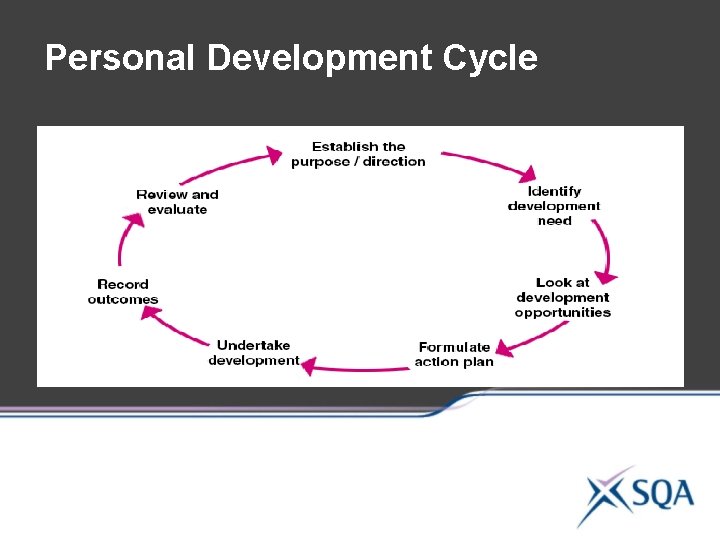
SQA’s CPD Model – Personal Development Plan (PDP) Personal development planning is the process of: Ø establishing aims and objectives (or goals) - what you want to achieve or where you want to go, in the short, medium or long-term in your career Ø assessing current realities Ø identifying needs for skills, knowledge or competence Ø selecting appropriate development activities to meet those perceived needs.
Personal Development Cycle
SQA’s CPD Model – Continuing Professional Development Record (CPDR) The sequential stages of Continuing Professional Development Record (CPDR) are: Ø Identify the date of the activity took place. Ø What did you do that contributes to your Continuing Professional Development (CPD)? Ø What did you learn from this activity that relates to some aspect of your Continuing Professional Development (CPD)? Ø How would you implement this learning? Ø Is there any further action? Ø Advise on the number of CPD hours completed.
Any Questions
“Ushare”
Objectives Ø Introduction to Ushare Ø How to register Ø How to upload links
SQA – Ushare Ø A new electronic platform for sharing general resources. (Learning and Teaching) Ø Vocational subject areas Ø Platform has been available since May 2015
SQA – Ushare Ø Health and Social Care (since Nov 2015) Ø SQA has added some useful links Ø Delegates encouraged to add useful links
SQA – Ushare Ø How do you access this website? – Page 5 Ø How do you register for this site?
SQA – Ushare – Weblink https: //ushare. education/Ushare/Home
Ushare as a Resource Ø Continually use links on site Ø Users of site add links to the site – Page 7
SQA Academy – Course Ø CPD for centre staff/students participating in HNCs/SVQs in Social Services, Childhood Practices and Healthcare Ø Joining a course on SQA Academy – Page 8
SQA Academy Ø CPD for centre staff/students participating in HNCs/SVQs in Social Services, Childhood Practices and Healthcare 2018/2019 Ø All legislation and guidance has been reviewed and updated where appropriate
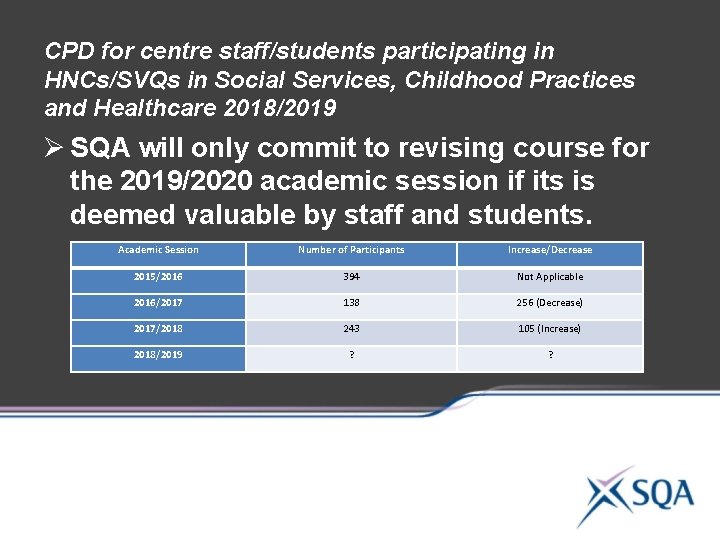
CPD for centre staff/students participating in HNCs/SVQs in Social Services, Childhood Practices and Healthcare 2018/2019 Ø SQA will only commit to revising course for the 2019/2020 academic session if its is deemed valuable by staff and students. Academic Session Number of Participants Increase/Decrease 2015/2016 394 Not Applicable 2016/2017 138 256 (Decrease) 2017/2018 243 105 (Increase) 2018/2019 ? ?
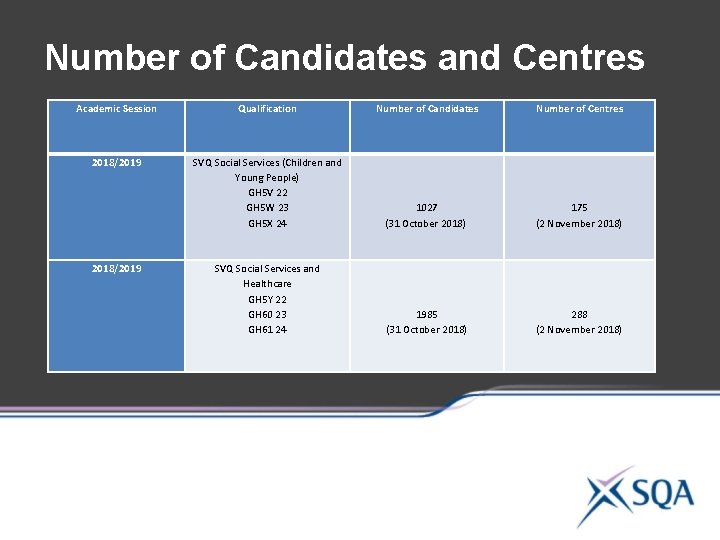
Number of Candidates and Centres Academic Session Qualification Number of Candidates Number of Centres 2018/2019 SVQ Social Services (Children and Young People) GH 5 V 22 GH 5 W 23 GH 5 X 24 1027 (31 October 2018) 175 (2 November 2018) SVQ Social Services and Healthcare GH 5 Y 22 GH 60 23 GH 61 24 1985 (31 October 2018) 288 (2 November 2018) 2018/2019
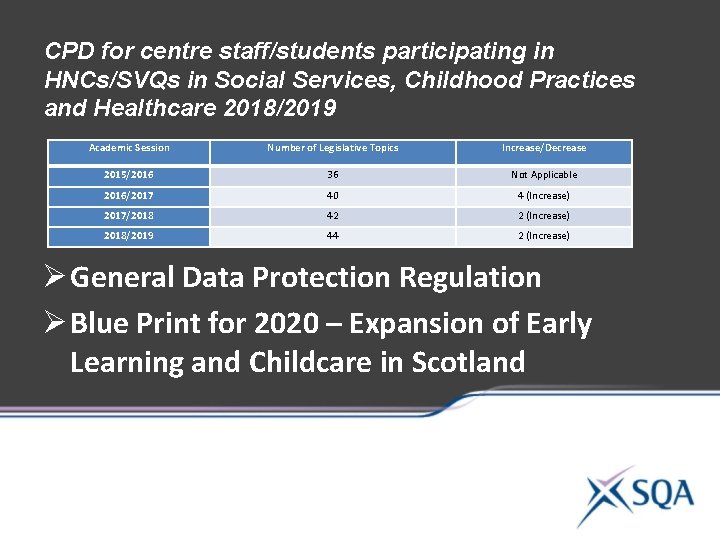
CPD for centre staff/students participating in HNCs/SVQs in Social Services, Childhood Practices and Healthcare 2018/2019 Academic Session Number of Legislative Topics Increase/Decrease 2015/2016 36 Not Applicable 2016/2017 40 4 (Increase) 2017/2018 42 2 (Increase) 2018/2019 44 2 (Increase) Ø General Data Protection Regulation Ø Blue Print for 2020 – Expansion of Early Learning and Childcare in Scotland
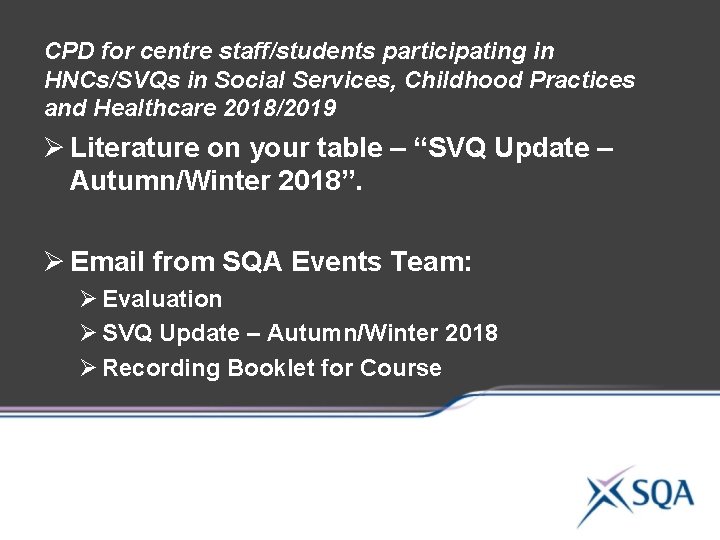
CPD for centre staff/students participating in HNCs/SVQs in Social Services, Childhood Practices and Healthcare 2018/2019 Ø Literature on your table – “SVQ Update – Autumn/Winter 2018”. Ø Email from SQA Events Team: Ø Evaluation Ø SVQ Update – Autumn/Winter 2018 Ø Recording Booklet for Course
Any Questions
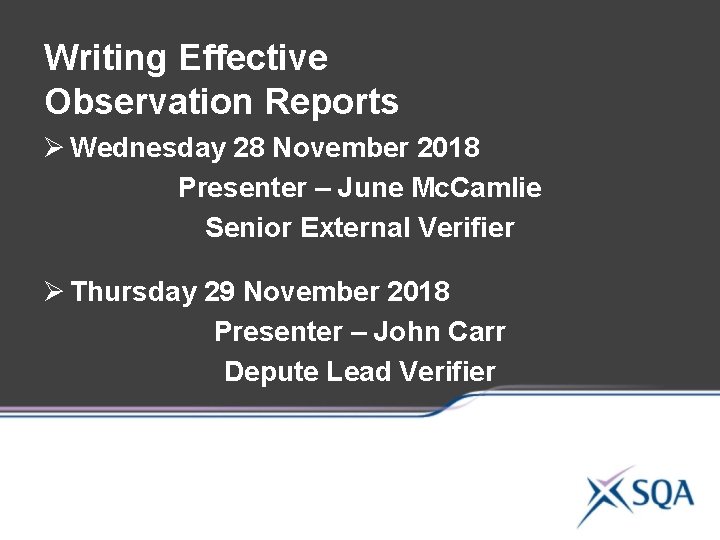
Writing Effective Observation Reports Ø Wednesday 28 November 2018 Presenter – June Mc. Camlie Senior External Verifier Ø Thursday 29 November 2018 Presenter – John Carr Depute Lead Verifier
Persuading the Reader Consider the various audiences and their needs from your reports. Ø Candidates. Ø Centre internal verifiers. Ø Qualification Verifiers. Ø Employers.
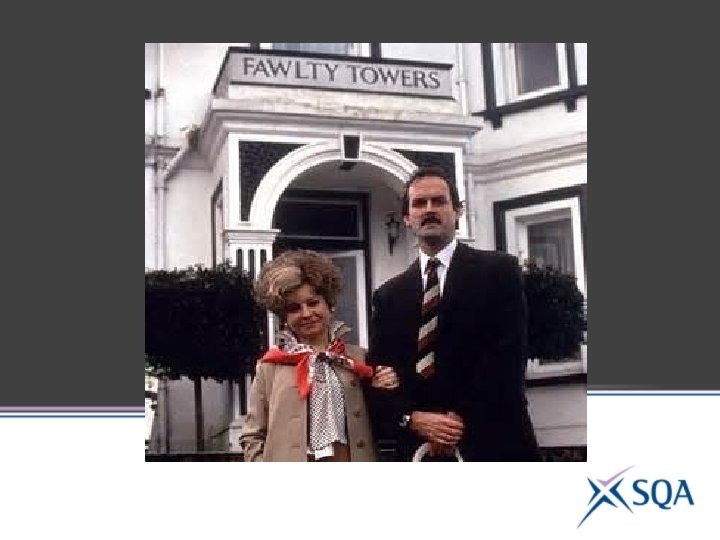
Persuading the Reader Hotel Report. Offering an ideal and idyllic location for your holiday. This modern and well equipped hotel offers easy access to the resort and all it’s amenities. The staff are professional and attentive and will create a pleasant and relaxing atmosphere throughout your stay.
Writing Effective Observation Reports Ø Write evidence-based, factual, evaluative statements – don’t express personal opinions. Ø Write in full sentences, not in note form. Ø Check spelling and grammar. Ø Ensure all terminology is current and correct. Avoid acronyms. Ø Avoid over-personalisation, use formal third person.
Persuading the Reader When writing evidence-based evaluative observation statements within a report, make sure that the evidence you have examined, observed or scrutinised supports your evaluations. Group Activity 1. Evaluative Statements
Persuading the Reader Group Activity 1 Albion Rovers vs Airdrie Instructions: 1 Nominate someone to report back from your group. 2 Read the information provided. 3 Within the group, agree a response to each question.
Persuading the Reader Sometimes things are not what they seem. Giorglo Varasi wrote the following evaluative statement within a report in 1178 about ‘Gerardo di Gerardo’. “He surveyed the site thoroughly before laying the foundation stones for the bell tower. Gerardo took great care and attention to ensure that the structure was sound, compact and stable. His professionalism, meticulous approach to detail and planning ensured a well constructed bell tower that will stand the test of time. ”
Any Questions
Question and Answer Session
www. sqa. org. uk I 0303 333 0330