Infants Children and Adolescents Eighth Edition Chapter 11


- Slides: 36
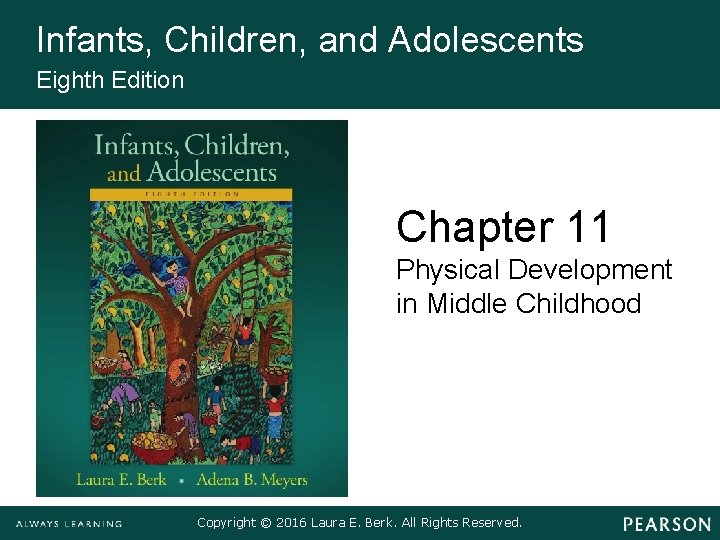
Infants, Children, and Adolescents Eighth Edition Chapter 11 Physical Development in Middle Childhood Copyright © 2016 Laura E. Berk. All Rights Reserved.
Learning Objectives (1 of 3) • • 11. 1 Describe changes in body size, proportions, and skeletal maturity during middle childhood. 11. 2 Describe brain development in middle childhood. 11. 3 Describe the causes and consequences of serious nutritional problems in middle childhood, giving special attention to obesity. 11. 4 What factors contribute to myopia, otitis media, nocturnal enuresis, and asthma, and how can these health problems be reduced? Copyright © 2016 Laura E. Berk. All Rights Reserved.
Learning Objectives (2 of 3) • • 11. 5 Describe changes in the occurrence of unintentional injuries during middle childhood, and cite effective interventions. 11. 6 What can parents and teachers do to encourage good health practices in school-age children? 11. 7 Cite major changes in gross- and fine-motor development during middle childhood. 11. 8 Describe individual differences in motor performance during middle childhood. Copyright © 2016 Laura E. Berk. All Rights Reserved.
Learning Objectives (3 of 3) • • 11. 9 What qualities of children’s play are evident in middle childhood? 11. 10 What steps can schools take to promote physical fitness in middle childhood? Copyright © 2016 Laura E. Berk. All Rights Reserved.
Body Growth in Middle Childhood • Physical growth continues at a slow, regular pace. • Girls are slightly shorter and lighter than boys until about age 9, when this trend reverses. • Lower portion of body is growing fastest. • After age 8, girls accumulate fat at a faster rate. Copyright © 2016 Laura E. Berk. All Rights Reserved.
Middle Childhood Growth Worldwide • Shortest children are found in South America, Asia, Pacific Islands, parts of Africa. • Tallest children are found in Australia, northern and central Europe, Canada, United States. • Factors accounting for physical size differences: – Heredity: Evolutionary adaptations to particular climates – Environment: Availability or scarcity of food; control of infectious diseases Copyright © 2016 Laura E. Berk. All Rights Reserved.
Secular Trends in Physical Growth • In industrialized nations, a secular gain in height and weight – appears early in life. – increases over childhood and early adolescence. – declines as mature body size is reached. • Gain is largely due to improved health and nutrition. • Gains in height have stabilized, but weight gain continues. Copyright © 2016 Laura E. Berk. All Rights Reserved.
Skeletal Growth in Middle Childhood • Bones lengthen and broaden. • Ligaments are not yet firmly attached to bones, resulting in unusual flexibility. • Nighttime “growing pains” are common. • By age 12, all primary teeth have been replaced by permanent teeth. • Malocclusion occurs in one-third of school-age children. Copyright © 2016 Laura E. Berk. All Rights Reserved.
Brain Development in Middle Childhood • Weight of the brain increases by 10%: – White matter rises steadily, especially in prefrontal cortex, parietal lobes, and corpus callosum. – Gray matter peaks in middle childhood and then declines as as result of synaptic pruning. • Synaptic pruning and reorganization and selection of brain circuits lead to more effective information processing. • Neurotransmitters and hormones may affect brain development and functioning. Copyright © 2016 Laura E. Berk. All Rights Reserved.
Common Health Problems in Middle Childhood • Nutrition • Overweight and obesity • Vision and hearing • Bedwetting • Illnesses • Unintentional injuries Copyright © 2016 Laura E. Berk. All Rights Reserved.
Nutrition in Middle Childhood • Causes of poor nutrition: – – More focus on new friends and activities, less on eating Drop in percentage of children eating meals with family Poor-quality diets high in soft drinks and fast foods Malnutrition resulting from poverty • Children report feeling better and focusing better after eating healthy foods. • Prolonged malnutrition can result in permanent physical and mental impairments. Copyright © 2016 Laura E. Berk. All Rights Reserved.
Overweight and Obesity • About 32% of U. S. children and adolescents are overweight, 17% obese, based on body mass index (BMI). • Dramatic rise in overweight and obesity has occurred in many Western nations. • Obesity rates have risen in developing countries as a result of urbanization and dietary shifts. – In China, 20% of children are overweight and 8% are obese—a fortyfold increase over the past 25 years. – Cultural beliefs may contribute (view of overweight as sign of prosperity). • Obese children are at risk for physical, emotional, and social problems. Copyright © 2016 Laura E. Berk. All Rights Reserved.
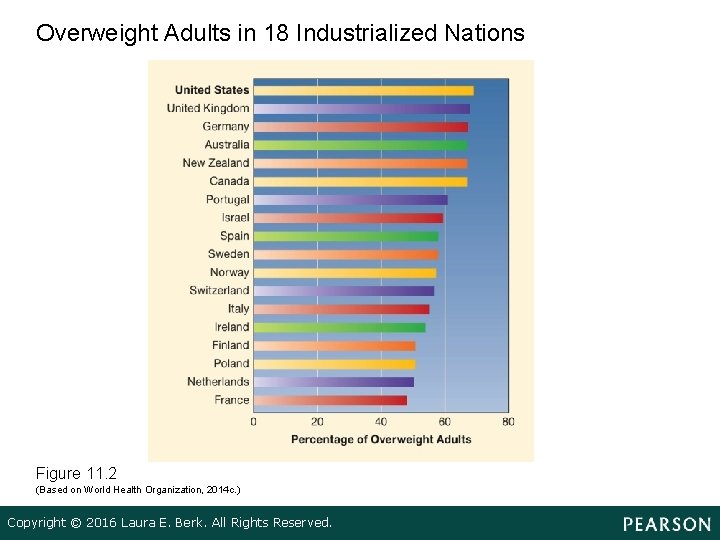
Overweight Adults in 18 Industrialized Nations Figure 11. 2 (Based on World Health Organization, 2014 c. ) Copyright © 2016 Laura E. Berk. All Rights Reserved.
Causes of Obesity in Middle Childhood • Heredity (overweight parents) • Socioeconomic status • Early growth pattern of rapid weight gain • Family eating habits: use of food as reward, overfeeding, parental control of children’s intake • Responsiveness to food cues vs. hunger • Lack of physical activity • Television viewing • Early malnutrition and growth stunting Copyright © 2016 Laura E. Berk. All Rights Reserved.
Family Stressors and Childhood Obesity Stressful daily life prompts overeating through various routes: • Elevated stress hormones signal brain to boost caloric intake. • Chronic stress triggers insulin resistance. • Effort required to manage persistent stress strains self-regulatory capacity, interfering with ability to limit excessive eating. Copyright © 2016 Laura E. Berk. All Rights Reserved.
Consequences of Obesity • Social isolation leads to emotional, social, and school difficulties. • Unhappiness and overeating contribute to each other. • Overweight girls are likely to reach puberty early. • Life chances are reduced by psychological consequences combined with discrimination. Copyright © 2016 Laura E. Berk. All Rights Reserved.
Treating Obesity • Family-based interventions: – Focus is on changing behaviors, both diet and exercise. – Rewards for giving up inactivity are helpful. • School interventions: – Schools can serve healthier lunches and ensure regular physical activity. – Other measures include weight-related school screenings and improved school nutrition standards. • National campaigns, such as Let’s Move Copyright © 2016 Laura E. Berk. All Rights Reserved.
Vision and Hearing • Myopia (nearsightedness): – Most common vision problem in middle childhood – Affected by heredity, early biological trauma, increased eye strain – Increases with SES • Otitis media (middle ear infection): – Common in early childhood – May cause hearing loss after repeated infections • Regular screenings: Early detection and correction of vision and hearing defects Copyright © 2016 Laura E. Berk. All Rights Reserved.
Bedwetting Nocturnal enuresis (bedwetting during the night) • occurs in 10 children. • affects more boys than girls at all ages. • usually has biological roots. • can be treated with medication or, more effectively, by using a urine alarm. Copyright © 2016 Laura E. Berk. All Rights Reserved.
Illnesses in Middle Childhood • Rates of illness rise during first two years of school because of – exposure to sick children. – an immune system that is still developing. • About 20– 25% of U. S. children living at home have chronic diseases: – Asthma, the most common, has increased steadily over past several decades. – Severe illnesses (sickle cell anemia, cystic fibrosis, diabetes, arthritis, cancer, AIDS) affect about 2% of U. S. children. Copyright © 2016 Laura E. Berk. All Rights Reserved.
Interventions for Families with Chronically Ill Children • Health education: Parents and children learn about illness and how to manage it. • Home visits: Health professionals offer counseling and social support to parents and children. • Schools can accommodate special health and education needs. • Disease-specific summer camps teach children self-help skills and give parents time off. • Parent and peer support groups can help families cope. Copyright © 2016 Laura E. Berk. All Rights Reserved.
Unintentional Injuries in Middle Childhood • Most common types of injuries: – Motor vehicle accidents involving children as passengers or pedestrians – Bicycle accidents • Characteristics of effective injury-prevention programs: – Modeling and rehearsing safety practices – Targeting specific injury risks, such as traffic safety – Emphasizing helmet use while bicycling, in-line skating, skateboarding, or using scooters – Taking steps to alter high-risk factors in families of highly active, impulsive children Copyright © 2016 Laura E. Berk. All Rights Reserved.
Health Education for School-Age Children • School-age period is especially important for fostering healthy lifestyles. – Gap remains between knowledge of health information and children’s behavior. – Adults should work to reduce environmental health risks. – Parents and teachers must model and reinforce good health practices. Copyright © 2016 Laura E. Berk. All Rights Reserved.
Fostering Healthy Lifestyles in School-Age Children • Increase health-related knowledge, encourage healthy behaviors. • Involve parents in supporting health education. • Provide healthy environments in schools. • Provide voluntary screening for risk factors. • Promote pleasurable physical activity. • Teach children to be critical of media advertising. • Work for safer, healthier community environments. Copyright © 2016 Laura E. Berk. All Rights Reserved.
Motor Development in Middle Childhood • Gains in basic gross-motor capacities: – Flexibility – Balance – Agility – Force • Advances in fine-motor skills: – Writing – Drawing Copyright © 2016 Laura E. Berk. All Rights Reserved.
Changes in Gross-Motor Skills During Middle Childhood • Running: increased speed • Other gait variations: skipping, sideways stepping • Vertical jump and standing broad jump: performance improvements • Precision jumping and hopping • Throwing and catching: improved ability over greater distances • Kicking: improved speed and accuracy • Batting: more effective batting motions • Dribbling: improvements in style Copyright © 2016 Laura E. Berk. All Rights Reserved.
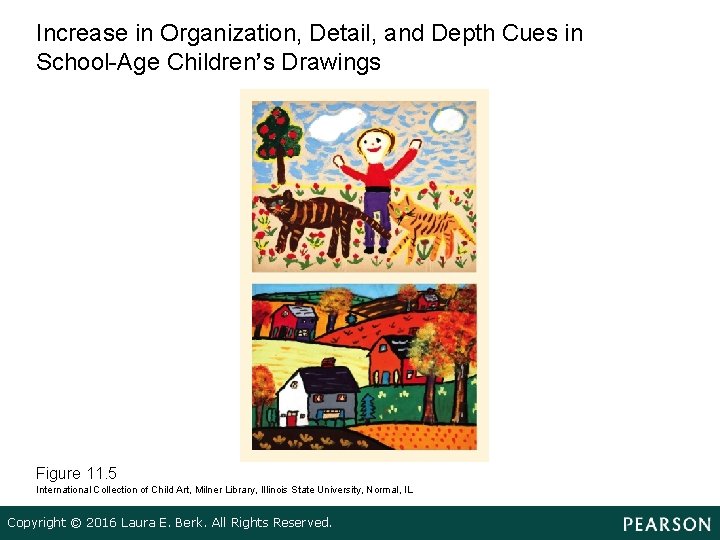
Fine-Motor Development in Middle Childhood Writing: • Mastery of uppercase letters, then lowercase • Increased legibility Drawing: • Dramatic gains in organization, detail, representation of depth • Ability to copy two-dimensional shapes • Ability to relate objects to one another as part of an organized whole Copyright © 2016 Laura E. Berk. All Rights Reserved.
Increase in Organization, Detail, and Depth Cues in School-Age Children’s Drawings Figure 11. 5 International Collection of Child Art, Milner Library, Illinois State University, Normal, IL Copyright © 2016 Laura E. Berk. All Rights Reserved.
Individual Differences in Motor Skills • Differences reflect both heredity and environment. • Body build: Taller, more muscular children excel at many motor tasks. • Family income and parental encouragement affect access to lessons in athletics and other motor skills. • Sex differences extend and, in some instances, become more pronounced: – Girls have advantage in fine-motor skills as well as balance and agility. – Boys outperform girls on throwing, kicking, and other gross-motor skills. • Educating parents about minimal differences between boys’ and girls’ physical capacities can help increase girls’ self-confidence and participation. Copyright © 2016 Laura E. Berk. All Rights Reserved.
Games with Rules • Gains in perspective taking permit transition to games with rules. • These experiences contribute to emotional and social development. • Informal play is declining in industrialized countries, as a result of – parental concern about neighborhood safety. – competition from TV, video games, Internet. – rise in adult-organized sports • Child-organized games express distinct cultural values. Copyright © 2016 Laura E. Berk. All Rights Reserved.
Adult-Organized Youth Sports • About half of U. S. children aged 5 to 18 participate in organized sports outside of school. • Participation is generally associated with increased self-esteem and social skills. • Valid criticisms of organized sports include – overemphasis on competition and adult control. – potential for social ostracism of weaker performers, especially for boys. Copyright © 2016 Laura E. Berk. All Rights Reserved.
Providing Developmentally Appropriate Organized Sports in Middle Childhood • Build on children’s interests. • Teach age-appropriate skills. • Emphasize enjoyment. • Limit frequency and length of practices. • Focus on personal and team improvement. • Discourage unhealthy competition. • Let children contribute to rules and strategies. Copyright © 2016 Laura E. Berk. All Rights Reserved.
Rough-and-Tumble Play • Friendly chasing and play-fighting • Emerges in preschool years, peaks in middle childhood • Common in many mammals and across cultures • More common among boys • Helpful in establishing dominance hierarchy Copyright © 2016 Laura E. Berk. All Rights Reserved.
School Recess • In U. S. school districts, – 80% no longer mandate recess for students. – fewer than half mandate at least 20 minutes of recess per day. • Recess periods boost classroom learning by – distributing cognitively demanding task over longer time. – enhancing attention and performance at all ages. • Children may be more active at recess than in gym class. • Recess fosters children’s health and physical, academic, and social competence. Copyright © 2016 Laura E. Berk. All Rights Reserved.
Physical Education in Middle Childhood • Physical activity supports children’s – health. – sense of self-worth as physically active, capable beings. – cognitive and social skills necessary for getting along with others. • Among U. S. students, – nearly half have no physical education classes in a typical week. – fewer than one-third engage in moderate-intensity activity for 60 minutes per day. • Physical education should – emphasize enjoyable, informal games and individual exercise. – focus on each child’s personal progress and team contribution. Copyright © 2016 Laura E. Berk. All Rights Reserved.
Readers may view, browse, and/or download material for temporary copying purposes only, provided these uses are for noncommercial personal purposes. Except as provided by law, this material may not be further reproduced, distributed, transmitted, modified, adapted, performed, displayed, published, or sold in whole or in part, without prior written permission from the publisher. Copyright © 2016 Laura E. Berk. All Rights Reserved.