Strategies for a Successful LMS Replacement January 11
- Slides: 26
Strategies for a Successful LMS Replacement January 11, 2013
Presenters John Leh VP of Sales and Marketing Meridian Knowledge Solutions, LLC jleh@meridianksi. com Twitter: @John. Leh Linked. In: John. Leh
Meridian • • Providing a portfolio of human capital platforms and subject matter expertise Empowering organizations to optimize their business processes and drive breakthrough results – Founded in 1997 – Product and a Service Company – Wholly owned subsidiary of Visionary Integration Professionals – #1 Enterprise LMS – ELearning! Magazine (2011 & 2012) – #1 in Ease of Use & Overall Usability - e. Learning Guild Survey – #1 in Customer Service – Latest CLO Awards – 98% Customer Retention Rate – Strategic focus on large, global, integrated learning technology solutions – Brandon Hall Smart Choice Award Winner – 8, 500, 000+ active users and 350 deployments worldwide
Today’s Agenda • • Top 5 Replacement Strategies Multi Industry Case Study Steps of a LMS Replacement Process Wrap up and Questions
Poll Question One • Who is on the webinar today? • • • We’re happy with our LMS What LMS? Actively Searching for LMS replacement Underway on replacement implementation Trying to build a business case to switch Other If you’ve selected “other” please describe in the Q&A box.
Why Organizations Replace their LMS • • Scared about current vendor going out of business Need integrated PM and TM Want to migrate to a Saa. S solution Your LMS was acquired No longer supporting Behind the Firewall Need to support the extended enterprise Reporting and Integration Challenges Functionality Shortfalls
Top 5 Successful Replacement Strategies 1. Consider Your Entire Eco-System 2. Search for Hidden ROI 3. Partner with your Provider 4. Requirements and RFP 5. Focus on Organizational Acceptance
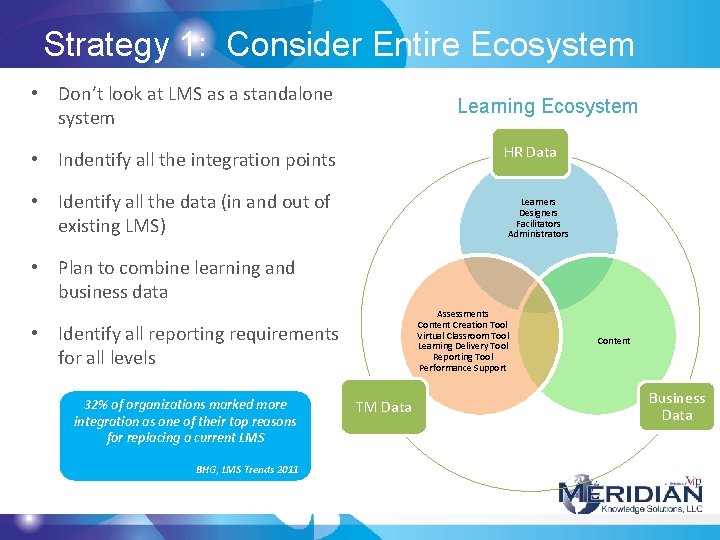
Strategy 1: Consider Entire Ecosystem • Don’t look at LMS as a standalone system Learning Ecosystem HR Data • Indentify all the integration points • Identify all the data (in and out of existing LMS) Learners Designers Facilitators Administrators • Plan to combine learning and business data Assessments Content Creation Tool Virtual Classroom Tool Learning Delivery Tool Reporting Tool Performance Support • Identify all reporting requirements for all levels 32% of organizations marked more integration as one of their top reasons for replacing a current LMS BHG, LMS Trends 2011 TM Data Content Business Data
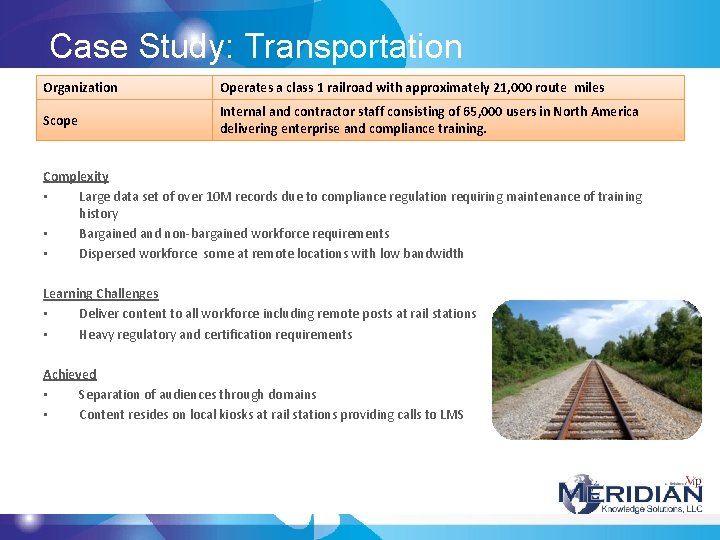
Case Study: Transportation Organization Operates a class 1 railroad with approximately 21, 000 route miles Scope Internal and contractor staff consisting of 65, 000 users in North America delivering enterprise and compliance training. Complexity • Large data set of over 10 M records due to compliance regulation requiring maintenance of training history • Bargained and non-bargained workforce requirements • Dispersed workforce some at remote locations with low bandwidth Learning Challenges • Deliver content to all workforce including remote posts at rail stations • Heavy regulatory and certification requirements Achieved • Separation of audiences through domains • Content resides on local kiosks at rail stations providing calls to LMS
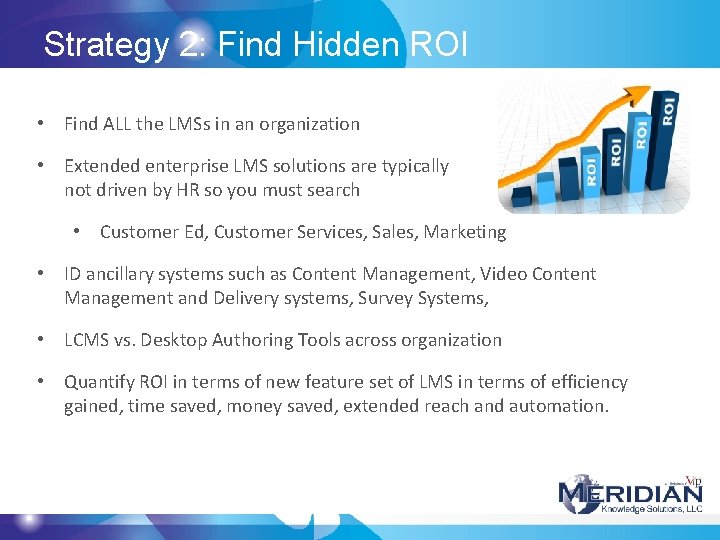
Strategy 2: Find Hidden ROI • Find ALL the LMSs in an organization • Extended enterprise LMS solutions are typically not driven by HR so you must search • Customer Ed, Customer Services, Sales, Marketing • ID ancillary systems such as Content Management, Video Content Management and Delivery systems, Survey Systems, • LCMS vs. Desktop Authoring Tools across organization • Quantify ROI in terms of new feature set of LMS in terms of efficiency gained, time saved, money saved, extended reach and automation.
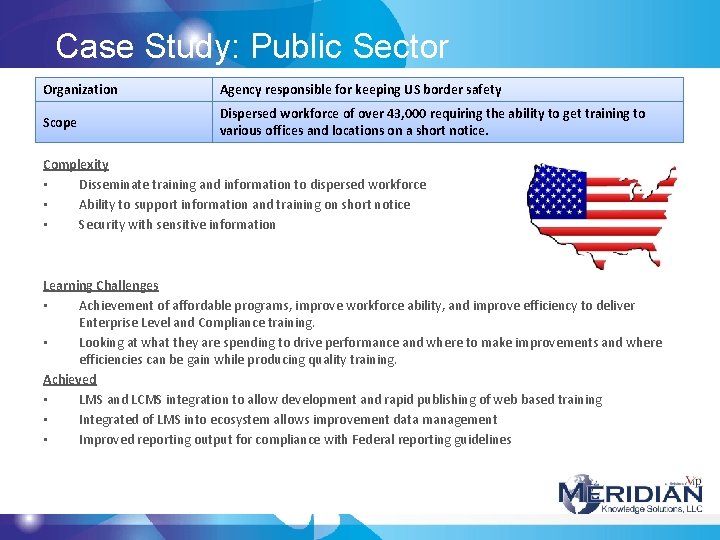
Case Study: Public Sector Organization Agency responsible for keeping US border safety Scope Dispersed workforce of over 43, 000 requiring the ability to get training to various offices and locations on a short notice. Complexity • Disseminate training and information to dispersed workforce • Ability to support information and training on short notice • Security with sensitive information Learning Challenges • Achievement of affordable programs, improve workforce ability, and improve efficiency to deliver Enterprise Level and Compliance training. • Looking at what they are spending to drive performance and where to make improvements and where efficiencies can be gain while producing quality training. Achieved • LMS and LCMS integration to allow development and rapid publishing of web based training • Integrated of LMS into ecosystem allows improvement data management • Improved reporting output for compliance with Federal reporting guidelines
Poll Question Two What is your PRIMARY concern in replacing your LMS? 1. Moving my content and courses 2. Communicating changes to end-users 3. Transferring historical reporting data 4. Re-setting up structure and domain information 5. Other If you’ve selected other please place your concern in the Q&A box.
Strategy 3: Requirements and RFP • Take the Time! Never be too busy for a RFP • Use Hidden ROI to expand requirements • Quantify current functionality gaps • Prioritize extended enterprise requirements • Use case scenarios and demonstrations • Don’t not send RFP to more than 5 vendors 27% of organizations marked ease of use and reporting features one of their top reasons for replacing a current LMS BHG, LMS Trends 2011
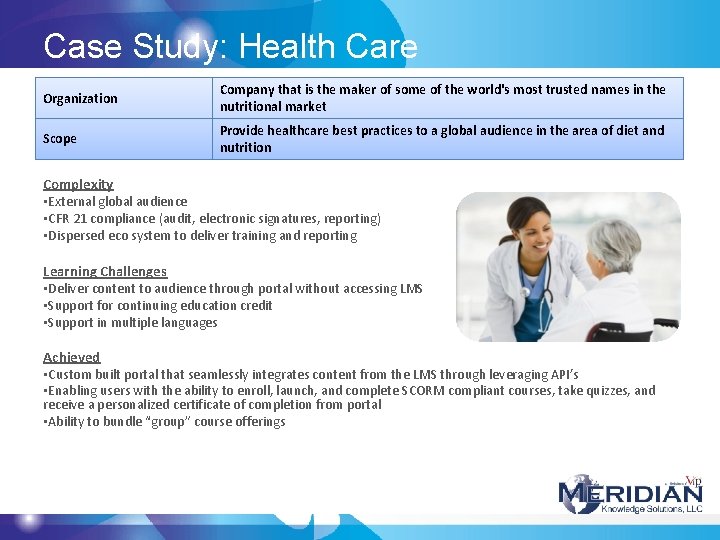
Case Study: Health Care Organization Company that is the maker of some of the world's most trusted names in the nutritional market Scope Provide healthcare best practices to a global audience in the area of diet and nutrition Complexity • External global audience • CFR 21 compliance (audit, electronic signatures, reporting) • Dispersed eco system to deliver training and reporting Learning Challenges • Deliver content to audience through portal without accessing LMS • Support for continuing education credit • Support in multiple languages Achieved • Custom built portal that seamlessly integrates content from the LMS through leveraging API’s • Enabling users with the ability to enroll, launch, and complete SCORM compliant courses, take quizzes, and receive a personalized certificate of completion from portal • Ability to bundle “group” course offerings
Strategy 4: Partner with your Provider • Execute the NDA and be free with information • Don’t keep the top contenders in the dark • Define your LMS provider project manager, relationship manager, and executive sponsor. • Spend time learning about the experience and approach of your LMS provider.
Case Study: Financial Organization Provides professional financial guidance and credit counseling, to consumers via phone, Internet and in-person sessions. Scope Deploy a learning and development backbone to support the launching, tracking, reporting needs of internal, partner organizations and the constituents they serve. Complexity • Achieve needs of both internal and external community • Transition from paper based processes to web based system with automation • Protect sensitive information Learning Challenges • Enable their business grow exponentially and provide measurable value to their clients through training offerings • To support their clients who want to send their employees to courses or curriculums. • Improvement management of ILT activities throughout the organization. • Deliver, track and report on e-Learning progress Achieved • Created full automation on training and outreach activities • Business process and workflow changes providing in improved efficiency • Improved data analytics improved helped create focus on core issues
Strategy 5: Focus on Organization Acceptance Begin with the end in mind • You’ve already identified the audiences, the next step is easy. • Create top down communication plans to launch the LMS for each audience. • Quick step action video or guide for audiences on what they are expected to do • Tailor LMS functionality for each audience to only display what is required. • Unhappy and confused end-users – unable to find content, access reports, or leverage the tool in their work day • Schedule and automate reports 27% of organizations marked ease of use and reporting features one of their top reasons for replacing a current LMS BHG, LMS Trends 2011
Case Study: Extended Enterprise Organization Sells training to support CPA continued education Scope External audience with nearly 370, 000 CPA members in 128 countries in business and industry, public practice, government, education, student affiliates and international associates Complexity • External global audience with various browsers and internet speed • Seasonality resulting in peak usage time putting extreme demand on the system • Revenue driven model vs. organizational performance Learning Challenges • Ability to market content and offerings • Increase content purchase to drive revenue Achieved • 600 course completions per hour during peak • Revenue increase of 50% over previous year
Top 5 Successful Replacement Strategies 1. Consider Your Entire Eco-System 2. Search for Hidden ROI 3. Partner with your Provider 4. Requirements and RFP 5. Focus on Organizational Acceptance
Poll Question Three What are your QUESTIONS in today's current LMS market? 1. Merger and acquisition activity 2. Meeting the needs of internal and external audiences 3. Evolution and adoption of multiple delivery methods 4. Evolution from learning reporting to performance analytics 5. Other If you’ve selected other please place the question area in the Q&A box.
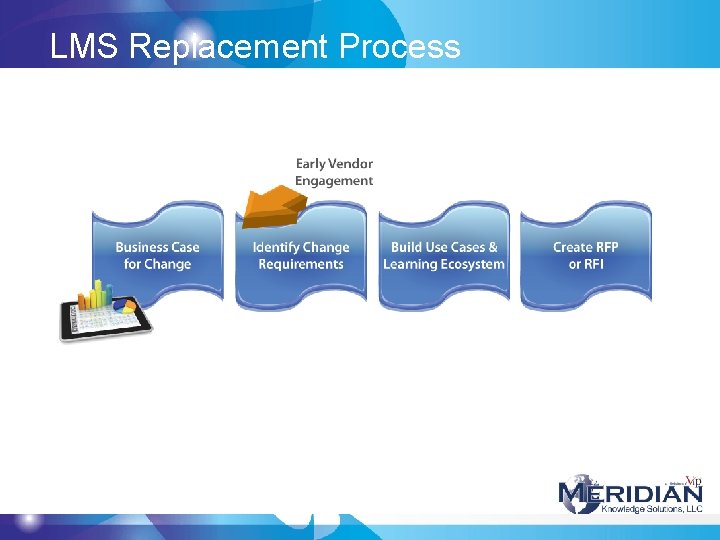
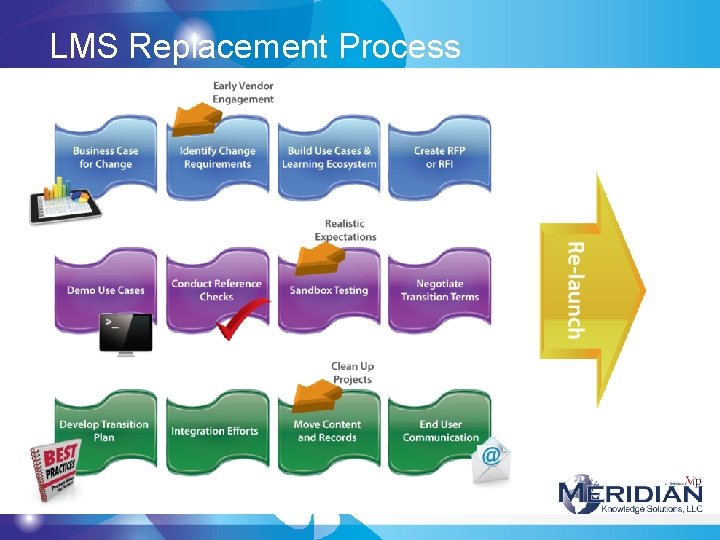
LMS Replacement Process
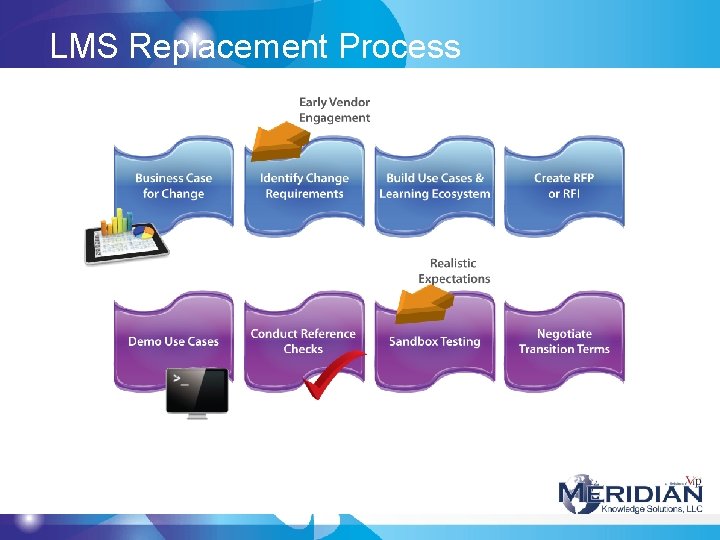
LMS Replacement Process
LMS Replacement Process
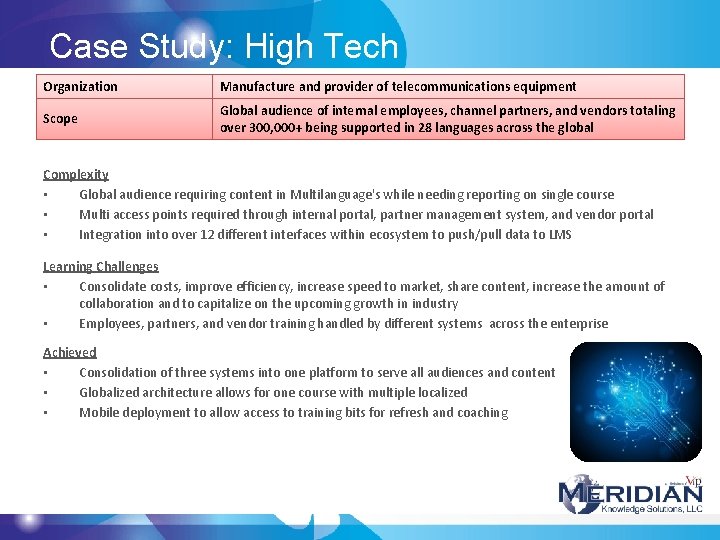
Case Study: High Tech Organization Manufacture and provider of telecommunications equipment Scope Global audience of internal employees, channel partners, and vendors totaling over 300, 000+ being supported in 28 languages across the global Complexity • Global audience requiring content in Multilanguage's while needing reporting on single course • Multi access points required through internal portal, partner management system, and vendor portal • Integration into over 12 different interfaces within ecosystem to push/pull data to LMS Learning Challenges • Consolidate costs, improve efficiency, increase speed to market, share content, increase the amount of collaboration and to capitalize on the upcoming growth in industry • Employees, partners, and vendor training handled by different systems across the enterprise Achieved • Consolidation of three systems into one platform to serve all audiences and content • Globalized architecture allows for one course with multiple localized • Mobile deployment to allow access to training bits for refresh and coaching
Questions John Leh VP of Sales and Marketing Meridian Knowledge Solutions, LLC jleh@meridianksi. com Twitter: @John. Leh Linked. In: John. Leh
Thank You!