Strategic Planning and Measurement Where are you going
- Slides: 93
Strategic Planning and Measurement • Where are you going? • How do you know you’re there?
Introduction Housekeeping items –Restroom locations –Breaks –Lunch –Cell phone use – Questions welcome – Balance between content and sharing – “Parking lot” for ideas 2
Introduction • • • Name Organization One concept from Course I that you did or will apply
Introduction Learning Objectives: – Assess current recognition initiatives – Align recognition strategies to business objectives and culture – Identify goals to support plan – Create baseline measurements – Measure and track plan – Link Best Practices to future plan
Introduction CRP Background – One of four certification courses – Facilitator led – Pass exam – Set common standards – Acquire skills and knowledge
Introduction Agenda (2 breaks & lunch) – Setting the Stage – Assessment – Strategy – Implementation – Review – Summary – Testing
Introduction Materials: – Models, – Worksheets, – Best Practices examples, – Article excerpts, – Progress Checks, – Reference and resource suggestions, and – Course evaluation (start NOW)
Setting the Stage Section Learning Objectives – Distinguish between incentives, awards, rewards, and recognition – List the five key Recognition Strategy components – Describe how recognition contributes to Unique People Practices – Describe how recognition fits into a Total Rewards structure – Identify how recognition can reduce turnover
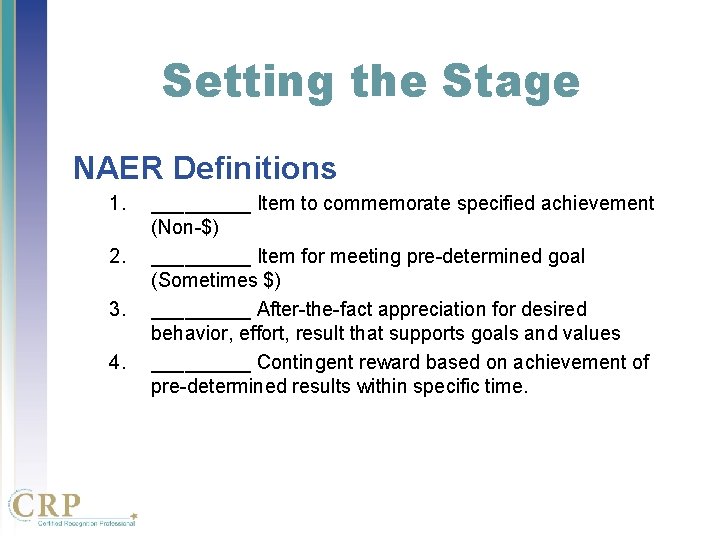
Setting the Stage NAER Definitions 1. 2. 3. 4. _____ Item to commemorate specified achievement (Non-$) _____ Item for meeting pre-determined goal (Sometimes $) _____ After-the-fact appreciation for desired behavior, effort, result that supports goals and values _____ Contingent reward based on achievement of pre-determined results within specific time.
Setting the Stage Descriptor Answers 1. Informal 2. Formal 3. Day-to-day
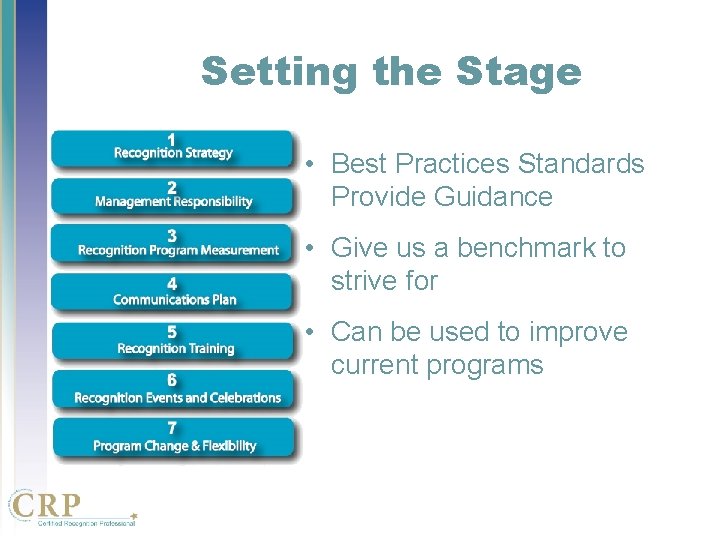
Setting the Stage • Best Practices Standards Provide Guidance • Give us a benchmark to strive for • Can be used to improve current programs
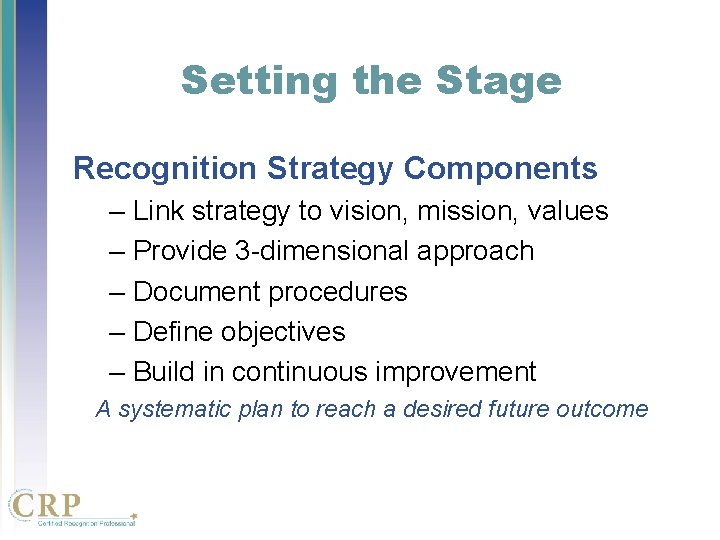
Setting the Stage Recognition Strategy Components – Link strategy to vision, mission, values – Provide 3 -dimensional approach – Document procedures – Define objectives – Build in continuous improvement A systematic plan to reach a desired future outcome
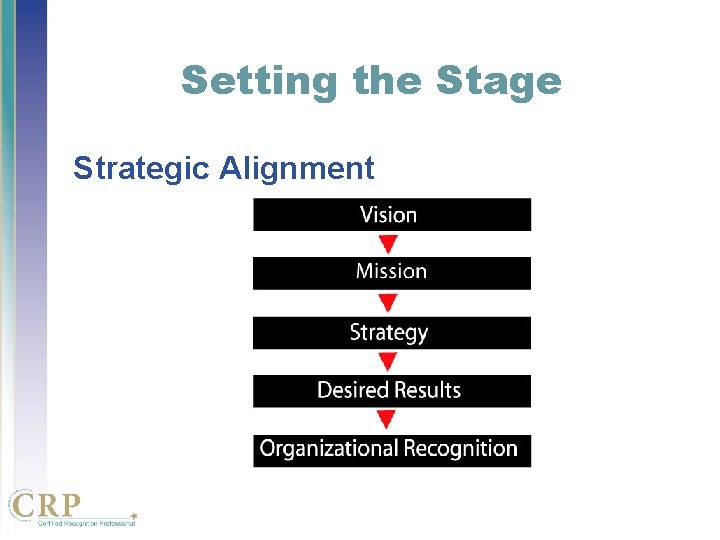
Setting the Stage Strategic Alignment
Setting the Stage Cascading Linkages: – Companywide – Business unit – Site/location – Functional – Departmental
Setting the Stage Concepts from SRPS – Job satisfaction – Pay and promotion – Trust – Maslow
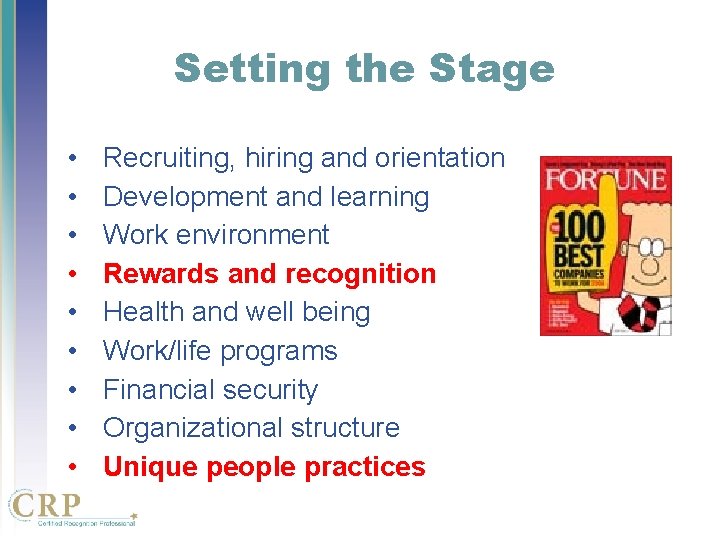
Setting the Stage • • • Recruiting, hiring and orientation Development and learning Work environment Rewards and recognition Health and well being Work/life programs Financial security Organizational structure Unique people practices
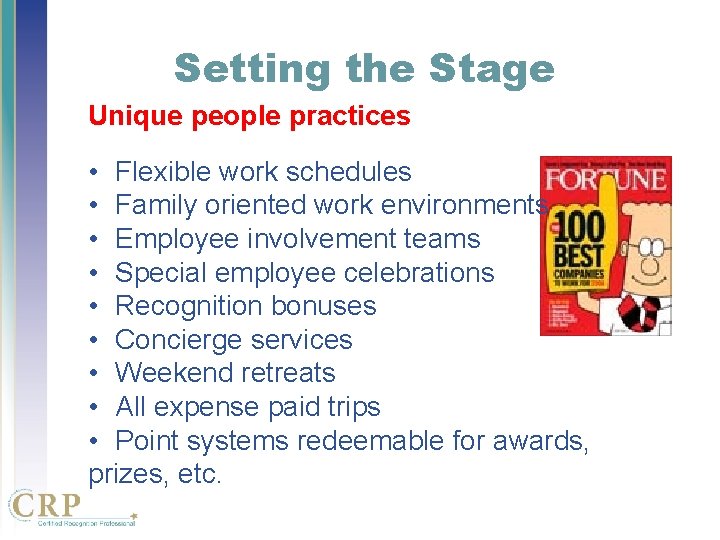
Setting the Stage Unique people practices • Flexible work schedules • Family oriented work environments • Employee involvement teams • Special employee celebrations • Recognition bonuses • Concierge services • Weekend retreats • All expense paid trips • Point systems redeemable for awards, prizes, etc.
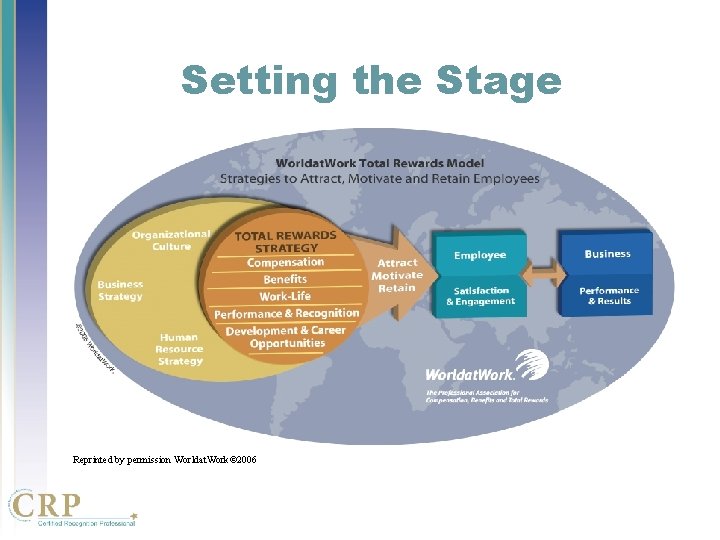
Setting the Stage Reprinted by permission Worldat. Work© 2006
Setting the Stage Total Rewards Context – Recognition is one aspect of Total Rewards – Separate from compensation (bonuses) – Separate from benefits
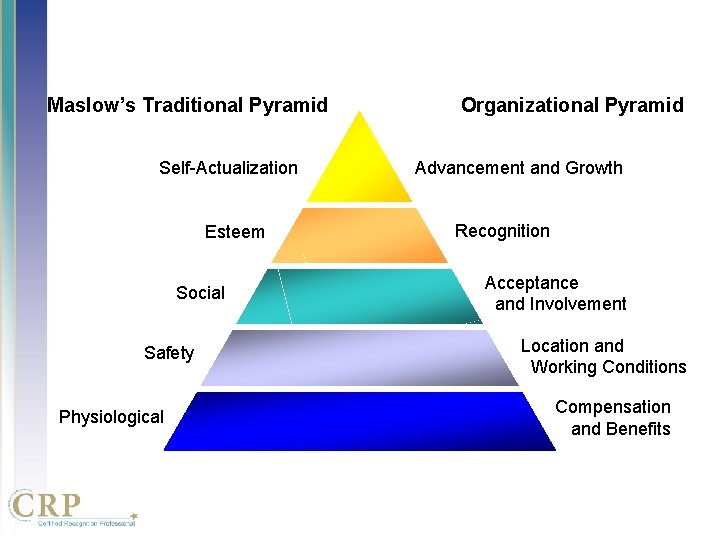
Maslow’s Traditional Pyramid Self-Actualization Esteem Social Safety Physiological Organizational Pyramid Advancement and Growth Recognition Acceptance and Involvement Location and Working Conditions Compensation and Benefits
Setting the Stage Activity – Write the corresponding Total Rewards letter(s) to the right of the organizational pyramid. – There may be more than one letter per level
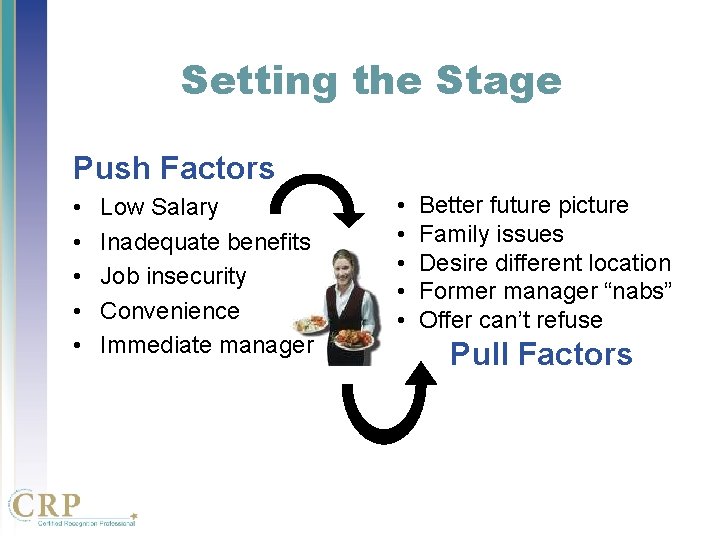
Setting the Stage Push Factors • • • Low Salary Inadequate benefits Job insecurity Convenience Immediate manager • • • Better future picture Family issues Desire different location Former manager “nabs” Offer can’t refuse Pull Factors
Setting the Stage Turnover is EXPENSIVE – Direct – Indirect – From 50% + of annual wage/salary Between $25, 000 - $37, 500 for $50, 000 salary
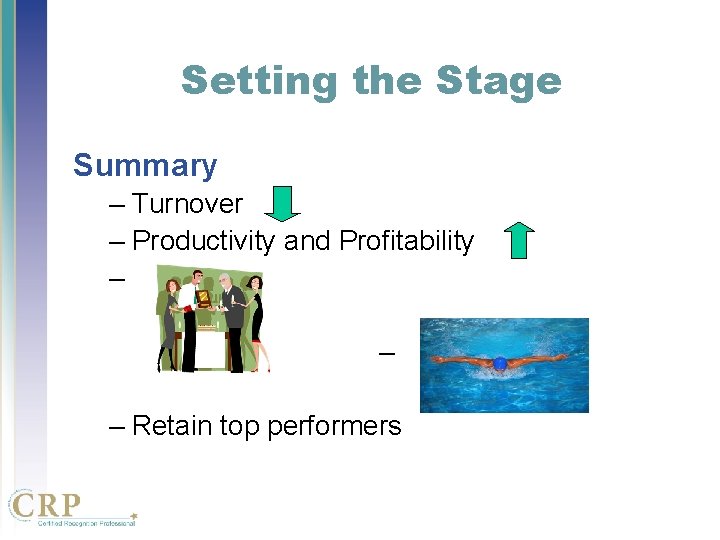
Setting the Stage Summary – Turnover – Productivity and Profitability – – – Retain top performers
Setting the Stage Progress Check – See what YOU think is important! – Assigned pages by group – Come up with 1 question – Be ready to present question to rest of group
Assessment and Strategy Section Learning Objectives – Conduct an initial inventory – Align to goals and culture – Name four SWOT quadrants – Identify benchmarking strategy
Assessment and Strategy Four Strategic Planning Phases Simplified chart
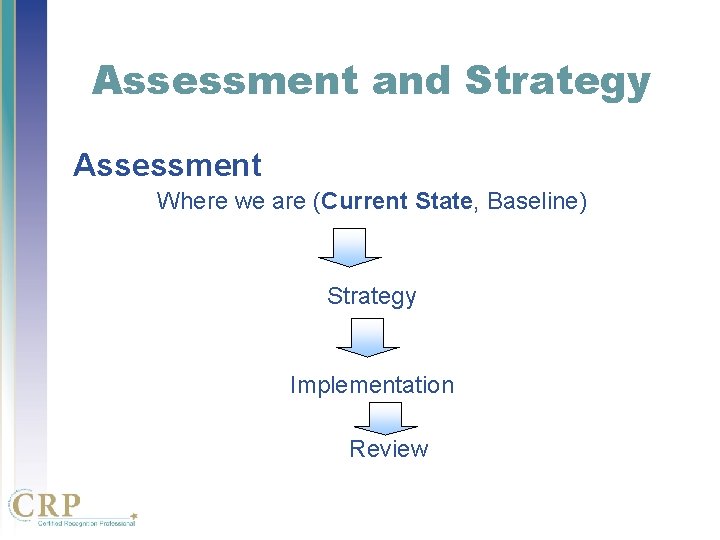
Assessment and Strategy Assessment Where we are (Current State, Baseline) Strategy Implementation Review
Assessment and Strategy Assessment Considerations Programs? • Name as many as you can in left-hand column Type? • Incentives or recognition? Dimension • Day-to-day, informal, formal? Include? • Seven Best Practices Standards • Objectives in alignment • Feedback
Assessment and Strategy Current State Inventory - Worksheet Activity – pages 21 -23 (overall sheet) – Check and tally for each Component • • Type Dimension Standards Feedback
Assessment and Strategy Results? – What’s the mix? – What are you over using? – What’s missing? – What will stay/go?
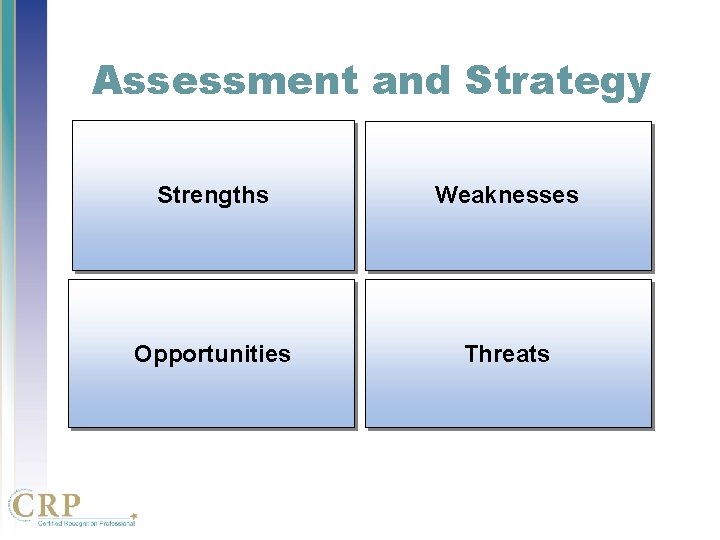
Assessment and Strategy Strengths Weaknesses Opportunities Threats
Assessment and Strategy SWOT Analysis – Strengths (what keep) – Weaknesses (what eliminate/revise) – Opportunities (enhance, fill gap) – Threats (what’s getting in the way)
Assessment and Strategy SWOT in a Nutshell – Be realistic – Distinguish between today and future – Specific – Short and simple Subjective
Assessment and Strategy Exercise – Review your Current State organizational worksheet – Transfer 2 -3 conclusions for each part of the SWOT diagram
Assessment and Strategy Benchmarking – Assessment – If want to enhance, create, develop a benchmarking strategy – Within, external, best practices – Identify goals www. recognition. org
Assessment and Strategy Benchmarking Considerations – Resources – process analysis, research, change management – Discovery phase • • • Data collection plan List Tracking plan Gap analysis Final Report Recommendations
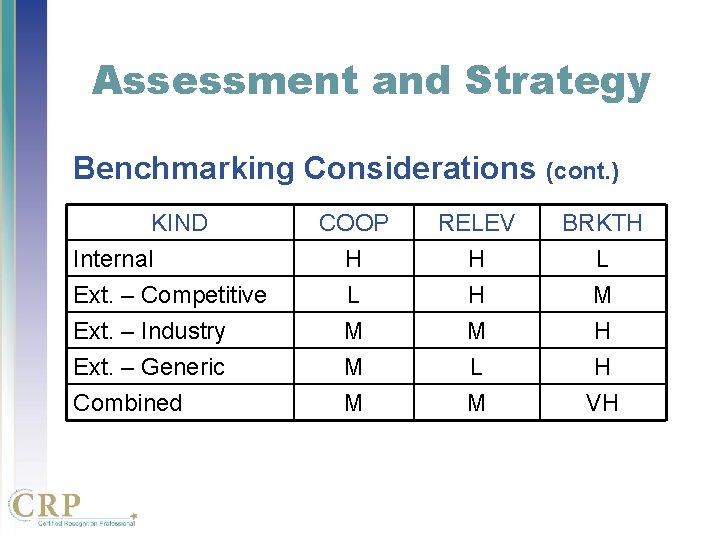
Assessment and Strategy Benchmarking Considerations (cont. ) KIND Internal Ext. – Competitive Ext. – Industry Ext. – Generic Combined COOP H L M RELEV H H M BRKTH L M H M M L M H VH
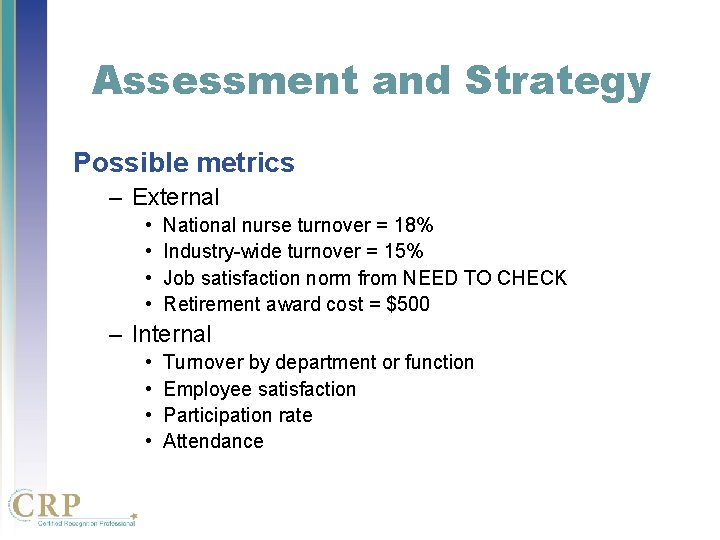
Assessment and Strategy Possible metrics – External • • National nurse turnover = 18% Industry-wide turnover = 15% Job satisfaction norm from NEED TO CHECK Retirement award cost = $500 – Internal • • Turnover by department or function Employee satisfaction Participation rate Attendance
Assessment and Strategy Best Practices White Paper – Read the excerpt – Notations about • Kind of recognition • 3 Dimensions • Other
Assessment and Strategy Assessment to Strategy insert model
Assessment and Strategy Exercise Based on the Westfield Group excerpt, draw some conclusions about their Desired State: 1. 2. 3.
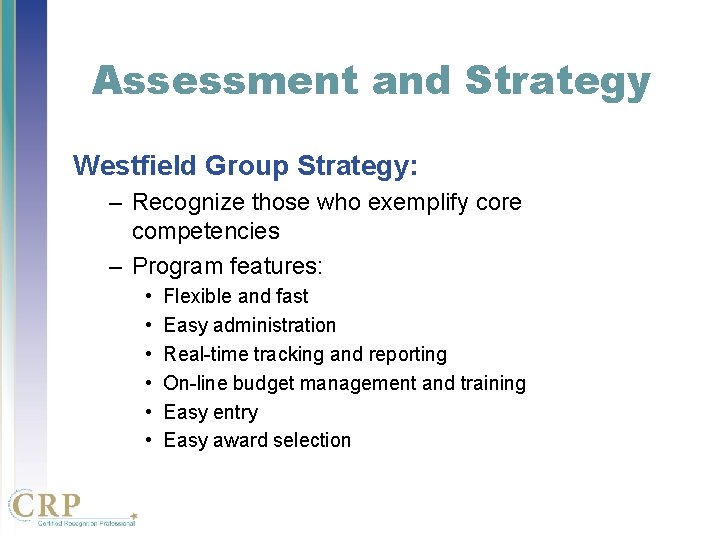
Assessment and Strategy Westfield Group Strategy: – Recognize those who exemplify core competencies – Program features: • • • Flexible and fast Easy administration Real-time tracking and reporting On-line budget management and training Easy entry Easy award selection
Assessment and Strategy Exercise – Review your Current State organizational worksheet and SWOT – Map out your Desired State and possible goals
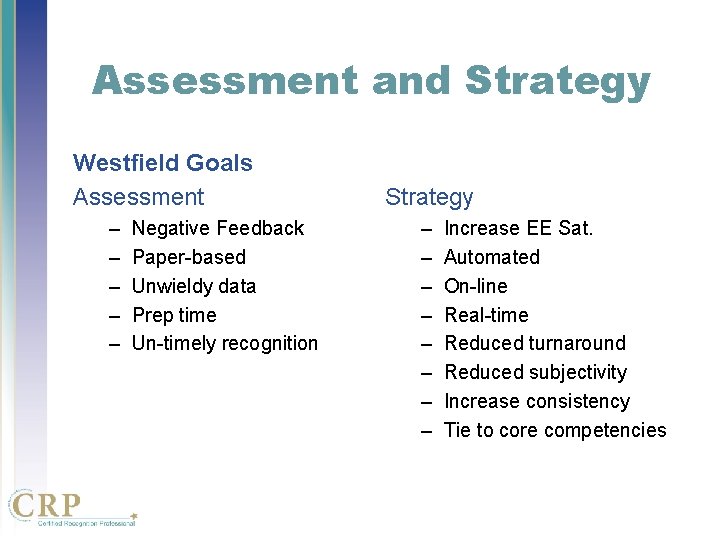
Assessment and Strategy Westfield Goals Assessment – – – Negative Feedback Paper-based Unwieldy data Prep time Un-timely recognition Strategy – – – – Increase EE Sat. Automated On-line Real-time Reduced turnaround Reduced subjectivity Increase consistency Tie to core competencies
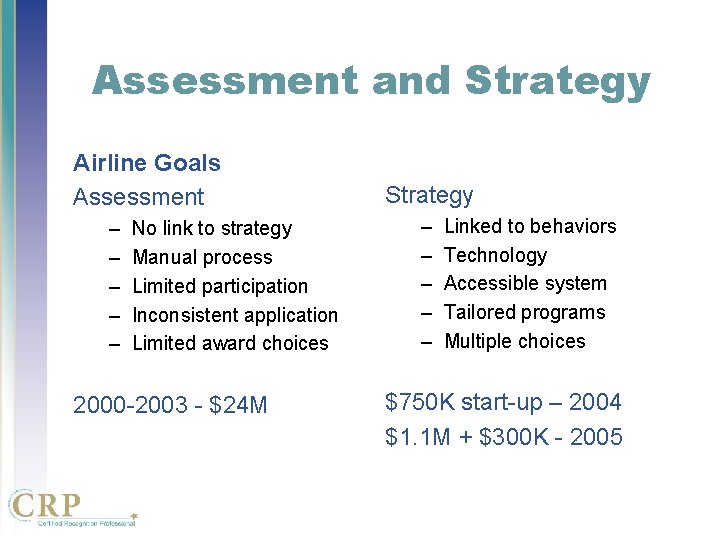
Assessment and Strategy Airline Goals Assessment – – – No link to strategy Manual process Limited participation Inconsistent application Limited award choices 2000 -2003 - $24 M Strategy – – – Linked to behaviors Technology Accessible system Tailored programs Multiple choices $750 K start-up – 2004 $1. 1 M + $300 K - 2005
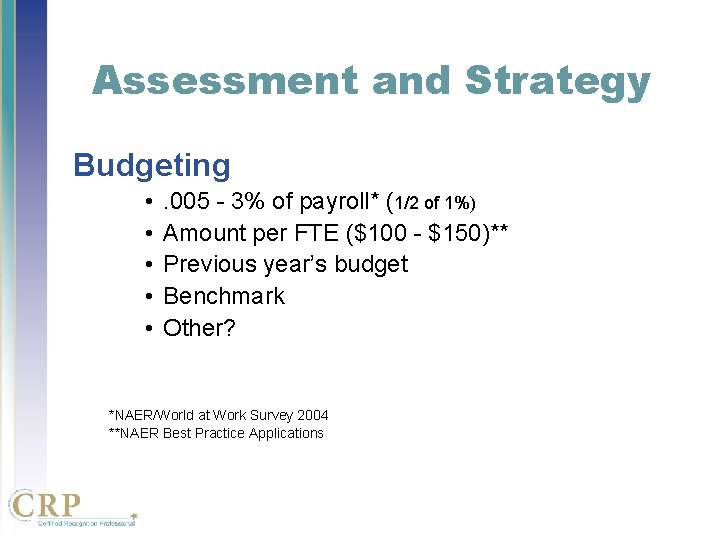
Assessment and Strategy Budgeting • • • . 005 - 3% of payroll* (1/2 of 1%) Amount per FTE ($100 - $150)** Previous year’s budget Benchmark Other? *NAER/World at Work Survey 2004 **NAER Best Practice Applications
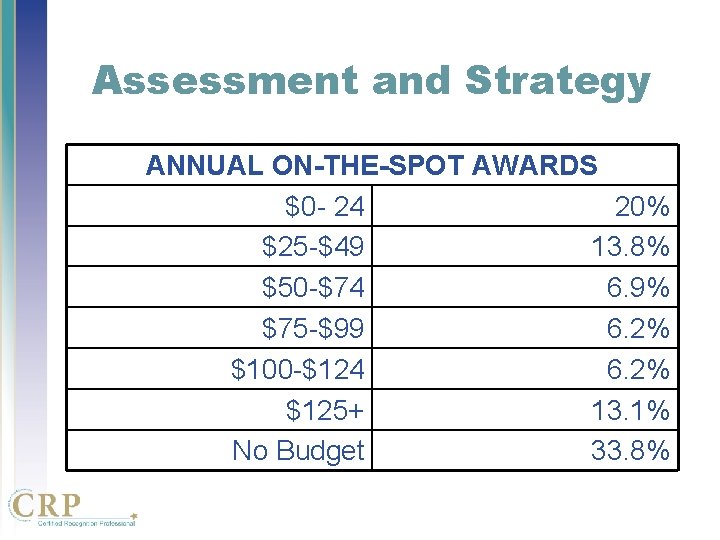
Assessment and Strategy ANNUAL ON-THE-SPOT AWARDS $0 - 24 20% $25 -$49 13. 8% $50 -$74 6. 9% $75 -$99 6. 2% $100 -$124 6. 2% $125+ 13. 1% No Budget 33. 8%
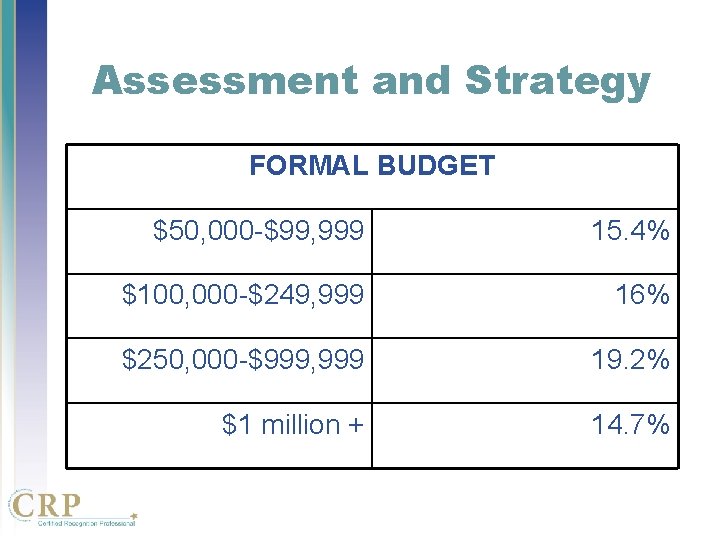
Assessment and Strategy FORMAL BUDGET $50, 000 -$99, 999 15. 4% $100, 000 -$249, 999 16% $250, 000 -$999, 999 19. 2% $1 million + 14. 7%
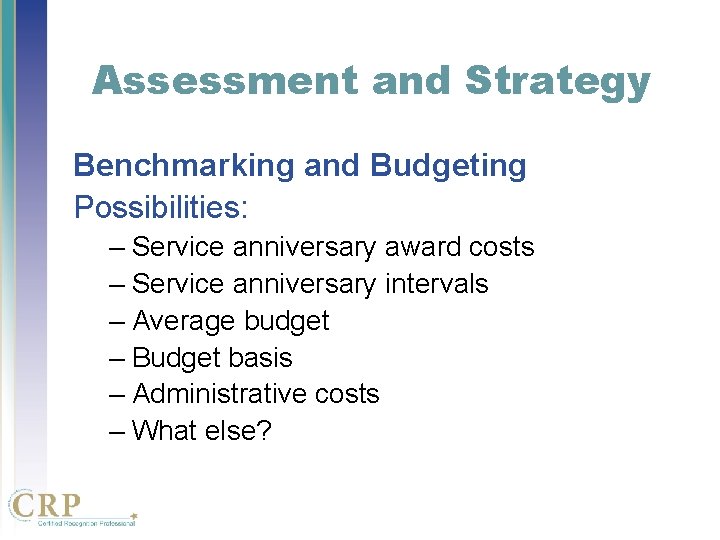
Assessment and Strategy Benchmarking and Budgeting Possibilities: – Service anniversary award costs – Service anniversary intervals – Average budget – Budget basis – Administrative costs – What else?
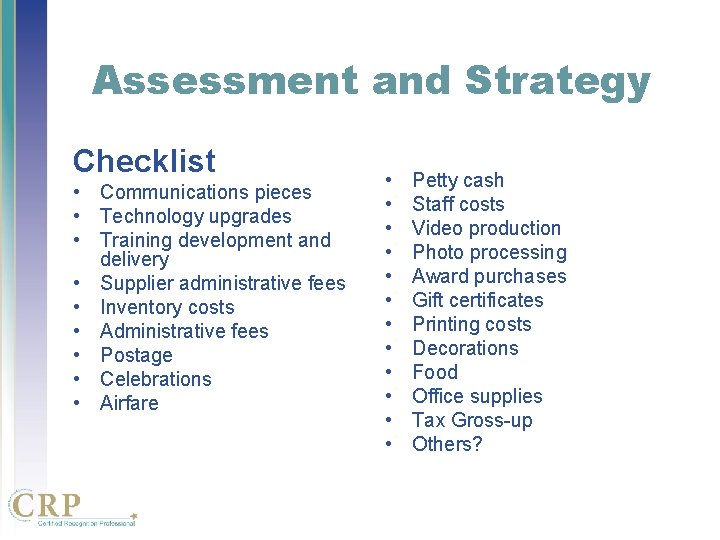
Assessment and Strategy Checklist • Communications pieces • Technology upgrades • Training development and delivery • Supplier administrative fees • Inventory costs • Administrative fees • Postage • Celebrations • Airfare • • • Petty cash Staff costs Video production Photo processing Award purchases Gift certificates Printing costs Decorations Food Office supplies Tax Gross-up Others?
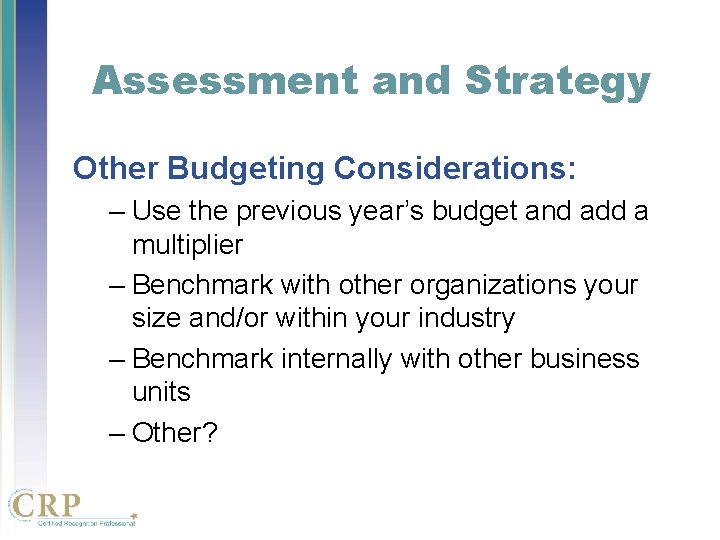
Assessment and Strategy Other Budgeting Considerations: – Use the previous year’s budget and add a multiplier – Benchmark with other organizations your size and/or within your industry – Benchmark internally with other business units – Other?
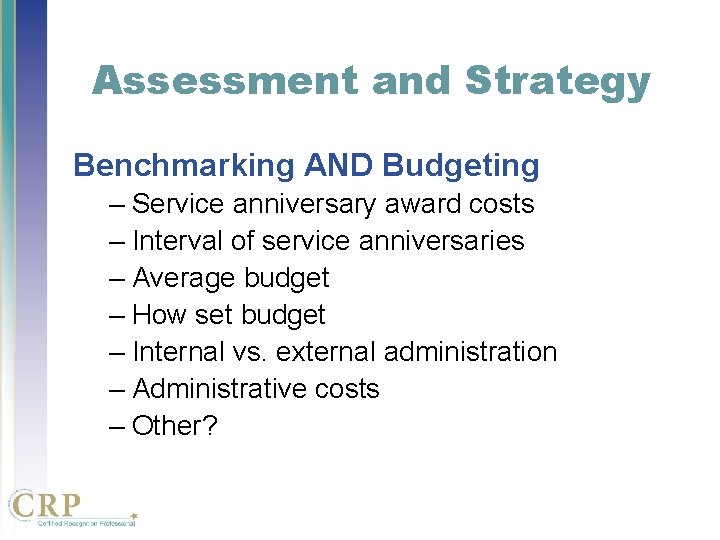
Assessment and Strategy Benchmarking AND Budgeting – Service anniversary award costs – Interval of service anniversaries – Average budget – How set budget – Internal vs. external administration – Administrative costs – Other?
Assessment and Strategy Budgeting Checklist – Activity – Read through the items on page 41 – Circle the items you don’t currently include – What other items could be added to this list?
Assessment and Strategy Progress Check True or False 1. The assessment phase begins with Current State. 2. SWOT is comprehensive and objective. 3. Beneficial to tie to strategies. Multiple Choice 1. “O” in SWOT stands for: 2. Most critical budget consideration is:
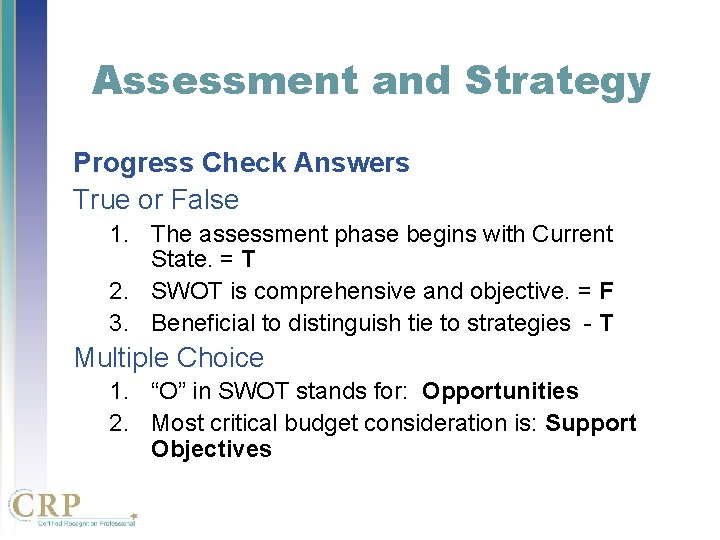
Assessment and Strategy Progress Check Answers True or False 1. The assessment phase begins with Current State. = T 2. SWOT is comprehensive and objective. = F 3. Beneficial to distinguish tie to strategies - T Multiple Choice 1. “O” in SWOT stands for: Opportunities 2. Most critical budget consideration is: Support Objectives
Strategy to Implementation Section Learning Objectives – Name four evaluation levels – Determine baseline measurements – Measure and track – Select possible ROI criteria – Use scorecard approach
Strategy to Implementation Until you start measuring. . . everything else is just practice
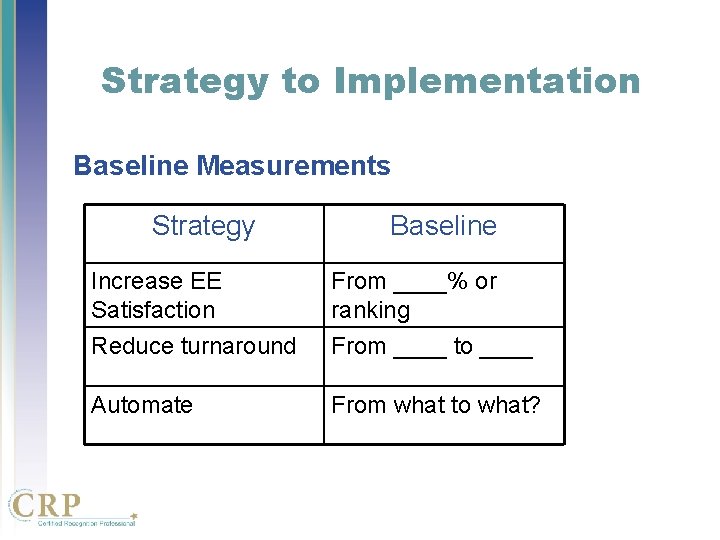
Strategy to Implementation Baseline Measurements Strategy Baseline Increase EE Satisfaction From ____% or ranking Reduce turnaround From ____ to ____ Automate From what to what?
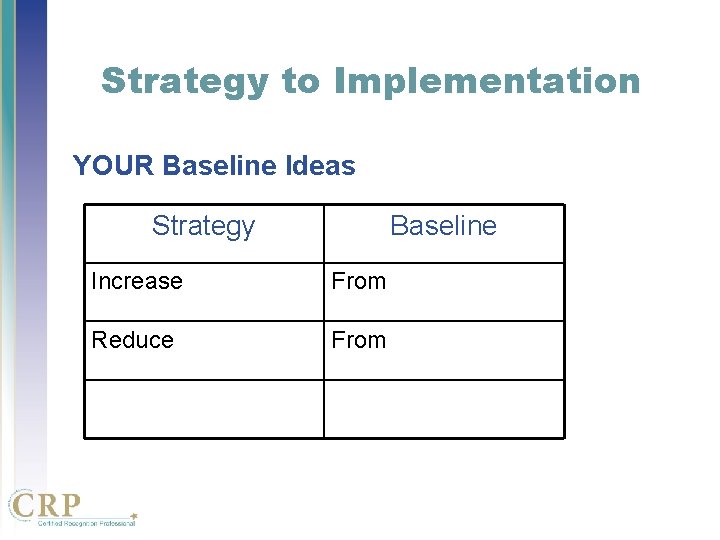
Strategy to Implementation YOUR Baseline Ideas Strategy Baseline Increase From Reduce From
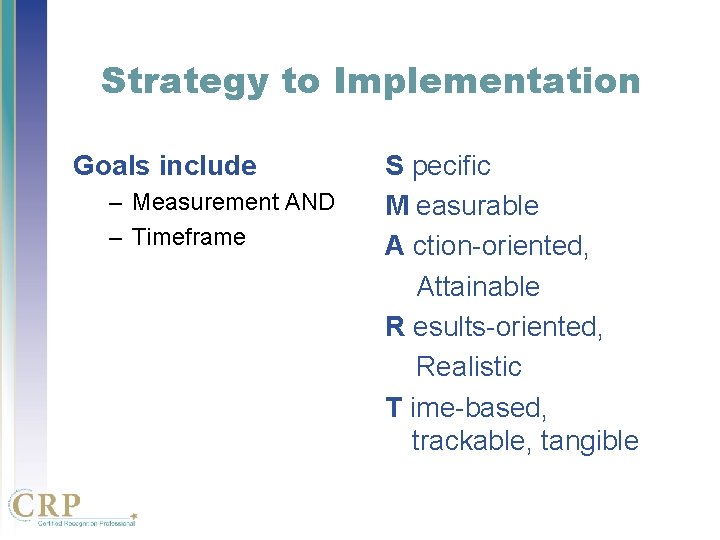
Strategy to Implementation Goals include – Measurement AND – Timeframe S pecific M easurable A ction-oriented, Attainable R esults-oriented, Realistic T ime-based, trackable, tangible
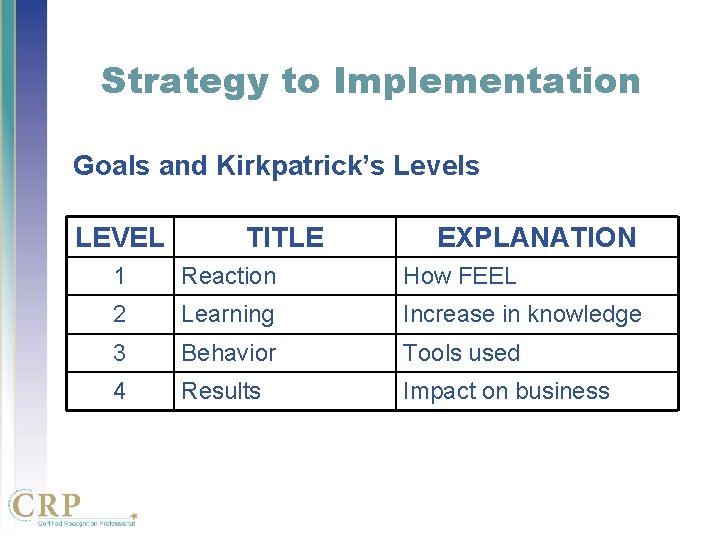
Strategy to Implementation Goals and Kirkpatrick’s Levels LEVEL TITLE EXPLANATION 1 Reaction How FEEL 2 Learning Increase in knowledge 3 Behavior Tools used 4 Results Impact on business
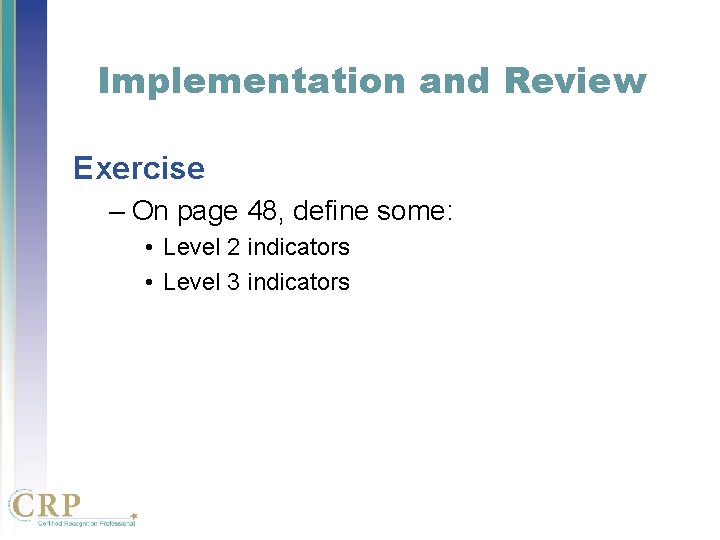
Implementation and Review Exercise – On page 48, define some: • Level 2 indicators • Level 3 indicators
Strategy to Implementation Insert model here for focus
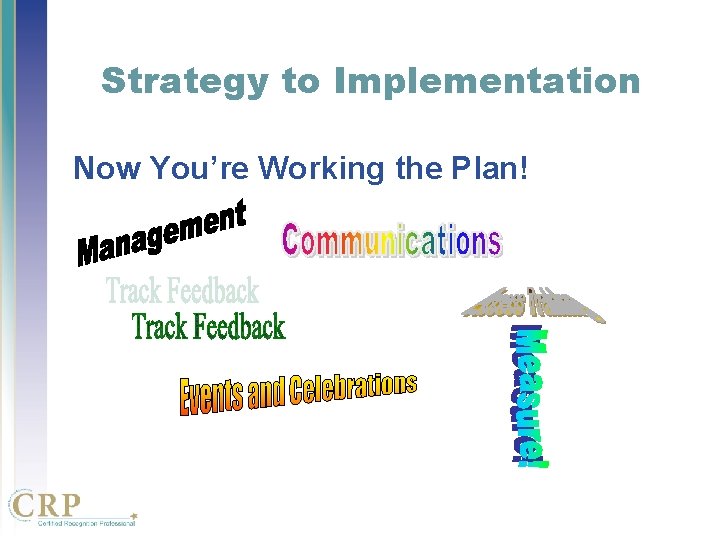
Strategy to Implementation Now You’re Working the Plan!
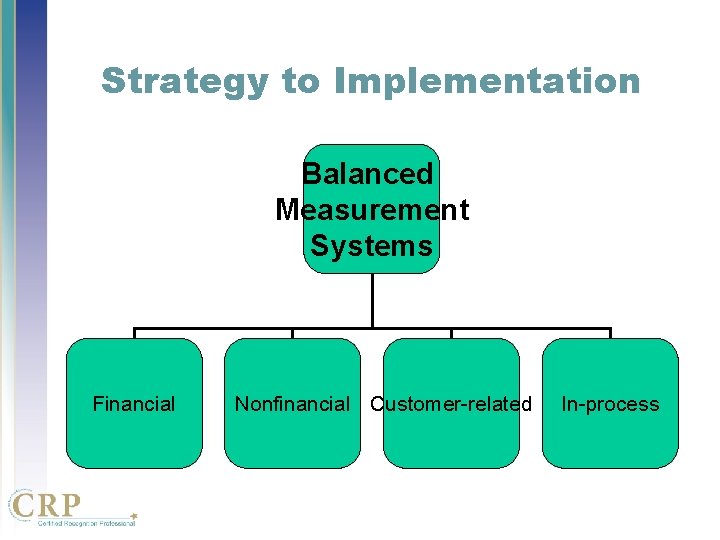
Strategy to Implementation Balanced Measurement Systems Financial Nonfinancial Customer-related In-process
Implementation to Review Insert model here
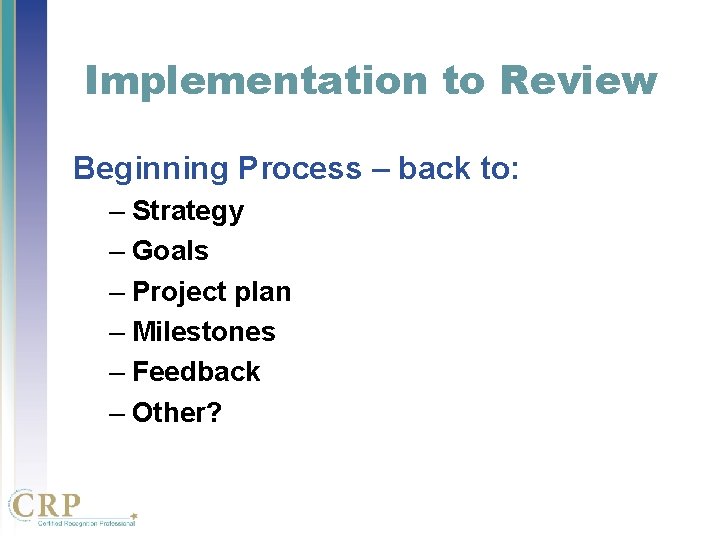
Implementation to Review Beginning Process – back to: – Strategy – Goals – Project plan – Milestones – Feedback – Other?
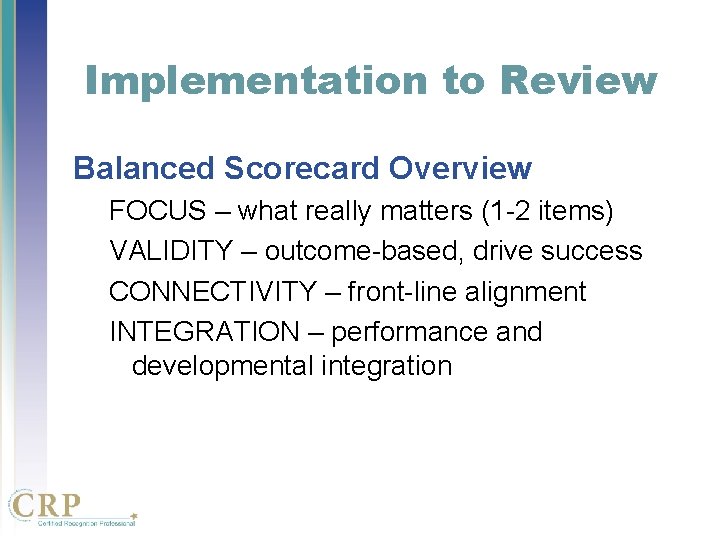
Implementation to Review Balanced Scorecard Overview FOCUS – what really matters (1 -2 items) VALIDITY – outcome-based, drive success CONNECTIVITY – front-line alignment INTEGRATION – performance and developmental integration
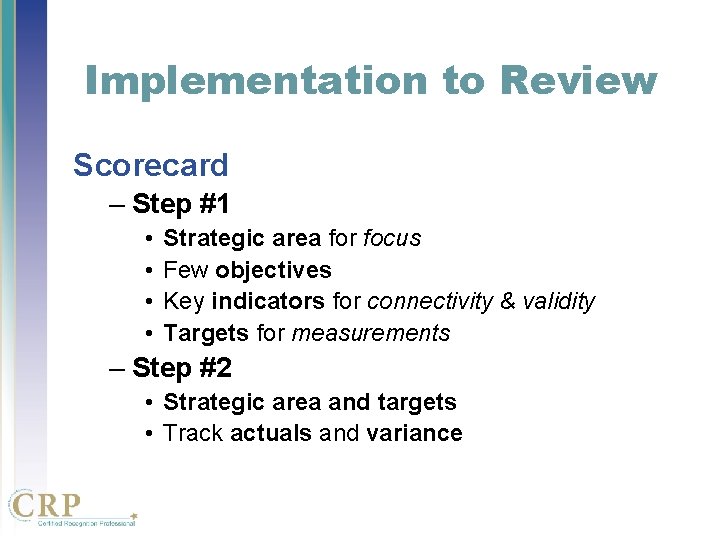
Implementation to Review Scorecard – Step #1 • • Strategic area for focus Few objectives Key indicators for connectivity & validity Targets for measurements – Step #2 • Strategic area and targets • Track actuals and variance
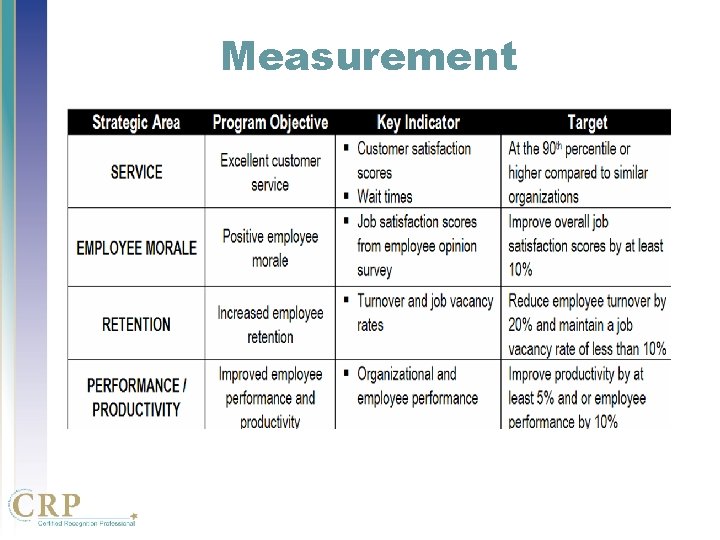
Measurement
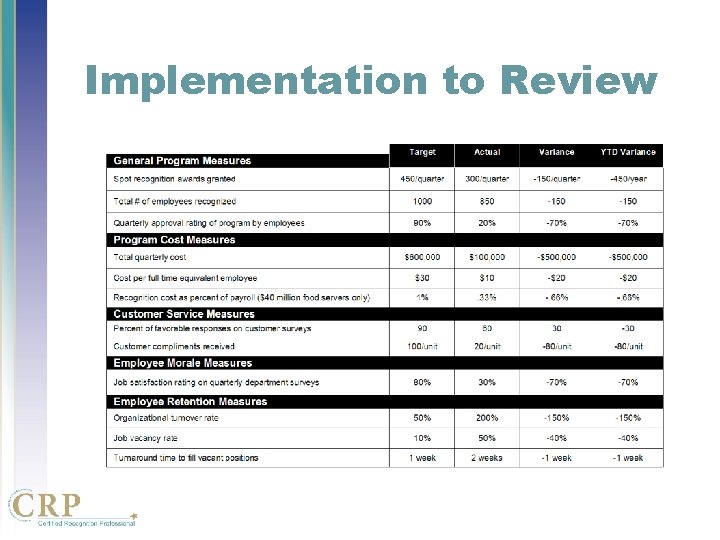
Implementation to Review
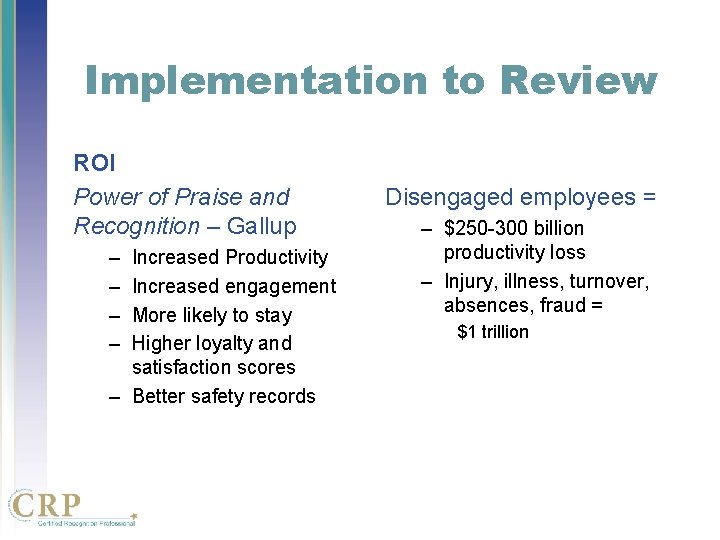
Implementation to Review ROI Power of Praise and Recognition – Gallup – – Increased Productivity Increased engagement More likely to stay Higher loyalty and satisfaction scores – Better safety records Disengaged employees = – $250 -300 billion productivity loss – Injury, illness, turnover, absences, fraud = $1 trillion
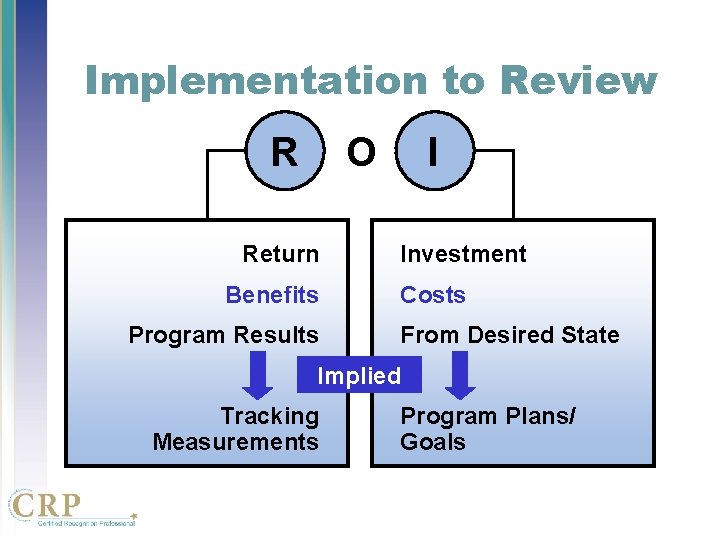
Implementation to Review R O Return Benefits Program Results I Investment Costs From Desired State Implied Tracking Measurements Program Plans/ Goals
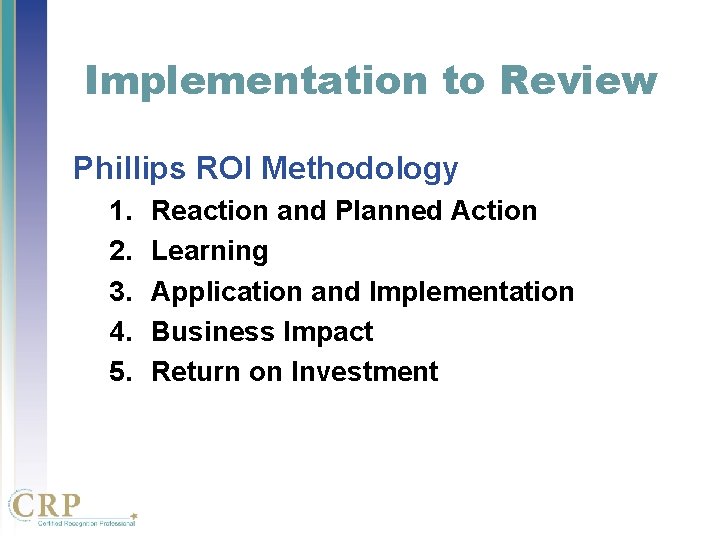
Implementation to Review Phillips ROI Methodology 1. 2. 3. 4. 5. Reaction and Planned Action Learning Application and Implementation Business Impact Return on Investment
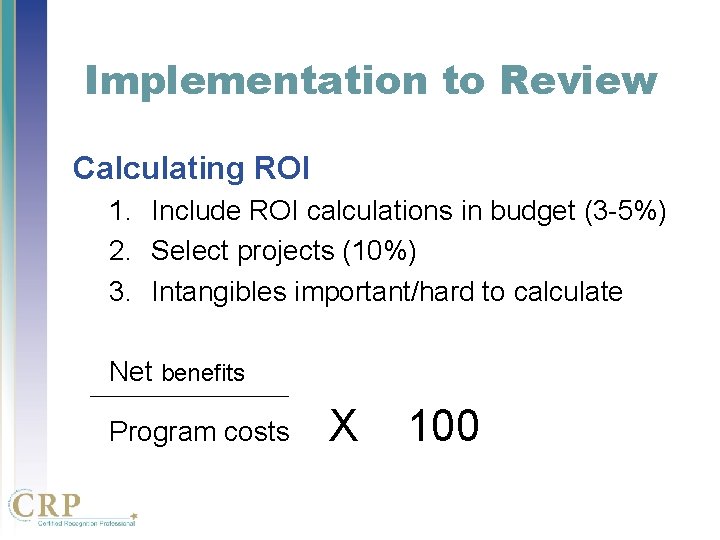
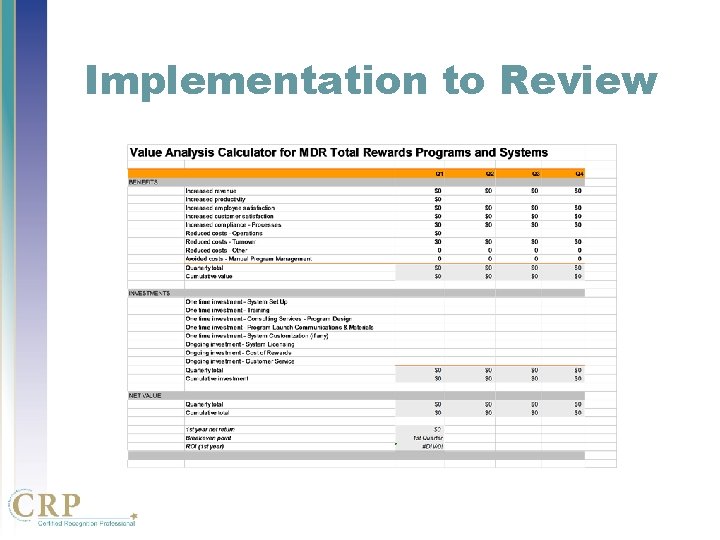
Implementation to Review Calculating ROI 1. Include ROI calculations in budget (3 -5%) 2. Select projects (10%) 3. Intangibles important/hard to calculate Net benefits Program costs X 100
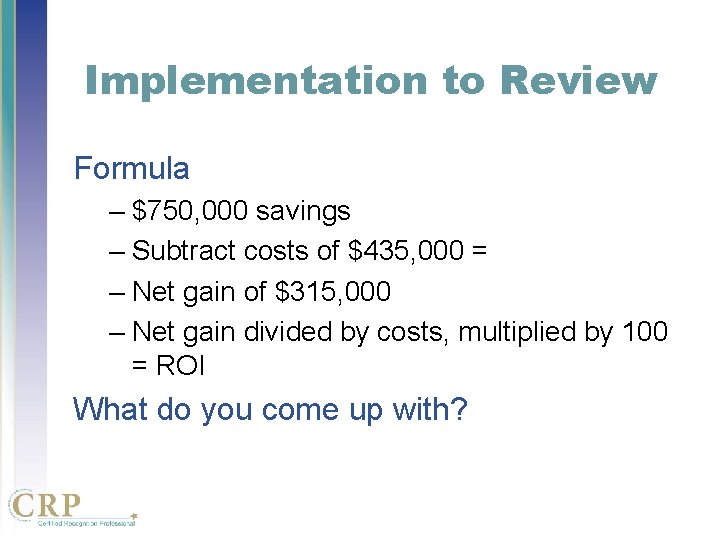
Implementation to Review Formula – $750, 000 savings – Subtract costs of $435, 000 = – Net gain of $315, 000 – Net gain divided by costs, multiplied by 100 = ROI What do you come up with?
Implementation to Review
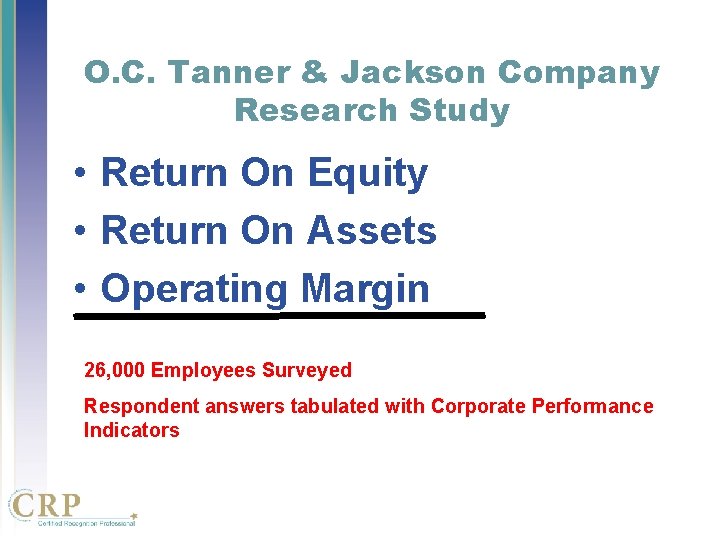
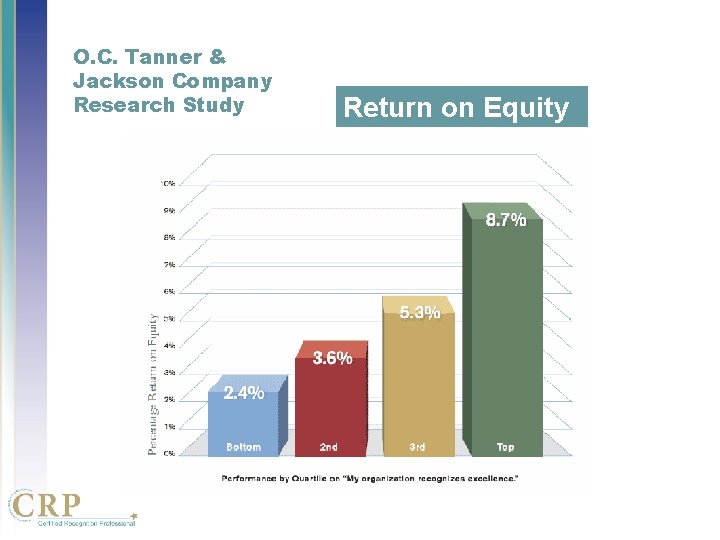
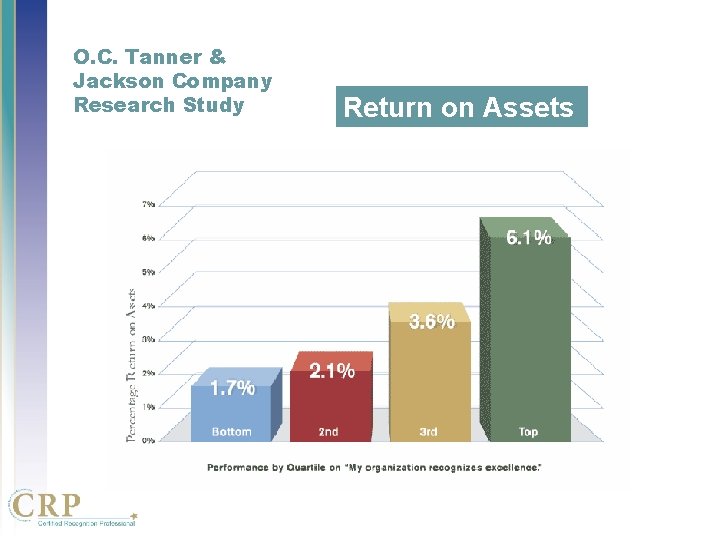
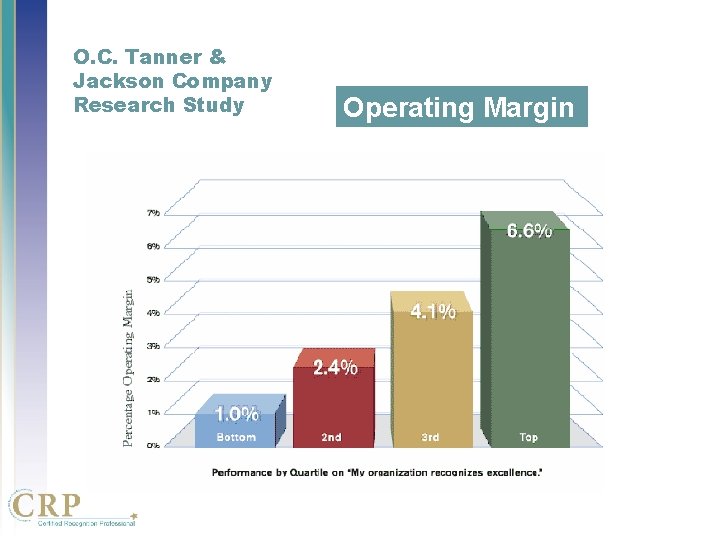
O. C. Tanner & Jackson Company Research Study • Return On Equity • Return On Assets • Operating Margin 26, 000 Employees Surveyed Respondent answers tabulated with Corporate Performance Indicators
O. C. Tanner & Jackson Company Research Study Return on Equity
O. C. Tanner & Jackson Company Research Study Return on Assets
O. C. Tanner & Jackson Company Research Study Operating Margin
Implementation to Review Best Practices White Paper – Read the excerpt – Notations about measurements
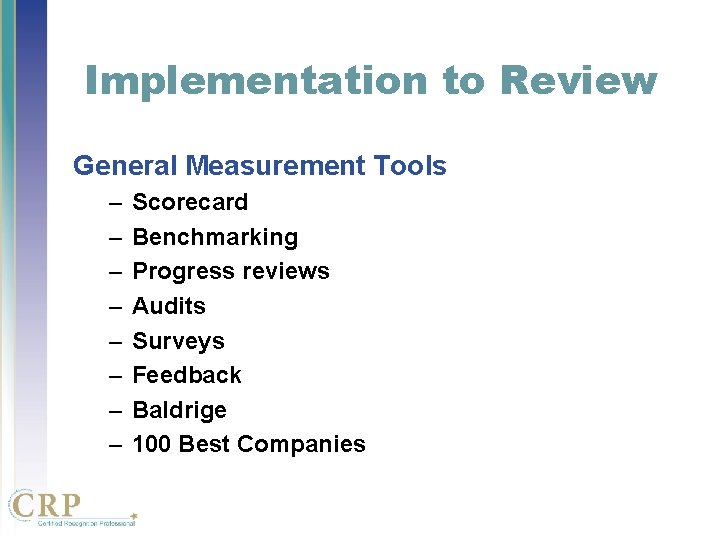
Implementation to Review General Measurement Tools – – – – Scorecard Benchmarking Progress reviews Audits Surveys Feedback Baldrige 100 Best Companies
Implementation to Review Progress Check Write Philips ROI Levels in Order True or False 1. 2. 3. Balanced scorecard only part of the Review Phase ROI calculation-divide net benefits by costs and multiply by 100. Connectivity important to balanced scorecard. Multiple Choice 1. 2. “R” in ROI also stand for: NOT part of balanced scorecard
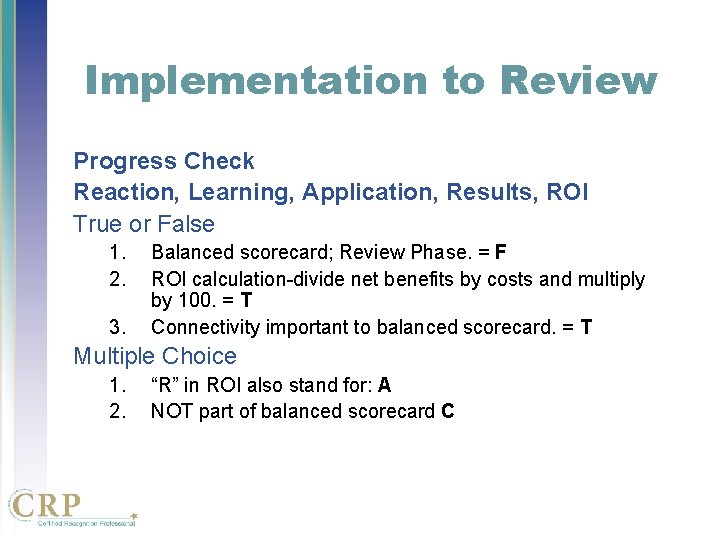
Implementation to Review Progress Check Reaction, Learning, Application, Results, ROI True or False 1. 2. 3. Balanced scorecard; Review Phase. = F ROI calculation-divide net benefits by costs and multiply by 100. = T Connectivity important to balanced scorecard. = T Multiple Choice 1. 2. “R” in ROI also stand for: A NOT part of balanced scorecard C
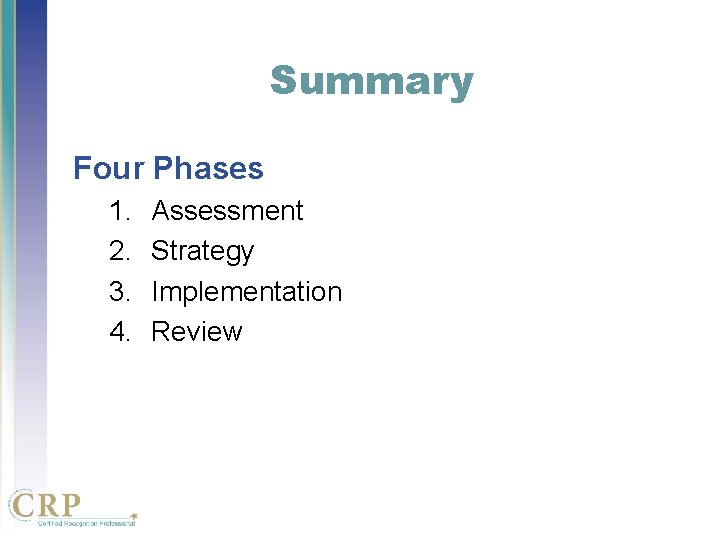
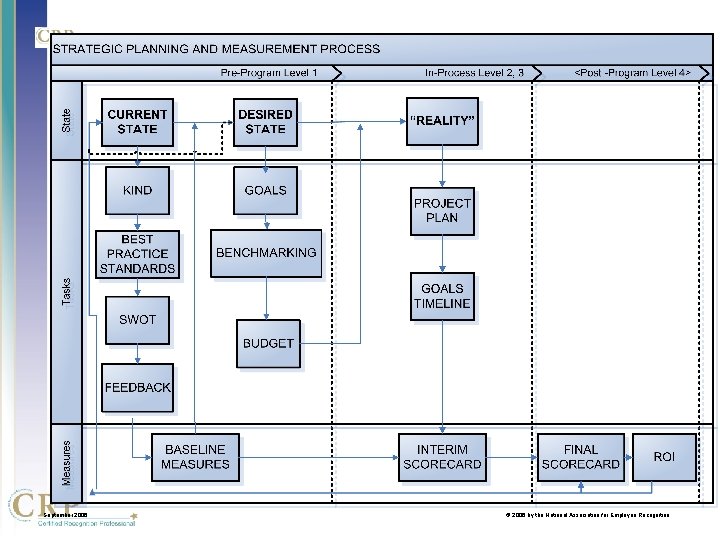
Summary Four Phases 1. 2. 3. 4. Assessment Strategy Implementation Review
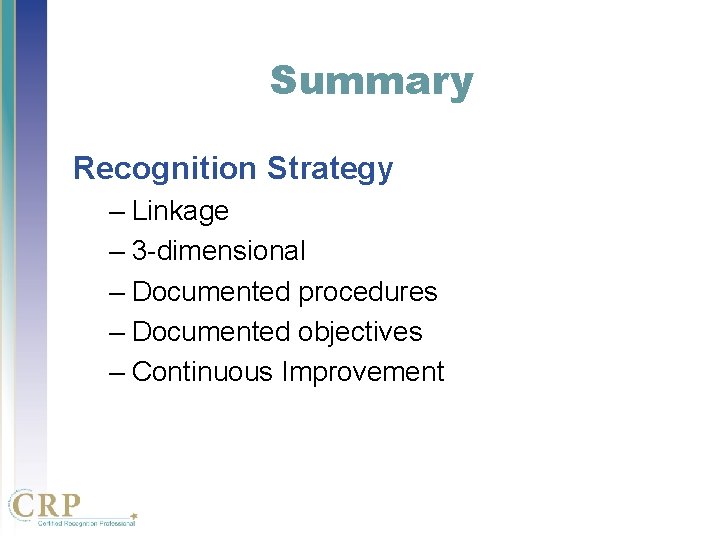
Summary Recognition Strategy – Linkage – 3 -dimensional – Documented procedures – Documented objectives – Continuous Improvement
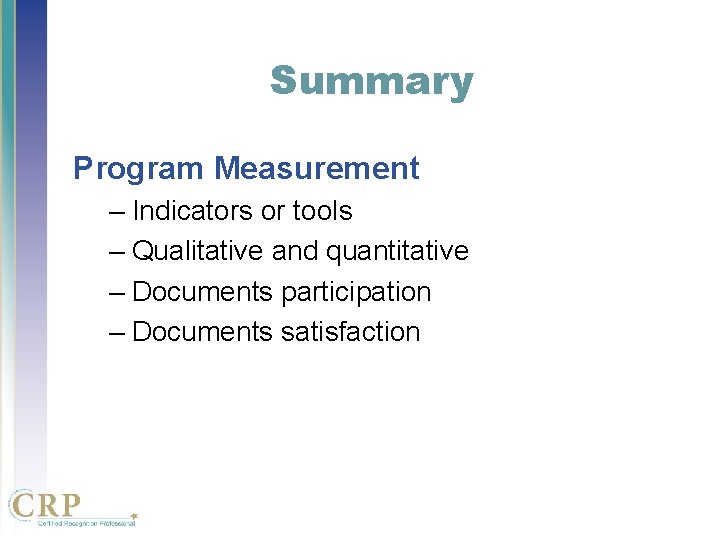
Summary Program Measurement – Indicators or tools – Qualitative and quantitative – Documents participation – Documents satisfaction
Summary Model
September 2006 by the National Association for Employee Recognition
Summary Review
Overall Summary