
CHAPTER 4 MarketOriented Strategic Planning PERSPECTIVES OF THE
- Slides: 17
CHAPTER 4 Market-Oriented Strategic Planning
PERSPECTIVES OF THE FIRM ¬ Objective of the firm is to: ¬ Maximize profits - Economist ¬ Maximize shareholder value – Financial type ¬ Create customer-satisfying value at a profit Marketing ¬ Balance the interest of shareholders, customers, employees, suppliers, and the community – Management type. ¬ These perspectives shape the strategic planning process within the firm.
THE FIRM AS A SYSTEM ¬The following are performed: ¬Coordination, integration, Mutual Purpose, An Objective ¬Objective of superior customer value at reduced cost provides guidance and direction ¬Market realities drive the firm
MARKET ORIENTATION ¬There are three behavioral components: ¬Customer Orientation ¬Competitor Orientation ¬Inter-functional Coordination ¬There are two Decision Criteria: ¬Long-Term Focus ¬Profitability
STRATEGIC PLANNING ¬ Developing a game plan for achieving long-run objectives based upon existing opportunities and resources. ¬ Strategy should ensure long-run survival and growth ¬ The aim of strategic planning is to develop a Sustainable Competitive Advantage (Low Cost, Focus, Differentiation, Preemptive Move, Synergy).
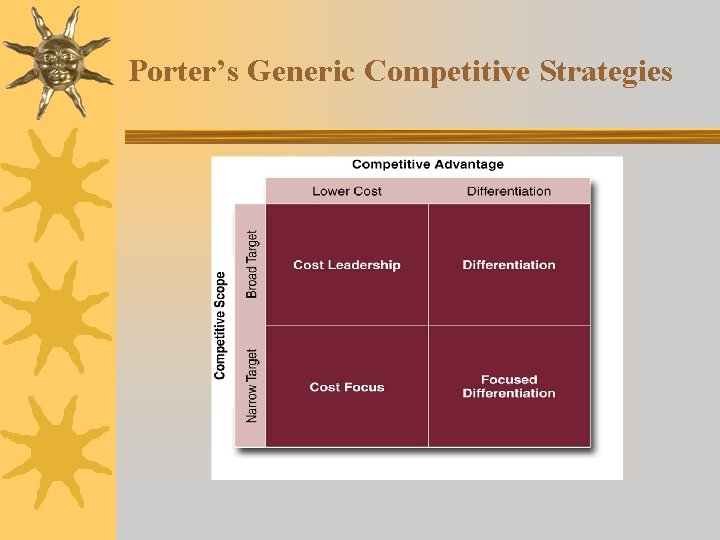
Porter’s Generic Competitive Strategies
Porter’s Competitive Strategies Cost Leadership: – Low-cost competitive strategy – Aimed at broad mass market – Aggressive construction of efficientscale facilities – Cost reductions – Cost minimization
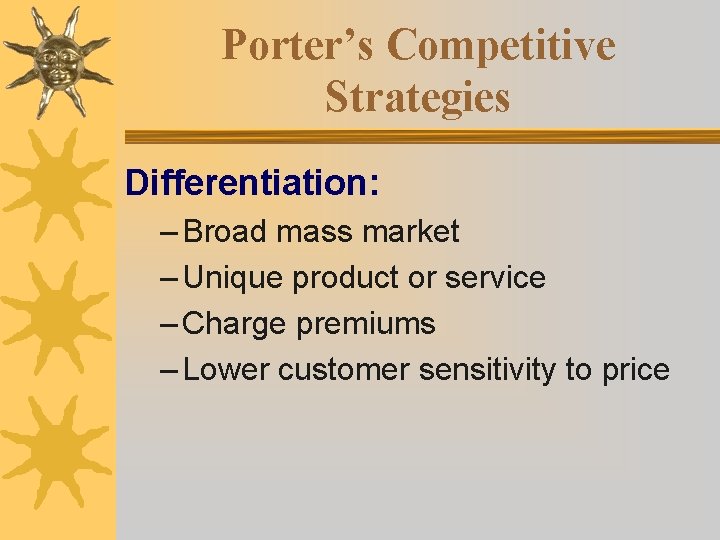
Porter’s Competitive Strategies Differentiation: – Broad mass market – Unique product or service – Charge premiums – Lower customer sensitivity to price
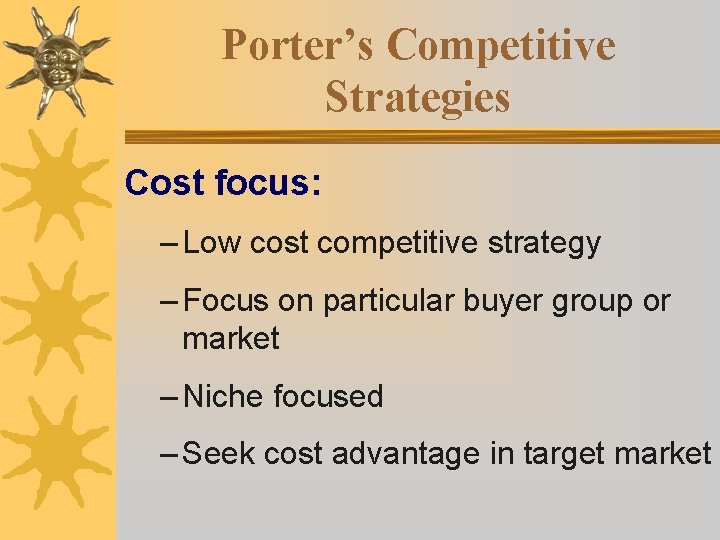
Porter’s Competitive Strategies Cost focus: – Low cost competitive strategy – Focus on particular buyer group or market – Niche focused – Seek cost advantage in target market
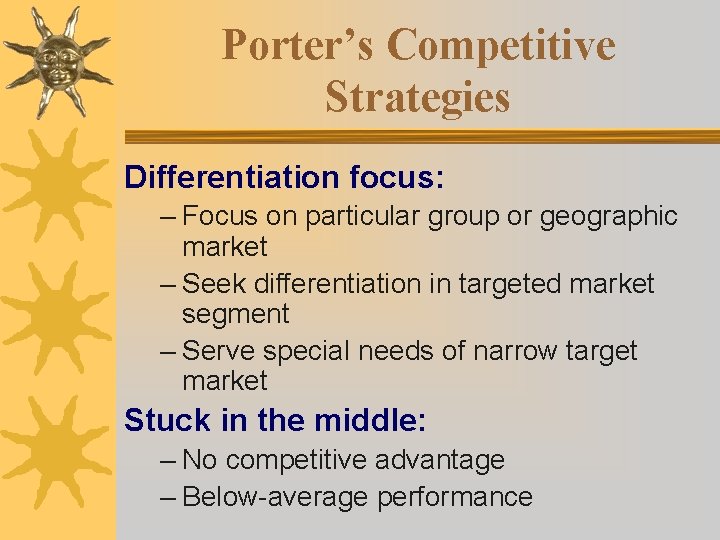
Porter’s Competitive Strategies Differentiation focus: – Focus on particular group or geographic market – Seek differentiation in targeted market segment – Serve special needs of narrow target market Stuck in the middle: – No competitive advantage – Below-average performance
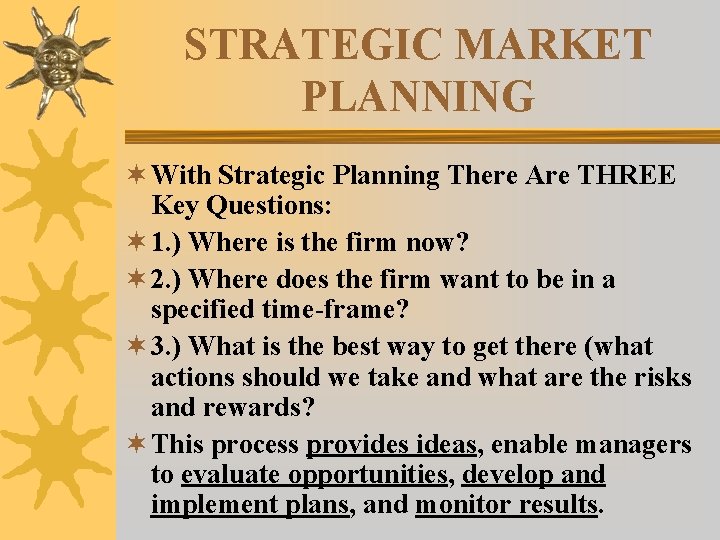
STRATEGIC MARKET PLANNING ¬ With Strategic Planning There Are THREE Key Questions: ¬ 1. ) Where is the firm now? ¬ 2. ) Where does the firm want to be in a specified time-frame? ¬ 3. ) What is the best way to get there (what actions should we take and what are the risks and rewards? ¬ This process provides ideas, enable managers to evaluate opportunities, develop and implement plans, and monitor results.
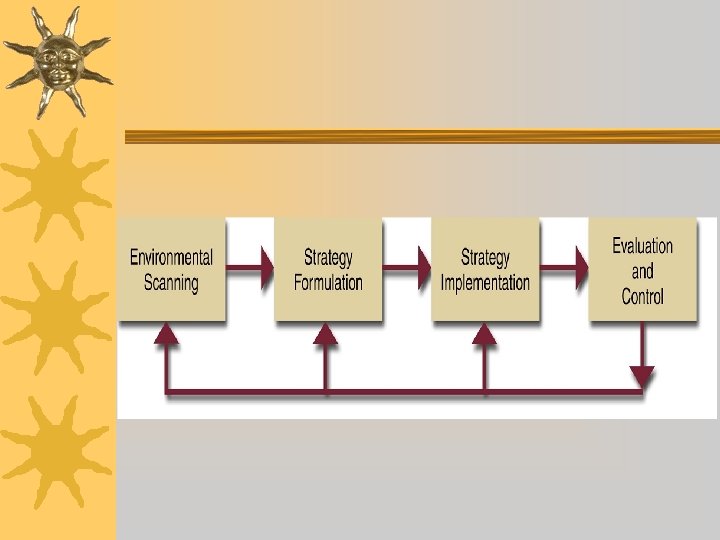
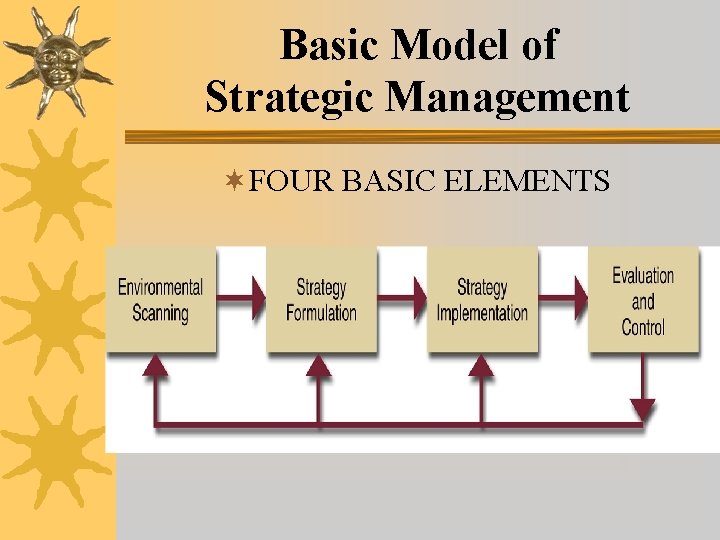
Basic Model of Strategic Management ¬FOUR BASIC ELEMENTS
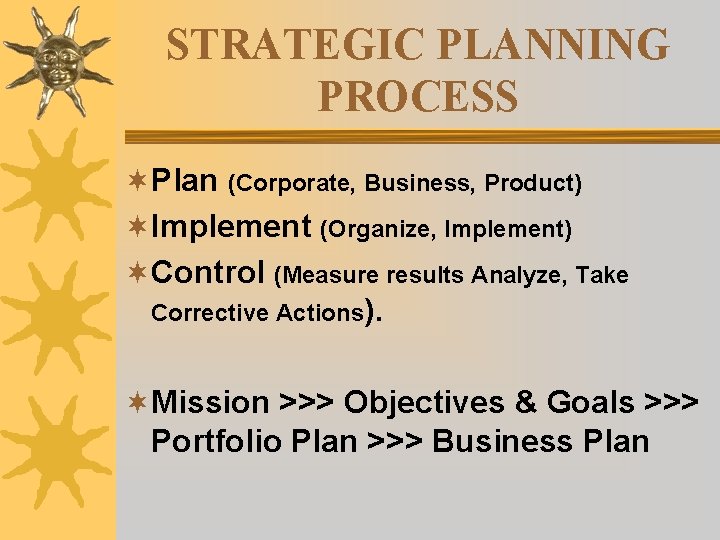
STRATEGIC PLANNING PROCESS ¬Plan (Corporate, Business, Product) ¬Implement (Organize, Implement) ¬Control (Measure results Analyze, Take Corrective Actions). ¬Mission >>> Objectives & Goals >>> Portfolio Plan >>> Business Plan
STRATEGIC PLANNING PROCESS ¬ Mission – clear statement providing a sense of opportunity and direction in terms of customer needs, groups and technologies ¬ Objectives & Goals – Actionable quantitative and realistic restatement of the mission ¬ Portfolio Plan – Analysis of each business unit of analysis in terms of profitability, market share, attractiveness or other relevant measures (BCG Growth/Share Matrix, GE Multifactor Matrix).
STRATEGIC PLANNING GAP ¬ Kotler identifies the firm’s Strategic Planning Gap as the difference between the actual and desired or expect sales. ¬ For change to occur, the gap must be large enough to move the firm to strategic action. ¬ Once the gap is recognized management can move to fill the gap (Intensive Growth – action within present product-market scope, Integrative Growth opportunities within firm’s market system, Diversification opportunities outside firm’s marketing system)
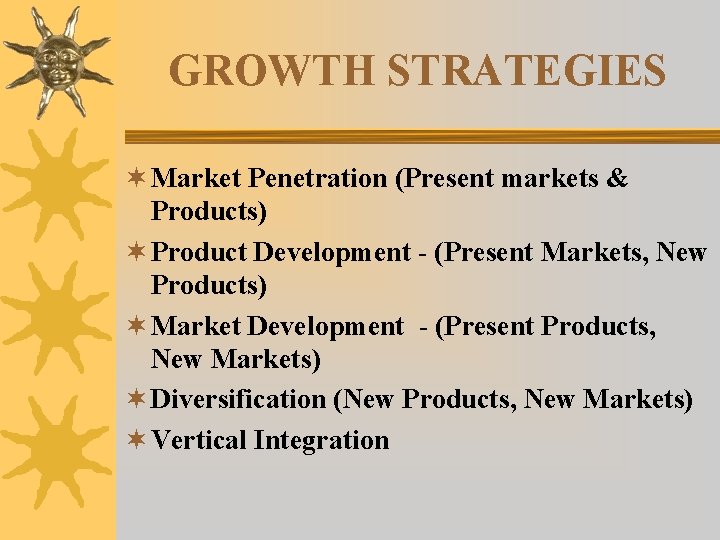
GROWTH STRATEGIES ¬ Market Penetration (Present markets & Products) ¬ Product Development - (Present Markets, New Products) ¬ Market Development - (Present Products, New Markets) ¬ Diversification (New Products, New Markets) ¬ Vertical Integration