Semantics of Clausal Complements Lauri Karttunen Annie Zaenen
- Slides: 49
Semantics of Clausal Complements Lauri Karttunen Annie Zaenen CSLI, Stanford Berlin, Oct. 19, 2012
Outline Basic distinctions An ambiguous example: not wait to Phrasal implicatives Work in progress Invited inferences Predicative adjectives Lucky
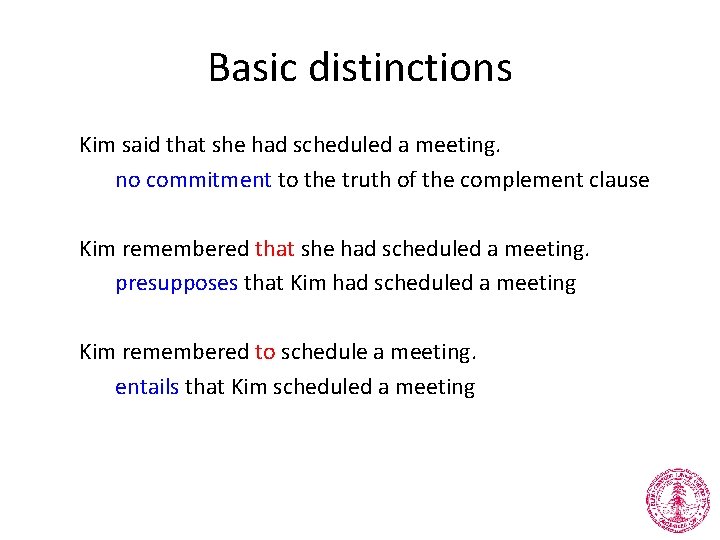
Basic distinctions Kim said that she had scheduled a meeting. no commitment to the truth of the complement clause Kim remembered that she had scheduled a meeting. presupposes that Kim had scheduled a meeting Kim remembered to schedule a meeting. entails that Kim scheduled a meeting
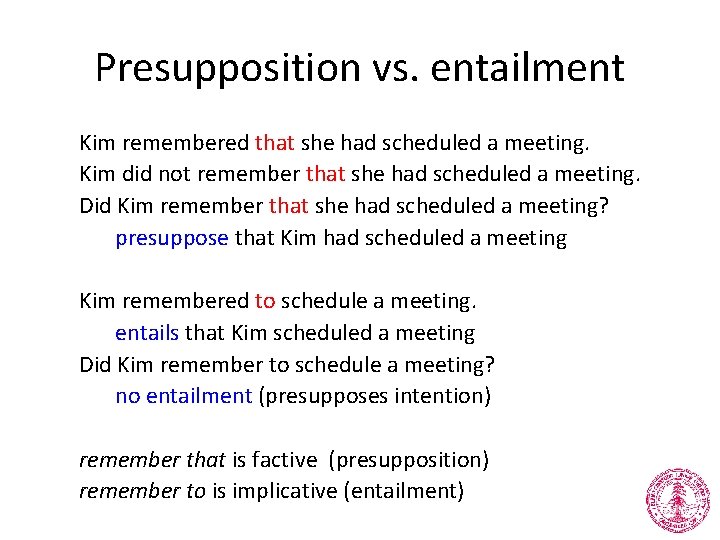
Presupposition vs. entailment Kim remembered that she had scheduled a meeting. Kim did not remember that she had scheduled a meeting. Did Kim remember that she had scheduled a meeting? presuppose that Kim had scheduled a meeting Kim remembered to schedule a meeting. entails that Kim scheduled a meeting Did Kim remember to schedule a meeting? no entailment (presupposes intention) remember that is factive (presupposition) remember to is implicative (entailment)
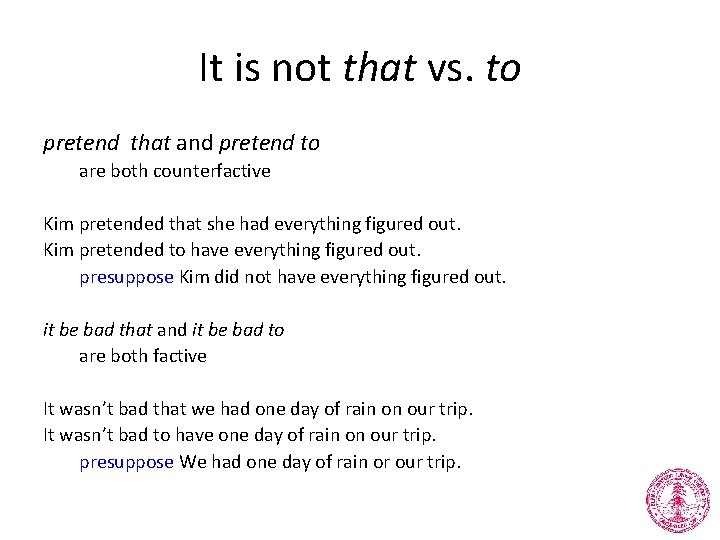
It is not that vs. to pretend that and pretend to are both counterfactive Kim pretended that she had everything figured out. Kim pretended to have everything figured out. presuppose Kim did not have everything figured out. it be bad that and it be bad to are both factive It wasn’t bad that we had one day of rain on our trip. It wasn’t bad to have one day of rain on our trip. presuppose We had one day of rain or our trip.
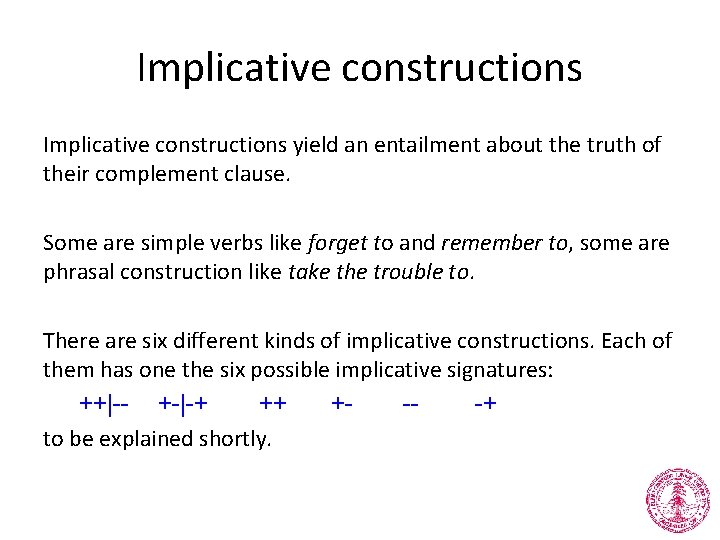
Implicative constructions yield an entailment about the truth of their complement clause. Some are simple verbs like forget to and remember to, some are phrasal construction like take the trouble to. There are six different kinds of implicative constructions. Each of them has one the six possible implicative signatures: ++|-- +-|-+ ++ +--+ to be explained shortly.
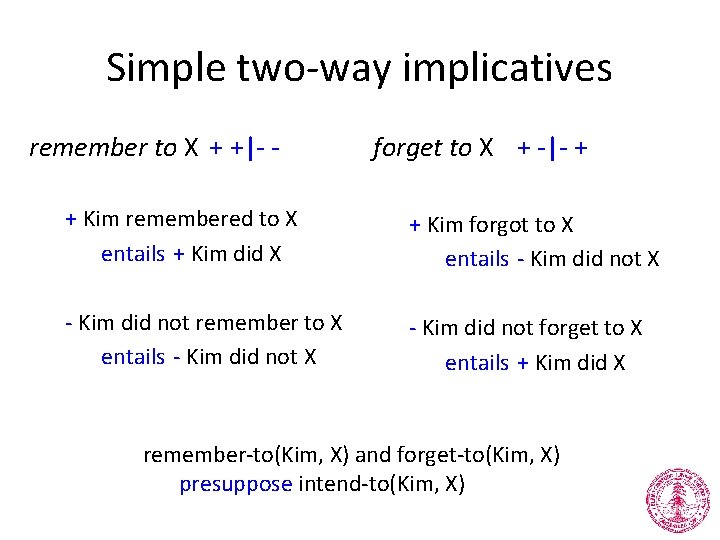
Simple two-way implicatives remember to X + +|- - forget to X + -|- + + Kim remembered to X entails + Kim did X + Kim forgot to X entails - Kim did not X - Kim did not remember to X entails - Kim did not X - Kim did not forget to X entails + Kim did X remember-to(Kim, X) and forget-to(Kim, X) presuppose intend-to(Kim, X)
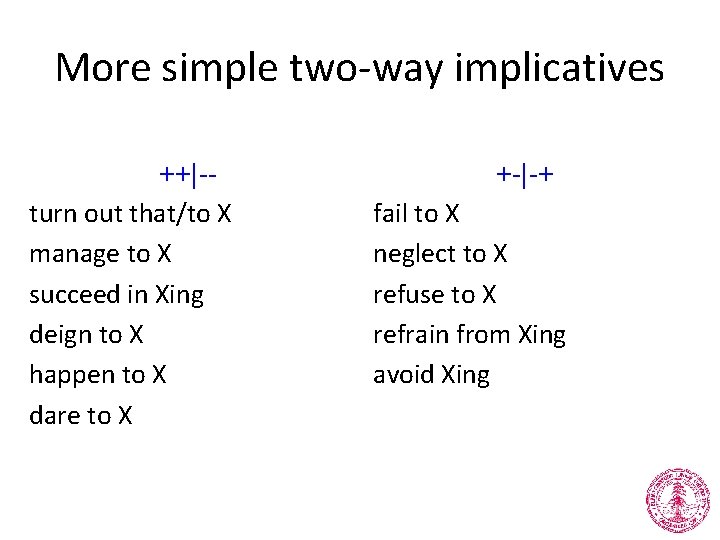
More simple two-way implicatives ++|-turn out that/to X manage to X succeed in Xing deign to X happen to X dare to X +-|-+ fail to X neglect to X refuse to X refrain from Xing avoid Xing
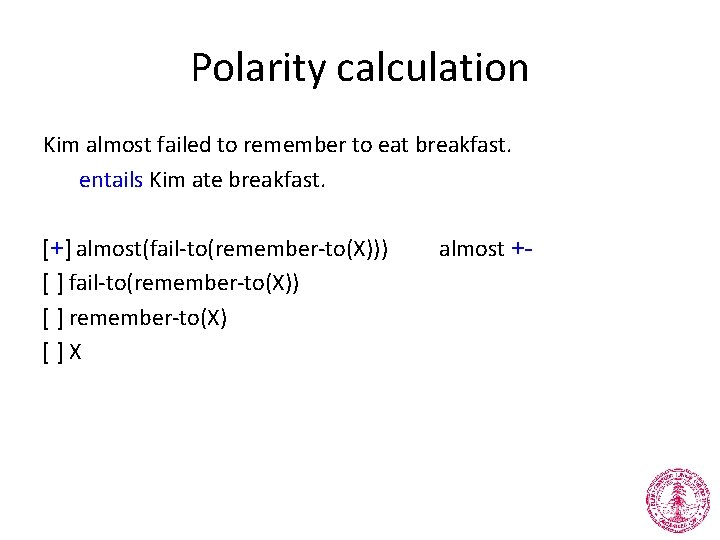
Polarity calculation Kim almost failed to remember to eat breakfast. entails Kim ate breakfast. [+] almost(fail-to(remember-to(X))) [ ] fail-to(remember-to(X)) [ ] remember-to(X) []X almost +-
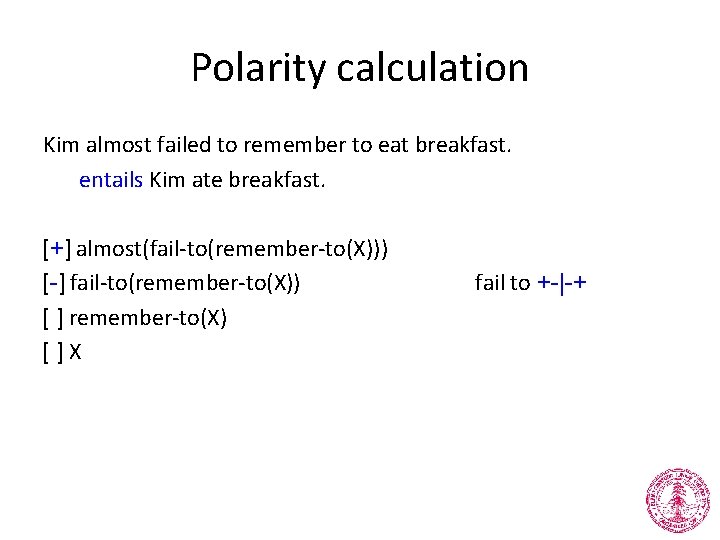
Polarity calculation Kim almost failed to remember to eat breakfast. entails Kim ate breakfast. [+] almost(fail-to(remember-to(X))) [-] fail-to(remember-to(X)) [ ] remember-to(X) []X fail to +-|-+
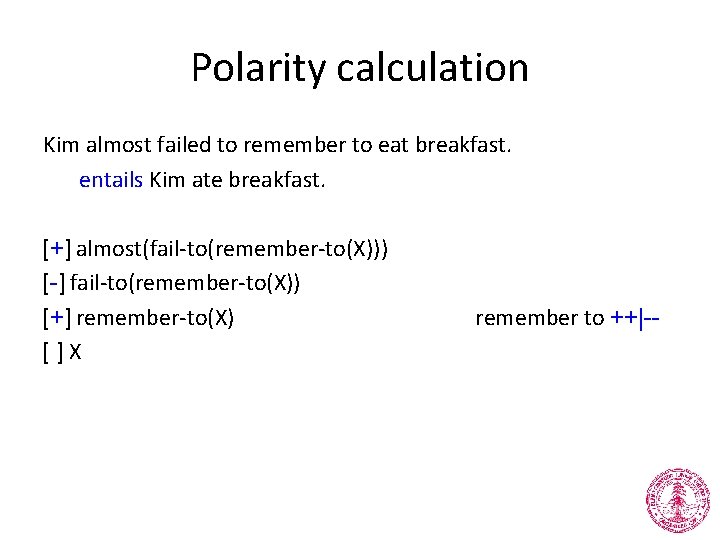
Polarity calculation Kim almost failed to remember to eat breakfast. entails Kim ate breakfast. [+] almost(fail-to(remember-to(X))) [-] fail-to(remember-to(X)) [+] remember-to(X) []X remember to ++|--
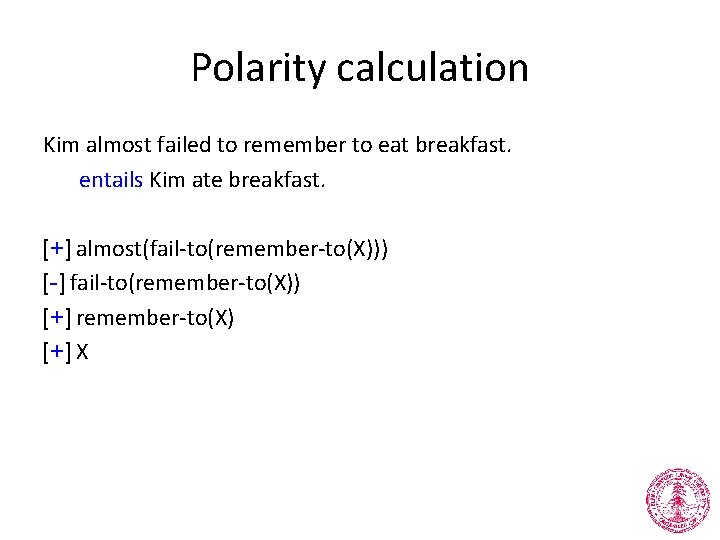
Polarity calculation Kim almost failed to remember to eat breakfast. entails Kim ate breakfast. [+] almost(fail-to(remember-to(X))) [-] fail-to(remember-to(X)) [+] remember-to(X) [+] X
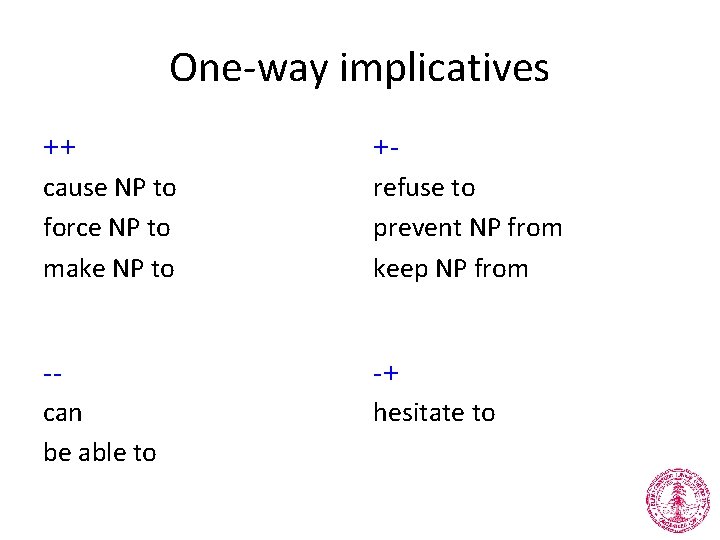
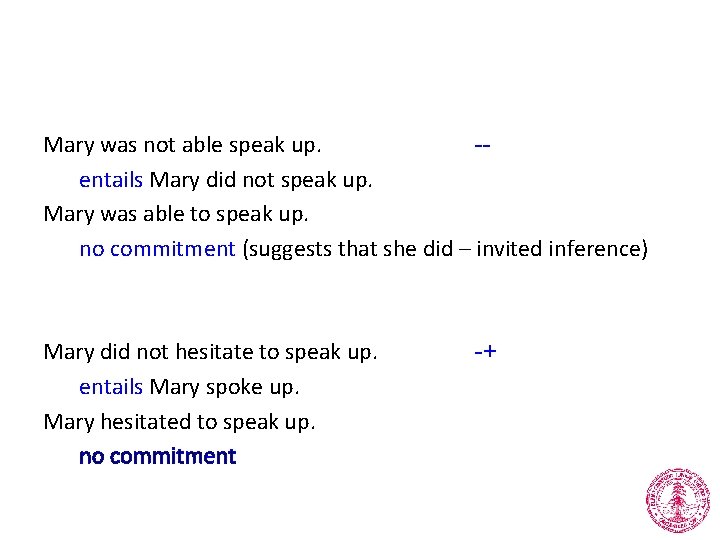
One-way implicatives ++ cause NP to force NP to make NP to +refuse to prevent NP from keep NP from -can be able to -+ hesitate to
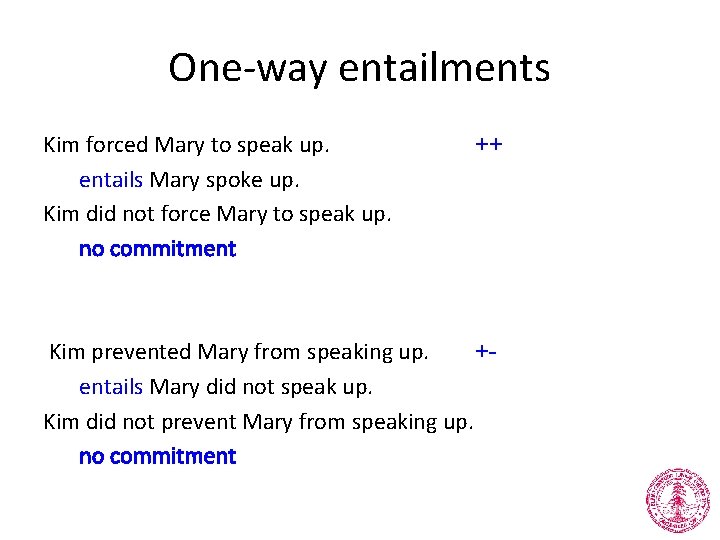
One-way entailments Kim forced Mary to speak up. entails Mary spoke up. Kim did not force Mary to speak up. no commitment ++ Kim prevented Mary from speaking up. +entails Mary did not speak up. Kim did not prevent Mary from speaking up. no commitment
Mary was not able speak up. -entails Mary did not speak up. Mary was able to speak up. no commitment (suggests that she did – invited inference) Mary did not hesitate to speak up. entails Mary spoke up. Mary hesitated to speak up. no commitment -+
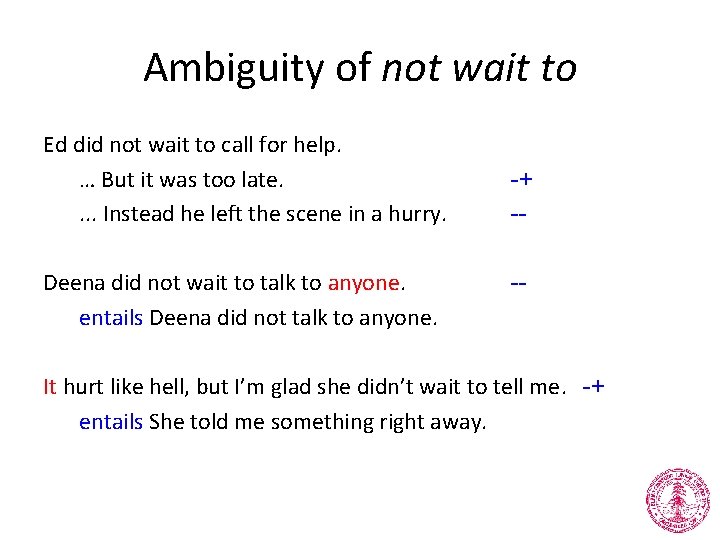
Ambiguity of not wait to Ed did not wait to call for help. … But it was too late. . Instead he left the scene in a hurry. Deena did not wait to talk to anyone. entails Deena did not talk to anyone. -+ --- It hurt like hell, but I’m glad she didn’t wait to tell me. -+ entails She told me something right away.
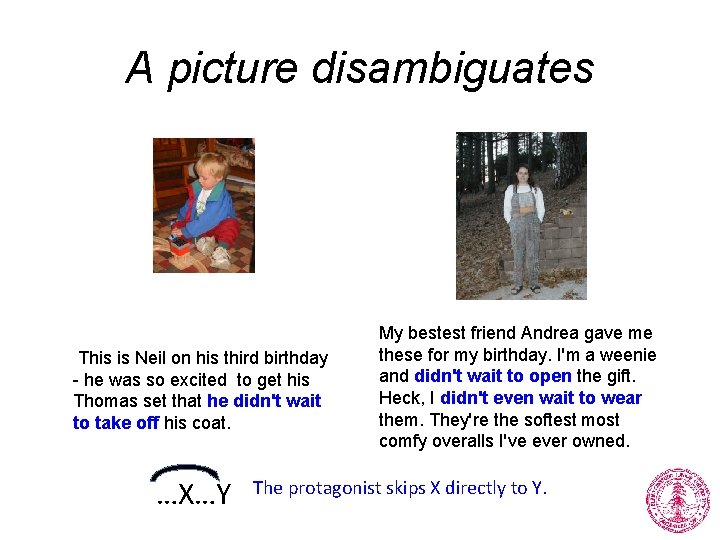
A picture disambiguates This is Neil on his third birthday - he was so excited to get his Thomas set that he didn't wait to take off his coat. …X…Y My bestest friend Andrea gave me these for my birthday. I'm a weenie and didn't wait to open the gift. Heck, I didn't even wait to wear them. They're the softest most comfy overalls I've ever owned. The protagonist skips X directly to Y.
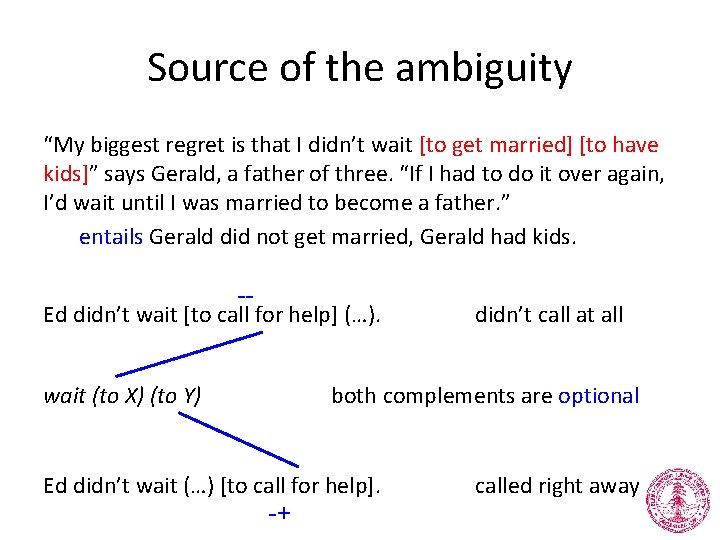
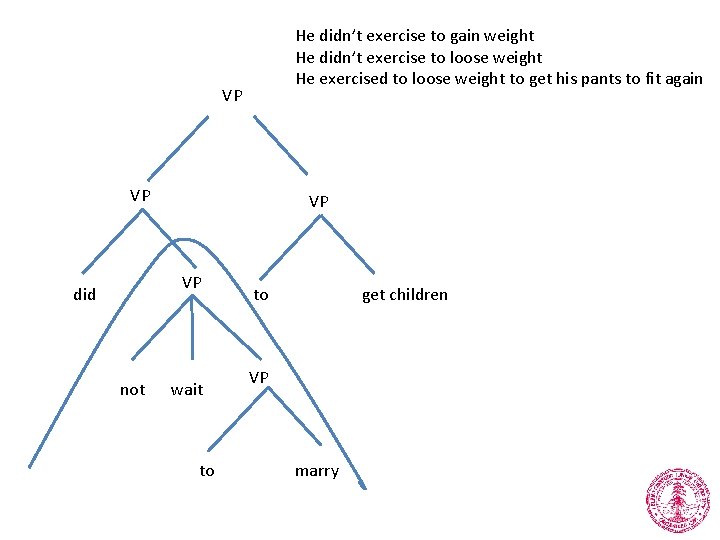
Source of the ambiguity “My biggest regret is that I didn’t wait [to get married] [to have kids]” says Gerald, a father of three. “If I had to do it over again, I’d wait until I was married to become a father. ” entails Gerald did not get married, Gerald had kids. -Ed didn’t wait [to call for help] (…). wait (to X) (to Y) didn’t call at all both complements are optional Ed didn’t wait (…) [to call for help]. -+ called right away
He didn’t exercise to gain weight He didn’t exercise to loose weight He exercised to loose weight to get his pants to fit again VP VP did not wait to to get children VP marry
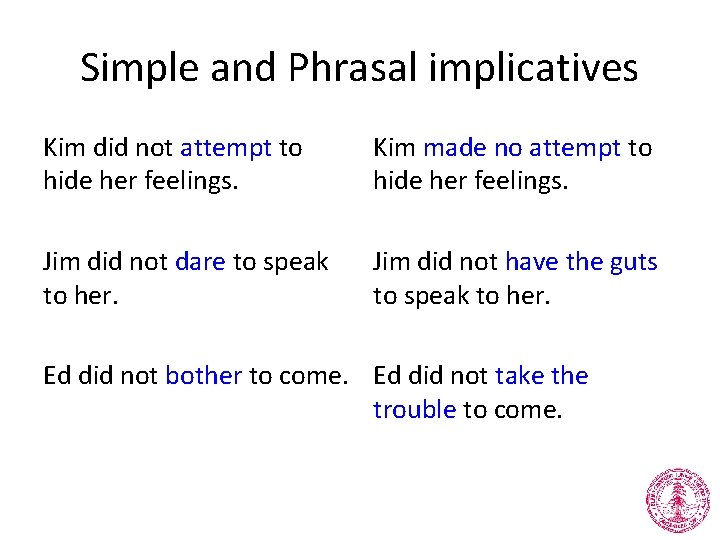
Simple and Phrasal implicatives Kim did not attempt to hide her feelings. Kim made no attempt to hide her feelings. Jim did not dare to speak to her. Jim did not have the guts to speak to her. Ed did not bother to come. Ed did not take the trouble to come.
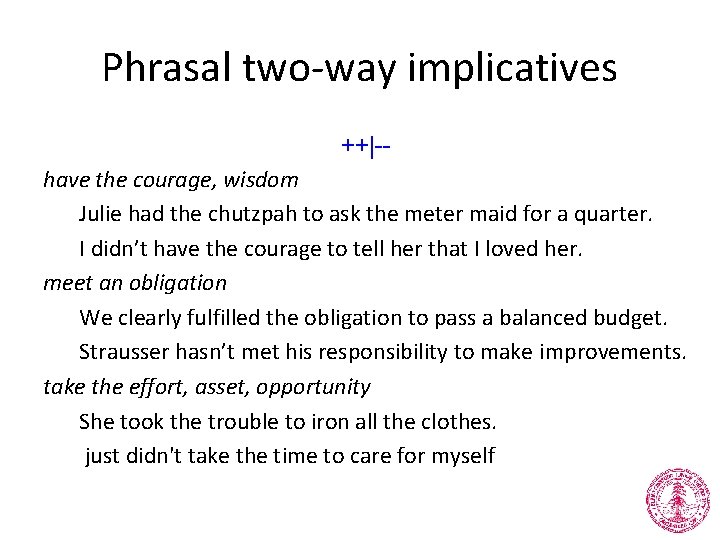
Phrasal two-way implicatives ++|-have the courage, wisdom Julie had the chutzpah to ask the meter maid for a quarter. I didn’t have the courage to tell her that I loved her. meet an obligation We clearly fulfilled the obligation to pass a balanced budget. Strausser hasn’t met his responsibility to make improvements. take the effort, asset, opportunity She took the trouble to iron all the clothes. just didn't take the time to care for myself
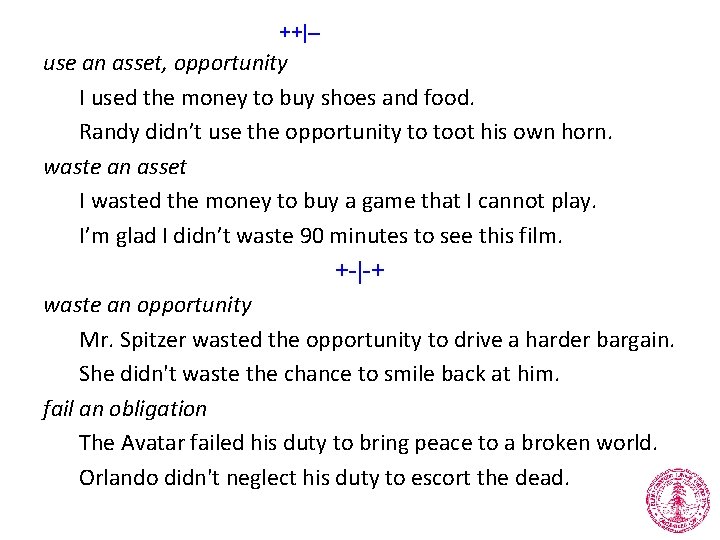
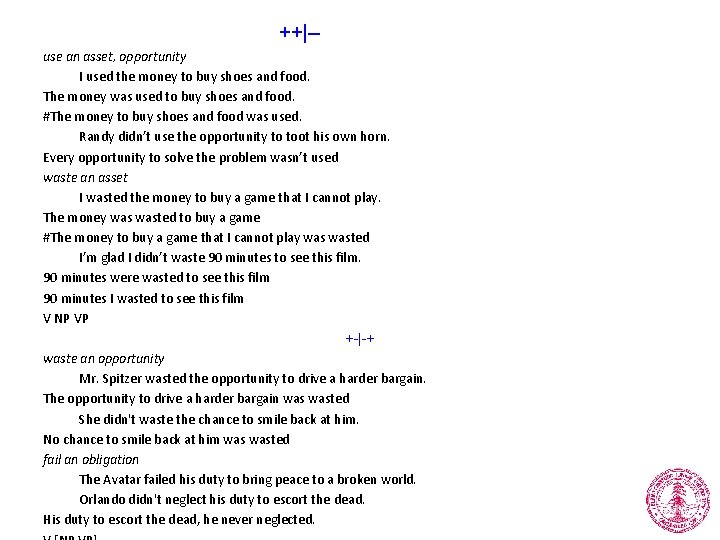
++|-- use an asset, opportunity I used the money to buy shoes and food. Randy didn’t use the opportunity to toot his own horn. waste an asset I wasted the money to buy a game that I cannot play. I’m glad I didn’t waste 90 minutes to see this film. +-|-+ waste an opportunity Mr. Spitzer wasted the opportunity to drive a harder bargain. She didn't waste the chance to smile back at him. fail an obligation The Avatar failed his duty to bring peace to a broken world. Orlando didn't neglect his duty to escort the dead.
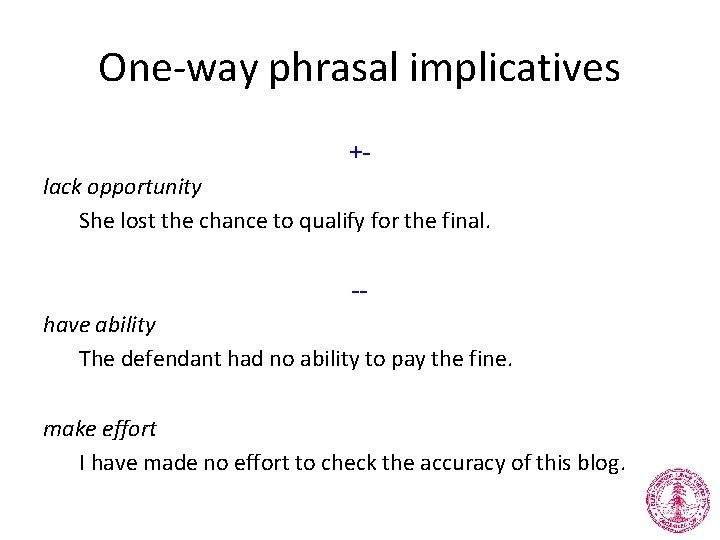
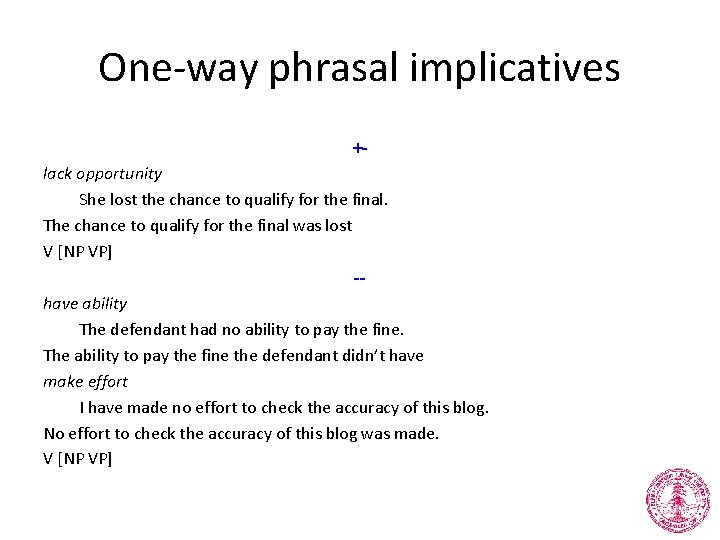
One-way phrasal implicatives +lack opportunity She lost the chance to qualify for the final. -have ability The defendant had no ability to pay the fine. make effort I have made no effort to check the accuracy of this blog.
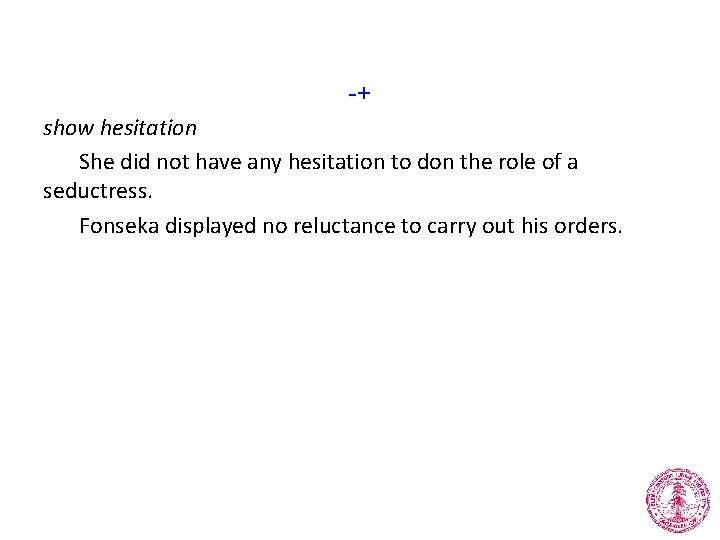
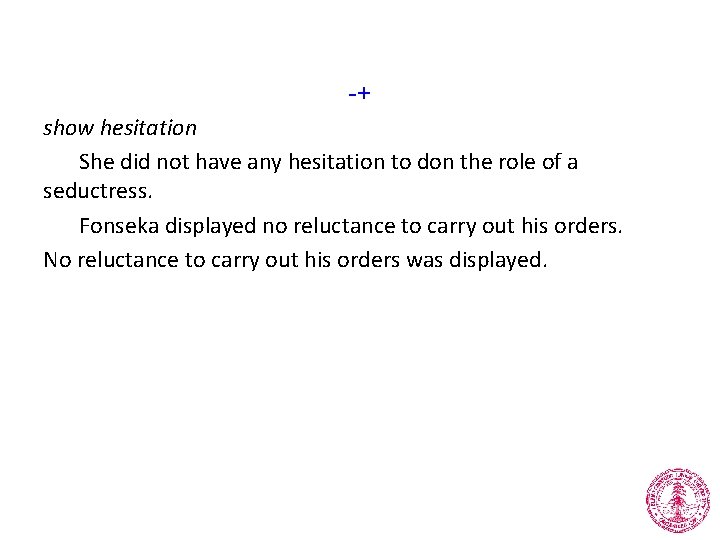
-+ show hesitation She did not have any hesitation to don the role of a seductress. Fonseka displayed no reluctance to carry out his orders.
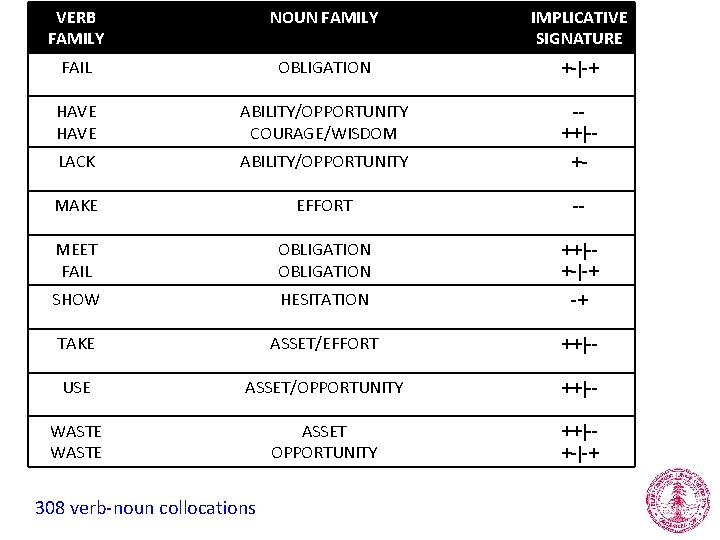
VERB FAMILY NOUN FAMILY IMPLICATIVE SIGNATURE FAIL OBLIGATION +-|-+ HAVE ABILITY/OPPORTUNITY COURAGE/WISDOM -++|-- LACK ABILITY/OPPORTUNITY +- MAKE EFFORT -- MEET FAIL OBLIGATION ++|-+-|-+ SHOW HESITATION -+ TAKE ASSET/EFFORT ++|-- USE ASSET/OPPORTUNITY ++|-- WASTE ASSET OPPORTUNITY ++|-+-|-+ 308 verb-noun collocations
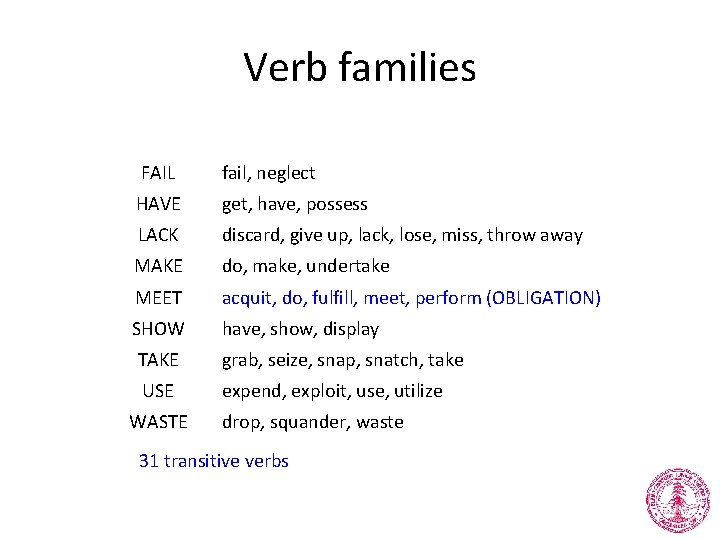
Verb families FAIL fail, neglect HAVE get, have, possess LACK discard, give up, lack, lose, miss, throw away MAKE do, make, undertake MEET acquit, do, fulfill, meet, perform (OBLIGATION) SHOW have, show, display TAKE grab, seize, snap, snatch, take USE expend, exploit, use, utilize WASTE drop, squander, waste 31 transitive verbs
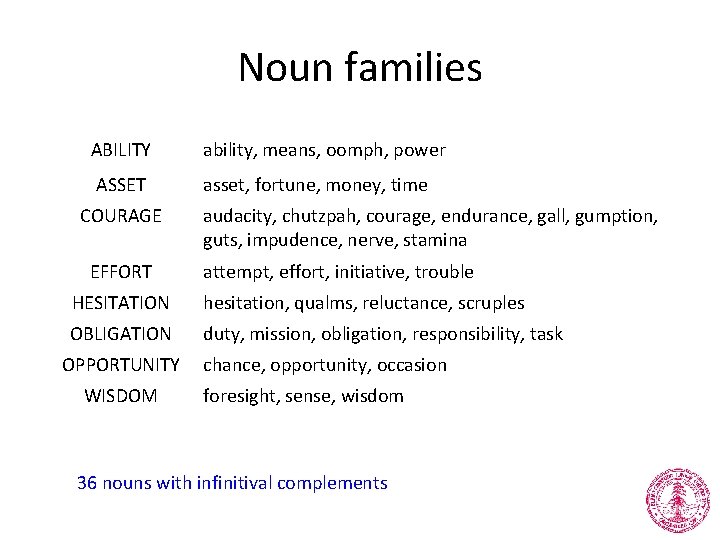
Noun families ABILITY ability, means, oomph, power ASSET asset, fortune, money, time COURAGE EFFORT audacity, chutzpah, courage, endurance, gall, gumption, guts, impudence, nerve, stamina attempt, effort, initiative, trouble HESITATION hesitation, qualms, reluctance, scruples OBLIGATION duty, mission, obligation, responsibility, task OPPORTUNITY WISDOM chance, opportunity, occasion foresight, sense, wisdom 36 nouns with infinitival complements
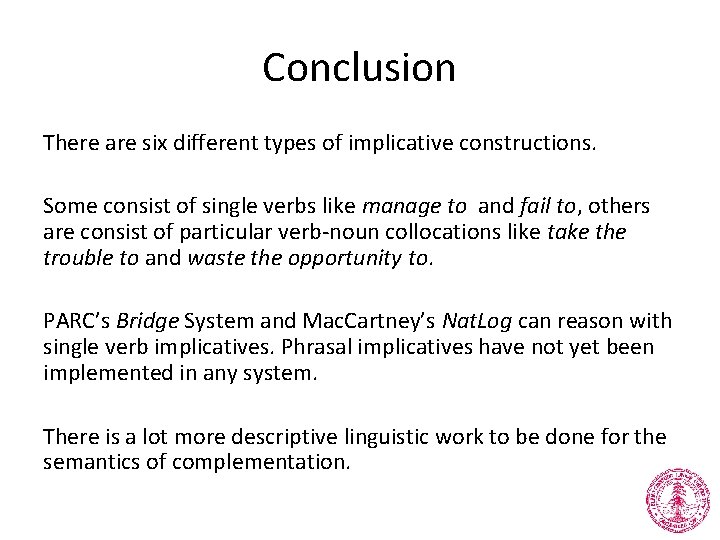
Conclusion There are six different types of implicative constructions. Some consist of single verbs like manage to and fail to, others are consist of particular verb-noun collocations like take the trouble to and waste the opportunity to. PARC’s Bridge System and Mac. Cartney’s Nat. Log can reason with single verb implicatives. Phrasal implicatives have not yet been implemented in any system. There is a lot more descriptive linguistic work to be done for the semantics of complementation.
Work in progress • Invited inferences • Predicative adjective constructions
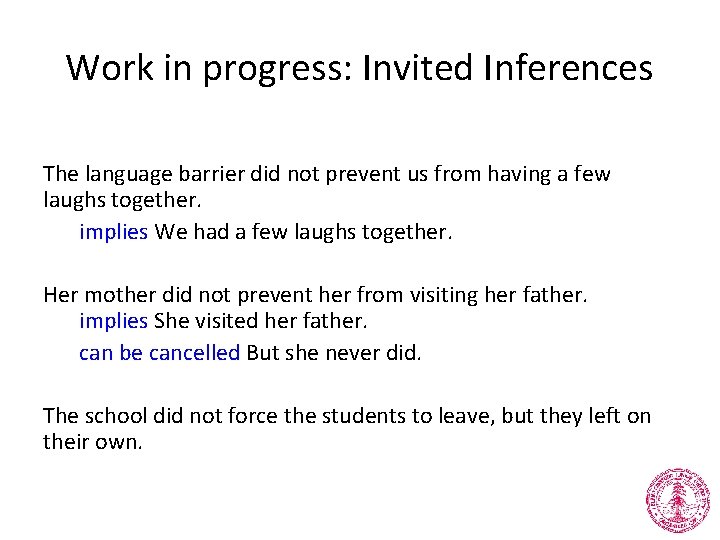
Work in progress: Invited Inferences The language barrier did not prevent us from having a few laughs together. implies We had a few laughs together. Her mother did not prevent her from visiting her father. implies She visited her father. can be cancelled But she never did. The school did not force the students to leave, but they left on their own.
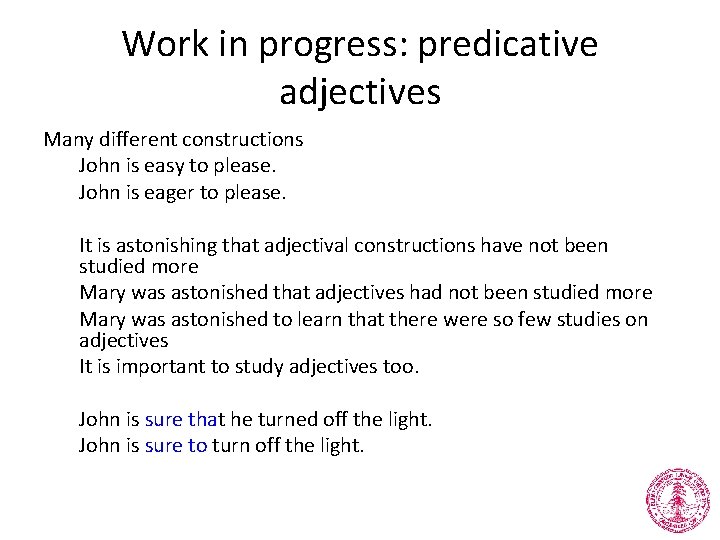
Work in progress: predicative adjectives Many different constructions John is easy to please. John is eager to please. It is astonishing that adjectival constructions have not been studied more Mary was astonished that adjectives had not been studied more Mary was astonished to learn that there were so few studies on adjectives It is important to study adjectives too. John is sure that he turned off the light. John is sure to turn off the light.
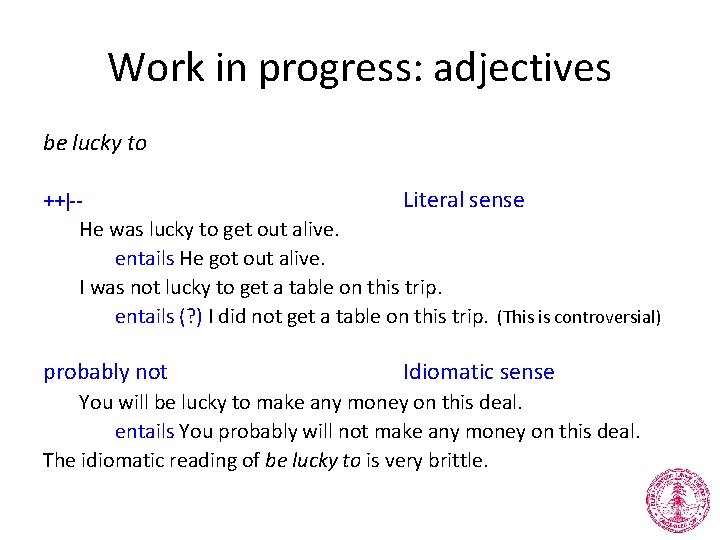
Work in progress: adjectives be lucky to ++|-- Literal sense He was lucky to get out alive. entails He got out alive. I was not lucky to get a table on this trip. entails (? ) I did not get a table on this trip. (This is controversial) probably not Idiomatic sense You will be lucky to make any money on this deal. entails You probably will not make any money on this deal. The idiomatic reading of be lucky to is very brittle.
You will be lucky to break even Cleo Condoravdi, Miriam King-Connor, Tania Rojas-Esponda Lauri Karttunen, Marianne Naval, Stanley Peters and Annie Zaenen literal meaning: implicative or factive? Idiomatic sense: ‘probably not’
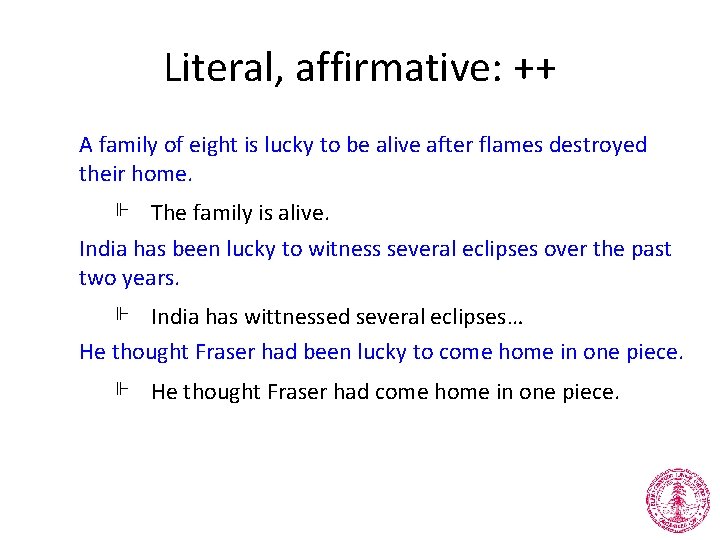
Literal, affirmative: ++ A family of eight is lucky to be alive after flames destroyed their home. ⊩ The family is alive. India has been lucky to witness several eclipses over the past two years. ⊩ India has wittnessed several eclipses… He thought Fraser had been lucky to come home in one piece. ⊩ He thought Fraser had come home in one piece.
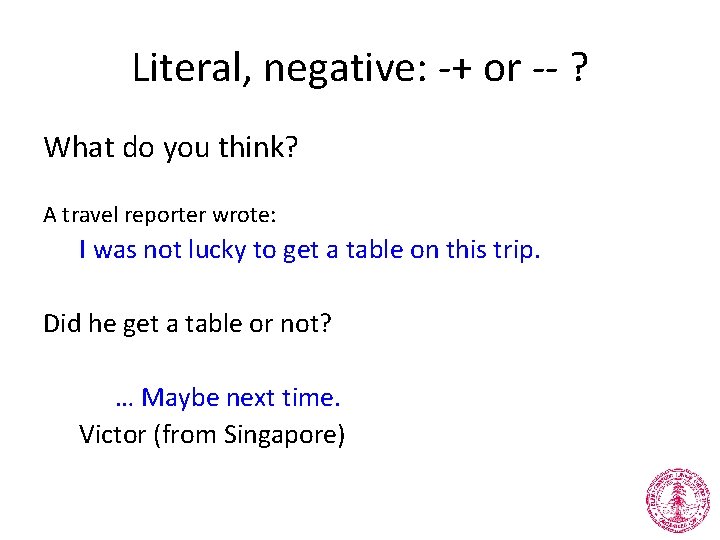
Literal, negative: -+ or -- ? What do you think? A travel reporter wrote: I was not lucky to get a table on this trip. Did he get a table or not? … Maybe next time. Victor (from Singapore)
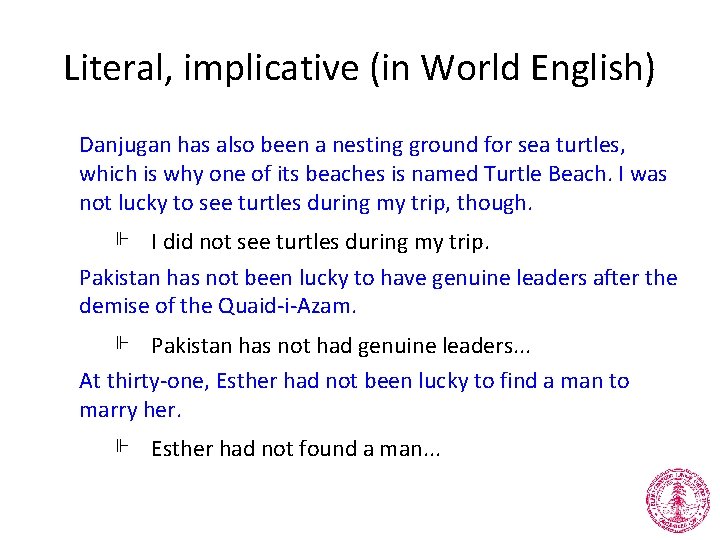
Literal, implicative (in World English) Danjugan has also been a nesting ground for sea turtles, which is why one of its beaches is named Turtle Beach. I was not lucky to see turtles during my trip, though. ⊩ I did not see turtles during my trip. Pakistan has not been lucky to have genuine leaders after the demise of the Quaid-i-Azam. ⊩ Pakistan has not had genuine leaders. . . At thirty-one, Esther had not been lucky to find a man to marry her. ⊩ Esther had not found a man. . .
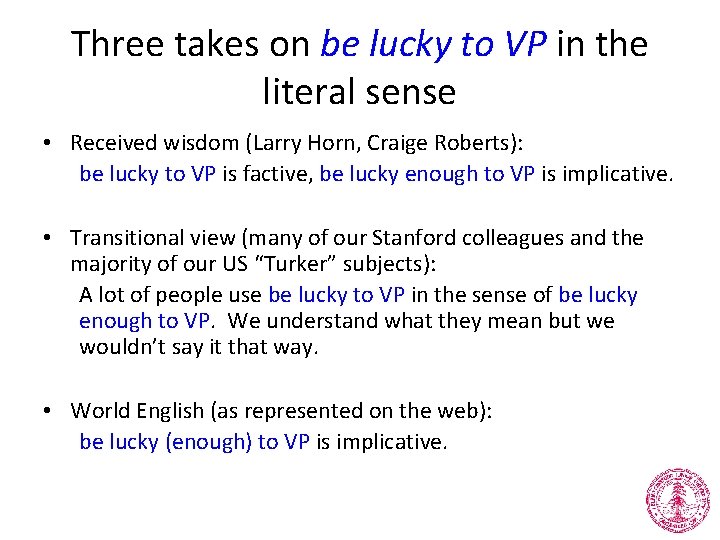
Three takes on be lucky to VP in the literal sense • Received wisdom (Larry Horn, Craige Roberts): be lucky to VP is factive, be lucky enough to VP is implicative. • Transitional view (many of our Stanford colleagues and the majority of our US “Turker” subjects): A lot of people use be lucky to VP in the sense of be lucky enough to VP. We understand what they mean but we wouldn’t say it that way. • World English (as represented on the web): be lucky (enough) to VP is implicative.
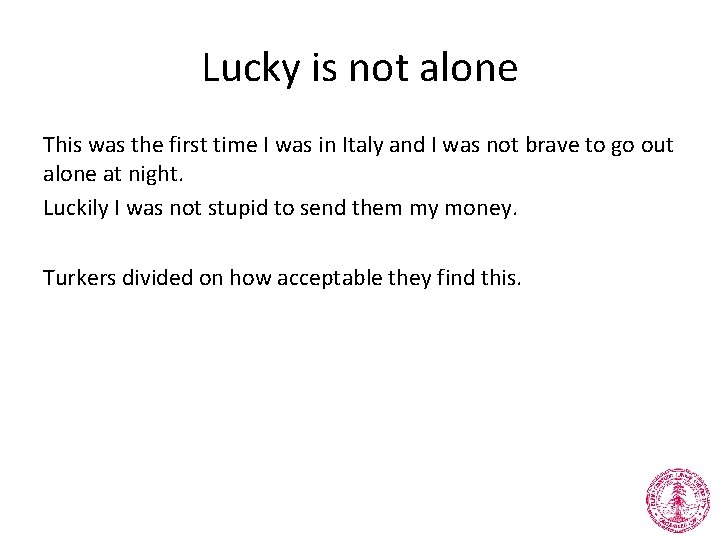
Lucky is not alone This was the first time I was in Italy and I was not brave to go out alone at night. Luckily I was not stupid to send them my money. Turkers divided on how acceptable they find this.
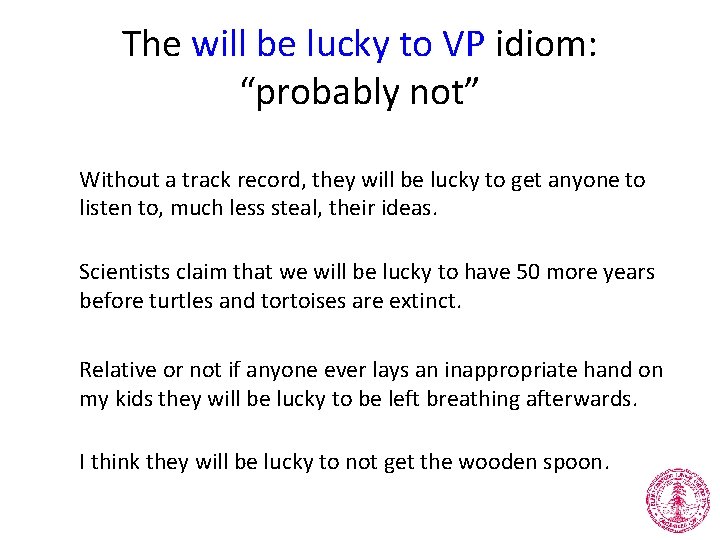
The will be lucky to VP idiom: “probably not” Without a track record, they will be lucky to get anyone to listen to, much less steal, their ideas. Scientists claim that we will be lucky to have 50 more years before turtles and tortoises are extinct. Relative or not if anyone ever lays an inappropriate hand on my kids they will be lucky to be left breathing afterwards. I think they will be lucky to not get the wooden spoon.
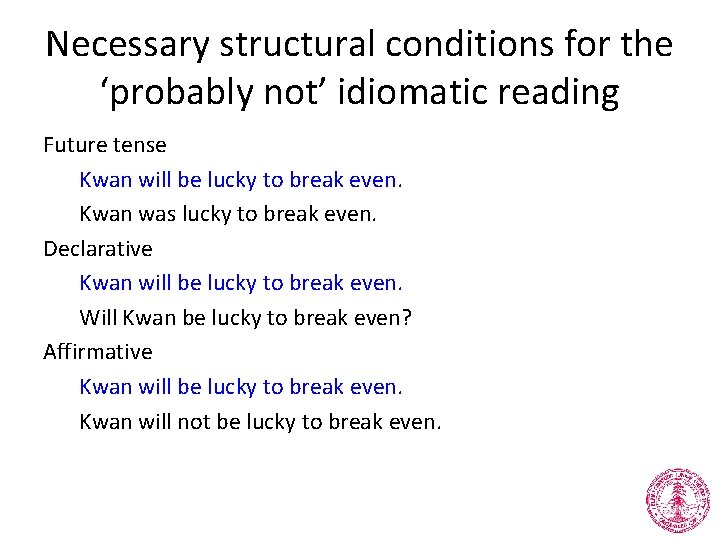
Necessary structural conditions for the ‘probably not’ idiomatic reading Future tense Kwan will be lucky to break even. Kwan was lucky to break even. Declarative Kwan will be lucky to break even. Will Kwan be lucky to break even? Affirmative Kwan will be lucky to break even. Kwan will not be lucky to break even.
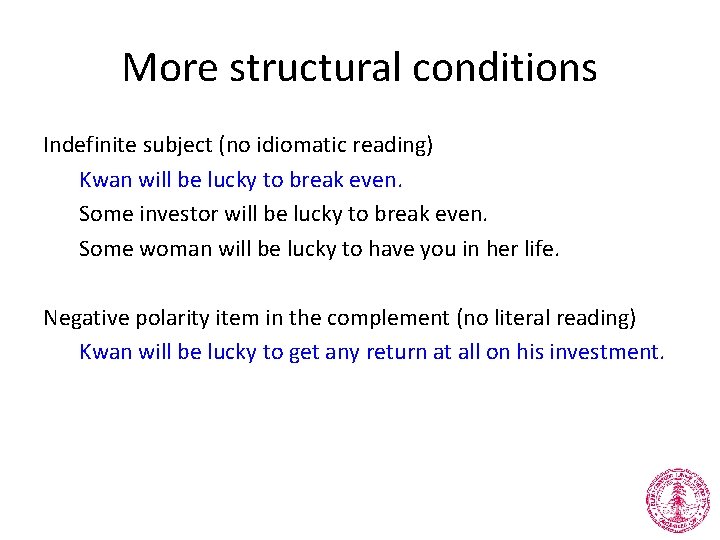
More structural conditions Indefinite subject (no idiomatic reading) Kwan will be lucky to break even. Some investor will be lucky to break even. Some woman will be lucky to have you in her life. Negative polarity item in the complement (no literal reading) Kwan will be lucky to get any return at all on his investment.
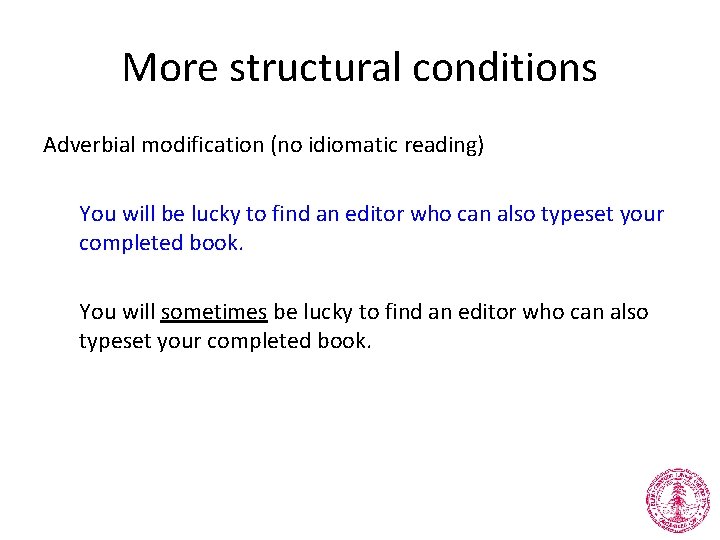
More structural conditions Adverbial modification (no idiomatic reading) You will be lucky to find an editor who can also typeset your completed book. You will sometimes be lucky to find an editor who can also typeset your completed book.
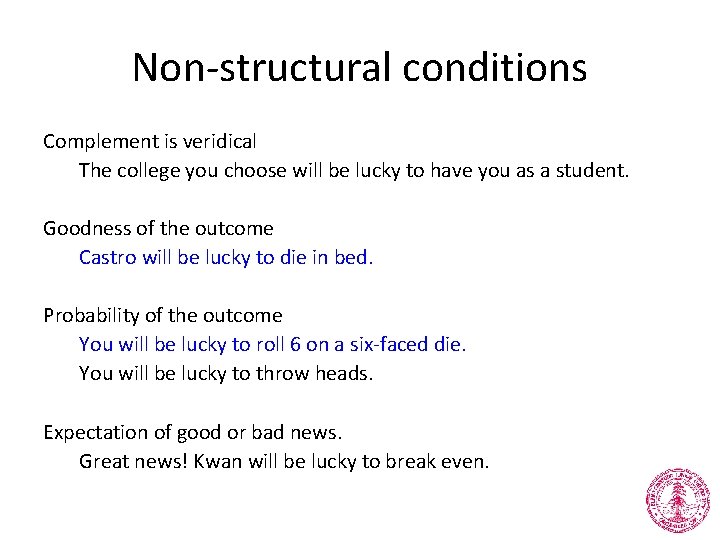
Non-structural conditions Complement is veridical The college you choose will be lucky to have you as a student. Goodness of the outcome Castro will be lucky to die in bed. Probability of the outcome You will be lucky to roll 6 on a six-faced die. You will be lucky to throw heads. Expectation of good or bad news. Great news! Kwan will be lucky to break even.
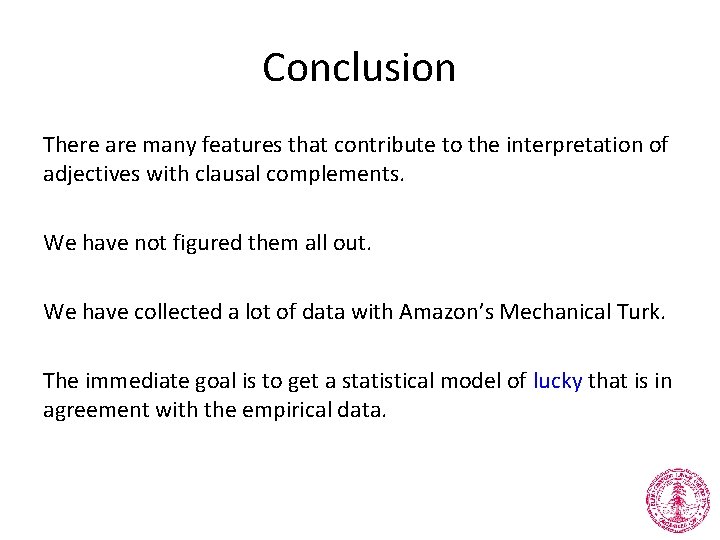
Conclusion There are many features that contribute to the interpretation of adjectives with clausal complements. We have not figured them all out. We have collected a lot of data with Amazon’s Mechanical Turk. The immediate goal is to get a statistical model of lucky that is in agreement with the empirical data.
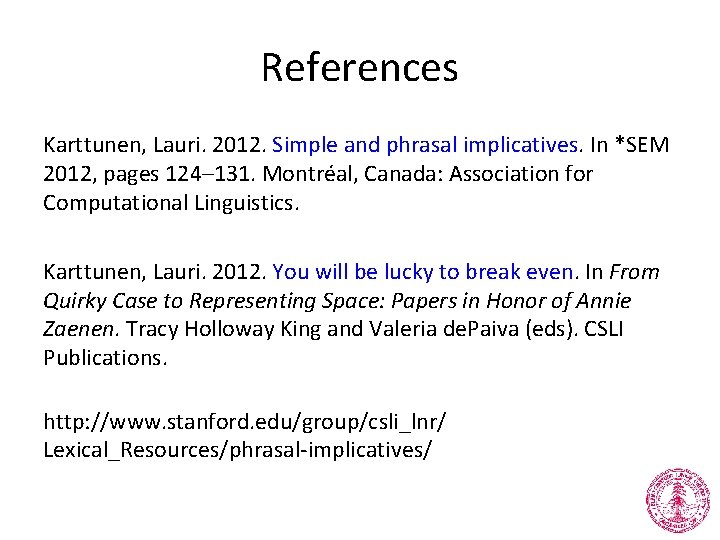
References Karttunen, Lauri. 2012. Simple and phrasal implicatives. In *SEM 2012, pages 124– 131. Montréal, Canada: Association for Computational Linguistics. Karttunen, Lauri. 2012. You will be lucky to break even. In From Quirky Case to Representing Space: Papers in Honor of Annie Zaenen. Tracy Holloway King and Valeria de. Paiva (eds). CSLI Publications. http: //www. stanford. edu/group/csli_lnr/ Lexical_Resources/phrasal-implicatives/
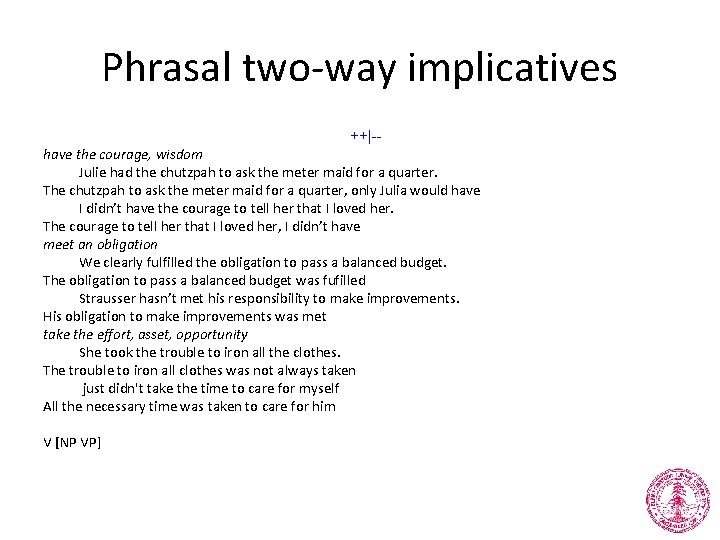
Phrasal two-way implicatives ++|-have the courage, wisdom Julie had the chutzpah to ask the meter maid for a quarter. The chutzpah to ask the meter maid for a quarter, only Julia would have I didn’t have the courage to tell her that I loved her. The courage to tell her that I loved her, I didn’t have meet an obligation We clearly fulfilled the obligation to pass a balanced budget. The obligation to pass a balanced budget was fufilled Strausser hasn’t met his responsibility to make improvements. His obligation to make improvements was met take the effort, asset, opportunity She took the trouble to iron all the clothes. The trouble to iron all clothes was not always taken just didn't take the time to care for myself All the necessary time was taken to care for him V [NP VP]
++|-use an asset, opportunity I used the money to buy shoes and food. The money was used to buy shoes and food. #The money to buy shoes and food was used. Randy didn’t use the opportunity to toot his own horn. Every opportunity to solve the problem wasn’t used waste an asset I wasted the money to buy a game that I cannot play. The money wasted to buy a game #The money to buy a game that I cannot play wasted I’m glad I didn’t waste 90 minutes to see this film. 90 minutes were wasted to see this film 90 minutes I wasted to see this film V NP VP +-|-+ waste an opportunity Mr. Spitzer wasted the opportunity to drive a harder bargain. The opportunity to drive a harder bargain wasted She didn't waste the chance to smile back at him. No chance to smile back at him wasted fail an obligation The Avatar failed his duty to bring peace to a broken world. Orlando didn't neglect his duty to escort the dead. His duty to escort the dead, he never neglected.
One-way phrasal implicatives +lack opportunity She lost the chance to qualify for the final. The chance to qualify for the final was lost V [NP VP] -have ability The defendant had no ability to pay the fine. The ability to pay the fine the defendant didn’t have make effort I have made no effort to check the accuracy of this blog. No effort to check the accuracy of this blog was made. V [NP VP]
-+ show hesitation She did not have any hesitation to don the role of a seductress. Fonseka displayed no reluctance to carry out his orders. No reluctance to carry out his orders was displayed.