
Bertrand Complements Analysis What are complements Two firms
Bertrand Complements Analysis.
What are complements? • • Two firms each choose a price. Total price was the sum of the two prices. Demand was set by the total price. What on earth fits this story? – Computer and screen. – Computer and operating system. – Shoes and shoelaces. – Plane ticket and airport use.
Krugman, NY times • Who is Krugman? • Krugman has lately been known for his anti-Bush columns. • Would he be, in favor, of breaking up a monopolist such as Microsoft? • In his column “MICROSOFT: WHAT NEXT? ” written in April 2000. He says the following.
What next? • Baron Wilhelm von Gates was the lord of two castles along the Rhine. • From these castles he was able to demand money from all the travellers who passed by. • This made him wealthy, but also much disliked. Eventually the Holy Roman Emperor split up the Gates domain and give one to the Baron’s nephew. • But the results of this breakup were not quite what the emperor's legal department had promised.
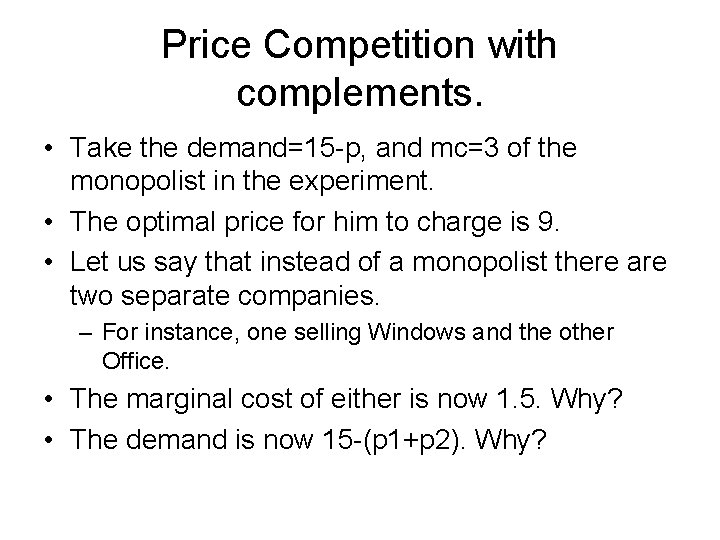
Price Competition with complements. • Take the demand=15 -p, and mc=3 of the monopolist in the experiment. • The optimal price for him to charge is 9. • Let us say that instead of a monopolist there are two separate companies. – For instance, one selling Windows and the other Office. • The marginal cost of either is now 1. 5. Why? • The demand is now 15 -(p 1+p 2). Why?
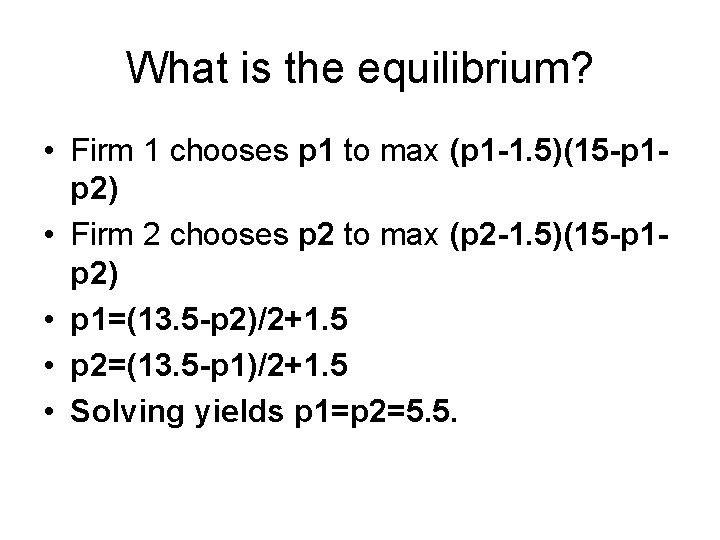
What is the equilibrium? • Firm 1 chooses p 1 to max (p 1 -1. 5)(15 -p 1 p 2) • Firm 2 chooses p 2 to max (p 2 -1. 5)(15 -p 1 p 2) • p 1=(13. 5 -p 2)/2+1. 5 • p 2=(13. 5 -p 1)/2+1. 5 • Solving yields p 1=p 2=5. 5.
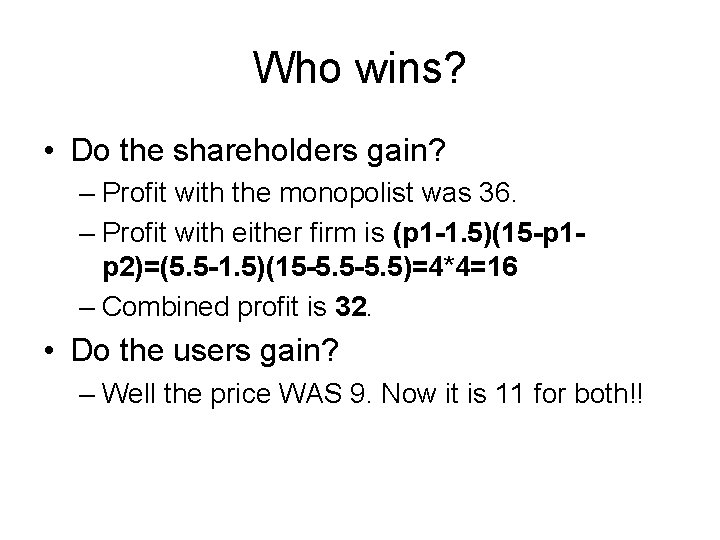
Who wins? • Do the shareholders gain? – Profit with the monopolist was 36. – Profit with either firm is (p 1 -1. 5)(15 -p 1 p 2)=(5. 5 -1. 5)(15 -5. 5)=4*4=16 – Combined profit is 32. • Do the users gain? – Well the price WAS 9. Now it is 11 for both!!
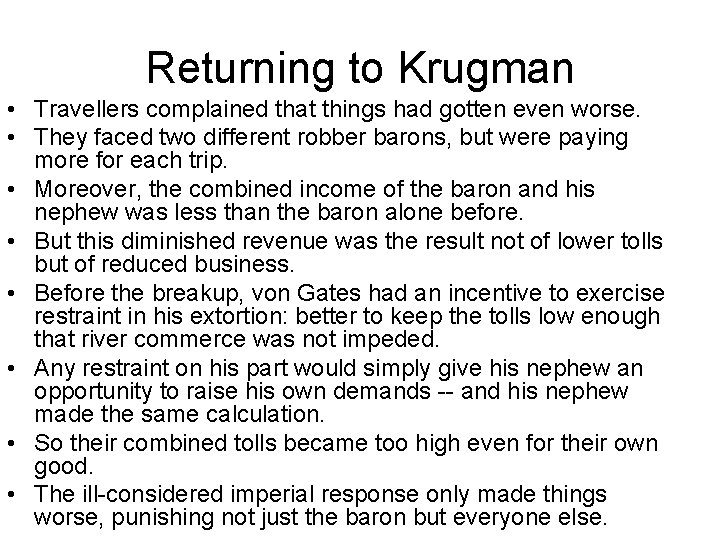
Returning to Krugman • Travellers complained that things had gotten even worse. • They faced two different robber barons, but were paying more for each trip. • Moreover, the combined income of the baron and his nephew was less than the baron alone before. • But this diminished revenue was the result not of lower tolls but of reduced business. • Before the breakup, von Gates had an incentive to exercise restraint in his extortion: better to keep the tolls low enough that river commerce was not impeded. • Any restraint on his part would simply give his nephew an opportunity to raise his own demands -- and his nephew made the same calculation. • So their combined tolls became too high even for their own good. • The ill-considered imperial response only made things worse, punishing not just the baron but everyone else.
Someone paid attention to Krugman for once. • Sept. 2001. The US Department of Justice has announced that it will no longer push to have software giant Microsoft broken up.
Homework • There is a very Beersheva to Haifa train line. Travellers either go between – Haifa and Tel Aviv with demand 12 -p – Tel Aviv and Beersheva 12 -p – Haifa and Beersheva. 18 -p • Say it is all owned by one profit maximizing monopolist with marginal cost of zero. For simplicity assume that the monopolist must set the price of the Haifa-Beersheva route equal to the sum of the other two. What would he charge for all three routes? • Now say the government thinks it needs to add competition to the rail industry. It divides things into two companies. One takes care of the Haifa-Tel Aviv route and the other the Tel Aviv-Beersheva route. The price of the combined trip is the sum of the other two. • What are the new prices? • Who wins and who loses?
- Slides: 10